




A Radio Frequency Fingerprint Open-set Identification MethodCombining Multi-scale Wavelet Front-end and Hyperspherical Metric Learning
-
摘要: 针对低信噪比环境下射频指纹特征易被噪声掩盖、多径效应引发非线性失真,以及现有方法在特征提取与未知设备检测能力上的不足,该文提出一种结合多尺度小波与超球面表示的射频指纹开集识别方法。首先,设计基于一维平稳小波变换的多尺度特征提取前端,实现对I/Q信号的全分辨率、多尺度分解,为后续网络提供高判别性输入。其次,构建多尺度残差注意力网络,融合深度残差学习、全局自注意力机制与双向长短时记忆网络,增强模型对微弱指纹特征的感知能力与长程时序依赖建模能力。最后,引入超球面度量学习,将特征空间约束至单位超球面,通过优化角度间隔构建类内紧凑、类间可分离的特征分布,并基于余弦相似度实现未知设备的有效检测。在基于IEEE 802.11协议的高保真仿真数据集上的实验结果表明,所提方法在–5~20 dB信噪比范围内均能保持较高的开集识别准确率,平均分类准确率达65.34%,在–5 dB低信噪比下曲线下面积(AUC)达0.81,显著优于现有对比方法,验证了其在极端恶劣信道环境下的鲁棒性与有效性。Abstract:
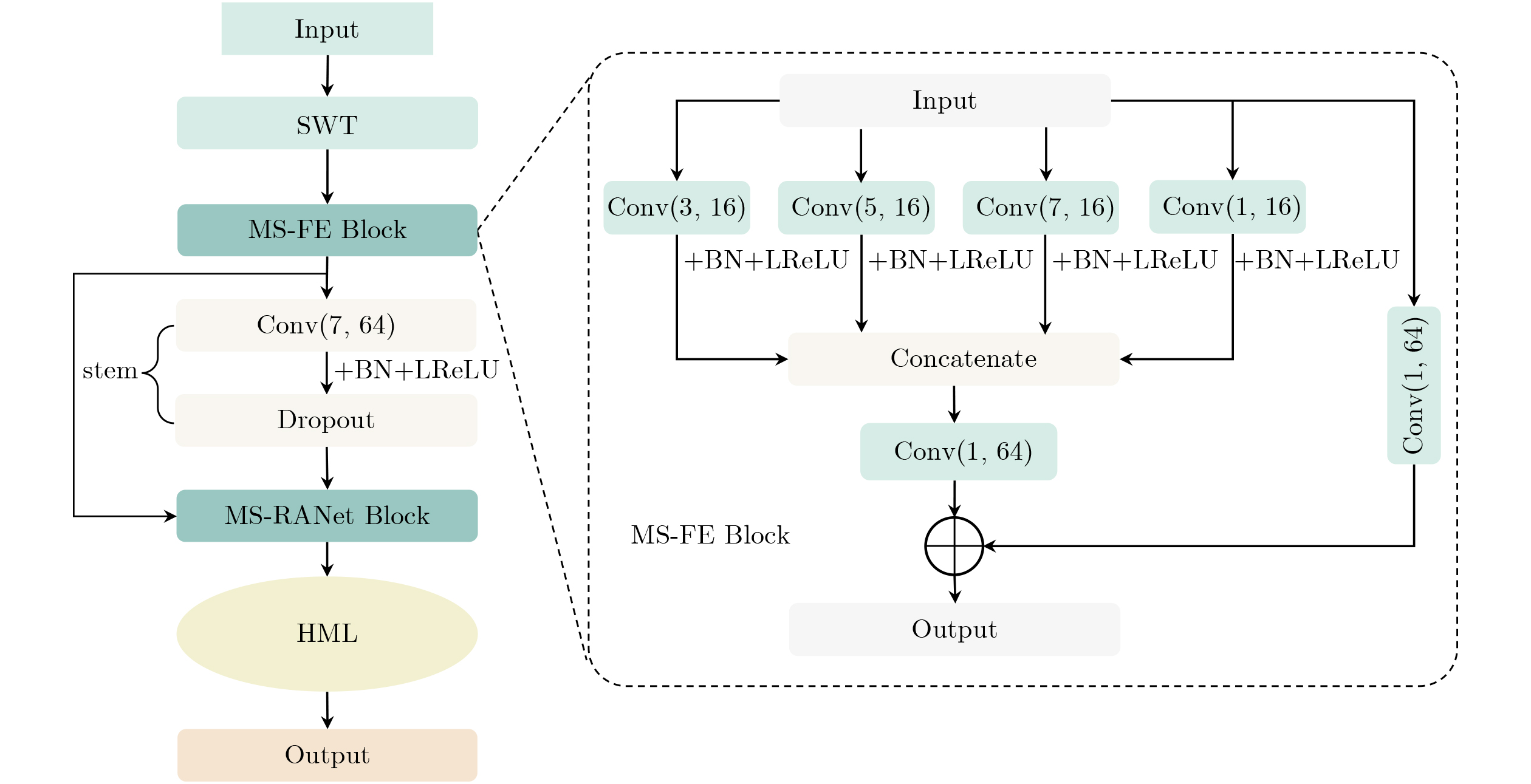
Objective Open-set Radio Frequency Fingerprint (RFF) identification under low Signal-to-Noise Ratio (SNR) conditions is challenging because fingerprint features are easily masked by noise, multipath effects induce nonlinear distortions, and existing methods struggle with feature extraction and unknown device detection. This study proposes a deep learning framework that integrates a multi-scale wavelet front-end with hyperspherical metric learning to achieve robust open-set RFF identification. Methods The proposed method, MS-RANet, comprises three key components. First, a multi-scale wavelet front-end based on one-dimensional stationary wavelet transform performs full-resolution, multi-scale decomposition of I/Q signals, preserving discriminative fingerprint information while suppressing noise. Second, a multi-scale residual attention network incorporates deep residual learning, global self-attention, and Bidirectional LSTM (BiLSTM) to enhance sensitivity to subtle fingerprint features and capture long-range temporal dependencies. Third, hyperspherical metric learning constrains the feature space onto a unit hypersphere, optimizing angular margins to produce compact intra-class and separable inter-class feature distributions. Unknown devices are subsequently detected using cosine similarity. Results and Discussions Experiments on a high-fidelity IEEE 802.11 simulation dataset demonstrate the effectiveness of MS-RANet. The method achieves an average classification accuracy of 65.34% across SNR levels from –5 dB to 20 dB, and an Area Under the Curve (AUC) of 0.81 at –5 dB SNR, outperforming DNN, GRU, CNN-LSTM, ResNet50, and DRSN-CA. Confusion matrices and Receiver Operating Characteristic (ROC) curves confirm robustness under extreme channel conditions. t-SNE visualization shows well-separated, compact clusters for known devices, while unknown samples are effectively isolated from known class regions. Ablation studies verify the contributions of the multi-scale wavelet front-end, global attention, BiLSTM, and hyperspherical metric learning modules. Conclusions This study presents a robust open-set RFF identification method combining a multi-scale wavelet front-end with hyperspherical metric learning. The framework exhibits strong noise resilience, enhanced feature discrimination, and reliable detection of unknown devices under low-SNR and multipath fading conditions. Future work will focus on reducing computational complexity, improving inference speed, evaluating generalization across diverse scenarios and protocols, and integrating the method with complementary physical-layer security mechanisms for collaborative authentication. -
表 1 信号模型参数
参数类型 参数设置 参数类型 参数设置 通信协议 IEEE 802.11 帧类型 L-LTF 载波频率(GHz) 5 信道带宽(MHz) 20 采样长度(Point) 160 信噪比(dB) –5:5:20 指纹参数$ \alpha $ [0.7, 1.3] 指纹参数$ \beta $ $ \approx \alpha $–1 信道类型 多径瑞利衰落 直流偏移(dB) [–50, –32] 设备数(已知/未知) 67/20 频率偏移(ppm) [–4, 4] 样本划分(Train: Val: Test) 8:1:1 相位噪声(rad) [0.01, 0.3] 样本总量(Frame) 87000 噪声类型 加性高斯白噪声  下载: 导出CSV
表 2 训练过程超参数
参数名称 数值 参数名称 数值 初始学习率 0.0008 最大迭代轮数 30 学习率衰减因子 0.6 丢弃率$ \rho $ 0.3 学习率衰减周期 8 超球面半径$ s $ 16 惩罚因子$ \lambda $ 0.0001 特征空间维度$ d $ 256 批量大小$ \varOmega $ 96 梯度裁剪阈值 1
下载: 导出CSV
表 4 MS-RANet模块消融实验结果
序号 MS-FE
模块BiLSTM
模块全局注意
力模块HML
模块平均
准确率(%)AUC
(SNR=–5 dB)1 × × × × 35.61 0.53 2 √ × × × 57.85 0.68 3 √ √ × × 59.23 0.70 4 √ √ √ × 60.15 0.72 5 √ √ √ √ 65.64 0.79
下载: 导出CSV
-
[1] HUAN Xintao, HAO Yi, MIAO Kaitao, et al. Carrier frequency offset in Internet of Things radio frequency fingerprint identification: An experimental review[J]. IEEE Internet of Things Journal, 2024, 11(5): 7359–7373. doi: 10.1109/JIOT.2023.3328025. [2] CHEN Yuchi. Fully incrementing visual cryptography from a succinct non-monotonic structure[J]. IEEE Transactions on Information Forensics and Security, 2017, 12(5): 1082–1091. doi: 10.1109/TIFS.2016.2641378. [3] ZHANG Zhentian, WONG K K, DANG Jian, et al. On fundamental limits for fluid antenna-assisted integrated sensing and communications for unsourced random access[J]. IEEE Journal on Selected Areas in Communications, 2026, 44: 136–149. doi: 10.1109/JSAC.2025.3608113. [4] 吴海锋, 余文波, 曾玉, 等. 动态干扰下射频识别耦合认证的风险调控学习框架[J]. 电子与信息学报, 2026, 48(5): 2288–2303. doi: 10.11999/JEIT251108.WU Haifeng, YU Wenbo, ZENG Yu, et al. A risk-modulated learning framework for physical-layer RFID authentication under dynamic interference[J]. Journal of Electronics & Information Technology, 2026, 48(5): 2288–2303. doi: 10.11999/JEIT251108. [5] WANG Xuyu, WANG Xiangyu, and MAO Shiwen. RF sensing in the internet of things: A general deep learning framework[J]. IEEE Communications Magazine, 2018, 56(9): 62–67. doi: 10.1109/MCOM.2018.1701277. [6] ALSINDI N, CHALOUPKA Z, ALKHANBASHI N, et al. An empirical evaluation of a probabilistic RF signature for WLAN location fingerprinting[J]. IEEE Transactions on Wireless Communications, 2014, 13(6): 3257–3268. doi: 10.1109/TWC.2014.041714.131113. [7] LEE E, CHOI D H, NAM T, et al. An analysis of electromagnetic signatures from triangularly modulated spread spectrum clocking signals[J]. IEEE Transactions on Electromagnetic Compatibility, 2024, 66(3): 749–760. doi: 10.1109/TEMC.2024.3377245. [8] 张在琛, 江浩. 智能超表面使能无人机高能效通信信道建模与传输机理分析[J]. 电子学报, 2023, 51(10): 2623–2634. doi: 10.12263/DZXB.20221352.ZHANG Zaichen and JIANG Hao. Channel modeling and characteristics analysis for high energy-efficient RIS-assisted UAV communications[J]. Acta Electronica Sinica, 2023, 51(10): 2623–2634. doi: 10.12263/DZXB.20221352. [9] LIN Yun, TU Ya, DOU Zheng, et al. Contour stella image and deep learning for signal recognition in the physical layer[J]. IEEE Transactions on Cognitive Communications and Networking, 2021, 7(1): 34–46. doi: 10.1109/TCCN.2020.3024610. [10] YIN Pengcheng, PENG Linning, ZHANG Junqing, et al. LTE device identification based on RF fingerprint with multi-channel convolutional neural network[C]. IEEE Global Communications Conference (GLOBECOM), Madrid, Spain, 2021: 1–6. doi: 10.1109/GLOBECOM46510.2021.9685067. [11] LI Haozhe, LIAO Yilin, WANG Wenhai, et al. A novel time-domain graph tensor attention network for specific emitter identification[J]. IEEE Transactions on Instrumentation and Measurement, 2023, 72: 5501414. doi: 10.1109/TIM.2023.3241976. [12] ZHA Xiong, LI Tianyun, YANG Kaiyuan, et al. Open-set radio frequency fingerprint identification via uncertainty awareness[C]. International Conference on Wireless Communications and Signal Processing (WCSP), Hangzhou, China, 2023: 785–790. doi: 10.1109/WCSP58612.2023.10405358. [13] YANG Tianwen, ZHAO Jianing, WANG Xin, et al. Deep learning based RFF recognition with differential constellation trace figure towards closed and open set[C]. IEEE/CIC International Conference on Communications in China (ICCC), Foshan, China, 2022: 908–913. doi: 10.1109/ICCC55456.2022.9880623. [14] MENG Zepeng, ZHAO Caidan, XIAO Liang, et al. Domain adaptive open-set recognition algorithm based on data augmentation[C]. IEEE/CIC International Conference on Communications in China (ICCC), Hangzhou, China, 2024: 527–532. doi: 10.1109/ICCC62479.2024.10682042. [15] LI Kunling, BAO Jiazhong, XIE Xin, et al. Receiver-agnostic radio frequency fingerprint identification for zero-trust wireless networks[J]. IEEE Journal on Selected Areas in Communications, 2025, 43(6): 1981–1997. doi: 10.1109/JSAC.2025.3560002. [16] 赵慎, 李广选, 周鲜成, 等. 多无人机射频信号CNN| Triplet-DNN异构网络特征提取与机型识别[J]. 电子与信息学报, 2026, 48(3): 1230–1240. doi: 10.11999/JEIT250757.ZHAO Shen, LI Guangxuan, ZHOU Xiancheng, et al. Multi-UAV RF signals CNN| Triplet-DNN heterogeneous network feature extraction and Type Recognition[J]. Journal of Electronics & information technology, 2026, 48(3): 1230–1240. doi: 10.11999/JEIT250757. [17] SHI Feng, WAN Hong, FENG Ziqin, et al. Enhanced radio frequency fingerprint identification using length-robust representation and incremental learning[J]. IEEE Internet of Things Journal, 2025, 12(10): 14709–14719. doi: 10.1109/JIOT.2025.3526579. [18] 刘冰, 时明心, 刘佳琪. 基于小波熵特征的无人机射频信号识别算法研究[J]. 电子与信息学报, 2025, 47(8): 2736–2745. doi: 10.11999/JEIT250051.LIU Bing, SHI Mingxin, LIU Jiaqi. Research on unmanned aircraft radio frequency signal recognition algorithm based on wavelet entropy features[J]. Journal of Electronics & Information Technology, 2025, 47(8): 2736–2745. doi: 10.11999/JEIT250051. [19] SZEGEDY C, LIU Wei, JIA Yangqing, et al. Going deeper with convolutions[C]. IEEE Conference on Computer Vision and Pattern Recognition (CVPR), Boston, USA, 2015: 1–9. doi: 10.1109/CVPR.2015.7298594. [20] XIE Renjie, XU Wei, CHEN Yanzhi, et al. A generalizable model-and-data driven approach for open-set RFF authentication[J]. IEEE Transactions on Information Forensics and Security, 2021, 16: 4435–4450. doi: 10.1109/TIFS.2021.3106166. [21] SHEN Guanxiong, ZHANG Junqing, MARSHALL A, et al. Towards scalable and channel-robust radio frequency fingerprint identification for LoRa[J]. IEEE Transactions on Information Forensics and Security, 2022, 17: 774–787. doi: 10.1109/TIFS.2022.3152404. [22] CAI Zhuoran, LIU Zhiyuan, and KOU Liang. Reliable UAV monitoring system using deep learning approaches[J]. IEEE Transactions on Reliability, 2022, 71(2): 973–983. doi: 10.1109/TR.2021.3119068. [23] HE Kaiming, ZHANG Xiangyu, REN Shaoqing, et al. Deep residual learning for image recognition[C]. IEEE Conference on Computer Vision and Pattern Recognition (CVPR), Las Vegas, USA, 2016: 770–778. doi: 10.1109/CVPR.2016.90. [24] WANG Yinglin, CAO Chunjie, LI Yifan, et al. Radiofrequency fingerprint feature extraction and recognition using a coordinate attention-guided deep residual shrinkage network[C]. International Conference on Networking and Network Applications (NaNA), Qingdao, China, 2023: 551–557. doi: 10.1109/NaNA60121.2023.00097. [25] VAN DER MAATEN L and HINTON G. Visualizing data using t-SNE[J]. Journal of Machine Learning Research, 2008, 9(86): 2579–2605. -

 下载:
下载:




图(8) / 表(4)
计量
- 文章访问数: 904
- HTML全文浏览量: 352
- PDF下载量: 51
- 被引次数: 0
