




Full-Space Covert Integrated Sensing and Communications Assisted by Simultaneous Transmitting and Reflecting Reconfigurable Intelligent Surface
-
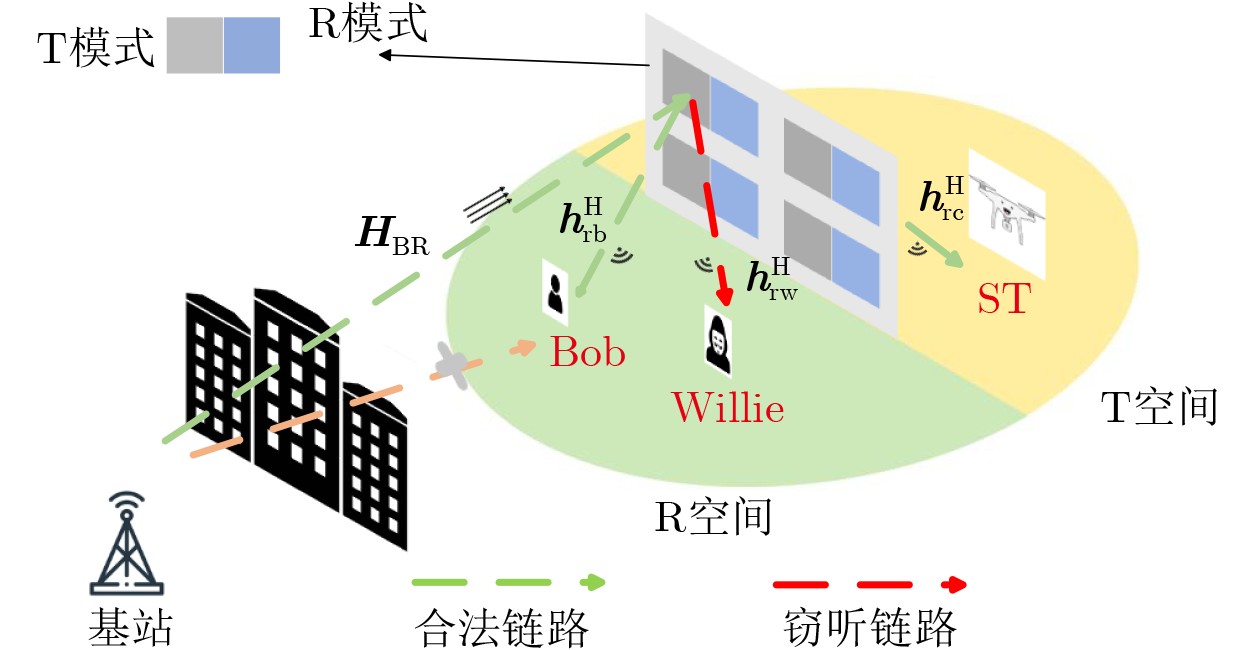
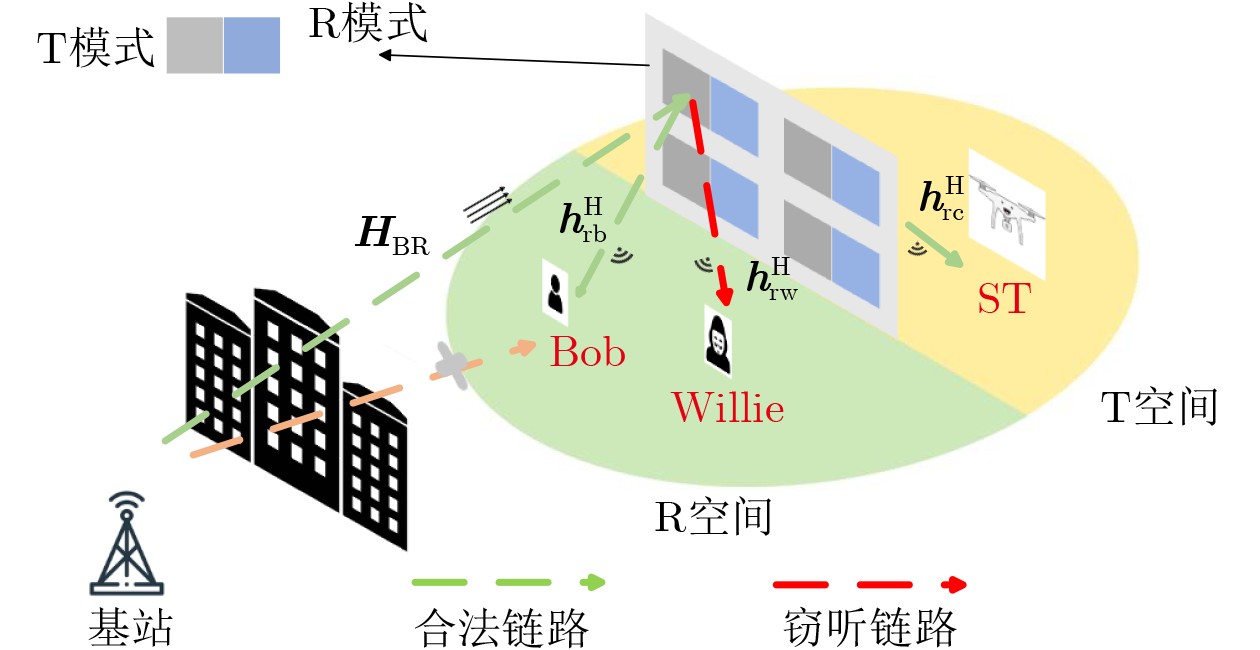
摘要: 为提高通感一体化(ISAC)系统中信息传输的隐蔽性,该文研究基于超大规模同时透射与反射可重构智能表面(XL-STAR-RIS)辅助的近场通感一体化系统,旨在实现隐蔽通信的资源优化。首先,建立近场球面波信道模型与信号传输模型,分析窃听者Willie的最优检测性能,并推导其最小检测错误概率的闭合下界表达式。在此基础上,根据通信要求,以最大化隐蔽通信速率为目标,综合考虑发射功率约束、感知信噪比约束及隐蔽性要求,构建了联合波束成形优化问题。为解决该非凸问题,该文提出一种融合半定松弛(SDR)、Dinkelbach型迭代与惩罚函数的分层交替优化算法,实现了主动发射波束与被动STAR-RIS系数的协同设计。仿真结果表明,所提方案在隐蔽通信速率、感知精度与收敛性能方面均优于传统被动RIS及无RIS基准方案。
-
关键词:
- 隐蔽通信 /
- 超大规模同时透射与反射可重构智能表面 /
- 通感一体化
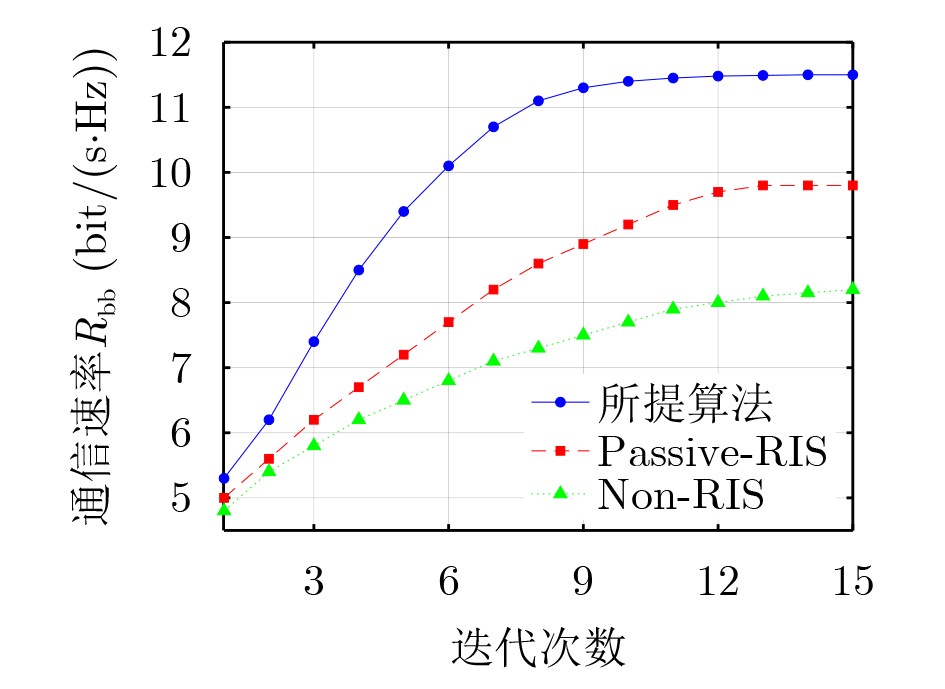
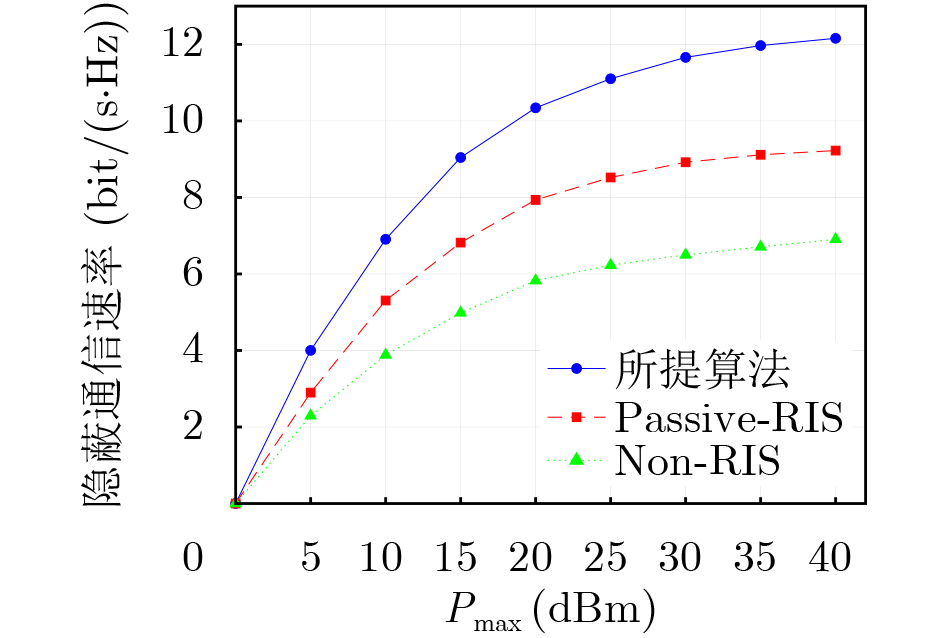
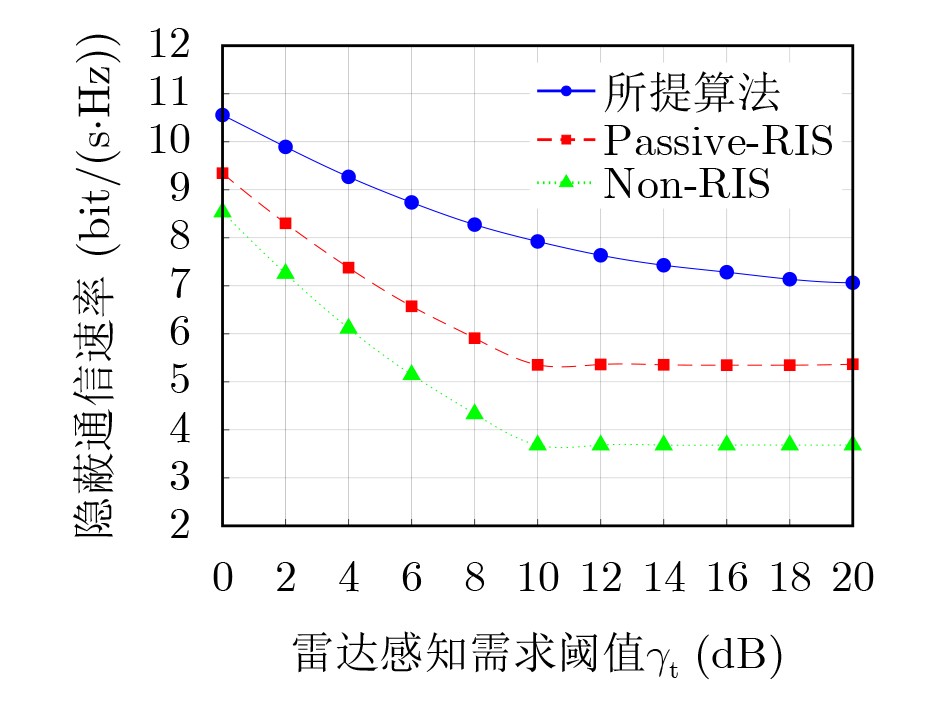
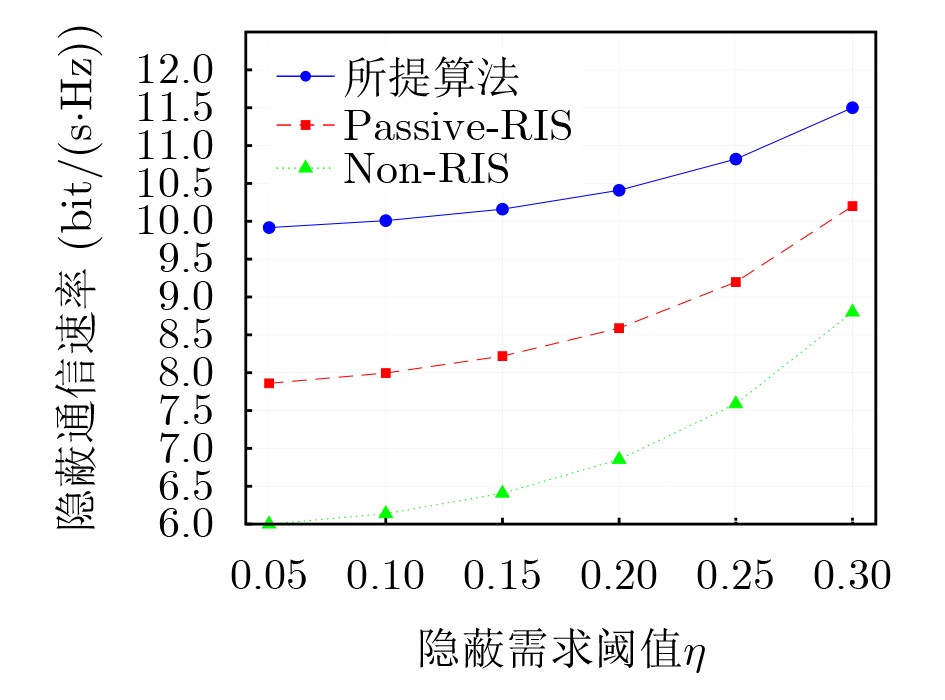
Abstract:Objective The evolution of Sixth Generation (6G) mobile communications toward higher frequencies and larger antenna arrays has made Integrated Sensing And Communication (ISAC) a key enabling technology. However, ISAC systems still face limited communication covertness and resource competition between sensing and communication. Covert communication and Reconfigurable Intelligent Surface (RIS) techniques provide promising solutions. However, most existing studies use reflective RISs with half-space coverage and assume far-field propagation. These assumptions limit deployment flexibility and fail to capture near-field spherical-wave characteristics. To address these issues, this paper proposes a near-field full-space ISAC framework assisted by an Extremely Large-Scale Simultaneously Transmitting And Reflecting Reconfigurable Intelligent Surface (XL-STAR-RIS). The objective is to jointly optimize active transmit beamforming and passive XL-STAR-RIS coefficient design to improve the covert communication rate while satisfying sensing performance and covertness requirements. Methods The detection capability of warden Willie is first analyzed, and a closed-form lower-bound expression for the minimum Detection Error Probability (DEP) is derived. A non-convex optimization problem is then formulated to maximize the covert communication rate under sensing Signal-to-Noise Ratio (SNR), covertness, and total transmit power constraints. Direct solution is difficult because the active transmit beamforming vectors and passive XL-STAR-RIS coefficients are strongly coupled. An Alternating Optimization (AO) framework is therefore adopted to decompose the original problem into two tractable subproblems. The active transmit beamforming subproblem is solved using SemiDefinite Relaxation (SDR) combined with a penalty-based successive convex approximation method. The passive XL-STAR-RIS coefficient design subproblem is solved using the Dinkelbach algorithm and a rank-one penalty method. The two subproblems are solved alternately until convergence. Results and Discussions Simulation results verify the effectiveness of the proposed framework. The algorithm converges within approximately 10 iterations and achieves a covert communication rate of about 11.5 bit/(s·Hz). This rate is higher than those of the passive-RIS scheme (9.8 bit/(s·Hz)) and the non-RIS scheme (8.0 bit/(s·Hz)). The performance gain becomes more evident as the transmit power increases, which indicates strong power adaptability. The proposed framework also maintains robust performance under strict operational constraints. When the sensing SNR threshold increases, it achieves a higher covert communication rate than the benchmark schemes. Under a stricter covertness requirement, it also preserves a higher communication rate. These results show that joint active transmit beamforming and passive XL-STAR-RIS coefficient design can effectively balance communication, sensing, and covertness in near-field ISAC systems. Conclusions This paper presents an XL-STAR-RIS-assisted covert communication framework for near-field ISAC systems. By jointly designing active transmit beamforming and passive XL-STAR-RIS coefficients through an efficient AO algorithm, the proposed framework balances communication rate, sensing performance, and communication covertness. Simulation results confirm its advantages over conventional passive-RIS and non-RIS schemes, especially under strict sensing and covertness constraints. The results also indicate the potential of XL-STAR-RIS for secure full-space 6G applications. Future work will consider imperfect Channel State Information (CSI), dynamic propagation environments, and multi-RIS collaboration to improve practical robustness. -
表 1 仿真参数
参数 符号和数值 单位 波长 $ \lambda =0.03 $ m 天线间距 $ d=\dfrac{\lambda }{2} $ m 1 m处的路径损耗 $ {\rho }_{0}=30 $ dB 总传输功率 $ {P}_{\max }=30 $ dBm 噪声功率 $ {\sigma }^{2}=-85 $ dB 莱斯因子 $ \varepsilon =3 $ dB 路径损耗指数 $ {\alpha }_{\text{br}}=2 $  下载: 导出CSV
-
[1] 徐金雷, 赵俊湦, 卢华兵, 等. 面向6G的多维扩展通感一体化研究综述[J]. 电子与信息学报, 2024, 46(5): 1672-1683. doi: 10.11999/JEIT231045.XU Jinlei, ZHAO Junsheng, LU Huabing, et al. An Overview on Multi-dimensional Expanded Integrated Sensing andCommunication for 6G[J]. Journal of Electronics & InformationTechnology, 2024, 46(5): 1672-1683. doi: 10.11999/JEIT231045. [2] 谢文武, 袁曾家, 李桂林, 等. STAR-RIS辅助无线供能通信的吞吐量优化研究[J]. 无线电通信技术, 2025, 51(5): 891–898.XIE Wenwu, YUAN Zengjia, LI Guilin, et al. Throughput optimization of active STAR-RIS assisted wireless powered communication network[J]. Radio Communications Technology, 2025, 51(5): 891–898. [3] CHEN Xinying, AN Jianping, XIONG Zehui, et al. Covert communications: A comprehensive survey[J]. IEEE Communications Surveys & Tutorials, 2023, 25(2): 1173–1198. doi: 10.1109/COMST.2023.3263921. [4] 朱政宇, 杨晨一, 李铮, 等. 智能反射面辅助通感一体化系统安全资源分配算法[J]. 电子与信息学报, 2025, 47(1): 66–74. doi: 10.11999/JEIT240083.ZHU Zhengyu, YANG Chenyi, LI Zheng, et al. Resource allocation algorithm for intelligent reflecting surface-assisted secure integrated sensing and communications system[J]. Journal of Electronics & Information Technology, 2025, 47(1): 66–74. doi: 10.11999/JEIT240083. [5] 周小波, 阮丹阳, 周修颖, 等. IRS辅助的感知与隐蔽通信一体化资源分配算法[J]. 电子与信息学报, 2025, 47(2): 375-385. doi: 10.11999/JEIT240643.ZHOU Xiaobo, RUAN Danyang, ZHOU Xiuying, et, al. Resource allocation algorithm for intelligent reflecting surface-assisted integrated sensing and covert communication[J]. Journal of Electronics & Information Technology, 2025, 47(2): 375-385. doi: 10.11999/JEIT240643. [6] 谢文武, 张沁可, 梁锡涛, 等. 双RIS辅助的MISO系统吞吐量最大化研究[J]. 电子与信息学报, 2025, 47(2): 353–362. doi: 10.11999/JEIT240612.XIE Wenwu, ZHANG Qinke, LIANG Xitao, et al. Throughput maximization for double RIS-assisted MISO systems[J]. Journal of Electronics & Information Technology, 2025, 47(2): 353–362. doi: 10.11999/JEIT240612. [7] SRIVASTAVA V and PRASAD B. Reconfigurable intelligent surface enabled cognitive radio networks[C]. 2024 IEEE International Conference on Signal Processing, Informatics, Communication and Energy Systems (SPICES), Kottayam, India, 2024: 1–5. doi: 10.1109/SPICES62143.2024.10779647. [8] HUA Meng, WU Qingqing, CHEN Wen, et al. Secure intelligent reflecting surface-aided integrated sensing and communication[J]. IEEE Transactions on Wireless Communications, 2024, 23(1): 575–591. doi: 10.1109/TWC.2023.3280179. [9] XIE Wenwu, LI Zilong, YU Chao, et al. Movable-antenna-assisted covert communications with reconfigurable intelligent surfaces[J]. IEEE Internet of Things Journal, 2025, 12(9): 12369–12382 doi: 10.1109/JIOT.2024.3520710. [10] YAN Shihao, ZHOU Xiangyun, HU Jinsong, et al. Low probability of detection communication: Opportunities and challenges[J]. IEEE Wireless Communications, 2019, 26(5): 19–25. doi: 10.1109/MWC.001.1900057. [11] HU Langtao, YANG Rui, WU Lei, et al. RIS-assisted integrated sensing and covert communication design[J]. IEEE Internet of Things Journal, 2024, 11(9): 16505–16516. doi: 10.1109/JIOT.2024.3354247. [12] ZHANG Jifa, XU Jinlei, LU Weidong, et al. Secure transmission for IRS-aided UAV-ISAC networks[J]. IEEE Transactions on Wireless Communications, 2024, 23(9): 12256–12269. doi: 10.1109/TWC.2024.3390169. [13] WANG Chao, LI Zan, ZHANG Haibin, et al. Achieving covertness and security in broadcast channels with finite blocklength[J]. IEEE Transactions on Wireless Communications, 2022, 21(9): 7624–7640. doi: 10.1109/TWC.2022.3160051. [14] BASH B A, GOECKEL D, TOWSLEY D, et al. Hiding information in noise: Fundamental limits of covert wireless communication[J]. IEEE Communications Magazine, 2015, 53(12): 26–31. doi: 10.1109/MCOM.2015.7355562. [15] MA Shuai, SHENG Haihong, YANG Ruixin, et al. Covert beamforming design for integrated radar sensing and communication systems[J]. IEEE Transactions on Wireless Communications, 2023, 22(1): 718–731. doi: 10.1109/TWC.2022.3197940. [16] LUO Zhiquan, MA W K, SO A M C, et al. Semidefinite relaxation of quadratic optimization problems[J]. IEEE Signal Processing Magazine, 2010, 27(3): 20–34. doi: 10.1109/MSP.2010.936019. [17] ZAPPONE A and JORSWIECK E. Energy efficiency in wireless networks via fractional programming theory[J]. Foundations and Trends® in Communications and Information Theory, 2015, 11(3/4): 185–396. doi: 10.1561/0100000088. -

 下载:
下载:

图(5) / 表(1)
计量
- 文章访问数: 728
- HTML全文浏览量: 311
- PDF下载量: 56
- 被引次数: 0
