




Research on Energy Efficiency Optimization for Rotatable Hybrid Reconfigurable Intelligent Surface-aided Communication
-
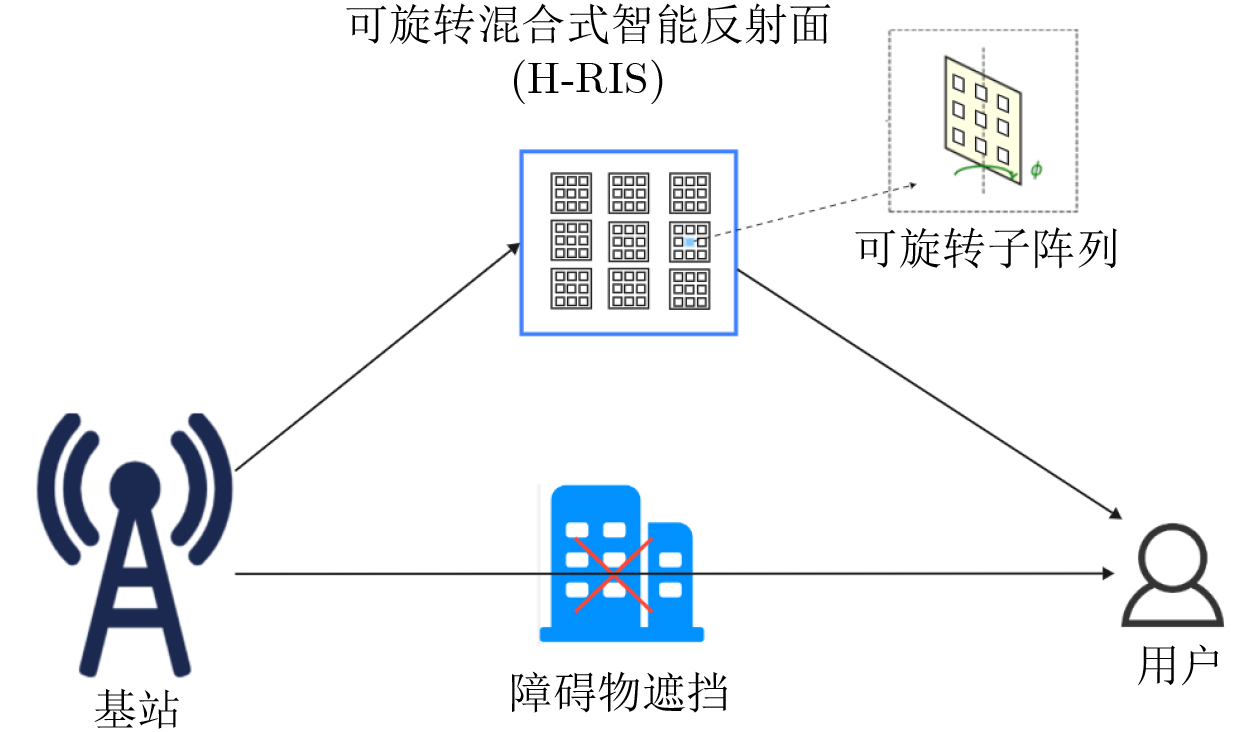
摘要: 智能反射面(RIS)作为第6代移动通信中的关键技术之一,主要通过智能重构无线信道来改善通信的服务质量。然而,传统固定式RIS在面对非正对信号时存在角度失配损耗和高电路能耗问题,难以满足绿色通信的低功耗要求。该文研究一种基于可旋转混合式智能反射面(H-RIS)辅助的通信系统,旨在通过联合优化基站发射功率、子阵列开关状态、物理旋转角度及电子相移以解决机械旋转与开关控制下的下行通信资源分配问题,实现频谱效率与系统功耗的有效折中。针对该非凸的混合整数非线性规划(MINLP)优化问题,该文采用基于块坐标下降(BCD)的交替优化框架进行求解:首先,提出一种基于信道贡献度的排序策略以降低二元开关变量的搜索复杂度;其次,利用Dinkelbach算法将原分式目标函数转化为参数化减式形式进行功率优化;最后,通过黄金分割搜索法迭代求解旋转角度与电子相移。仿真结果表明,所提方案能根据用户位置灵活调整H-RIS的面板朝向与激活规模,在保证通信质量的同时,能够显著降低系统冗余功耗。
-
关键词:
- 旋转混合式智能反射面 /
- 资源分配 /
- 能量效率 /
- 开关控制 /
- 块坐标下降法
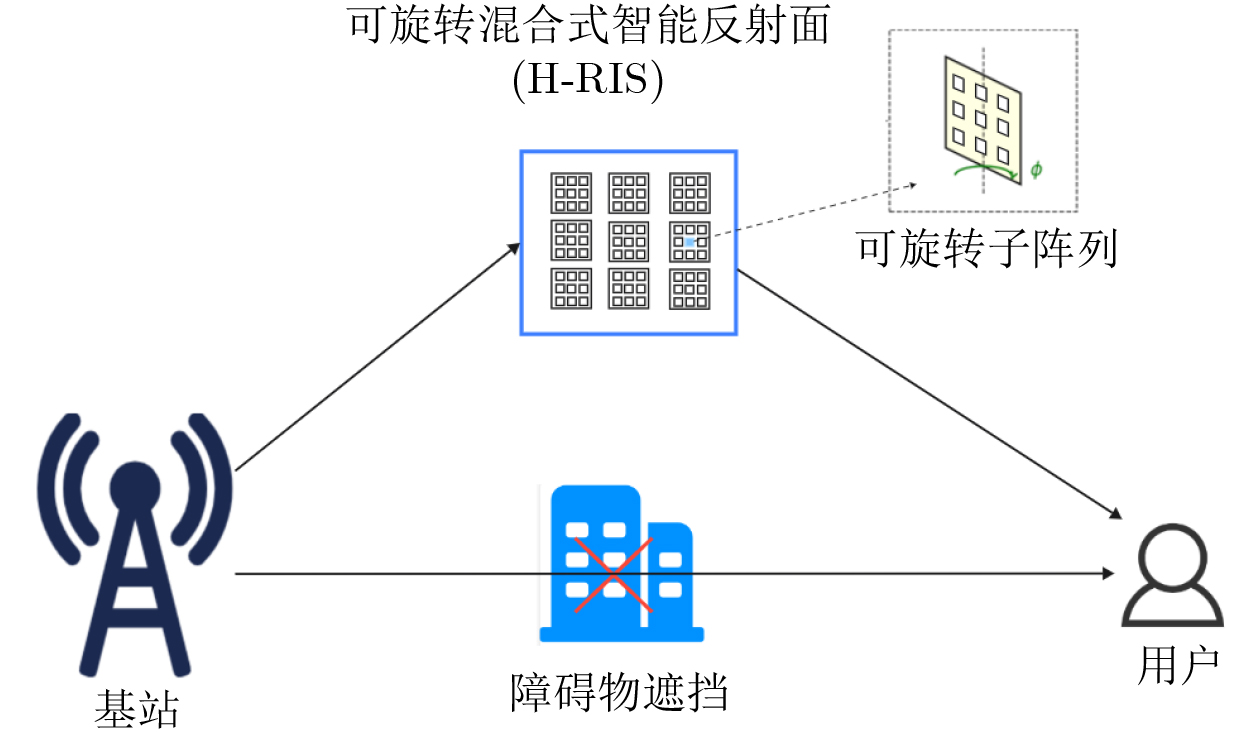
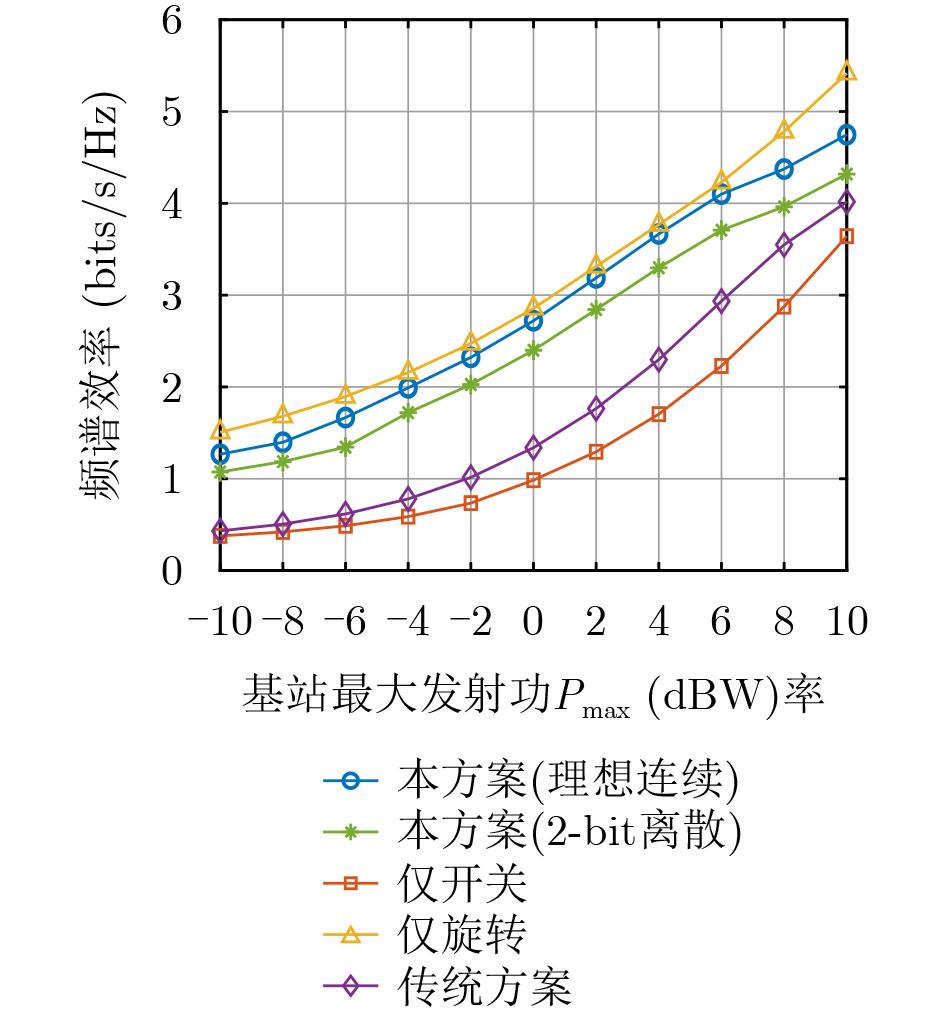
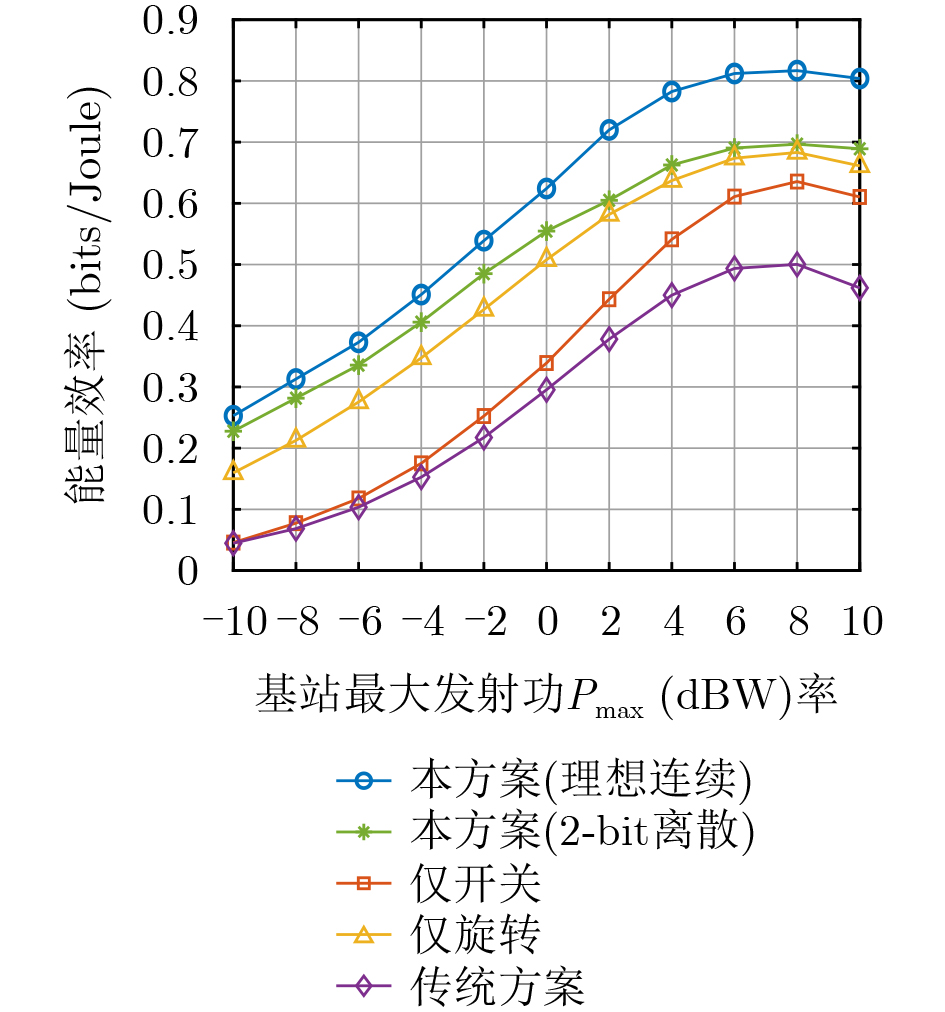
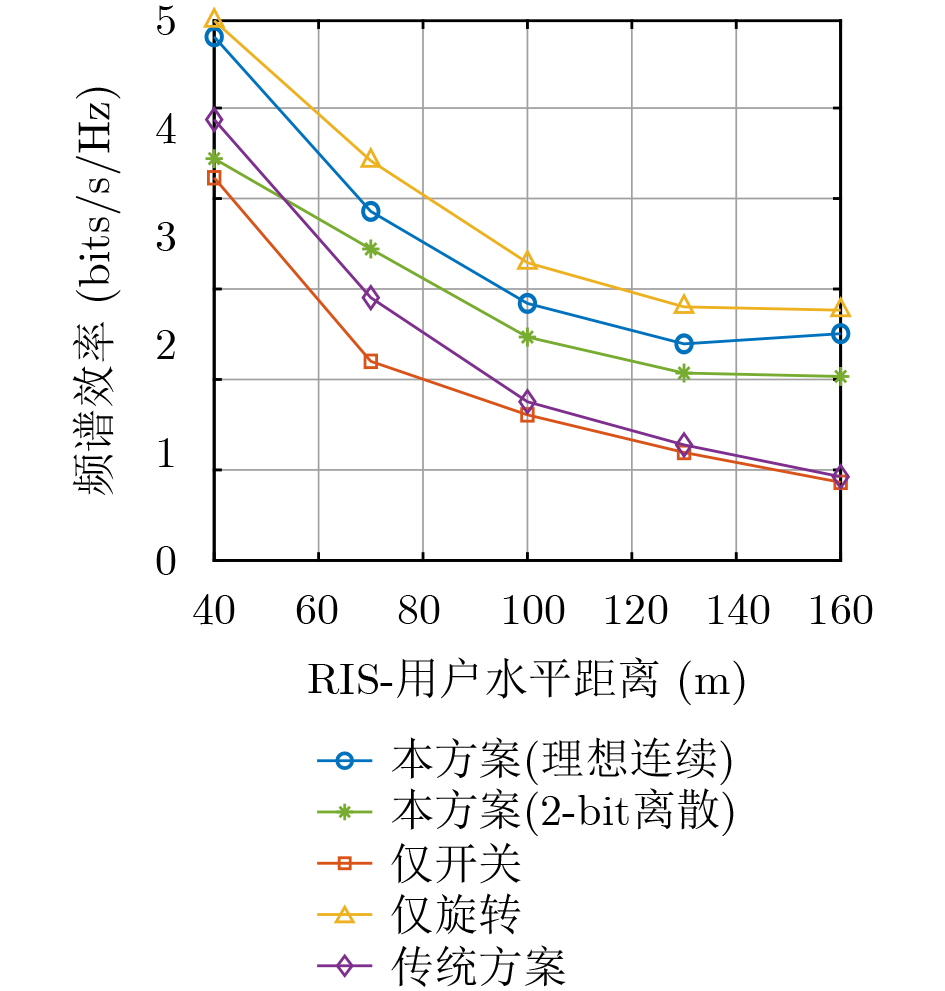
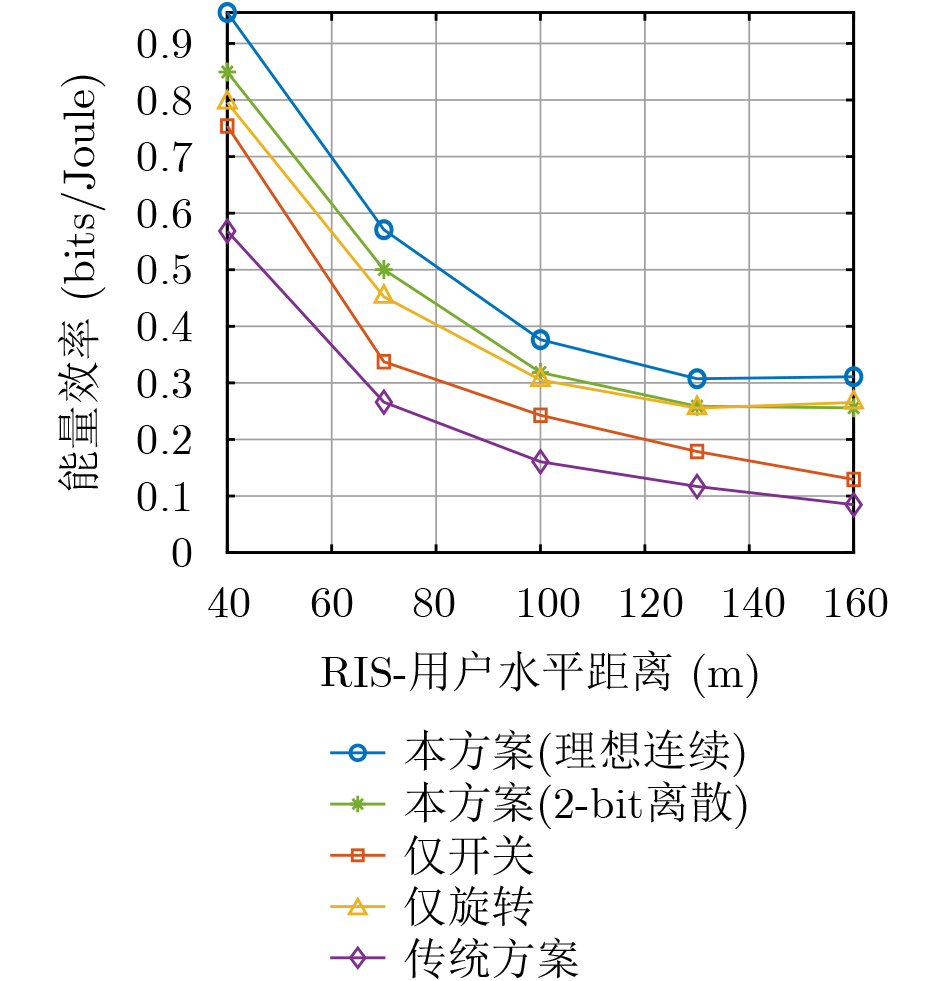
Abstract:Objective With the evolution of sixth-generation (6G) communication networks, Reconfigurable Intelligent Surfaces (RISs) have become a promising technology for reshaping wireless propagation environments and improving spectral efficiency. However, conventional fixed RIS architectures face two main deployment challenges. The first is angle-mismatch loss, in which the effective aperture is reduced when users are located at large angles from the RIS normal. The second is the energy-consumption bottleneck caused by the cumulative power consumption of Radio Frequency (RF) circuits and static control elements in large-scale arrays. Existing studies often consider mechanical rotation and element switching separately. A unified framework is still needed to balance mechanical and circuit energy consumption with communication gain. To address these limitations, this paper investigates a Rotatable and Switchable Hybrid RIS (H-RIS)-aided downlink communication system. The objective is to maximize system Energy Efficiency (EE) by jointly optimizing the base-station transmit power, subarray activation states, physical rotation angles, and electronic phase shifts. Mechanical rotation degrees of freedom are used to compensate for path loss, whereas dynamic switching is used to reduce redundant power consumption and support green communication. Methods A joint optimization framework is established for an H-RIS-aided single-user Multiple-Input Single-Output (MISO) system. The system model accounts for the dynamic power consumption induced by mechanical rotation and the static power consumption of active subarrays. The optimization problem is formulated as a non-convex Mixed-Integer Nonlinear Programming (MINLP) problem with coupled binary variables for subarray activation states and continuous variables for transmit power, rotation angles, and phase shifts. To solve this problem, a Block Coordinate Descent (BCD)-based Alternating Optimization (AO) algorithm is proposed to decouple the variables into three subproblems. First, a channel-contribution-based ranking strategy is developed to address the exponential complexity caused by binary switching variables. Eigenvalue decomposition is performed on the cascaded channel correlation matrix to quantify the priority of each subarray, reducing the search space from exponential to linear complexity. Second, for the power-allocation subproblem, the non-convex fractional objective function is transformed into a parametric subtractive form by using the Dinkelbach algorithm and is then solved by the interior-point method. Third, for physical-rotation and electronic-phase optimization, the problem is decomposed into single-variable subproblems. A Golden Section Search algorithm is used to iteratively obtain the optimal rotation angle and phase shift of each subarray within bounded constraints, which ensures monotonic convergence of the objective function. Results and Discussions Extensive simulations are conducted to evaluate the proposed H-RIS scheme against benchmark schemes, including “Only-Rotation” (always on), “Only-Switching” (fixed angle), and “Conventional” (fixed and always on). The simulation results under the maximum transmit power Pmax (Fig. 2 and Fig. 3) show that the proposed method achieves the highest EE across the full power range. In the low-power regime, the proposed algorithm turns off redundant subarrays when the rate gain cannot offset the circuit power cost. This strategy yields higher EE than the “Only-Rotation” scheme, which suffers from high static power consumption. The effect of user distance is also analyzed (Fig. 4 and Fig. 5). The results show that the proposed scheme maintains high spectral efficiency comparable to that of the “Only-Rotation” scheme by dynamically adjusting the rotation angles to align with the Line-of-Sight (LoS) path. This adjustment effectively compensates for the angle-mismatch loss observed in the “Only-Switching” and “Conventional” schemes. In addition, the subarray activation pattern varies in a “U” shape with distance (Table 1), enabling flexible adjustment of array size and orientation according to the user-RIS geometry. Conclusions This paper proposes an energy-efficient transmission scheme for H-RIS-aided communication systems by integrating mechanical rotation with dynamic switching. A low-complexity BCD-based algorithm is developed to jointly optimize the transceiver design. The results confirm that mechanical rotation mitigates angle-mismatch loss, whereas the proposed channel-contribution-based switching strategy reduces redundant energy consumption. Compared with conventional fixed RIS architectures, the proposed H-RIS architecture provides a better trade-off between spectral efficiency and EE, offering a feasible solution for future green 6G networks. -
1 基于BCD的能量效率最大化算法
初始化:输入信道矩阵$ {\boldsymbol{H}}_{\text{{B}{R}}},{\boldsymbol{H}}_{\text{{R}{U}}} $,最大发射功率$ {P}_{\text{max}} $,收敛容限$ \epsilon $,随机初始化旋转角度$ \boldsymbol{\phi } $ 和电子相移$ \boldsymbol{\psi } $,令迭代计数$ t=0 $ while $ \left| {\eta }^{\left(t\right)}-{\eta }^{\left(t-1\right)}\right| \gt $ 且 $ t\le I\mathrm{_{max}} $ do • 基于当前物理旋转角度$ {\phi }^{\left(t\right)} $,更新等效级联信道 • 根据式(12)计算子阵列信道贡献度权重,生成优先级排序索引$ S_{\mathrm{sort}} $ • for 候选激活数量$ l =1 $to$ N\mathrm{_{sub}} $do • 激活 $ {S}_{\text{sort}} $ 中优先级最高的前$ l $个子阵列,其余关闭 • 构建参数化Dinkelbach子问题,利用内点法迭代求解当前最优发射功率$ {\boldsymbol{w}}_{l} $ • 计算当前配置下的系统能效$ {\eta }_{l} $ • end for • 选取使能效$ {\eta }_{l} $最大的激活状态$ {\boldsymbol{\alpha}}^{\left(t+1\right)} $ 和功率$ {\boldsymbol{w}}^{\left(t+1\right)} $ • 固定$ {\boldsymbol{\alpha}}^{\left(t+1\right)} $ 和$ {\boldsymbol{w}}^{\left(t+1\right)} $,利用黄金分割搜索法更新物理旋转角度$ {\boldsymbol{\phi }}^{\left(t+1\right)} $ • 固定其他变量,利用黄金分割搜索法更新电子相移$ {{\boldsymbol{\psi }}}^{\left(t+1\right)} $ • $ t \leftarrow t +1 $ end while 输出:最优波束赋形向量$ {\boldsymbol{w}}^{*} $,旋转角度$ {\boldsymbol{\phi }}^{*} $,电子相移$ {{\boldsymbol{\psi }}}^{*} $ 及开关状态$ {\boldsymbol{\alpha}}^{*} $  下载: 导出CSV
表 1 角度(绝对物理角度)与开关动态变化表
子阵列序号 初始角度(rad) 40 m 70 m 100 m 130 m 160 m 1 – 1.1327 0.5411 0.4868 0.4655 0.4538 0.4468 2 – 1.1327 0.5372 0.4828 0.4603 0.4503 0.4433 3 – 1.1327 0.1784 0.4828 0.4603 0.4486 0.4416 4 – 1.1327 0.3199 0.4849 0.4674 0.4576 0.4503 5 – 1.1327 0.5353 0.4849 0.4603 0.4486 0.4416 6 – 1.1327 0.5392 0.4830 0.4653 0.4518 0.4433 7 – 1.1327 0.2793 OFF OFF OFF 0.4451 8 – 1.1327 0.3456 OFF OFF OFF 0.4433 9 – 1.1327 0.5324 OFF OFF OFF 0.4416 10 – 1.1327 0.5411 OFF OFF OFF 0.4433 11 – 1.1327 0.2897 OFF OFF OFF OFF 12 – 1.1327 0.5353 OFF OFF OFF OFF 13 – 1.1327 0.543 0 OFF OFF OFF OFF 14 – 1.1327 OFF OFF OFF OFF OFF 15 – 1.1327 OFF OFF OFF OFF OFF 16 – 1.1327 OFF OFF OFF OFF OFF
下载: 导出CSV
-
[1] LU Haiquan, ZENG Yong, YOU Changsheng, et al. A tutorial on near-field XL-MIMO communications toward 6G[J]. IEEE Communications Surveys & Tutorials, 2024, 26(4): 2213–2257. doi: 10.1109/COMST.2024.3387749. [2] CUI Miao, ZHANG Guangchi, and ZHANG Rui. Secure wireless communication via intelligent reflecting surface[J]. IEEE Wireless Communications Letters, 2019, 8(5): 1410–1414. doi: 10.1109/LWC.2019.2919685. [3] DI RENZO M, ZAPPONE A, DEBBAH M, et al. Smart radio environments empowered by reconfigurable intelligent surfaces: How it works, state of research, and the road ahead[J]. IEEE Journal on Selected Areas in Communications, 2020, 38(11): 2450–2525. doi: 10.1109/JSAC.2020.3007211. [4] WU Qingqing and ZHANG Rui. Towards smart and reconfigurable environment: Intelligent reflecting surface aided wireless network[J]. IEEE Communications Magazine, 2020, 58(1): 106–112. doi: 10.1109/MCOM.001.1900107. [5] DONG Zhenjun and ZENG Yong. Near-field spatial correlation for extremely large-scale array communications[J]. IEEE Communications Letters, 2022, 26(7): 1534–1538. doi: 10.1109/LCOMM.2022.3170735. [6] CHANG Hengtai, WANG Chengxiang, BIAN Ji, et al. A novel 3D beam domain channel model for UAV massive MIMO communications[J]. IEEE Transactions on Wireless Communications, 2023, 22(8): 5431–5445. doi: 10.1109/TWC.2023.3233961. [7] WANG Jinghe, TANG Wankai, LIANG Jingcheng, et al. Reconfigurable intelligent surface: Power consumption modeling and practical measurement validation[J]. IEEE Transactions on Communications, 2024, 72(9): 5720–5734. doi: 10.1109/TCOMM.2024.3382332. [8] LI Zhiyi, ZHANG Jida, ZHU Jieao, et al. RIS energy efficiency optimization with practical power models[C]. 2023 International Wireless Communications and Mobile Computing (IWCMC), Marrakesh, Morocco, 2023: 1172–1177. doi: 10.1109/IWCMC58020.2023.10183034. [9] CHEN Weicong, YANG Xinyi, WEN Chaokai, et al. Rotatable block-controlled RIS: Bridging the performance gap to element-controlled systems[J]. IEEE Communications Letters, 2025, 29(1): 185–189. doi: 10.1109/LCOMM.2024.3508848. [10] WANG Junbo, ZHU Bingqian, PAN Yijin, et al. Power control and passive beamforming for the STAR-RIS with rotatable angles[J]. IEEE Transactions on Vehicular Technology, 2024, 73(8): 12121–12125. doi: 10.1109/TVT.2024.3369617. [11] XU Shuqing, GUO Haiyan, DONG Wen, et al. Optimal elevation and azimuth rotation for RIS-assisted wireless transmission[J]. IEEE Communications Letters, 2024, 28(12): 2909–2913. doi: 10.1109/LCOMM.2024.3477957. [12] TAHERI Z and SOLEYMANI M R. Optimizing energy efficiency in large RIS-aided multi-user MISO communication systems[C]. 2024 IEEE 100th Vehicular Technology Conference (VTC2024-Fall), Washington, USA, 2024: 1–5. doi: 10.1109/VTC2024-Fall63153.2024.10757578. [13] YANG Xinyi, CHEN Weicong, LI Xiao, et al. Performance evaluation for subarray-based reconfigurable intelligent surface-aided wireless communication systems[C]. GLOBECOM 2023 - 2023 IEEE Global Communications Conference, Kuala Lumpur, Malaysia, 2023: 2027–2032. doi: 10.1109/GLOBECOM54140.2023.10437470. [14] YANG Wanning, LI Ming, and LIU Qian. A practical channel estimation strategy for XL-MIMO communication systems[J]. IEEE Communications Letters, 2023, 27(6): 1580–1583. doi: 10.1109/LCOMM.2023.3266821. [15] ZHAO Boqun, OUYANG Chongjun, LIU Yuanwei, et al. Modeling and analysis of near-field ISAC[J]. IEEE Journal of Selected Topics in Signal Processing, 2024, 18(4): 678–693. doi: 10.1109/JSTSP.2024.3386054. [16] LI Jin, ZHOU Gui, GONG Tantao, et al. A framework for mutual information-based MIMO integrated sensing and communication beamforming design[J]. IEEE Transactions on Vehicular Technology, 2024, 73(6): 8352–8366. doi: 10.1109/TVT.2024.3355899. [17] QU Kaiqian, GUO Shuaishuai, SAEED N, et al. Near-field integrated sensing and communication: Performance analysis and beamforming design[J]. IEEE Open Journal of the Communications Society, 2024, 5: 6353–6366. doi: 10.1109/OJCOMS.2024.3470844. [18] ZHU Lipeng, MA Wenyan, and ZHANG Rui. Modeling and performance analysis for movable antenna enabled wireless communications[J]. IEEE Transactions on Wireless Communications, 2024, 23(6): 6234–6250. doi: 10.1109/TWC.2023.3330887. [19] DINKELBACH W. On nonlinear fractional programming[J]. Management Science, 1967, 13(7): 492–498. [20] ZHAO Mingmin, WU Qingqing, ZHAO Minjian, et al. Intelligent reflecting surface enhanced wireless networks: Two-timescale beamforming optimization[J]. IEEE Transactions on Wireless Communications, 2021, 20(1): 2–17. doi: 10.1109/TWC.2020.3022297. -

 下载:
下载:

图(5) / 表(2)
计量
- 文章访问数: 454
- HTML全文浏览量: 183
- PDF下载量: 25
- 被引次数: 0
