




Optimizing Satisfiability-Based Automatic Test Pattern Generation Systems: Unified Fault Set Construction,Modeling, and Solving
-
摘要: 基于布尔可满足性的自动测试向量生成系统作为芯片故障检测的关键环节,系统效率受故障压缩策略、布尔可满足性建模策略及求解器传播能力共同制约,随着集成电路复杂度持续提升,其性能面临严峻挑战。该文提出一种面向自动测试向量生成系统的统一优化框架。构建检测点驱动的动态故障集,在保持可测故障覆盖完备性的前提下压缩待测故障规模。提出基于新型故障敏化约束的布尔可满足建模方法,通过显式敏化条件替代故障电路复制并约束于故障扇出锥内,减少合取范式变量与子句规模。引入面向扇出-重汇聚结构的动态蕴含学习,将结构相关性转化为增量蕴含以加强传播并提升冲突剪枝效率。实验结果表明,该方法能平均压缩故障集规模57.59%,子句和变量数开销平均降低11.44%和3.50%,平均将求解时间缩短22.43%,性能优于已有的测试向量生成系统。Abstract:
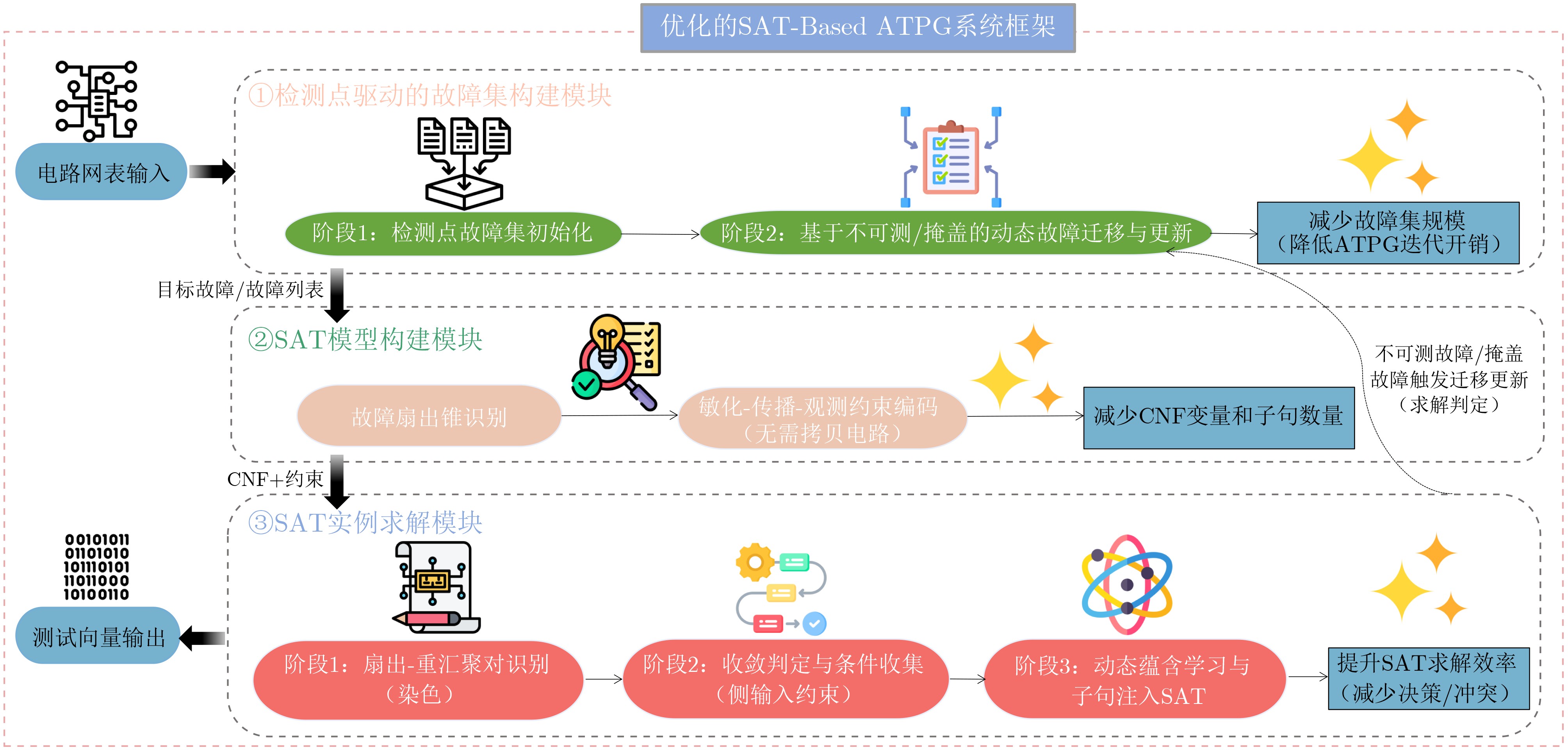
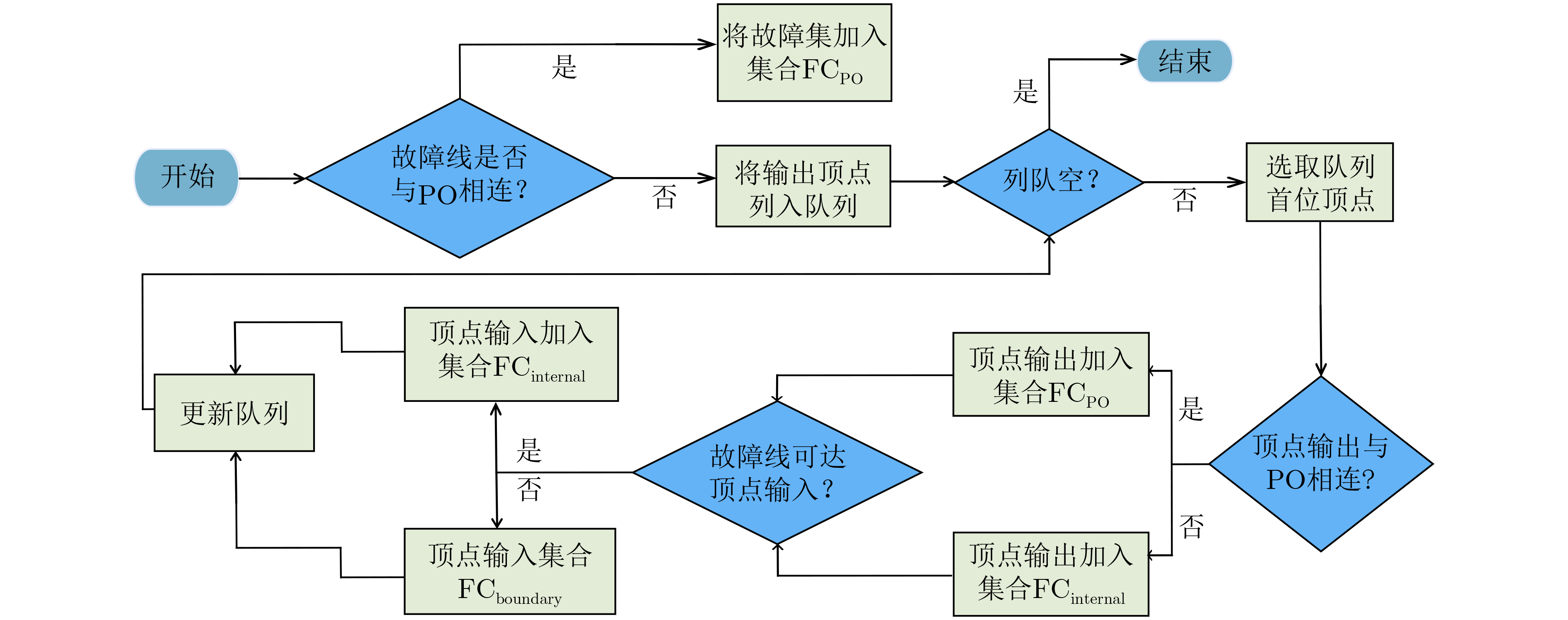
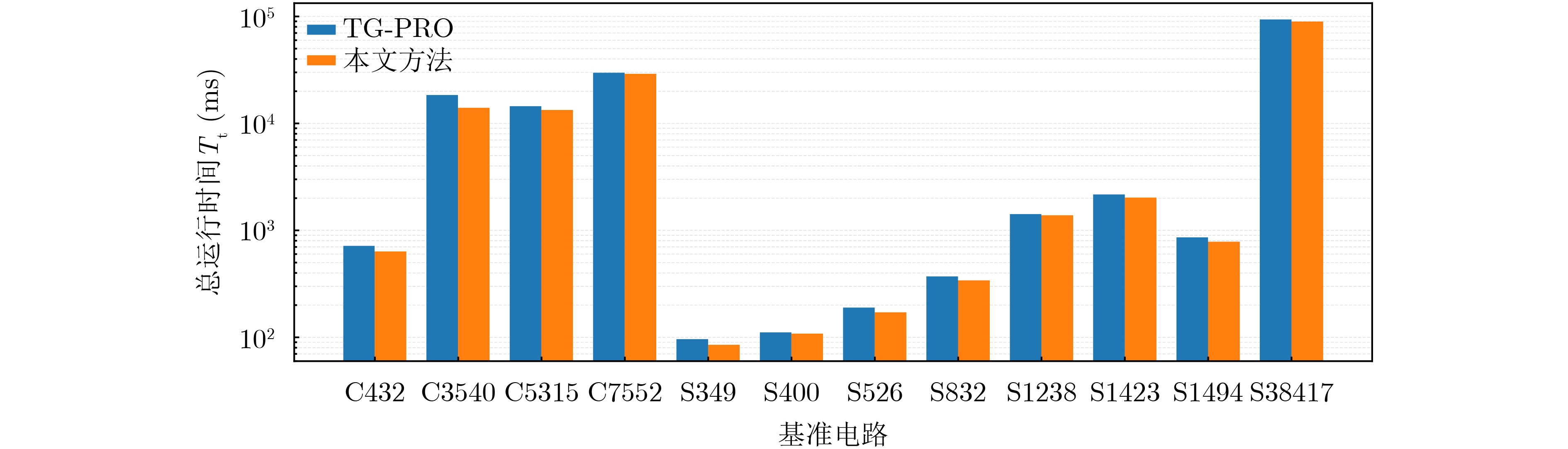
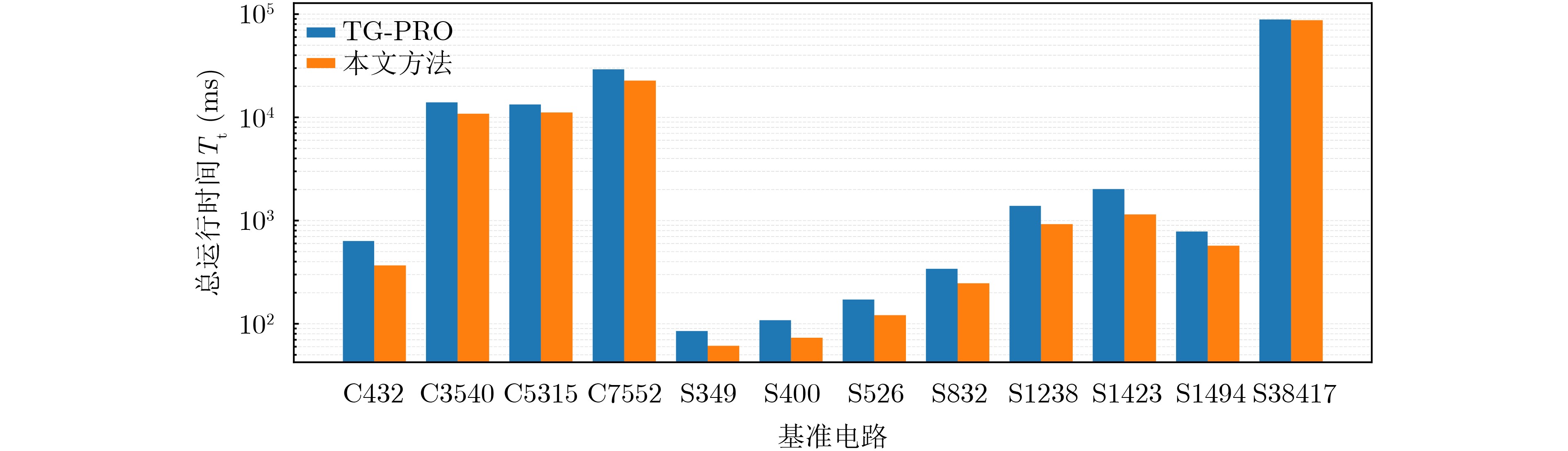
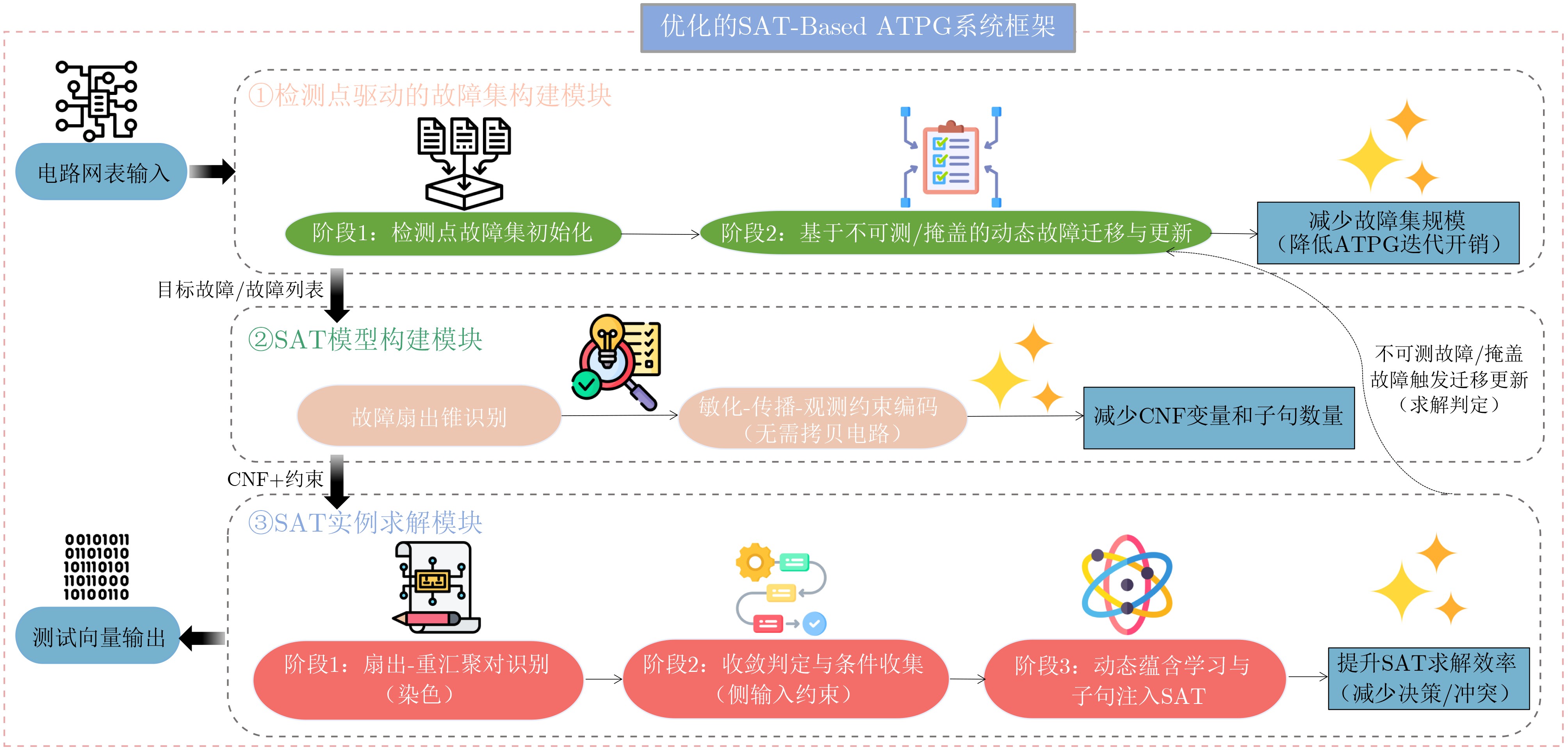
Objective Boolean SATisfiability-Based Automatic Test Pattern Generation (SAT-Based ATPG) is widely used to generate tests for hard-to-detect single stuck-at faults and to prove fault untestability in combinational logic. When SAT-Based ATPG is applied to large netlists with dense fanout and reconvergence, its runtime and memory consumption are often dominated by three interacting issues. Representative fault lists produced by conventional dominance- or equivalence-based fault collapsing can remain large, increasing the number of SAT calls and enlarging the incremental context that must be maintained across faults. Meanwhile, SAT modeling may introduce redundant Conjunctive Normal Form (CNF) overhead, especially when an explicit faulty-circuit copy is constructed or when propagation constraints are encoded globally without locality control. In addition, fanout-reconvergence structures amplify assignment correlations along sensitized paths, and such correlations are often exposed only after repeated decisions and backtracking when only standard unit propagation is used. The unified optimization objective is therefore to reduce overall CNF size and solving cost while preserving completeness, so that a practical SAT-Based ATPG system remains efficient and stable across circuits of different scales. Methods A three-part framework is developed and implemented in an incremental SAT-Based ATPG flow, and the overall workflow is illustrated ( Fig. 1 ). First, a checkpoint-driven dynamic fault-set construction method is proposed. Checkpoints are collected during netlist-to-directed-acyclic-graph conversion, including all primary inputs and all fanout branches, and XOR/XNOR outputs are additionally recorded as supplementary checkpoints to avoid over-collapsing XOR-related fault behavior. Representative faults are initialized on checkpoints by compact rules that combine dominance-oriented fault collapsing with equivalence-aware refinement, and solver-guided repair is performed when an untestable representative fault indicates potential masking under structural constraints. The procedure is summarized in Algorithm 1. Second, an SAT modeling method based on fault sensitization constraints is adopted to avoid explicit faulty-circuit duplication. Fault activation, propagation, and observability are represented by additional fault sensitization constraints over the original circuit variables, and auxiliary variables are introduced only when local bookkeeping is required. Constraint localization is restricted to the fault fanout cone, and cone-boundary and internal vertices are identified through a graph-traversal procedure (Fig. 2 ). Third, a dynamic implication learning mechanism oriented to fanout-reconvergence pairs is integrated into the incremental solving loop. Reconvergence pairs within the fault fanout cone are monitored under partial assignments, and structure-induced implications are injected either as implied assignments when a reconvergent output becomes functionally determined or as short conflict clauses when a branch-value combination becomes inconsistent with the fault sensitization constraints. The dynamic implication learning procedure is summarized in Algorithm 2.Results and Discussions The unified system is evaluated on ISCAS’85 and ISCAS’89 benchmark circuits, with TG-PRO used as the baseline implementation under the same SAT solver and termination settings. The checkpoint-driven dynamic fault-set construction method substantially reduces the representative fault space entering ATPG. Relative to the uncollapsed fault space, the average representative-fault ratio decreases from 51.38% to 42.41%, corresponding to an average fault-space reduction of 57.59%. The best-case ratio reaches 33.19% on large circuits with heavy reconvergence, which indicates that checkpoint-centered representative-fault allocation effectively suppresses redundancy without enlarging the untestable fault set ( Table 1 ). The reduced fault-set size is reflected in preprocessing efficiency, and the total runtime for fault-set construction is consistently reduced, with an average reduction of 8.37% across the evaluated circuits (Fig. 3 ). For SAT model construction, the fault-sensitization-constraint encoding reduces CNF overhead relative to the baseline model construction. Across the benchmark set, the numbers of CNF clauses and CNF variables are reduced by 11.44% and 3.50%, respectively, which shows that avoiding explicit faulty-circuit duplication and localizing auxiliary constraints to the fault fanout cone effectively lowers memory demand (Table 2 ). The reduced CNF size and strengthened locality of constraints are further reflected in end-to-end runtime, and the total runtime of SAT modeling and solving is reduced across the evaluated benchmarks (Fig. 4 ). Dynamic implication learning further improves solving efficiency in reconvergence-heavy structures. Compared with static implication learning, CNF construction time increases by 3.0% on average because of the additional monitoring and injection operations, yet the overall runtime decreases by 4.42% on average, which indicates a favorable cost-benefit trade-off. The overhead attributed to dynamic implication learning accounts for 2.51% of the total runtime aggregated across circuits, which confirms that the injected implications and pruning clauses provide measurable solving benefits at limited extra cost (Table 3 ).Conclusions A unified optimization framework for SAT-Based ATPG is developed by combining checkpoint-driven dynamic fault-set construction, localized fault sensitization constraints for CNF modeling, and fanout-reconvergence-oriented dynamic implication learning. Representative faults are compressed through solver-guided repair of dominance and equivalence relations to avoid masking, CNF growth is controlled through duplication-free modeling localized to the fault fanout cone, and reconvergence correlations are exploited through incremental implication injection to strengthen propagation and enable early conflict pruning. Experimental results on standard benchmark circuits show consistent reductions in representative fault scale, CNF size, and total runtime, providing a practical approach for scaling SAT-Based ATPG to larger designs with complex fanout and reconvergence. -
1 动态故障集构建流程
输入:Lcheck, Lxor 1. F ← $ \mathit{\varnothing} $; 2. for each l in Lcheck do 3. if is PI(l) and |D(l) | > 1 then 4. F ← F $ \cup $ {stem(l, s-a-0), stem(l, s-a-1)}; continue; 5. for each vd in D(l) do 6. if Type(vd) in {XOR, XNOR, INV, BUF} then 7. F ← F $ \cup $ { fault(l →vd, s-a-0), fault(l →vd, s-a-1)};
continue;8. F ← F $ \cup $ { fault(l → vd, dom) }; 9. if AllFaninInCheckpoints(vd) and IsMinPin(l, vd) then 10. F ← F $ \cup $ {fault(l → vd, eq)}; 11. for each l in Lxor do 12. if |D(l) | > 1 then 13. F ← F $ \cup $ {stem(l, s-a-0), stem(l, s-a-1)}; continue; 14. d ← UniqueDest(l); 15. F ← F $ \cup $ { fault(l →d, s-a-0), fault(l →d, s-a-1) }; 16. for each f reported as U during ATPG do 17. if Type(f) == stem then continue; 18. f ← EqShift(f); 19. if NeedCompensate(VertexOf(f)) then 20. g ← DomFaultAtOutput(VertexOf(f)); 21. g ← EqShift(g); 22. F ← F $ \cup $ {g}; 输出: F  下载: 导出CSV
2 基于扇出-重汇聚对动态蕴含方法
输入:G={V, E}, CNF 1. CNF' ← CNF; F-Rpairs ← $ \varnothing $; maxcolor[ ] ← 1; 2. for each PI $ \in $ PIs do assign PI.color[0] ← maxcolor[0]++; 3. if |Vd(PI)| > 1 then CandidateFanouts[PI.color[0]] ← PI; 4. push all outputs of PIs into Ldyeing; 5. while Ldyeing not empty do l ← pop(Ldyeing); vd ← Vd(l); 6. if vd == $ \varnothing $ then continue; LD ← LogicDepth(l); 7. if maxcolor[LD] == 0 then maxcolor[LD] ← 1; 8. PropagateColor(l, vd, maxcolor); push(vd.output) into
Ldyeing;9. if |vd.inputs| > 1 and AllInputsColored(vd) then 10. c ← MergeColor(vd.inputs); f ← CandidateFanouts[c]; 11. if f ≠ $ \varnothing $ then add (f, vd) to F-Rpairs; 12. CandidateFanouts[c] ← UpdateFanout(c, vd.output); 13. for each (f, r) ∈ F-Rpairs do InitPairType(f, r); 14. during CDCL solving, when a literal in cone(f, r) is assigned do 15. $ \varDelta $ ← ImplyByPair(f, r); 16. if $ \varDelta $ == CONFLICT then LearnClause(); return UNSAT; 17. if $ \varDelta $ ≠ $ \varnothing $ then CNF' ← CNF' ∧ Encode($ \varDelta $); Enqueue($ \varDelta $); 输出:CNF′
下载: 导出CSV
表 1 不同故障集构建方法故障数目对比
基准电路 #Fuc TG-PRO系统 本文方法 #Ft #Fd #Fud #Ft/#Fuc(%) #Ft #Fd #Fud #Ft/#Fuc(%) C432 864 524 520 4 60.65 458 454 4 53.01 C3540 7080 3428 3291 137 48.42 2905 2768 137 41.03 C5315 10630 5350 5291 59 50.33 4528 4469 59 42.60 C7552 15104 7550 7419 131 49.99 6148 6017 131 40.70 S349 698 350 348 2 50.14 275 273 2 39.40 S400 800 424 418 6 53.00 388 374 14 48.50 S526 1052 555 554 1 52.76 474 473 1 45.06 S832 1664 870 856 14 52.28 719 705 14 43.21 S1238 2476 1355 1286 69 54.73 1040 971 69 42.00 S1423 2846 1515 1501 14 53.23 1213 1199 14 42.62 S1494 2988 1506 1496 12 50.40 1123 1111 12 37.58 S38417 76834 31180 31015 165 40.58 25502 25337 165 33.19
下载: 导出CSV
表 2 不同SAT模型构建方法所需的CNF子句、变量数目开销
基准电路 TG-PRO系统 本文方法 #Ave
(Clauses)#Ave
(Variables)#Ave
(Clauses)#Ave
(Variables)C432 2013.830 523.181 1370.430 382.111 C1908 4592.400 1618.990 3802.680 1343.480 C3540 6681.410 2537.880 6099.210 2269.700 C5315 3159.040 3386.380 2973.550 3262.150 C7552 4446.020 4507.700 4270.750 4376.600 S349 377.590 259.269 343.145 228.284 S400 395.008 289.958 346.834 261.849 S526 474.880 386.776 439.203 356.188 S832 541.756 599.791 517.921 565.063 S1238 1604.910 809.356 1447.820 721.873 S1423 1772.140 993.290 1428.690 861.201 S1494 844.5180 941.913 832.800 897.744 S38417 1873.810 25358.300 1612.890 25207.300
下载: 导出CSV
表 3 不同蕴含学习方法对运行时间的影响(ms)
基准电路 静态蕴含 动态蕴含 TCNF Tsolve Tt TCNF Tsolve Tt Timpl C432 258 106 367 272 77 351 14 C3540 8036 2723 10766 8065 1738 9810 29 C5315 8975 2077 11062 9215 1542 10766 240 C7552 17894 4608 22516 18372 2563 20935 478 S349 49 11 61 50 7 57 1 S400 59 13 73 60 11 72 0 S526 97 22 121 97 18 116 0 S832 204 39 246 207 36 246 3 S1238 733 183 919 741 123 865 7 S1423 932 207 1142 1066 135 1126 134 S1494 445 121 569 447 85 539 2 S38417 56256 30365 86679 58570 25060 83690 2314
下载: 导出CSV
-
[1] HUANG Junhua, ZHEN Huiling, WANG Naixing, et al. Accelerate SAT-based ATPG via preprocessing and new conflict management heuristics[C]. 2022 27th Asia and South Pacific Design Automation Conference (ASP-DAC), Taipei, China, 2022: 365–370. doi: 10.1109/ASP-DAC52403.2022.9712573. [2] ROTH J P. Diagnosis of automata failures: A calculus and a method[J]. IBM Journal of Research and Development, 1966, 10(4): 278–291. doi: 10.1147/rd.104.0278. [3] GOEL P. An implicit enumeration algorithm to generate tests for combinational logic circuits[J]. IEEE Transactions on Computers, 1981, C-30(3): 215–222. doi: 10.1109/TC.1981.1675757. [4] FUJIWARA H and SHIMONO T. On the acceleration of test generation algorithms[J]. IEEE Transactions on Computers, 1983, C-32(12): 1137–1144. doi: 10.1109/TC.1983.1676174. [5] LARRABEE T. Test pattern generation using Boolean satisfiability[J]. IEEE Transactions on Computer-Aided Design of Integrated Circuits and Systems, 1992, 11(1): 4–15. doi: 10.1109/43.108614. [6] SHI Junhao, FEY G, DRECHSLER R, et al. PASSAT: Efficient SAT-based test pattern generation for industrial circuits[C]. The IEEE Computer Society Annual Symposium on VLSI: New Frontiers in VLSI Design (ISVLSI’05), Tampa, USA, 2005: 212–217. doi: 10.1109/ISVLSI.2005.55. [7] DRECHSLER R, DIEPENBECK M, EGGERSGLÜß S, et al. PASSAT 2.0: A multi-functional SAT-based testing framework[C]. The 2013 14th Latin American Test Workshop - LATW, Cordoba, Argentina, 2013: 1. doi: 1 0.1109/LATW.2013.6562675. [8] CZUTRO A, POLIAN I, LEWIS M, et al. TIGUAN: Thread-parallel integrated test pattern generator utilizing satisfiability ANalysis[C]. The 22nd International Conference on VLSI Design, New Delhi, India, 2009: 227–232. doi: 10.1109/VLSI.Design.2009.20. [9] SILVA J O M and SAKALLAH K A. Robust search algorithms for test pattern generation[C]. The 27th International Symposium on Fault Tolerant Computing, Seattle, USA, 1997: 152–161. doi: 10.1109/FTCS.1997.614088. [10] CHEN Huan and MARQUES-SILVA J. TG-PRO: A new model for SAT-based ATPG[C]. 2009 IEEE International High Level Design Validation and Test Workshop, San Francisco, USA, 2009: 76–81. doi: 10.1109/HLDVT.2009.5340173. [11] DAO A Q, LIN M P H, and MISHCHENKO A. SAT-based fault equivalence checking in functional safety verification[J]. IEEE Transactions on Computer-Aided Design of Integrated Circuits and Systems, 2018, 37(12): 3198–3205. doi: 10.1109/TCAD.2018.2791465. [12] POMERANZ I and REDDY S M. Equivalence, dominance, and similarity relations between fault pairs and a fault pair collapsing process for fault diagnosis[J]. IEEE Transactions on Computers, 2010, 59(2): 150–158. doi: 10.1109/TC.2009.112. [13] GRIGORYAN T, MALKHASYAN H, MUSHYAN G, et al. Fault collapsing for digital circuits based on relations between stuck-at faults[C]. 2015 Computer Science and Information Technologies (CSIT), Yerevan, Armenia, 2015: 15–18. doi: 10.1109/CSITechnol.2015.7358242. [14] 秦蔚蓉, 崔晓通, 程克非. 面向输出混淆度最优化的逻辑加密线性规划方法[J]. 电子与信息学报, 2025, 47(9): 3167–3177. doi: 10.11999/JEIT250527.QIN Weirong, CUI Xiaotong, and CHENG Kefei. Optimizing output obfuscation of logic locking with linear programming[J]. Journal of Electronics & Information Technology, 2025, 47(9): 3167–3177. doi: 10.11999/JEIT250527. [15] SCHULZ M H and AUTH E. Advanced automatic test pattern generation and redundancy identification techniques[C]. The Eighteenth International Symposium on Fault-Tolerant Computing. Digest of Papers, Tokyo, Japan, 1988: 30–35. doi: 10.1109/FTCS.1988.5293. [16] KUNZ W and PRADHAN D K. Recursive learning: An attractive alternative to the decision tree for test generation in digital circuits[C]. International Test Conference 1992, Baltimore, USA, 1992: 816–825. doi: 10.1109/TEST.1992.527905. [17] ARORA R and HSIAO M S. Enhancing SAT-based equivalence checking with static logic implications[C]. The Eighth IEEE International High-Level Design Validation and Test Workshop, San Francisco, USA, 2003: 63–68. doi: 10.1109/HLDVT.2003.1252476. [18] LIU Hongduo, XU Peng, PU Yuan, et al. NeuroSelect: Learning to select clauses in SAT solvers[C]. The 61st ACM/IEEE Design Automation Conference, San Francisco, USA, 2024: 131. doi: 10.1145/3649329.3656250. [19] YAN Zhiyuan, LI Min, SHI Zhengyuan, et al. AsymSAT: Accelerating SAT solving with asymmetric graph-based model prediction[C]. 2024 Design, Automation & Test in Europe Conference & Exhibition (DATE), Valencia, Spain, 2024: 1–2. doi: 10.23919/DATE58400.2024.10546648. [20] 储著飞, 马铖昱, 闫鸣, 等. 基于半张量积的逻辑综合研究进展[J]. 电子与信息学报, 2024, 46(9): 3490–3502. doi: 10.11999/JEIT231457.CHU Zhufei, MA Chengyu, YAN Ming, et al. Research progress in logic synthesis based on semi-tensor product[J]. Journal of Electronics & Information Technology, 2024, 46(9): 3490–3502. doi: 10.11999/JEIT231457. [21] SHI Zhengyuan, TANG Tiebing, ZHU Jiaying, et al. Logic optimization meets SAT: A novel framework for circuit-SAT solving[C]. 2025 62nd ACM/IEEE Design Automation Conference (DAC), San Francisco, USA, 2025: 1–7. doi: 10.1109/DAC63849.2025.11133310. [22] CHAO Zhiteng, ZHANG Xindi, HUANG Junying, et al. A fast test compaction method using dedicated Pure MaxSAT solver embedded in DFT flow[J]. Integration, 2025, 100: 102265. doi: 10.1016/j.vlsi.2024.102265. [23] CHAO Zhiteng, WANG Senlin, TIAN Pengyu, et al. A distributed ATPG system combining test compaction based on pure MaxSAT[C]. The 2023 IEEE 32nd Asian Test Symposium (ATS), Beijing, China, 2023: 1–6. doi: 10.1109/ATS59501.2023.10317948. [24] 易茂祥, 张佳桐, 鲁迎春, 等. 一种基于BRAM分段同步查表的测试向量编解码方案[J]. 电子与信息学报, 2025, 47(9): 3374–3384. doi: 10.11999/JEIT250053.YI Maoxiang, ZHANG Jiatong, LU Yingchun, et al. A test vector CODEC scheme based on BRAM-segmented synchronous table lookup[J]. Journal of Electronics & Information Technology, 2025, 47(9): 3374–3384. doi: 10.11999/JEIT250053. [25] CHAO Zhiteng, ZHANG Xindi, ZHANG Xinyu, et al. PastATPG: A hybrid ATPG framework for better test compaction with partial assignment SAT[C]. The 2025 62nd ACM/IEEE Design Automation Conference (DAC), San Francisco, USA, 2025: 1–7. doi: 10.1109/DAC63849.2025.11132425. [26] FAZEKAS K, NIEMETZ A, PREINER M, et al. Satisfiability modulo user propagators[J]. Journal of Artificial Intelligence Research, 2024, 81: 989–1017. doi: 10.1613/jair.1.16163. [27] QIAN Yuhang, CHEN Zhihan, ZHANG Xindi, et al. X-SAT: An efficient circuit-based SAT solver[C]. 2025 62nd ACM/IEEE Design Automation Conference (DAC), San Francisco, USA, 2025: 1–7. doi: 10.1109/DAC63849.2025.11132604. [28] ZHANG Yu, ZHEN Huiling, YUAN Mingxuan, et al. DiffSAT: Differential MaxSAT layer for SAT solving[C]. The 43rd IEEE/ACM International Conference on Computer-Aided Design, Newark, USA, 2024: 114. doi: 10.1145/3676536.3676748. [29] SHI Zhengyuan, JIANG Wentao, ZHANG Xindi, et al. DynamicSAT: Dynamic configuration tuning for SAT solving[C]. The 31st International Conference on Principles and Practice of Constraint Programming (CP), Glasgow, Scotland, 2025: 34. doi: 10.4230/LIPIcs.CP.2025.34. [30] ZHOU Shuai, ZHANG Weikang, ZHANG Xindi, et al. Parallel dynamic partitioning for datapath combinational equivalence checking[C]. The 2025 62nd ACM/IEEE Design Automation Conference (DAC), San Francisco, USA, 2025: 1–7. doi: 10.1109/DAC63849.2025.11132837. -

 下载:
下载:

图(4) / 表(5)
计量
- 文章访问数: 721
- HTML全文浏览量: 407
- PDF下载量: 43
- 被引次数: 0
