




Rotatable-Antenna-Aided Near-Field Wideband Integrated Sensing and Communication System: Hybrid Beamforming Design
-
摘要: 针对通信感知一体化(ISAC)系统在近场宽带场景下存在的近场效应与波束分裂挑战,该文提出一种可旋转天线(RA)辅助的系统架构。通过引入天线视轴可调的旋转自由度并结合真时延器(TTD)全连接混合波束赋形结构,构建了以最大化系统和速率为目标的联合优化模型。针对模型的高度非凸与强耦合特性,该文提出一种基于罚函数的全数字逼近(PBFDA)优化算法,通过将原问题分解为3个子问题并采用交替迭代方式进行求解:第1个子问题利用粒子群(PSO)方法优化天线指向;第2个子问题结合降维技术与连续凸逼近(SCA)方法求解最优全数字波束赋形器;第3个子问题运用流形方法与块坐标下降(BCD)法协同优化混合波束赋形参数。仿真结果表明,该方案能在保证感知性能的前提下显著提升系统和速率,性能优于传统固定天线架构且接近全数字方案。该研究验证了RA辅助架构在近场宽带ISAC场景中的有效性,为系统能量聚焦与频率鲁棒性提升提供了新思路。
-
关键词:
- 通信感知一体化(ISAC) /
- 可旋转天线(RA) /
- 真时延器(TTD) /
- 混合波束赋形 /
- 近场通信
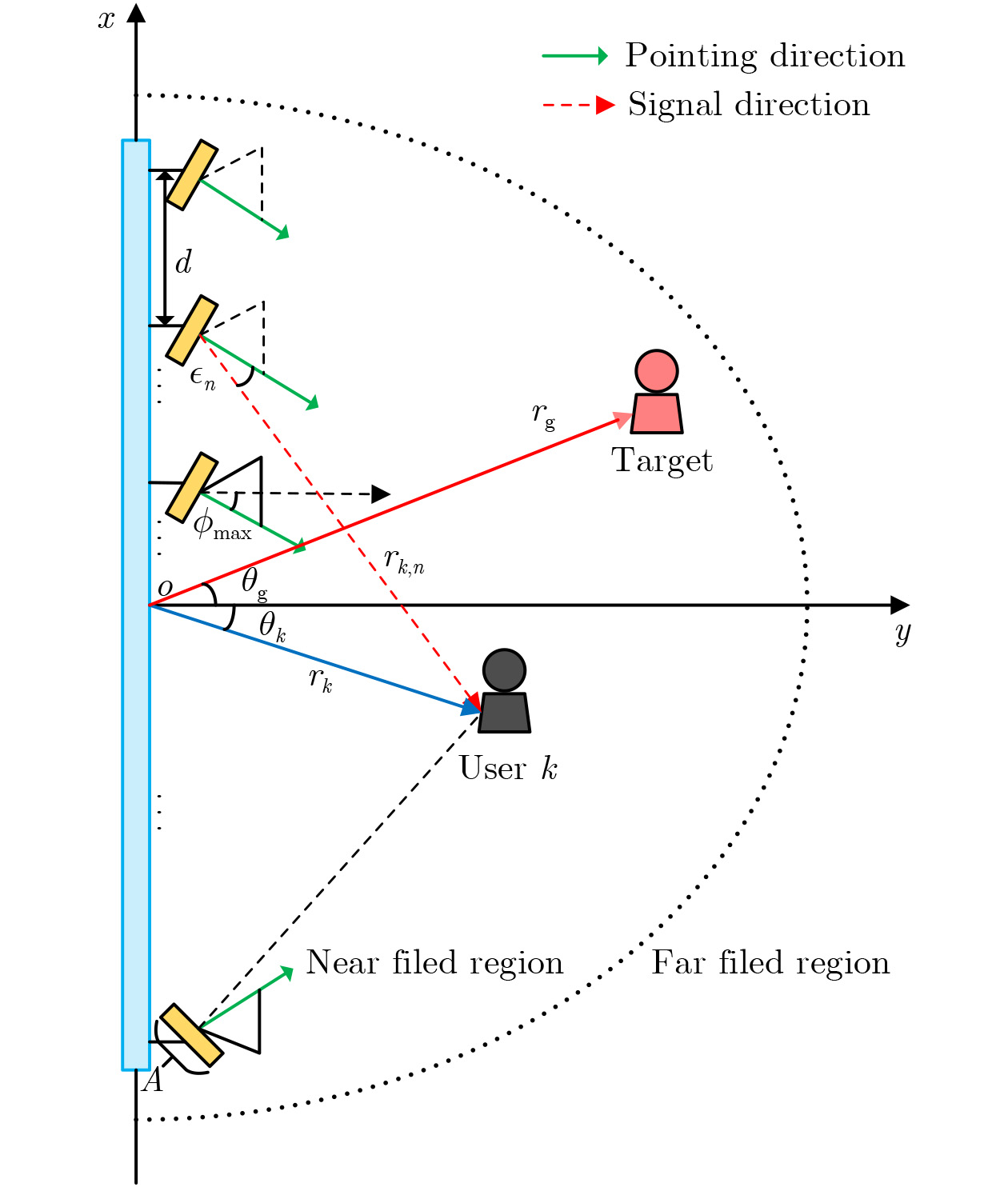
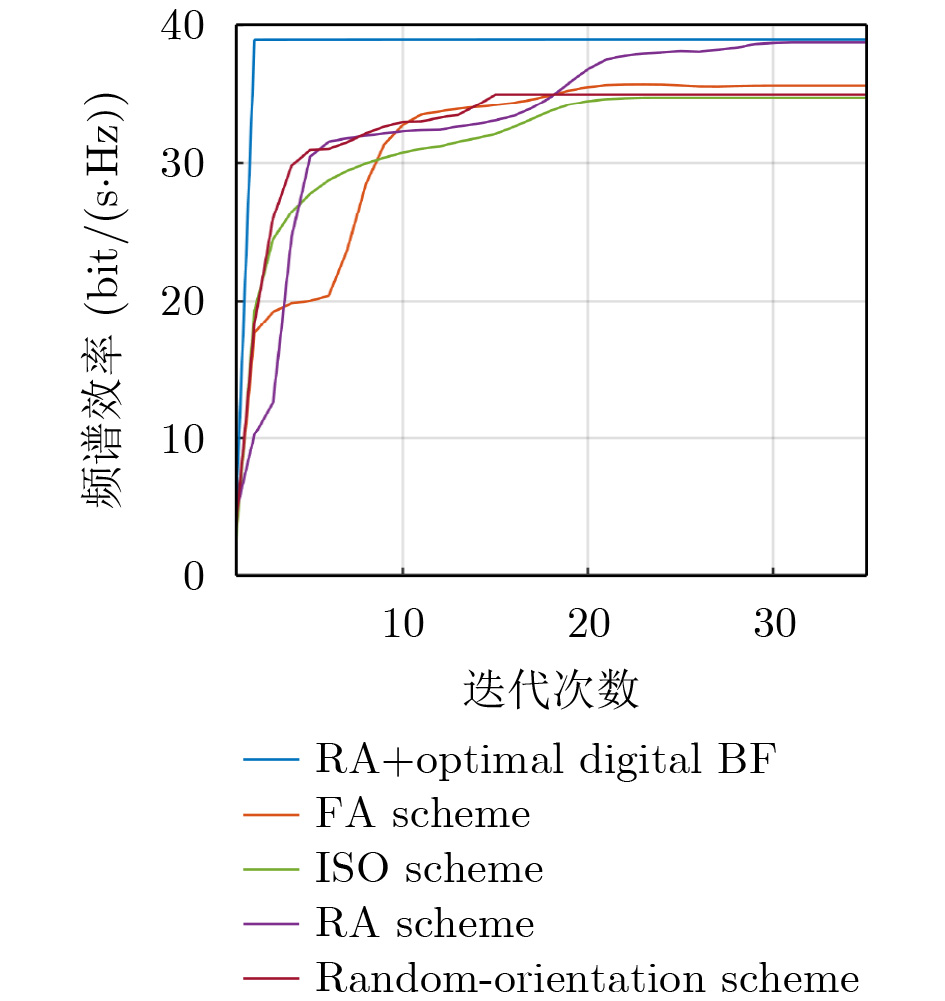
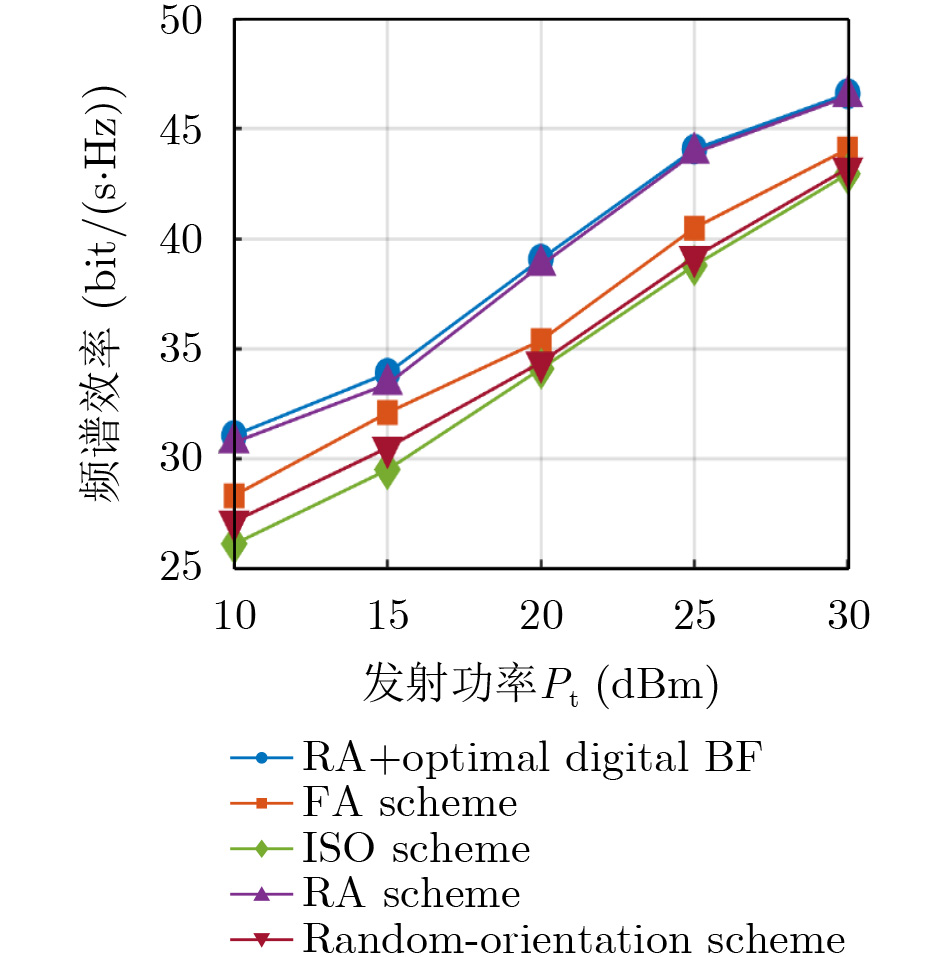
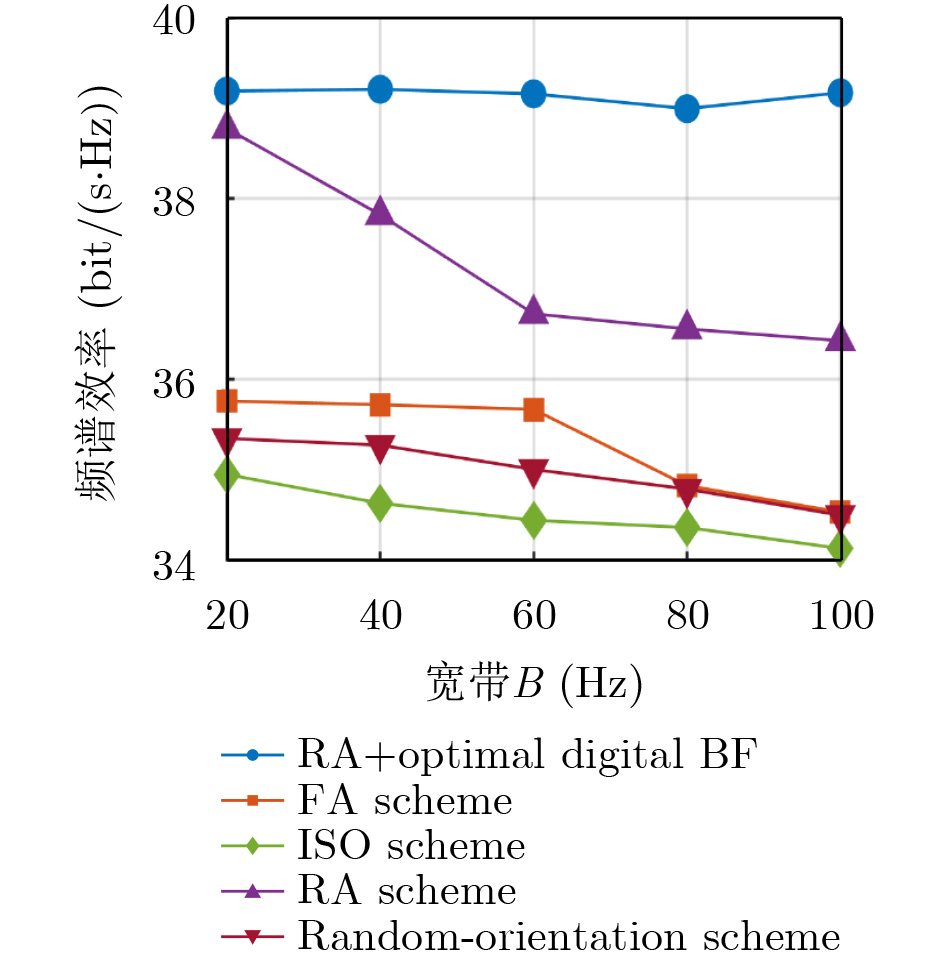
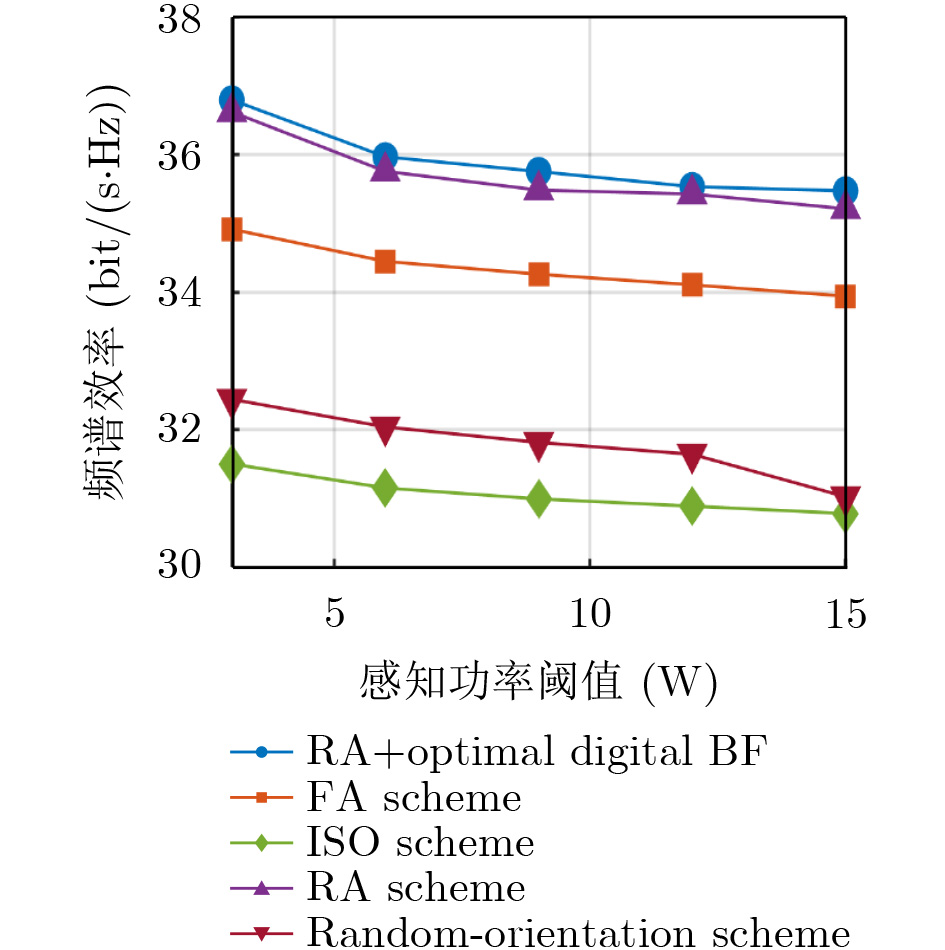
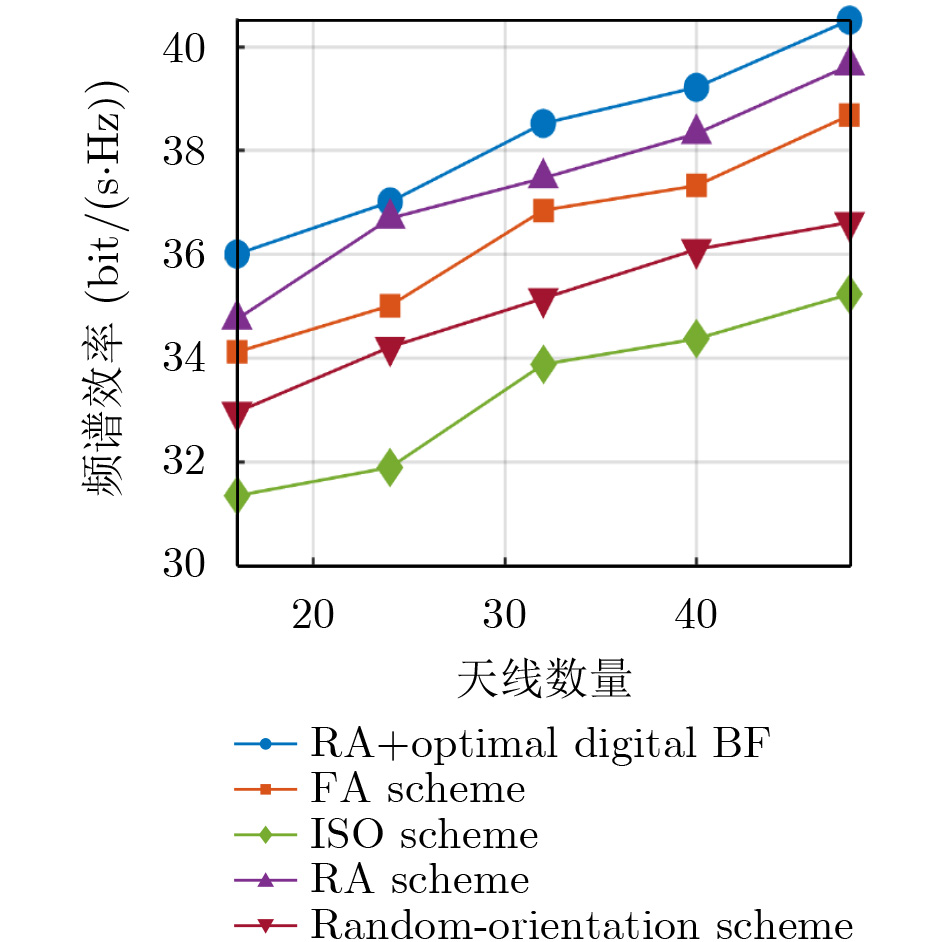
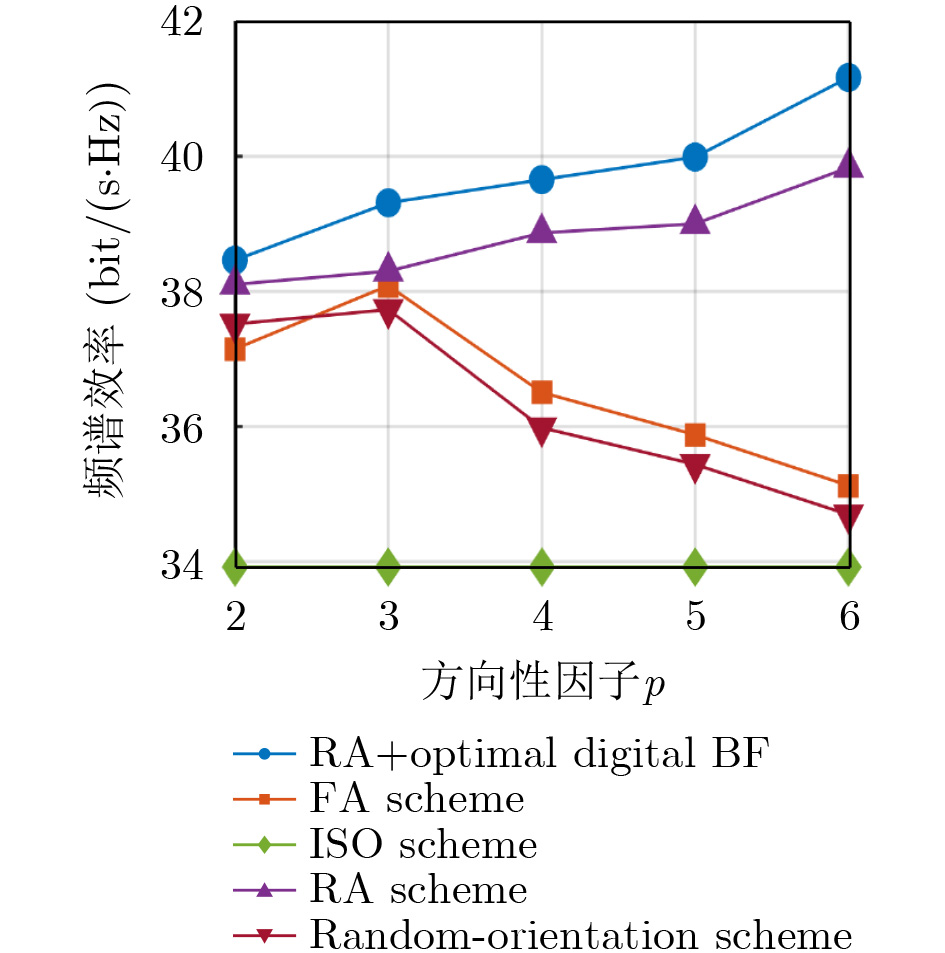
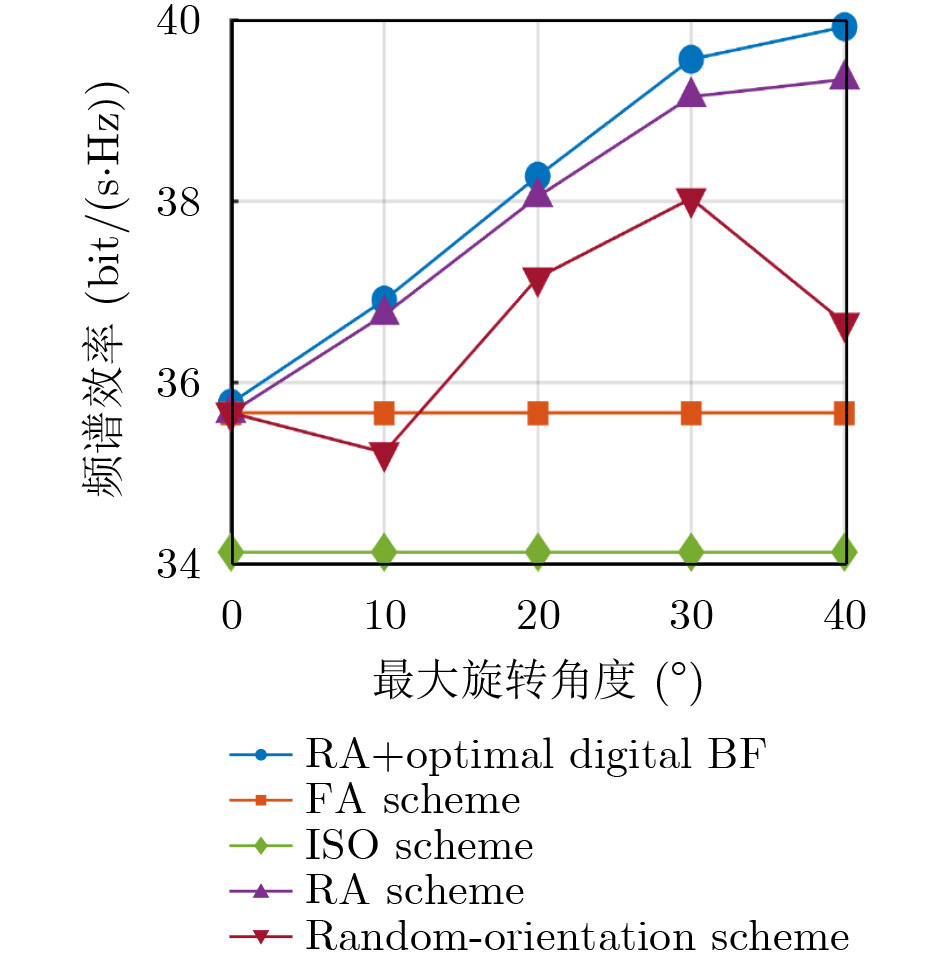
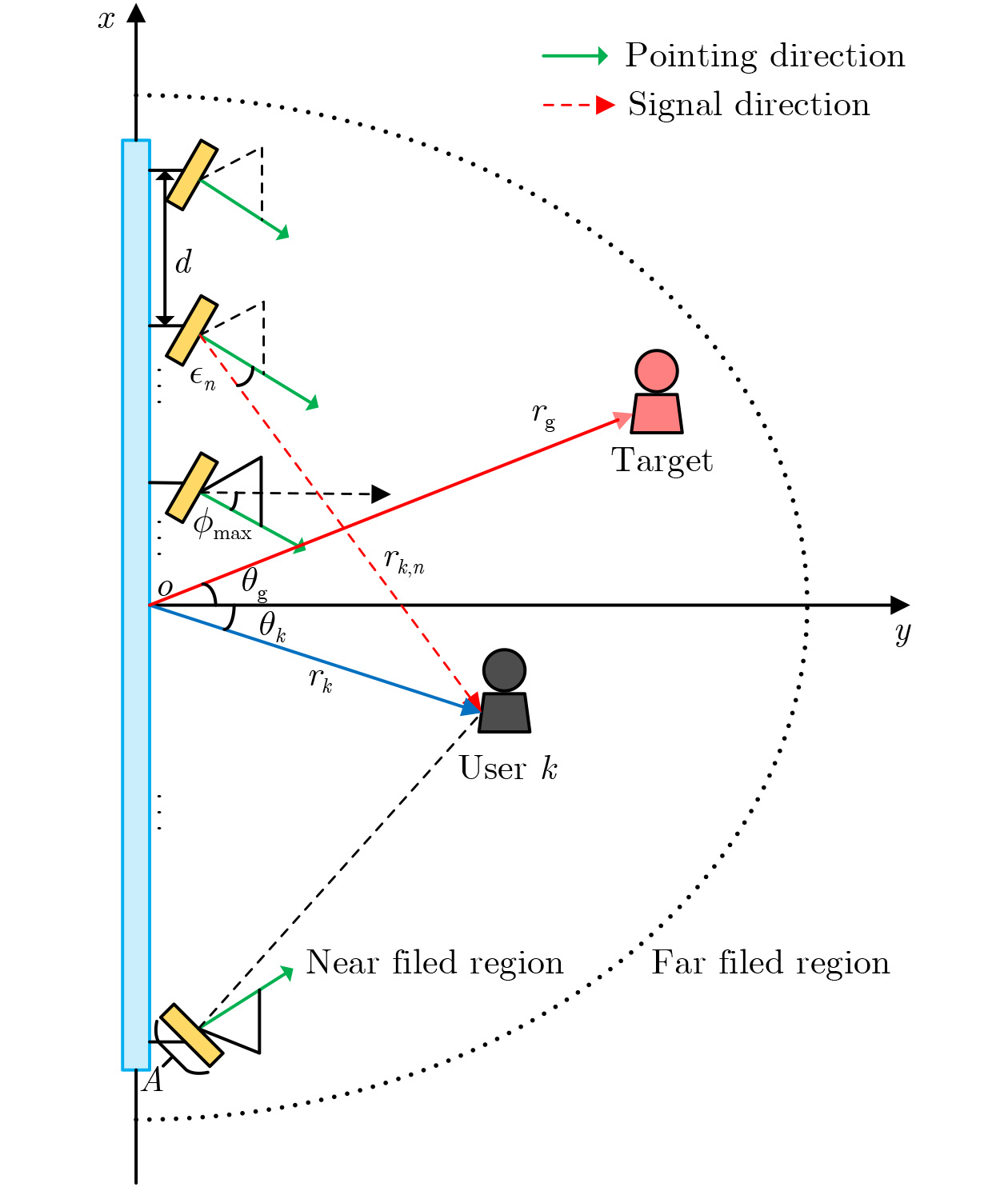
Abstract:Objective Near-field wideband Integrated Sensing and Communication (ISAC) systems face two main challenges: pronounced near-field effects and wideband beam splitting. These effects reduce communication throughput and sensing reliability, particularly when fixed-orientation antenna arrays and phase-shifter-based beamforming architectures are used. Because such architectures provide limited spatial adaptability and frequency-independent phase control, the spatial-frequency degrees of freedom available in near-field wideband channels cannot be fully used. To address this issue, a Rotatable-Antenna-assisted near-field wideband ISAC architecture is investigated to improve the system sum rate under sensing constraints. Methods A near-field wideband ISAC architecture assisted by Rotatable Antennas (RAs) is proposed. By allowing the antenna boresight direction to be adjusted mechanically or electronically, additional angular degrees of freedom are provided at the element level, which enables more flexible spatial coverage and more accurate energy focusing. A True Time Delay (TTD)-based hybrid beamforming architecture is further adopted to provide frequency-dependent phase shifts and compensate for the frequency-independent property of conventional phase shifters. Consistent beam focusing across subcarriers is thus maintained, and wideband beam splitting is effectively suppressed. Based on a spherical-wave near-field channel model that incorporates propagation distance, angular information, and the orientation gain of RAs, a joint optimization problem is formulated to maximize the system sum rate under transmit power constraints, sensing power thresholds, and antenna rotation constraints. Because the resulting problem is highly non-convex, a Penalty-Based Fully Digital Approximation (PBFDA) algorithm is developed. In each iteration, the RA orientations are first optimized by Particle Swarm Optimization (PSO) to improve the weighted channel gain. Then, with the antenna orientations fixed, a reduced-dimensional formulation with Successive Convex Approximation (SCA) is used to solve the fully digital beamforming problem. Finally, a manifold-based Block Coordinate Descent (BCD) algorithm is used to jointly optimize the analog beamformer, digital beamformer, and TTD units, so that the hybrid beamforming solution gradually approaches the fully digital solution (Algorithm 1–Algorithm 4). Results and Discussions Simulation results verify the effectiveness of the proposed RA-assisted near-field wideband ISAC framework. The proposed PBFDA algorithm converges monotonically within a limited number of iterations, which confirms its numerical stability and efficiency ( Fig. 2 ). Compared with fixed-antenna architectures, the proposed RA-assisted scheme achieves a clear improvement in system sum rate under the same transmit power constraint (Fig. 3 ). When the system bandwidth increases, the spectral efficiency of TTD-based hybrid beamforming decreases because the limited number of TTD units and the restricted maximum delay weaken frequency-dependent compensation and aggravate beam splitting. By contrast, the optimal fully digital beamforming scheme maintains nearly unchanged spectral efficiency because each subcarrier can be controlled accurately (Fig. 4 ). When the sensing power threshold increases, the achievable sum rate decreases for all schemes, which reflects the trade-off between communication and sensing. The proposed method, however, consistently outperforms the benchmark schemes (Fig. 5 ). The effects of antenna number, antenna directivity factor, and maximum rotation angle are also evaluated. Spectral efficiency increases with the number of antennas because of the higher array gain (Fig. 6 ). As the antenna directivity factor increases, the RA-assisted system attains further gains through adaptive orientation, whereas fixed-orientation and isotropic schemes degrade (Fig. 7 ). A larger allowable rotation range also provides greater spatial alignment flexibility and further improves system performance (Fig. 8 ). Overall, the proposed architecture improves near-field energy focusing and achieves performance close to that of fully digital beamforming with lower hardware complexity.Conclusions A Rotatable-Antenna-assisted near-field wideband ISAC system with a TTD-based fully connected hybrid beamforming architecture is investigated. By jointly using antenna rotation and true time delay, the proposed framework effectively mitigates near-field effects and wideband beam splitting. The developed PBFDA algorithm solves the resulting highly non-convex optimization problem efficiently. Numerical results show that the proposed scheme significantly improves the system sum rate under sensing constraints and approaches the performance of fully digital beamforming, which supports its use in near-field wideband ISAC systems. -
2 求解最优全数字波束的算法
1:初始化$ t \leftarrow 0, {\boldsymbol{\varOmega}}^{(t)} \leftarrow {\boldsymbol{\varOmega}}^{(0)}, \tau, T_{\max} $; 2:重复 3: t$ \leftarrow t + 1 $ 4: 根据式(26)、式(27)更新$ \mu^{(t)} $, $\lambda^{(t)} $ 5: 求解式(25)关于${\boldsymbol{\varOmega}}^{(t)} $的子问题,更新${\boldsymbol{\varOmega}}^{(t)} $ 6:直到:问题(25)的目标函数值的相对变化量小于$\tau $或达到最大
迭代次数$ T_{\max} $7:返回${\boldsymbol{\varOmega}}^* = {\boldsymbol{\varOmega}}^{(t)}, \mu^* = \mu^{(t)}, \lambda^* = \lambda^{(t)} $  下载: 导出CSV
4 用于求解问题式(13)的罚函数法
1: 初始化矩阵FRF, Tm, Vm, Wm, F,以及参数0<e<1, ρ>0; 2: 重复 3: 重复 4: 利用算法1更新F 5: 利用算法2和式(28)更新Wm 6: for i = 1:L 7: 利用算法3更新矩阵FRF 8: 利用式(36)更新矩阵Tm 9: 利用式(37)更新FBB,m 10: end for 11: 直到:问题式(14)的目标函数值的相对变化量小于τ 或达
到最大迭代次数Tmax12: 将惩罚因子更新为ρ = eρ 13: 直到:罚函数值小于设定的阈值; 14: 缩放数字波束$ {\boldsymbol{F}}_{{\mathrm{BB}},m} = \dfrac{P_{\mathrm{t}}}{\|{\boldsymbol{W}}_m - {\boldsymbol{F}}_{{\mathrm{RF}}}{\boldsymbol{T}}_m{\boldsymbol{F}}_{{\mathrm{BB}},m} \|_{\mathrm{F}}^2} {\boldsymbol{F}}_{{\mathrm{BB}},m} $
下载: 导出CSV
1 PSO求解指向矩阵F
1: 初始化: $\{{\boldsymbol{\theta}}_i^{(0)}, {\boldsymbol{\psi}}_i^{(0)}\}_{i=1}^S, \alpha_{\max}, \alpha_{\min}, \beta_1, \beta_2, \xi_1, \xi_2, T $; 2: ${\boldsymbol{\theta}}_i^* = {\boldsymbol{\theta}}_i^{(0)}, {\boldsymbol{\theta}}^{\mathrm{best}} = {\boldsymbol{\theta}}_{{\mathrm{arg}} \mathop{\mathrm{max}}\limits_{P=1,2,\cdots,S} J({\boldsymbol{\theta}}_i^*)}' $ 3: for t=1:T 4: $\alpha = \alpha_{\max} - (\alpha_{\max} - \alpha_{\min}) t/T $; 5: for i=1:S 6: ${\boldsymbol{\psi}}_i^{(t)} = \alpha{\boldsymbol{\psi}}_i^{(t-1)} + \beta_1\xi_1({\boldsymbol{\theta}}_i^* - {\boldsymbol{\theta}}_i^{(t-1)}) +$
$ \beta_2\xi_2({\boldsymbol{\theta}}^{{\mathrm{best}}} - {\boldsymbol{\theta}}_i^{(t-1)}); $7: ${\boldsymbol{\theta}}_i^{(t)} = {\boldsymbol{\theta}}_i^{(t-1) }+ {\boldsymbol{\psi}}_i^{(t)}; $ 8: 通过式(23)对${\boldsymbol{\theta}}_i^{(t)} $投影修正以满足约束式(13f); 9: if $ J({\boldsymbol{\theta}}_i^{(t)}) \gt J({\boldsymbol{\theta}}_i^*) $, ${\boldsymbol{\theta}}_i^* = {\boldsymbol{\theta}}_i^{(t)} $; 10: end for 11: ${\boldsymbol{\theta}}^{\mathrm{best}} = {\boldsymbol{\theta}}_{{\mathrm{arg}} \mathop{\mathrm{max}}\limits_{i=1,2,\cdots,S} J({\boldsymbol{\theta}}_i^*)}' $ 12: end for 13: 输出:通过${\boldsymbol{\theta}}^{\mathrm{best}} $构造指向矩阵F。
下载: 导出CSV
3 黎曼流形求解模拟波束赋形器$\mathbf{F}_{{\mathrm{RF}}} $
1:初始化:$\{ \mathbf{W}_m \}_{m=1}^M, \{ \mathbf{F}_{{\mathrm{BB}},m} \}_{m=1}^M, \eta, \xi, i = 0, I $ 2:$ {\boldsymbol{\varPhi}}_0 = \mathbf{F}_{{\mathrm{RF}}}, {\boldsymbol{\varDelta}}_0 = -\text{ grad } F({\boldsymbol{\varPhi}}_0) $ 3:for $i = 1 : I $ 4: ${\boldsymbol{\varPhi}}_i = ({\boldsymbol{\varPhi}}_{i-1} + \eta {\boldsymbol{\varDelta}}_{i-1}) \oslash |{\boldsymbol{\varPhi}}_{i-1} + \eta {\boldsymbol{\varDelta}}_{i-1}| $ 5: ${\boldsymbol{\varPhi}}_i = {\boldsymbol{\varPhi}}_i \circ {\boldsymbol{\varPhi}}_{\text{ref}} $ 6: $\mathbf{C}_{i-1} = {\boldsymbol{\varDelta}}_{i-1} - \Re({\boldsymbol{\varDelta}}_{i-1} \circ {\boldsymbol{\varPhi}}_i^*) \circ {\boldsymbol{\varPhi}}_i $ 7: ${\boldsymbol{\varDelta}}_i = \xi \mathbf{C}_{i-1} - \text{grad } F({\boldsymbol{\varPhi}}_i) $ 8:end for 9:输出:$\mathbf{F}_{{\mathrm{RF}}} = {\boldsymbol{\varPhi}}_I $
下载: 导出CSV
表 1 仿真参数
参数名称 符号 数值 参数名称 符号 数值 基站天线数 $ N $ 32 天线间距 $ d $ $ {\lambda }_{\text{c}}/2 $ 射频链路数 $ {N}_{\text{RF}} $ 4 TTD数量 $ {N}_{\text{T}} $ 8 载波中心频率 $ {f}_{\text{c}} $ 2.4 GHz TTD最大时延 $ {t}_{\max } $ $ N/(2{f}_{\text{c}})\approx 6.67 $ ns 系统带宽 $ B $ 80 MHz 最大旋转角度 $ {\phi }_{\max } $ $ \text{π} /6 $ 子载波数 $ M $ 6 用户/目标数 $ K $/ - 4 / 1 循环前缀长度 $ {L}_{\text{CP}} $ 4 用户距离范围 - 5 $ \sim $ 10 m 非视距路径数 $ {L}_{k} $ 2 噪声功率 $ \sigma _{m,k}^{2} $ –80 dBm 方向性因子 $ p $ 4 单天线尺寸 $ A $ $ \lambda _{\text{c}}^{2}/4\text{π} $ 单载波最大发射功率 $ {P}_{\text{t}} $ 20 dBm 感知功率阈值 $ {P}_{0} $ 3 W 收敛阈值 $ \epsilon $ 10–6 惩罚因子 $ \rho $ 103 缩减系数 $ e $ 0.5 一维搜索精度 $ Q $ 103 最大/最小惯性系数 $ {\alpha }_{\max } $/$ {\alpha }_{\min } $ 0.9/0.4 学习因子 $ {\beta }_{1} $/$ {\beta }_{2} $ 2 更新次数/粒子数量 $ T $/$ S $ 500/50 PSO惩罚因子 $ \lambda $ 500
下载: 导出CSV
-
[1] SHAMEER M and RUTRAVIGNESHWARAN P. A comprehensive survey of IoT security, trust models, and cloud-based solutions for ensuring a secure connected future[C]. The 2024 International Conference on Computing and Intelligent Reality Technologies (ICCIRT), Coimbatore, India, 2024: 11–16. doi: 10.1109/ICCIRT59484.2024.10921791. [2] QU Kaiqian, GUO Shuaishuai, SAEED N, et al. Near-field integrated sensing and communication: Performance analysis and beamforming design[J]. IEEE Open Journal of the Communications Society, 2024, 5: 6353–6366. doi: 10.1109/OJCOMS.2024.3470844. [3] 林粤伟, 张奇勋, 尉志青, 等. 通信感知一体化硬件设计——现状与展望[J]. 电子与信息学报, 2025, 47(1): 1–21. doi: 10.11999/JEIT240012.LIN Yuewei, ZHANG Qixun, WEI Zhiqing, et al. Status and prospect of hardware design on integrated sensing and communication[J]. Journal of Electronics & Information Technology, 2025, 47(1): 1–21. doi: 10.11999/JEIT240012. [4] WANG Xiangrong, ZHAI Weitong, WANG Xianghua, et al. Wideband near-field integrated sensing and communications: A hybrid precoding perspective[J]. IEEE Signal Processing Magazine, 2025, 42(1): 88–105. doi: 10.1109/MSP.2024.3496396. [5] 褚宏云, 杨梦瑶, 黄航, 等. 混合智能反射面辅助的通信感知一体化: 高能效波束成形设计[J]. 电子与信息学报, 2024, 46(6): 2462–2469. doi: 10.11999/JEIT230699.CHU Hongyun, YANG Mengyao, HUANG Hang, et al. Hybrid reconfigurable intelligent surface assisted integrated sensing and communication: Energy efficient beamforming design[J]. Journal of Electronics & Information Technology, 2024, 46(6): 2462–2469. doi: 10.11999/JEIT230699. [6] WANG Xiangrong, ZHAI Weitong, WANG Xianghua, et al. Wideband near-field integrated sensing and communication with sparse transceiver design[J]. IEEE Journal of Selected Topics in Signal Processing, 2024, 18(4): 662–677. doi: 10.1109/JSTSP.2024.3394970. [7] 张若愚, 任红, 陈光毅, 等. MIMO雷达通信一体化: 波束图增益最大化波束成形设计[J]. 电子与信息学报, 2025, 47(3): 687–695. doi: 10.11999/JEIT240631.ZHANG Ruoyu, REN Hong, CHEN Guangyi, et al. MIMO dual-functional radar-communication: Beampattern gain maximization beamforming design[J]. Journal of Electronics & Information Technology, 2025, 47(3): 687–695. doi: 10.11999/JEIT240631. [8] GAO Zhen, WAN Ziwei, ZHENG Dezhi, et al. Integrated sensing and communication with mmWave massive MIMO: A compressed sampling perspective[J]. IEEE Transactions on Wireless Communications, 2023, 22(3): 1745–1762. doi: 10.1109/TWC.2022.3206614. [9] CONG Jiayi, YOU Changsheng, LI Jiapeng, et al. Near-field integrated sensing and communication: Opportunities and challenges[J]. IEEE Wireless Communications, 2024, 31(6): 162–169. doi: 10.1109/MWC.002.2400033. [10] WANG Zhaolin, MU Xidong, and LIU Yuanwei. Beamfocusing optimization for near-field wideband multi-user communications[J]. IEEE Transactions on Communications, 2025, 73(1): 555–572. doi: 10.1109/TCOMM.2024.3424244. [11] WANG Zhaolin, MU Xidong, LIU Yuanwei, et al. TTD configurations for near-field beamforming: Parallel, serial, or hybrid?[J]. IEEE Transactions on Communications, 2024, 72(6): 3783–3799. doi: 10.1109/TCOMM.2024.3370832. [12] ELBIR A M, CELIK A, and ELTAWIL A M. Near-field hybrid beamforming for terahertz-band integrated sensing and communications[C]. The 2023 IEEE Globecom Workshops (GC Wkshps), Kuala Lumpur, Malaysia, 2023: 1117–1122. doi: 10.1109/GCWkshps58843.2023.10464709. [13] LUO Hongliang, GAO Feifei, YUAN Wanmai, et al. Beam squint assisted user localization in near-field integrated sensing and communications systems[J]. IEEE Transactions on Wireless Communications, 2024, 23(5): 4504–4517. doi: 10.1109/TWC.2023.3319474. [14] NEW W K, WONG K K, XU Hao, et al. A tutorial on fluid antenna system for 6G networks: Encompassing communication theory, optimization methods and hardware designs[J]. IEEE Communications Surveys & Tutorials, 2025, 27(4): 2325–2377. doi: 10.1109/COMST.2024.3498855. [15] WONG K K, SHOJAEIFARD A, TONG K F, et al. Fluid antenna systems[J]. IEEE Transactions on Wireless Communications, 2021, 20(3): 1950–1962. doi: 10.1109/TWC.2020.3037595. [16] ZHU Lipeng, MA Wenyan, and ZHANG Rui. Modeling and performance analysis for movable antenna enabled wireless communications[J]. IEEE Transactions on Wireless Communications, 2024, 23(6): 6234–6250. doi: 10.1109/TWC.2023.3330887. [17] WU Qingjie, ZHENG Beixiong, MA Tiantian, et al. Modeling and optimization for rotatable antenna enabled wireless communication[C]. The ICC 2025-IEEE International Conference on Communications, Montreal, Canada, 2025: 1055–1060. doi: 10.1109/ICC52391.2025.11161853. [18] LIU Yuanwei, WANG Zhaolin, XU Jiaqi, et al. Near-field communications: A tutorial review[J]. IEEE Open Journal of the Communications Society, 2023, 4: 1999–2049. doi: 10.1109/OJCOMS.2023.3305583. [19] HE Xiuli, XU Hongbo, ZHANG Guoping, et al. RIS-assisted joint near-field channel estimation and beamforming design based on deep unfolding[J]. IEEE Transactions on Vehicular Technology, 2026, 75(3): 4411–4423. doi: 10.1109/TVT.2025.3612046. -

 下载:
下载:

图(8) / 表(5)
计量
- 文章访问数: 827
- HTML全文浏览量: 288
- PDF下载量: 100
- 被引次数: 0
