




Multipath Scheduling Algorithm for UAV Video Streaming
-
摘要: 在无人机实时视频流传输场景中,可利用多路径传输协议的带宽聚合优势提升视频体验质量(QoE)。针对该协议在无人机网络环境下面临的动态异构挑战,该文提出一种基于神经置信上界(NeuralUCB)算法的多路径调度框架NeuroFly。首先,将多路径流量调度建模为上下文多臂老虎机(CMAB)问题。然后,基于NeuralUCB设计在线学习策略:融合多维度异构特征构建上下文空间,引入帧优先级驱动的冗余传输机制构建动作空间,并结合多目标奖励函数设计,实现动态异构网络下的自适应流量调度。此外,还设计一种上下文监控机制,能够实时检测上下文分布变化并适时重启学习过程,以提升NeuroFly对环境突变的应对能力。最后,仿真和野外环境下的实验结果表明,与现有先进调度算法和传输方案相比,NeuroFly第99百分位延迟降低19.9%~51.0%,并在多项视频QoE指标上取得显著领先:平均视频帧率提升最高达24.6%,图像结构相似性提升最高达49.2%,缓冲时间占比减少13.4%~77.6%,证明其在无人机动态异构网络下具有更为出色的持续传输优化能力,能够有效降低传输延迟并提升视频QoE。Abstract:
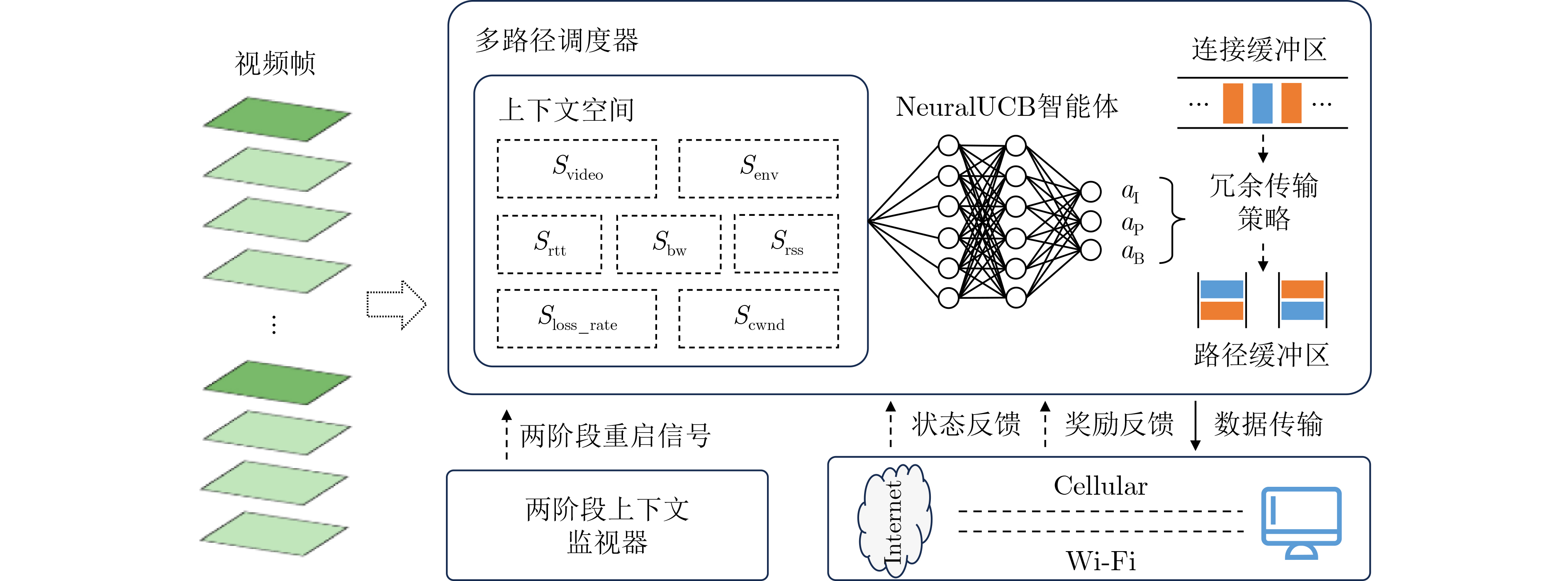
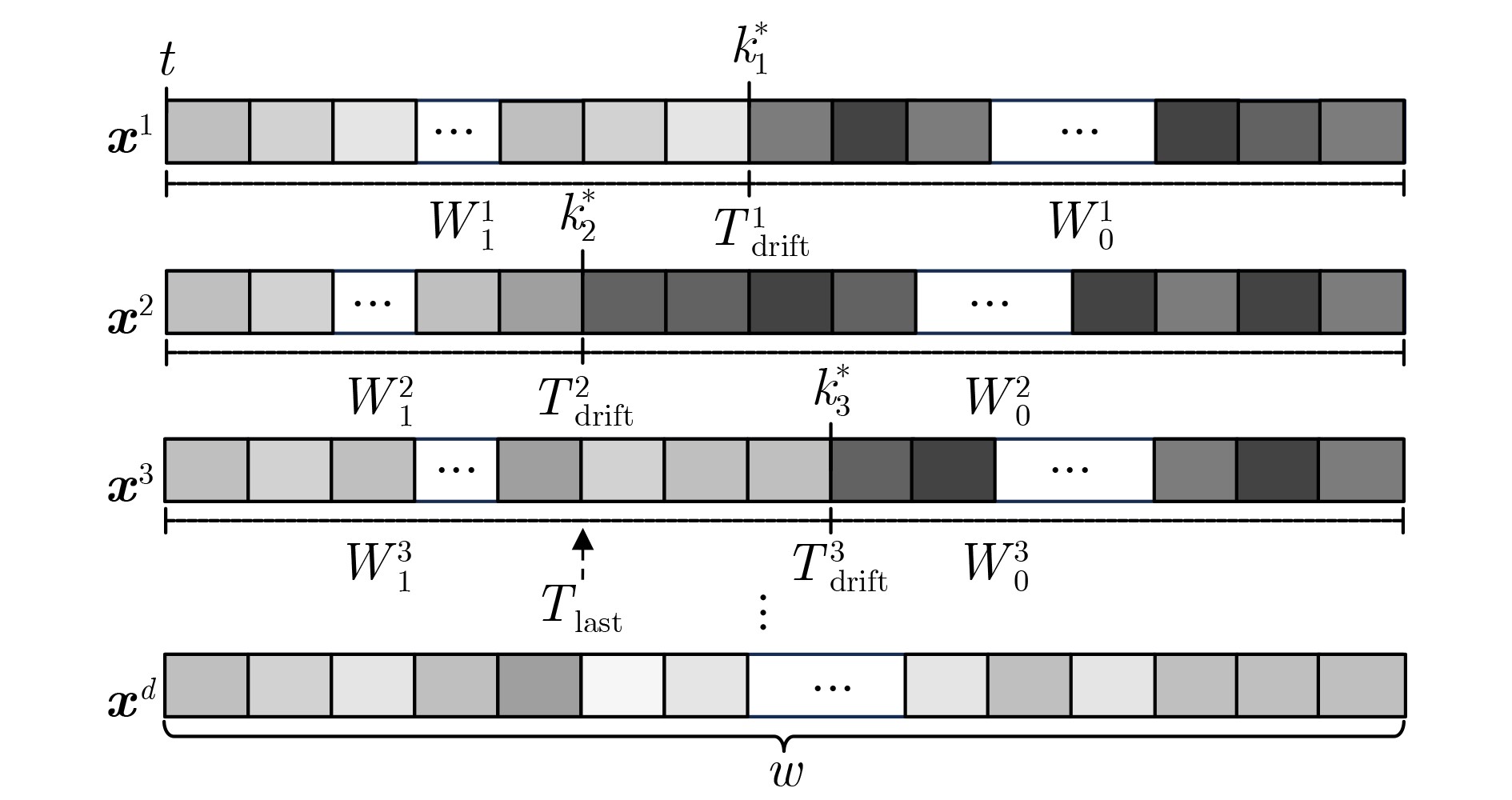
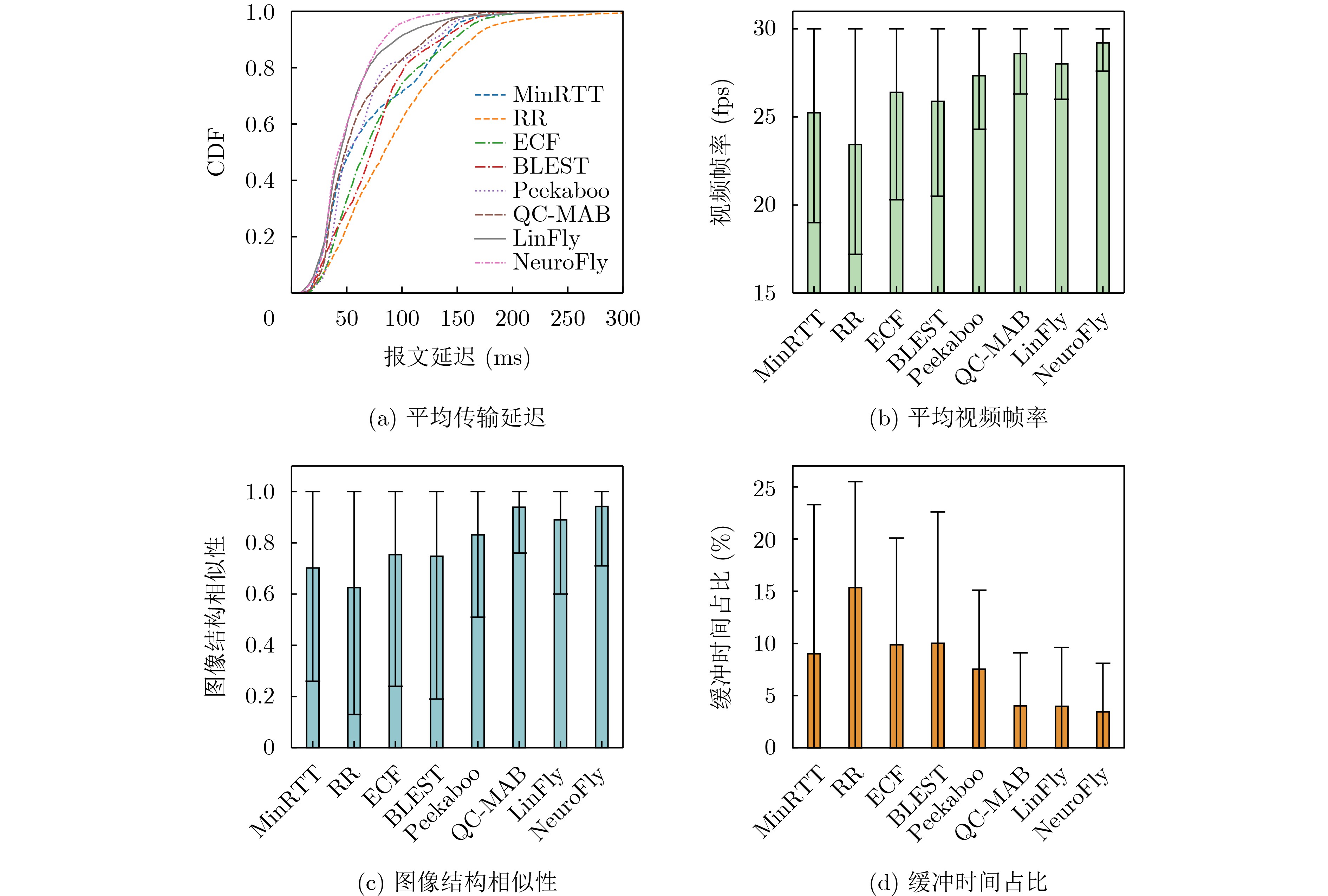
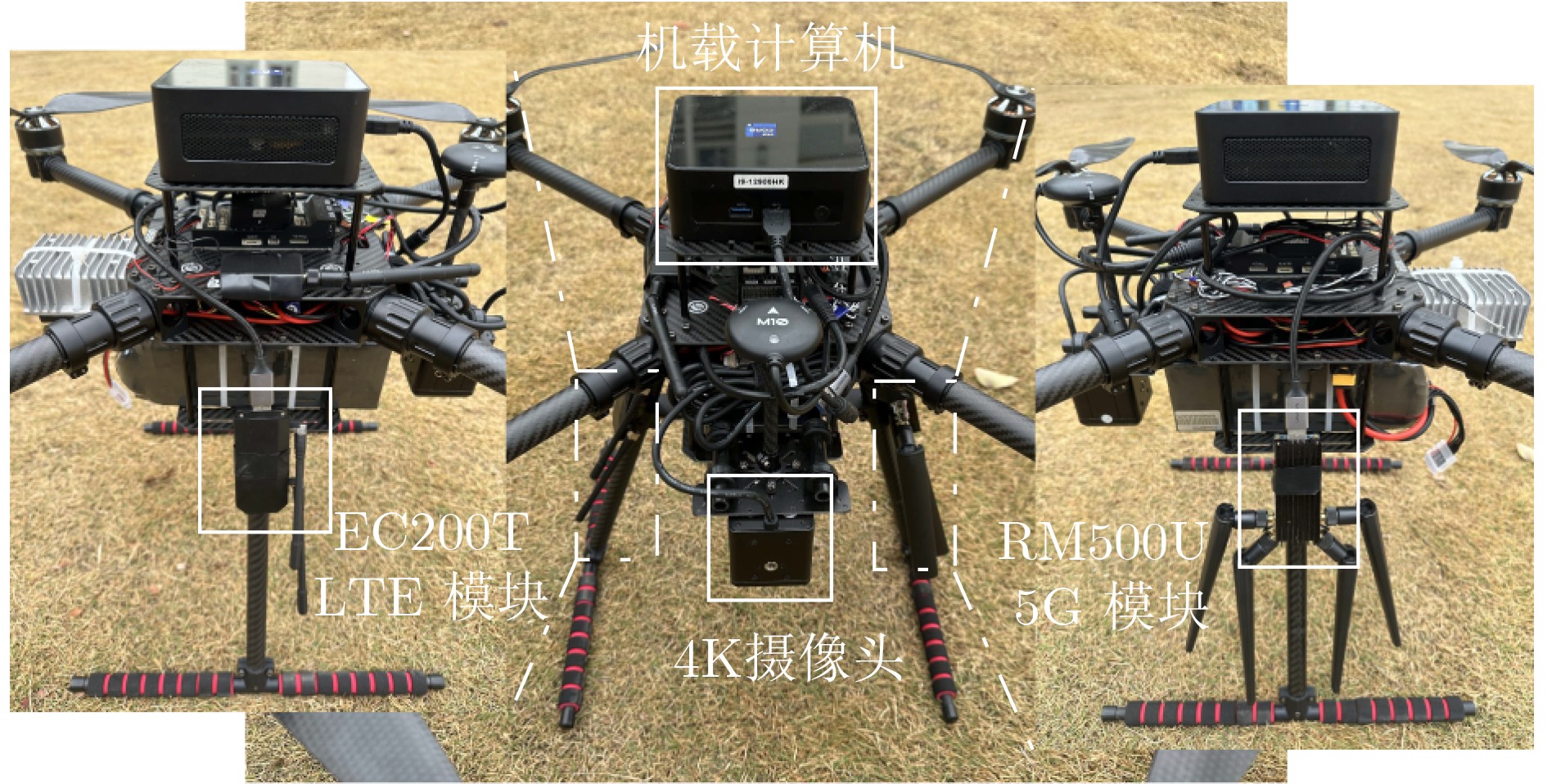
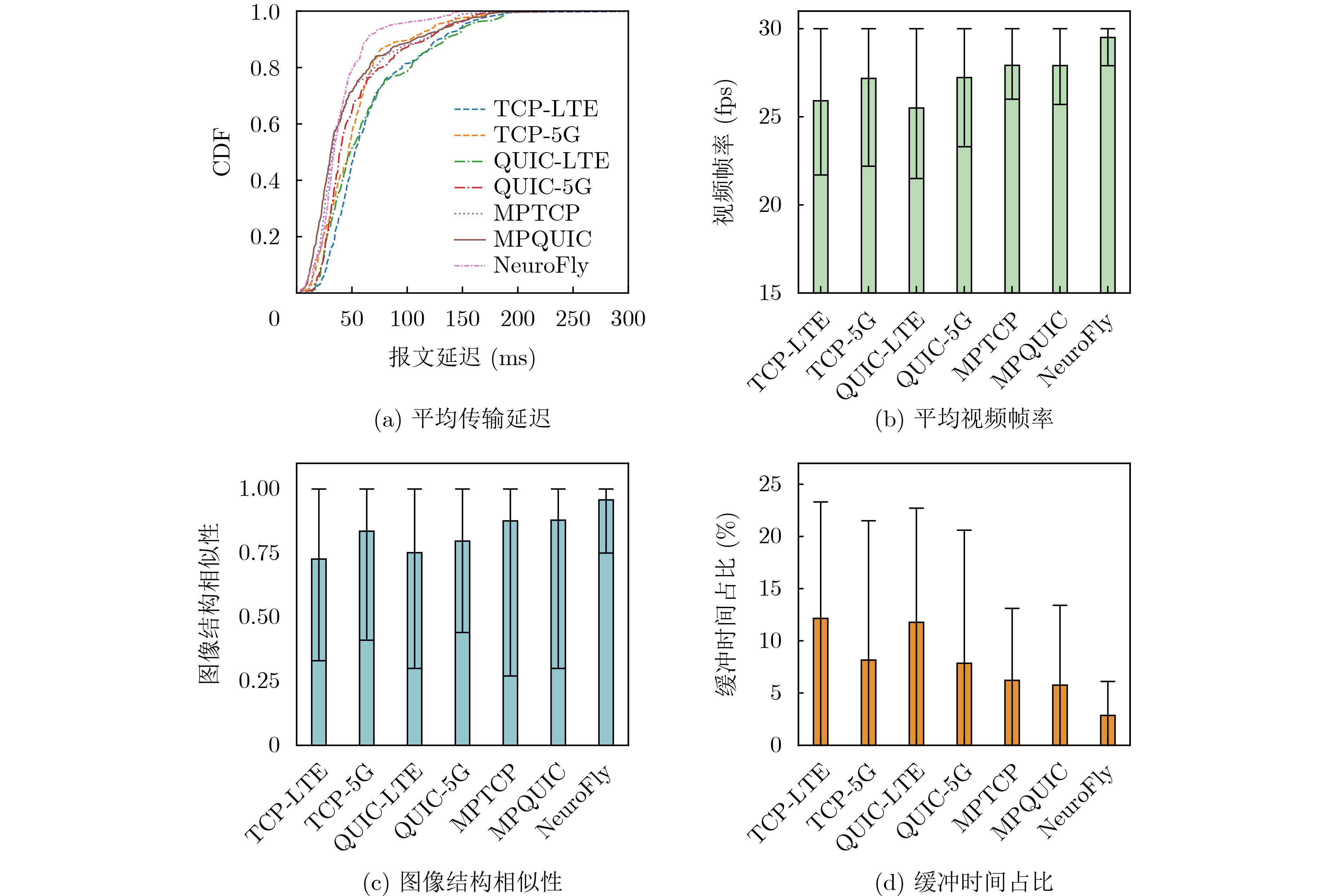
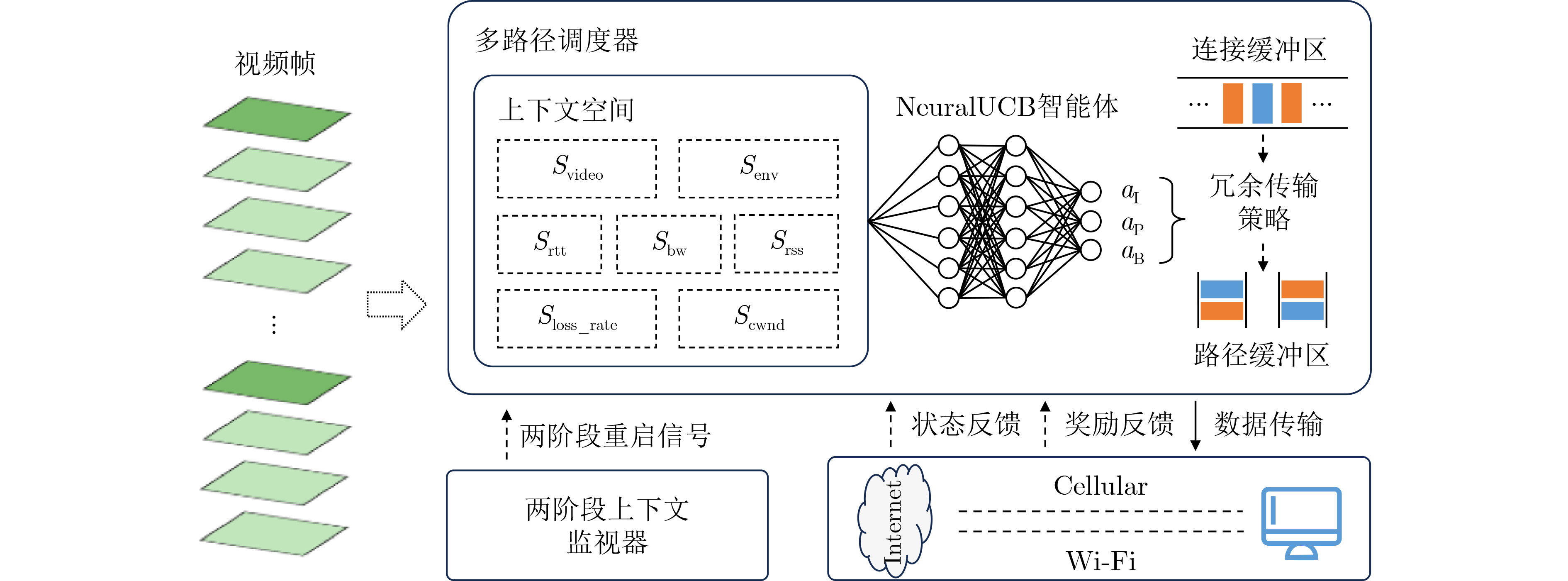
Objective With the rapid growth of the low-altitude economy, Unmanned Aerial Vehicle (UAV) technology has been widely used in emergency rescue, disaster monitoring, urban security, and other applications. In these scenarios, stable, low-latency, and high-fidelity video backhaul is critical for task execution. Multipath transport protocols can improve Quality of Experience (QoE) through bandwidth aggregation, providing an effective basis for UAV video streaming. However, under dynamic and heterogeneous network conditions, the performance of multipath transport protocols depends strongly on the design of multipath scheduling algorithms. Existing heuristic schedulers use predefined rules to reduce head-of-line blocking and inter-path load imbalance, but their adaptability remains limited in highly dynamic environments. Learning-based schedulers can learn the mapping between network states and scheduling rewards from real-time feedback, enabling adaptive performance optimization. However, most existing learning-based schedulers are designed for general network scenarios. They are not optimized for UAV networks, and their ability to guarantee QoE has not been fully validated. A multipath scheduling algorithm tailored to UAV video streaming is therefore needed to better exploit the performance potential of multipath transport protocols. Methods To address the dynamic and heterogeneous challenges of UAV video streaming, this paper proposes NeuroFly, a multipath scheduling framework based on the NeuralUCB algorithm. In NeuroFly, multipath traffic scheduling is formulated as a Contextual Multi-Armed Bandit (CMAB) problem. The context space is constructed by integrating path state information, video encoding features, and UAV mobility parameters, which jointly characterize the current transmission environment. In the action space, a frame-priority-driven redundant transmission mechanism is proposed. Video frames are assigned different frame priorities according to decoding dependencies, and differentiated redundancy strategies are used to improve the probability of successful video-frame delivery. A multi-objective reward function is further designed to guide policy learning and support adaptive optimization under dynamic and heterogeneous network conditions. In addition, a context monitoring mechanism is integrated into NeuroFly to handle abrupt environmental changes caused by high UAV mobility. This mechanism detects context distribution shifts and triggers a two-stage restart strategy. A soft restart is activated when gradual context drift is detected, removing outdated historical experience. A hard restart is performed under abrupt context changes by clearing the experience replay buffer and reinitializing model parameters, allowing learning to restart under a new distribution. Results and Discussions The proposed NeuroFly framework is evaluated in both simulation and field environments. First, Mininet-WiFi is used to simulate realistic UAV network environments and evaluate overall QoE performance. The results ( Fig. 4 ) show that, compared with state-of-the-art heuristic and learning-based schedulers, NeuroFly achieves broad performance gains by fully using aggregated multipath bandwidth. Specifically, the 99th-percentile latency is reduced by 19.9%~51.0%, the average video frame rate is increased by up to 24.6%, image structural similarity is improved by up to 49.2%, and the buffering time ratio is reduced by 13.4%~77.6%. These results demonstrate the strong ability of NeuroFly to guarantee QoE. Field experiments (Fig. 6 ) further confirm that NeuroFly provides favorable optimization in real UAV operation scenarios. Compared with mainstream transport solutions widely deployed in production environments, NeuroFly achieves better real-time transmission performance and shows strong practical applicability for future large-scale UAV deployment.Conclusions This paper addresses network dynamics, path heterogeneity, and time-varying transmission conditions in UAV video streaming over multipath transport protocols. An intelligent multipath scheduling framework, NeuroFly, is proposed based on the NeuralUCB algorithm. In this framework, multipath traffic scheduling is modeled as a CMAB problem. Through the design of the context space, action space, and multi-objective reward function, online learning and adaptive optimization of traffic allocation policies are achieved. To further improve robustness under severe environmental changes, a lightweight context monitoring mechanism is introduced to detect context distribution drift and restart the learning process when needed. Systematic evaluations are conducted on both simulation platforms and real UAV operation environments. The simulation results show that NeuroFly achieves consistent improvements across QoE metrics compared with state-of-the-art heuristic and learning-based schedulers. The field results further indicate that NeuroFly provides reliable guarantees in actual UAV operation scenarios when compared with mature solutions that have been widely deployed in production environments. These results validate the practicality, robustness, and engineering feasibility of NeuroFly, and suggest its potential for large-scale deployment in UAV applications that are sensitive to real-time video quality, including emergency response, power inspection, agricultural monitoring, and logistics delivery. -
1 NeuroFly多路径调度算法
输入:调度周期持续时间$ {T}_{\text{S}} $,冗余粒度参数$ K $ 输出:冗余率决策 (1) 初始化:神经网络参数$ {{\boldsymbol{\theta}} }_{0} $,经验回放池$ M $ (2) for 时间步$ t=1,2,\cdots,T $ do (3) 获取当前上下文观测$ \{{\boldsymbol{x}}_{t,{{{a}}_{i}}}\}_{i=0}^{K} $ (4) for each $ a\in \mathcal{A}=\{{{a}}_{0},{{a}}_{1},\cdots ,{{a}}_{K}\} $ do (5) 计算动作$ {a} $的置信上界$ U_t^{{a}} $ (6) 令动作$ {a}_t=\mathrm{arg}\max_{{a}\in\mathcal{A}}U_t^{{a}} $ (7) end for (8) 执行动作$ {a}_t $,开始冗余传输 (9) 在调度周期结束时刻计算奖励$ {r}_{t} $ (10) 将样本$ \left\langle {\boldsymbol{x}}_{t,{{{a}}_{t}}},{r}_{t}\right\rangle $存入经验回放池$ M $ (11) 从$ M $中随机采样一个批次的历史经验 (12) 通过随机梯度下降更新网络参数$ {{\boldsymbol{\theta}} }_{t} $ (13) end for  下载: 导出CSV
表 1 基础路径配置
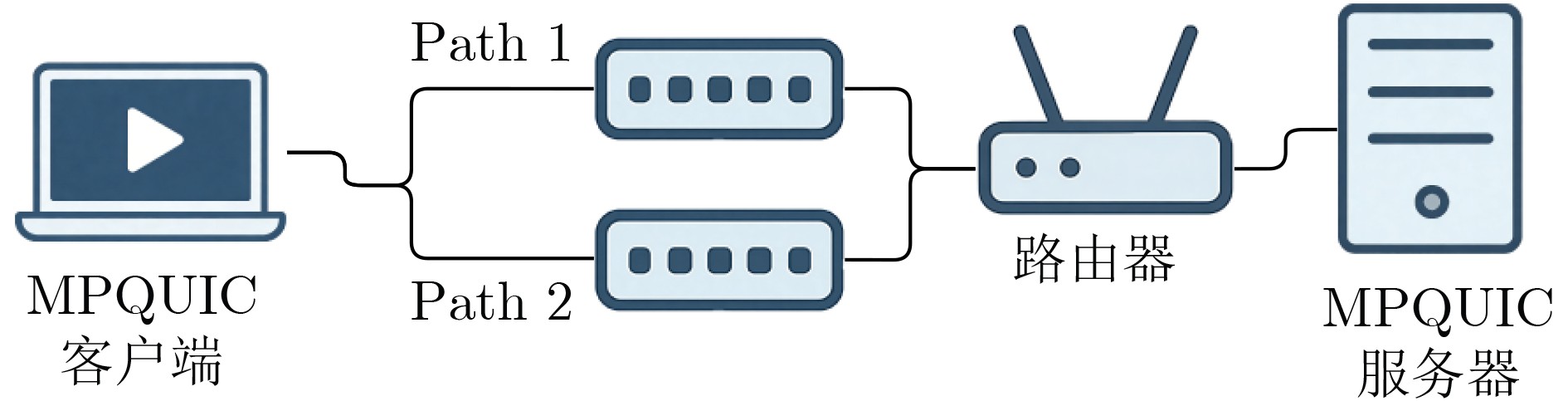
RTT(ms) 抖动(ms) 丢包率(%) 带宽(Mbit/(s·Hz)) Path 1 25~50 0~10 0~3 20~30 Path 2 50~100 0~20 0~3 20~30
下载: 导出CSV
-
[1] 钱志鸿, 王义君. 低空经济赋能者: 智能无人机技术体系综述与展望[J]. 电子与信息学报, 2026, 48(1): 1–33. doi: 10.11999/JEIT251246.QIAN Zhihong and WANG Yijun. Intelligent unmanned aerial vehicles for low-altitude economy: A review of the technology framework and future prospects[J]. Journal of Electronics & Information Technology, 2026, 48(1): 1–33. doi: 10.11999/JEIT251246. [2] SHEN Dian, YANG Bin, ZHANG Junxue, et al. eMPTCP: A framework to fully extend multipath TCP[J]. IEEE/ACM Transactions on Networking, 2024, 32(6): 5459–5474. doi: 10.1109/TNET.2024.3469396. [3] KIMURA B, FERLIN S, PAIVA T, et al. Evaluating adaptive video streaming over multipath QUIC with shared bottleneck detection[J]. ACM Transactions on Multimedia Computing, Communications, and Applications, 2025, 21(9): 246. doi: 10.1145/3711862. [4] RAICIU C, PAASCH C, BARRE S, et al. How hard can it be? Designing and implementing a deployable multipath TCP[C]. Proceedings of the 9th USENIX Conference on Networked Systems Design and Implementation, San Jose, USA, 2012: 29. [5] PAASCH C, FERLIN S, ALAY O, et al. Experimental evaluation of multipath TCP schedulers[C]. The 2014 ACM SIGCOMM Workshop on Capacity Sharing Workshop, Chicago, USA, 2014: 27–32. doi: 10.1145/2630088.2631977. [6] LIM Y S, NAHUM E M, TOWSLEY D, et al. ECF: An MPTCP path scheduler to manage heterogeneous paths[C]. The 13th International Conference on Emerging Networking Experiments and Technologies, Incheon, Republic of Korea, 2017: 147–159. doi: 10.1145/3143361.3143376. [7] FERLIN S, ALAY Ö, MEHANI O, et al. BLEST: Blocking estimation-based MPTCP scheduler for heterogeneous networks[C]. 2016 IFIP Networking Conference and Workshops, Vienna, Austria, 2016: 431–439. doi: 10.1109/IFIPNetworking.2016.7497206. [8] ZHANG Han, LI Wenzhong, GAO Shaohua, et al. ReLeS: A neural adaptive multipath scheduler based on deep reinforcement learning[C]. IEEE INFOCOM 2019 – IEEE Conference on Computer Communications, Paris, France, 2019: 1648–1656. doi: 10.1109/INFOCOM.2019.8737649. [9] WU Hongjia, ALAY Ö, BRUNSTRÖM A, et al. Peekaboo: Learning-based multipath scheduling for dynamic heterogeneous environments[J]. IEEE Journal on Selected Areas in Communications, 2020, 38(10): 2295–2310. doi: 10.1109/JSAC.2020.3000365. [10] YANG Wenjun, CAI Lin, SHU Shengjie, et al. QoS-driven contextual MAB for MPQUIC supporting video streaming in mobile networks[J]. IEEE Transactions on Mobile Computing, 2025, 24(4): 3274–3287. doi: 10.1109/TMC.2024.3507051. [11] ZHOU Dongruo, LI Lihong, and GU Quanquan. Neural contextual bandits with UCB-based exploration[C]. The 37th International Conference on Machine Learning, 2020: 11492–11502. [12] LU T, PÁL D, and PAL M. Contextual multi-armed bandits[C]. The Thirteenth International Conference on Artificial Intelligence and Statistics, Sardinia, Italy, 2010: 485–492. [13] HUA Boyu, NI Haoran, ZHU Qiuming, et al. Channel modeling for UAV-to-ground communications with posture variation and fuselage scattering effect[J]. IEEE Transactions on Communications, 2023, 71(5): 3103–3116. doi: 10.1109/TCOMM.2023.3255900. [14] LI Lihong, CHU Wei, LANGFORD J, et al. A contextual-bandit approach to personalized news article recommendation[C]. The 19th International Conference on World Wide Web, Raleigh, USA, 2010: 661–670. doi: 10.1145/1772690.1772758. [15] VALKO M, KORDA N, MUNOS R, et al. Finite-time analysis of kernelised contextual bandits[C]. The Twenty-Ninth Conference on Uncertainty in Artificial Intelligence, Bellevue, USA, 2013: 654–663. [16] FILIPPI S, CAPPÉ O, GARIVIER A, et al. Parametric bandits: The generalized linear case[C]. The 24th International Conference on Neural Information Processing Systems, Vancouver, Canada, 2010: 586–594. [17] BIFET A and GAVALDÀ R. Learning from time-changing data with adaptive windowing[C]. The 2007 SIAM International Conference on Data Mining (SDM), Minneapolis, USA, 2007: 443–448. doi: 10.1137/1.9781611972771.42. [18] SEEMANN M. quic-go[EB/OL]. https://github.com/quic-go/quic-go, 2025. [19] LIU Yanmei, MA Yunfei, DE CONINCK Q, et al. Multipath extension for QUIC[EB/OL]. https://www.ietf.org/archive/id/draft-ietf-quic-multipath-10.html, 2024. [20] DOS REIS FONTES R, ROTHENBERG C E. Mininet-WiFi: A platform for hybrid physical-virtual software-defined wireless networking research[C]. The 2016 ACM SIGCOMM Conference, Florianopolis, Brazil, 2016: 607–608. doi: 10.1145/2934872.2959070. [21] ROOSENDAAL T. Big buck bunny[C]. ACM SIGGRAPH ASIA 2008 Computer Animation Festival, Singapore, 2008: 62. [22] NI Yunzhe, ZHENG Zhilong, LIN Xianshang, et al. CellFusion: Multipath vehicle-to-cloud video streaming with network coding in the wild[C]. The ACM SIGCOMM 2023 Conference, New York, USA, 2023: 668–683. doi: 10.1145/3603269.3604832. [23] FROMMGEN A, ERBSHÄUSSER T, BUCHMANN A, et al. ReMP TCP: Low latency multipath TCP[C]. 2016 IEEE International Conference on Communications (ICC), Kuala Lumpur, Malaysia, 2016: 1–7. doi: 10.1109/ICC.2016.7510787. [24] XING Yitao, XUE Kaiping, ZHANG Yuan, et al. A stream-aware MPQUIC scheduler for HTTP traffic in mobile networks[J]. IEEE Transactions on Wireless Communications, 2023, 22(4): 2775–2788. doi: 10.1109/TWC.2022.3213638. [25] E Jinlong, HE Lin, ZHAO Zongyi, et al. AggDeliv: Aggregating multiple wireless links for efficient mobile live video delivery[C]. IEEE INFOCOM 2024 – IEEE Conference on Computer Communications, Vancouver, Canada, 2024: 1173–1180. doi: 10.1109/INFOCOM52122.2024.10621184. [26] XING Yitao, XUE Kaiping, ZHANG Yuan, et al. A low-latency MPTCP scheduler for live video streaming in mobile networks[J]. IEEE Transactions on Wireless Communications, 2021, 20(11): 7230–7242. doi: 10.1109/TWC.2021.3081498. [27] YANG Wenjun, CAI Lin, SHU Shengjie, et al. Scheduler design for mobility-aware multipath QUIC[C]. GLOBECOM 2022–2022 IEEE Global Communications Conference, Rio de Janeiro, Brazil, 2022: 2849–2854. doi: 10.1109/GLOBECOM48099.2022.10001247. [28] XING Yitao, XUE Kaiping, ZHANG Yuan, et al. An online learning assisted packet scheduler for MPTCP in mobile networks[J]. IEEE/ACM Transactions on Networking, 2023, 31(5): 2297–2312. [29] HAN Xueqiang, HAN Biao, LI Ruidong, et al. MARS: An adaptive multi-agent DRL-based scheduler for multipath QUIC in dynamic networks[C]. 2023 IEEE/ACM 31st International Symposium on Quality of Service (IWQoS), Orlando, USA, 2023: 1–10. doi: 10.1109/IWQoS57198.2023.10188744. [30] HAN Jiangping, XUE Kaiping, LI Jian, et al. EdAR: An experience-driven multipath scheduler for seamless handoff in mobile networks[J]. IEEE Transactions on Wireless Communications, 2023, 22(10): 6839–6852. doi: 10.1109/TWC.2023.3246082. -

 下载:
下载:

图(6) / 表(2)
计量
- 文章访问数: 756
- HTML全文浏览量: 465
- PDF下载量: 67
- 被引次数: 0
