




Efficient and Verifiable Ciphertext Retrieval Scheme Based on Trusted Execution Environment
-
摘要: 密文检索机制(Ciphertext Retrieval)支持密态数据下的安全检索,对称可搜索加密(Symmetric Searchable Encryption, SSE)是其核心研究分支。在实际应用中,云服务器为节约算力,可能返回错误或不完整的检索结果;同时攻击者可利用搜索与访问模式的泄露信息逆向推导关键字,从而引发严重的隐私泄露问题。因此,实现检索结果可验证性,并兼顾搜索与访问模式的隐私保护,具备重要的研究意义。现有支持模式隐私保护的可验证SSE方案,普遍依赖关键字遍历机制,验证效率较低,会显著增加用户的计算与通信开销,难以满足高效安全的密文检索需求。针对上述性能瓶颈,该文提出一种基于可信执行环境(Trusted Execution Environment, TEE)的高效可验证密文检索方案。为提升密文检索等效率,该方案借助硬件级安全隔离与不经意数据重排的协同,实现关键字陷门尺寸独立于关键字字典的规模。同时,通过嵌入随机数以及盲化多项式常数项方式验证返回结果的正确性。得益于上述设计,该方案在效率层面取得了显著提升。具体而言,其一,该方案使得关键字陷门规模仅与查询关键字数量相关,而与全局字典规模无关,有效降低了计算和通信成本;其二,该方案仅需存储两个随机数即可实现可验证功能,大幅降低了用户本地存储开销。其三,数据用户与单服务器单轮交互中获取检索结果以及对称同态加密机制的应用等技术进一步提升了运行效率。此外,TEE中的密态计算弱化了对TEE的安全假设和信任程度。在通过模拟游戏方式完成对方案安全性的证明之后,该文对所提出的方案进行了综合的性能评估,评估结果证实了该方案在效率上显著优于其他具备相同功能的方案。Abstract:
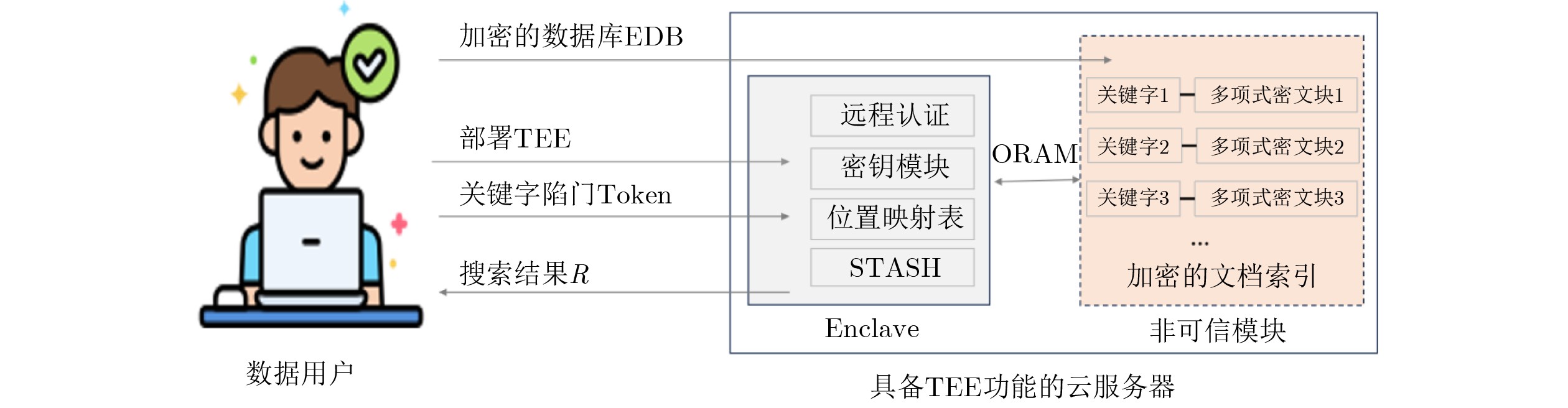
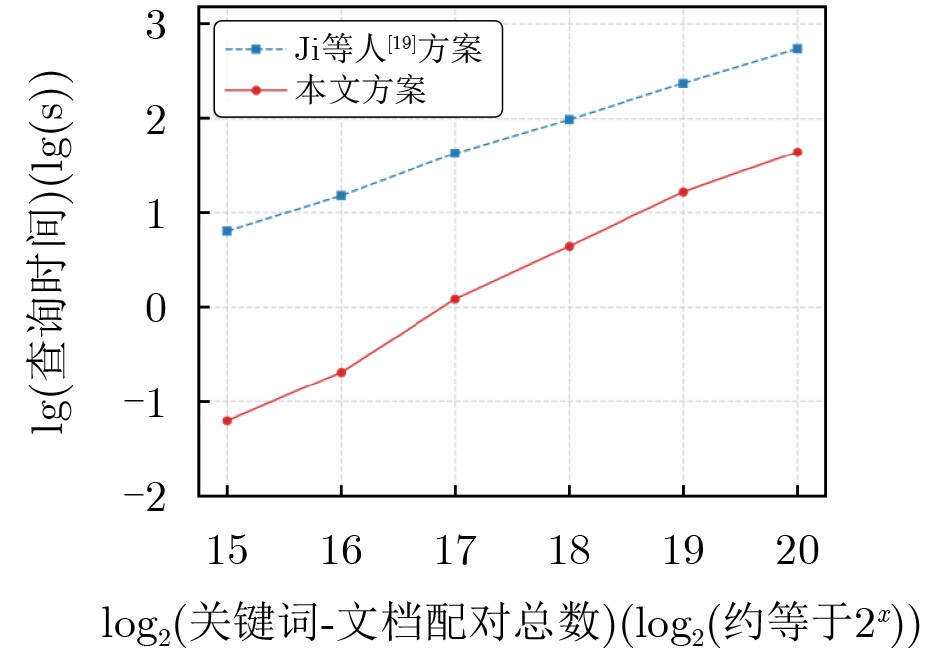
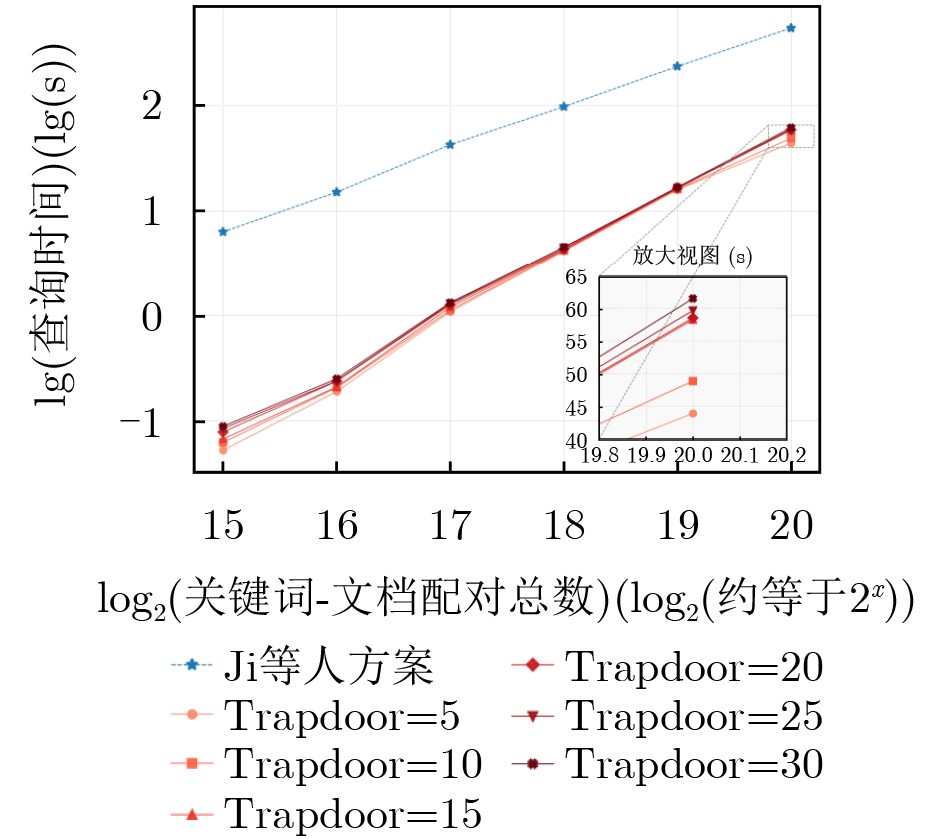
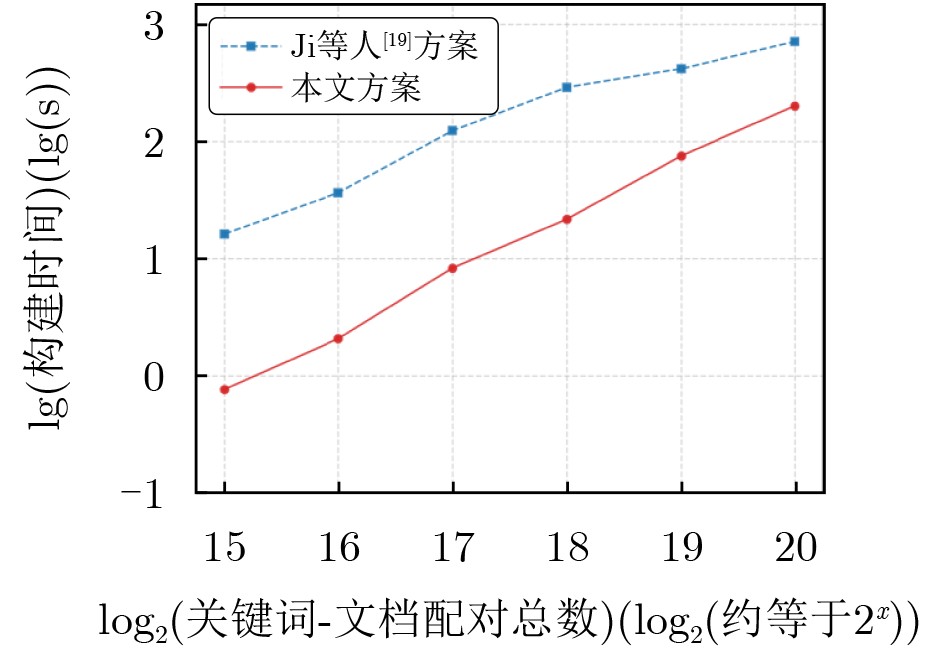
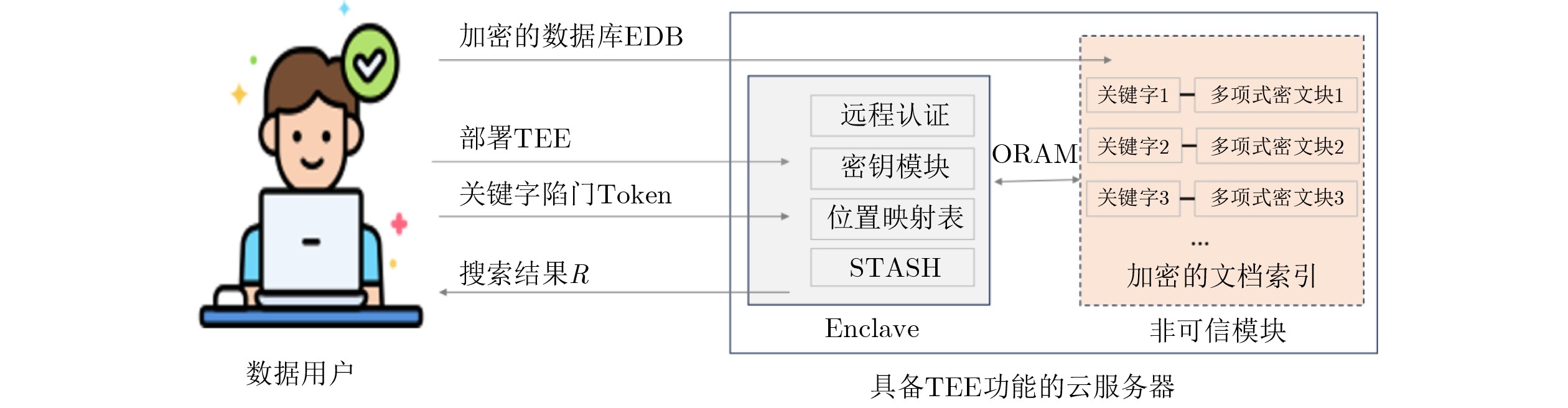
Objective Ciphertext retrieval enables searching over encrypted data. Symmetric Searchable Encryption (SSE) constitutes a critical branch of ciphertext retrieval. However, cloud servers may return incorrect or incomplete results to conserve computational resources. Furthermore, adversaries may exploit information leaked from search and access patterns to recover keyword details, which introduces severe privacy risks. Therefore, preserving the privacy of search and access patterns while guaranteeing result verifiability is both necessary and meaningful. Nevertheless, existing verifiable SSE schemes supporting search and access pattern privacy generally adopt keyword traversal mechanisms with inefficient verification procedures. This imposes heavy computational and communication overhead on data users and fails to satisfy the requirements for efficient and secure ciphertext retrieval. Methods To tackle the above performance bottlenecks, this paper proposes an efficient verifiable ciphertext retrieval mechanism based on the Trusted Execution Environment (TEE) and Oblivious Random Access Machine (ORAM). The data user transmits keyword trapdoors to the Enclave inside TEE via a secure channel. The cloud server regards the Enclave as a client and leverages Path ORAM to implement oblivious access to the ciphertext database. This mechanism eliminates multi-round interactions and redundant information transmission between the Enclave and the user, rendering the size of keyword trapdoors independent of the scale of the keyword dictionary. To achieve verifiability of search results, the data user embeds a designated random number during polynomial construction and blinds the polynomial’s constant term using the output of a hash function. Upon receiving the search results, the user deblinds the blinded polynomial returned by the cloud server to reconstruct the complete polynomial, and validates the correctness of the search procedure and the integrity of search results by checking whether this designated random number is a root of the polynomial. Results and Discussions Benefiting from the above designs, significant efficiency improvements are achieved. Specifically, the scheme ensures that the size of keyword trapdoors depends only on the number of query keywords, rather than the size of the global keyword dictionary, which effectively cuts communication and computational costs. Moreover, the scheme requires merely two random numbers to realize the verifiability of search results, substantially reducing the user-side local storage overhead. In addition, techniques including single-server single-round result retrieval and symmetric homomorphic encryption are adopted to further boost operational efficiency. Experimental results demonstrate that, under equivalent functionality, the proposed scheme achieves performance gains of several times or even orders of magnitude in query efficiency, database construction overhead, user-side local storage, and communication overhead. The proposed scheme achieves prominent advantages in ciphertext retrieval efficiency and overhead optimization, yet it has certain application limitations. The scheme is mainly designed for static ciphertext datasets and lacks adequate adaptability to dynamic ciphertext environments with frequent data insertion, deletion and update operations. Besides, we only optimize the performance for single-user search scenarios. For complex data-sharing scenarios such as multi-user concurrent search, the concurrent processing capability and permission isolation mechanism remain to be improved. Conclusions This paper proposes an efficient verifiable ciphertext retrieval scheme based on TEE. Combining hardware-level security isolation with oblivious data rearrangement, the scheme decouples keyword trapdoor size from the scale of the keyword dictionary. It verifies search result correctness via random number embedding and blinding of polynomial constant terms. With a single-round user-server interaction architecture and symmetric homomorphic encryption, the scheme further improves search efficiency. Comprehensive experiments show that this scheme substantially outperforms equivalent competing schemes in overall execution efficiency. -
1 加密数据的构建$ \text{DBBuild} $
输入:$ {\lambda } $和$ \text{DB} $ 输出:$ \text{EDBtree} $, $ \text{PM} $, $ \text{VK} $和$ \text{SK} $ $ {{\text{EDB}}}\leftarrow {\varnothing } $ 参数选择 设关键字字典$ {W} $的大小为$ {m} $ 选择一个随机数$ {\beta } $和一个随机数$ {\theta } $ 随机选择两个哈希函数$ {{H}\colon \{{0},{1}\}}^{{*}}\rightarrow {\mathbb{Z}}_{{p}} $ 随机抽样一个私钥为$ {k} $的伪随机函数$ {F} $ 初始化一个私钥为$ \text{sk} $的对称同态加密算法${ \text{ASHE}}=({{\text{Setup}}},{{\text{Enc}}},{{\text{Dec}}}) $ 具体步骤 (1) $ {L}={\{|{{\text{DB}}}\left({{w}}_{{i}}\right)|\}}_{{\max}} $ (2) 对于每个关键字$ {{w}}_{{i}}\in {W} $,执行下面的算法: (3) $ {{k}}_{{{{w}}_{{i}}}}\leftarrow {F}\left({k},{{w}}_{{i}}\right) $ (4) $ {{P}}_{{{{w}}_{{i}}}}\left({x}\right)={{x}}^{{L}-\left| \text{{D}{B}}\left({{w}}_{{i}}\right)\right| }{({x}-{\beta })\prod }_{\text{{i}{d}}\in \text{{D}{B}}\left({{w}}_{{i}}\right)}({x}-(\text{{i}{d}}||{H}\left(\text{{i}{d}}\right)))=\displaystyle\sum\nolimits _{{j}=\mathbf{0}}^{{j}={L}+\mathbf{1}}{{{{\tau }}_{{i}{j}}}{x}}^{{j}} $ (5) $ {\text{EDB}}_{{{{w}}_{{i}}}}={\text{Enc}}_\text{{s}{k}}\left({{P}}_{{{{w}}_{{i}}}}\left({x}\right)-{H}({{w}}_{{i}}||{\theta })\right)={{\displaystyle\sum\nolimits _{{j}={0}}^{{L}+{1}}}{{\text{Enc}}}}_{{h}{p}{k}}\left({{\tau }}_{{i}{j}}\right){{x}}^{{j}} $ (6) $ {{\text{EDB}}}\leftarrow (({{k}}_{{{{w}}_{{1}}}},{\text{EDB}}_{{{{w}}_{{1}}}}),{{k}}_{{{{w}}_{{2}}}},{{{\text{EDB}}}}_{{{{w}}_{{2}}}}),\cdots ,({{k}}_{{{{w}}_{{m}}}},{{{\text{EDB}}}}_{{{{w}}_{{m}}}})) $和$ \text{{V}{K}}\leftarrow {\beta },{\theta } $ (7) 初始化Path ORAM二叉树结构EDBtree; (8) PM$ \leftarrow $随机将每个关键字映射到一条路径; (9) 对每个关键字对应的多项式执行: (10) 将多项式加密为数据块; (11) 将数据块插入到关键字映射路径上的对应桶中; (12) 使用虚拟块(dummy blocks)将每个桶填充至大小S; (13) 返回加密数据库$ {{\text{EDBtree}}} $,$ {{\text{PM}}} $,$ {{\text{VK}}} $和私钥$ {{\text{SK}}}=\left({k},\text{{s}{k}}\right) $; (14) 上传$ {{\text{EDBtree}}} $到云服务器的不可信环境; (15) 通过安全信道上传PM到云服务器的Enclave。  下载: 导出CSV
2 关键字陷门生成Trapdoor
输入:SK和被询问的关键字集合$ {Q} $ 输出:关键字陷门$ \text{Token} $ (1) 对于$ {{w}}_{{i}}\in {Q} $,执行下面的循环: (2) $ {{k}}_{{{{w}}_{{i}}}\boldsymbol{'}}\leftarrow {F}\left({k},{{w}}_{{i}}\right) $。 (3) 返回关键字陷门$ {{\text{Token}}}=\{{{k}}_{{{{w}}_{{1}}}{'}},{{k}}_{{{{w}}_{{2}}}{'}},\cdots ,{{k}}_{{{{w}}_{{n}}}{'}}\} $ (4) 通过与TEE建立的安全信道上传到Enclave中
下载: 导出CSV
3 搜索过程Search
输入:$ \text{EDBtree} $和$ \text{Token} $ 输出:搜索结果$ {R} $ 云服务器 // Enclave (1)$ {R}\leftarrow \{\} $ (2) 解析$ {\text{Token}}=\{{{k}}_{{{{w}}_{{1}}}{'}}{{k}}_{{{{w}}_{{2}}}{'}},\cdots ,{{k}}_{{{{w}}_{{n}}}{'}}\} $ (3) 对于$ {{k}}_{{{{w}}_{{i}}}{'}} $执行: (4) 如果$ {{k}}_{{{{w}}_{{i}}}{'}} $对应的多项式数据块不在STASH中,执行: (5) 从PM中读取对应的路径PATH; (6) Enclave调用Path ORAM的Access (PATH, EDBtree)接口,从不可信环境中读取EDBtree中PATH路径上的密文数据块; (7) 解密数据块并得到$ {{k}}_{{{{w}}_{{i}}}{'}} $对应的加密多项式; (8) 计算$ {\text{Enc}}_\text{{s}{k}}(\mathbb{P}\left({x}\right){'})={\text{EDB}}_{{{{w}}_{{1}}}{'}} +{\text{EDB}}_{{{{w}}_{{2}}}{'}}$+···+$ {\text{EDB}}_{{{{w}}_{{i}}}{'}} $+···+$ {\text{EDB}}_{{{{w}}_{{n}}}{'}} $ $ \text{=}{\text{Enc}}_\text{{s}{k}}(\left({{P}}_{{{{w}}_{{1}}}{'}}\left({x}\right)-{H}({{w}}_{{1}}||{\theta })\right)+{H}({{w}}_{{2}}||{\theta })+\cdots +\left({{P}}_{{{{w}}_{{n}}}{'}}\left({x}\right)-{H}({{w}}_{{n}}||{\theta })\right)) $ (9)将搜索结果$ {\text{Enc}}_\text{{s}{k}}\left(\mathbb{P}\left({x}\right){'}\right) $返回给数据用户。 数据用户 (10) 数据用户通过解密密钥$ {{\text{sk}}} $计算出明文$ \mathbb{P}{\left({x}\right)}^{{'}}={\text{Dec}}_\text{{s}{k}}\left({\text{Enc}}_\text{{s}{k}}\left(\mathbb{P}{\left({x}\right)}^{{'}}\right)\right)=\left({{P}}_{{{{w}}_{{1}}}{'}}\left({x}\right)-{H}({{w}}_{{1}}||{\theta })\right)+\cdots +$
$\left({{P}}_{{{{w}}_{{n}}}{'}}\left({x}\right)-{H}({{w}}_{{n}}||{\theta })\right) $(11) 对于$ {{w}}_{{i}}\in {Q}=({{w}}_{{1}},{{w}}_{{2}},\cdots ,{{w}}_{{n}}) $,数据用户通过$ {{\text{VK}}} $获得$ \mathbb{P}\left({x}\right)=\mathbb{P}{\left({x}\right)}^{{'}}+{H}({{w}}_{{1}}||{\theta })+{H}({{w}}_{{2}}||{\theta })+\cdots +{H}({{w}}_{{n}}||{\theta }) $ (12)如果$ {\mathbb{P}}_{{\alpha }}\left({\beta }\right)\neq {0} $,数据用户拒绝搜索结果。如果验证通过,则数据用户计算出多项式$ \mathbb{P}\left({x}\right) $的根,然后从中找到符合格式$ \text{{i}{d}}||{H}\left(\text{{i}{d}}\right) $的有效根并将其添加到结果$ {R} $中。
下载: 导出CSV
4 算法模拟
输入:$ {\mathcal{L}}_{{I}}{'}=({m},{L},{n}) $ 输出:$ \text{EDB} $和$ \text{Token} $ 加密数据$ \text{EDB} $的生成: (1) $ \text{EDB}\leftarrow {\varnothing } $ (2) 对于$ {i}\in [{1},{m}] $,执行下面的算法: (3) 选择随机数$ {{k}}_{{{{w}}_{{i}}}} $并记录元组$ ({i},{{k}}_{{{{w}}_{{i}}}}) $到表格$ {T} $中 (4) 选择$ {L} $+1个随机数$ {{\eta }}_{{j}} $得到$ {\text{EDB}}_{{{{w}}_{{i}}}}=\displaystyle\sum\nolimits_{{j}={1}}^{{L}+{1}}{{\eta }}_{{j}}{{x}}^{{j}} $ (5) 生成$ \text{EDB}=(({{k}}_{{{{w}}_{{1}}}},{\text{EDB}}_{{1}}),{{k}}_{{{{w}}_{{2}}}},{\text{EDB}}_{{2}}),\cdots , $
$({{k}}_{{{{w}}_{{m}}}},{\text{EDB}}_{{m}})) $生成陷门$ {\text{Token}} $ (6) 对于$ {i}\in [{1},{n}] $,执行下面的循环: (7) 从$ {T} $中根据索引选出$ {{k}}_{{{{w}}_{{i}}}} $ (8) 返回关键字陷门$ {\text{Token}}=\{{{k}}_{{{{w}}_{{1}}}},{{k}}_{{{{w}}_{{2}}}},\cdots ,{{k}}_{{{{w}}_{{n}}}}\} $
下载: 导出CSV
表 1 搜索模式和访问模式隐藏的可验证多关键字可搜索加密机制比较
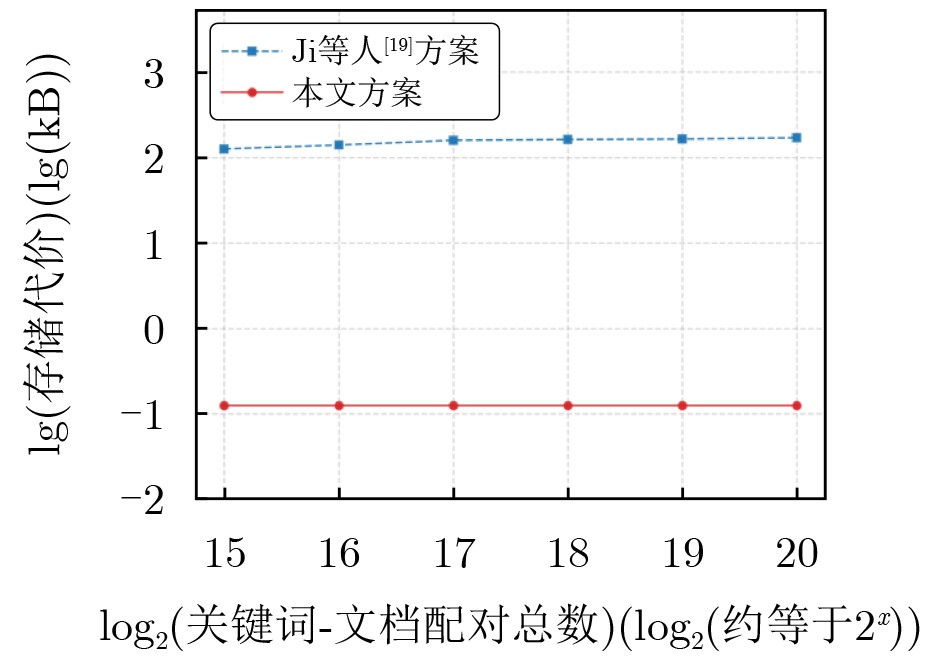
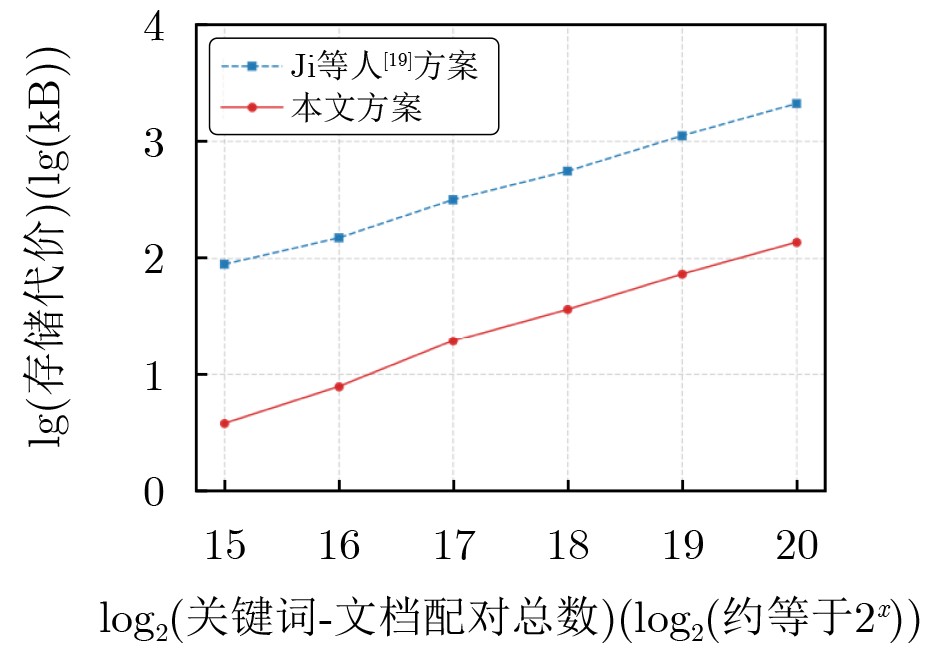
方案 计算代价 本地通信代价 本地存储代价 加法同态加密机制 初始化 陷门生成 搜索阶段 初始化 搜索 Wu方案[18] $ {O}({mL}) $ $ {O}({m}) $ $ {O}({mL}) $ $ {O}({mL}) $ $ {O}({mL}) $ $ {O}(1) $ 公钥加密 Ji方案[19] $ {O}({mL}) $ $ {O}({m}) $ $ {O}({mL}) $ $ {O}({mL}) $ $ {O}({mL}) $ $ {O}({m}) $ 对称机制 本文方案 $ {O}({mL}) $ $ {O}({n}) $ $ {n*O}(\mathrm{log}{N}) $ $ {O}({mL}) $ $ {O}(\mathrm{log}{L}) $ ${O}(1) $ 对称机制 注:$ {m} $是关键字字典集合的大小;$ {L} $是包含关键字文档标识集合大小的最大值;$ {n} $是要搜索关键字集合的大小;$ {N} $是Path ORAM桶的数量。
下载: 导出CSV
-
[1] SINGH A and CHATTERJEE K. Cloud security issues and challenges: A survey[J]. Journal of Network and Computer Applications, 2017, 79: 88–115. doi: 10.1016/j.jnca.2016.11.027. [2] 张玉清, 王晓菲, 刘雪峰, 等. 云计算环境安全综述[J]. 软件学报, 2016, 27(6): 1328–1348. doi: 10.13328/j.cnki.jos.005004.ZHANG Yuqing, WANG Xiaofei, LIU Xuefeng, et al. Survey on cloud computing security[J]. Journal of Software, 2016, 27(6): 1328–1348. doi: 10.13328/j.cnki.jos.005004. [3] RAGHAVENDRA S, REDDY C S, GEETA C M, et al. Survey on data storage and retrieval techniques over encrypted cloud data[J]. International Journal of Computer Science and Information Security, 2016, 14(9): 718. [4] 王祥宇, 马鑫迪, 梁岩荣, 等. 开放大数据安全存储与检索系统[J]. 网络空间安全科学学报, 2024, 2(3): 13–26. doi: 10.20172/j.issn.2097-3136.240302.WANG Xiangyu, MA Xindi, LIANG Yanrong, et al. Secure storage and retrieval system for open big data[J]. Journal of Cybersecurity, 2024, 2(3): 13–26. doi: 10.20172/j.issn.2097-3136.240302. [5] 迟佳琳, 冯登国, 张敏, 等. 隐私保护密文检索技术研究进展[J]. 电子与信息学报, 2024, 46(5): 1546–1569. doi: 10.11999/JEIT231300.CHI Jialin, FENG Dengguo, ZHANG Min, et al. Advances in privacy-preserving ciphertext retrieval[J]. Journal of Electronics & Information Technology, 2024, 46(5): 1546–1569. doi: 10.11999/JEIT231300. [6] LI Feng, MA Jianfeng, MIAO Yinbin, et al. A survey on searchable symmetric encryption[J]. ACM Computing Surveys, 2024, 56(5): 119. doi: 10.1145/3617991. [7] WANG Na, ZHOU Wen, HAN Qingyun, et al. A lightweight privacy-preserving ciphertext retrieval scheme based on edge computing[J]. IEEE Transactions on Cloud Computing, 2024, 12(4): 1273–1290. doi: 10.1109/TCC.2024.3461732. [8] DOU Haochen, DAN Zhenwu, XU Peng, et al. Dynamic searchable symmetric encryption with strong security and robustness[J]. IEEE Transactions on Information Forensics and Security, 2024, 19: 2370–2384. doi: 10.1109/TIFS.2024.3350330. [9] GAO Nan, FAN Kai, WANG Haoyang, et al. Dynamic multi-user authorization in ciphertext retrieval with proxy re-encryption[J]. IEEE Transactions on Dependable and Secure Computing, 2025, 22(6): 5918–5930. doi: 10.1109/TDSC.2025.3577208. [10] WU Axin, YANG Anjia, LUO Weiqi, et al. Enabling traceable and verifiable multi-user forward secure searchable encryption in hybrid cloud[J]. IEEE Transactions on Cloud Computing, 2023, 11(2): 1886–1898. doi: 10.1109/tcc.2022.3170362. [11] OYA S and KERSCHBAUM F. Hiding the access pattern is not enough: Exploiting search pattern leakage in searchable encryption[C]. The 30th USENIX Security Symposium, 2021. [12] CASH D, GRUBBS P, PERRY J, et al. Leakage-abuse attacks against searchable encryption[C]. The 22nd ACM SIGSAC Conference on Computer and Communications Security, Denver Colorado, USA, 2015: 668–679. doi: 10.1145/2810103.2813700. [13] LIU Chang, ZHU Liehuang, WANG Mingzhong, et al. Search pattern leakage in searchable encryption: Attacks and new construction[J]. Information Sciences, 2014, 265: 176–188. doi: 10.1016/j.ins.2013.11.021. [14] WANG Yunling, SUN Shifeng, WANG Jianfeng, et al. Achieving searchable encryption scheme with search pattern hidden[J]. IEEE Transactions on Services Computing, 2022, 15(2): 1012–1025. doi: 10.1109/TSC.2020.2973139. [15] SONG Qiyang, LIU Zhuotao, CAO Jiahao, et al. SAP-SSE: Protecting search patterns and access patterns in searchable symmetric encryption[J]. IEEE Transactions on Information Forensics and Security, 2021, 16: 1795–1809. doi: 10.1109/tifs.2020.3042058. [16] SHANG Zhiwei, OYA S, PETER A, et al. Obfuscated access and search patterns in searchable encryption[C]. The 28th Annual Network and Distributed System Security Symposium, 2021: 1–18. [17] YANG Yunbo, HU Yiwei, DONG Xiaolei, et al. OpenSE: Efficient verifiable searchable encryption with access and search pattern hidden for cloud-IoT[J]. IEEE Internet of Things Journal, 2024, 11(8): 13793–13809. doi: 10.1109/jiot.2023.3337336. [18] WU Axin, FENG Dengguo, ZHANG Min, et al. Efficient verifiable searchable encryption with search and access pattern privacy[J]. Security and Safety, 2025, 4: 2024022. doi: 10.1051/sands/2024022. [19] JI Licheng, LI Jiguo, ZHANG Yicheng, et al. Verifiable searchable symmetric encryption over additive homomorphism[J]. IEEE Transactions on Information Forensics and Security, 2025, 20: 1320–1332. doi: 10.1109/TIFS.2025.3526062. [20] LI Mengyuan, YANG Yuheng, CHEN Guoxing, et al. SoK: Understanding design choices and pitfalls of trusted execution environments[C]. The 19th ACM Asia Conference on Computer and Communications Security, Singapore, Singapore, 2024: 1600–1616. doi: 10.1145/3634737.3644993. [21] SUN H and JAFAR S A. The capacity of private information retrieval[J]. IEEE Transactions on Information Theory, 2017, 63(7): 4075–4088. doi: 10.1109/TIT.2017.2689028. [22] FERREIRA B, PORTELA B, OLIVEIRA T, et al. Boolean searchable symmetric encryption with filters on trusted hardware[J]. IEEE Transactions on Dependable and Secure Computing, 2022, 19(2): 1307–1319. doi: 10.1109/TDSC.2020.3012100. [23] FUHRY B, BAHMANI R, BRASSER F, et al. HardIDX: Practical and secure index with SGX[C]. Proceedings of the 31st Annual IFIP WG 11.3 Conference on Data and Applications Security and Privacy XXXI, Philadelphia, USA, 2017. doi: 10.1007/978-3-319-61176-1_22. [24] JIANG Qin, CHANG E C, QI Yong, et al. Rphx: Result pattern hiding conjunctive query over private compressed index using Intel SGX[J]. IEEE Transactions on Information Forensics and Security, 2022, 17: 1053–1068. doi: 10.1109/TIFS.2022.3144877. [25] WU Haotian, PENG Zhe, XIAO Jiang, et al. HeX: Encrypted rich queries with forward and backward privacy using trusted hardware[J]. IEEE Transactions on Dependable and Secure Computing, 2025, 22(4): 3751–3765. doi: 10.1109/TDSC.2025.3540958. [26] JIANG Qin, QI Yong, QI Saiyu, et al. Pbsx: A practical private boolean search using Intel SGX[J]. Information Sciences, 2020, 521: 174–194. doi: 10.1016/j.ins.2020.02.031. [27] TINOCO A, GAO Sixiang, and SHI E. ENIGMAP: External-memory oblivious map for secure enclaves[C]. Proceedings of the 32nd USENIX Conference on Security Symposium, Anaheim, USA, 2023: 226. [28] YE Zikai, WANG Xiangyu, LIU Zesen, et al. OBIR-tree: An efficient oblivious index for spatial keyword queries on secure enclaves[J]. Proceedings of the ACM on Management of Data, 2025, 3(1): 58. doi: 10.1145/3709708. [29] WANG Tao, WANG Jingyi, YANG Qiliang, et al. An efficient verifiable searchable encryption scheme with aggregating authorization for blockchain-enabled IoT[J]. IEEE Internet of Things Journal, 2022, 9(20): 20666–20680. doi: 10.1109/JIOT.2022.3175859. [30] 黄一才, 李森森, 郁滨. 云环境下对称可搜索加密研究综述[J]. 电子与信息学报, 2023, 45(3): 1134–1146. doi: 10.11999/JEIT211572.HUANG Yicai, LI Sensen, and YU Bin. A survey of symmetric searchable encryption in cloud environment[J]. Journal of Electronics & Information Technology, 2023, 45(3): 1134–1146. doi: 10.11999/JEIT211572. [31] WANG Jiafan and CHOW S S M. Unus pro omnibus: Multi-client searchable encryption via access control[C]. Proceedings of the 31st Annual Network and Distributed System Security Symposium, San Diego, USA, 2024: 1–18. [32] ZHU Xiaojie, ZHOU Jiancong, DAI Yueyue, et al. A verifiable and efficient symmetric searchable encryption scheme for dynamic dataset with forward and backward privacy[J]. IEEE Transactions on Dependable and Secure Computing, 2025, 22(3): 2741–2755. doi: 10.1109/TDSC.2024.3521423. [33] ZHANG Yupeng, KATZ J, and PAPAMANTHOU C. All your queries are belong to us: The power of file-injection attacks on searchable encryption[C]. Proceedings of the 25th USENIX Conference on Security Symposium, Austin, USA, 2016: 707–720. [34] QUAN Yue, FAN Kai, WANG Haoyang, et al. DMASP: Dynamic multi-keyword searchable encryption for protected access and search patterns with differential privacy[C]. 2024 IEEE 23rd International Conference on Trust, Security and Privacy in Computing and Communications, Sanya, China, 2024: 1423–1429. doi: 10.1109/TrustCom63139.2024.00197. [35] LIU Gang, XIAO Zheng, LI Kenli, et al. HM-ORAM: A lightweight crash-consistent ORAM framework on hybrid memory system[J]. ACM Transactions on Storage, 2025, 21(2): 16. doi: 10.1145/3715009. [36] PAPADIMITRIOU A, BHAGWAN R, CHANDRAN N, et al. Big data analytics over encrypted datasets with seabed[C]. The 12th USENIX Symposium on Operating Systems Design and Implementation, Savannah, USA, 2016: 587–602. [37] SAVVAS S, KHANDELWAL D, and EUGSTER P. Efficient confidentiality-preserving data analytics over symmetrically encrypted datasets[J]. Proceedings of the VLDB Endowment, 2020, 13(8): 1290–1303. doi: 10.14778/3389133.3389144. [38] STEFANOV E, VAN DIJK M, SHI E, et al. Path ORAM: An extremely simple oblivious RAM protocol[J]. Journal of the ACM (JACM), 2018, 65(4): 18. doi: 10.1145/3177872. [39] KISSNER L and SONG D. Privacy-preserving set operations[C]. The 25th Annual International Cryptology Conference on Advances in Cryptology, Santa Barbara, USA, 2005: 241–257. doi: 10.1007/11535218_15. [40] YANG Lei, MEI Qiaozhu, ZHENG Kai, et al. Query log analysis of an electronic health record search engine[J]. AMIA Annual Symposium Proceedings, 2011, 2011: 915–924. -

 下载:
下载:

图(6) / 表(5)
计量
- 文章访问数: 1193
- HTML全文浏览量: 451
- PDF下载量: 152
- 被引次数: 0
