




Semantic Relation-enhanced Adaptive Graph Representation Learning for Next POI Recommendation
-
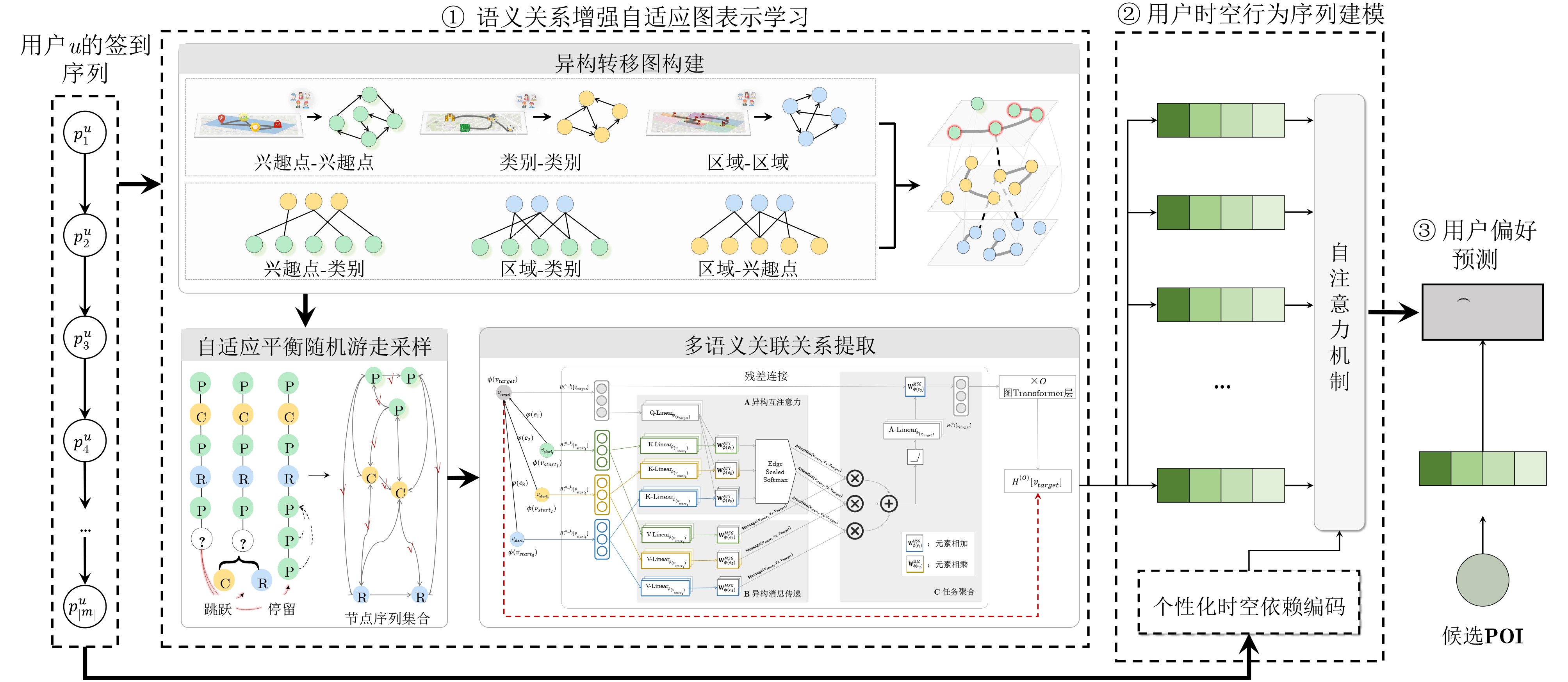
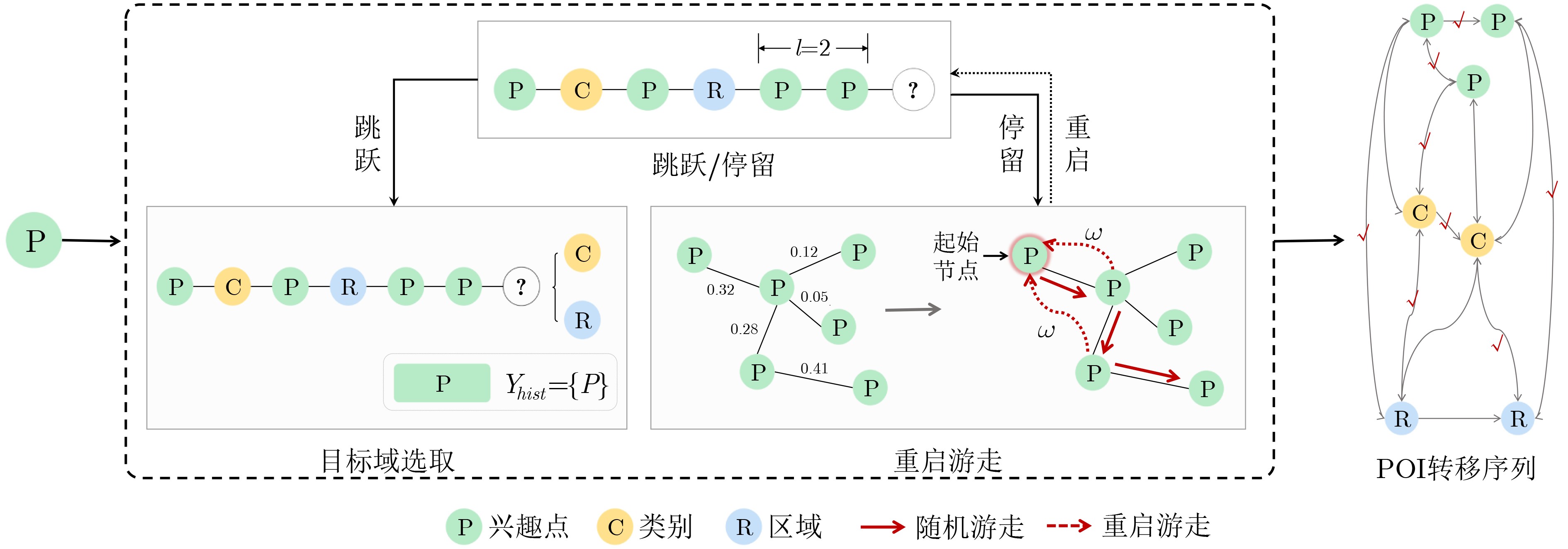
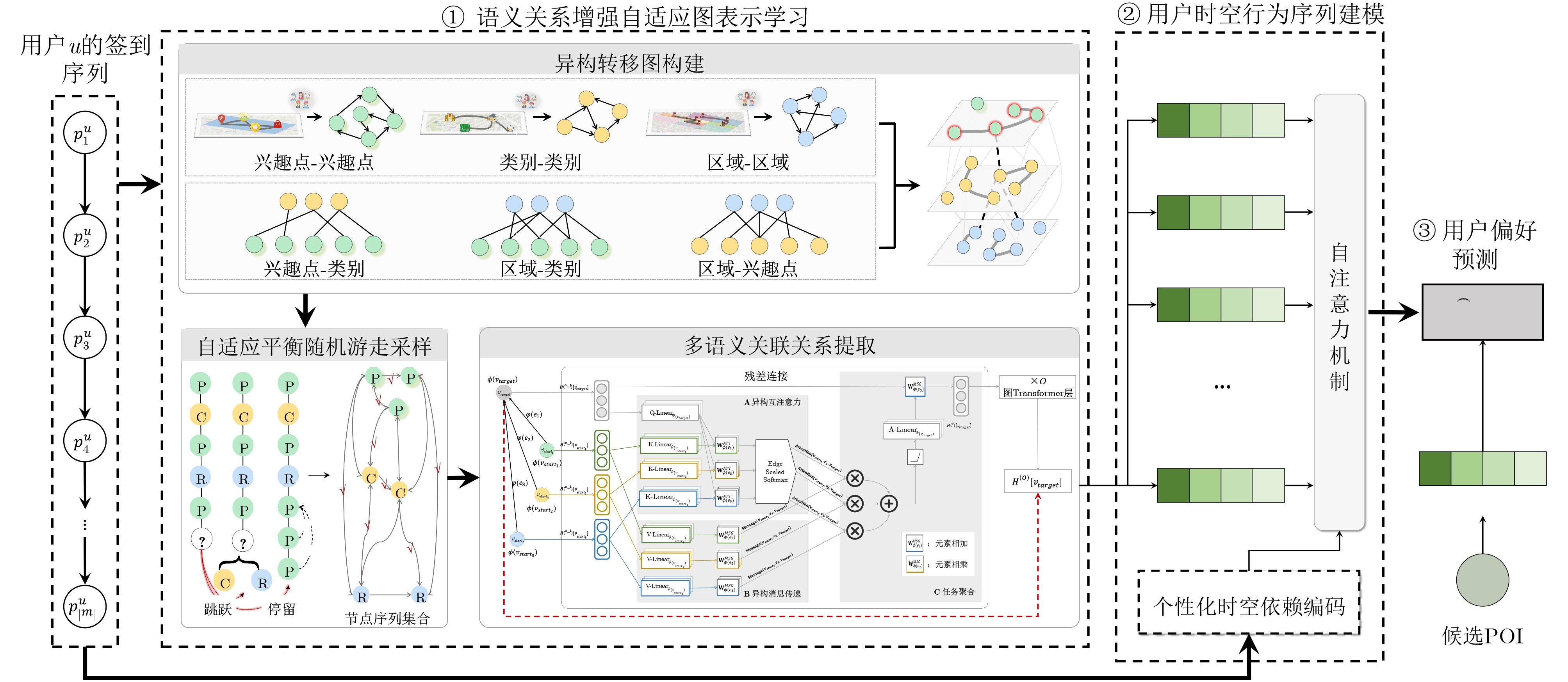
摘要: 针对现有基于图表示学习的下一个兴趣点推荐方法无法有效平衡不同域的节点分布、未充分考虑异质关系之间的特征差异等问题,该文提出基于语义关系增强的自适应图表示学习下一个兴趣点推荐方法(SR-GRL)。该方法利用兴趣点(POI)、POI类别、区域3种类型实体构建异构转移图,设计自适应平衡随机游走算法进行跨域节点采样,通过跳跃和停留动态平衡不同域上的节点分布,避免采样序列偏向于局部结构。然后建立类型感知注意力机制捕捉不同类型节点之间的语义关联关系形成POI解耦表示,有效区分了不同类型节点间的特征差异。在此基础上,结合自注意力机制聚合用户行为的时序偏好特征,通过Softmax函数实现下一个POI推荐。3个真实数据集上的对比实验结果表明,SR-GRL方法相比于其他对比方法具有更好的推荐性能。Abstract:
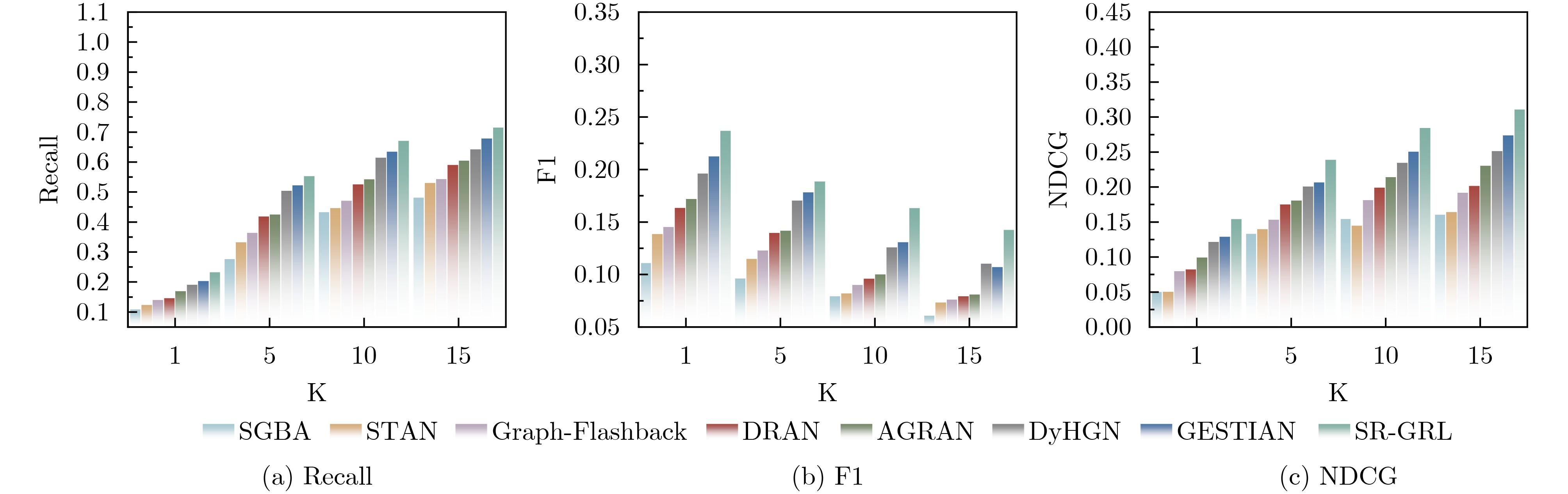
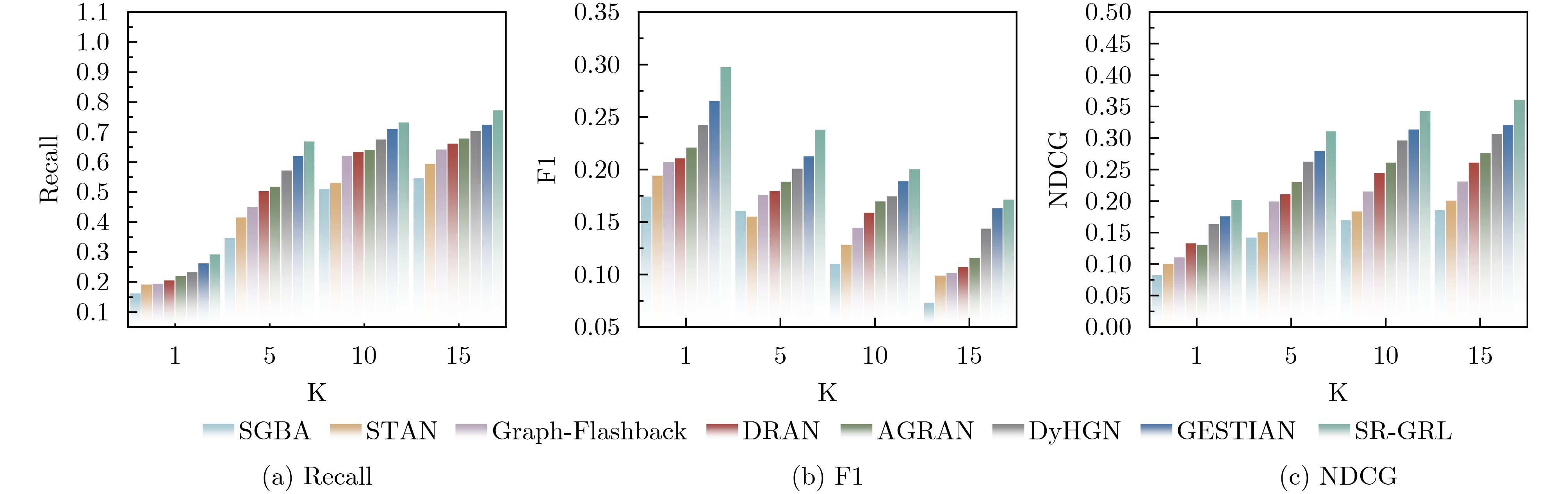
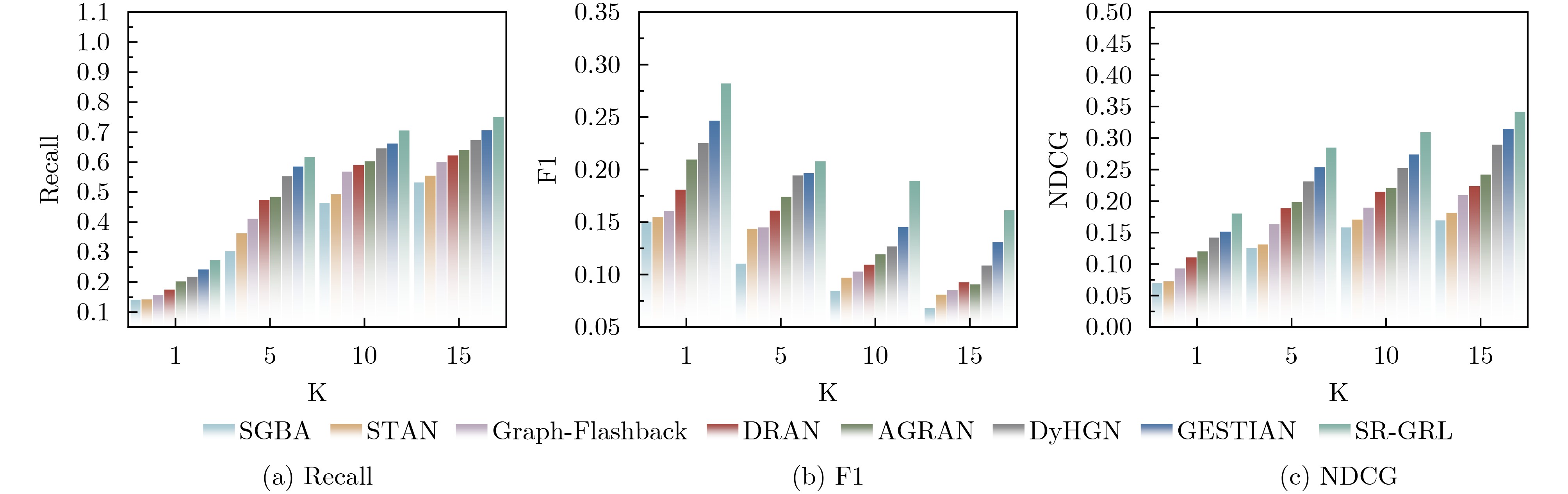
Objective In recent years, next Point Of Interest (POI) recommendation has played an increasingly important role in Location-Based Social Networks (LBSNs). However, existing Graph Representation Learning (GRL)-based recommendation methods have struggled to balance node distributions across different domains (i.e., node types) effectively and have often overlooked feature differences among heterogeneous relations. Thus, complex semantic dependencies in contextual information cannot be fully captured when users’ temporal preference patterns are modeled. Methods To address these issues, a next POI recommendation method based on Semantic Relation-enhanced adaptive Graph Representation Learning (SR-GRL) is proposed. A heterogeneous transition graph is constructed to integrate three entity types, namely POIs, POI categories, and regions, and their complex interrelationships. An adaptive balanced random walk sampling strategy is designed to balance node distributions across different domains dynamically and to reduce information redundancy. A type-aware attention mechanism is then used to learn semantic associations among nodes through relation-specific transformation matrices, so that feature differences across node types can be identified effectively. The obtained disentangled POI representations are then used for spatiotemporal encoding of user check-in sequences, and a self-attention mechanism is applied to aggregate users, temporal preference features. Finally, next POI recommendation is generated through a Softmax function. Results and Discussions Experiments on the Foursquare datasets from Tokyo and New York and the Sina Weibo dataset from Shanghai show that, compared with state-of-the-art baselines, the SR-GRL method achieves Recall@10 improvements of 2.22%$ \sim $24.16%, F1@10 improvements of 1.16%$ \sim $10.48%, and NDCG@10 improvements of 3.01%$ \sim $17.37%, indicating better recommendation performance. Conclusions Overall, the SR-GRL approach can balance the distributions of different node types dynamically and strengthen the modeling of complex semantic dependencies in heterogeneous contextual information. -
表 1 数据集统计
数据集名称 用户数 POI数 区域数 POI类别数 签到总数 TKY 2292 11 333 642 211 368 256 NYC 1056 8140 1257 228 142 622 新浪微博 1 951 1508 516 134 279 761  下载: 导出CSV
表 2 超参数设置
数据集名称 序列最大长度 学习率 批量大小 dropout值 迭代次数 注意力头数 负样本率 TKY 50 0.003 128 0.4 100 6 6 NYC 50 0.003 256 0.4 100 8 6 新浪微博 70 0.005 256 0.5 150 8 8
下载: 导出CSV
-
[1] FANG Jinfeng, MENG Xiangfu, and QI Xueyue. A top-k POI recommendation approach based on LBSN and multi-graph fusion[J]. Neurocomputing, 2023, 518: 219–230. doi: 10.1016/j.neucom.2022.10.048. [2] 闵明慧, 杨爽, 胥俊怀, 等. 三维空间位置服务中智能语义位置隐私保护方法[J]. 电子与信息学报, 2024, 46(6): 2627–2637. doi: 10.11999/JEIT230708.MIN Minghui, YANG Shuang, XU Junhuai, et al. Intelligent semantic location privacy protection method for location based services in three-dimensional spaces[J]. Journal of Electronics & Information Technology, 2024, 46(6): 2627–2637. doi: 10.11999/JEIT230708. [3] ZUO Changqi, ZHANG Xu, YAN Liang, et al. GUGEN: Global user graph enhanced network for next POI recommendation[J]. IEEE Transactions on Mobile Computing, 2024, 23(12): 14975–14986. doi: 10.1109/TMC.2024.3455107. [4] RAO Xuan, JIANG Renhe, SHANG Shuo, et al. Next point-of-interest recommendation with adaptive graph contrastive learning[J]. IEEE Transactions on Knowledge and Data Engineering, 2025, 37(3): 1366–1379. doi: 10.1109/TKDE.2024.3509480. [5] 柴瑞敏, 殷臣. 用户关系和上下文感知的下一个兴趣点推荐[J]. 计算机工程与应用, 2022, 58(7): 197–205. doi: 10.3778/j.issn.1002-8331.2010-0115.CHAI Ruimin and YIN Chen. User relationship and context-aware next point of interest recommendation[J]. Computer Engineering and Applications, 2022, 58(7): 197–205. doi: 10.3778/j.issn.1002-8331.2010-0115. [6] WANG Chen, YUAN Mengting, YANG Yang, et al. Revisiting long- and short-term preference learning for next POI recommendation with hierarchical LSTM[J]. IEEE Transactions on Mobile Computing, 2024, 23(12): 12693–12705. doi: 10.1109/TMC.2024.3417405. [7] WANG Zhaobo, ZHU Yanmin, ZHANG Qiaomei, et al. Graph-enhanced spatial-temporal network for next POI recommendation[J]. ACM Transactions on Knowledge Discovery from Data (TKDD), 2022, 16(6): 104. doi: 10.1145/3513092. [8] ZHOU Wei, FU Cheng, SANG Chunyan, et al. Next POI recommendation based on graph convolutional networks and multiple context-awareness[J]. IEEE Transactions on Services Computing, 2025, 18(1): 302–313. doi: 10.1109/TSC.2024.3463500. [9] WANG Zhaobo, ZHU Yanmin, LIU Haobing, et al. Learning graph-based disentangled representations for next POI recommendation[C]. The 45th International ACM SIGIR Conference on Research and Development in Information Retrieval, Madrid, Spain, 2022: 1154–1163. doi: 10.1145/3477495.3532012. [10] ZHANG Xu, LIU Deao, YAN Liang, et al. Graph-enhanced spatio-temporal interval aware network for next POI recommendation in mobile environment[J]. Journal of Internet Technology, 2024, 25(4): 619–628. doi: 10.70003/160792642024072504012. [11] WANG Zhaobo, ZHU Yanmin, WANG Chunyang, et al. Adaptive graph representation learning for next POI recommendation[C]. The 46th International ACM SIGIR Conference on Research and Development in Information Retrieval, Taipei, China, 2023: 393–402. doi: 10.1145/3539618.3591634. [12] WANG Tianci, LAI Yantong, CHEN Gaode, et al. A dynamic-aware heterogeneous graph neural network for next poi recommendation[C]. The 20th Pacific Rim International Conference on Artificial Intelligence, Jakarta, Indonesia, 2023: 313–326. doi: 10.1007/978-981-99-7019-3_30. [13] LIU Jiawei, GAO Haihan, YANG Cheng, et al. Heterogeneous spatio-temporal graph contrastive learning for point-of-interest recommendation[J]. Tsinghua Science and Technology, 2025, 30(1): 186–197. doi: 10.26599/TST.2023.9010148. [14] YANG Kang and ZHU Jinghua. Next poi recommendation via graph embedding representation from h-deepwalk on hybrid network[J]. IEEE Access, 2019, 7: 171105–171113. doi: 10.1109/ACCESS.2019.2956138. [15] CHEN Juan and LI Qiao. Heterogeneous graph structure learning for next point-of-interest recommendation[J]. Algorithms, 2025, 18(8): 478. doi: 10.3390/a18080478. [16] 石美惠, 申德荣, 寇月, 等. 融合全局和局部特征的下一个兴趣点推荐方法[J]. 软件学报, 2022, 34(2): 786–801. doi: 10.13328/j.cnki.jos.006712.SHI Meihui, SHEN Derong, KOU Yue, et al. Next point-of-interest recommendation approach with global and local feature fusion[J]. Journal of Software, 2023, 34(2): 786–801. doi: 10.13328/j.cnki.jos.006712. [17] GUO Qing, SUN Zhu, ZHANG Jie, et al. An attentional recurrent neural network for personalized next location recommendation[C]. The 34th AAAI Conference on Artificial Intelligence, New York, USA, 2020: 83–90. doi: 10.1609/aaai.v34i01.5337. [18] ZHOU Shiyang, ZHU Jinghua, XI Heran, et al. Heterogeneous graph based long- and short-term preference learning model for next POI recommendation[C]. The 22nd International Conference on Algorithms and Architectures for Parallel Processing, Copenhagen, Denmark, 2022: 455–470. doi: 10.1007/978-3-031-22677-9_24. [19] TANG Qing, XU Shenghua, WANG Zhuolu, et al. Personalized region of interest recommendation through adaptive fusion of multi-dimensional user preferences[J]. Journal of Big Data, 2025, 12(1): 191. doi: 10.1186/s40537-025-01224-4. [20] LUO Yingtao, LIU Qing, and LIU Zhaocheng. STAN: Spatio-temporal attention network for next location recommendation[C]. The Web Conference 2021, Ljubljana Slovenia, 2021: 2177–2185. doi: 10.1145/3442381.3449998. [21] RAO Xuan, CHEN Lisi, LIU Yong, et al. Graph-flashback network for next location recommendation[C]. The 28th ACM SIGKDD Conference on Knowledge Discovery and Data Mining, Washington, USA, 2022: 1463–1471. doi: 10.1145/3534678.3539383. -

 下载:
下载:



图(13) / 表(2)
计量
- 文章访问数: 581
- HTML全文浏览量: 265
- PDF下载量: 39
- 被引次数: 0
