




Joint Optimization of Service Placement and Task Offloading for QoS Balancing in Satellite-Terrestrial Integrated Networks
-
摘要: 星地融合网络通过协同调度地面网络与卫星节点的计算资源,为用户提供全域随遇接入的计算服务与多样化业务支持。针对星地边缘节点服务放置、云边端协同任务卸载、任务服务质量(QoS)的时延、安全性与隐私等级需求问题,该文提出一种平衡QoS的服务放置与任务卸载联合优化方案(BQSPTO)。首先,采用终端侧、边缘侧、云服务器协同的方式搭建星地网络模型,考虑任务密钥被破解的概率定义任务避免攻击概率,通过任务模式和位置隐私定义任务隐私等级,结合任务完成时延、避免攻击概率、隐私等级构建QoS评估模型。其次,根据任务流行度预测和服务迁移的方式设计星地边缘节点服务放置策略,根据QoS值判定卸载位置和多节点协作方式设计云边端协同完全卸载策略,基于星地边缘节点服务放置和云边端协同任务卸载策略,考虑通信资源与计算资源约束,以最大化总任务QoS值为目标完成优化问题建模。然后,将联合优化问题解耦为服务放置与任务卸载子问题,通过基于多维QoS非支配排序遗传的服务放置算法与融合鲸鱼与灰狼优化云边端协作的任务卸载算法分别解决子问题并进行交替优化完成方案求解。仿真结果表明,所提BQSPTO方案不仅能够有效提升服务放置与任务卸载总QoS值,而且能够保障任务的时延、安全性与隐私等级需求。Abstract:
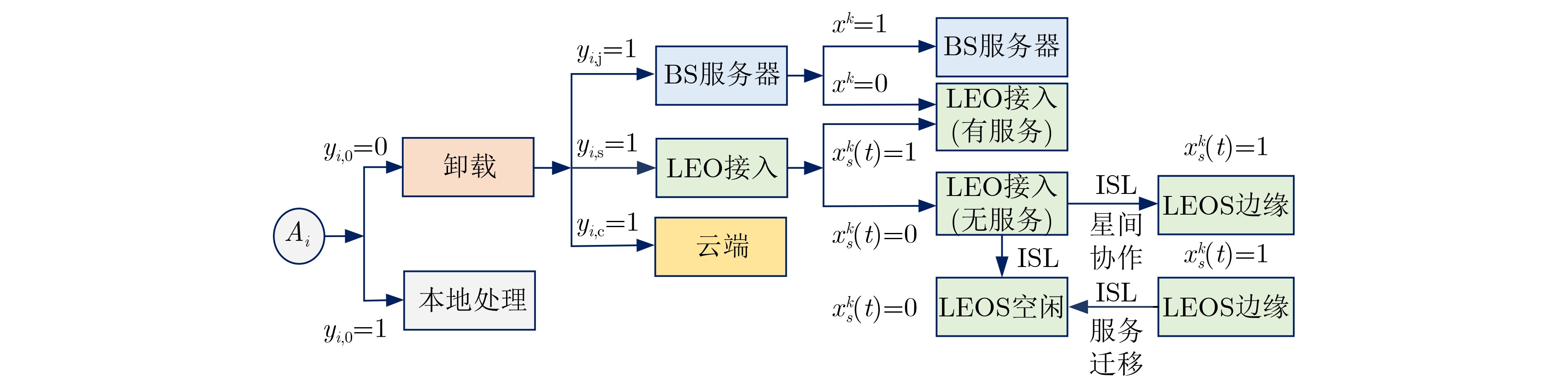
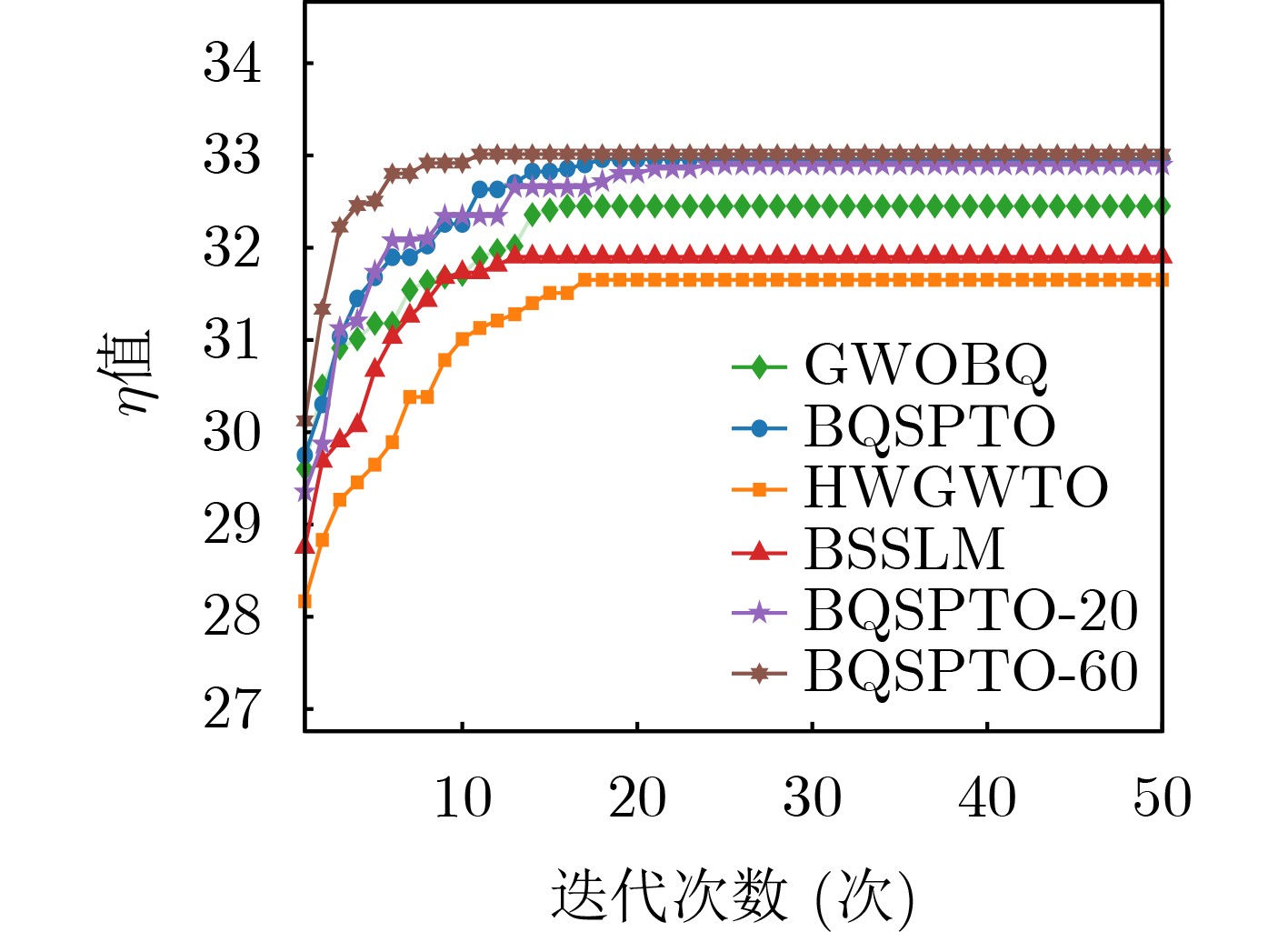
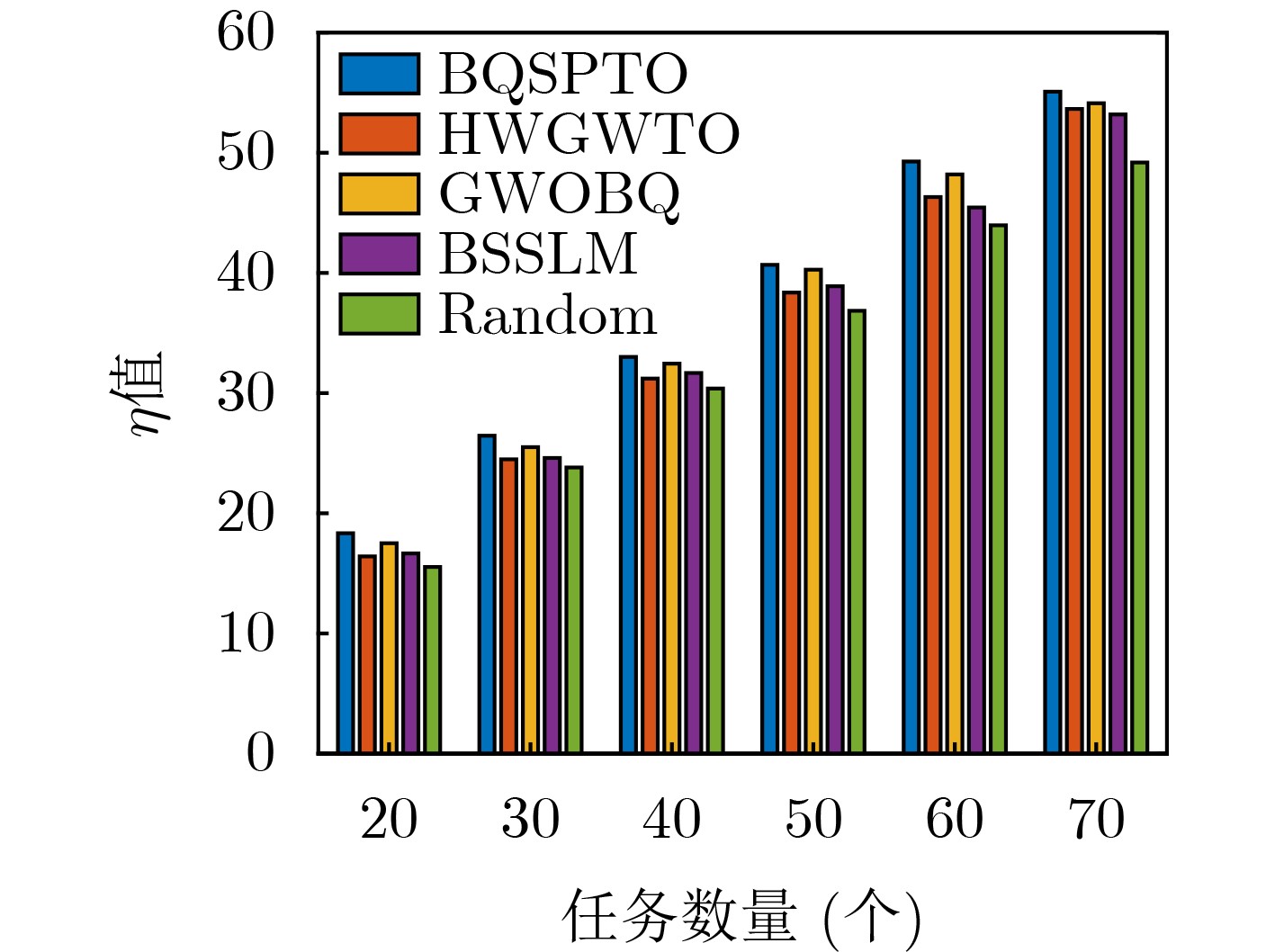
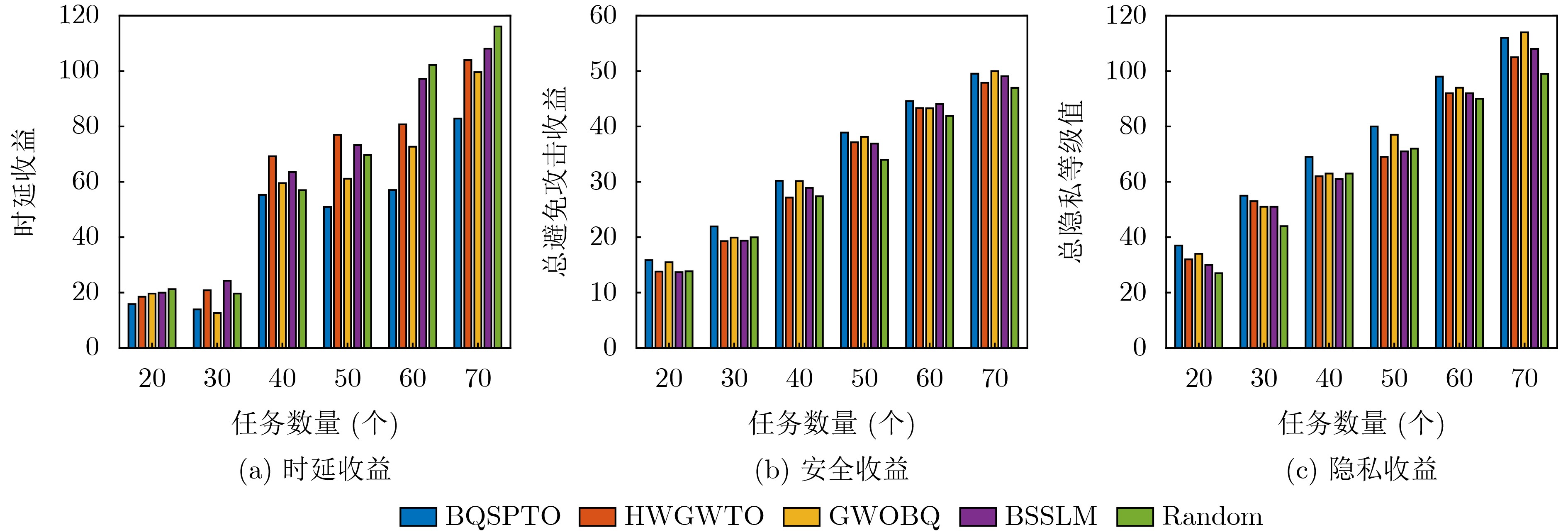
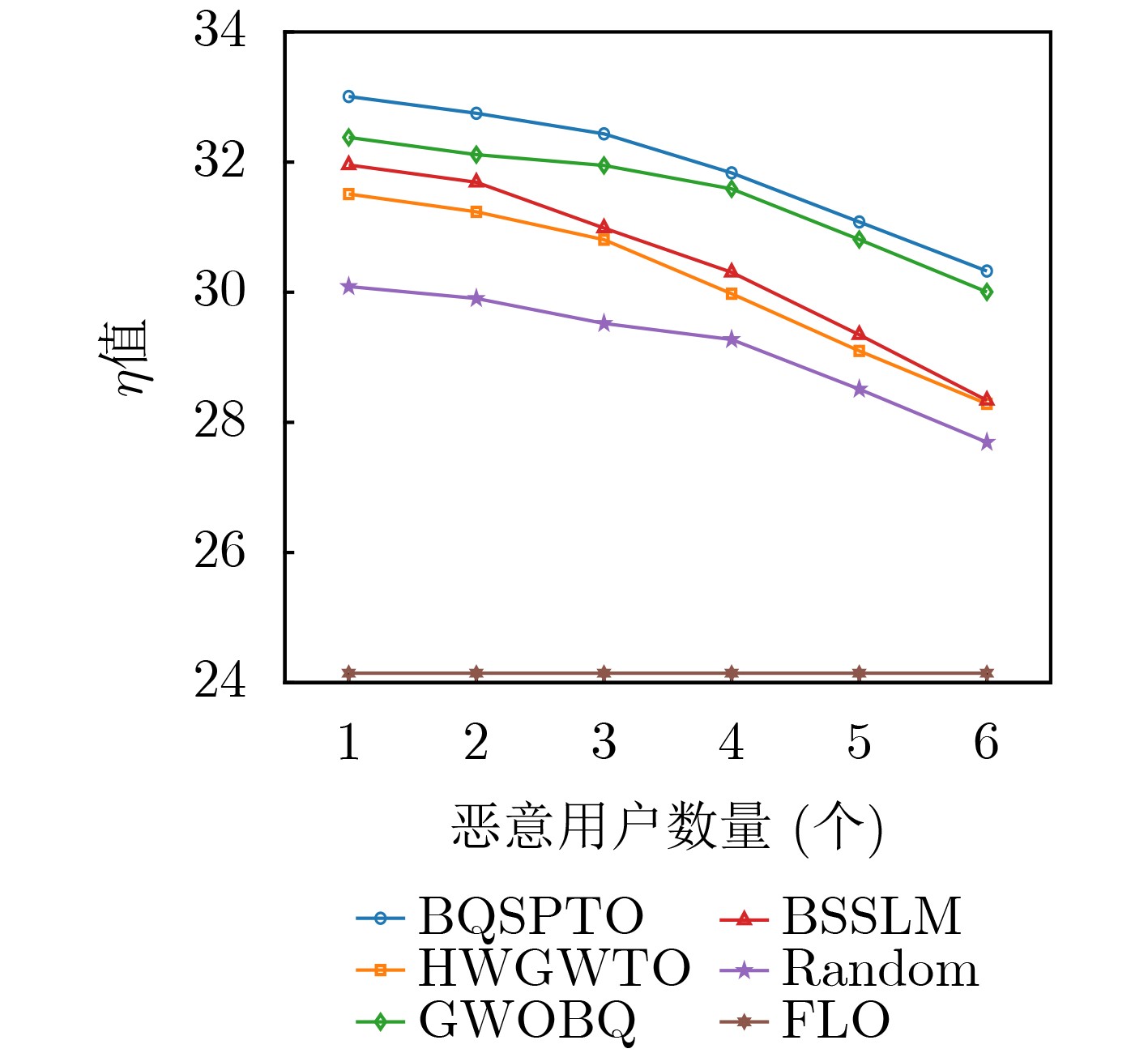
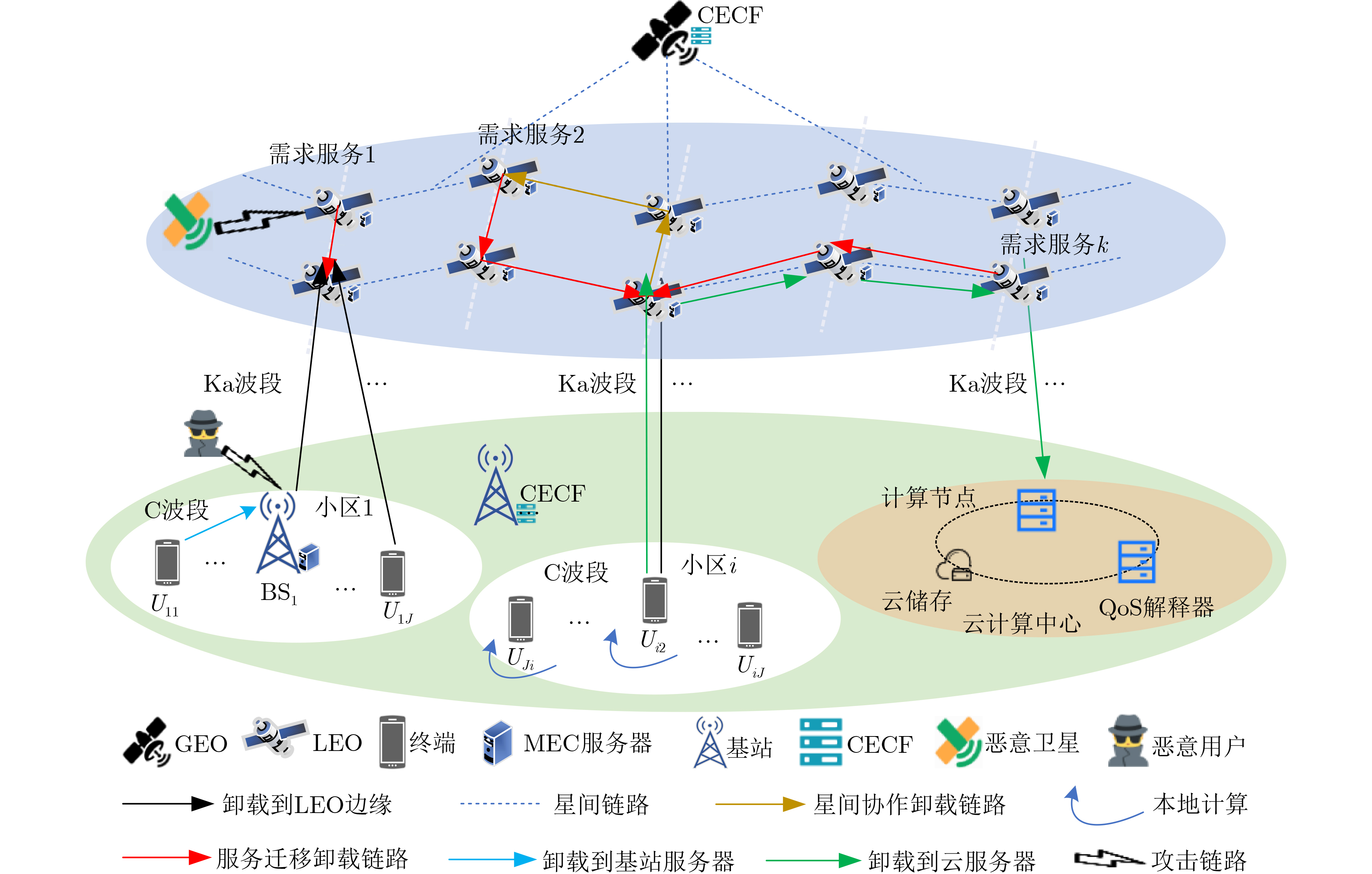
Objective Satellite-Terrestrial Integrated Networks (STIN) integrate multi-source and multi-dimensional services from terrestrial and satellite networks, providing wide coverage, large capacity, and flexible networking. These features support global coverage and ubiquitous access for diverse services. However, the dynamic topology and heterogeneous, resource-constrained nodes in STIN complicate service placement at satellite-terrestrial edge nodes. This further increases the difficulty of matching user service requests with edge computing resources during task offloading, making it difficult to satisfy Quality of Service (QoS) requirements. To address this issue, a joint optimization scheme for QoS-Balanced Service Placement and Task Offloading (BQSPTO) is proposed. The scheme integrates a Delay, Security, and Privacy-aware QoS (DSPQoS) evaluation model with satellite-terrestrial collaboration, inter-satellite cooperation, and service migration. It enables joint optimization of service placement and task offloading in a cloud-edge-end architecture, while satisfying task latency, security, and privacy requirements. Methods The proposed scheme integrates service placement, task offloading, and QoS evaluation into a unified framework. First, a cloud-edge-end collaborative STIN model is constructed, including terminal devices, terrestrial edge servers, satellite edge nodes, and cloud servers. Task security is quantified using the attack avoidance probability derived from key-cracking capability, and task privacy is characterized by usage-pattern privacy and location privacy. A DSPQoS evaluation model is established by combining task completion latency, attack avoidance probability, and privacy level. Second, a service placement strategy is designed based on task popularity prediction and service migration. A cloud-edge-end collaborative full offloading strategy is developed by determining offloading locations and multi-node cooperation modes according to QoS performance. Based on the service placement strategy and task offloading decisions, an optimization problem is formulated to maximize the total QoS performance under communication and computation resource constraints. Third, the joint optimization problem is decomposed into service placement and task offloading subproblems. A Non-dominated Sorting Genetic Algorithm II (NSGA-II) is applied to the service placement subproblem, while a hybrid Grey Wolf Optimization (GWO) and Whale Optimization Algorithm (WOA) is applied to the task offloading subproblem. Alternating optimization is employed to iteratively update both decisions and obtain the final solution. Results and Discussions The QoS performance of the proposed BQSPTO scheme is evaluated through MATLAB simulations. The cloud-edge-end collaborative task processing model ( Fig. 2 ) and the overall BQSPTO framework (Fig. 3 ) are analyzed. The proposed scheme is compared with three baseline methods: GWOBQ (Grey Wolf Optimization Algorithm-based BQSPTO Scheme), BSSLM (BQSPTO Scheme Without Service Migration), and HWGWTO (Hybrid Grey Wolf Optimization with Whale Algorithm Fusion for Task Offloading). Results show that BQSPTO achieves faster convergence and better avoids local optima, resulting in higher QoS performance (Fig. 4 ). Compared with GWOBQ, HWGWTO, and BSSLM, the QoS performance is improved by approximately 2.1%, 5.4%, and 4.8%, respectively. As the number of tasks increases, QoS performance improves for all methods, while BQSPTO consistently achieves the highest performance (Fig. 5 ). Latency, security, and privacy metrics increase with task volume, and BQSPTO maintains superior performance across these metrics, although trade-offs appear due to multi-objective optimization (Fig. 6 ). QoS performance decreases as the number of malicious users increases, while BQSPTO shows stronger robustness and stability (Fig. 7 ). As satellite capacity increases, the number of deployable service types grows, and QoS performance improves for all methods. BQSPTO remains superior under different capacity settings (Fig. 8 ).Conclusions A joint optimization scheme for service placement and task offloading in STIN is proposed under multi-objective QoS constraints. The DSPQoS evaluation model integrates latency, security, and privacy into a unified evaluation framework. The joint optimization problem is decomposed and solved using alternating optimization, enabling effective coordination between service placement and task offloading. Simulation results demonstrate that the proposed scheme achieves higher QoS performance, better convergence stability, and improved multi-objective balance under varying task loads, malicious user scales, and satellite capacities. -
1 多维QoS非支配排序遗传的服务放置算法
输入: $ \text{tasks} $, $ \text{sm} $, $ \text{mds} $, $ {\text{pop}}_{\text{size}} $,$ \text{cr} $,$ \text{mr} $,$ {G}_{\max } $ 输出: $ \text{Best}\_\text{Placement} $ (1) 基于卫星存储容量约束与任务流行度,初始化服务放置种群
$ \text{Pop} $,且$ \sum\text{Pop}\times k\leq s $,定义多目标指标计算函数:$ {\eta }_{n} $, $ {Q}_{n} $,
初始化全局精英方案$ {\text{Global}}_{\text{elite}} $、帕累托最优集合$ {\text{Pareto}}_{\text{set}} $(2) 遍历迭代次数$ g $从1~$ {G}_{\max } $: (3) for $ g=1 $ to $ G $ do (4) for $ X=1 $ to $ \mathrm{Pop} $ do (5) 计算适应度$ \text{Fitness}(X) $ end for (6) 进行非支配排序$ \text{Fronts} $与拥挤度计算$ \text{Growd}(X) $ (7) for $ {\text{Pop}}_{\text{size}}/2 $ do (8) 生成父代$ \text{Parents} $ end for (9) for $ \text{Parents}({X}_{1},{X}_{2}) $do (10) 交叉生成子代$ \text{Offsprings} $ end for (11) for $ X $ in $ \text{Offsprings} $ do (12) 按卫星变异优化子代$ \text{Offsprings} $ end for (13) 合并$ \text{Pop} $, $ \text{Offsprings} $, $ {\text{Global}}_{\text{elite}} $ (14) If $ \text{current}\_\text{best}\_\text{fitness} $ > $ {\text{Global}}_{\text{elite}} $ (15) 得到新一代种群$ \text{Pop} $,更新$ {\text{Pareto}}_{\text{set}} $, $ {\text{Global}}_{\text{elite}} $ (16) end if (17) end for (18) 迭代结束,从$ {\text{Pareto}}_{\text{set}} $中选择总QoS高的个体 (19) 输出: $ \text{Best}\_\text{Placement} $, $ {\text{Pareto}}_{\text{set}} $、总QoS曲线  下载: 导出CSV
2 融合鲸鱼与灰狼优化云边端协作的任务卸载算法
输入:$ \text{tasks} $, $ \text{sm} $, $ \text{mds} $, $ \text{Best}\_\text{Placement} $, $ {\text{Wolves}}_{\text{size}} $, $ {{T}}_{\text{max}} $ 输出:$ \text{Best}\_\text{offloading} $ (1) 基于卫星存储容量约束与任务流行度,初始化任务卸载灰狼
种群$ \text{Wolves} $,且$ \forall s, \sum_{i=1}^{N_{\mathrm{task}}} {\mathrm{II}}(X(i)=s) \le N_{\max, s} $、定义多
目标指标计算函数:$ {\eta }_{n} $,$ {Q}_{n} $,初始化全局最优个体$ {{\boldsymbol{X}}}_{\alpha } $、次优
个体$ {{\boldsymbol{X}}}_{\beta } $、第3优个体$ {{\boldsymbol{X}}}_{\delta } $(2) 遍历迭代次数$ t $从1~$ {T}_{\max } $: (3) for $ t=1 $ to $ {T}_{\max } $do (4) for $ X=1 $ to $ \text{Wolves} $do (5) 计算适应度$ \text{Fitness}(X) $end for (6) 更新个体,取前3名分别为$ {{\boldsymbol{X}}}_{\alpha } $, $ {{\boldsymbol{X}}}_{\beta } $, $ {{\boldsymbol{X}}}_{\delta } $ (7) 计算收敛因子$ a=2-2\times t/{T}_{\max } $,混合策略概率
$ p=0.5+t/\left(2T\right) $(8) for$ \text{Wolves} $ do (9) if $ \text{rand}() \lt P(t) $ (灰狼协作更新) (10) 计算$ {\boldsymbol{A}} $,$ {\boldsymbol{C}} $得到$ {\boldsymbol{X}}(t+1) $ (11) else (12) 计算$ {\bf{Levy}} $, $ {\bf{Lx}} $得到$ {\boldsymbol{X}}(t+1) $ (13) end if (14) end for (15) 约束修复,确保狼群个体$ \mathrm{Wolves} $为任务有效解 (16) 精英保留,保留适应度前$ \mathrm{Wolve}{\mathrm{s}}_{\mathrm{size}} $个体 (17) end for (18) 迭代结束,选择$ {{\boldsymbol{X}}}_{\alpha } $重塑为$ \text{Best}\_\text{offloading} $ (19) 输出:收敛曲线,保存$ \text{Best}\_\text{offloading} $
下载: 导出CSV
3 BQSPTO方案算法
输入: $ \text{tasks} $, $ \text{sm} $, $ \text{mds} $, $ {\text{pop}}_{\text{size}} $, $ {\text{Wolves}}_{\text{size}} $, $ {{D}}_{\text{max}} $ 输出: $ \text{Best}\_\text{Placement} $,$ \text{Best}\_\text{offloading} $ (1) 初始化核心参数与变量:生成初始服务放置策略Placement
与任务卸载方案$ \text{offloading} $(2) 定义联合优化原问题式(21)、服务放置子问题式(22)与
任务卸载子问题式(23)(3) 交替优化迭代循环$ d $,直至$ d={D}_{\max } $: (4) for $ d=1 $ to $ D $do (5) 第t轮:固定任务卸载方案$ \text{offloading} $、求解服务放置子问
题(多维QoS非支配排序遗传的服务放置算法)(6) 第t轮:固定服务放置策略$ \text{Placement} $,求解任务卸载子问
题(融合鲸鱼与灰狼优化云边端协作的任务卸载算法)(7) 收敛准则判断,并更新迭代次数$ d=d+1 $,记录$ {\eta }_{n} $,
$ {Q}_{n} $,保存$ {\text{offloading}}_{d} $,$ {\text{Placement}}_{d} $(8) end for (9) 迭代结束,选择总QoS值最大的$ \text{Placement} $,$ \text{offloading} $组合
作为$ \text{Best}\_\text{Placement} $和$ \text{Best}\_\text{offloading} $(10) 输出并保存:$ \text{Best}\_\text{Placement} $,$ \text{Best}\_\text{offloading} $
下载: 导出CSV
参数 数值 参数 数值 $ U $ 40 $ {f}_{i,0} $ [0.5, 1] Gcycle/s $ {M}_{k} $ [200, 600] kB $ f_{i,\mathrm{j}} $ 50 Gcycle/s $ K $ 10 $ f_{i,\mathrm{s}} $ 40 Gcycle/s $ {\text{Cac}}_{s} $ 1200 kB$ f_{i,\mathrm{c}} $ 10 Pcycle/s $ {a}_{i} $ [0.2, 5] Mbit $ {B}_{i,j} $ 500 MHZ $ {c}_{i} $ [ 1000 ,1500 ] cycle/bit$ p_{i}^{\text{D}} $ 0.5 W $ {O}_{k} $ 5 $ \gamma $ 4 $ c $ 3×10⁸ m/s $ {N}_{{{0}_{i,j}}} $ –174 dBm/Hz
下载: 导出CSV
-
[1] SUN Yaohua, PENG Mugen, ZHANG Shijie, et al. Integrated satellite-terrestrial networks: Architectures, key techniques, and experimental progress[J]. IEEE Network, 2022, 36(6): 191–198. doi: 10.1109/MNET.106.2100622. [2] MAO Yuyi, YOU Changsheng, ZHANG Jun, et al. A survey on mobile edge computing: The communication perspective[J]. IEEE Communications Surveys & Tutorials, 2017, 19(4): 2322–2358. doi: 10.1109/COMST.2017.2745201. [3] JIANG Guanwu, HAN Shujun, XU Xiaodong, et al. Task-oriented cloud-edge-device collaborative semantic communication: Trade-off between privacy-preserving and QoAIS[J]. IEEE Transactions on Information Forensics and Security, 2025, 20: 11134–11149. doi: 10.1109/TIFS.2025.3622076. [4] 张治霖, 毛忠阳, 陆发平, 等. 海上无线通信跨层协同资源分配: QoS感知功率调控与知识增强业务调度[J]. 电子与信息学报, 2025, 47(10): 3595–3609. doi: 10.11999/JEIT250252.ZHANG Zhilin, MAO Zhongyang, LU Faping, et al. Cross-layer collaborative resource allocation in maritime wireless communications: QoS-aware power control and knowledge-enhanced service scheduling[J]. Journal of Electronics & Information Technology, 2025, 47(10): 3595–3609. doi: 10.11999/JEIT250252. [5] WOLDEYES S K, ZHANG Yongmin, WANG Wei, et al. HAC-LSTM: Mobility-aware joint service placement and task offloading scheme in MEC[C]. ICC 2025 - IEEE International Conference on Communications, Montreal, Canada, 2025: 1–6. doi: 10.1109/ICC52391.2025.11161941. [6] DING Erzhu, LI Hewu, LIU Jun, et al. Research on edge server deployment strategy in LEO mega-constellation[C]. 2024 IEEE Wireless Communications and Networking Conference (WCNC), Dubai, United Arab Emirates, 2024: 1–6. doi: 10.1109/WCNC57260.2024.10570809. [7] DENG Peng, GONG Xiangyang, and QUE Xirong. A mobility adaptive service placement scheme in satellite edge computing network[C]. 2022 IEEE 24th Int Conf on High Performance Computing & Communications; 8th Int Conf on Data Science & Systems; 20th Int Conf on Smart City; 8th Int Conf on Dependability in Sensor, Cloud & Big Data Systems & Application (HPCC/DSS/SmartCity/DependSys), Hainan, China, 2022: 1430–1435. doi: 10.1109/HPCC-DSS-SmartCity-DependSys57074.2022.00221. [8] WOLDEYES S K, ZHANG Yongmin, WANG Wei, et al. Joint resource placement and service replica placement scheme in mobile edge computing[C]. 2023 IEEE Intl Conf on Parallel & Distributed Processing with Applications, Big Data & Cloud Computing, Sustainable Computing & Communications, Social Computing & Networking (ISPA/BDCloud/SocialCom/SustainCom), Wuhan, China, 2023: 360–367. doi: 10.1109/ISPA-BDCloud-SocialCom-SustainCom59178.2023.00079. [9] TANG Qingqing, FEI Zesong, LI Bin, et al. Computation offloading in LEO satellite networks with hybrid cloud and edge computing[J]. IEEE Internet of Things Journal, 2021, 8(11): 9164–9176. doi: 10.1109/JIOT.2021.3056569. [10] 贾子晔, 姜官旺, 崔灿, 等. 面向低空智联网的分布式鲁棒任务卸载方法[J]. 电子与信息学报, 2025, 47(5): 1450–1460. doi: 10.11999/JEIT240799.JIA Ziye, JIANG Guanwang, CUI Can, et al. Distributionally robust task offloading for low-altitude intelligent networks[J]. Journal of Electronics & Information Technology, 2025, 47(5): 1450–1460. doi: 10.11999/JEIT240799. [11] 王练, 闫润搏, 徐静. 车载边缘计算中多任务部分卸载方案研究[J]. 电子与信息学报, 2023, 45(3): 1094–1101. doi: 10.11999/JEIT211620.WANG Lian, YAN Runbo, and XU Jing. Research on multi-task partial offloading scheme in vehicular edge computing[J]. Journal of Electronics & Information Technology, 2023, 45(3): 1094–1101. doi: 10.11999/JEIT211620. [12] SONG Liangjun, SUN Gang, YU Hongfang, et al. SD-AETO: Service-deployment-enabled adaptive edge task offloading scheme in MEC[J]. IEEE Internet of Things Journal, 2023, 10(21): 19296–19311. doi: 10.1109/JIOT.2023.3281603. [13] LI Xin, ZHANG Xinglin, and HUANG Tiansheng. Joint task offloading and service placement for mobile edge computing: An online two-timescale approach[J]. IEEE Transactions on Cloud Computing, 2023, 11(4): 3656–3671. doi: 10.1109/TCC.2023.3312283. [14] DU Jianbo, KONG Ziwen, SUN Aijing, et al. MADDPG-based joint service placement and task offloading in MEC empowered air–ground integrated networks[J]. IEEE Internet of Things Journal, 2024, 11(6): 10600–10615. doi: 10.1109/JIOT.2023.3326820. [15] ZHAO Youhan, LIU Chenxi, HU Xiaoling, et al. Joint content caching, service placement, and task offloading in UAV-enabled mobile edge computing networks[J]. IEEE Journal on Selected Areas in Communications, 2025, 43(1): 51–63. doi: 10.1109/JSAC.2024.3460049. [16] 戴翠琴, 王泓运, 郭浩鹏. 面向6G星地融合的QoAIS保障技术研究[J]. 移动通信, 2025, 49(6): 83–94. doi: 10.3969/j.issn.1006-1010.20250425-0001.DAI Cuiqin, WANG Hongyun, and GUO Haopeng. Research on QoAIS guarantee technologies for the 6G satellite-terrestrial integrated network[J]. Mobile Communications, 2025, 49(6): 83–94. doi: 10.3969/j.issn.1006-1010.20250425-0001. [17] FADLULLAH Z M, MAO Bomin, and KATO N. Balancing QoS and security in the edge: Existing practices, challenges, and 6g opportunities with machine learning[J]. IEEE Communications Surveys & Tutorials, 2022, 24(4): 2419–2448. doi: 10.1109/COMST.2022.3191697. [18] 闫富朝, 刘怡良, 韩帅, 等. 空天地通信网络中物理层安全技术综述[J]. 电信科学, 2020, 36(9): 1–13. doi: 10.11959/j.issn.1000-0801.2020263.YAN Fuchao, LIU Yiliang, HAN Shuai, et al. A survey of physical layer security in space-air-ground communication and networks[J]. Telecommunications Science, 2020, 36(9): 1–13. doi: 10.11959/j.issn.1000-0801.2020263. [19] LAN Wenjun, CHEN Kongyang, LI Yikai, et al. Deep reinforcement learning for privacy-preserving task offloading in integrated satellite-terrestrial networks[J]. IEEE Transactions on Mobile Computing, 2024, 23(10): 9678–9691. doi: 10.1109/TMC.2024.3366928. [20] 戴翠琴, 李小玉, 廖明霞, 等. 星地融合网络中的计算卸载与资源分配联合优化[J]. 重庆邮电大学学报(自然科学版), 2025, 37(4): 471–482. doi: 10.3979/j.issn.1673-825X.202412090292.DAI Cuiqin, LI Xiaoyu, LIAO Mingxia, et al. Joint optimization of computation offloading and resource allocation in satellite-terrestrial integrated networks[J]. Journal of Chongqing University of Posts and Telecommunications (Natural Science Edition), 2025, 37(4): 471–482. doi: 10.3979/j.issn.1673-825X.202412090292. [21] LIU Nianshen, CAI Jianjun, ZENG Xiaojuan, et al. Cryptographic performance for Rijndael and RC6 block ciphers[C]. 2017 11th IEEE International Conference on Anti-counterfeiting, Security, and Identification, Xiamen, China, 2017: 36–39. doi: 10.1109/ICASID.2017.8285739. [22] 梁承超, 柏耀辅, 陈前斌. 基于鲁棒优化的卫星虚拟网络准入控制与资源分配研究[J]. 电子与信息学报, 2023, 45(12): 4327–4335. doi: 10.11999/JEIT221381.LIANG Chengchao, BAI Yaofu, and CHEN Qianbin. Research on satellite virtual network admission control and resource allocation based on robust optimization[J]. Journal of Electronics & Information Technology, 2023, 45(12): 4327–4335. doi: 10.11999/JEIT221381. [23] 3GPP TR 38.811. Study on new radio (NR) to support non-terrestrial networks (Release15)[S]. 3GPP, 2020. [24] 3GPP TR 38.821. Solutions for NR to support non-terrestrial networks (NTN) (Release 16)[S]. 3GPP, 2023. -


 下载:
下载:



图(8) / 表(4)
计量
- 文章访问数: 814
- HTML全文浏览量: 374
- PDF下载量: 74
- 被引次数: 0
