




SAR Saturated Interference Suppression Method Guided by Precise Saturation Model
-
摘要: 合成孔径雷达(SAR)极易受到射频干扰(RFI)的影响。相关学者针对SAR干扰抑制已经开展了深入的研究,并提出了一系列干扰抑制算法。然而,目前大多数算法并未考虑到SAR接收机发生饱和的影响。实际上,当干扰功率较大时,SAR接收机非常容易发生饱和,使受干扰回波产生非线性畸变,导致饱和干扰与当前干扰抑制算法的模型失配。目前仍缺少能够精确描述饱和受干扰回波特性的数学模型以及饱和干扰抑制方法。为此,该文首先提出了精确饱和干扰分析模型,并验证了该模型在分析饱和干扰幅相信息时的准确性。基于该模型,提出了一种能有效缓解饱和干扰的抑制方法。首先,基于干扰基波大功率特性通过特征子空间分解来提取基波;然后,利用谐波与基波的相位关系,构建涵盖目标回波、干扰基波、干扰谐波以及互调谐波的综合完备字典;最后求解稀疏优化问题,完成饱和干扰的分离与抑制。通过实测数据验证,并与其他抑制方法进行对比,验证了所提方法在应对饱和干扰时的有效性。Abstract:
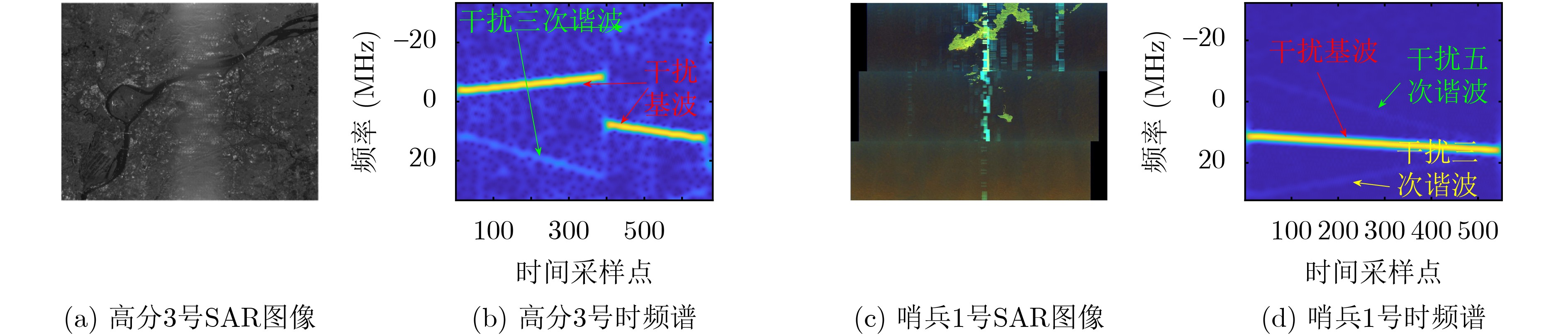
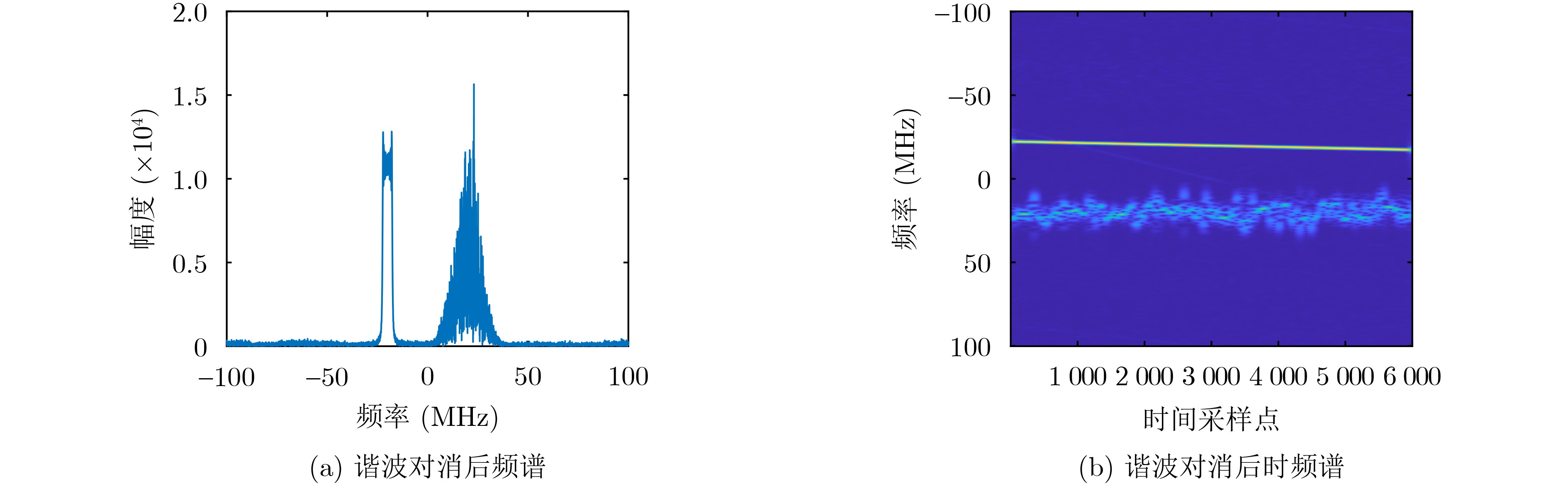
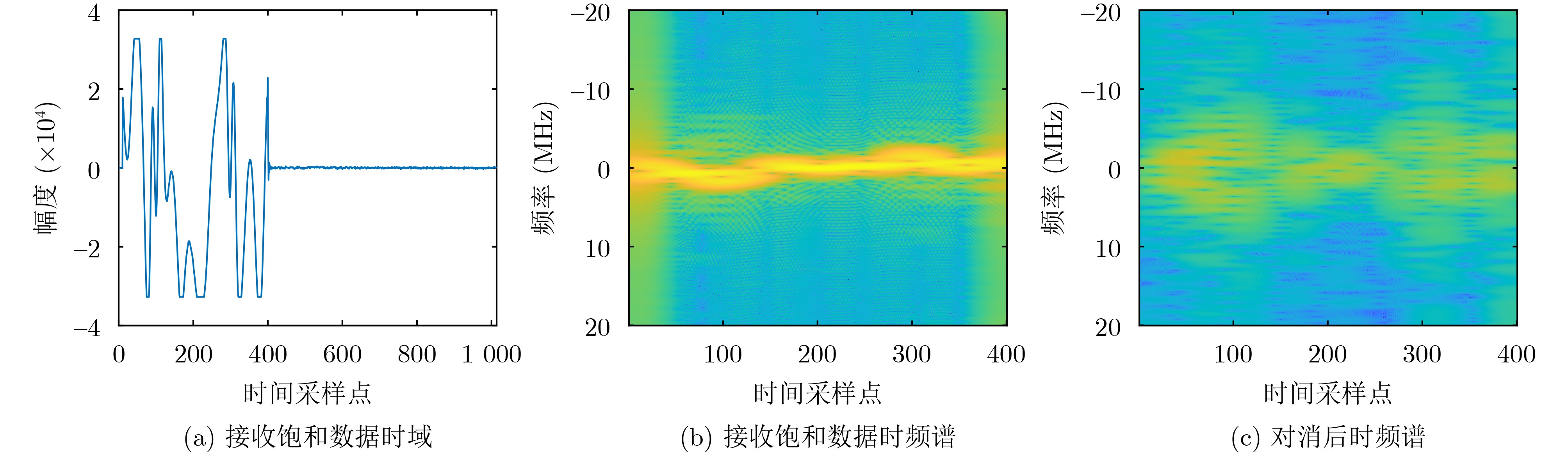
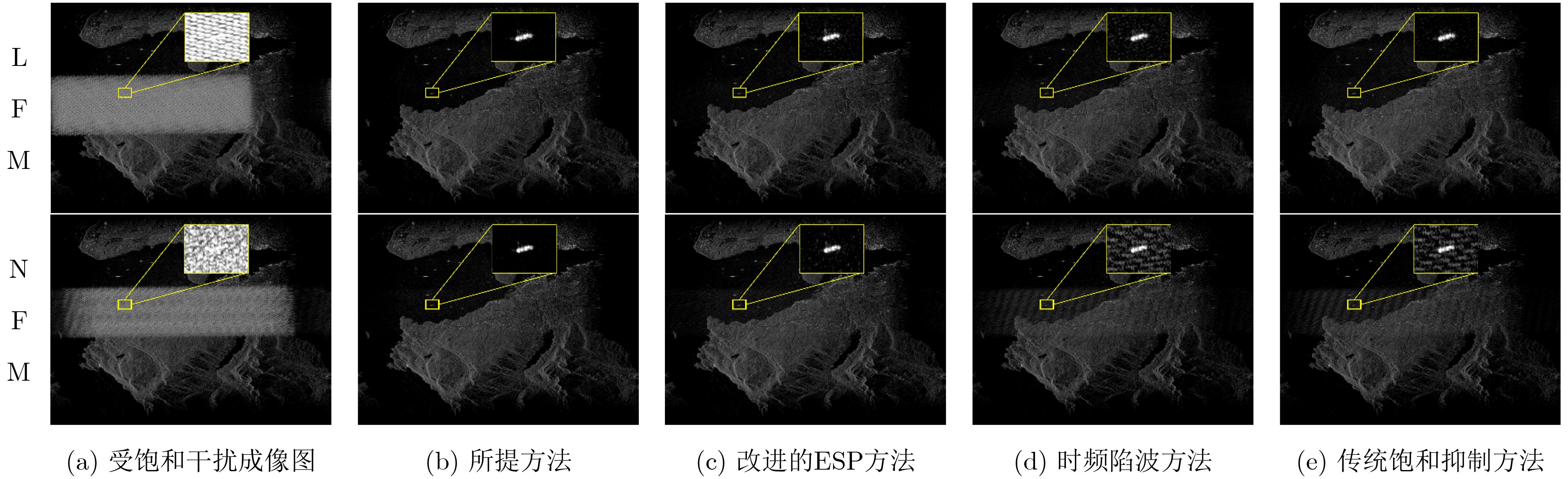
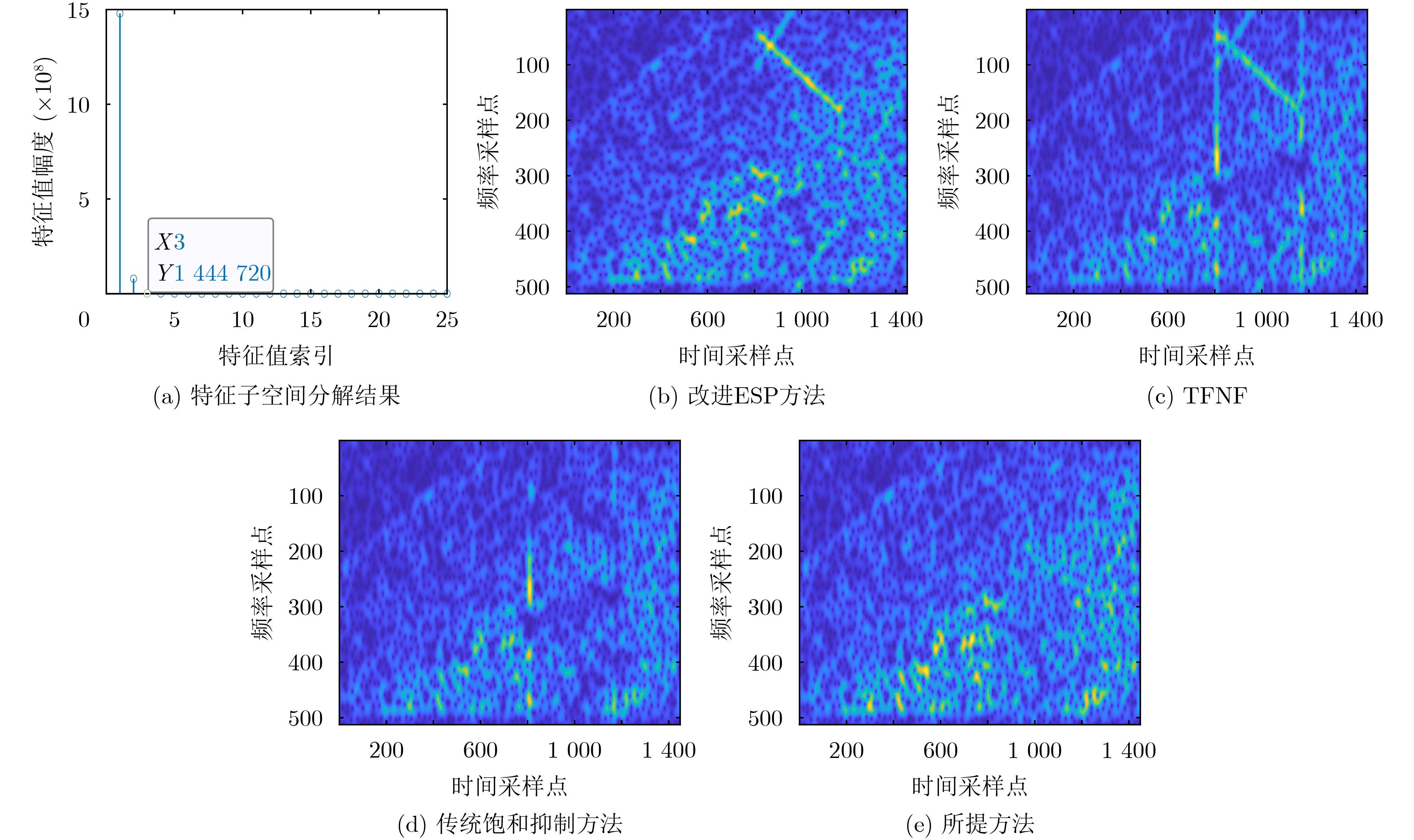
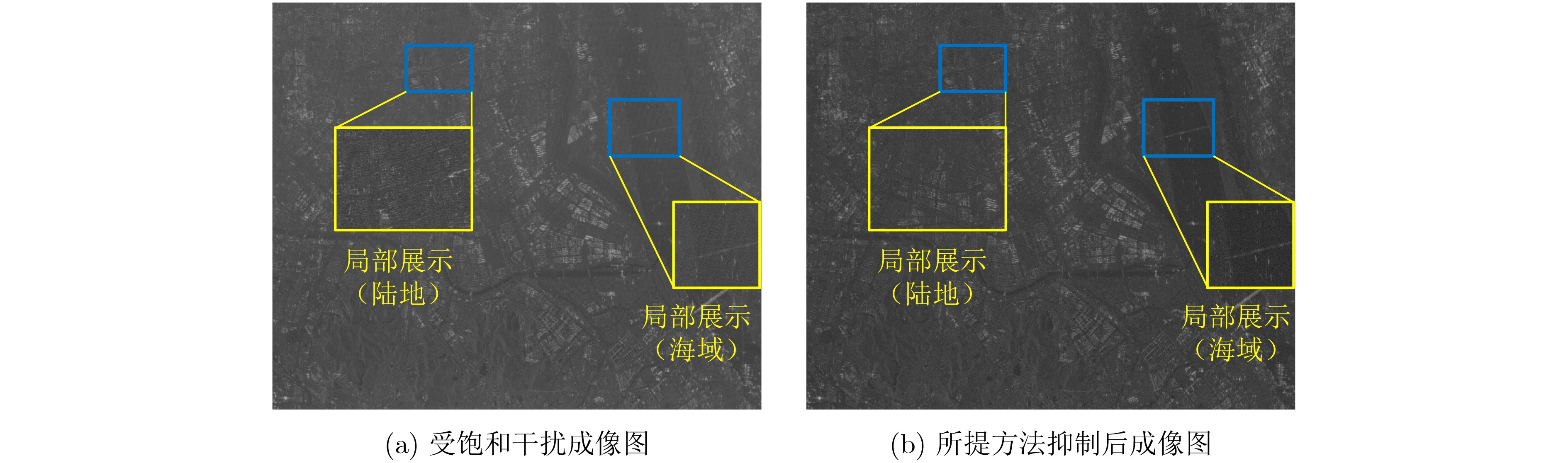
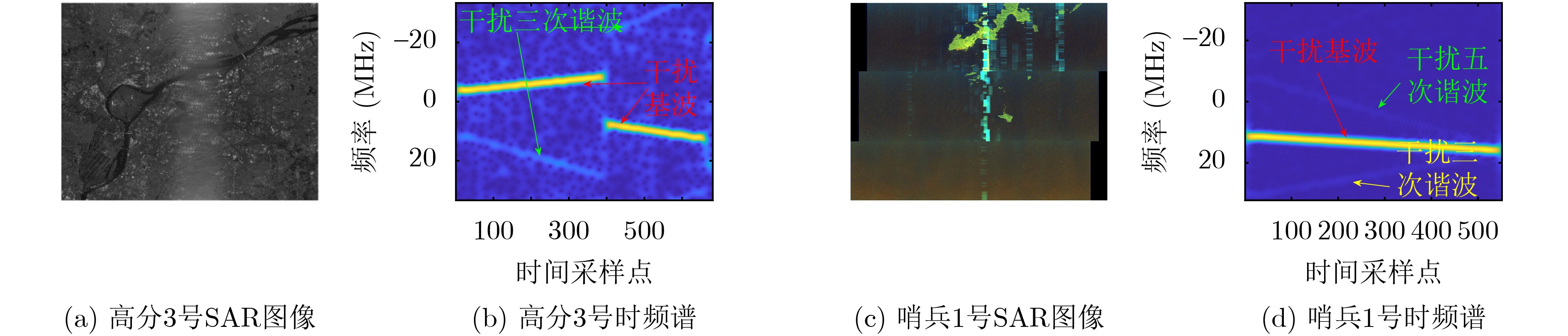
Objective With the increasing number of electromagnetic devices, Synthetic Aperture Radar (SAR) is highly susceptible to Radio Frequency Interference (RFI) within the same frequency band. RFI typically appears as bright streaks in SAR images and severely degrades image quality. Considerable research has been conducted on interference suppression, and many effective methods have been proposed. However, most existing approaches do not consider the nonlinear saturation of interfered echoes. In practical scenarios, the interference power is usually high, and the gain controller in the SAR receiver cannot effectively regulate the amplitude of interfered echoes. Therefore, the input signal amplitude of the Analog-to-Digital Converter (ADC) exceeds its dynamic range. This condition drives the SAR receiver into saturation and leads to nonlinear distortion in the interfered echoes. Such phenomena have been observed in multiple SAR systems. Documented cases include receiver saturation in the LuTan-1 satellite and several airborne SAR platforms. Analyses of SAR data further confirm the presence of saturated interference in systems such as Sentinel-1, Gaofen-3, and other spaceborne SAR platforms. After saturation occurs, the echo spectrum exhibits spurious components and spectral artifacts. These effects cause a mismatch between existing suppression methods and the actual characteristics of saturated interference. Therefore, many current methods cannot effectively mitigate this type of interference. Moreover, accurate models that precisely describe the output components of saturated interfered echoes remain limited. To address these issues, a precise analytical model for saturated interference is established, and an effective saturated interference suppression method is proposed based on this model. Methods Based on the processing of the basic saturation model, a mathematical model is first developed to accurately characterize the output components of saturated interference. The accuracy of the model in describing amplitude and phase is validated through simulations. A detailed analysis of the output components of interfered echoes under saturation conditions is also conducted. Compared with the one-bit sampling model and the traditional tanh saturation model, the proposed model provides higher accuracy in describing amplitude information. In addition, the model is not limited by the sampling bit width of ADCs and can theoretically be extended to describe saturation outputs in other radar receivers. Based on the observation that harmonic phases can be expressed as a linear combination of the phases of the original signal components, and by exploiting the high-power characteristic of the interference fundamental harmonic, a saturated interference suppression method is proposed. First, because the interference fundamental harmonic has relatively high power, it is extracted using eigen-subspace decomposition. Then, based on harmonic phase relationships, the extracted interference fundamental harmonic, and the SAR transmitted signal, various interference harmonics are systematically constructed. These include higher-order interference harmonics, target harmonics, and intermodulation harmonics, which together form a complete dictionary. Finally, a sparse optimization problem is solved to achieve separation and suppression of saturated interference. The effectiveness of the proposed method is verified using measured Gaofen-3 data. Results and Discussions Experiments are conducted using both simulated and measured data to verify the effectiveness of the proposed method in suppressing saturated interference. For simulated data, the proposed method completely removes interference stripes in the SAR image ( Fig. 7 ). Analysis of the time-frequency spectra of the processed echoes (Fig. 8 andFig. 9 ) shows that traditional methods cannot effectively eliminate higher-order harmonics. Thus, the proposed method improves the Target-to-Background Ratio (TBR) by 1.76 dB and achieves the lowest Root Mean Square Error (RMSE) of 0.078 3 (Table 3 ). For the measured Gaofen-3 data, analysis of the processed images and the time-frequency spectra of echoes confirms that the proposed method effectively suppresses interference. Conventional methods still exhibit residual interference in the processed results (Fig. 10 andFig. 11 ).Conclusions With the increasing deployment of electromagnetic devices, SAR systems are increasingly susceptible to in-band interference. High-power interference can drive the SAR receiver into saturation and cause nonlinear distortion, which reduces the effectiveness of traditional interference suppression methods. To address this issue, a model that precisely characterizes the saturated output components of interfered echoes is established. Based on this model, an interference suppression method for saturated interference is proposed. Simulation and experimental results show that the model accurately describes saturation behavior and that the proposed method effectively suppresses saturated interference. -
表 1 实验参数设置
参数名称 参数值 目标参数名称 参数值 干扰参数名称 参数值 雷达工作频率 5 GHz 信号形式 线性调频信号 信号形式 噪声调频信号 系统采样率 40 MHz 脉宽 10 $ \text{μs} $ 脉宽 10 $ \text{μs} $ 系统ADC位数 16 bit 带宽 2 MHz 带宽 3 MHz 中心频率 0 MHz 中心频率 0 MHz  下载: 导出CSV
表 2 仿真实验参数设置
参数名称 参数值 参数名称 参数值 参数名称 参数值 雷达工作频率 5.300 GHz LFM干扰载频 5.297 GHz NFM干扰载频 5.310 GHz 系统采样率 32.317 MHz LFM干扰脉宽 11 $ \text{μs} $ NFM干扰脉宽 9 $ \text{μs} $ 脉冲重复频率 1256.98 HzLFM干扰带宽 3 MHz NFM干扰带宽 10 MHz 发射信号带宽 30.116 MHz 饱和系数 0.8 饱和系数 0.6
下载: 导出CSV
表 3 不同干扰抑制方法指标对比
干扰类型 指标 所提方法 改进的ESP方法 时频陷波方法 传统饱和干扰抑制方法 LFM干扰 TBR(dB) 11.5913 9.8282 8.6264 10.1765 RMSE 0.0783 0.1282 0.1688 0.1304 ISR 0.7736 0.7688 0.7640 0.7673 NFM干扰 TBR(dB) 9.9470 8.1746 3.5580 3.5839 RMSE 0.1187 0.1858 0.4510 0.4190 ISR 0.7028 0.6939 0.6497 0.6563
下载: 导出CSV
-
[1] 黄岩, 赵博, 陶明亮, 等. 合成孔径雷达抗干扰技术综述[J]. 雷达学报, 2020, 9(1): 86–106. doi: 10.12000/JR19113.HUANG Yan, ZHAO Bo, TAO Mingliang, et al. Review of synthetic aperture radar interference suppression[J]. Journal of Radars, 2020, 9(1): 86–106. doi: 10.12000/JR19113. [2] SHEN Yan, WANG Yuming, MA Liyun, et al. Research on simulation method for nonlinear effects of airborne SAR electromagnetic interference[J]. AIP Advances, 2023, 13(10): 105002. doi: 10.1063/5.0157444. [3] CAI Yonghua, LI Junfeng, YANG Qingyue, et al. First demonstration of RFI mitigation in the phase synchronization of LT-1 bistatic SAR[J]. IEEE Transactions on Geoscience and Remote Sensing, 2023, 61: 5217319. doi: 10.1109/TGRS.2023.3310613. [4] 李东, 占木杨, 方志平, 等. 基于HAF的参数化SAR宽带干扰抑制[J]. 系统工程与电子技术, 2017, 39(3): 514–521. doi: 10.3969/j.issn.1001-506X.2017.03.09.LI Dong, ZHAN Muyang, FANG Zhiping, et al. Parameterized wideband interference suppression for SAR imaging based on HAF[J]. Systems Engineering and Electronics, 2017, 39(3): 514–521. doi: 10.3969/j.issn.1001-506X.2017.03.09. [5] LIU Zhiling, LIAO Guisheng, and YANG Zhiwei. Time variant RFI suppression for SAR using iterative adaptive approach[J]. IEEE Geoscience and Remote Sensing Letters, 2013, 10(6): 1424–1428. doi: 10.1109/LGRS.2013.2259575. [6] TAO Mingliang, ZHOU Feng, and ZHANG Zijing. Wideband interference mitigation in high-resolution airborne synthetic aperture radar data[J]. IEEE Transactions on Geoscience and Remote Sensing, 2016, 54(1): 74–87. doi: 10.1109/TGRS.2015.2450754. [7] ZHAO Tengfei, ZHANG Yongsheng, YANG Lin, et al. The RFI suppression method based on Stft applied to SAR[J]. Progress in Electromagnetics Research M, 2013, 31: 171–188. doi: 10.2528/PIERM13050113. [8] HAN Wenchang and ZHOU Feng. SAR wideband interference suppression method using second-order multisynchrosqueezing transform[J]. IEEE Transactions on Geoscience and Remote Sensing, 2022, 60: 5230215. doi: 10.1109/TGRS.2022.3184945. [9] FENG Jin, ZHENG Huifang, DENG Yunkai, et al. Application of subband spectral cancellation for SAR narrow-band interference suppression[J]. IEEE Geoscience and Remote Sensing Letters, 2012, 9(2): 190–193. doi: 10.1109/LGRS.2011.2163150. [10] 舒高峰, 刘明月, 李宁. 采用改进特征子空间投影的SAR脉冲式直达波干扰抑制方法[J]. 电子与信息学报, 2024, 46(4): 1382–1390. doi: 10.11999/JEIT230665.SHU Gaofeng, LIU Mingyue, and LI Ning. SAR pulsed direct wave interference suppression method using improved Eigen-subspace projection[J]. Journal of Electronics & Information Technology, 2024, 46(4): 1382–1390. doi: 10.11999/JEIT230665. [11] 周峰, 邢孟道, 保铮. 基于特征子空间滤波的SAR窄带干扰抑制方法[J]. 电子与信息学报, 2005, 27(5): 767–770.ZHOU Feng, XING Mengdao, and BAO Zheng. Narrow band interference suppression for SAR using Eigen-subspace based filtering[J]. Journal of Electronics & Information Technology, 2005, 27(5): 767–770. [12] NGUYEN L H and TRAN T D. Efficient and robust RFI extraction via sparse recovery[J]. IEEE Journal of Selected Topics in Applied Earth Observations and Remote Sensing, 2016, 9(6): 2104–2117. doi: 10.1109/JSTARS.2016.2528884. [13] SU Jia, TAO Hailong, TAO Mingliang, et al. Narrow-band interference suppression via RPCA-based signal separation in time–frequency domain[J]. IEEE Journal of Selected Topics in Applied Earth Observations and Remote Sensing, 2017, 10(11): 5016–5025. doi: 10.1109/JSTARS.2017.2727520. [14] CHEN Xuezhi, HUANG Yan, YU Xutao, et al. A RFI mitigation approach for spaceborne SAR using homologous interference knowledge at coastal regions[J]. IEEE Journal of Selected Topics in Applied Earth Observations and Remote Sensing, 2025, 18: 5990–6006. doi: 10.1109/JSTARS.2025.3530473. [15] ZHAO Jiayi, YUE Yaxing, ZHANG Xuepan, et al. A joint framework of wavelet filtering and fast GSVT-LRSD algorithm for SAR narrowband pulsed RFI suppression[J]. IEEE Transactions on Geoscience and Remote Sensing, 2025, 63: 5216316. doi: 10.1109/TGRS.2025.3587054. [16] 韩朝赟, 岑熙, 崔嘉禾, 等. 纹理异常感知SAR自监督学习干扰抑制方法[J]. 雷达学报, 2023, 12(1): 154–172. doi: 10.12000/JR22168.HAN Zhaoyun, CEN Xi, CUI Jiahe, et al. Self-supervised learning method for SAR interference suppression based on abnormal texture perception[J]. Journal of Radars, 2023, 12(1): 154–172. doi: 10.12000/JR22168. [17] FAN Weiwei, TIAN Tian, WANG Siyao, et al. AMDIS-Net: A multiple attention mechanism based deep dense interference suppression network for Sentinel-1 SAR data[J]. IEEE Transactions on Aerospace and Electronic Systems, 2025, 61(6): 16869–16887. doi: 10.1109/TAES.2025.3601099. [18] WEI Shunjun, ZHANG Hao, ZENG Xiangfeng, et al. CARNet: An effective method for SAR image interference suppression[J]. International Journal of Applied Earth Observation and Geoinformation, 2022, 114: 103019. doi: 10.1016/j.jag.2022.103019. [19] SHEN Jiayuan, HAN Bing, SUN Xian, et al. A lightweight network for radio frequency interference suppression in SAR amplitude images using matrix representation and decomposition[J]. IEEE Transactions on Geoscience and Remote Sensing, 2025, 63: 5216718. doi: 10.1109/TGRS.2025.3591388. [20] CEN Xi, LI Yachao, HAN Zhaoyun, et al. Self-supervised learning method for SAR multiinterference suppression[J]. IEEE Transactions on Geoscience and Remote Sensing, 2023, 61: 5220017. doi: 10.1109/TGRS.2023.3328019. [21] ZHENG Fenghao, ZHANG Zhongmin, and ZHANG Kexin. Prior knowledge constraints network (PKCNet) for synthetic aperture radar pulse radio frequency interference suppression[J]. IEEE Geoscience and Remote Sensing Letters, 2024, 21: 4007105. doi: 10.1109/LGRS.2024.3380675. [22] LOU Mingyue, AN Hongyang, ZUO Haowen, et al. Feature-enhanced low-rank and sparse decomposition network for SAR RFI suppression[J]. IEEE Transactions on Geoscience and Remote Sensing, 2025, 63: 5210517. doi: 10.1109/TGRS.2025.3564509. [23] LI Zhou, LI Chunsheng, YU Ze, et al. Effects of receiver saturation on image formation[C]. IEEE International Geoscience and Remote Sensing Symposium, Vancouver, Canada, 2011: 535–538. doi: 10.1109/IGARSS.2011.6049183. [24] XIAO Peng, LIU Min, GUO Wei, et al. Reconstruction of synthetic aperture radar raw data under analog-to-digital converter saturation distortion for large dynamic range scenes[J]. Remote Sensing, 2019, 11(9): 1043. doi: 10.3390/rs11091043. [25] ZHAO Bo, HUANG Lei, and BAO Weimin. One-bit SAR imaging based on single-frequency thresholds[J]. IEEE Transactions on Geoscience and Remote Sensing, 2019, 57(9): 7017–7032. doi: 10.1109/TGRS.2019.2910284. [26] DUAN Lunhao, LU Xingyu, YANG Jianchao, et al. Saturated interference in SAR: Theoretical analysis and suppression solutions[J]. IEEE Journal of Selected Topics in Applied Earth Observations and Remote Sensing, 2025, 18: 9244–9261. doi: 10.1109/JSTARS.2025.3554199. [27] 邢家省, 张愿章. 应用傅里叶级数展开定理证明推广的黎曼—勒贝格引理[J]. 河南科学, 2013, 31(3): 253–257. doi: 10.13537/j.issn.1004-3918.2013.03.029.XING Jiasheng and ZHANG Yuanzhang. The proof of generalized Riemann-Lebesgue Lemma by using Fourier series expansion theory[J]. Henan Science, 2013, 31(3): 253–257. doi: 10.13537/j.issn.1004-3918.2013.03.029. [28] BOYD S, PARIKH N, CHU E, et al. Distributed optimization and statistical learning via the alternating direction method of multipliers[J]. Foundations and Trends in Machine Learning, 2011, 3(1): 1–122. doi: 10.1561/2200000016. -

 下载:
下载:





图(11) / 表(4)
计量
- 文章访问数: 1058
- HTML全文浏览量: 554
- PDF下载量: 88
- 被引次数: 0
