




A Semantic-Enhanced Cybersecurity Named Entity Recognition Approach Oriented to Lightweight Adaptation of Large Language Models
-
摘要: 网络安全领域命名实体识别作为支撑威胁情报分析、安全事件响应及漏洞管理的核心技术,面临着标注数据稀缺、专业术语密集与语义融合不足等严峻挑战,而现有的大语言模型方法又存在领域语义融合不足和稀有实体召回率低等缺陷。针对以上挑战,该文提出了一种面向大语言模型轻量化适配的语义增强型网络安全命名实体识别方法。该方法集成LLM2Vec与低秩适配的轻量化适配策略以保留深层语义编码并降低训练成本,设计稀疏门控注意力机制以强化领域关键词融合,并引入基于SecRoBERTa的语义增强组件以提升小样本场景下的特征鲁棒性,最终采用掩蔽条件随机场约束标签路径的合法性。在DNRTI和APTNER两个公开数据集上的实验结果表明,所提方法在精确率、召回率和F1分数上均优于现有主流方法,其中在DNRTI数据集上F1分数达到91.91%,较当前最优模型提升2.14%,验证了其在网络安全实体识别任务中的有效性。该方法为低资源场景下的网络安全命名实体识别提供了高效、轻量化的解决方案,对推动威胁情报自动化分析与安全防护体系智能化具有实际意义。Abstract:
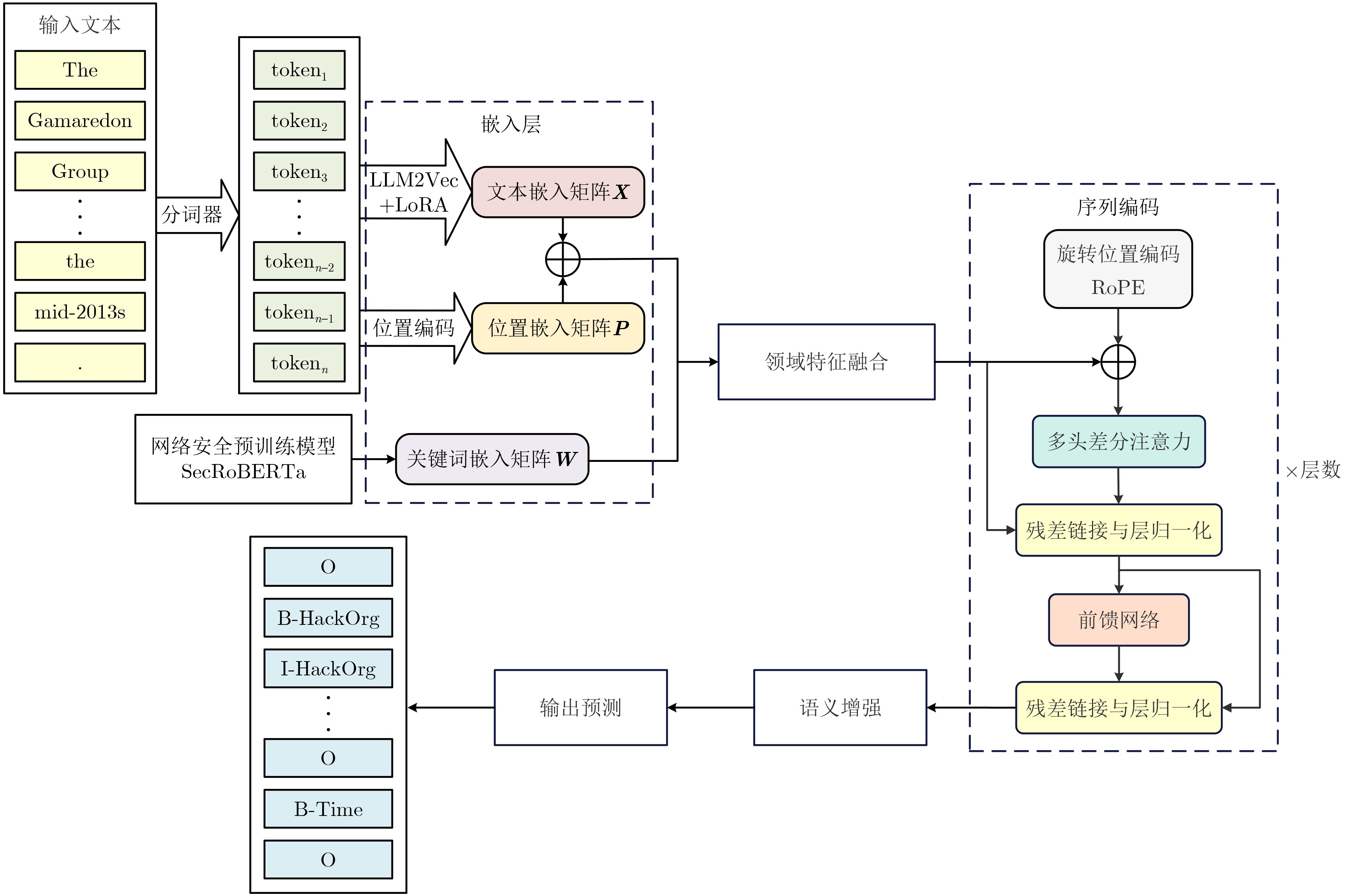
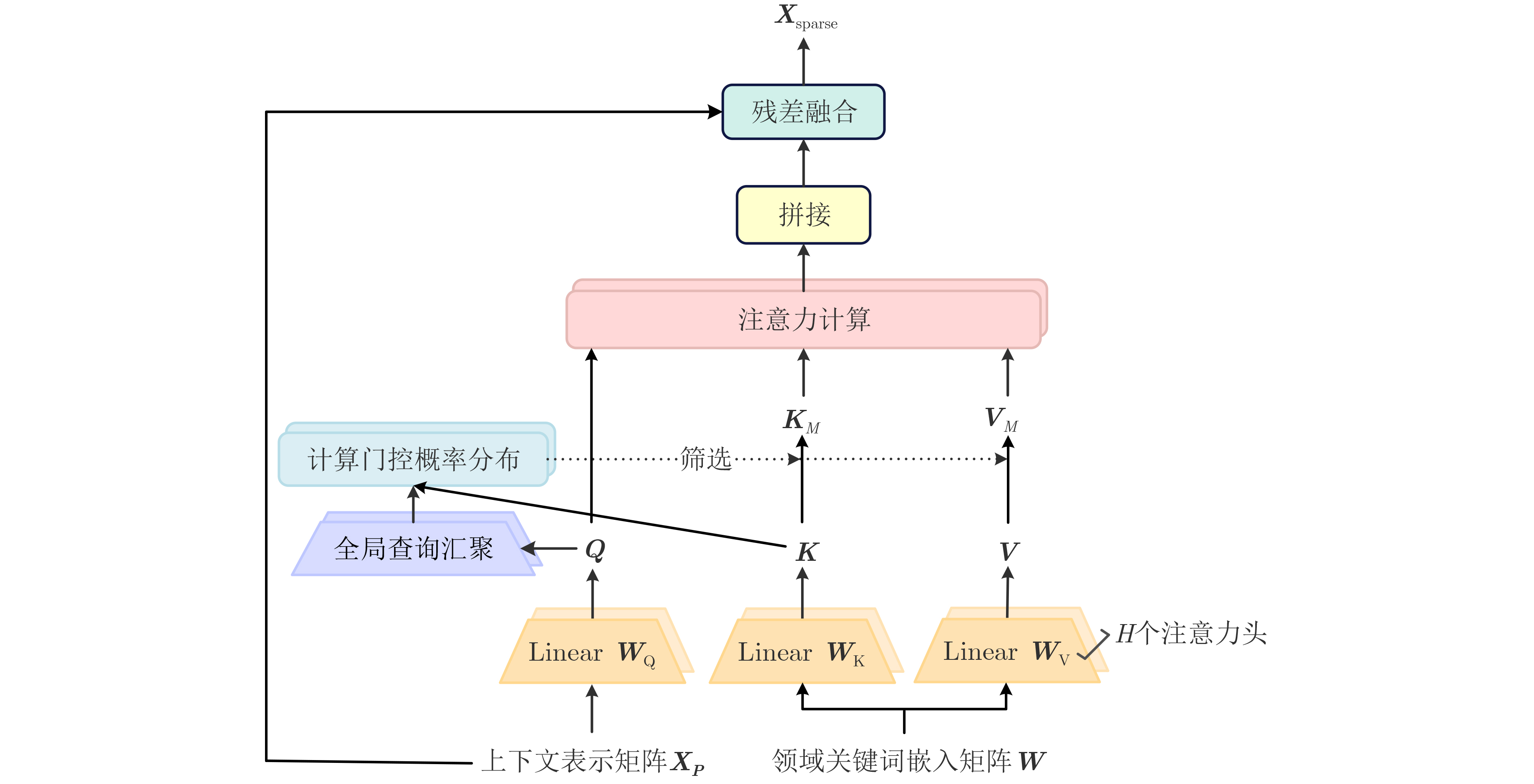
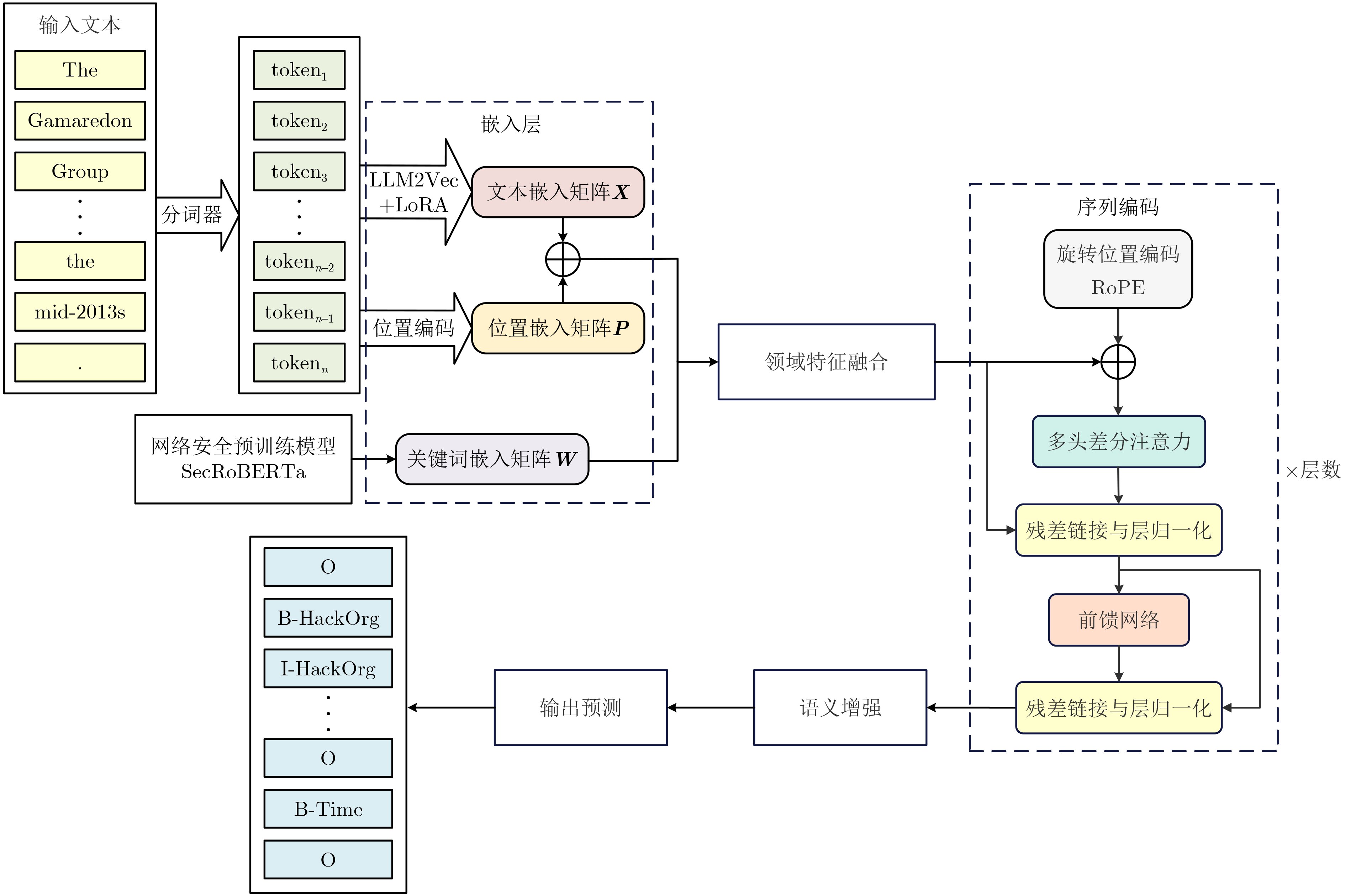
Objective Named Entity Recognition (NER) in cybersecurity is a core technology for threat intelligence analysis, vulnerability management, and security incident response. However, this field faces several challenges, including dense technical terminology, limited labeled data, dynamic entity categories, and highly complex semantic features. These factors reduce the domain adaptability and semantic fusion capacity of traditional deep learning models and existing Large Language Models (LLMs). To address these issues while meeting the need for lightweight deployment, a cybersecurity NER approach is proposed to strengthen domain semantic representation, improve rare-entity recognition, and support low-resource environments. This approach provides a reliable technical path for intelligent threat analysis in cybersecurity scenarios. Methods To address the complex semantic features of cybersecurity texts, a semantically enhanced, lightweight, and LLM-adaptable cybersecurity NER approach is proposed. LLM2Vec is used to achieve bidirectional semantic reconstruction of large-model decoders, and Low-Rank Adaptation (LoRA) is combined for low-rank fine-tuning. This design preserves deep semantic encoding capacity while substantially reducing the number of updated parameters. To address sparse keywords and severe noise interference in cybersecurity texts, a sparse gated attention mechanism is proposed to strengthen keyword-focused feature extraction. High-contribution cybersecurity terms are selected dynamically through global gating and sparse inference. A SecRoBERTa-based semantic enhancement module is also proposed. This module uses a domain-pretrained model to generate similar-word embeddings, improves feature robustness in small-sample settings, and reduces the difficulty of identifying out-of-vocabulary words and low-frequency terms. Finally, a Masked Conditional Random Field (MCRF) is used to constrain label transitions and ensure BIO-compliant output sequences, thereby achieving robust and consistent entity boundary prediction. Results and Discussions Extensive experiments are conducted on two public cybersecurity datasets, DNRTI and APTNER. The proposed approach achieves an F1 score of 91.91% on DNRTI, exceeding the previous state-of-the-art model by 2.14%. On APTNER, it achieves an F1 score of 80.37%, exceeding the best baseline by 2.97%. Ablation studies confirm the contribution of each key component. The sparse gated attention mechanism improves F1 by 3.57% over standard multi-head attention on DNRTI. The semantic enhancement module contributes a 2.32% increase in F1. The model also shows efficient training and inference, consistent with the goals of lightweight design. Conclusions A lightweight LLM-based adaptation approach is proposed for NER in the cybersecurity domain. The approach effectively addresses the limitations of existing LLM-based NER methods in domain adaptation and rare-entity recognition. By integrating LLM2Vec and LoRA for lightweight fine-tuning, a sparse gated attention mechanism for domain feature fusion, and a SecRoBERTa-based semantic enhancement module for similar-word precomputation, the proposed approach achieves strong performance on the DNRTI and APTNER datasets. This research provides an efficient technical path for NER tasks in low-resource cybersecurity scenarios and supports downstream tasks such as automated threat intelligence analysis. -
表 1 核心参数设置
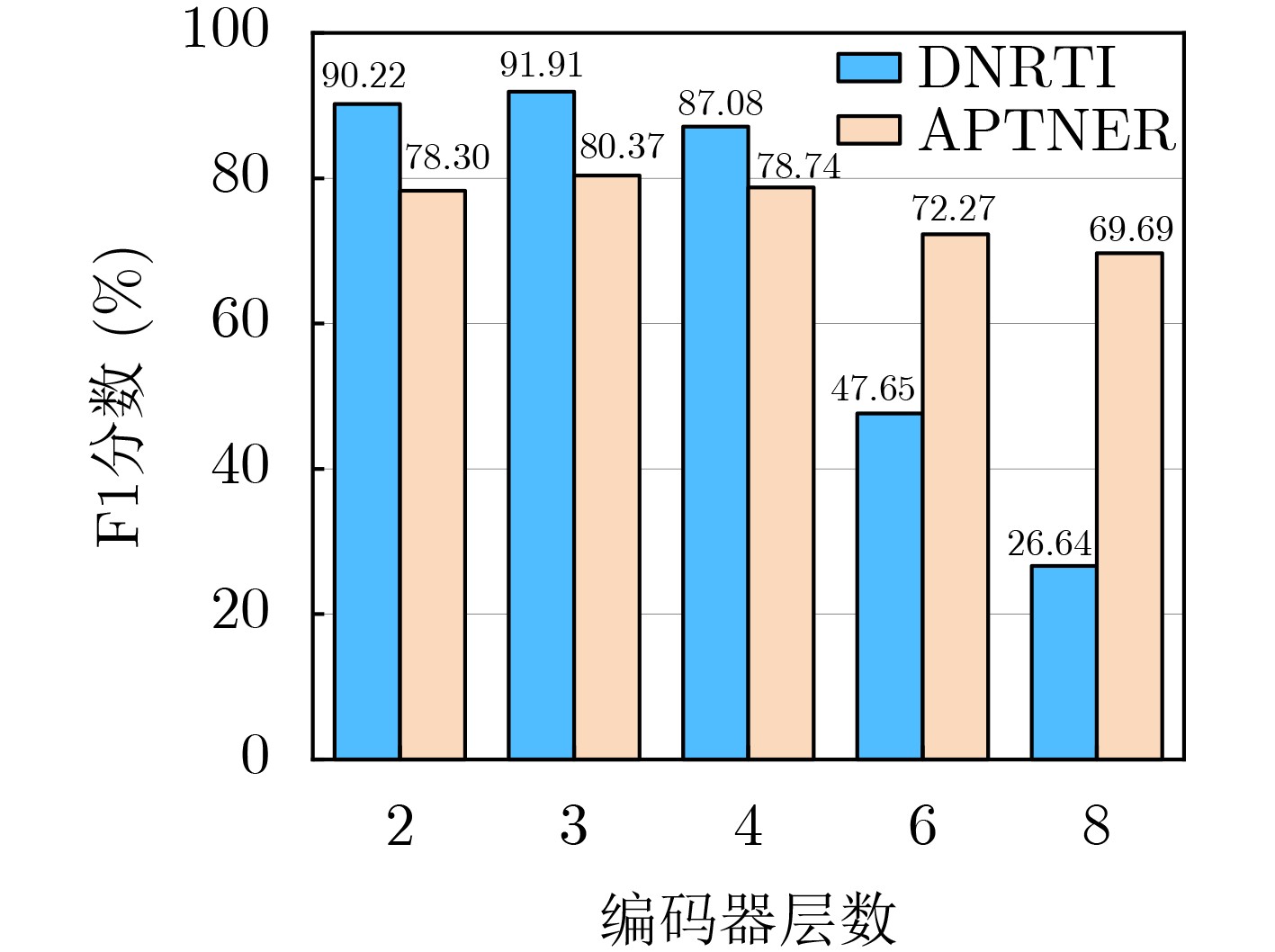
参数 DNRTI APTNER 最大学习率 1×10⁻⁴ 2×10⁻⁵ 批次大小 32 16 优化器 AdamW AdamW token序列最大长度 200 200 隐藏层维度 256 256 编码器层数 3 3 稀疏门控注意力机制中的注意力头数 4 6 编码器中的注意力头数 4 8  下载: 导出CSV
表 2 本文方法与其他NER方法对比实验结果(%)
数据集 方法 精确率 召回率 F1分数 DNRTI BNER[24] (2025) 80.16 81.16 80.66 TISCG[25] (2024) 86.16 86.86 86.51 CTERMRFRAT[26] (2024) - - 88.31 UTERMMF[27] (2023) 90.50 88.34 89.41 DCR-CharNet-TBDN[11] (SOTA, 2025) 90.03 89.51 89.77 本文方法 93.19 90.66 91.91 APTNER SecRoberta[12] (2025) 54.69 61.87 58.06 SecureBERT[12] (2025) 60.76 67.79 64.08 GLM+对比学习[28] (2025) - - 65.52 BERT+BiLSTM+CRF[29] (SOTA, 2024) 80.20 74.80 77.40 本文方法 80.35 80.40 80.37 注:加粗数字表示本文方法结果。
下载: 导出CSV
表 3 DNRTI数据集上各实体类别预测结果(%)
标签 精确率 召回率 F1分数 HackOrg 95.04 92.94 93.98 OffAct 70.77 100.00 82.88 SamFile 89.86 100.00 94.66 SecTeam 92.49 97.92 95.13 Tool 85.16 100.00 91.99 Time 100.00 96.72 98.33 Purp 84.70 94.61 89.38 Area 99.06 76.64 86.42 Idus 100.00 100.00 100.00 Org 100.00 98.00 98.99 Way 30.67 95.83 46.47 Exp 100.00 87.17 93.15 Features 85.84 95.02 90.20
下载: 导出CSV
表 4 APTNER数据集上各实体类别预测结果(%)
标签 精确率 召回率 F1分数 TOOL 69.60 73.54 71.52 MAL 81.48 72.78 76.88 APT 85.69 82.73 84.18 TIME 78.48 84.09 81.19 LOC 83.27 88.58 85.84 SECTEAM 76.55 81.99 79.18 IDTY 60.52 72.71 66.06 FILE 82.49 74.91 78.52 PROT 72.22 82.98 77.23 ACT 70.54 63.20 66.67 OS 75.00 84.00 79.25 DOM 82.61 88.37 85.39 VULID 97.06 100.00 98.51 SHA1 100.00 100.00 100.00 SHA2 100.00 96.97 98.46 EMAIL 100.00 100.00 100.00 IP 95.65 91.67 93.62 ENCR 75.00 90.00 81.82 VULNAME 74.32 76.39 75.34 MD5 94.74 100.00 97.30 URL 63.64 70.00 66.67
下载: 导出CSV
表 5 位置嵌入消融实验结果(%)
数据集 方法 精确率 召回率 F1分数 DNRTI 本文方法 93.19 90.66 91.91 位置嵌入 88.07 88.08 88.07 APTNER 本文方法 80.35 80.40 80.37 位置嵌入 76.09 78.27 77.16 注:加粗数字表示本文方法结果。
下载: 导出CSV
表 6 关键词嵌入消融实验结果(%)
数据集 方法 精确率 召回率 F1分数 DNRTI 使用稀疏门控注意力机制进行关键词嵌入 93.19 90.66 91.91 使用多头自注意力机制进行关键词嵌入 88.79 87.90 88.34 不使用关键词嵌入 88.62 86.24 87.41 APTNER 使用稀疏门控注意力机制进行关键词嵌入 80.35 80.40 80.37 使用多头自注意力机制进行关键词嵌入 77.28 79.08 78.17 不使用关键词嵌入 75.44 77.01 76.22
下载: 导出CSV
表 7 语义增强组件的消融实验结果(%)
数据集 方法 精确率 召回率 F1分数 DNRTI 本文方法 93.19 90.66 91.91 语义增强 91.58 87.68 89.59 APTNER 本文方法 80.35 80.40 80.37 语义增强 78.78 78.31 78.54 注:加粗数字表示本文方法结果。
下载: 导出CSV
-
[1] 陈曙东, 欧阳小叶. 命名实体识别技术综述[J]. 无线电通信技术, 2020, 46(3): 251–260. doi: 10.3969/j.issn.1003-3114.2020.03.001.CHEN Shudong and OUYANG Xiaoye. Overview of named entity recognition technology[J]. Radio Communications Technology, 2020, 46(3): 251–260. doi: 10.3969/j.issn.1003-3114.2020.03.001. [2] SATVAT K, GJOMEMO R, and VENKATAKRISHNAN V N. Extractor: Extracting attack behavior from threat reports[C]. 2021 IEEE European Symposium on Security and Privacy (EuroS&P), Vienna, Austria, 2021: 598–615. doi: 10.1109/EuroSP51992.2021.00046. [3] GAO Chen, ZHANG Xuan, HAN Mengting, et al. A review on cyber security named entity recognition[J]. Frontiers of Information Technology & Electronic Engineering, 2021, 22(9): 1153–1168. doi: 10.1631/FITEE.2000286. [4] 李永斌, 刘楝, 郑杰. 一种面向特定信息领域的大模型命名实体识别方法[J]. 电子与信息学报, 2026, 48(2): 662–672. doi: 10.11999/JEIT250764.LI Yongbin, LIU Lian, and ZHENG Jie. A method for named entity recognition in military intelligence domain using large language models[J]. Journal of Electronics & Information Technology, 2026, 48(2): 662–672. doi: 10.11999/JEIT250764. [5] HU Chenxi, WU Tao, LIU Chunsheng, et al. Joint contrastive learning and belief rule base for named entity recognition in cybersecurity[J]. Cybersecurity, 2024, 7(1): 19. doi: 10.1186/s42400-024-00206-y. [6] BEHNAMGHADER P, ADLAKHA V, MOSBACH M, et al. LLM2Vec: Large language models are secretly powerful text encoders[J]. arXiv preprint arXiv: 2404.05961, 2024. doi: 10.48550/arXiv.2404.05961. [7] HU E J, SHEN Yelong, WALLIS P, et al. LoRA: Low-rank adaptation of large language models[C]. The 10th International Conference on Learning Representations, 2022. [8] YI Feng, JIANG Bo, WANG Lu, et al. Cybersecurity named entity recognition using multi-modal ensemble learning[J]. IEEE Access, 2020, 8: 63214–63224. doi: 10.1109/ACCESS.2020.2984582. [9] MA Pingchuan, JIANG Bo, LU Zhigang, et al. Cybersecurity named entity recognition using bidirectional long short-term memory with conditional random fields[J]. Tsinghua Science and Technology, 2021, 26(3): 259–265. doi: 10.26599/TST.2019.9010033. [10] YI Junkai, LIU Yuan, JIANG Zhongbai, et al. Text command intelligent understanding for cybersecurity testing[J]. Electronics, 2024, 13(21): 4330. doi: 10.3390/electronics13214330. [11] 胡泽, 李文君, 杨宏宇. 基于字符表示学习与时序边界扩散的网络安全实体识别方法[J]. 电子与信息学报, 2025, 47(5): 1554–1568. doi: 10.11999/JEIT240953.HU Ze, LI Wenjun, and YANG Hongyu. A cybersecurity entity recognition approach based on character representation learning and temporal boundary diffusion[J]. Journal of Electronics & Information Technology, 2025, 47(5): 1554–1568. doi: 10.11999/JEIT240953. [12] ZHANG Yunlong, LIU Jingju, ZHONG Xiaofeng, et al. SecLMNER: A framework for enhanced named entity recognition in multi-source cybersecurity data using large language models[J]. Expert Systems with Applications, 2025, 271: 126651. doi: 10.1016/j.eswa.2025.126651. [13] ZHANG Hao, WU Tingmin, ZHU Tianqing, et al. CyberLLaMA: A fine-tuned large language model for cybersecurity named entity recognition[J]. Knowledge-Based Systems, 2025, 328: 114183. doi: 10.1016/j.knosys.2025.114183. [14] VASWANI A, SHAZEER N, PARMAR N, et al. Attention is all you need[C]. The 31st International Conference on Neural Information Processing Systems, Long Beach, USA, 2017: 6000–6010. [15] Hugging Face. jackaduma/SecRoBERTa[EB/OL]. https://huggingface.co/jackaduma/SecRoBERTa, 2024. [16] 才华, 冉越, 付强, 等. 多粒度文本感知分层特征交互的视觉定位方法[J]. 电子与信息学报, 2025, 47(11): 4594–4605. doi: 10.11999/JEIT250387.CAI Hua, RAN Yue, FU Qiang, et al. Multi-granularity text perception and hierarchical feature interaction method for visual grounding[J]. Journal of Electronics & Information Technology, 2025, 47(11): 4594–4605. doi: 10.11999/JEIT250387. [17] 姜小波, 邓晗珂, 莫志杰, 等. 规则压缩模型和灵活架构的Transformer加速器设计[J]. 电子与信息学报, 2024, 46(3): 1079–1088. doi: 10.11999/JEIT230188.JIANG Xiaobo, DENG Hanke, MO Zhijie, et al. Design of transformer accelerator with regular compression model and flexible architecture[J]. Journal of Electronics & Information Technology, 2024, 46(3): 1079–1088. doi: 10.11999/JEIT230188. [18] YE Tianzhu, DONG Li, XIA Yuqing, et al. Differential transformer[J]. arXiv preprint arXiv: 2410.05258, 2024. doi: 10.48550/arXiv.2410.05258. [19] SU Jianlin, AHMED M, LU Yu, et al. RoFormer: Enhanced transformer with rotary position embedding[J]. Neurocomputing, 2024, 568: 127063. doi: 10.1016/j.neucom.2023.127063. [20] LIU Peipei, LI Hong, WANG Zuoguang, et al. Multi-features based semantic augmentation networks for named entity recognition in threat intelligence[C]. The 26th International Conference on Pattern Recognition (ICPR), Montreal, Canada, 2022: 1557–1563. doi: 10.1109/ICPR56361.2022.9956373. [21] WEI Tianwen, QI Jianwei, HE Shenghuan, et al. Masked conditional random fields for sequence labeling[C]. 2021 Conference of the North American Chapter of the Association for Computational Linguistics: Human Language Technologies, 2021: 2024–2035. doi: 10.18653/v1/2021.naacl-main.163. [22] WANG Xuren, LIU Xinpei, AO Shengqin, et al. DNRTI: A large-scale dataset for named entity recognition in threat intelligence[C].2020 IEEE 19th International Conference on Trust, Security and Privacy in Computing and Communications (TrustCom), Guangzhou, China, 2020: 1842–1848. doi: 10.1109/TrustCom50675.2020.00252. [23] WANG Xuren, HE Songheng, XIONG Zihan, et al. APTNER: A specific dataset for NER missions in cyber threat intelligence field[C]. 2022 IEEE 25th International Conference on Computer Supported Cooperative Work in Design (CSCWD), Hangzhou, China, 2022: 1233–1238. doi: 10.1109/CSCWD54268.2022.9776031. [24] CAI Yongxin, KANG Lei, LENG Tao, et al. BNER: A broad learning system-based named entity recognition method for cyber threat intelligence[C].2025 11th IEEE International Conference on Privacy Computing and Data Security (PCDS), Hakodate, Japan, 2025: 397–404. doi: 10.1109/PCDS65695.2025.00060. [25] DU Chao, LIU Xuhong, MIAO Lin, et al. Threat intelligence named entity recognition based on global gated feature fusion[C]. 2024 6th International Conference on Internet of Things, Automation and Artificial Intelligence (IoTAAI), Guangzhou, China, 2024: 618–622. doi: 10.1109/IoTAAI62601.2024.10692655. [26] WANG Peng and LIU Jingju. A cyber threat entity recognition method based on robust feature representation and adversarial training[C]. 2023 12th International Conference on Computing and Pattern Recognition, Qingdao, China, 2024: 255–259. doi: 10.1145/3633637.3633677. [27] CHANG Yu, WANG Gang, ZHU Peng, et al. Research on unified cyber threat intelligence entity recognition method based on multiple features[C].2023 4th International Conference on Computers and Artificial Intelligence Technology (CAIT), Macau, China, 2023: 233–240. doi: 10.1109/CAIT59945.2023.10469250. [28] 孙语晨. 基于大语言模型的威胁情报信息抽取研究与实现[D]. [硕士论文], 北京邮电大学, 2025. doi: 10.26969/d.cnki.gbydu.2025.002794.SUN Yuchen. Research and implemention of threat intelligence information extraction based on large language model[D]. [Master dissertation], Beijing University of Posts and Telecommunications, 2025. doi: 10.26969/d.cnki.gbydu.2025.002794. [29] 汪溢镭, 孙歆, 韩嘉佳, 等. 暗网高质量威胁情报获取技术与实现[J/OL]. https://doi.org/10.19678/j.issn.1000-3428.0068805, 2024.WANG Yilei, SUN Xin, HAN Jiajia, et al. Techniques and implementation of high-quality threat intelligence acquisition from the dark web[J/OL]. https://doi.org/10.19678/j.issn.1000-3428.0068805, 2024. -

 下载:
下载:

图(3) / 表(7)
计量
- 文章访问数: 776
- HTML全文浏览量: 339
- PDF下载量: 72
- 被引次数: 0
