




Pearson Correlation Fusion Sensing Method for Noncircular Signals
-
摘要: 针对传统圆信号频谱感知方案无法精确识别非圆信号的问题,该文提出一种皮尔逊相关系数驱动的融合感知方法。该方法通过实值复合表示形式捕捉非圆信号的2阶统计信息,并据此构建实值相干矩阵以获取接收天线间的皮尔逊相关强度。随后采用线性数据融合方法对不同天线间的皮尔逊相关系数进行加权叠加,并以偏因径系数为性能测度建立理论最优权重及其样本估计值,最终设计出无需依赖信道先验参数的非参量感知技术。通过分析平方皮尔逊相关系数和检验统计量的2阶特性及统计分布,建立虚警概率、感知阈值等关键指标的理论计算解析式。实验结果表明,所提方案相较于其他对比算法,在接收机工作特性(ROC)曲线、感知概率、偏因径系数和曲线下面积(AUC)等性能测度下均表现更优,尤其是在低信噪比环境中,其性能优势更为显著。Abstract:
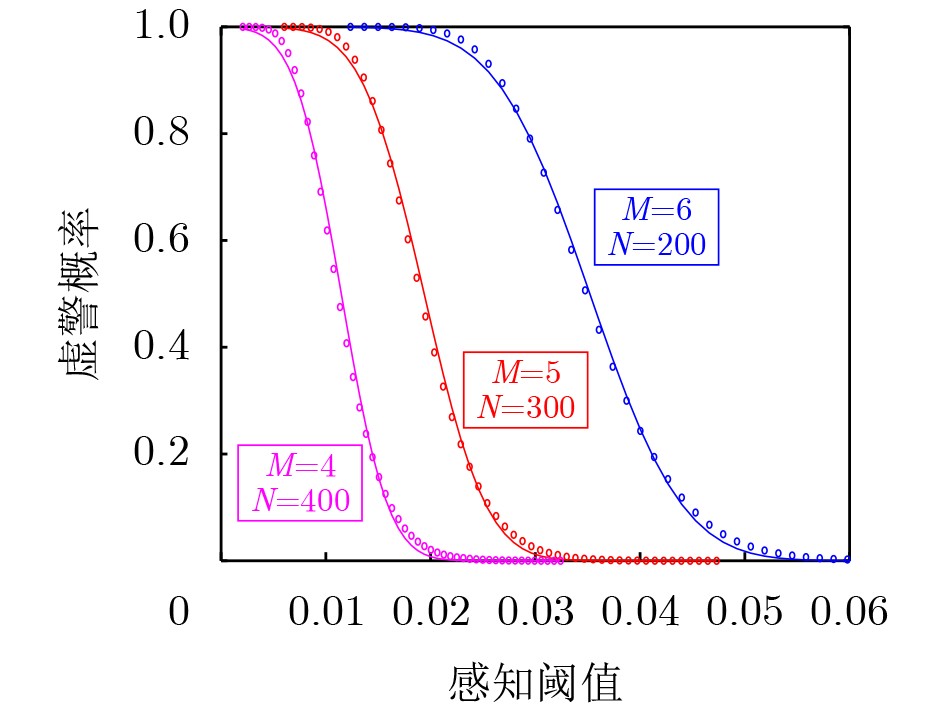
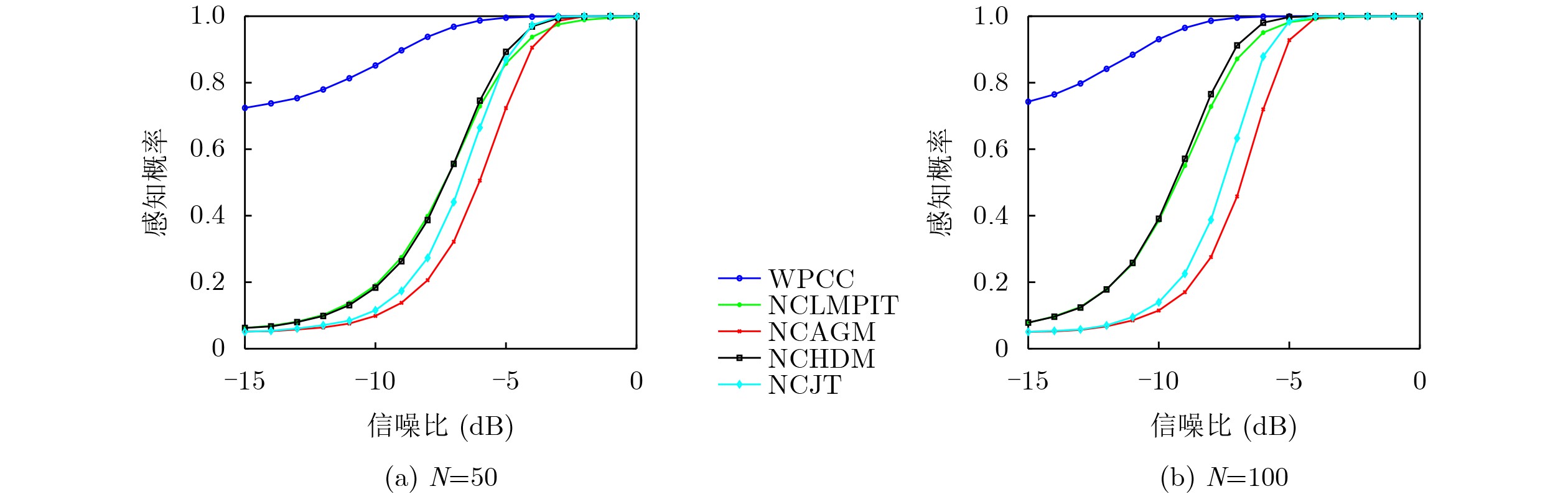
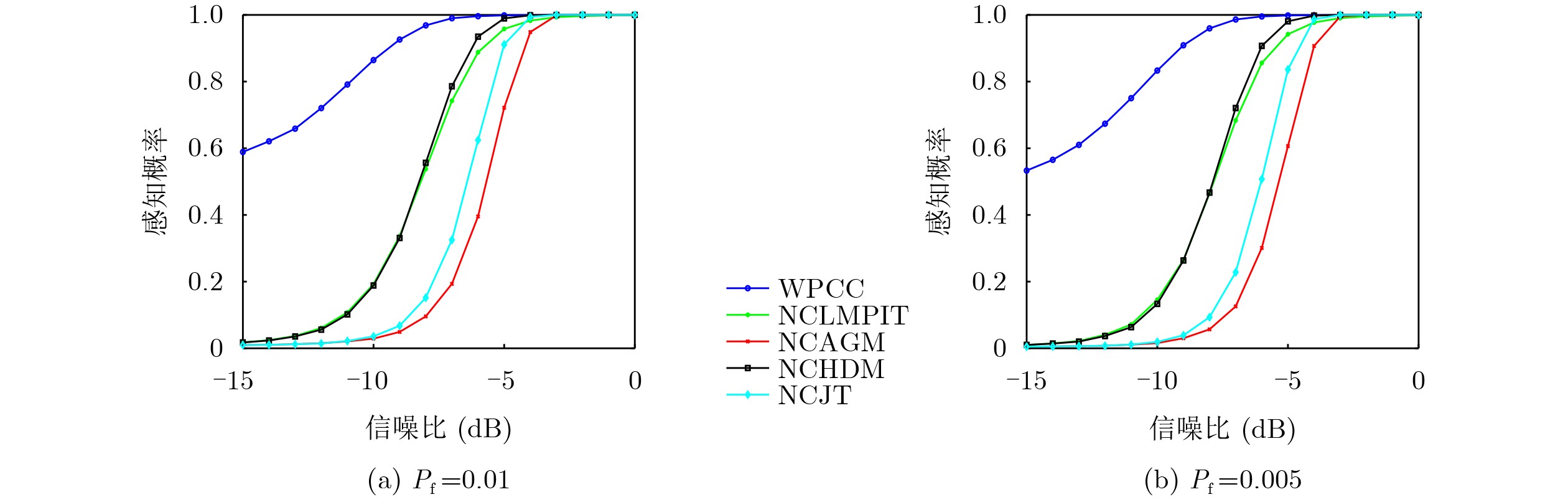
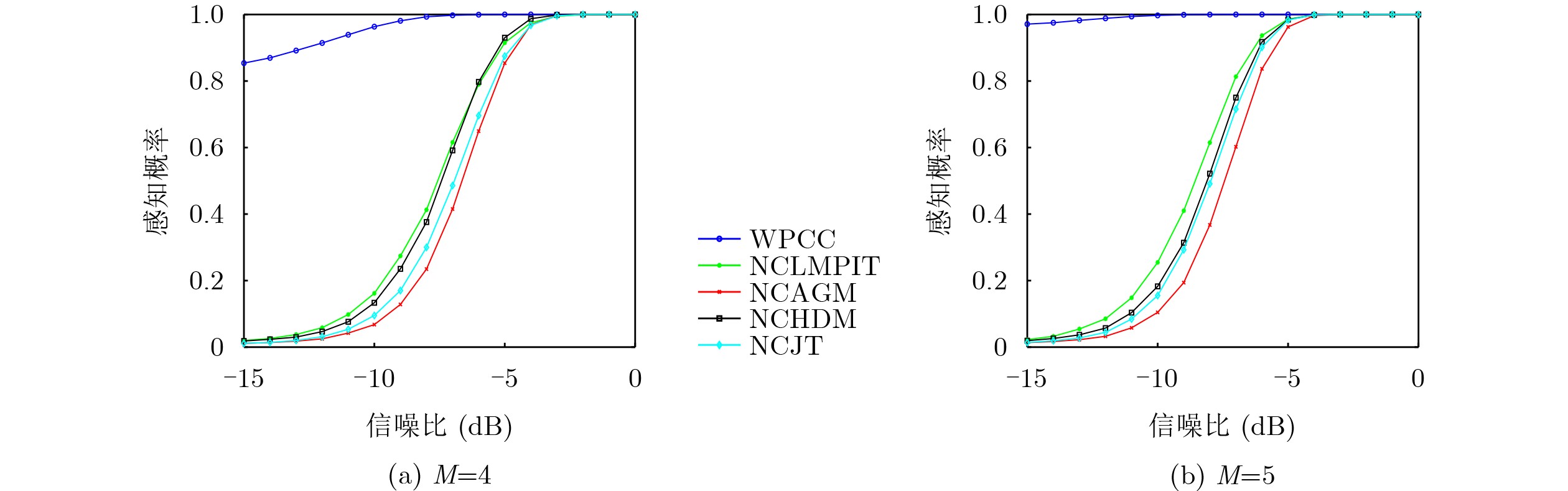
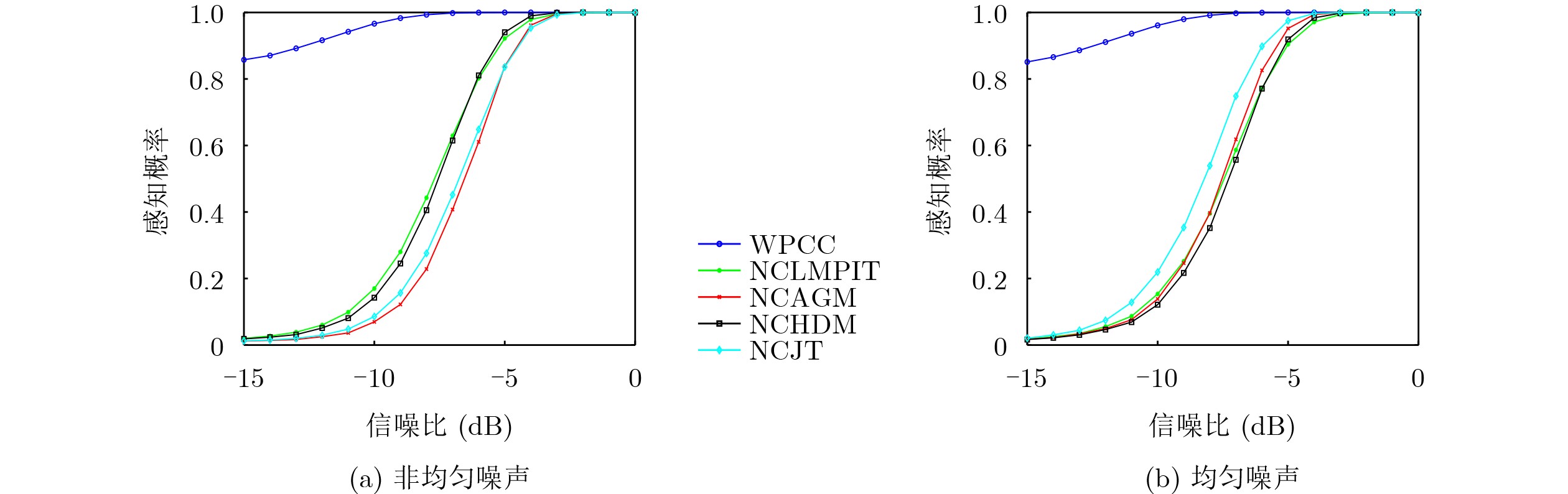
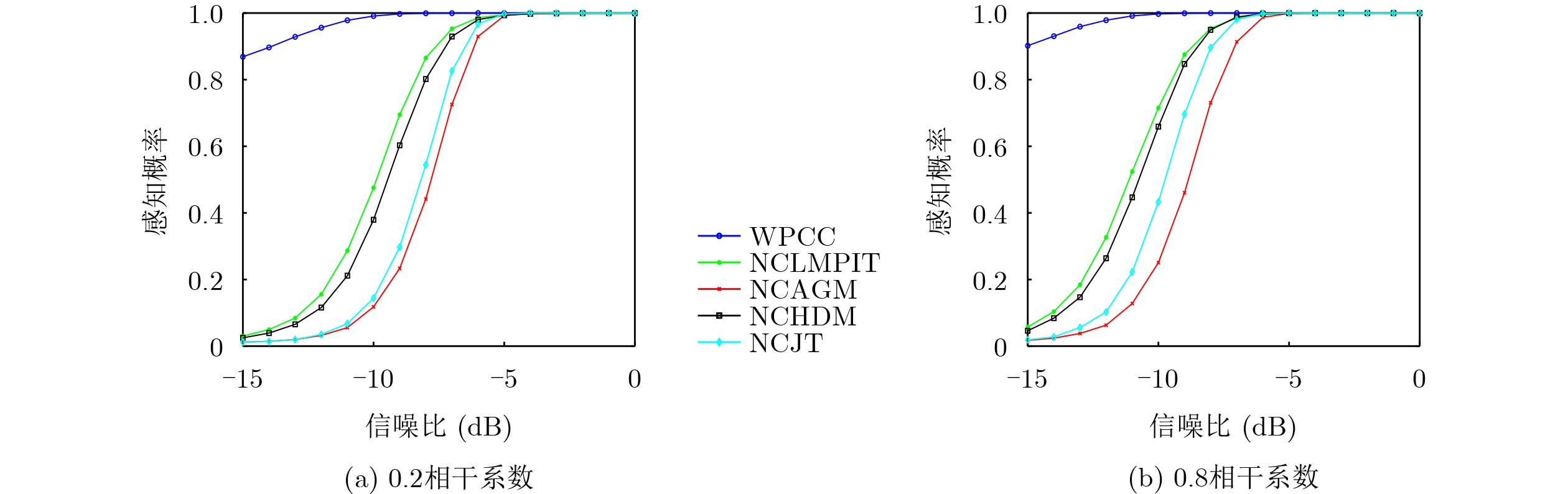
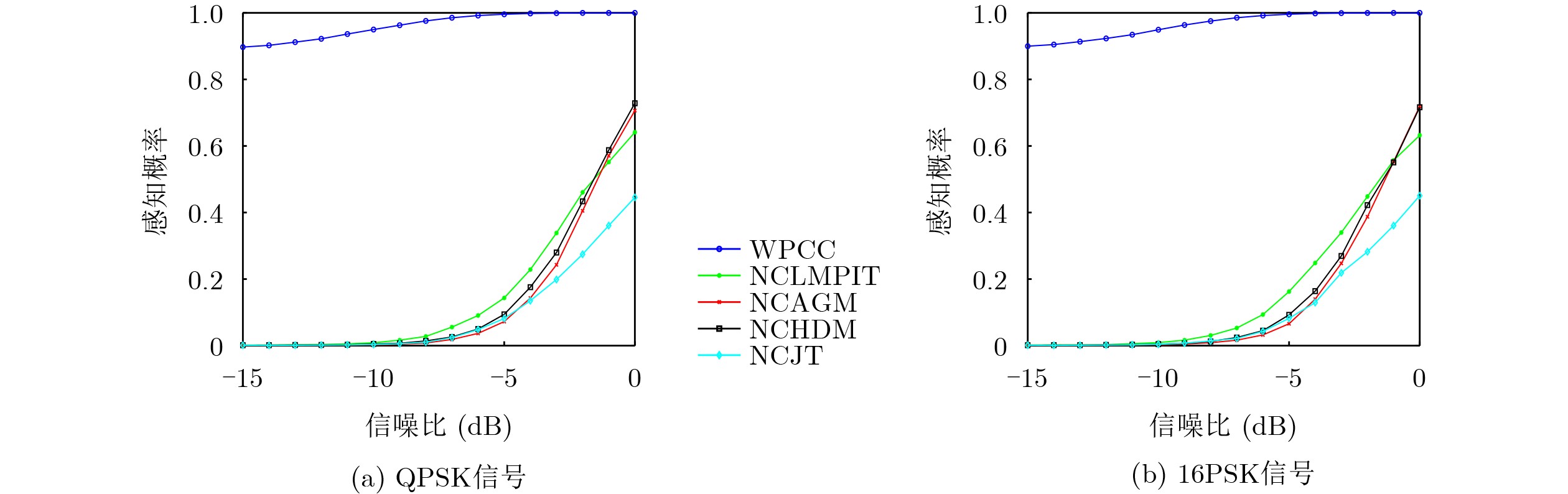
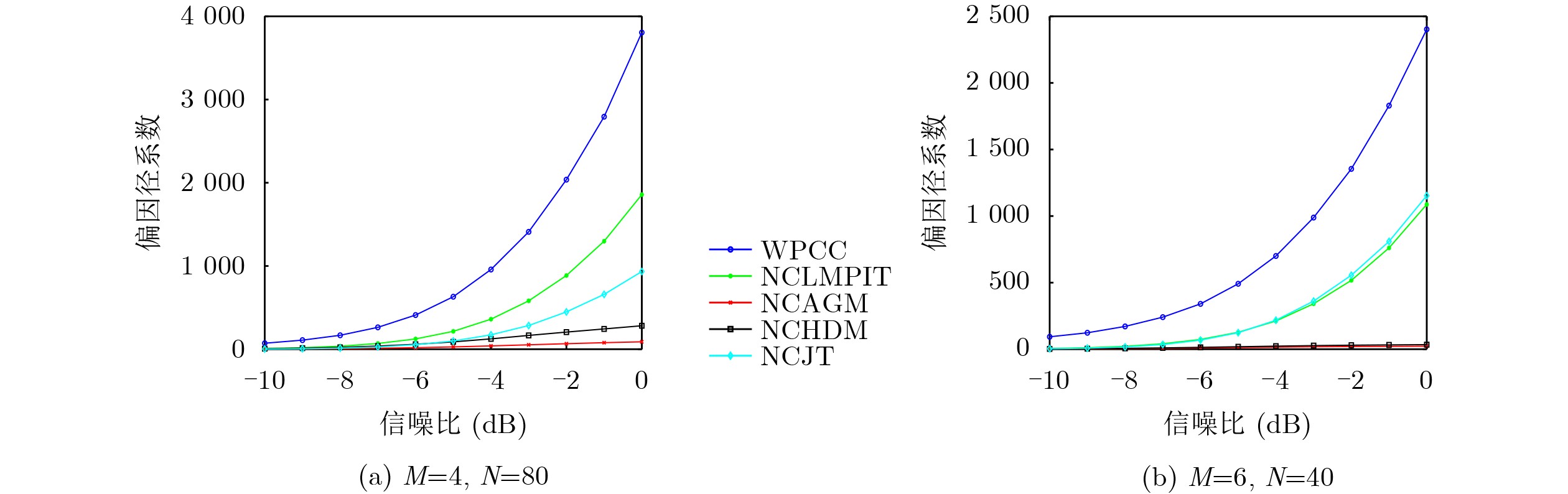
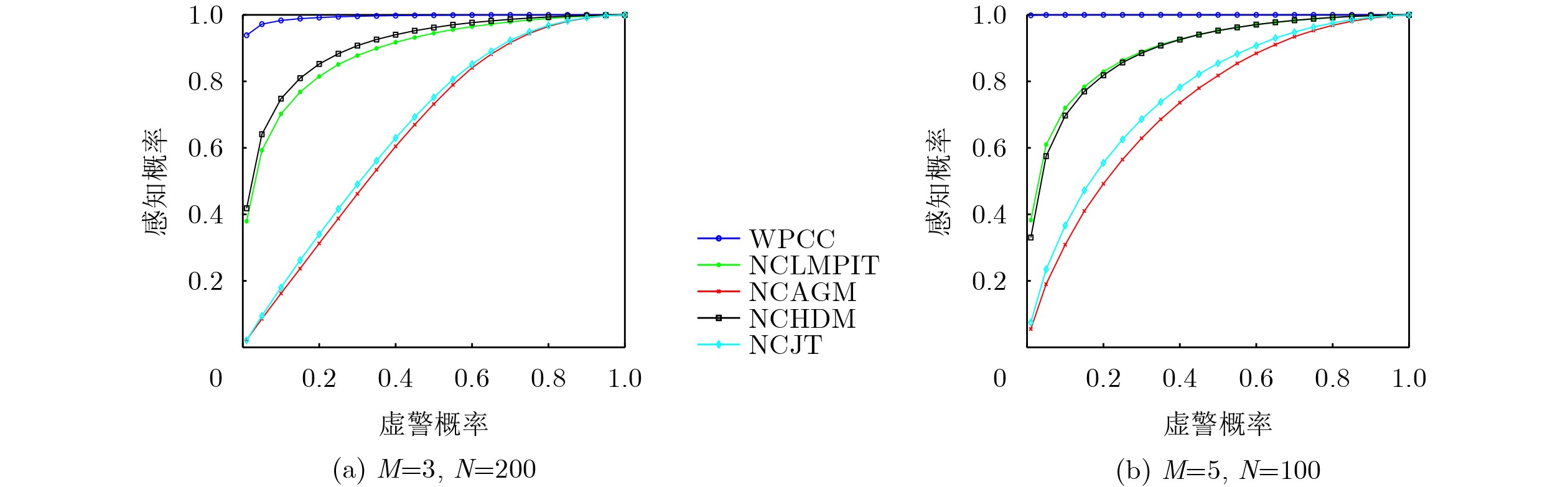
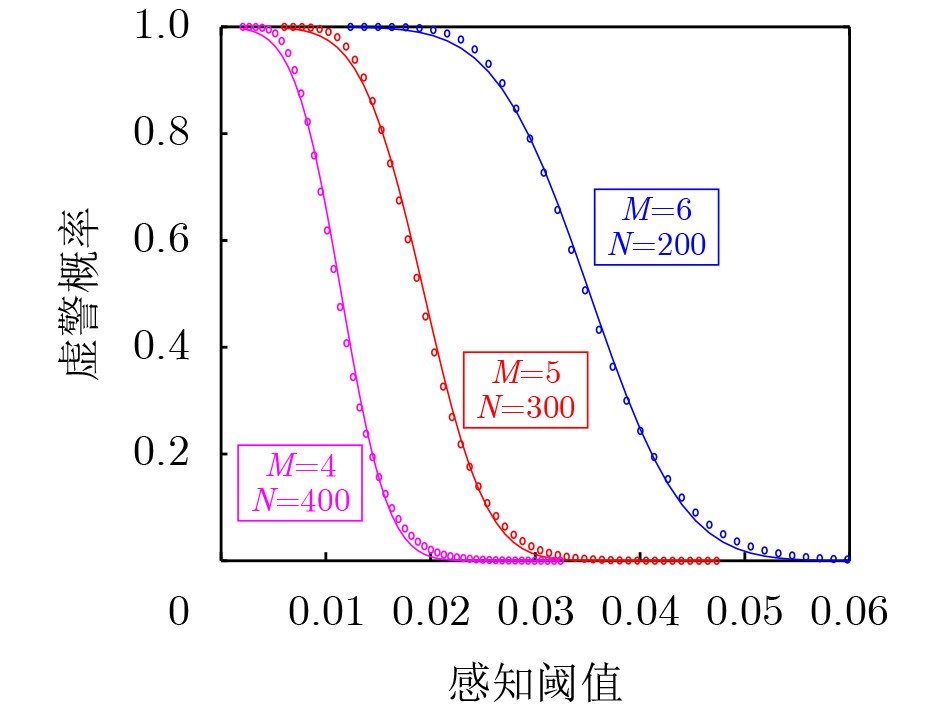
Objective With the rapid growth of wireless devices and communication services, spectrum resources have become increasingly scarce. Spectrum sensing, as a fundamental function of cognitive radio, enables dynamic spectrum access and improves spectrum utilization efficiency. However, conventional spectrum sensing methods based on circular signal assumptions cannot effectively detect noncircular signals. In addition, some detectors designed for noncircular signals show degraded performance under low Signal-to-Noise Ratio (SNR) or limited sample conditions. To address these limitations, a nonparametric spectrum sensing scheme based on the Weighted Pearson Correlation Coefficient (WPCC) is proposed. The scheme applies a linear fusion strategy to the real-valued composite coherence matrix, which captures the second-order statistical characteristics of noncircular signals. Methods The WPCC detector constructs a real-valued composite observation vector and computes the corresponding composite coherence matrix. Pearson Correlation Coefficients (PCCs) are extracted from this matrix to characterize the statistical properties of noncircular signals. The first two product moments of squared sample PCCs are derived, and optimal fusion weights are obtained based on the deflection coefficient. The true PCCs are approximated by their sample estimates to obtain data-driven fusion weights that do not require prior knowledge of sensing channels. These weights are then linearly combined with the squared sample PCCs to construct the WPCC test statistic, thereby exploiting the spatial diversity of sensing antennas. The final decision is made by comparing the WPCC statistic with a sensing threshold determined by the specified false alarm probability. Specifically, a WPCC value below the threshold indicates the null hypothesis of an idle frequency band, whereas a value above the threshold indicates the alternative hypothesis that the frequency band is occupied by primary users. Results and Discussions Simulation experiments evaluate the sensing performance of the proposed nonparametric WPCC-based method (Algorithm 1) in terms of sensing probability, deflection coefficient, Receiver Operating Characteristic (ROC) curve, and Area Under the Curve (AUC), with comparisons to NCLMPIT, NCAGM, NCHDM, and NCJT. The numerical results show that the proposed method outperforms the compared detectors under various simulation conditions. In particular, the WPCC detector achieves the highest sensing probability and exhibits superior performance at low false alarm probabilities of 0.05 ( Fig. 2 ), 0.01 (Fig. 3(a) ), and 0.005 (Fig. 3(b) ), with sample sizes not exceeding 100. In addition, the proposed method shows clear advantages under different numbers of antennas (Fig. 4 ), different noise variance conditions (Fig. 5 ), and different levels of correlation strength (Fig. 6 ). The applicability of the WPCC method to circular signals is also demonstrated by its high sensing probability for QPSK and 16PSK signals (Fig. 7 ). The superior overall performance of the proposed detector is further confirmed by higher deflection coefficient curves and ROC curves (Figs. 8, 9 ). The largest AUC values quantitatively demonstrate its overall optimality among all considered methods (Table 1 ). These results indicate strong robustness under low SNR and small-sample conditions.Conclusions A Pearson correlation fusion sensing method for noncircular signals is proposed based on the real-valued composite covariance representation and the Locally Most Powerful Invariant Test (LMPIT) framework. By combining optimal fusion weights derived from sample PCCs with a linear weighting scheme, the method fully exploits second-order statistical information. It enhances strongly correlated components while suppressing weak correlations and noise interference. Analytical expressions for the false alarm probability and sensing threshold are derived. Both theoretical analysis and simulation results show that the proposed method achieves superior performance compared with existing noncircular signal sensing methods in terms of sensing probability, deflection coefficient, ROC curve, and AUC. -
1 面向非圆信号的皮尔逊相关融合感知
输入:观测样本$\{{\boldsymbol{z}}_i\}_{i=1}^N $和虚警概率$P_{\mathrm{f}} $ 输出:$\mathcal{H}_0 $或$\mathcal{H}_1 $ 1. 基于式(2)构造增广向量$\tilde{{\boldsymbol{z}}}_i $,并基于式(4)计算复合样本协方差
矩阵${\boldsymbol{S}} $2.通过式(6)计算样本皮尔逊相关系数$\hat{C}_{mn} $ 3. 基于式(54)计算基于样本皮尔逊相关系数的最优融合权重
$\hat{W}_{mn}^\mathrm{o} $4. 构建加权皮尔逊相关系数统计量: $\varLambda_{\text{WPCC}} = \displaystyle\sum\limits_{m=1}^{2M-1} \displaystyle\sum\limits_{n=m+1}^{2M} \hat{W}_{mn}^\mathrm{o} \hat{C}_{mn}^2 $ 5. 基于给定的虚警概率,计算感知阈值$\eta_{\text{WPCC}} $ $\eta_{\text{WPCC}} = \sqrt{\dfrac{2(N-1)}{N^2(N+2)} \displaystyle\sum\limits_{n>m}^{2M} \left( \hat W_{mn}^\mathrm{o} \right)^2} \, Q^{-1}(1-P_{\mathrm{f}}) + \dfrac{1}{N} \displaystyle\sum\limits_{n>m}^{2M} \hat{W}_{mn}^\mathrm{o} $ 6. 若$\varLambda_{\text{WPCC}} \gt \eta_{\text{WPCC}} $,输出$\mathcal{H}_1 $,否则输出$\mathcal{H}_0 $  下载: 导出CSV
-
[1] XU Tianheng, XU Yinjun, ZHOU Ting, et al. Elastic spectrum sensing: An adaptive sensing method for non-terrestrial communication under highly dynamic channels[J]. IEEE Transactions on Wireless Communications, 2025, 24(5): 3868–3881. doi: 10.1109/TWC.2025.3535559. [2] 王安义, 龚健超, 朱涛. 基于多尺度熵的抗频谱感知数据篡改攻击协作频谱感知方法研究[J]. 电子与信息学报, 2025, 47(7): 2080–2088. doi: 10.11999/JEIT241091.WANG Anyi, GONG Jianchao, and ZHU Tao. Cooperative spectrum sensing method against spectrum sensing data falsification attacks based on multiscale entropy[J]. Journal of Electronics & Information Technology, 2025, 47(7): 2080–2088. doi: 10.11999/JEIT241091. [3] WU Jun, LI Yunlong, DAI Mingyuan, et al. Quantization-based multibit combination for cooperative spectrum sensing[J]. IEEE Internet of Things Journal, 2025, 12(17): 36274–36284. doi: 10.1109/JIOT.2025.3581392. [4] SHARMA S K, BOGALE T E, CHATZINOTAS S, et al. Cognitive radio techniques under practical imperfections: A survey[J]. IEEE Communications Surveys & Tutorials, 2015, 17(4): 1858–1884. doi: 10.1109/COMST.2015.2452414. [5] ZENG Yonghong and LIANG Yingchang. Spectrum-sensing algorithms for cognitive radio based on statistical covariances[J]. IEEE Transactions on Vehicular Technology, 2009, 58(4): 1804–1815. doi: 10.1109/TVT.2008.2005267. [6] WEI Lu, DHARMAWANSA P, and TIRKKONEN O. Multiple primary user spectrum sensing in the low SNR regime[J]. IEEE Transactions on Communications, 2013, 61(5): 1720–1731. doi: 10.1109/TCOMM.2013.022713.120610. [7] WEI Lu and TIRKKONEN O. Spectrum sensing in the presence of multiple primary users[J]. IEEE Transactions on Communications, 2012, 60(5): 1268–1277. doi: 10.1109/TCOMM.2012.022912.110073. [8] RAMÍREZ D, VAZQUEZ-VILAR G, LÓPEZ-VALCARCE R, et al. Detection of rank-P signals in cognitive radio networks with uncalibrated multiple antennas[J]. IEEE Transactions on Signal Processing, 2011, 59(8): 3764–3774. doi: 10.1109/TSP.2011.2146779. [9] QIU Xinquan, JIANG Yuan, and ZHAO Lei. A blind spatial spectrum sensing algorithm for noncircular signals[J]. IEEE Communications Letters, 2025, 29(4): 679–683. doi: 10.1109/LCOMM.2025.3539762. [10] 赖华东, 罗朋, 徐今强, 等. 基于广义似然比的非圆信号频谱感知方法[J]. 电子科技大学学报, 2025, 54(3): 377–383. doi: 10.12178/1001-0548.2024075.LAI Huadong, LUO Peng, XU Jinqiang, et al. Spectrum sensing for non-circular signals based on generalized likelihood ratio[J]. Journal of University of Electronic Science and Technology of China, 2025, 54(3): 377–383. doi: 10.12178/1001-0548.2024075. [11] HUANG Lei, XIAO Yuhang, and ZHANG Q T. Robust spectrum sensing for noncircular signal in multiantenna cognitive receivers[J]. IEEE Transactions on Signal Processing, 2015, 63(2): 498–511. doi: 10.1109/TSP.2014.2371776. [12] LAI Huadong, LUO Peng, LIU Mingxin, et al. LMPIT-based spectrum sensing for non-circular signals in multi-antenna cognitive radios[J]. IEEE Transactions on Wireless Communications, 2025, 24(7): 5961–5976. doi: 10.1109/TWC.2025.3550407. [13] RAMIREZ D, VIA J, SANTAMARIA I, et al. Locally most powerful invariant tests for correlation and sphericity of Gaussian vectors[J]. IEEE Transactions on Information Theory, 2013, 59(4): 2128–2141. doi: 10.1109/TIT.2012.2232705. [14] GUPTA A K and NAGAR D K. Matrix Variate Distributions[M]. New York: Chapman and Hall/CRC, 2000. doi: 10.1201/9780203749289. [15] Wikipedia. F-distribution[EB/OL]. https://en.wikipedia.org/wiki/F-distribution, 2025. [16] Wikipedia. Beta distribution[EB/OL]. https://en.wikipedia.org/wiki/Beta_distribution, 2025. [17] KASSAM S A. Signal Detection in Non-Gaussian Noise[M]. New York: Springer, 1988: 234. doi: 10.1007/978-1-4612-3834-8. [18] QUAN Zhi, CUI Shuguang, and SAYED A H. Optimal linear cooperation for spectrum sensing in cognitive radio networks[J]. IEEE Journal of Selected Topics in Signal Processing, 2008, 2(1): 28–40. doi: 10.1109/JSTSP.2007.914882. -

 下载:
下载:

图(9) / 表(2)
计量
- 文章访问数: 605
- HTML全文浏览量: 342
- PDF下载量: 47
- 被引次数: 0
