




Modulation Recognition Method for High-Speed Mobile Communication Based on Attention Dynamic Fusion and Hybrid Pruning Transformer
-
摘要: 针对高速移动通信场景下,多普勒频移与时变信道导致信号调制特征严重畸变,现有深度学习模型存在鲁棒性不足、推理延迟高的问题,本文提出了一种基于RollingQ动态融合与混合剪枝Transformer的调制识别方法。首先,引入RollingQ机制,动态评估与调整注意力查询方向,打破注意力固化,实现多维度信号表征的自适应均衡融合,提升了模型在复杂信道下的泛化能力。其次,设计多头注意力频域增强Transformer结构,通过轻量级卷积、多头/空间/通道注意力以及频域选择模块的协同,有效融合信号的局部与全局、时域与频域特征。最后,采用注意力动态混合剪枝策略,在推理时根据输入信号稀疏化激活计算路径,在几乎不损失精度的情况下实现了模型的结构轻量化与推理加速。在公开数据集RadioML 2016.10a和RML22上的实验表明,本文方法平均分类准确率分别达到63.84%和71.13%,且单条信号推理时间仅需2.2 ms。与多种主流深度学习模型相比,平均分类准确率提升4%~10%,显著兼顾了高速移动通信场景下调制识别的鲁棒性与实时性。Abstract:
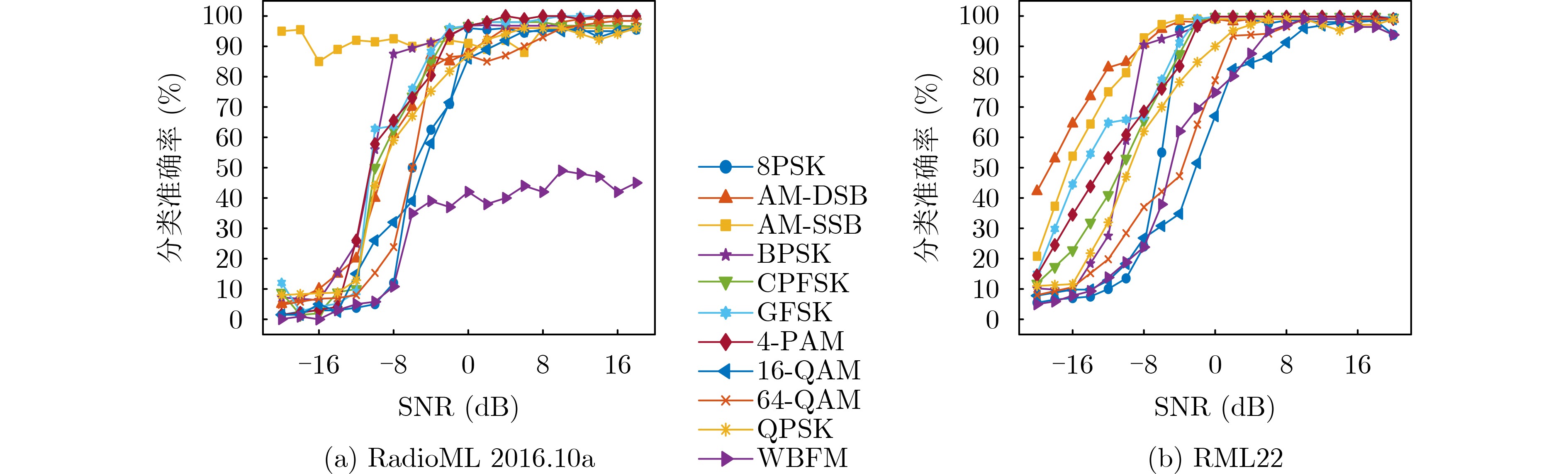
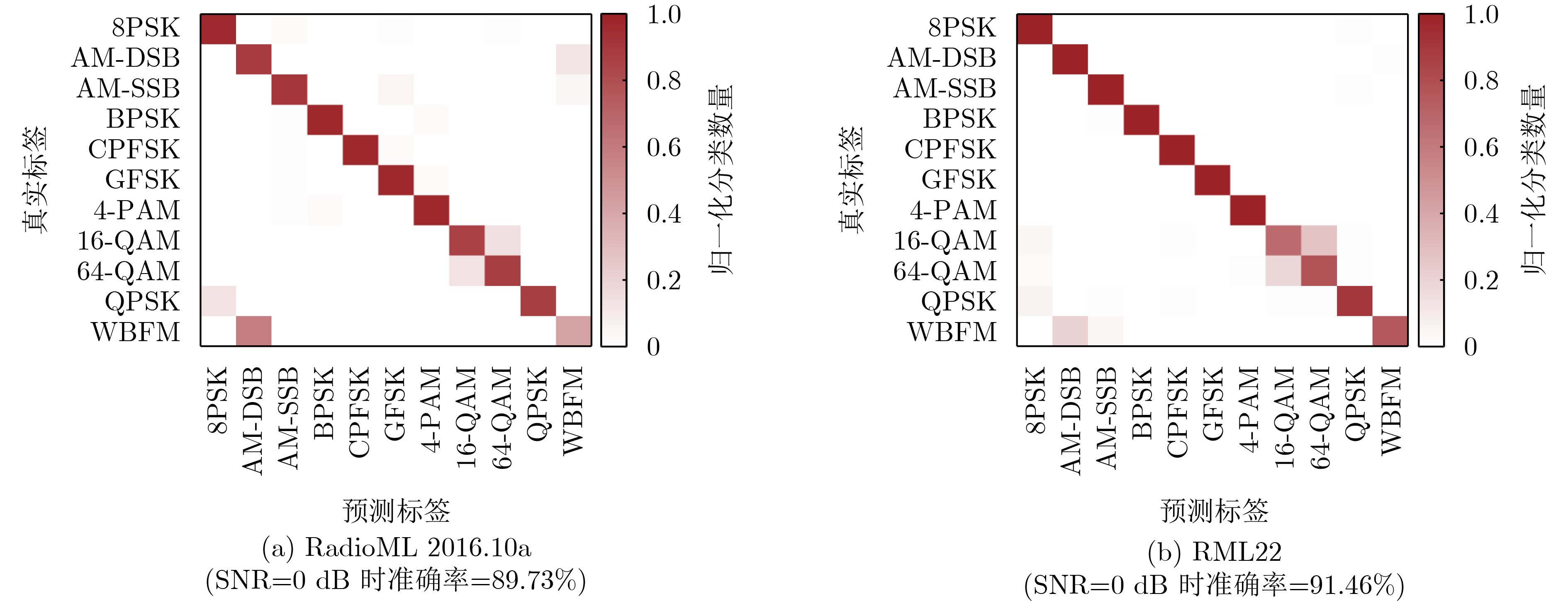
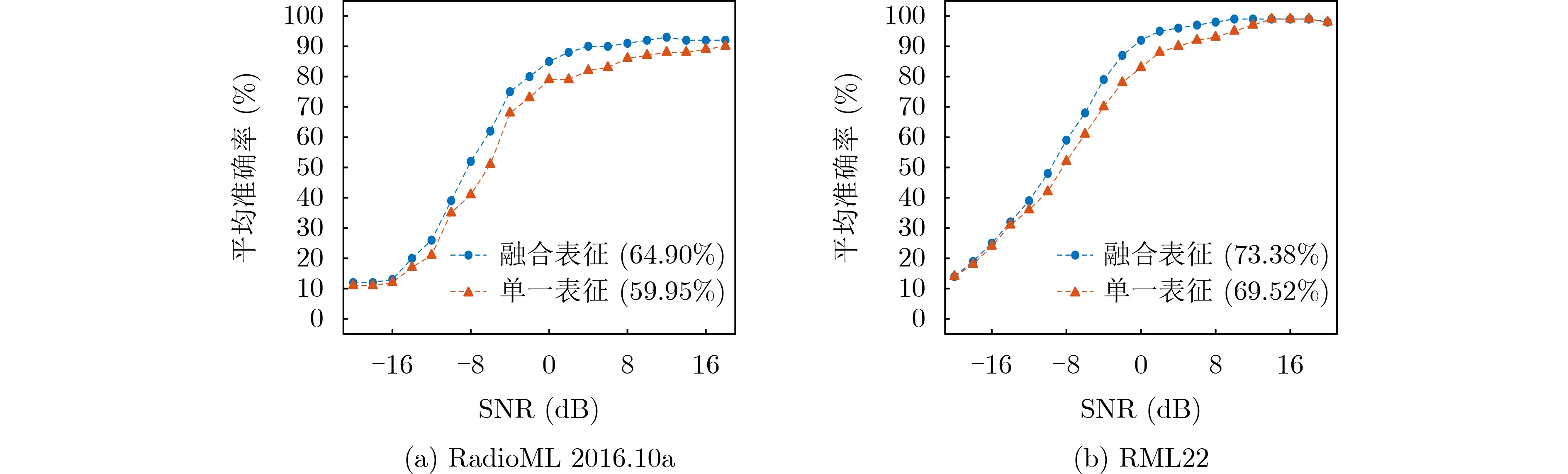
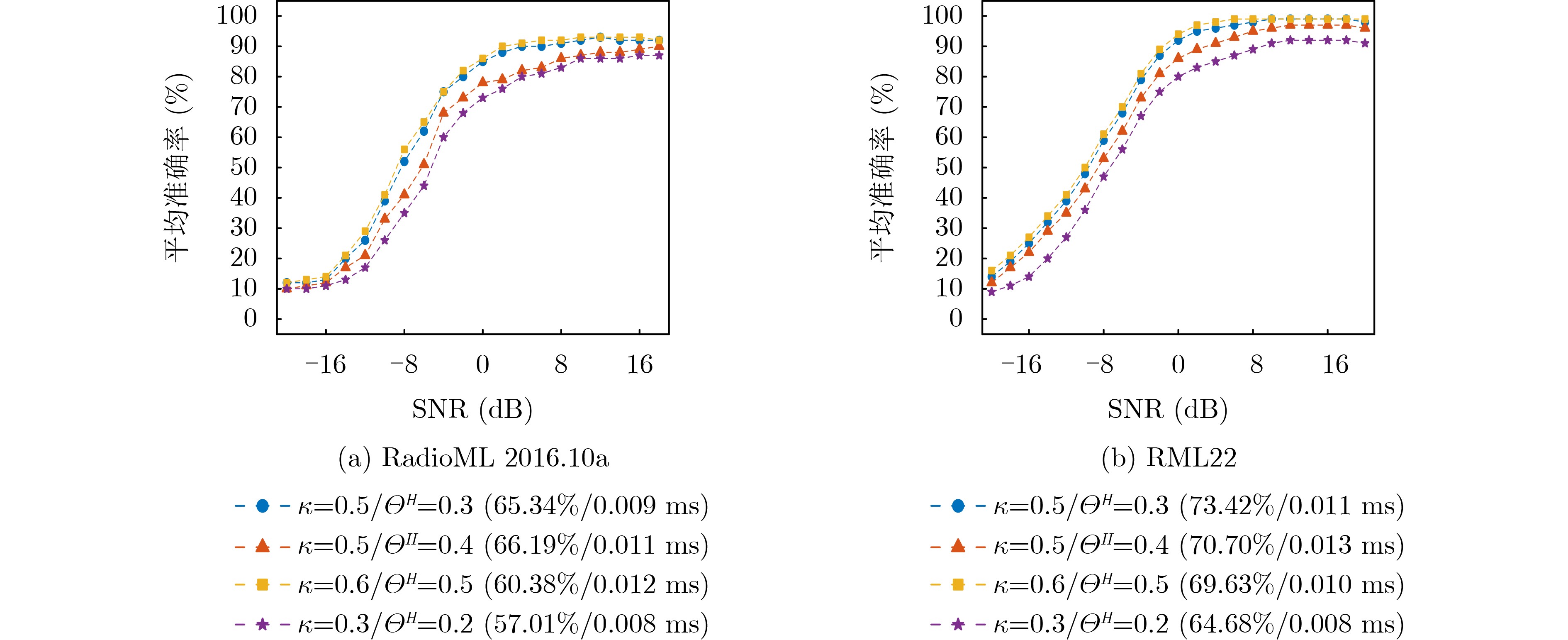
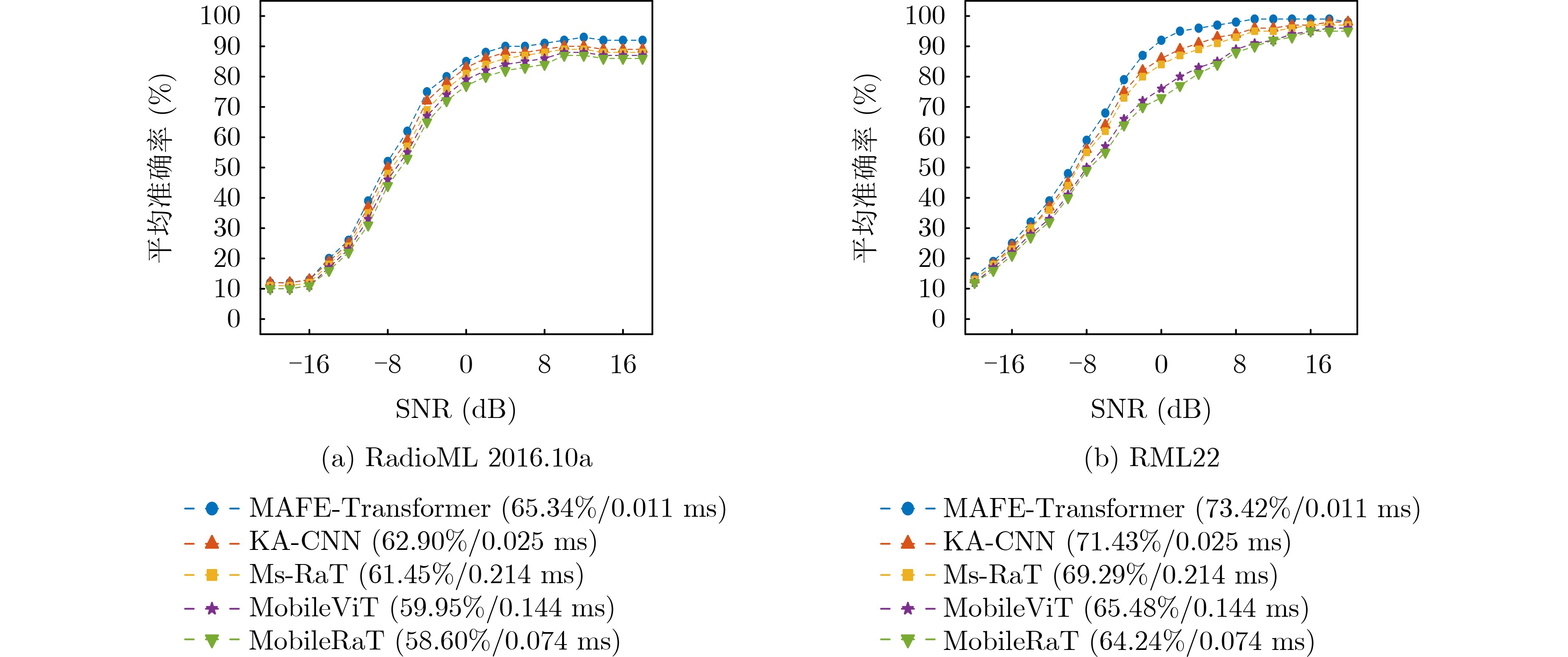
Objective Automatic modulation recognition is a critical preprocessing step in dynamic spectrum access and anti-jamming communication systems, directly impacting the robustness and spectrum efficiency of non-cooperative communication. In high-speed mobile communication scenarios such as satellite, high-speed rail, and drone swarm communications, signal modulation features suffer severe distortion due to Doppler shifts, time-varying channels, and non-stationary interference. The above issues pose significant challenges to traditional modulation recognition methods based on static assumptions, leading to feature mismatch and increased misjudgment rates. To address the issues of insufficient robustness and real-time performance in existing deep learning-based modulation recognition models under high-speed mobile environments, this paper proposes a lightweight dynamic fusion Transformer-based approach. Methods The proposed method consists of three main components: signal representation fusion block, Transformer model design, and model pruning for lightweight inference. First, a RollingQ mechanism is introduced to dynamically adjust the direction of attention query matrix based on the quality of each signal representation, breaking the cycle of attention fixation and achieving the balanced utilization of all types of signal representations. Then, the multi-head attention frequency enhancement Transformer (MAFE-Transformer) is designed, which integrates local and global spatiotemporal features through modules including lightweight convolutional enhancement, multi-attention feature extraction, and frequency learning and selection. Finally, an attention-based dynamic hybrid pruning strategy is applied to reduce structural redundancy and accelerate inference, enabling real-time modulation recognition. Results and Discussions Extensive experiments are conducted on two public datasets, RadioML 2016.10a and RML22, to validate the effectiveness of the proposed method. The MAFE-Transformer achieves average classification accuracies of 65.14% and 78.40% on the two datasets, respectively. Under low SNR conditions of –20~0 dB, the model demonstrates strong robustness, particularly on the RML22 dataset with dynamic channel model ETU70 ( Fig. 5 ). The confusion matrix shows that the error distribution of MAFE-Transformer is relatively uniform among different modulation schemes, reflecting its well-balanced classification performance (Fig. 6 ). Ablation studies confirm that the RollingQ-based dynamic fusion mechanism improves accuracy by 7.2% on RadioML 2016.10a and 9.5% on RML22 compared to single signal representation (Fig. 7 ). The hybrid pruning strategy reduces inference latency to 2.2 ms per signal while maintaining high accuracy (Fig. 8 ). Comparative experiments show that the proposed model outperforms several state-of-the-art deep learning models (e.g., Ms-RaT, MobileViT, MobileRaT, and KA-CNN) by 4%–10% in recognition accuracy, demonstrating superior performance in high-speed mobile communication scenarios (Fig. 9 ).Conclusions This paper proposes a lightweight dynamic fusion Transformer-based automatic modulation recognition method to address the challenges of robustness and real-time performance in high-speed mobile communication environments. By introducing RollingQ mechanism and the MAFE-Transformer structure combined with dynamic hybrid pruning, the proposed method achieves a better trade-off between recognition accuracy and inference efficiency. Experimental results on public datasets confirm its effectiveness and robustness under complex channel conditions with Doppler shifts and time-varying interference. However, the proposed method has not been systematically evaluated under more complex interference such as impulsive noise or frequency-selective fading. Future work will focus on improving adaptability to non-stationary noise, cross-device generalization, and optimization for edge deployment. -
表 1 信号模型参数
参数类型 RadioML 2016.10a RML22 符号率偏移(kHz) 0.1~0.4 0.0001 ~0.05频率偏移(kHz) 0~0.01 0.0001 ~0.5相位偏移 0~0.01×2π 0.0001 ~1×2π时钟误差 0~0.02 0~0.2 采样点数 2×128 2×128 信噪比(dB) –20:2:18 –20:2:20 噪声类型 加性高斯白噪声 加性高斯白噪声 信道环境 莱斯+瑞利 3GPP ETU70 调制类型 11种 11种 样本数量 2.2×10⁶ 4.62×10⁶  下载: 导出CSV
表 2 模型超参数设置
数据集 触发阈值β 调整强度ρ 注意力头H 嵌入维度d 缩减率r 块剪枝比率$ \kappa $ 头剪枝阈值$ {{\varTheta }}^{H} $ RadioML 2016.10a 0.6 0.3 8 1024 16 0.5 0.3 RML22 0.7 0.4 8 1024 16 0.6 0.4
下载: 导出CSV
-
[1] CUI Qimei, YOU Xiaohu, WEI Ni, et al. Overview of AI and communication for 6G network: Fundamentals, challenges, and future research opportunities[J]. Science China Information Sciences, 2025, 68(7): 171301. doi: 10.1007/s11432-024-4337-1. [2] ZHENG Qinghe, TIAN Xinyu, YU Lisu, et al. Recent advances in automatic modulation classification technology: Methods, results, and prospects[J]. International Journal of Intelligent Systems, 2025, 2025: 4067323. doi: 10.1155/int/4067323. [3] 王祯, 刘伟, 卢万杰, 等. 面向低信噪比序列的多模态联合自动调制方式识别方法[J]. 电子与信息学报, 2025, 47(12): 5082–5093. doi: 10.11999/JEIT250594.WANG Zhen, LIU Wei, LU Wanjie, et al. Multi-modal joint automatic modulation recognition method towards low SNR sequences[J]. Journal of Electronics & Information Technology, 2025, 47(12): 5082–5093. doi: 10.11999/JEIT250594. [4] CHANG Shuo, ZHANG Ruiyun, JI Kejia, et al. A hierarchical classification head based convolutional gated deep neural network for automatic modulation classification[J]. IEEE Transactions on Wireless Communications, 2022, 21(10): 8713–8728. doi: 10.1109/TWC.2022.3168884. [5] 郑庆河, 刘方霖, 余礼苏, 等. 一种结合小波去噪卷积与稀疏Transformer的调制识别方法[J]. 电子与信息学报, 2025, 47(7): 2361–2374. doi: 10.11999/JEIT241159.ZHENG Qinghe, LIU Fanglin, YU Lisu, et al. A modulation recognition method combining wavelet denoising convolution and sparse transformer[J]. Journal of Electronics & Information Technology, 2025, 47(7): 2361–2374. doi: 10.11999/JEIT241159. [6] XUAN Qi, ZHOU Jinchao, QIU Kunfeng, et al. AvgNet: Adaptive visibility graph neural network and its application in modulation classification[J]. IEEE Transactions on Network Science and Engineering, 2022, 9(3): 1516–1526. doi: 10.1109/TNSE.2022.3146836. [7] NIU Wenqing, HA Yinaer, and CHI Nan. Support vector machine based machine learning method for GS 8QAM constellation classification in seamless integrated fiber and visible light communication system[J]. Science China Information Sciences, 2020, 63(10): 202306. doi: 10.1007/s11432-019-2850-3. [8] XING Huijun, ZHANG Xuhui, CHANG Shuo, et al. Joint signal detection and automatic modulation classification via deep learning[J]. IEEE Transactions on Wireless Communications, 2024, 23(11): 17129–17142. doi: 10.1109/TWC.2024.3450972. [9] 李杰, 李靖, 吕璐, 等. 基于可微分架构搜索的多载波信号自动调制识别[J]. 通信学报, 2024, 45(9): 14–25. doi: 10.11959/j.issn.1000-436x.2024164.LI Jie, LI Jing, LV Lu, et al. Differentiable architecture search-based automatic modulation recognition for multi-carrier signals[J]. Journal on Communications, 2024, 45(9): 14–25. doi: 10.11959/j.issn.1000-436x.2024164. [10] 戴江安, 栾声扬, 赵明龙, 等. 脉冲噪声下基于平滑循环相关熵谱的调制识别方法[J]. 通信学报, 2021, 42(12): 121–133. doi: 10.11959/j.issn.1000-436x.2021231.DAI Jiang’an, LUAN Shengyang, ZHAO Minglong, et al. Pol-CCES based modulation recognition method under impulsive noise[J]. Journal on Communications, 2021, 42(12): 121–133. doi: 10.11959/j.issn.1000-436x.2021231. [11] 杨洁, 董标, 付雪, 等. 基于轻量化分布式学习的自动调制分类方法[J]. 通信学报, 2022, 43(7): 134–142. doi: 10.11959/j.issn.1000-436x.2022145.YANG Jie, DONG Biao, FU Xue, et al. Lightweight decentralized learning-based automatic modulation classification method[J]. Journal on Communications, 2022, 43(7): 134–142. doi: 10.11959/j.issn.1000-436x.2022145. [12] ZHANG Duona, LU Yuanyao, LI Yundong, et al. Frequency learning attention networks based on deep learning for automatic modulation classification in wireless communication[J]. Pattern Recognition, 2023, 137: 109345. doi: 10.1016/j.patcog.2023.109345. [13] 国强, 聂孟允, 戚连刚, 等. 基于单通道多尺度图神经网络的自动调制识别[J]. 电子与信息学报, 2023, 45(5): 1575–1584. doi: 10.11999/JEIT220840.GUO Qiang, NIE Mengyun, QI Liangang, et al. Automatic modulation recognition based on single-channel multi-scale graph neural network[J]. Journal of Electronics & Information Technology, 2023, 45(5): 1575–1584. doi: 10.11999/JEIT220840. [14] LEE I and LEE W. UniQGAN: Towards improved modulation classification with adversarial robustness using scalable generator design[J]. IEEE Transactions on Dependable and Secure Computing, 2024, 21(2): 732–745. doi: 10.1109/TDSC.2023.3261983. [15] SHI Yunhao, XU Hua, ZHANG Yue, et al. GAF-MAE: A self-supervised automatic modulation classification method based on Gramian angular field and masked autoencoder[J]. IEEE Transactions on Cognitive Communications and Networking, 2024, 10(1): 94–106. doi: 10.1109/TCCN.2023.3318414. [16] LIN Wensheng, HOU Dongbin, HUANG Junsheng, et al. Transfer learning for automatic modulation recognition using a few modulated signal samples[J]. IEEE Transactions on Vehicular Technology, 2023, 72(9): 12391–12395. doi: 10.1109/TVT.2023.3267270. [17] HAO Xiaoyang, FENG Zhixi, YANG Shuyuan, et al. Automatic modulation classification via meta-learning[J]. IEEE Internet of Things Journal, 2023, 10(14): 12276–12292. doi: 10.1109/JIOT.2023.3247162. [18] GUO Yuanpu, ZHONG Dan, SUN Haixin, et al. SemiAMR: Semi-supervised automatic modulation recognition with corrected pseudo-label and consistency regularization[J]. IEEE Transactions on Cognitive Communications and Networking, 2024, 10(1): 107–121. doi: 10.1109/TCCN.2023.3319530. [19] ZHENG Qinghe, TIAN Xinyu, YU Zhiguo, et al. DL-PR: Generalized automatic modulation classification method based on deep learning with priori regularization[J]. Engineering Applications of Artificial Intelligence, 2023, 122: 106082. doi: 10.1016/j.engappai.2023.106082. [20] SATHYANARAYANAN V, GERSTOFT P, and GAMAL A E. RML22: Realistic dataset generation for wireless modulation classification[J]. IEEE Transactions on Wireless Communications, 2023, 22(11): 7663–7675. doi: 10.1109/TWC.2023.3254490. [21] ZHENG Qinghe, ZHAO Penghui, WANG Hongjun, et al. Fine-grained modulation classification using multi-scale radio transformer with dual-channel representation[J]. IEEE Communications Letters, 2022, 26(6): 1298–1302. doi: 10.1109/LCOMM.2022.3145647. [22] ZHENG Qinghe, SAPONARA S, TIAN Xinyu, et al. A real-time constellation image classification method of wireless communication signals based on the lightweight network MobileViT[J]. Cognitive Neurodynamics, 2024, 18(2): 659–671. doi: 10.1007/s11571-023-10015-7. [23] ZHENG Qinghe, TIAN Xinyu, YU Zhiguo, et al. MobileRaT: A lightweight radio transformer method for automatic modulation classification in drone communication systems[J]. Drones, 2023, 7(10): 596. doi: 10.3390/drones7100596. [24] 郑庆河, 刘方霖, 余礼苏, 等. 基于改进Kolmogorov-Arnold混合卷积神经网络的调制识别方法[J]. 电子与信息学报, 2025, 47(8): 2584–2597. doi: 10.11999/JEIT250161.ZHENG Qinghe, LIU Fanglin, YU Lisu, et al. An improved modulation recognition method based on hybrid Kolmogorov-Arnold convolutional neural network[J]. Journal of Electronics & Information Technology, 2025, 47(8): 2584–2597. doi: 10.11999/JEIT250161. [25] MA Jitong, HU Mutian, CHEN Xiao, et al. Few-shot automatic modulation classification via semi-supervised metric learning and lightweight Conv-Transformer model[J]. IEEE Transactions on Cognitive Communications and Networking, 2026, 12: 1012–1024. doi: 10.1109/TCCN.2025.3574312. -








图(10) / 表(2)
计量
- 文章访问数: 311
- HTML全文浏览量: 163
- PDF下载量: 39
- 被引次数: 0
 下载:
下载:
