




A Complexity-Reduced Active Interference Cancellation Algorithm in f-OFDM
-
摘要: 滤波正交频分复用(f-OFDM)使用子带滤波器对不同子带进行了有效隔离,实现了子带参数的灵活配置和异步传输,但代价是引入了一定量的固有干扰,尤其是由于子带的带外辐射(OOBE)而导致的子带间干扰(ITBI),造成了系统性能下降。因此抑制子带的OOBE对于降低ITBI,提升f-OFDM系统性能具有重要作用。该文根据f-OFDM的系统结构特点,构建了f-OFDM中的降复杂度主动干扰抵消(CRAIC)优化模型,并设计了对应的数域转换和类型转换方法,将CRAIC的优化模型转化为2阶锥规划问题进行了求解。该文还通过计算机仿真对所提CRAIC算法进行了验证,仿真结果显示,该文所提CRAIC算法可以有效降低f-OFDM子带的OOBE,从而降低对相邻子带的ITBI,提高其性能。此外,该文还对消除子载波(CCs)个数、参与生成CCs的数据子载波个数,以及带外目标抑制频点个数等主要参数对CRAIC算法性能的影响进行了仿真分析,从功率谱密度、误码率等角度揭示了f-OFDM中CRAIC算法参数设置的内在特性。Abstract:
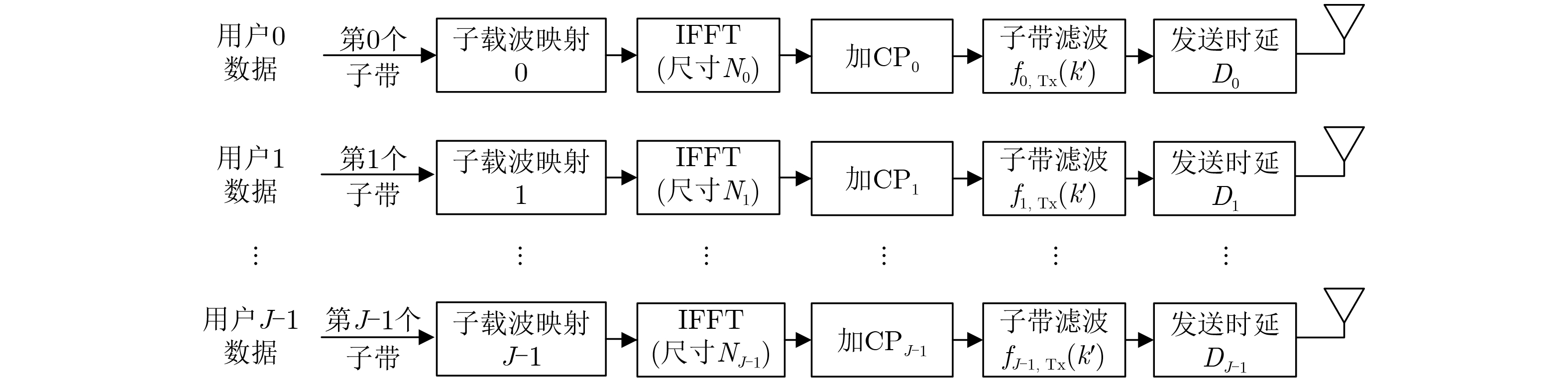
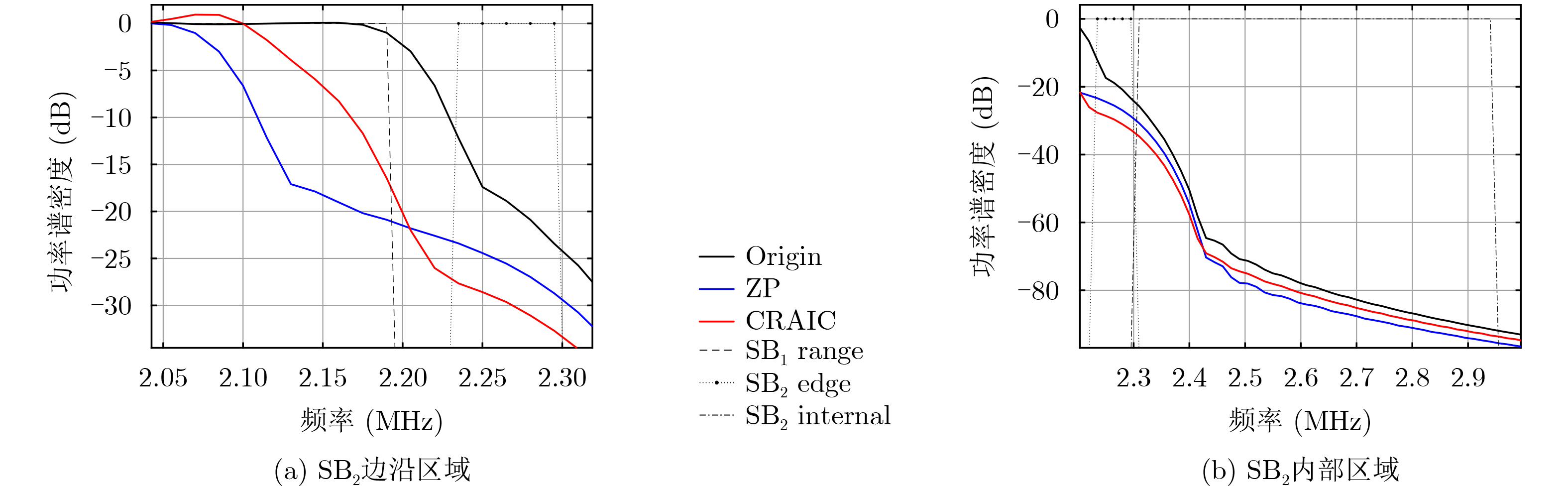
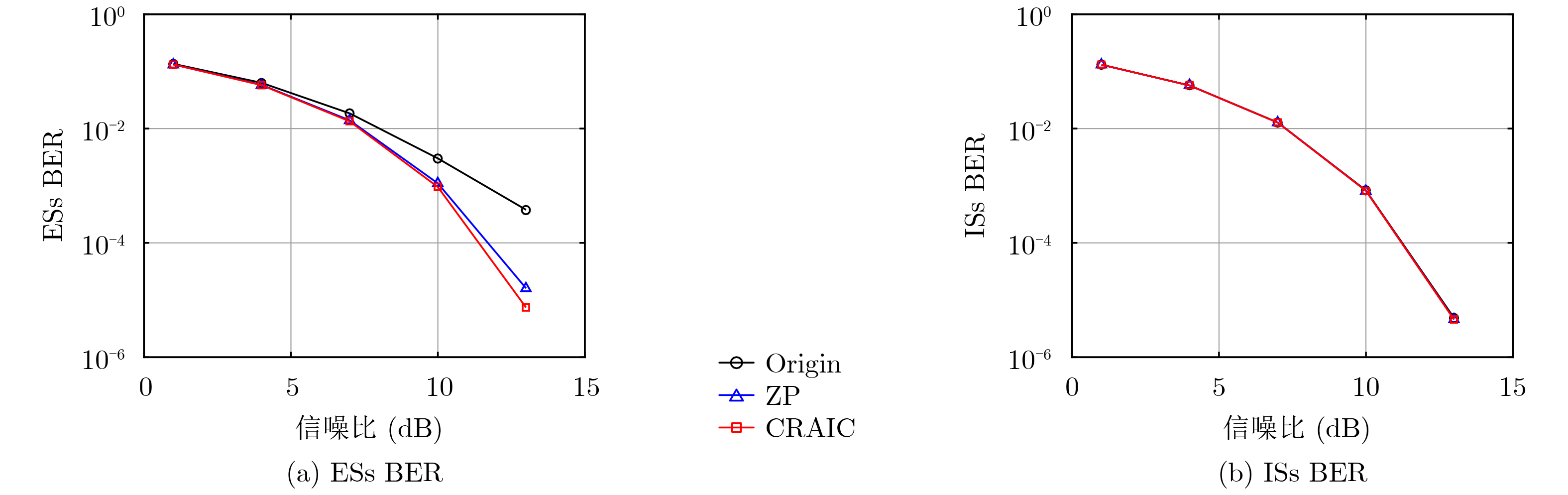
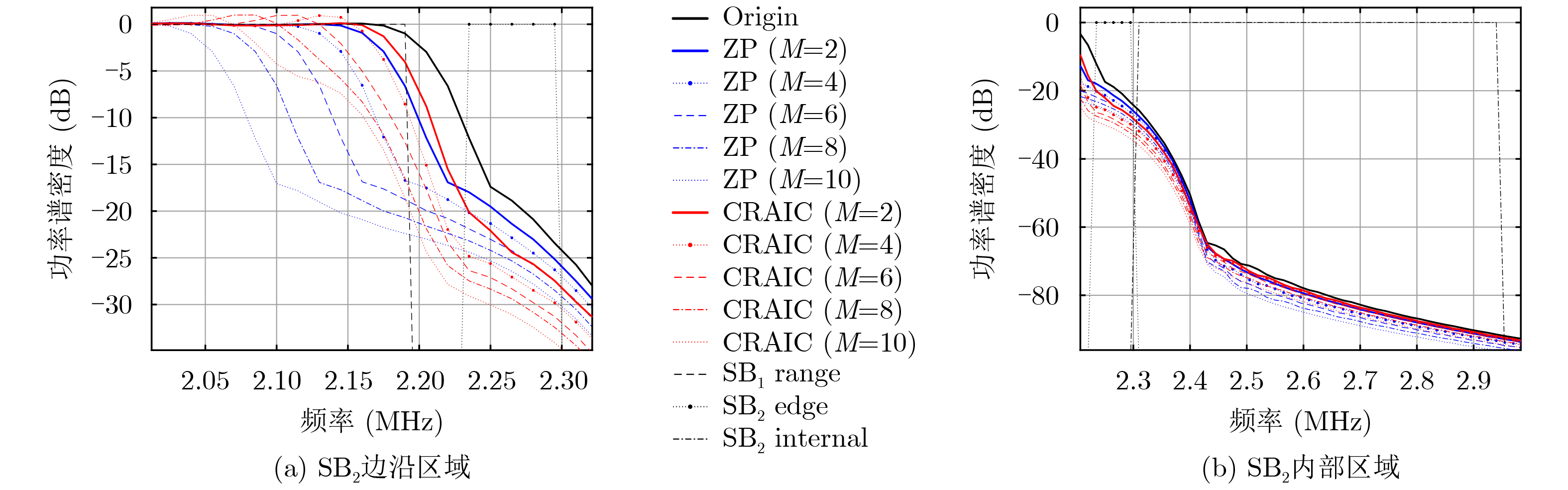
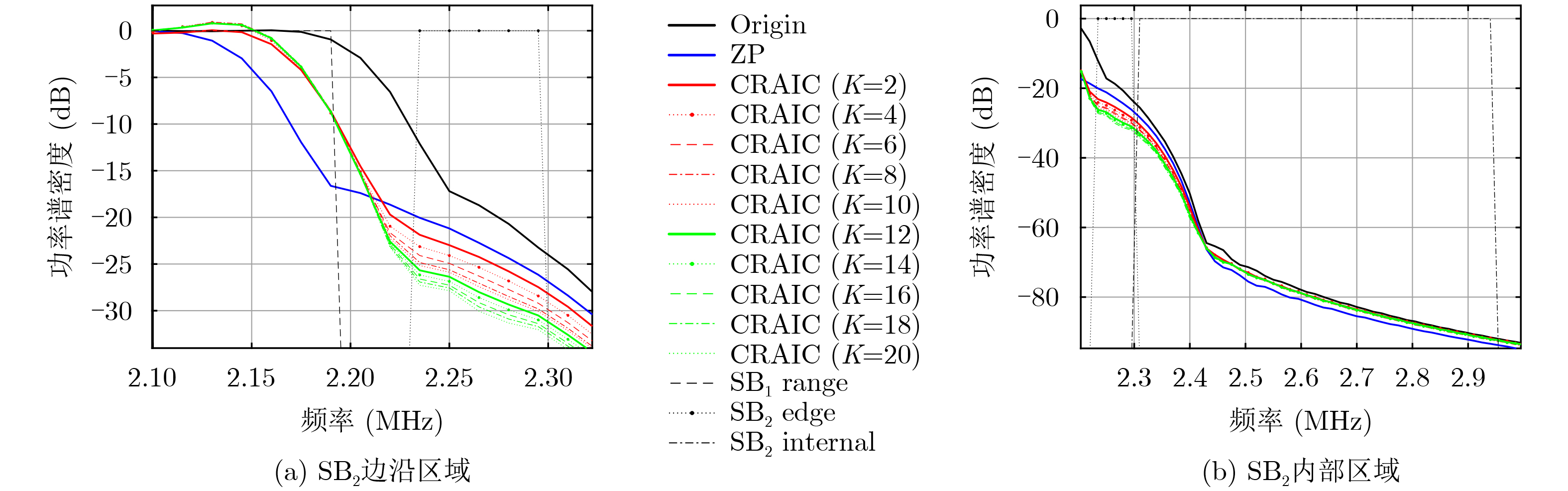
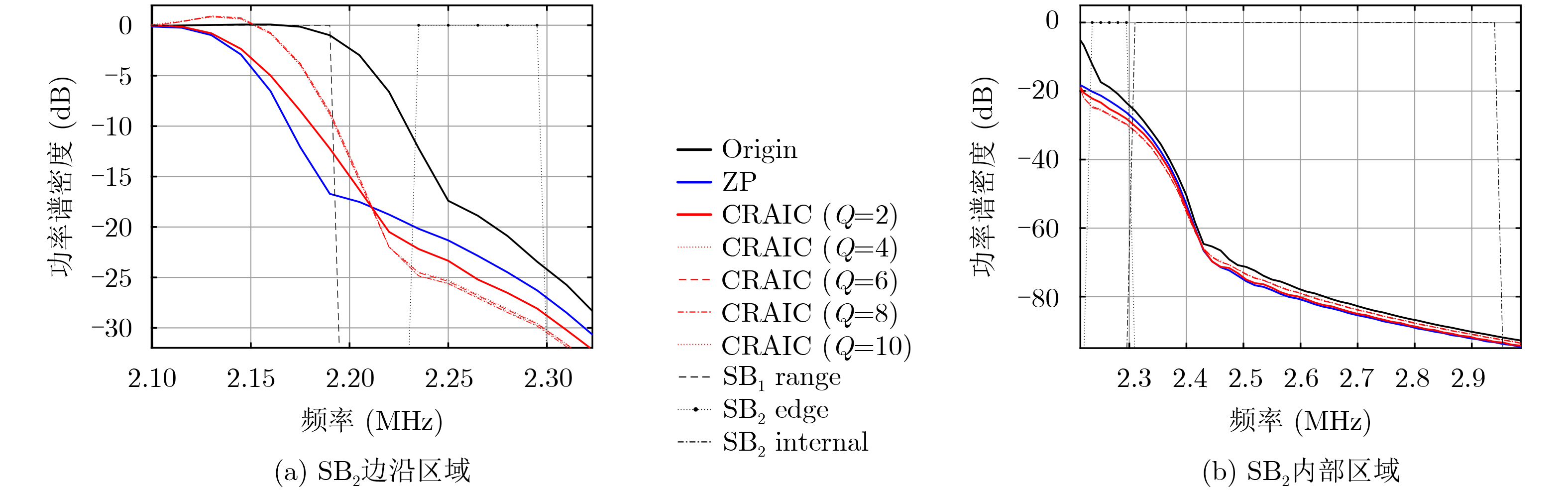
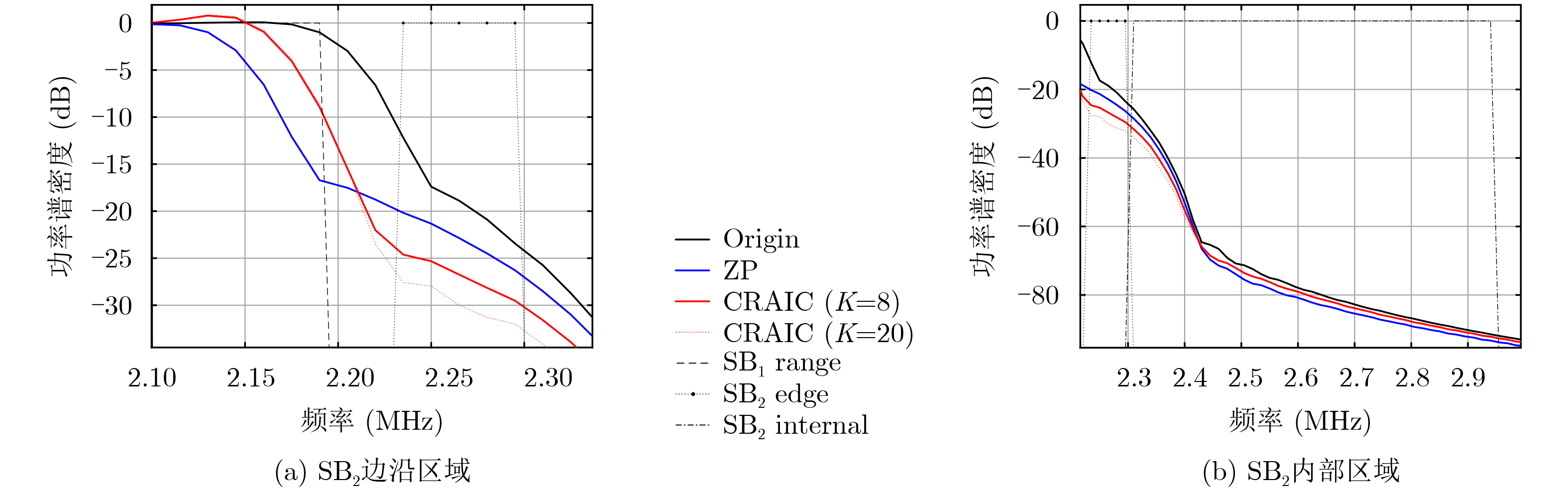
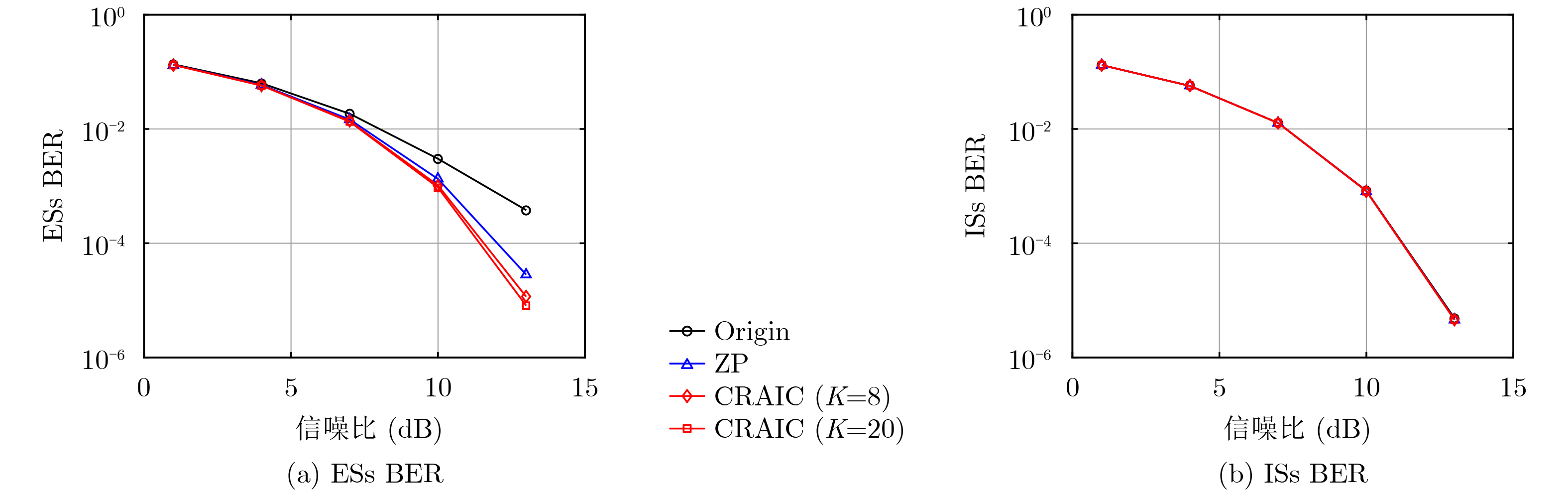
Objective Due to spectrum scarcity and diverse communication requirements, a waveform technology with high spectral efficiency, flexible subband configuration, and support for asynchronous communication is required for Sixth Generation mobile communication (6G). Among the candidate waveforms, filtered Orthogonal Frequency Division Multiplexing (f-OFDM) is considered a promising solution that satisfies these requirements. By applying subband filtering, f-OFDM enables flexible subband configuration and asynchronous transmission. However, the filtering mechanism inevitably introduces intrinsic interference into the system. A dominant component of this interference is InTer-subBand Interference (ITBI), which is mainly caused by Out-Of-Band Emission (OOBE) leakage from adjacent subbands. Therefore, suppressing subband OOBE is essential for reducing ITBI and improving the performance of f-OFDM systems. Based on the structure of f-OFDM systems, a Complexity-Reduced Active Interference Cancellation (CRAIC) algorithm is proposed to suppress the OOBE of f-OFDM subbands and improve overall system performance. Methods First, based on the spectral structure of f-OFDM, a subset of data subcarriers in the target subband is used to generate Cancellation Carriers (CCs). A CRAIC optimization model for f-OFDM systems is then constructed under the constraint of CCs power. The cost function is defined according to the superposed spectrum of data subcarriers and CCs at Desired Frequency Points (DFPs). Second, by introducing a real-complex domain transformation and reformulating the optimization model, the original complex-domain CRAIC programming problem is converted into a real-domain Second-Order Cone Programming (SOCP) problem, which enables efficient computation. Furthermore, computer simulations evaluate the effects of key parameters on CRAIC performance, including the number of CCs ($ M $), the number of data subcarriers used to generate CCs ($ K $), and the number of DFPs ($ Q $). Based on these evaluations, practical recommendations are provided for configuring CRAIC parameters in f-OFDM systems. Results and Discussions Simulation results show that in the edge region of the adjacent subband, the proposed CRAIC algorithm produces the steepest Power Spectral Density (PSD) roll-off compared with the conventional ZP and Origin schemes. This result indicates that CRAIC provides the strongest ITBI suppression in this region and achieves the lowest Bit Error Rate (BER) for Edge Subcarriers (ESs) in the adjacent subband. Specifically, CRAIC achieves a maximum PSD reduction of 4 dB and 12 dB compared with ZP and Origin, respectively ( Fig. 2a ). This result occurs because the right Q/2 DFPs are largely located in the edge region of SB2, which leads to effective spectral suppression in this area. Therefore, the BER at the edge of SB2 is significantly lower for CRAIC than for Origin, and a visible performance improvement is also observed compared with ZP (Fig. 3a ). Furthermore, the effects of key parameters $ M $, $ K $ and $ Q $ are examined through simulations. The results show that increasing $ M $ continuously improves OOBE suppression capability (Fig. 4a ), although spectral efficiency gradually decreases. In contrast, increasing $ K $ and $ Q $ produces only limited performance improvement. When these parameters exceed certain values, further increases do not provide additional gains (Fig. 5a andFig. 6a ). Based on these observations, $ M=4 $, $ K=8 $, $ Q=4 $ are selected as typical parameter settings for the scenario considered in this study. Under this configuration, CRAIC ($ K=8 $) achieves significant improvements in ES BER compared with Origin and ZP (Fig. 8a ), whereas the BER of Internal Subcarriers (ISs) remains nearly the same as that of the two benchmark schemes (Fig. 8b ). Compared with the full-scale CRAIC scheme ($ K=20 $), CRAIC ($ K=8 $) reduces the size of the data-subcarrier mapping matrix by 60% while causing only limited BER degradation (Fig. 8a ). These results indicate that the proposed algorithm preserves the performance of the full-scale Active Interference Cancellation (AIC) scheme while substantially reducing computational complexity.Conclusions A CRAIC algorithm for filtered OFDM systems is studied. The CRAIC optimization model is constructed under the constraint of CC power, and the cost function is defined based on the superposed spectrum of selected data subcarriers and CCs at DFPs. Through real-imaginary domain conversion and model reformulation, the complex-domain optimization problem is converted into a real-domain SOCP problem. Simulation results show that the CRAIC algorithm effectively reduces the PSD of the target subband, particularly in the transition region of the adjacent subband, which leads to clear improvement in edge BER performance. The effects of key parameters are also evaluated. Increasing $ M $ increases the performance gain of CRAIC compared with ZP, although spectral efficiency decreases. Increasing $ K $ improves OOBE suppression, although the gain gradually decreases and computational complexity increases. Increasing $ Q $ does not continuously reduce PSD. Overall, the CRAIC algorithm improves subband isolation in f-OFDM systems, reduces ITBI, and improves system performance. -
表 1 主要仿真参数
参数 SB1 SB2 SCS(kHz) 30 15 滤波器长度/样点 512 1024 IFFT尺寸/样点 1024 2 048 CP长度/样点 16 32 子载波序号 50~73 149~196 每帧符号数 28 14  下载: 导出CSV
-
[1] ATAEEBOJD E, RASTI M, and LATVA-AHO M. Network selection and resource allocation for coexistence of eMBB and URLLC services in a 6G multi-band HetNet[J]. IEEE Transactions on Green Communications and Networking, 2025, 9(3): 1179–1194. doi: 10.1109/TGCN.2024.3481281. [2] 徐金雷, 赵俊湦, 卢华兵, 等. 面向6G的多维扩展通感一体化研究综述[J]. 电子与信息学报, 2024, 46(5): 1672–1683. doi: 10.11999/JEIT231045.XU Jinlei, ZHAO Junsheng, LU Huabing, et al. An overview on multi-dimensional expanded integrated sensing and communication for 6G[J]. Journal of Electronics & Information Technology, 2024, 46(5): 1672–1683. doi: 10.11999/JEIT231045. [3] CHEN Zirui, ZHANG Zhaoyang, and YANG Zhaohui. Big AI models for 6G wireless networks: Opportunities, challenges, and research directions[J]. IEEE Wireless Communications, 2024, 31(5): 164–172. doi: 10.1109/MWC.015.2300404. [4] RAWAT B S, SRIVASTAVA A, SHRIVASTAVA V, et al. A comprehensive analysis of applications in internet of things networks in 5G and 6G[C]. 2024 2nd International Conference on Computer, Communication and Control (IC4), Indore, India, 2024: 1–6. doi: 10.1109/IC457434.2024.10486565. [5] 束锋, 张钧豪, 张旗, 等. 混合智能反射面辅助感通算一体化车联网的联合功率时间分配方法[J]. 电子与信息学报, 2025, 47(4): 1026–1042. doi: 10.11999/JEIT240719.SHU Feng, ZHANG Junhao, ZHANG Qi, et al. Hybrid reconfigurable intelligent surface assisted sensing communication and computation for joint power and time allocation in vehicle ad-hoc network[J]. Journal of Electronics & Information Technology, 2025, 47(4): 1026–1042. doi: 10.11999/JEIT240719. [6] GUO Fengxian, YU F R, ZHANG Heli, et al. Enabling massive IoT toward 6G: A comprehensive survey[J]. IEEE Internet of Things Journal, 2021, 8(15): 11891–11915. doi: 10.1109/JIOT.2021.3063686. [7] YUAN Yifei, WANG Sen, WU Yongpeng, et al. NOMA for next-generation massive IoT: Performance potential and technology directions[J]. IEEE Communications Magazine, 2021, 59(7): 115–121. doi: 10.1109/MCOM.001.2000997. [8] 曾嵘, 邵智敏. 零前缀OFDM中智能反射表面环境下干扰抑制算法研究[J]. 电子与信息学报, 2022, 44(7): 2358–2365. doi: 10.11999/JEIT211389.ZENG Rong and SHAO Zhimin. Research on interference suppression algorithm in reconfigurable intelligent surface environment in ZP-OFDM[J]. Journal of Electronics & Information Technology, 2022, 44(7): 2358–2365. doi: 10.11999/JEIT211389. [9] EL HOUDA BOUDA N, ELAHMAR S A, and DAYOUB I. 5G MCM based NOMA in vehicular environments: A comparative analysis of F-OFDM and W-OFDM[C]. 2024 3rd International Conference on Advanced Electrical Engineering (ICAEE), Sidi-Bel-Abbes, Algeria, 2024: 1–5. doi: 10.1109/ICAEE61760.2024.10783226. [10] ABDOLI J, JIA Ming, and MA Jianglei. Filtered OFDM: A new waveform for future wireless systems[C]. 2015 IEEE 16th International Workshop on Signal Processing Advances in Wireless Communications (SPAWC), Stockholm, Sweden, 2015: 66–70. doi: 10.1109/SPAWC.2015.7227001. [11] 华惊宇, 杨乐, 闻建刚, 等. 通用滤波多载波系统原型滤波器的连续凸近似优化设计方法[J]. 电子与信息学报, 2025, 47(10): 3793–3803. doi: 10.11999/JEIT250278.HUA Jingyu, YANG Le, WEN Jian’gang, et al. A successive convex approximation optimization based prototype filter design method for universal filtered multi-carrier systems[J]. Journal of Electronics & Information Technology, 2025, 47(10): 3793–3803. doi: 10.11999/JEIT250278. [12] ZHANG Xi, JIA Ming, CHEN Lei, et al. Filtered-OFDM - enabler for flexible waveform in the 5th generation cellular networks[C]. 2015 IEEE Global Communications Conference (GLOBECOM), San Diego, USA, 2015: 1–6. doi: 10.1109/GLOCOM.2015.7417854. [13] CHEN Hao, HUA Jingyu, LI Feng, et al. Interference analysis in the asynchronous f-OFDM systems[J]. IEEE Transactions on Communications, 2019, 67(5): 3580–3596. doi: 10.1109/TCOMM.2019.2898867. [14] CHENG Xudong, HE Yejun, GE Baohong, et al. A filtered OFDM using FIR filter based on window function method[C]. 2016 IEEE 83rd Vehicular Technology Conference (VTC Spring), Nanjing, China, 2016: 1–5. doi: 10.1109/VTCSpring.2016.7504065. [15] LIU Mingxin, XUE Wei, XU Yidong, et al. Design of filters based on generic function model for reducing out-of-band emissions of the F-OFDM systems[J]. AEU - International Journal of Electronics and Communications, 2021, 139: 153908. doi: 10.1016/j.aeue.2021.153908. [16] CHEN Hao, HUA Jingyu, WEN Jiangang, et al. Uplink interference analysis of F-OFDM systems under non-ideal synchronization[J]. IEEE Transactions on Vehicular Technology, 2020, 69(12): 15500–15517. doi: 10.1109/TVT.2020.3041938. [17] VAN DE BEEK J and BERGGREN F. Out-of-band power suppression in OFDM[J]. IEEE Communications Letters, 2008, 12(9): 609–611. doi: 10.1109/LCOMM.2008.080587. [18] BRANDES S, COSOVIC I, and SCHNELL M. Reduction of out-of-band radiation in OFDM systems by insertion of cancellation carriers[J]. IEEE Communications Letters, 2006, 10(6): 420–422. doi: 10.1109/LCOMM.2006.1638602. [19] ALIZADEH F and GOLDFARB D. Second-order cone programming[J]. Mathematical Programming, 2003, 95(1): 3–51. doi: 10.1007/s10107-002-0339-5. [20] LOBO M S, VANDENBERGHE L, BOYD S, et al. Applications of second-order cone programming[J]. Linear Algebra and its Applications, 1998, 284(1/3): 193–228. doi: 10.1016/S0024-3795(98)10032-0. [21] ZHANG Ruijin, WANG Zhaowei, LIU Xinwei, et al. IPRSOCP: A primal-dual interior-point relaxation algorithm for second-order cone programming[J]. Journal of the Operations Research Society of China, 2024: 1–31. doi: 10.1007/s40305-024-00538-z. [22] FENG Zengzhe. A new $ O(\sqrt{n} L) $ iteration large-update primal-dual interior-point method for second-order cone programming[J]. Numerical Functional Analysis and Optimization, 2012, 33(4): 397–414. doi: 10.1080/01630563.2011.652269. [23] ZAIDI A A, BALDEMAIR R, MOLES-CASES V, et al. OFDM numerology design for 5G new radio to support IoT, eMBB, and MBSFN[J]. IEEE Communications Standards Magazine, 2018, 2(2): 78–83. doi: 10.1109/MCOMSTD.2018.1700021. -

 下载:
下载:

图(8) / 表(1)
计量
- 文章访问数: 668
- HTML全文浏览量: 259
- PDF下载量: 61
- 被引次数: 0
