




UWF-YOLO: A Lightweight Framework for Underwater Object Detection via Redundant Information Optimization
-
摘要: 针对现有水下目标检测方法在成像退化类型多样与背景干扰等复杂场景中鲁棒性差以及在设备资源受限条件下难以兼顾检测精度与模型轻量化的问题,该文提出一种基于冗余信息优化的轻量化水下目标检测网络(UnderWater Faster YOLO network based on redundancy information optimization, UWF-YOLO),并进一步构建了复杂场景水下目标检测数据集(Underwater Object Detection dataset with Complex Scene, CSUOD)。UWF-YOLO采用FasterNet Block重构C2f模块优化主干和颈部网络,通过特征通道选择机制减少冗余特征,并引入Ghost卷积增强颈部网络的多尺度特征融合能力;同时,通过基于分组卷积的参数共享检测头降低计算开销;最后,应用结构化通道剪枝进一步压缩网络规模。CSUOD数据集通过收集真实水下图像进行标注和分辨率标准化处理,覆盖雾化、色偏、非均匀照明等各种退化类型,可用于复杂场景下水下目标检测模型的鲁棒性训练与性能评测。在DUO,RUOD和TrashCan数据集上进行实验分析,相较于YOLOv8s,所提方法在计算量、权重大小与参数量3个指标上分别降低了60.4%, 77.3%和78.4%;与参数量相当的YOLOv9-tiny相比,mAP指标在3个数据集上分别提升了0.3%, 2.3%和3.4%。同时,在自建CSUOD数据集上的主客观对比实验,进一步证实所提模型在实现显著轻量化的同时,能够有效避免背景干扰导致的误检、漏检等问题,特别在复杂水下环境中展现出优异的检测性能。此外,该文构建的复杂场景水下数据集将有助于推动水下目标检测方法的发展。Abstract:
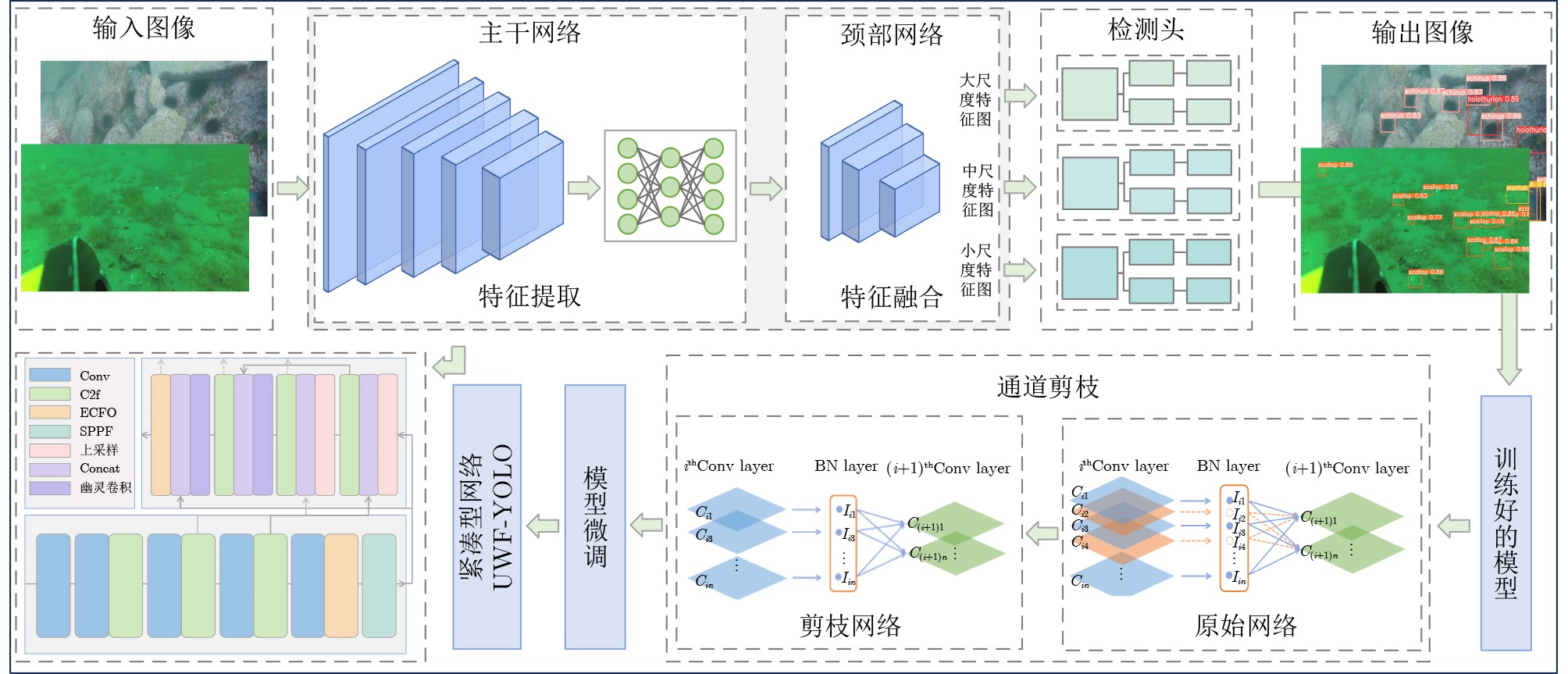
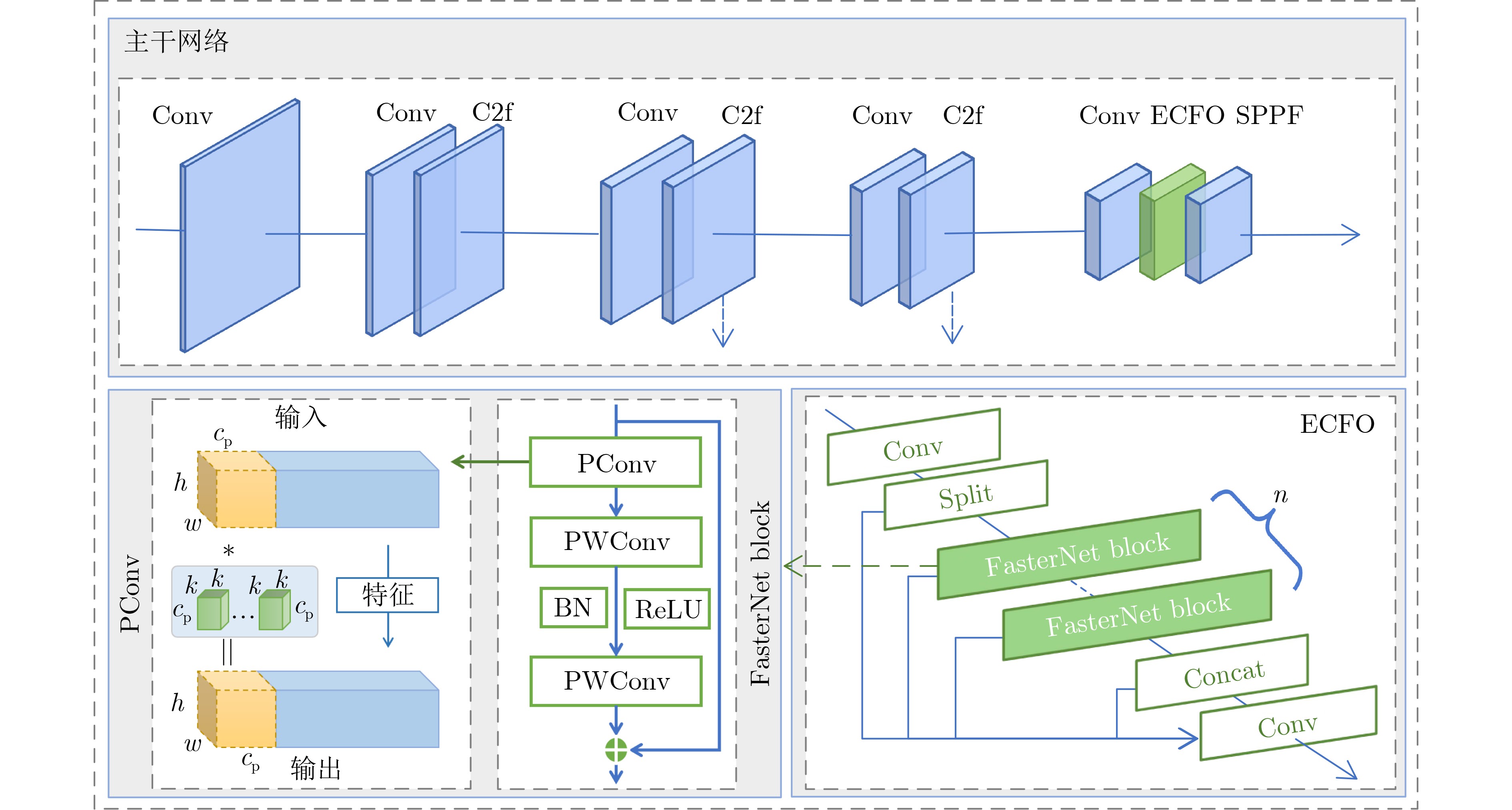
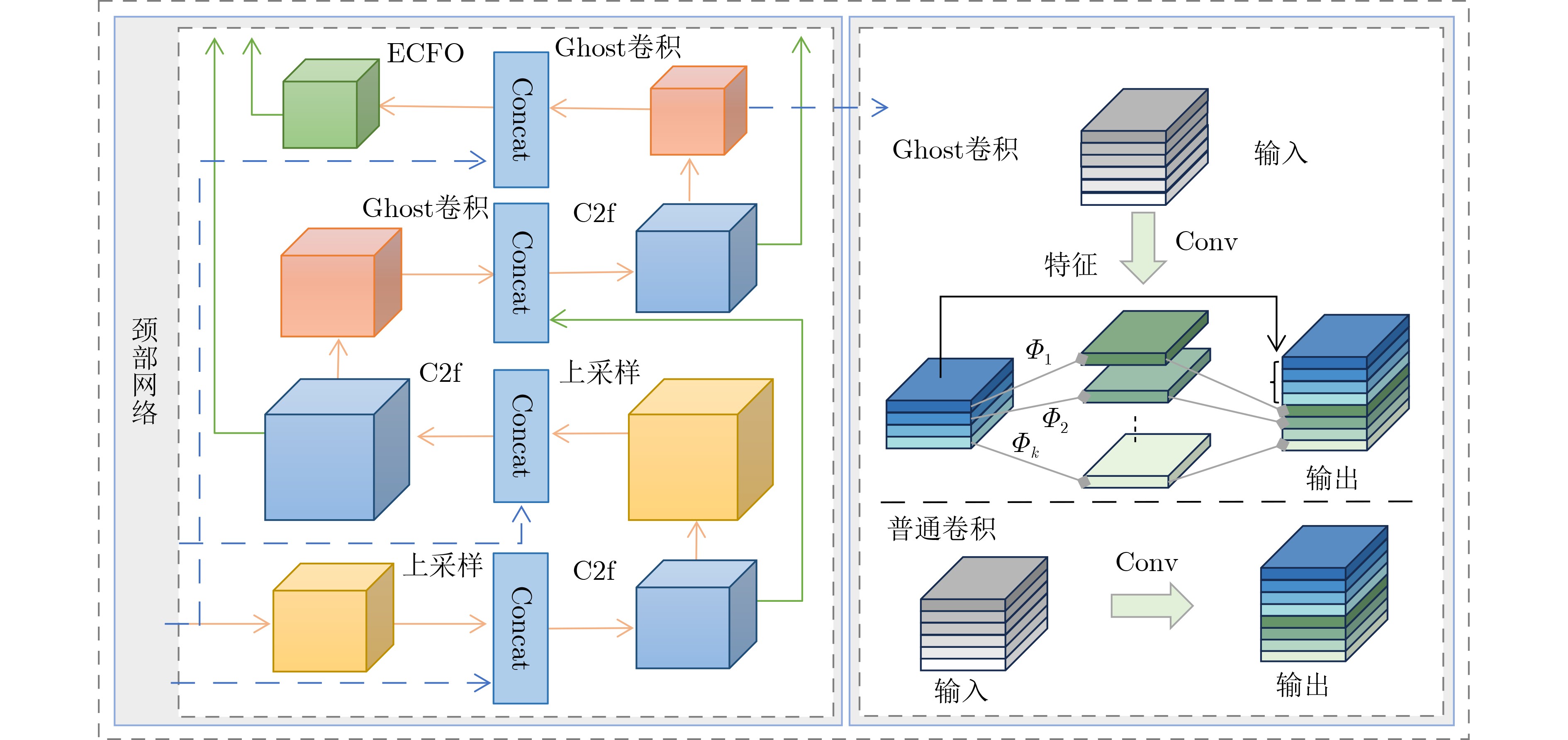
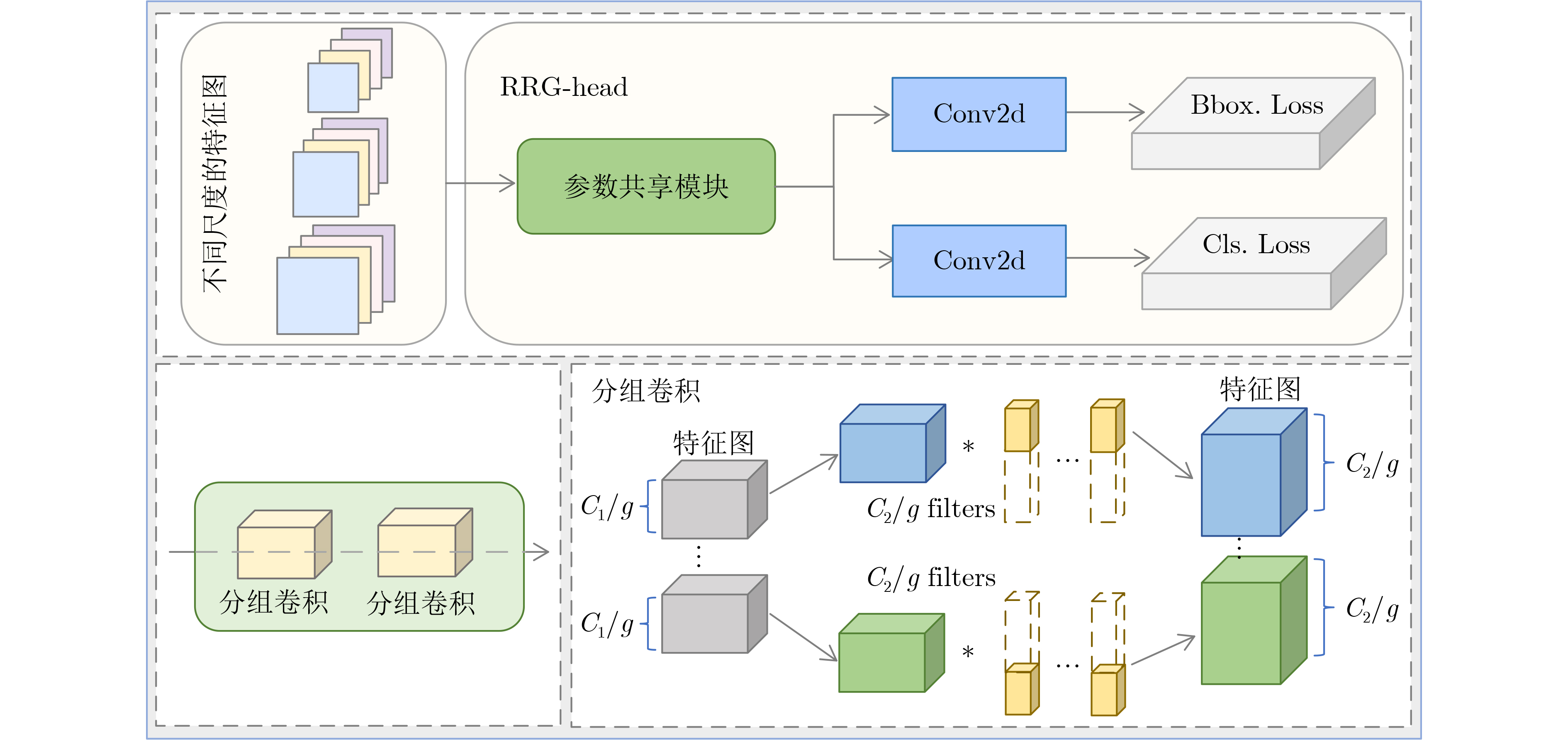
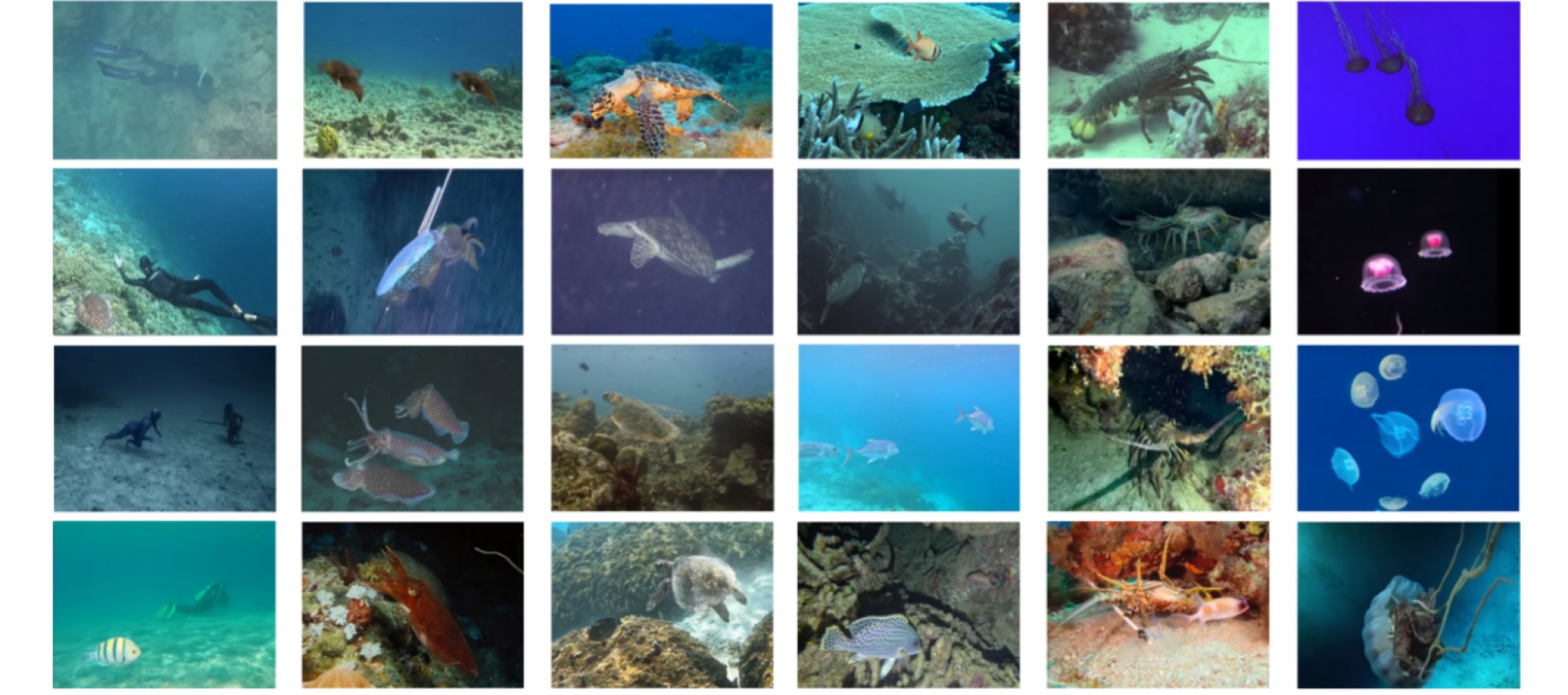
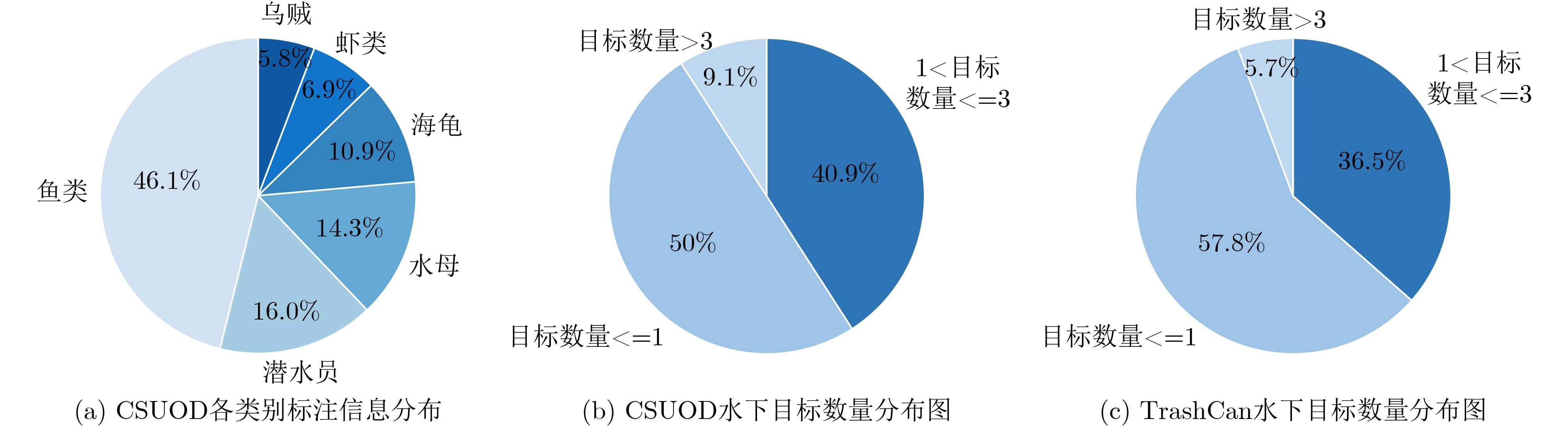
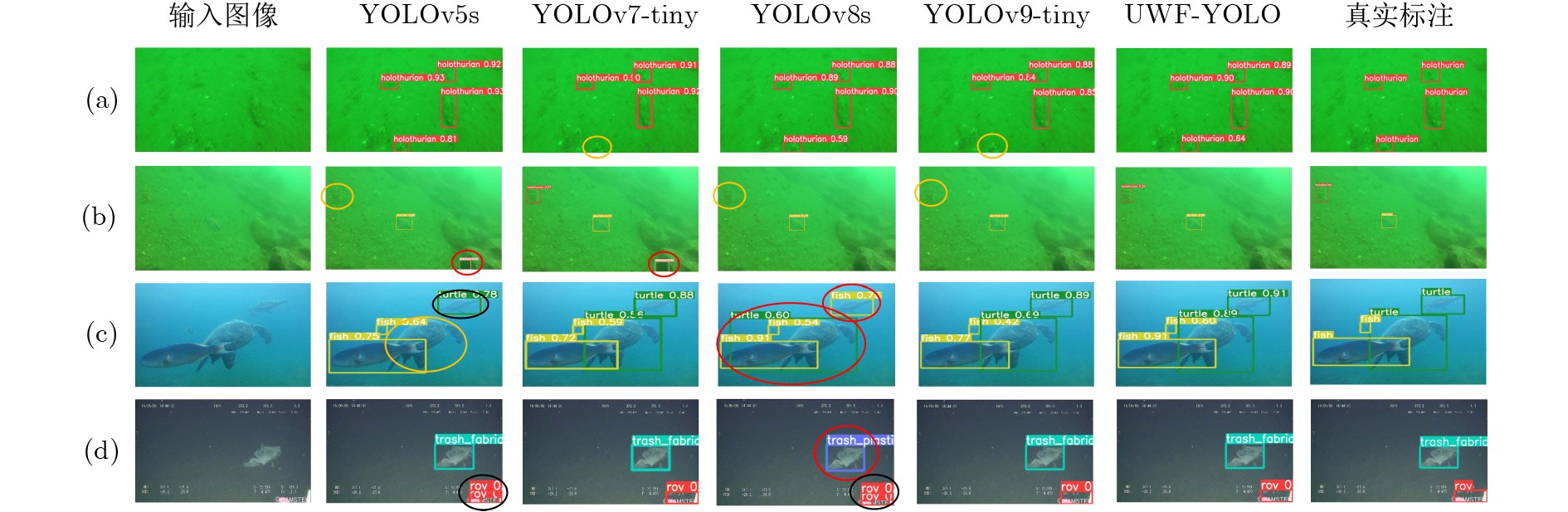
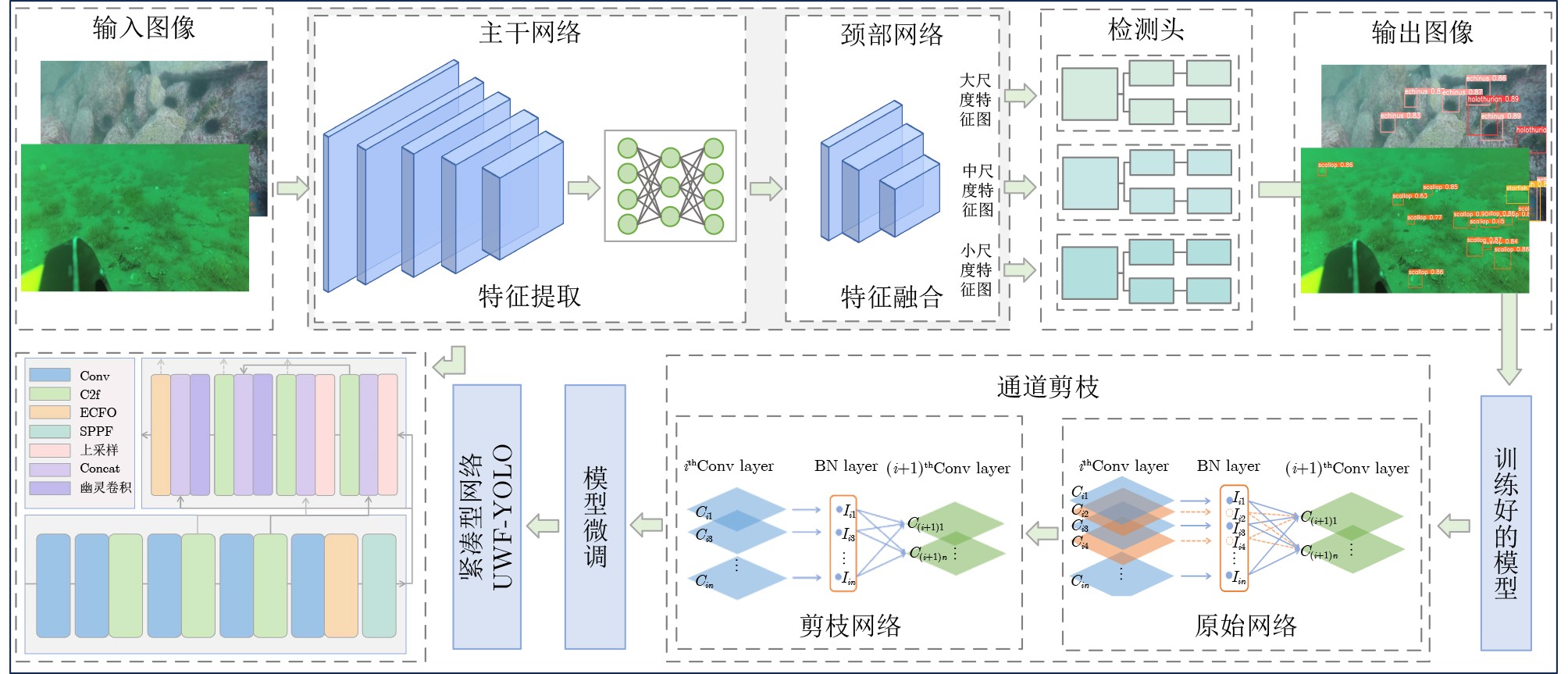
Objective The rapid development of underwater imaging technology has increased the significance of underwater object detection for resource exploration and environmental monitoring. Complex underwater environments often degrade image quality through color casts, haze-like effects, and non-uniform illumination. These factors reduce the performance of existing vision-based object detection algorithms, particularly for small objects, and often lead to missed detections and false positives. In addition, current deep learning-based underwater detection models face difficulty balancing detection accuracy and lightweight design under limited computational resources. Therefore, efficient underwater object detection methods are required for water-related vision tasks. Such methods support marine resource exploration, ecological monitoring, underwater robotics, and perception systems for autonomous underwater vehicles. Methods A lightweight framework based on redundant information optimization is proposed for underwater object detection. Specifically, a lightweight underwater object detection network, termed UWF-YOLO, is designed based on redundant information optimization. First, the C2f module is reconstructed using the FasterNet Block to optimize both the backbone and neck networks. A feature channel selection mechanism is integrated to reduce redundant feature representations. Furthermore, redundant convolutional features in the conventional YOLO neck limit adaptation to underwater environments. Therefore, Ghost Convolution is introduced to generate Ghost feature maps and improve the multi-scale feature fusion capability of the neck network. Next, parameter sharing is achieved by replacing the original detection head with a redundant optimization group detection head (RRG-Head) based on group convolution, which reduces computational cost. Finally, a structured channel pruning strategy is applied to identify inter-layer dependencies in the computational graph and bind pruning units. Combined with LAMP weight magnitude score normalization to evaluate channel importance, low-contributing groups are pruned and subsequently fine-tuned to compress the network size. In addition, existing underwater detection datasets usually contain monotonous scenes, and the objects are typically small and densely distributed. To address this limitation, an underwater object detection dataset with complex scenes, termed CSUOD, is constructed by collecting real-world underwater images from various websites and platforms. Manual annotation and resolution normalization are then performed to ensure dataset consistency. CSUOD is designed for challenging underwater environments characterized by color casts, haze-like effects, and non-uniform illumination. A total of 1 135 images containing six object categories are manually selected and annotated. Results and Discussions Extensive experiments are conducted on three public underwater object detection datasets, namely DUO, RUOD, and TrashCan, and several widely used detection methods are compared. The proposed model is evaluated against mainstream detectors, including YOLOv5s, YOLOv7-tiny, YOLOv8s, YOLOv9-tiny, and Deformable DETR. In terms of computational complexity, the proposed method reduces FLOPs, model size, and parameters by 60.4%, 77.3%, and 78.4%, respectively, compared with the baseline model. Furthermore, the proposed method outperforms YOLOv9-tiny with comparable parameters by 0.3%, 2.3%, and 3.4% in mAP on the three datasets. Additional comparative experiments on the constructed CSUOD dataset also demonstrate improved performance and stable detection capability in complex underwater environments. Qualitative visualization results further demonstrate the robustness and detection stability of the model under various underwater degradations, including haze-like effects and non-uniform illumination. Conclusions Quantitative and qualitative experiments on multiple datasets validate the effectiveness and robustness of the proposed method. The proposed framework achieves superior detection performance in complex underwater environments and reduces missed detections and false positives caused by background interference. Experimental results indicate that the proposed UWF-YOLO achieves significant model lightweighting while maintaining detection accuracy comparable to benchmark models. This balance between detection accuracy and low computational cost makes the framework suitable for underwater devices with limited resources. The proposed method also shows strong potential for practical applications such as marine ecological monitoring, underwater resource exploration, and perception systems for autonomous underwater vehicles. It provides a reliable technical foundation for real-time applications, supports integration into embedded platforms, and enables real-time perception and decision-making under different underwater conditions. In addition, the constructed CSUOD dataset helps address the limitations of existing underwater detection datasets and supports further research in underwater object detection. Future work will extend this framework to multi-modal perception systems and larger-scale datasets, enabling adaptive models for dynamic underwater scenarios and supporting broader applications in intelligent ocean observation and autonomous navigation. -
表 1 DUO, RUOD和TrashCan数据集客观指标对比
方法 mAP50(%) FLOPs(G) Weight(M) Params(M) DUO RUOD TrashCan DUO RUOD TrashCan DUO RUOD TrashCan DUO RUOD TrashCan YOLOv5s 82.3 85.9 89.2 15.8 15.8 15.9 14.4 14.5 14.5 7.0 7.0 7.1 Deformable DETR 80.1 83.3 81.4 51.1 51.1 51.1 480.0 480.0 480.0 39.8 39.8 39.8 YOLOv7-tiny 83.6 84.6 84.7 13.0 13.1 13.2 12.4 12.3 12.4 6.0 6.0 6.1 YOLOv8s 83.1 86.5 89.6 28.4 28.5 28.5 22.5 22.6 22.5 11.1 11.1 11.1 YOLOv9-tiny 82.8 84.3 86.0 10.7 10.7 10.7 6.1 6.1 6.1 2.6 2.6 2.6 UWF-YOLO
(剪枝前)84.2 87.0 90.1 19.5 19.5 19.5 14.7 14.7 14.7 7.2 7.2 7.2 UWF-YOLO 83.1 86.6 89.4 11.3 11.4 11.3 5.1 5.0 5.1 2.4 2.4 2.4 注:加粗数值为指标最优值。  下载: 导出CSV
表 2 自建CSUOD数据集指标对比(%)
方法 mAP50_all AP_j AP_c AP_f AP_s AP_d AP_t YOLOv5s 78.4 86.7 81.5 76.9 50.8 87.1 87.8 YOLOv7-tiny 65.3 56.6 70.2 74.0 52.6 72.6 65.6 YOLOv7 79.6 89.6 82.5 80.5 61.6 81.6 81.8 YOLOv8s 78.0 85.9 72 79.6 64.2 76.4 90 YOLOv9-tiny 65.1 76.5 63.1 64.9 45.6 65.9 74.4 UWF-YOLO 79.6 84.2 79.8 75.2 70.5 84.2 84.1 注:加粗数值为指标最优值。
下载: 导出CSV
表 3 消融实验
数据集 方案 基线模型 ECFO Ghost RRG-Head 通道剪枝 mAP50 (%) Params (M) FLOPs (G) Weight (M) RUOD 1 √ 86.5 11.1 28.5 22.6 2 √ √ 86.7 9.4 27.0 19.0 3 √ √ √ 86.7 9.0 26.6 18.3 4 √ √ √ √ 87.0 7.2 19.5 14.7 5 √ √ √ √ √ 86.6 2.4 11.4 5.0 TrashCan 1 √ 89.6 11.1 28.5 22.5 2 √ √ 90.0 9.4 27.1 19.0 3 √ √ √ 90.2 9.0 26.6 18.3 4 √ √ √ √ 90.1 7.2 19.5 14.7 5 √ √ √ √ √ 89.4 2.4 11.3 5.1 注:加粗数值为指标最优值。
下载: 导出CSV
-
[1] 黄海宁, 李宝奇, 刘纪元, 等. 声呐图像水下目标识别综述与展望[J]. 电子与信息学报, 2024, 46(5): 1742–1760. doi: 10.11999/JEIT231207.HUANG Haining, LI Baoqi, LIU Jiyuan, et al. Sonar image underwater target recognition: A comprehensive overview and prospects[J]. Journal of Electronics & Information Technology, 2024, 46(5): 1742–1760. doi: 10.11999/JEIT231207. [2] WANG Hao, ZHANG Weibo, XU Yinghao, et al. WaterCycleDiffusion: Visual-textual fusion empowered underwater image enhancement[J]. Information Fusion, 2025, 127: 103693. doi: 10.1016/j.inffus.2025.103693. [3] ZHANG Dehua, YU Changcheng, LI Zhen, et al. A lightweight network enhanced by attention-guided cross-scale interaction for underwater object detection[J]. Applied Soft Computing, 2025, 184: 113811. doi: 10.1016/j.asoc.2025.113811. [4] CHEW A L, TONG P B, and CHIA C S. Automatic detection and classification of man-made targets in side scan sonar images[C]. 2007 Symposium on Underwater Technology and Workshop on Scientific Use of Submarine Cables and Related Technologies, Tokyo, Japan, 2007: 126–132. doi: 10.1109/UT.2007.370841. [5] BEIJBOM O, EDMUNDS P J, KLINE D I, et al. Automated annotation of coral reef survey images[C]. 2012 IEEE Conference on Computer Vision and Pattern Recognition, Providence, USA, 2012: 1170–1177. doi: 10.1109/CVPR.2012.6247798. [6] LI Xiu, SHANG Min, QIN Hongwei, et al. Fast accurate fish detection and recognition of underwater images with fast R-CNN[C]. OCEANS 2015-MTS/IEEE Washington, Washington, USA, 2015: 1–5. doi: 10.23919/OCEANS.2015.7404464. [7] SONG Pinhao, LI Pengteng, DAI Linhui, et al. Boosting R-CNN: Reweighting R-CNN samples by RPN’s error for underwater object detection[J]. Neurocomputing, 2023, 530: 150–164. doi: 10.1016/j.neucom.2023.01.088. [8] 王非, 王欣宇, 周景春, 等. 一种基于YOLOv3的水下声呐图像目标检测方法[J]. 电子与信息学报, 2022, 44(10): 3419–3426. doi: 10.11999/JEIT220260.WANG Fei, WANG Xinyu, ZHOU Jingchun, et al. An underwater object detection method for sonar image based on YOLOv3 model[J]. Journal of Electronics & Information Technology, 2022, 44(10): 3419–3426. doi: 10.11999/JEIT220260. [9] DAI Linhui, LIU Hong, SONG Pinhao, et al. A gated cross-domain collaborative network for underwater object detection[J]. Pattern Recognition, 2024, 149: 110222. doi: 10.1016/j.patcog.2023.110222. [10] YUAN Jieyu, CAI Zhanchuan, and CAO Wei. A novel underwater detection method for ambiguous object finding via distraction mining[J]. IEEE Transactions on Industrial Informatics, 2024, 20(7): 9215–9224. doi: 10.1109/TII.2024.3383537. [11] 沈学利, 李东峰. 频域重标定与自适应稀疏金字塔水下实时目标检测[J/OL]. 激光与光电子学进展. https://link.cnki.net/urlid/31.1690.TN.20260121.1736.048, 2026.SHEN Xueli and LI Dongfeng. Real-time underwater object detection with frequency-domain recalibration and an adaptive sparse pyramid[J/OL]. Laser & Optoelectronics Progress. https://link.cnki.net/urlid/31.1690.TN.20260121.1736.048, 2026. [12] WANG Junzhe, CHEN Xinke, DAI Anbang, et al. LS-DETR: Lightweight transformer for object detection in forward-looking sonar images[J]. IEEE Geoscience and Remote Sensing Letters, 2025, 22: 1502805. doi: 10.1109/LGRS.2025.3575615. [13] JOCHER G, QIU Jing, and CHAURASIA A. Ultralytics YOLO[EB/OL]. https://github.com/ultralytics/ultralytics, 2025. [14] CHEN Jierun, KAO S H, HE Hao, et al. Run, don't walk: Chasing higher FLOPS for faster neural networks[C]. 2023 IEEE/CVF Conference on Computer Vision and Pattern Recognition, Vancouver, Canada, 2023: 12021–12031. doi: 10.1109/CVPR52729.2023.01157. [15] HAN Kai, WANG Yunhe, TIAN Qi, et al. GhostNet: More features from cheap operations[C]. 2020 IEEE/CVF Conference on Computer Vision and Pattern Recognition, Seattle, USA, 2020: 1577–1586. doi: 10.1109/CVPR42600.2020.00165. [16] FANG Gongfan, MA Xinyin, SONG Mingli, et al. DepGraph: Towards any structural pruning[C]. 2023 IEEE/CVF Conference on Computer Vision and Pattern Recognition, Vancouver, Canada, 2023: 16091–16101. doi: 10.1109/CVPR52729.2023.01544. [17] LEE J, PARK S, MO S, et al. Layer-adaptive sparsity for the magnitude-based pruning[C]. 9th International Conference on Learning Representations, 2021. [18] LIU Chongwei, LI Haojie, WANG Shuchang, et al. A dataset and benchmark of underwater object detection for robot picking[C]. 2021 IEEE International Conference on Multimedia & Expo Workshops, Shenzhen, China, 2021: 1–6. doi: 10.1109/ICMEW53276.2021.9455997. [19] FU Chenping, LIU Risheng, FAN Xin, et al. Rethinking general underwater object detection: Datasets, challenges, and solutions[J]. Neurocomputing, 2023, 517: 243–256. doi: 10.1016/j.neucom.2022.10.039. [20] HONG J, FULTON M, and SATTAR J. TrashCan: A semantically-segmented dataset towards visual detection of marine debris[EB/OL]. arXiv: 2007.08097. https://doi.org/10.48550/arXiv.2007.08097, 2020. [21] ZHU Xizhou, SU Weijie, LU Lewei, et al. Deformable DETR: Deformable transformers for end-to-end object detection[C]. 9th International Conference on Learning Representations, 2021. [22] JOCHER G. YOLOv5 by ultralytics[EB/OL]. https://github.com/ultralytics/yolov5, 2025. [23] WANG C Y, BOCHKOVSKIY A, and MARK LIAO H Y. YOLOv7: Trainable bag-of-freebies sets new state-of-the-art for real-time object detectors[C]. 2023 IEEE/CVF Conference on Computer Vision and Pattern Recognition, Vancouver, Canada, 2023: 7464–7475. doi: 10.1109/CVPR52729.2023.00721. [24] WANG C Y, YEH I H, and MARK LIAO H Y. Yolov9: Learning what you want to learn using programmable gradient information[C]. 18th European Conference on Computer Vision, Milan, Italy, 2025: 1–21. doi: 10.1007/978-3-031-72751-1_1. -

 下载:
下载:

图(7) / 表(3)
计量
- 文章访问数: 1233
- HTML全文浏览量: 853
- PDF下载量: 143
- 被引次数: 0
