




A Lightweight and High-Reliability Challenge Generation Strategy for APUF
-
摘要: 仲裁物理不可克隆函数(APUF)作为轻量级安全原语,已广泛应用于身份认证和密钥生成等安全场景,但其响应一致性易受温度、电压等环境因素干扰,导致同一激励在不同条件下产生不一致响应,严重降低应用的可靠性。针对现有基于硬件改进和激励筛选的APUF可靠性提升方案普遍存在资源开销大、效率低的问题,该文提出一种基于延迟差异约束的激励生成策略(DCGS),旨在提升资源受限场景下APUF的可靠性。该策略首先利用逻辑回归模型建模APUF的路径延迟特性,构建延迟权重向量;随后通过前缀比特初始化与逐位扩展机制构造激励,实时控制生成激励的延迟差介于设定阈值区间,最终直接生成具有高可靠性和高随机性的激励序列,无需额外候选激励筛选环节。仿真结果表明:DCGS生成的激励在实际应用面临的最大噪声强度下,可靠性仍保持100%,响应均匀性达50.02%,唯一性达50.46%,且生成1万条高可靠激励仅需0.017秒,在可靠性提升效果、分布均匀性、唯一性和生成效率四方面均优于基准方案。该策略无需增加硬件开销,能显著增强APUF在复杂环境中的适用性,适用于物联网节点、嵌入式设备等多类资源受限设备的双向认证和密钥生成场景。Abstract:
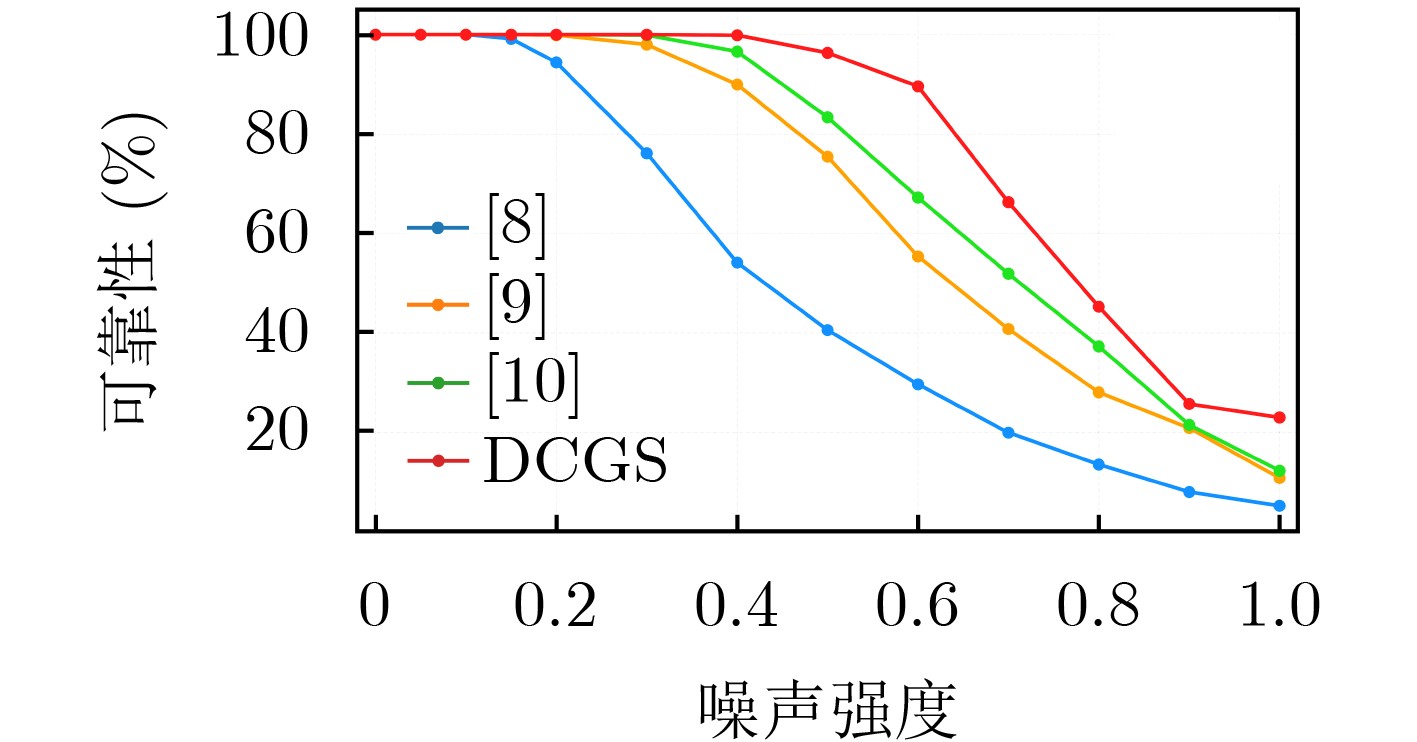
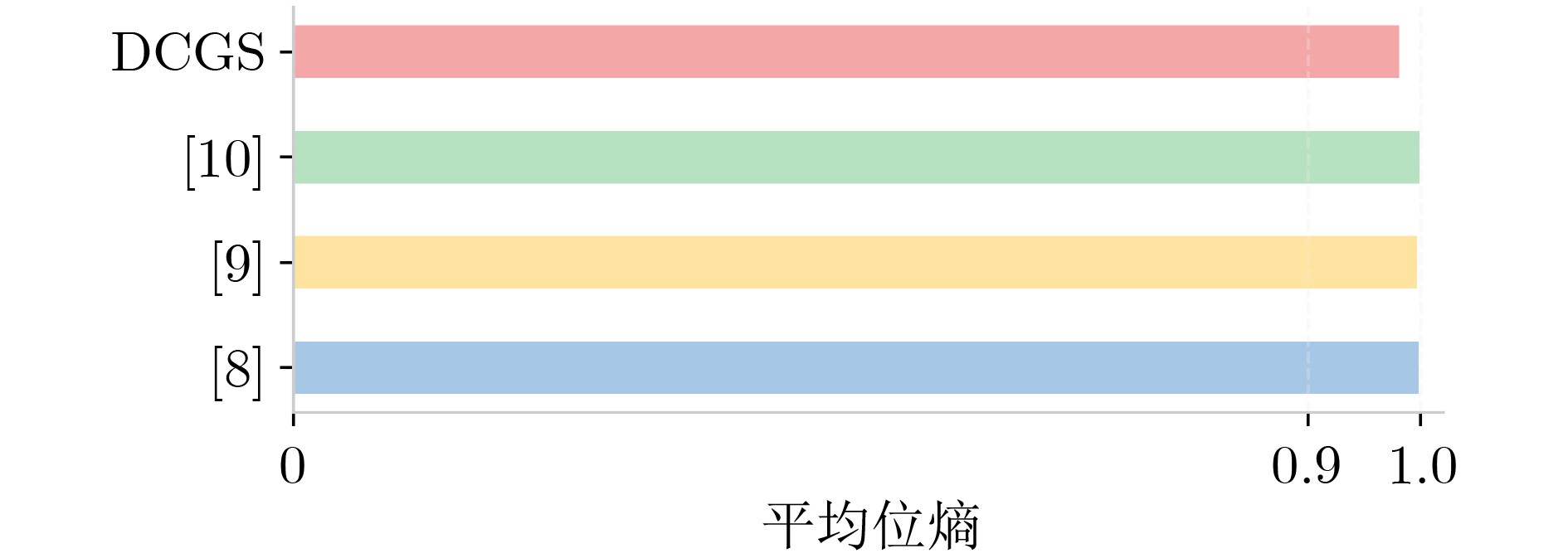
Objective The Arbiter Physical Unclonable Function (APUF) is a lightweight security primitive that has been widely adopted in identity authentication and key generation for resource-constrained devices. However, its response consistency is highly sensitive to environmental perturbations, leading to inconsistent responses for the same challenge under different conditions, severely undermining the reliability of APUF-based security systems. Existing reliability improvement schemes for APUF, which mainly rely on hardware modification or challenge screening, generally suffer from high resource overhead and low efficiency. To address the limitations of these existing solutions, a Delay-Constrained Challenge Generation Strategy (DCGS) is proposed to enhance APUF reliability without extra hardware overhead or screening-related inefficiencies. Methods The core of DCGS lies in modeling APUF path delay properties and constructing challenges with constrained delay differences to ensure response stability. First, a logistic regression (LR) model is established to characterize the relationship between APUF challenge bits and path delays. From the trained LR model, a delay weight vector is derived to quantify the contribution of each challenge bit to the overall path delay. Second, a two-stage challenge generation mechanism is designed to integrate delay constraint control: The first stage is prefix bit initialization, which generates distinct prefix sequences to establish a stable delay baseline for subsequent bit extension. The second stage is bit-wise extension, where each remaining challenge bit is dynamically determined based on the delay weight vector. During this extension process, the cumulative delay difference of the challenge is monitored in real time, ensuring it stays within a preset threshold range. Unlike traditional screening methods that post-process candidate challenges, DCGS directly generates stable challenges by design, eliminating the need for candidate pools and improving generation efficiency. Results and Discussions Performance evaluations of DCGS are conducted under varying noise intensities. At a noise intensity of 0.3 (maximum practical level), the reliability of DCGS-generated challenges remains at 100% ( Fig.2 ). In terms of generation efficiency, DCGS consumes only 0.017 seconds to generate 10,000 challenges (Table 4 ). For response uniformity, DCGS achieves a value of 50.02% (Table 4 ). For uniqueness, it reaches 50.46% (Table 4 ). These two key metrics are both close to the ideal theoretical value of 50%. Security analysis shows that the average bit entropy of DCGS-generated challenges is0.9807 (Fig.3 ), and the conditional entropy is0.9878 —only0.0023 lower than that of random challenges (0.9901 ).Conclusions This paper proposes a delay-constrained challenge generation strategy for APUF, aiming to address the problems of inconsistent responses, low generation efficiency, and high hardware resource consumption of traditional schemes in high-noise environments. By modeling the path delay characteristics of APUF using LR and integrating a prefix initialization mechanism with a bit-wise extension mechanism, the strategy ensures that the generated challenges meet the preset delay difference threshold range. Through this method, the DCGS achieves high reliability, high efficiency, and good response uniformity without increasing hardware overhead. Experimental results show that DCGS can effectively enhance the reliability of APUF in complex environments, providing strong technical support for secure applications in resource-constrained devices. -
1 算法1 基于延迟差约束的激励生成算法
输入 生成激励数量$ N $,激励位数$ n $,延迟权重向量$ \boldsymbol{w} $,阈值
$ T $,前缀长度$ P $,温度参数$ \tau $输出 激励集$ \boldsymbol{C}\in {\left\{0,1\right\}}^{N\times n} $ (1) 设定阈值区间$ {I}_{+}=[T,1.2T] $; ${I}_{-}=[-1.2T,-T] $;
${C\leftarrow 全零矩阵(N,n)} $(2) for $ i=1 $ to $ N $ do (3) $ (\mathrm{low}[i],\mathrm{high}[i]) \leftarrow (i是奇数?{\mathrm{I}}_{+}\colon {\mathrm{I}}_{-}) $ (4) $ 净延迟差S[i]\leftarrow 0;累积符号\text{tail}[i]\leftarrow +1 $ (5) end for (6) 生成$ N $个互异前缀,写入$ \boldsymbol{C} $的后$ P $位 # 计算前缀净延迟差 (8) for $ i=1 $ to $ N $ do (9) for $ j=n-1 $ to $ n-p $ do (10) if $ \boldsymbol{C}[i,j]=1 $ then $ \text{sign}\leftarrow -1 $ (11) else $ \text{sign}\leftarrow 1 $ (12) end if (13) $ \text{tail}\leftarrow \textit{tail}[\mathrm{i}]\cdot \text{sign;}S[i]\leftarrow S[i]\text{+tail}[i]\cdot \boldsymbol{w}[j] $ (14) end for (15) end for # 逐比特生成剩余激励位 (16) for $ j=n-p-1 $ to 0 do (17) for $ i=1 $ to $ N $ do (18) $ {S}_{0}\leftarrow S[i]+\mathrm{tail}[i]\cdot \boldsymbol{w}[j] $; ${S}_{1}\leftarrow S[i]-\mathrm{ta}i\mathrm{l}[\mathrm{i}]\cdot \boldsymbol{w}[j] $; ${e}_{0}\leftarrow dist({S}_{0},(low[i],high[i]) ) $; ${e}_{1}\leftarrow dist({S}_{1},(low[i],high[i]) ) $ # 根据输入的固定参数$ \tau $,选择采样方式 (19) if $ \tau =0 $ then (20) $ \mathrm{bit}\leftarrow ({e}_{0}\leq {e}_{1}) ?0\colon 1 $ (21) else (22) ${a}_{0}\leftarrow \exp (-{e}_{0}/\tau ) $; ${a}_{1}\leftarrow \exp (-{e}_{1}/\tau ) $; ${p}_{0}\leftarrow {a}_{0}/ $$({a}_{0}+{a}_{1}) $; $ \mu \leftarrow \left[0,1\right) $; $\mathrm{bit}\leftarrow (\mu \lt {p}_{0}) ?0\colon 1 $ (23) end if (24) if $ \mathrm{bit}=0 $ then (25) $ \boldsymbol{C}[i,j]\leftarrow 0;S[i]\leftarrow {S}_{0} $ (26) else $ \boldsymbol{C}[i,j]\leftarrow 1;S[i]\leftarrow {S}_{1};\mathrm{tail}[i]\leftarrow -\mathrm{ta}i\mathrm{l}[\mathrm{i}] $ (27) end if (28) end for (29) end for # 混淆N个激励的排列顺序,不改变激励本身的比特组合 (30) $ \boldsymbol{C}\leftarrow \mathrm{Shuffle}(\boldsymbol{C}) $ (31) return $ \boldsymbol{C} $  下载: 导出CSV
表 2 不同噪声下的可靠性
$ \lambda $ 可靠性(%) 0.00 100 0.05 90.87 0.10 82.74 0.20 64.29 0.30 50.08 0.60 17.92 0.80 8.72 1.00 3.93
下载: 导出CSV
表 3 不同参数配置对性能的影响
目标翻转概率 阈值(T) 温度($ \tau $) 可靠性(%) 熵 10–1 14.11 0 70.29 0.7252 10–3 20.74 0 99.54 0.7527 10–6 28.10 0 100.00 0.7675 10–6 28.10 1 100.00 0.9172 10–6 28.10 2 99.99 0.9807 10–6 28.10 3 96.09 0.9898
下载: 导出CSV
-
[1] HERDER C, YU M D, KOUSHANFAR F, et al. Physical unclonable functions and applications: A tutorial[J]. Proceedings of the IEEE, 2014, 102(8): 1126–1141. doi: 10.1109/JPROC.2014.2320516. [2] HEMAVATHY S and BHAASKARAN V S K. Arbiter PUF—a review of design, composition, and security aspects[J]. IEEE Access, 2023, 11: 33979–34004. doi: 10.1109/ACCESS.2023.3264016. [3] KANSAL M, ROY A, ROY D, et al. Priority arbiter PUF: Analysis[J]. Discrete Applied Mathematics, 2024, 356: 71–95. doi: 10.1016/j.dam.2024.05.013. [4] WANG Yao, ZHANG Guangyang, MEI Xue, et al. A high-reliability, non-CRP-discard arbiter PUF based on delay difference quantization[J]. IEEE Transactions on Circuits and Systems I: Regular Papers, 2025, 72(2): 573–585. doi: 10.1109/TCSI.2024.3466972. [5] DELVAUX J, GU Dawu, SCHELLEKENS D, et al. Helper data algorithms for PUF-based key generation: Overview and analysis[J]. IEEE Transactions on Computer-Aided Design of Integrated Circuits and Systems, 2015, 34(6): 889–902. doi: 10.1109/TCAD.2014.2370531. [6] 张源, 罗静茹, 张吉良. SDL PUF: 高可靠自适应偏差锁定PUF电路[J]. 电子与信息学报, 2024, 46(5): 2274–2280. doi: 10.11999/JEIT231313.ZHANG Yuan, LUO Jingru, and ZHANG Jiliang. SDL PUF: A high reliability self-adaption deviation locking PUF[J]. Journal of Electronics & Information Technology, 2024, 46(5): 2274–2280. doi: 10.11999/JEIT231313. [7] 徐梦凡, 张跃军, 刘天翔, 等. 基于自检测修复的比特配置物理不可克隆函数电路设计[J]. 电子与信息学报, 2025, 47(9): 3292–3302. doi: 10.11999/JEIT250359.XU Mengfan, ZHANG Yuejun, LIU Tianxiang, et al. Bit-configurable physical unclonable function circuit based on self-detection and repair method[J]. Journal of Electronics & Information Technology, 2025, 47(9): 3292–3302. doi: 10.11999/JEIT250359. [8] WEN Yuejiang and LAO Yingjie. Enhancing PUF reliability by machine learning[C]. 2017 IEEE International Symposium on Circuits and Systems (ISCAS), Baltimore, USA, 2017: 1–4. doi: 10.1109/ISCAS.2017.8050672. [9] ZHOU Ziyu, WANG Pengjun, LI Gang, et al. Improving the stability of APUF to 100% without extra hardware overhead for enhancing the performance of security authentication protocols[J]. IEEE Internet of Things Journal, 2025, 12(12): 19818–19832. doi: 10.1109/JIOT.2025.3541434. [10] MA Chaofang, MU Jianan, YE Jing, et al. Online reliability evaluation design: Select reliable CRPs for arbiter PUF and its variants[C]. 2023 IEEE European Test Symposium (ETS), Venezia, Italy, 2023: 1–6. doi: 10.1109/ETS56758.2023.10174198. [11] BANSAL G and SIKDAR B. Achieving secure and reliable UAV authentication: A Shamir’s secret sharing based approach[J]. IEEE Transactions on Network Science and Engineering, 2024, 11(4): 3598–3610. doi: 10.1109/TNSE.2024.3381599. [12] MILLWOOD O, MISKELLY J, YANG Bohao, et al. PUF-phenotype: A robust and noise-resilient approach to aid group-based authentication with DRAM-PUFs using machine learning[J]. IEEE Transactions on Information Forensics and Security, 2023, 18: 2451–2465. doi: 10.1109/TIFS.2023.3266624. [13] 姜冬梅, 唐旭升, 李冰, 等. 针对静态随机存取存储器物理不可克隆功能密钥提取的优化方法研究[J]. 电子与信息学报, 2025, 47(9): 3220–3229. doi: 10.11999/JEIT250551.JIANG Dongmei, TANG Xusheng, LI Bing, et al. Research on optimization methods for static random-access memory-physical unclonable function key extraction[J]. Journal of Electronics & Information Technology, 2025, 47(9): 3220–3229. doi: 10.11999/JEIT250551. [14] RÜHRMAIR U and SÖLTER J. PUF modeling attacks: An introduction and overview[C]. 2014 Design, Automation & Test in Europe Conference & Exhibition (DATE), Dresden, Germany, 2014: 1–6. doi: 10.7873/DATE.2014.361. [15] LIM D, LEE J W, GASSEND B, et al. Extracting secret keys from integrated circuits[J]. IEEE Transactions on Very Large Scale Integration (VLSI) Systems, 2005, 13(10): 1200–1205. doi: 10.1109/TVLSI.2005.859470. [16] KOYILY A, AVVARU S V S, ZHOU Chen, et al. Effect of aging on linear and nonlinear MUX PUFs by statistical modeling[C]. 2018 23rd Asia and South Pacific Design Automation Conference (ASP-DAC), Jeju, Korea (South), 2018: 76–83. doi: 10.1109/ASPDAC.2018.8297286. [17] MAES R. An accurate probabilistic reliability model for silicon PUFs[C]. Proceedings of 15th International Workshop on Cryptographic Hardware and Embedded Systems -- CHES 2013, Santa Barbara, USA, 2013: 73–89. doi: 10.1007/978-3-642-40349-1_5. [18] XU Chongyao, ZHANG Litao, MAK P I, et al. Fully symmetrical obfuscated interconnection and Weak-PUF-assisted challenge obfuscation strong PUFs against machine-learning modeling attacks[J]. IEEE Transactions on Information Forensics and Security, 2024, 19: 3927–3942. doi: 10.1109/TIFS.2024.3372801. [19] PAHLEVI R R, HASEGAWA H, YAMAGUCHI Y, et al. A pre-selection–enhanced arbiter PUF for strengthening PUF-based authentication[J]. IEEE Access, 2025, 13: 127526–127544. doi: 10.1109/ACCESS.2025.3590476. [20] GU Hongxiang, XU Teng, and POTKONJAK M. A low-power APUF-based environmental abnormality detection framework[C]. 2017 IEEE/ACM International Symposium on Low Power Electronics and Design (ISLPED), Taipei, China, 2017: 1–6. doi: 10.1109/ISLPED.2017.8009194. [21] KATZENBEISSER S, KOCABAŞ Ü, ROŽIĆ V, et al. PUFs: Myth, fact or busted? A security evaluation of physically unclonable functions (PUFs) cast in silicon[C]. Proceedings of 14th International Workshop on Cryptographic Hardware and Embedded Systems -- CHES 2012, Leuven, Belgium, 2012: 283–301. doi: 10.1007/978-3-642-33027-8_17. [22] GU Chongyan, LIU Weiqiang, CUI Yijun, et al. A flip-flop based arbiter physical unclonable function (APUF) design with high entropy and uniqueness for FPGA implementation[J]. IEEE Transactions on Emerging Topics in Computing, 2021, 9(4): 1853–1866. doi: 10.1109/TETC.2019.2935465. -


 下载:
下载:

图(3) / 表(5)
计量
- 文章访问数: 258
- HTML全文浏览量: 148
- PDF下载量: 28
- 被引次数: 0
