




Remote Sensing Data Intelligent Interpretation Task Scheduling Algorithm Based on Heterogeneous Platform
-
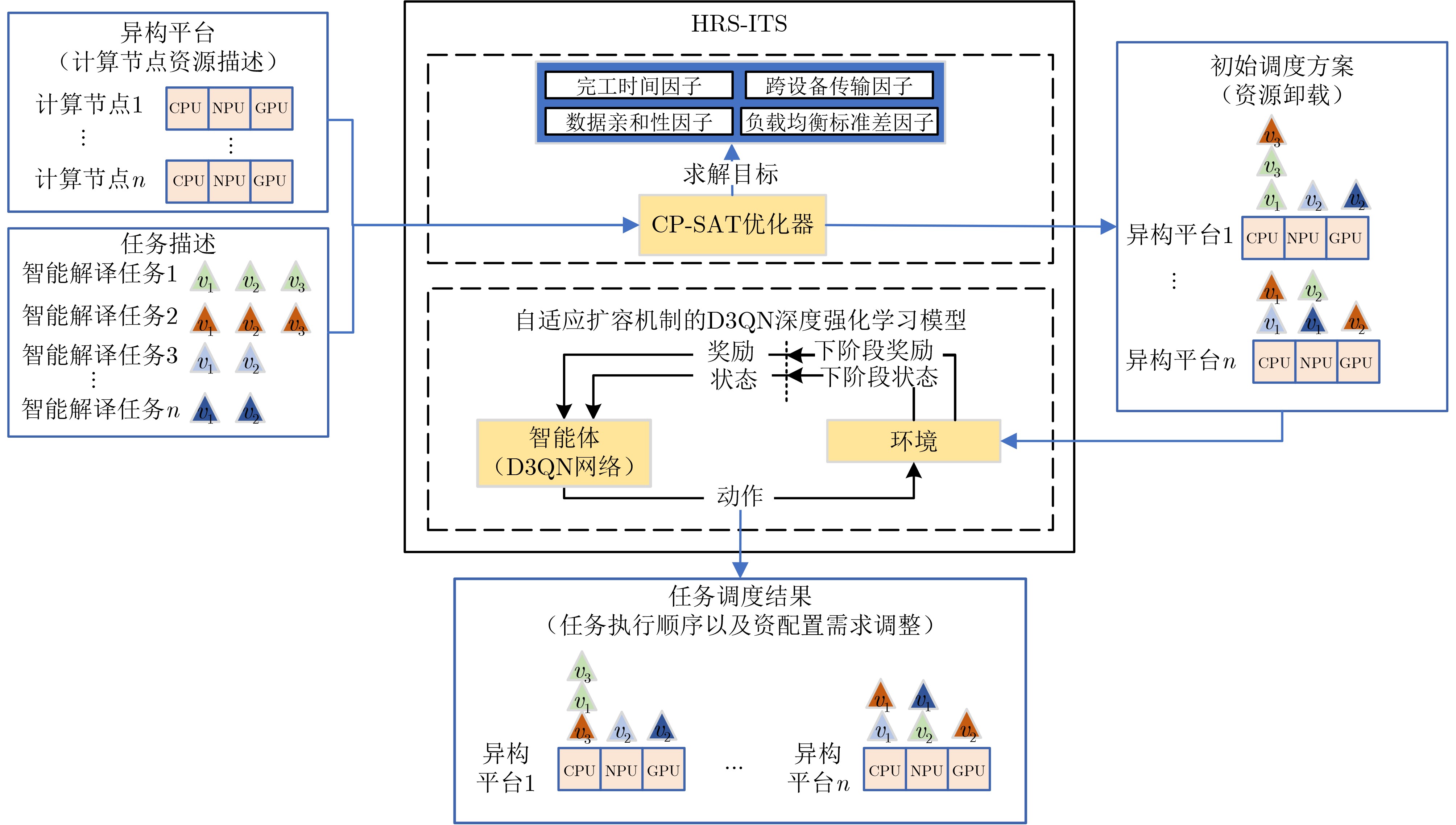
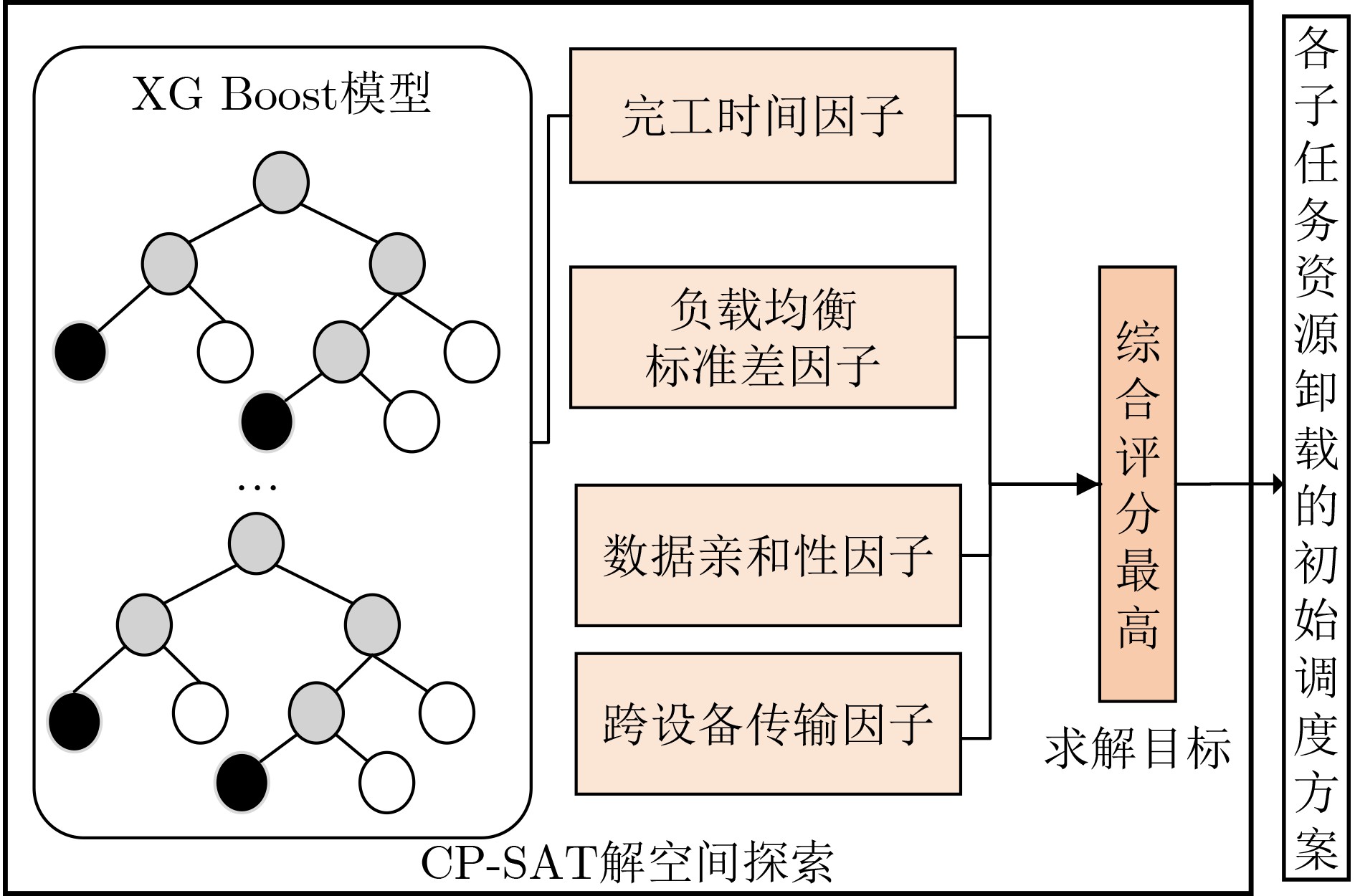
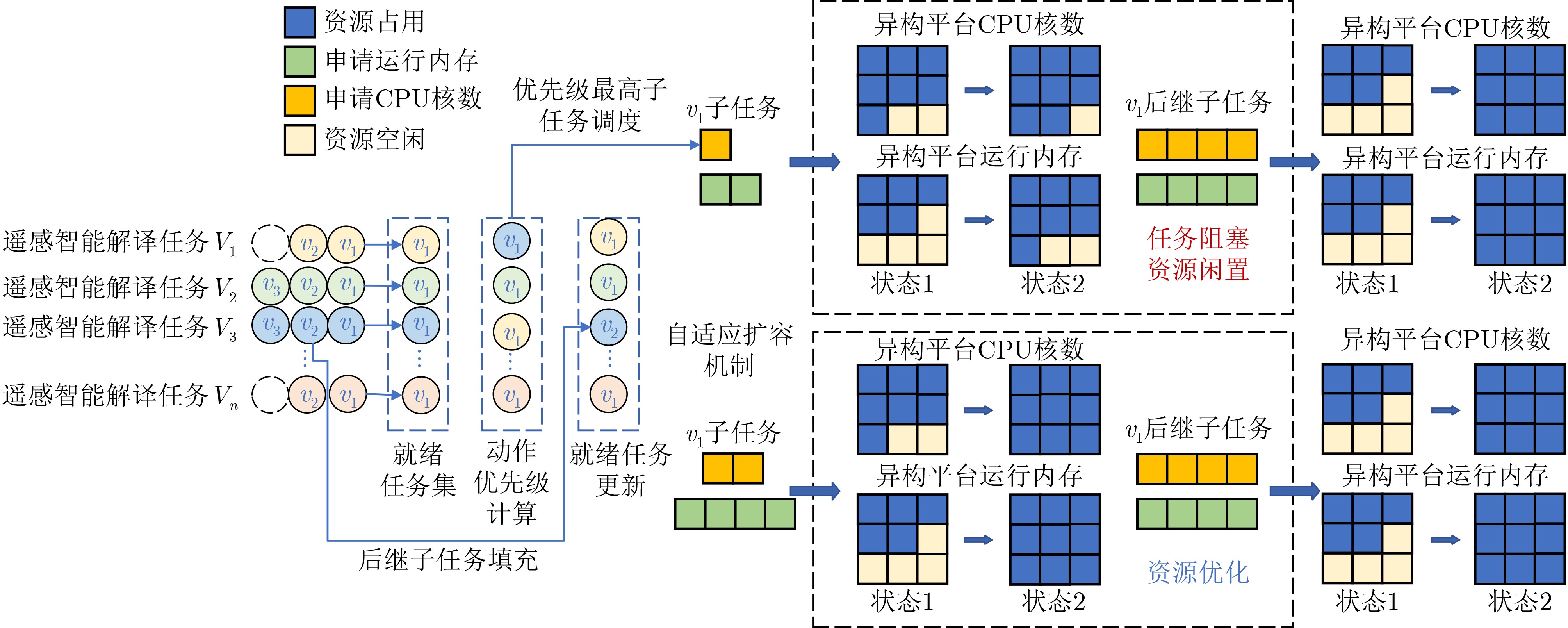
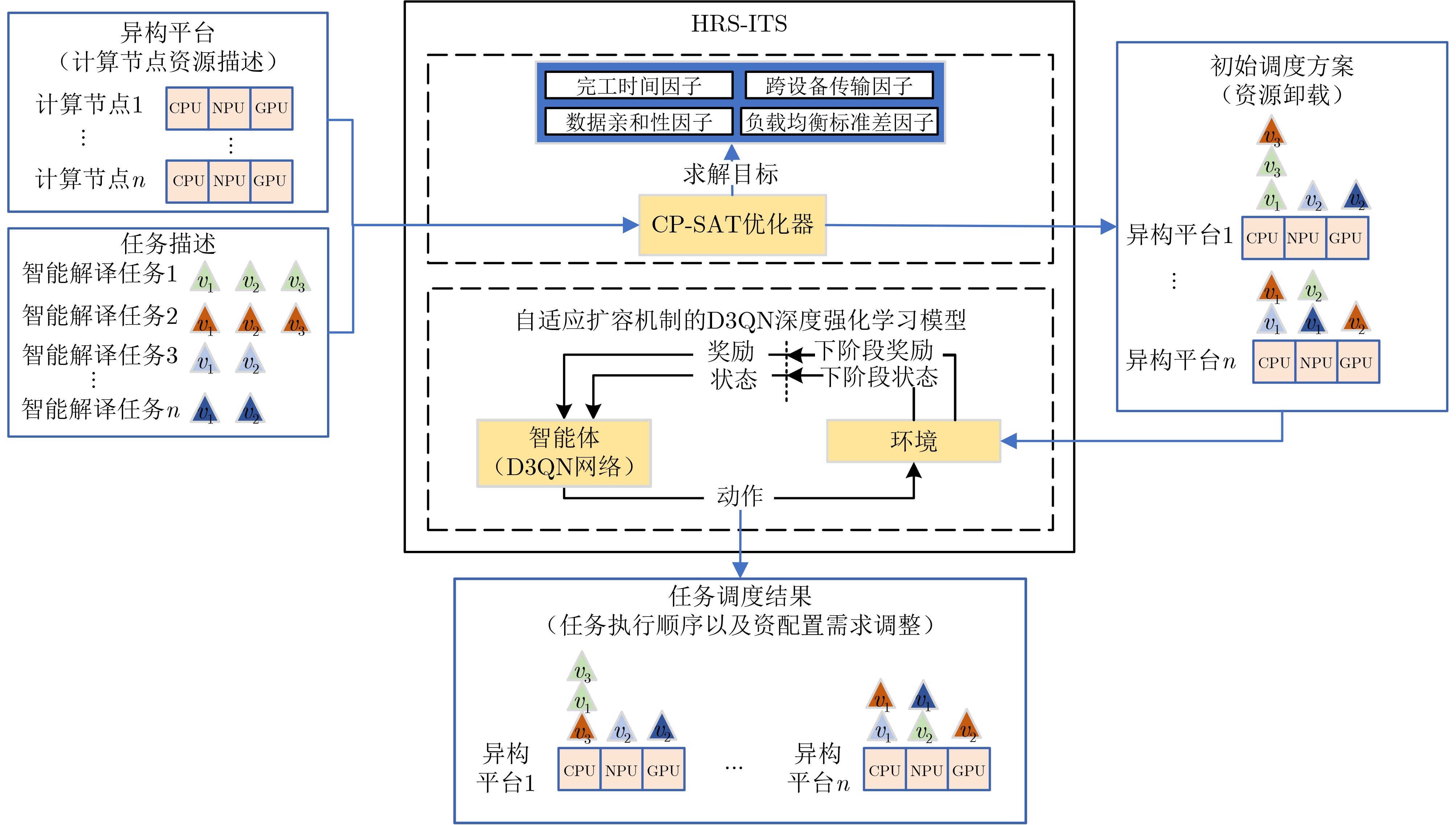
摘要: 基于异构平台的遥感数据智能解译任务存在任务多样、资源差异、环境动态变化等问题,多任务并发引发资源竞争,导致负载失衡、资源利用率下降,制约解译效率。如何实现复杂多任务在异构资源下的自适应高效调度,是当前的核心难题。该文提出异构遥感数据智能解译任务调度算法(HRS-ITS),通过双层优化提升效率与均衡性,一方面改进CP-SAT优化器,引入数据亲和性、负载均衡、完工时间以及跨设备传输4类评分因子,生成任务资源卸载的初始调度方案,解决任务阻塞问题;另一方面建立融合自适应资源扩展机制的D3QN深度强化学习模型,优化任务排序并动态调整资源配置,解决资源空闲问题。不同任务数量的仿真实验表明,与轮询、随机映射、贪心及DDQN调度算法相比,HRS-ITS任务完工时间分别缩短42.2%, 29.3%, 25.7% 和11.0%,负载均衡值平均降低34.1%, 39.2%, 31.9%和30.6%,显著提升解译效率与资源均衡性。Abstract:
Objective Intelligent remote sensing data intelligent interpretation tasks executed on heterogeneous platforms exhibit diverse task types, heterogeneous resources, sensitivity to real-time environmental disturbances, and inter-task resource contention. These characteristics often lead to load imbalance and reduced resource utilization across platforms. Therefore, adaptive and efficient scheduling of complex multi-task workloads in resource-heterogeneous environments remains a central challenge in heterogeneous platform task scheduling. Methods A Heterogeneous Remote Sensing-Intelligent Task Scheduling (HRS-ITS) algorithm is proposed. The CP-SAT optimizer is enhanced by incorporating four score factors—data affinity, load balancing, makespan prediction, and cross-device transmission efficiency—as optimization objectives to generate an initial task-resource mapping. An adaptive resource-scaling-based Dueling Double Deep Q-Network (D3QN) model is then constructed to optimize task execution sequences for makespan reduction. Resource allocation is dynamically adjusted to eliminate idle time during task queuing, enabling dynamic resource perception and configuration optimization. Results and Discussions By integrating static optimization with dynamic adaptation, the HRS-ITS algorithm improves scheduling efficiency and resource utilization on heterogeneous platforms, providing an effective solution for complex remote sensing data intelligent interpretation tasks. Conclusions The proposed framework combines global optimization with dynamic adaptation to achieve computationally efficient real-time remote sensing processing. It provides a basis for extension to more complex task dependencies and larger-scale clusters. -
表 1 实验环境参数
类型 CPU单核处理能力(MIPS) CPU核数(核) 运行内存(GB) 加速单元类型 加速单元算力(TOPs) 通信带宽(Mbit/s) PowerEdge R720 3080 12 32 - - 615 Atlas200IDKA2 3200 4 4 NPU 8 615 Jetson Orin Nano 4875 6 8 GPU 40 615 虚拟实验平台1 2560 8 16 APU 24 615 虚拟实验平台2 11520 4 8 NPU 40 615 虚拟实验平台3 6400 4 8 GPU 80 615  下载: 导出CSV
表 2 任务参数
参数 范围 参数 范围 预处理/后处理子任务使用CPU所需CPU核数 1~4核 预处理/后处理子任务使用加速单元所需运行内存 2~4 GB 预处理/后处理子任务使用加速单元所需CPU核数 1~2核 预处理/后处理子任务使用加速单元所需运行内存 2~4 GB 预处理/后处理子任务处理数据量大小 1~3 GB 推理/分类子任务处理数据量大小 1~3 GB 预处理/后处理子任务使用单元类型 NPU/CPU 推理/分类子任务使用单元类型 CPU/APU/
NPU/GPU推理/分类子任务使用加速单元所需CPU核数 3~4核 推理/分类子任务使用加速单元所需运行内存 2~6 GB 推理/分类子任务使用加速单元所需CPU核数 1~2核 推理/分类子任务使用加速单元所需运行内存 2~6 GB
下载: 导出CSV
表 3 训练参数
参数 数值 参数 数值 训练轮数 10000 更新网络周期 2 采样的经验批次大小$ N $ 128 经验池容量$ |D| $ 20000 贪心衰减策略初始探索率$ \varepsilon\mathrm{_{start}} $ 1.0 折扣因子$ \gamma $ 0.9 贪心衰减策略最终探索率$ \varepsilon_{\mathrm{final}} $ 1e–5 重要性采样权重调整参数$ \beta $ 0.4 探索率衰减的时间常数$ \varphi $ 0.99995 学习率$ \eta$ 0.0001 完工时间奖励贡献权重$ \lambda $ 0.1 资源利用率奖励贡献的权重$ \mu $ 1 梯度裁剪阈值$ \varepsilon_{\mathrm{c}} $ 5.0 软更新系数$ \psi $ 0.005
下载: 导出CSV
表 4 不同任务数量下各算法与HRS-ITS在任务完工时间上的对比结果(s)
算法 任务数量 35 55 75 95 115 135 155 175 200 随机映射 79.98 97.65 135.90 130.87 177.62 188.99 228.92 206.92 328.87 轮询算法 76.62 90.05 160.60 175.85 209.88 249.31 277.35 349.78 341.97 贪心算法 59.21 72.73 111.80 153.04 186.74 194.92 258.14 257.73 322.87 CP-SAT+DDQN 58.97 80.09 94.70 131.90 140.80 161.04 230.96 210.87 223.75 CP-SAT+D3QN 44.87 56.79 90.13 131.74 141.03 153.59 195.21 196.03 211.01 HRS-ITS(未引入评分因子) 52.04 64.90 97.75 123.93 152.94 174.20 197.28 226.08 238.06 HRS-ITS 44.87 62.11 89.13 131.21 134.75 153.65 182.21 196.21 190.89
下载: 导出CSV
表 5 不同任务数量下各算法与HRS-ITS在负载均衡值上的对比结果
算法 任务数量 35 55 75 95 115 135 155 175 200 随机映射 1.05 1.29 1.34 1.21 1.28 1.16 1.30 1.30 1.28 轮询算法 1.10 1.21 1.20 1.21 1.21 1.21 1.21 1.21 1.21 贪心算法 0.91 1.05 1.16 1.28 1.12 1.28 1.26 1.30 1.30 CP-SAT+DDQN 0.85 1.09 1.27 1.03 1.13 1.20 1.30 1.28 1.31 CP-SAT+D3QN 0.85 1.09 1.27 1.03 1.13 1.20 1.30 1.28 1.31 HRS-ITS(未引入评分因子) 0.67 0.78 0.82 0.83 0.75 0.82 0.80 0.85 0.87 HRS-ITS 0.64 0.80 0.79 0.75 0.76 0.85 0.87 0.83 0.89
下载: 导出CSV
-
[1] 孟麟芝, 孙小涓, 胡玉新, 等. 面向卫星在轨处理的强化学习任务调度算法[J]. 系统工程与电子技术, 2025, 47(6): 1917–1929. doi: 10.12305/j.issn.1001-506X.2025.06.20.MENG Linzhi, SUN Xiaojuan, HU Yuxin, et al. Reinforcement learning task scheduling algorithm for satellite on-orbit processing[J]. Systems Engineering and Electronics, 2025, 47(6): 1917–1929. doi: 10.12305/j.issn.1001-506X.2025.06.20. [2] MEI Shaohui, LIAN Jiawei, WANG Xiaofei, et al. A comprehensive study on the robustness of deep learning-based image classification and object detection in remote sensing: Surveying and benchmarking[J]. Journal of Remote Sensing, 2024, 4: 0219. doi: 10.34133/remotesensing.0219. [3] LIU Quanyong, PENG Jiangtao, ZHANG Genwei, et al. Deep contrastive learning network for small-sample hyperspectral image classification[J]. Journal of Remote Sensing, 2023, 3: 0025. doi: 10.34133/remotesensing.0025. [4] GROSOF I, YANG Kunhe, SCULLY Z, et al. Nudge: Stochastically improving upon FCFS[C/OL]. 2021 ACM SIGMETRICS/International Conference on Measurement and Modeling of Computer Systems, 2021: 11–12. doi: 10.1145/3410220.3460102. [5] PACHIPALA Y, SUREDDY K S, SRIYA KAITEPALLI A B S, et al. Optimizing task scheduling in cloud computing: An enhanced shortest job first algorithm[J]. Procedia Computer Science, 2024, 233: 604–613. doi: 10.1016/j.procs.2024.03.250. [6] BUSENHART C, HUNGERBÜHLER N, and XU W. A variant of the round-robin scheduling problem[J]. Ars Combinatoria, 2024, 158: 81–92. doi: 10.61091/ars158-09. [7] ABO-ALSABEH R and SALHI A. The genetic algorithm: A study survey[J]. Iraqi Journal of Science, 2022, 63(3): 1215–1231. doi: 10.24996/ijs.2022.63.3.27. [8] JIANG Qiangqiang, WANG Haipeng, KONG Qinglei, et al. On-orbit remote sensing image processing complex task scheduling model based on heterogeneous multiprocessor[J]. IEEE Transactions on Geoscience and Remote Sensing, 2023, 61: 1001718. doi: 10.1109/TGRS.2023.3327279. [9] 沈小龙, 马金全, 冀亚玮, 等. 面向异构处理平台任务调度的麻雀优化算法[J]. 电子科技, 2024, 37(1): 33–40. doi: 10.16180/j.cnki.issn1007-7820.2024.01.005.SHEN Xiaolong, MA Jinquan, JI Yawei, et al. Sparrow optimization algorithm for task scheduling of heterogeneous processing platform[J]. Electronic Science and Technology, 2024, 37(1): 33–40. doi: 10.16180/j.cnki.issn1007-7820.2024.01.005. [10] 郑雨昊, 唐琴琴, 谢人超, 等. 面向星地融合网络资源优化的智能任务调度机制[J]. 移动通信, 2025, 49(6): 52–58. doi: 10.3969/j.issn.1006-1010.20250422-0001.ZHENG Yuhao, TANG Qinqin, XIE Renchao, et al. Intelligent task scheduling mechanism for resource optimization in satellite-terrestrial integrated networks[J]. Mobile Communications, 2025, 49(6): 52–58. doi: 10.3969/j.issn.1006-1010.20250422-0001. [11] HUANG Jiaming, XIAO Chuming, and WU Weigang. RLSK: A job scheduler for federated Kubernetes clusters based on reinforcement learning[C/OL]. 2020 IEEE International Conference on Cloud Engineering (IC2E), Sydney, 2020: 116–123. doi: 10.1109/IC2E48712.2020.00019. [12] 童钊, 邓小妹, 陈洪剑, 等. 云环境下基于强化学习的多目标任务调度算法[J]. 小型微型计算机系统, 2020, 41(2): 285–290. doi: 10.3969/j.issn.1000-1220.2020.02.010.TONG Zhao, DENG Xiaomei, CHEN Hongjian, et al. Multi-objective task scheduling algorithm based on reinforcement learning in cloud environments[J]. Journal of Chinese Computer Systems, 2020, 41(2): 285–290. doi: 10.3969/j.issn.1000-1220.2020.02.010. [13] ZHANG Jianxiong, GUO Bing, DING Xuefeng, et al. An adaptive multi-objective multi-task scheduling method by hierarchical deep reinforcement learning[J]. Applied Soft Computing, 2024, 154: 111342. doi: 10.1016/j.asoc.2024.111342. [14] 周黎鸣, 余汐, 范明虎, 等. 基于双深度Q网络的多目标遥感产品生产任务调度算法[J]. 电子与信息学报, 2025, 47(8): 2819–2829. doi: 10.11999/JEIT250089.ZHOU Liming, YU Xi, FAN Minghu, et al. Multi-objective remote sensing product production task scheduling algorithm based on double deep Q-network[J]. Journal of Electronics & Information Technology, 2025, 47(8): 2819–2829. doi: 10.11999/JEIT250089. [15] HAN Bao’an and YANG Jianjun. Research on adaptive job shop scheduling problems based on dueling double DQN[J]. IEEE Access, 2020, 8: 186474–186495. doi: 10.1109/ACCESS.2020.3029868. [16] AGHAEI M, ASGHARI P, ADABI S, et al. Using recommender clustering to improve quality of services with sustainable virtual machines in cloud computing[J]. Cluster Computing, 2023, 26(2): 1479–1493. doi: 10.1007/s10586-022-03760-7. [17] KUCHUK H, MOZHAIEV O, KUCHUK N, et al. Devising a method for the virtual clustering of the internet of things edge environment[J]. Eastern-European Journal of Enterprise Technologies, 2024, 1(9): 60–71. doi: 10.15587/1729-4061.2024.298431. [18] GHASEMI A and KESHAVARZI A. Energy-efficient virtual machine placement in heterogeneous cloud data centers: A clustering-enhanced multi-objective, multi-reward reinforcement learning approach[J]. Cluster Computing, 2024, 27(10): 14149–14166. doi: 10.1007/s10586-024-04657-3. [19] HAN Xiaoyun, MU Chaoxu, ZHU Jiebei, et al. A safe virtual machine scheduling strategy for energy conservation and privacy protection of server clusters in cloud data centers[J]. IEEE Transactions on Sustainable Computing, 2024, 9(1): 46–60. doi: 10.1109/TSUSC.2023.3303637. [20] 刘明轩, 郭博渊, 刘曦, 等. 一种用于星载虚拟化平台的任务容器调度算法[J]. 西北工业大学学报, 2024, 42(2): 319–327. doi: 10.1051/jnwpu/20244220319.LIU Mingxuan, GUO Boyuan, LIU Xi, et al. A task container scheduling algorithm for spaceborne virtualization platform[J]. Journal of Northwestern Polytechnical University, 2024, 42(2): 319–327. doi: 10.1051/jnwpu/20244220319. [21] ALTAHAT M A, DARADKEH T, and AGARWAL A. Virtual machine scheduling and migration management across multi-cloud data centers: Blockchain-based versus centralized frameworks[J]. Journal of Cloud Computing, 2015, 14(1): 1. doi: 10.1186/s13677-024-00724-7. [22] 刘柳, 凡益民, 刘田, 等. 一种基于核数分配的任务智能调度方法[J]. 电波科学学报, 2025, 40(2): 246–251,275. doi: 10.12265/j.cjors.2024115.LIU Liu, FAN Yimin, LIU Tian, et al. A task intelligent scheduling method based on the number of cores[J]. Chinese Journal of Radio Science, 2025, 40(2): 246–251,275. doi: 10.12265/j.cjors.2024115. [23] CHO W H, SHMOYS D, and HENDERSON S. SPT optimality (mostly) via linear programming[J]. Operations Research Letters, 2023, 51(1): 99–104. doi: 10.1016/j.orl.2022.12.007. [24] GRAHAM R L. Bounds on multiprocessing timing anomalies[J]. SIAM Journal on Applied Mathematics, 1969, 17(2): 416–429. doi: 10.1137/0117039. [25] VAISHNAV A, PHAM K D, and KOCH D. Heterogeneous resource-elastic scheduling for CPU+FPGA architectures[C]. The 10th International Symposium on Highly-Efficient Accelerators and Reconfigurable Technologies, New York, USA, 2019: 1. doi: 10.1145/3337801.3337819. [26] BHUIYAN A, LIU Di, KHAN A, et al. Energy-efficient parallel real-time scheduling on clustered multi-core[J]. IEEE Transactions on Parallel and Distributed Systems, 2020, 31(9): 2097–2111. doi: 10.1109/TPDS.2020.2985701. [27] ZOU An, XU Yuankai, NI Yinchen, et al. A survey of real-time scheduling on accelerator-based heterogeneous architecture for time critical applications[EB/OL]. https://arxiv.org/abs/2505.11970, 2025. [28] KOBAYASHI T and ILBOUDO W E L. t-soft update of target network for deep reinforcement learning[J]. Neural Networks, 2021, 136: 63–71. doi: 10.1016/j.neunet.2020.12.023. -

 下载:
下载:


图(11) / 表(5)
计量
- 文章访问数: 765
- HTML全文浏览量: 534
- PDF下载量: 47
- 被引次数: 0
