




Jointly Improving Information Timeliness and Fidelity under Finite-Blocklength Source Coding in a Wireless IoT System
-
摘要: 实时无线物联信息更新系统是时间敏感物联网应用的核心。维持终端侧信源过程感知信息的高时效与高保真对业务质量至关重要。该文基于监视终端侧信息年龄(AoI)与信源过程实时估计均方误差(MSE),研究了有限码长信源编码下的信息时效与保真度。首先,考虑高斯-马尔可夫信源过程,建立有限码长信源编码与无线信息更新系统模型,精准推导时间平均AoI与时间平均MSE的解析表达式。其次,分析了二者关于信源编码失真容限、超限概率以及信息传输速率的单调性与凸性。最后,设计了优化算法联合优化失真容限、超限概率与传输速率,通过最小化时间平均AoI与时间平均MSE的加权和同步提升系统时效性与保真度。仿真与数值结果验证了所提理论分析的准确性与优化算法的有效性。仿真结果表明,所提优化方案在传输功率为20时,最高与最低失真容限方案相比,加权和性能提升约33.7%,且理论解析式与蒙特卡洛仿真的最大相对误差低于0.3%。Abstract:
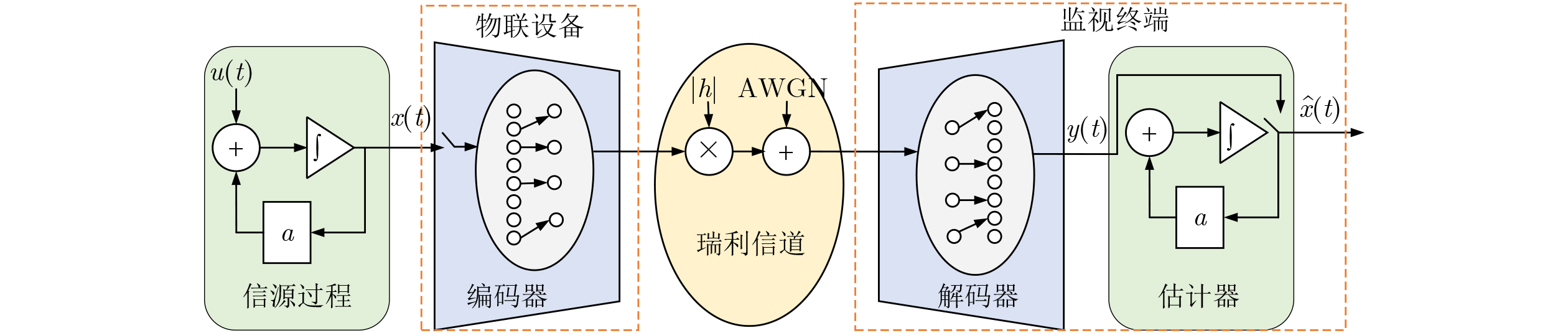
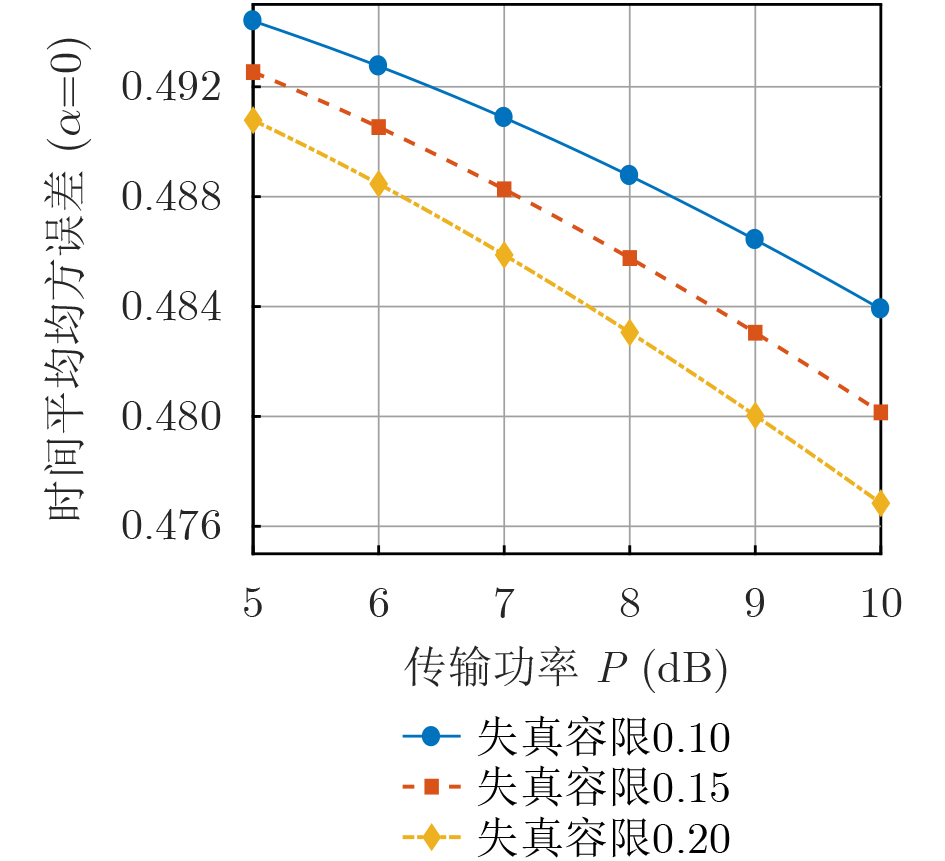
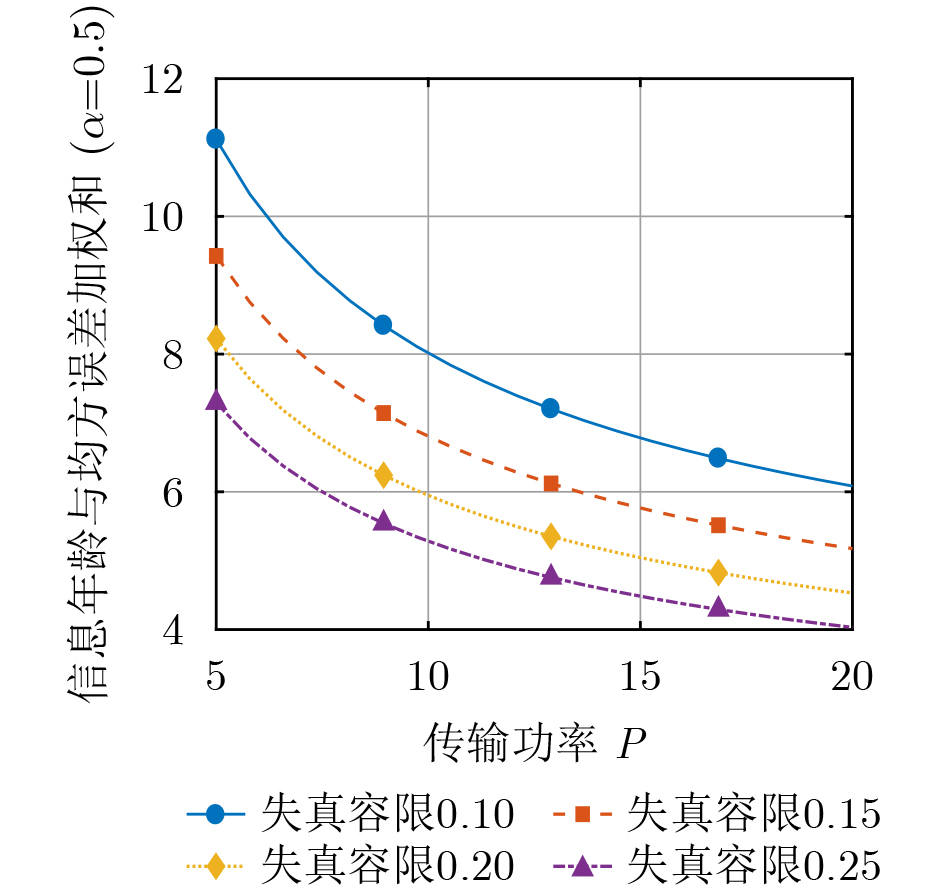
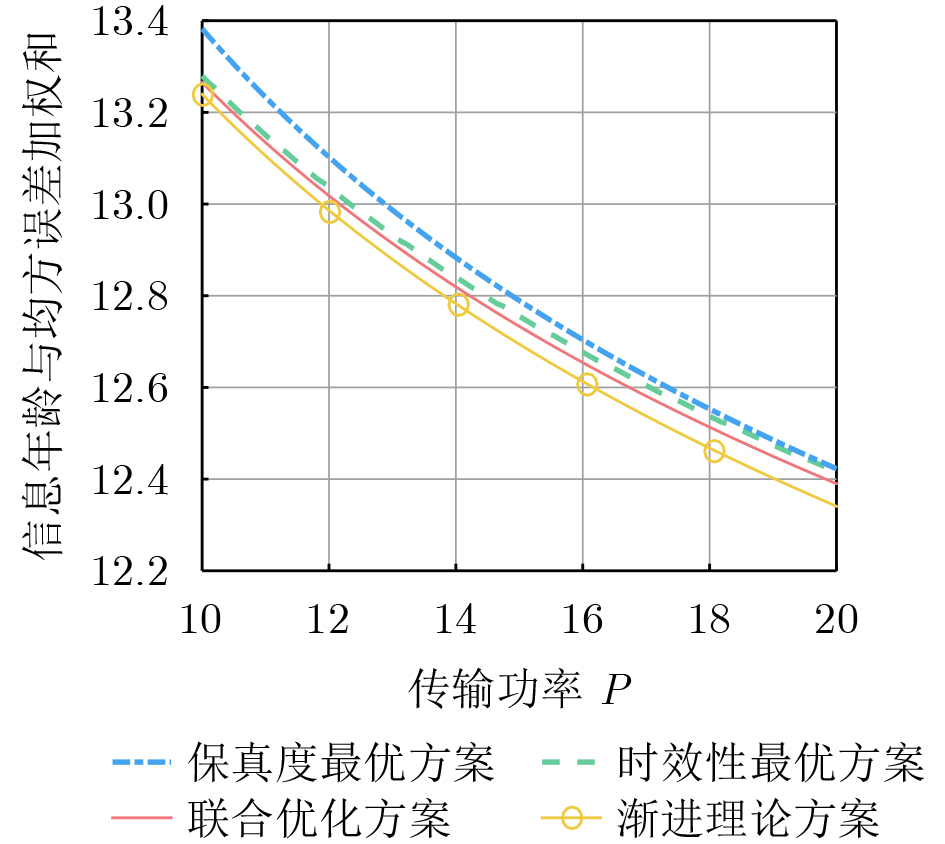
Objective Wireless Internet of Things (IoT) information update systems are essential for time-sensitive applications. In these systems, timely information delivery with high fidelity is critical for accurate sensing, estimation, and decision-making. However, short-packet transmission and strict latency requirements make classical asymptotic rate-distortion theory insufficient for characterizing practical system performance. Under finite-blocklength source coding, shorter source-coding blocklengths reduce latency but increase distortion, whereas longer source-coding blocklengths improve information fidelity at the cost of higher delay. This leads to a fundamental trade-off between information timeliness and information fidelity, which remains insufficiently characterized in the non-asymptotic regime. Methods Age of Information (AoI) and Mean Squared Error (MSE) are used to quantify information timeliness and information fidelity, respectively. Closed-form expressions for time-average AoI and time-average MSE are derived under finite-blocklength source coding. Based on distortion tolerance, excess distortion probability, and transmission rate, a joint optimization problem is formulated to minimize the weighted-sum objective of time-average AoI and time-average MSE. The monotonicity and convexity of the objective function are analyzed with respect to these design variables. An alternating iterative algorithm is then developed to jointly optimize distortion tolerance, excess distortion probability, and transmission rate. Results and Discussions Numerical simulations are conducted under different weight settings to examine the trade-off between information timeliness and information fidelity in representative operating scenarios. The proposed framework reveals the effect of finite-blocklength parameters on system performance. The results show that the proposed method balances AoI and MSE under different design priorities. At a transmit power of 20, the weighted-sum metric of the scheme with the highest distortion tolerance is improved by approximately 33.7% compared with that of the scheme with the lowest distortion tolerance. The maximum relative error between the theoretical analysis and Monte Carlo simulations remains below 0.3%, verifying the accuracy of the derived analytical expressions. Conclusions This paper presents a non-asymptotic analysis of the timeliness-fidelity trade-off in a wireless IoT information update system by explicitly considering finite-blocklength source coding. By treating distortion tolerance, excess distortion probability, and transmission rate as design variables, the proposed framework verifies the necessity of finite-blocklength modeling and the advantage of joint parameter optimization. The results provide theoretical guidance for the design and optimization of timely and high-fidelity wireless IoT systems. -
表 1 关键符号说明表
符号 物理含义 符号 物理含义 $ a $ 信源过程衰减系数($ a \lt 0 $) $ {q}_{x} $ 信源过程稳态方差 $ n $ 信源编码码长 $ d $ 失真容限 $ \varepsilon $ 超过失真容限的概率 $ R $ 有限码长信源编码速率 $ r $ 信息传输速率 $ p $ 传输中断概率 $ \overline{\varDelta } $ 时间平均信息年龄 $ \overline{M} $ 时间平均均方误差 $ T $ 包传输时间 $ J $ 时间平均信息年龄与均方误差的加权和  下载: 导出CSV
1 有限码长建模下失真容限、超限概率与传输速率联合优化算法
输入:系统参数$ (a,{q}_{u},{q}_{w},n,P,\alpha ) $;可行域$ d\in (0,{d}_{\max }],\varepsilon \in [{\varepsilon }_{\min },{\varepsilon }_{\max }],r\in [{r}_{\min },{r}_{\max }] $;算法参数$ ({I}_{\max },{c}_{{\mathrm{A}}},{c}_{\mathrm{{O}}},{c}_{{\mathrm{R}}},{\eta }_{{\mathrm{O}}},{\eta }_{{\mathrm{R}}}) $;初值
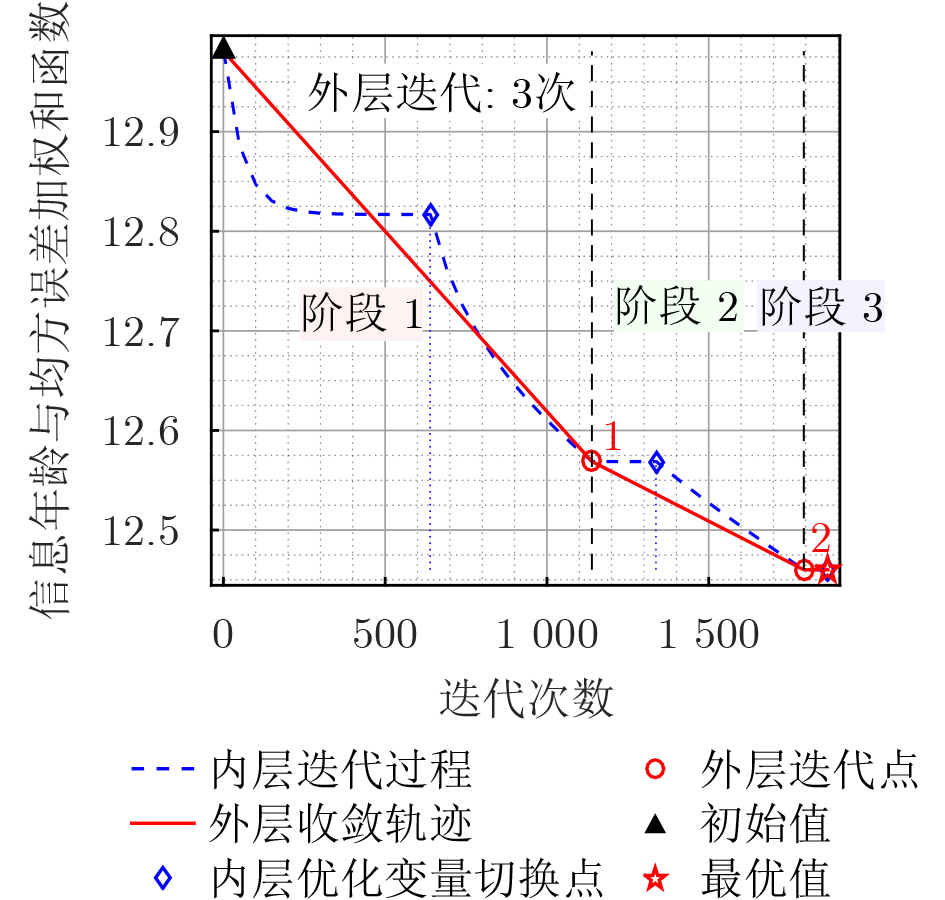
$ ({\varepsilon }^{(0)},{r}^{(0)}) $,定义$ {\varPi }_{[{{x}_{\min }},{{x}_{\max }}]}(x)=\min \{\max \{x,{x}_{\min }\},{{x}}_{\max }\} $输出:最优失真容限$ {d}^{*} $、最优超限概率$ {\varepsilon }^{*} $、最优传输速率$ {r}^{*} $、最小加权和$ {J}^{*} $ 1 确定 $ {d}^{*}={d}\_{\max } $ 2 初始化 设外层迭代索引$ i=1 $,计算初始目标函数值$ {J}^{(0)}=J({d}^{*},{\varepsilon }^{(0)},{r}^{(0)}) $ 3 外层交替迭代 当$ i \lt {I}_{\max } $,重复以下步骤 4 内层1:固定$ \varepsilon $,优化$ r $ 5 $ \varepsilon ={\varepsilon }^{(i-1)} $, $ r={r}^{(i-1)} $, $ {J}_{\text{old}}=J({d}^{*},\varepsilon ,r) $ 6 更新$ r\leftarrow {\varPi }_{[{{r}_{\min }},{{r}_{\max }}]}(r-{\eta }_{{\mathrm{R}}}{\nabla }_{r}J({d}^{*},\varepsilon ,r)) $,$ {J}_{\text{new}}=J({d}^{*},\varepsilon ,r) $ 7 重复上述更新直至$ |{J}_{\text{new}}-{J}_{\text{old}}| \lt {c}_{{\mathrm{R}}} $,并记$ {r}^{(i)}=r $ 8 内层2:固定$ r $,更新$ \varepsilon $ 9 $ r={r}^{(i)} $, $ \varepsilon ={\varepsilon }^{(i-1)} $, $ {J}_{\text{old}}=J({d}^{*},\varepsilon ,r) $ 10 更新$ \varepsilon \leftarrow {\varPi }_{[{{\varepsilon }_{\min }},{{\varepsilon }_{\max }}]}(\varepsilon -{\eta }_{{\mathrm{O}}}\nabla_{\varepsilon }J({d}^{*},\varepsilon ,r)) $, $ {J}_{\text{new}}=J({d}^{*},\varepsilon ,r) $ 11 重复上述更新直至$ |{J}_{\text{new}}-{J}_{\text{old}}| \lt {c}_{{\mathrm{O}}} $,并记$ {\varepsilon }^{(i)}=\varepsilon $ 12 更新$ {J}^{(i)}=J({d}^{*},{\varepsilon }^{(i)},{r}^{(i)}) $ 13 若$ |{J}^{(i)}-{J}^{(i-1)}| \lt {c}_{{\mathrm{A}}} $,则终止外层迭代;否则令$ i\leftarrow i+1 $ 14 输出 $ {\varepsilon }^{*}={\varepsilon }^{(i)},{r}^{*}={r}^{(i)},{J}^{*}={J}^{(i)} $
下载: 导出CSV
-
[1] SAH D K, VAHABI M, and FOTOUHI H. A comprehensive review on 5G IIoT test-beds[J]. IEEE Transactions on Consumer Electronics, 2025, 71(2): 4139–4163. doi: 10.1109/TCE.2025.3572058. [2] WANG Chengxiang, YOU Xiaohu, GAO Xiqi, et al. On the road to 6G: Visions, requirements, key technologies, and testbeds[J]. IEEE Communications Surveys & Tutorials, 2023, 25(2): 905–974. doi: 10.1109/COMST.2023.3249835. [3] 郑灿健, 郑福春. 超可靠低时延短包通信: 重新探索差分调制[J]. 移动通信, 2024, 48(10): 58–63. doi: 10.3969/j.issn.1006-1010.20240820-0001.ZHENG Canjian and ZHENG Fuchun. Ultra-reliable and low-latency short packet communications: Differential modulation revisited[J]. Mobile Communications, 2024, 48(10): 58–63. doi: 10.3969/j.issn.1006-1010.20240820-0001. [4] KAUL S, YATES R, and GRUTESER M. Real-time status: How often should one update?[C]. 2012 Proceedings IEEE INFOCOM, Orlando, USA, 2012: 2731–2735. doi: 10.1109/INFCOM.2012.6195689. [5] 于宝泉, 杨炜伟, 王权, 等. 无人机辅助通感一体化系统中的信息年龄分析优化[J]. 电子与信息学报, 2024, 46(5): 1996–2003. doi: 10.11999/JEIT231175.YU Baoquan, YANG Weiwei, WANG Quan, et al. Age of information analysis and optimization in unmanned aerial vehicles-assisted integrated sensing and communication systems[J]. Journal of Electronics & Information Technology, 2024, 46(5): 1996–2003. doi: 10.11999/JEIT231175. [6] BINIA J. Rate distortion function with a proportional mean-square error distortion measure[C]. 2008 IEEE International Symposium on Information Theory, Toronto, Canada, 2008: 862–866. doi: 10.1109/ISIT.2008.4595109. [7] CAO Jie, ZHU Xu, SUN Sumei, et al. Toward industrial metaverse: Age of information, latency and reliability of short-packet transmission in 6G[J]. IEEE Wireless Communications, 2023, 30(2): 40–47. doi: 10.1109/MWC.2001.2200396. [8] ROTH S, ARAFA A, POOR H V, et al. Remote short blocklength process monitoring: Trade-off between resolution and data freshness[C]. ICC 2020 - 2020 IEEE International Conference on Communications (ICC), Dublin, Ireland, 2020: 1–6. doi: 10.1109/ICC40277.2020.9149010. [9] ROTH S, ARAFA A, SEZGIN A, et al. Short blocklength process monitoring and scheduling: Resolution and data freshness[J]. IEEE Transactions on Wireless Communications, 2022, 21(7): 4669–4681. doi: 10.1109/TWC.2021.3132462. [10] ZHANG Tianci, CHEN Zhengchuan, TIAN Zhong, et al. Real-time monitoring Ornstein–Uhlenbeck process: Improving fidelity under freshness guarantees[J]. IEEE Communications Letters, 2023, 27(6): 1510–1514. doi: 10.1109/LCOMM.2023.3262545. [11] CHEN Zhengchuan, XU Mingjun, SHE Changyang, et al. Improving timeliness-fidelity tradeoff in wireless sensor networks: Waiting for all and waiting for partial sensor nodes[J]. IEEE Transactions on Communications, 2023, 71(7): 4151–4164. doi: 10.1109/TCOMM.2023.3277001. [12] ZHANG Di, SUN Mingxiao, SONG Lulu, et al. Information freshness and timeliness analysis in the finite blocklength regime for mission-critical applications[J]. IEEE Transactions on Communications, 2025, 73(12): 14458–14468. doi: 10.1109/TCOMM.2025.3615789. [13] ÅSTRÖM K J and MURRAY R M. Feedback Systems: An Introduction for Scientists and Engineers[M]. Princeton University Press, 2008. [14] KOSTINA V and VERDU S. Fixed-length lossy compression in the finite blocklength regime[J]. IEEE Transactions on Information Theory, 2012, 58(6): 3309–3338. doi: 10.1109/TIT.2012.2186786. [15] TSE D and VISWANATH P. Fundamentals of Wireless Communication[M].Cambridge University Press, 2005. Doi: 10.1017/CBO9780511807213. [16] SUN Yin, UYSAL-BIYIKOGLU E, YATES R D, et al. Update or wait: How to keep your data fresh[J]. IEEE Transactions on Information Theory, 2017, 63(11): 7492–7508. doi: 10.1109/TIT.2017.2735804. -

 下载:
下载:



图(7) / 表(2)
计量
- 文章访问数: 991
- HTML全文浏览量: 426
- PDF下载量: 68
- 被引次数: 0
