




Optimization of Energy Consumption in Semantic Communication Networks for Image Recovery Tasks
-
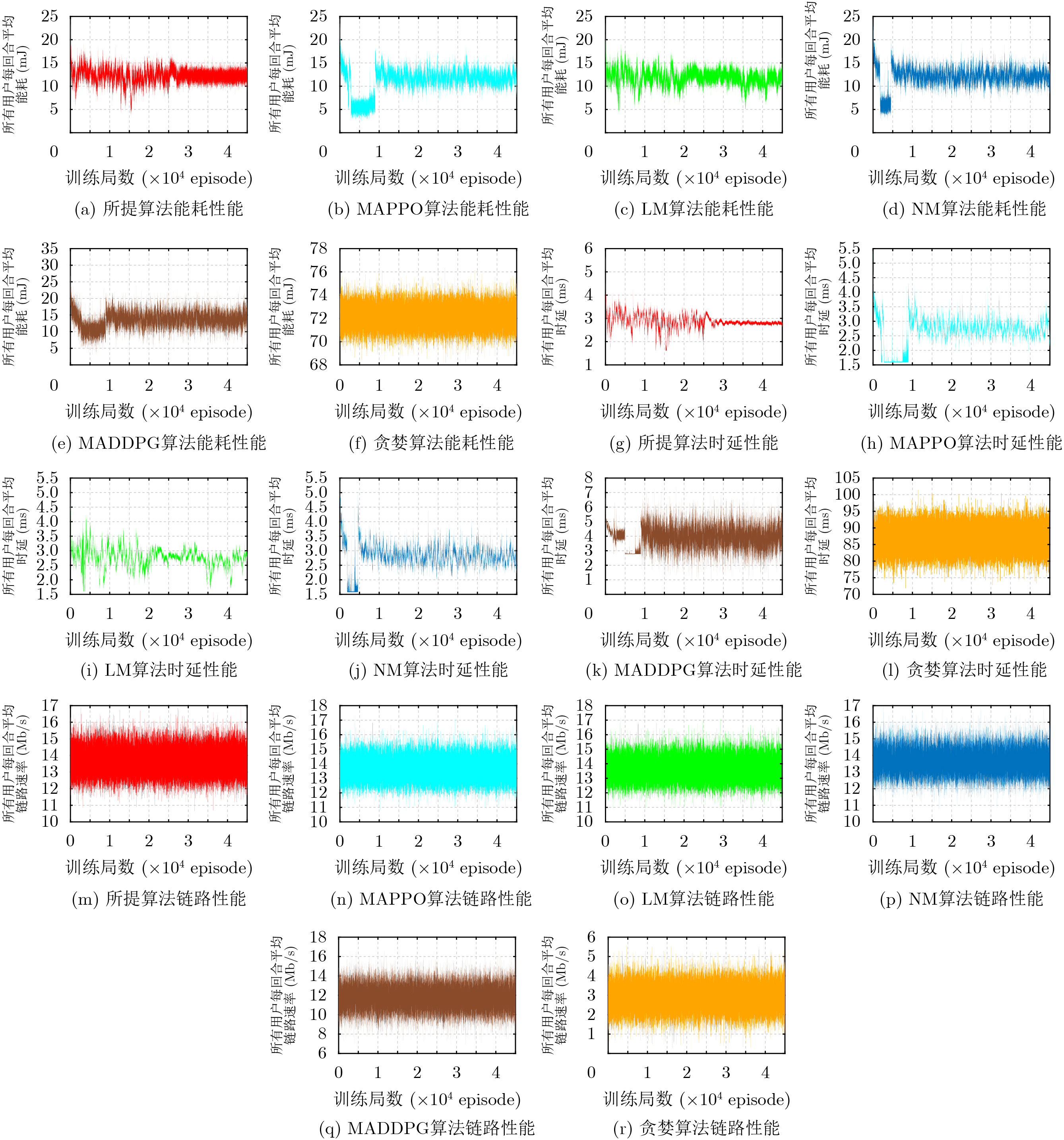
摘要: 针对语义通信网络在图像恢复任务中计算和传输能耗过高的问题,该文提出一种改进型多智能体近端策略优化算法驱动的网络能耗优化策略,在保障任务性能的同时最小化网络总能耗。首先,量化分析语义提取率、发射功率、计算资源与网络能耗间的耦合关系。随后,构建以小区总能耗最小化为目标,同时满足时延、图像恢复质量等多维约束的优化模型。最后,设计改进型多智能体近端策略优化算法对该模型进行求解。仿真结果表明,与基准算法相比,所提算法在维持相当能耗水平的同时,训练收敛速度提升66.7%~80%,网络能耗和用户时延稳定性显著提升,并能有效降低平均误符号率。
-
关键词:
- 语义通信 /
- 资源管理 /
- 能耗 /
- 多智能体深度强化学习
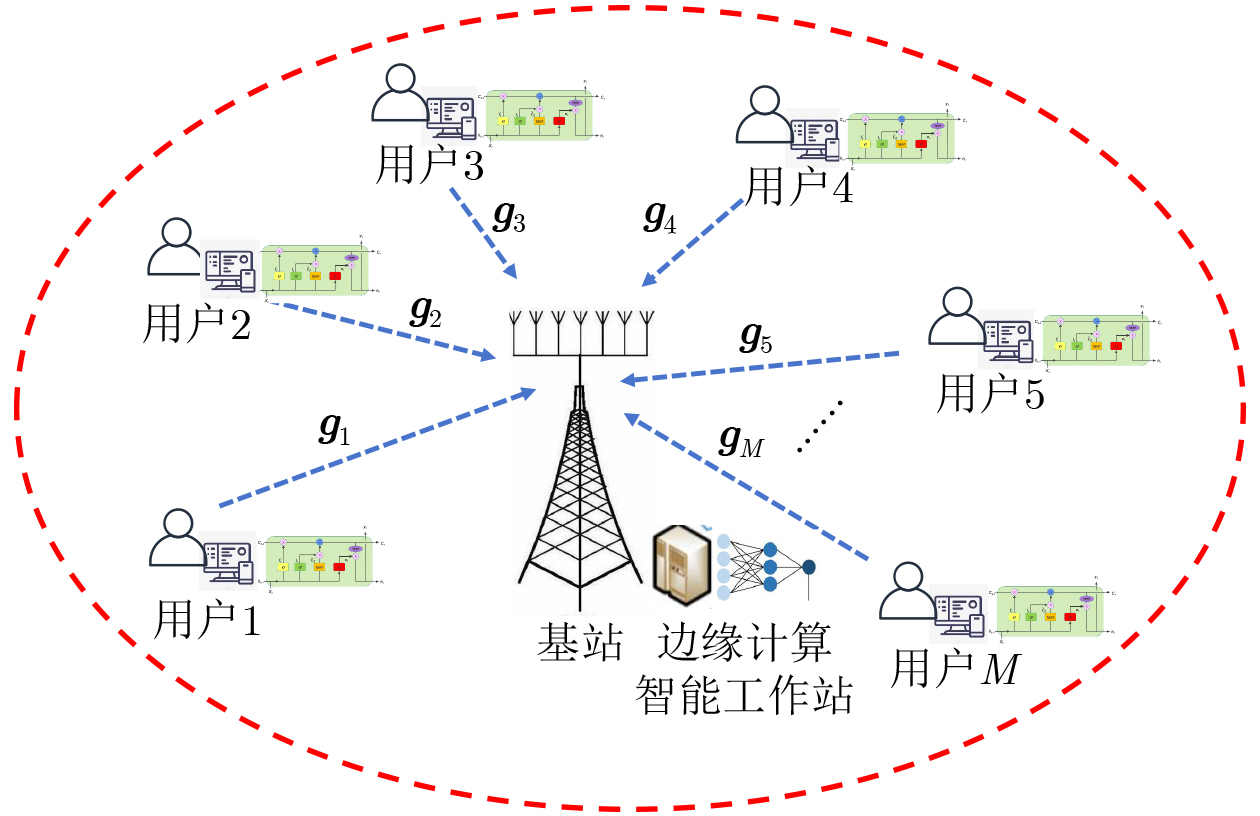
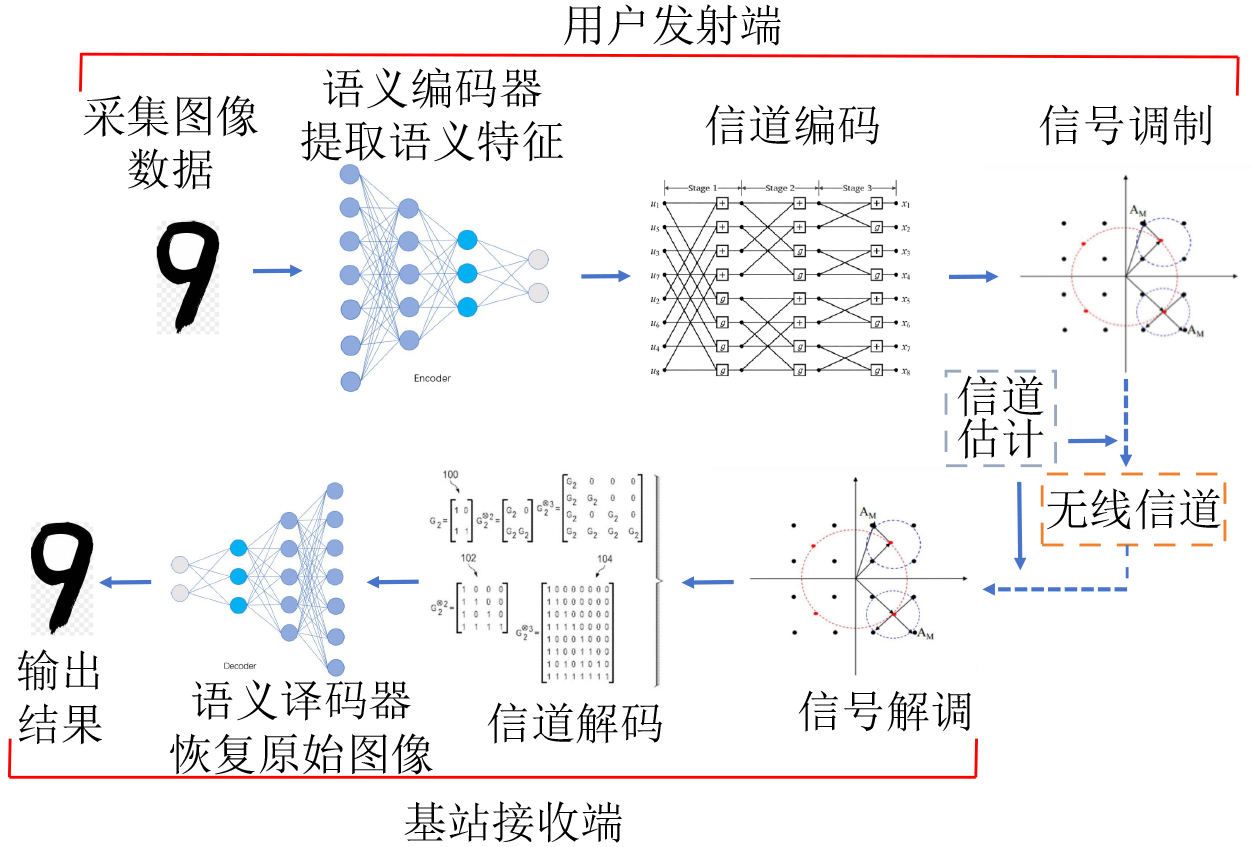
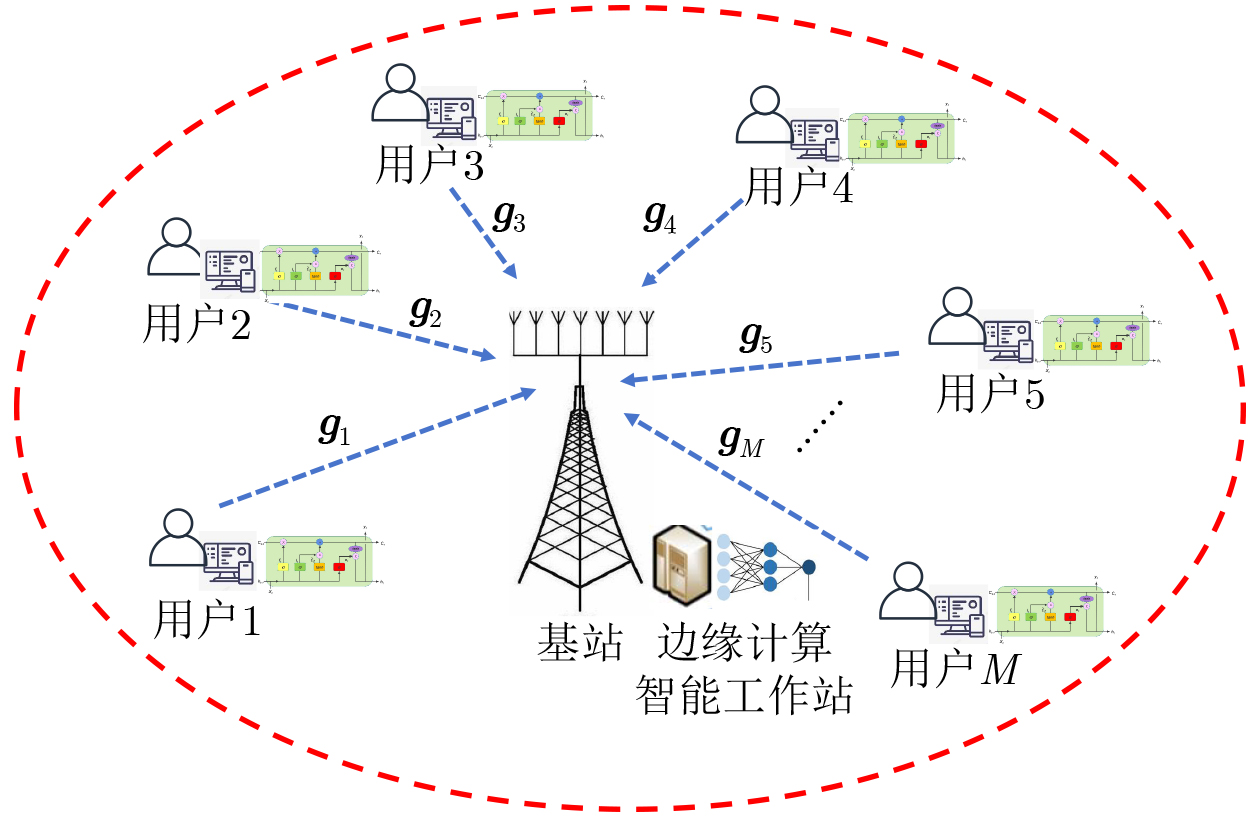
Abstract:Objective With the rapid development of semantic communication and the increasing demand for high-fidelity image recovery, high computational and transmission energy consumption remains a key factor limiting network deployment. Existing resource management strategies are largely static and show limited adaptability to dynamic wireless environments and user mobility. To address these issues, a robust energy optimization strategy driven by a modified Multi-Agent Proximal Policy Optimization (MAPPO) algorithm is proposed. By jointly optimizing communication and computing resources, the total network energy consumption is minimized while strictly satisfying multi-dimensional constraints, including latency and image recovery quality. Methods First, a theoretical model of the semantic communication network is constructed, and a closed-form expression for the user Symbol Error Rate (SER) is derived through asymptotic analysis of the uplink Signal-to-Interference-plus-Noise Ratio (SINR). Subsequently, the coupling relationships among semantic extraction rate, transmit power, computing resources, and network energy consumption are quantified. On this basis, a joint optimization model is formulated to minimize total energy consumption under constraints of delay, accuracy, and reliability. To solve this mixed-integer nonlinear programming problem, a modified MAPPO algorithm is designed. The algorithm integrates Long Short-Term Memory (LSTM) networks to capture temporal dynamics of user positions and channel states, and introduces a noise mechanism into the global state and advantage function to improve policy exploration and robustness. Results and Discussions Simulation results show that the proposed algorithm consistently outperforms baseline methods, including standard MAPPO, NOISE-MAPPO, LSTM-MAPPO, MADDPG, and greedy algorithms. The proposed strategy accelerates training convergence by 66.7%~80% relative to the benchmarks. In dynamic environments, network energy consumption stability is improved by approximately 50%, and user latency stability is enhanced by more than 96%. Additionally, the average SER is reduced by 4%~16.33% without degrading final image recovery performance, demonstrating an effective balance between energy efficiency and task reliability. Conclusions This study addresses energy optimization in semantic communication networks by combining theoretical modeling with a modified deep reinforcement learning framework. The proposed decision-making approach enhances the standard MAPPO algorithm through LSTM-based temporal feature extraction and noise-assisted robust exploration. Simulation results in dynamic single-cell and multi-cell scenarios show that the method improves convergence efficiency and system stability, and achieves a favorable trade-off between energy consumption and service quality. These results provide a theoretical basis and an efficient resource management framework for future energy-constrained semantic communication systems. -
表 1 仿真参数
仿真参数 参数值 小区数量 1 基站天线数量Nr 32 小区用户数量M 25 用户天线数量 1 用户最大发射功率Pk(mW) 100 功率$ \left\{{p_{{\mathrm{l}}1},p_{{\mathrm{l}}2},p_{{\mathrm{l}}3},p_{{\mathrm{l}}4}}\right\} $(mW) {25, 50, 75, 100} 语义提取率$ \{{\rho }_{{\mathrm{l1}}},{\rho }_{{\mathrm{l2}}} $, ${\rho }_{{\mathrm{l3}}},{\rho }_{{\mathrm{l4}}},{\rho }_{{\mathrm{l5}}},{\rho }_{{\mathrm{l6}}}\} $ {1/6,2/6,3/6,4/6,5/6,1} 小区半径(m) 900 用户上行信道带宽W(MHz) 1 能耗系数$ \kappa $ 10–28 时延约束$ t\mathrm{_{th}} $(ms) 100 用户计算容量f (GHz) 2 ECIW计算容量$ {F}_{\max } $(GHz) 25 噪声功率(dBm/Hz) –174  下载: 导出CSV
表 2 所提算法与基准算法的网络误符号性能对比
算法 所有用户每回合
最大平均误符号率均值所有用户每回合
最大平均误符号率方差所提算法 $ 1.3796\times {10}^{-4} $ $ 6.5535\times {10}^{-7} $ MAPPO $ 1.4420\times {10}^{-4} $ $ 6.8344\times {10}^{-7} $ LSTM-MAPPO $ \text{1.5349}\times {\text{10}}^{{-4}} $ $ 7.8464\times {10}^{-7} $ NOISE-MAPPO $ \text{1.6489}\times {\text{10}}^{{-4}} $ $ 7.2612\times {10}^{-7} $ MADDPG $ \text{1.5251}\times {\text{10}}^{{-4}} $ $ 7.1457\times {10}^{-7} $ 贪婪算法 $ \text{8.9753}\times {\text{10}}^{{-3}} $ $ 6.5866\times {10}^{-6} $
下载: 导出CSV
表 4 所提算法与基准算法的图像恢复性能对比(Imagenet数据集)
算法 所有用户每回合
平均峰值信噪比均值(dB)所有用户每回合
平均峰值信噪比方差所提算法 30.1345 0.0017 MAPPO 30.1005 0.0024 LSTM-MAPPO 29.5246 0.0084 NOISE-MAPPO 29.3471 0.0101 MADDPG 28.8562 0.0075 贪婪算法 11.1175 0.0159
下载: 导出CSV
表 3 所提算法与基准算法的图像恢复性能对比(MNIST数据集)
算法 所有用户每回合
平均峰值信噪比均值(dB)所有用户每回合
平均峰值信噪比方差所提算法 35.1475 0.0026 MAPPO 35.1005 0.0054 LSTM-MAPPO 34.5487 0.0097 NOISE-MAPPO 34.2211 0.0097 MADDPG 33.9256 0.0065 贪婪算法 15.6624 0.0219
下载: 导出CSV
-
[1] 张平. 语义通信: 未来通信系统的智简之道[J]. 中兴通讯技术, 2024, 30(1): 1. doi: 10.12142/ZTETJ.202401001.ZHANG Ping. Semantic communication: The intelligent and concise way to the future communication system[J]. ZTE Technology Journal, 2024, 30(1): 1. doi: 10.12142/ZTETJ.202401001. [2] 朱政宇, 梁馨月, 孙钢灿, 等. 智能超表面赋能语义通信系统研究综述[J]. 电子与信息学报, 2025, 47(2): 287–295. doi: 10.11999/JEIT240984.ZHU Zhengyu, LIANG Xinyue, SUN Gangcan, et al. Research overview of reconfigurable intelligent surface enabled semantic communication systems[J]. Journal of Electronics & Information Technology, 2025, 47(2): 287–295. doi: 10.11999/JEIT240984. [3] ZHANG Ping, LIU Yiming, SONG Yile, et al. Advances and challenges in semantic communications: A systematic review[J]. National Science Open, 2024, 3(4): 20230029. doi: 10.1360/nso/20230029. [4] SHAO Yulin, CAO Qi, and GÜNDÜZ D. A theory of semantic communication[J]. IEEE Transactions on Mobile Computing, 2024, 23(12): 12211–12228. doi: 10.1109/TMC.2024.3406375. [5] PENG Xiang, QIN Zhijin, TAO Xiaoming, et al. A robust image semantic communication system with multi-scale vision transformer[J]. IEEE Journal on Selected Areas in Communications, 2025, 43(4): 1278–1291. doi: 10.1109/JSAC.2025.3531413. [6] VAN CHIEN T, PHONG L H, PHUC D X, et al. Image restoration under semantic communications[C]. 2022 International Conference on Advanced Technologies for Communications, Ha Noi, Vietnam, 2022: 332–337. doi: 10.1109/ATC55345.2022.9943000. [7] ZHANG Guangyi, HU Qiyu, QIN Zhijin, et al. A unified multi-task semantic communication system for multimodal data[J]. IEEE Transactions on Communications, 2024, 72(7): 4101–4116. doi: 10.1109/TCOMM.2024.3364990. [8] YAN Zhigang and LI Dong. Semantic communications for digital signals via carrier images[J]. IEEE Wireless Communications Letters, 2025, 14(6): 1816–1820. doi: 10.1109/LWC.2025.3557843. [9] LIANG Chengyang and LI Dong. Image generation with supervised selection based on multimodal features for semantic communications[J]. IEEE Transactions on Communications. doi: 10.1109/TCOMM.2025.3615798. [10] DAI Jincheng, WANG Sixian, TAN Kailin, et al. Nonlinear transform source-channel coding for semantic communications[J]. IEEE Journal on Selected Areas in Communications, 2022, 40(8): 2300–2316. doi: 10.1109/JSAC.2022.3180802. [11] YANG Pujing, ZHANG Guangyi, and CAI Yunlong. Rate-adaptive generative semantic communication using conditional diffusion models[J]. IEEE Wireless Communications Letters, 2025, 14(2): 539–543. doi: 10.1109/LWC.2024.3515656. [12] YUAN Weiwen, REN Jinke, WANG Chongjie, et al. Generative semantic communication for joint image transmission and segmentation[C]. 2025 IEEE International Conference on Communications Workshops, Montreal, Canada, 2025: 1110–1115. doi: 10.1109/ICCWorkshops67674.2025.11162317. [13] ZHANG Guangyi, YANG Pujing, CAI Yunlong, et al. From analog to digital: Multi-order digital joint coding-modulation for semantic communication[J]. IEEE Transactions on Communications, 2025, 73(6): 4257–4271. doi: 10.1109/TCOMM.2024.3511949. [14] TUNG T Y, KURKA D B, JANKOWSKI M, et al. DeepJSCC-Q: Constellation constrained deep joint source-channel coding[J]. IEEE Journal on Selected Areas in Information Theory, 2022, 3(4): 720–731. doi: 10.1109/JSAIT.2022.3231042. [15] YANG Zhaohui, CHEN Mingzhe, ZHANG Zhaoyang, et al. Energy efficient semantic communication over wireless networks with rate splitting[J]. IEEE Journal on Selected Areas in Communications, 2023, 41(5): 1484–1495. doi: 10.1109/JSAC.2023.3240713. [16] ZHANG Hongwei, SHAO Shuo, TAO Meixia, et al. Deep learning-enabled semantic communication systems with task-unaware transmitter and dynamic data[J]. IEEE Journal on Selected Areas in Communications, 2023, 41(1): 170–185. doi: 10.1109/JSAC.2022.3221991. [17] 翟凯. 基于MMSE检测的MIMO及大规模MIMO系统性能精确分析[D]. [博士论文], 西南交通大学, 2021. doi: 10.27414/d.cnki.gxnju.2021.000015.ZHAI Kai. Exact performance analysis of MIMO and massive MIMO systems with MMSE receiver[D]. [Ph. D. dissertation], Southwest Jiaotong University, 2021. doi: 10.27414/d.cnki.gxnju.2021.000015. [18] QIN Langtian, LU Hancheng, CHEN Yuang, et al. Toward decentralized task offloading and resource allocation in user-centric MEC[J]. IEEE Transactions on Mobile Computing, 2024, 23(12): 11807–11823. doi: 10.1109/TMC.2024.3399766. [19] 张峻伟, 吕帅, 张正昊, 等. 基于样本效率优化的深度强化学习方法综述[J]. 软件学报, 2022, 33(11): 4217–4238. doi: 10.13328/j.cnki.jos.006391.ZHANG Junwei, LÜ Shuai, ZHANG Zhenghao, et al. Survey on deep reinforcement learning methods based on sample efficiency optimization[J]. Journal of Software, 2022, 33(11): 4217–4238. doi: 10.13328/j.cnki.jos.006391. [20] HU Siyue and HU Jian. Noisy-MAPPO: Noisy advantage values for cooperative multi-agent actor-critic methods[J]. arXiv: 2106.14334v1, 2021. doi: 10.48550/arXiv.2106.14334. [21] SCHULMAN J, WOLSKI F, DHARIWAL P, et al. Proximal policy optimization algorithms[J]. arXiv: 1707.06347, 2017. doi: 10.48550/arXiv.1707.06347. [22] LILLICRAP T P, HUNT J J, Pritzel A, et al. Continuous control with deep reinforcement learning[C]. The 4th International Conference on Learning Representations, San Juan, Puerto Rico, 2016. -

 下载:
下载:


图(4) / 表(4)
计量
- 文章访问数: 878
- HTML全文浏览量: 442
- PDF下载量: 61
- 被引次数: 0
