




A Clipped NMS List Decoding Algorithm for LDPC Codes in 5G URLLC
-
摘要: 低密度奇偶校验码(Low-Density Parity-Check, LDPC)译码器以接收信号转换得到的对数似然比作为输入,其译码性能对输入高度敏感。在实际无线通信系统中,由于环境的变化,信道容易受到突发干扰,这些干扰会打乱译码器的输入分布从而导致性能损失。为了解决上述问题,该文提出了一种面向5G URLLC场景的LDPC码限幅归一化最小和列表译码算法。该算法通过复用空闲处理单元来生成多条译码路径,并根据输入分布,为每条路径配备独立的限幅器,以此平滑突发干扰,在不增加硬件开销的情况下提升了译码器在干扰信道上的性能。实验表明,相较于单限幅分层NMS算法,该算法实现了0.5 dB左右的增益,并且处理单元的利用率平均提高了69%。Abstract:
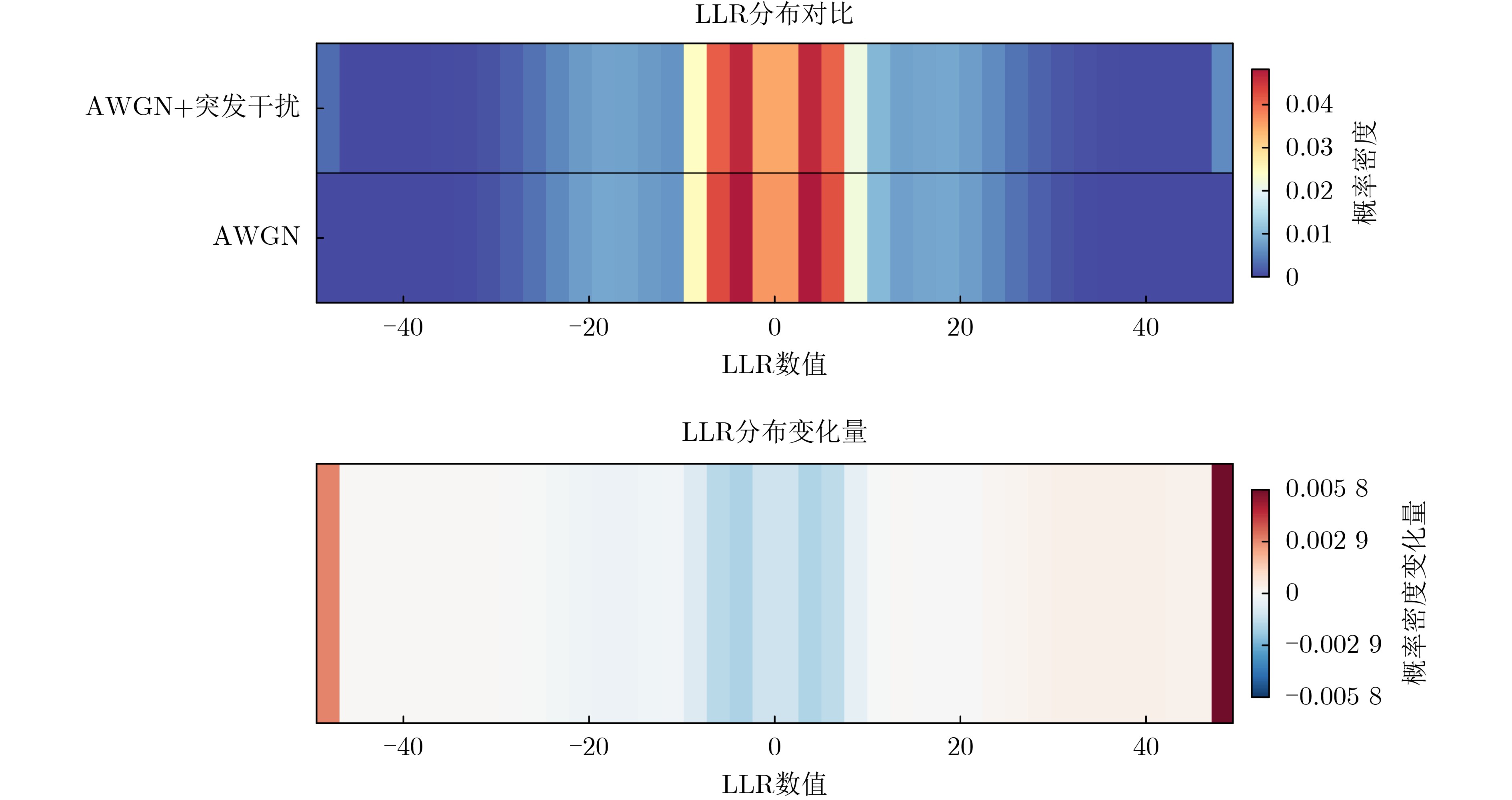
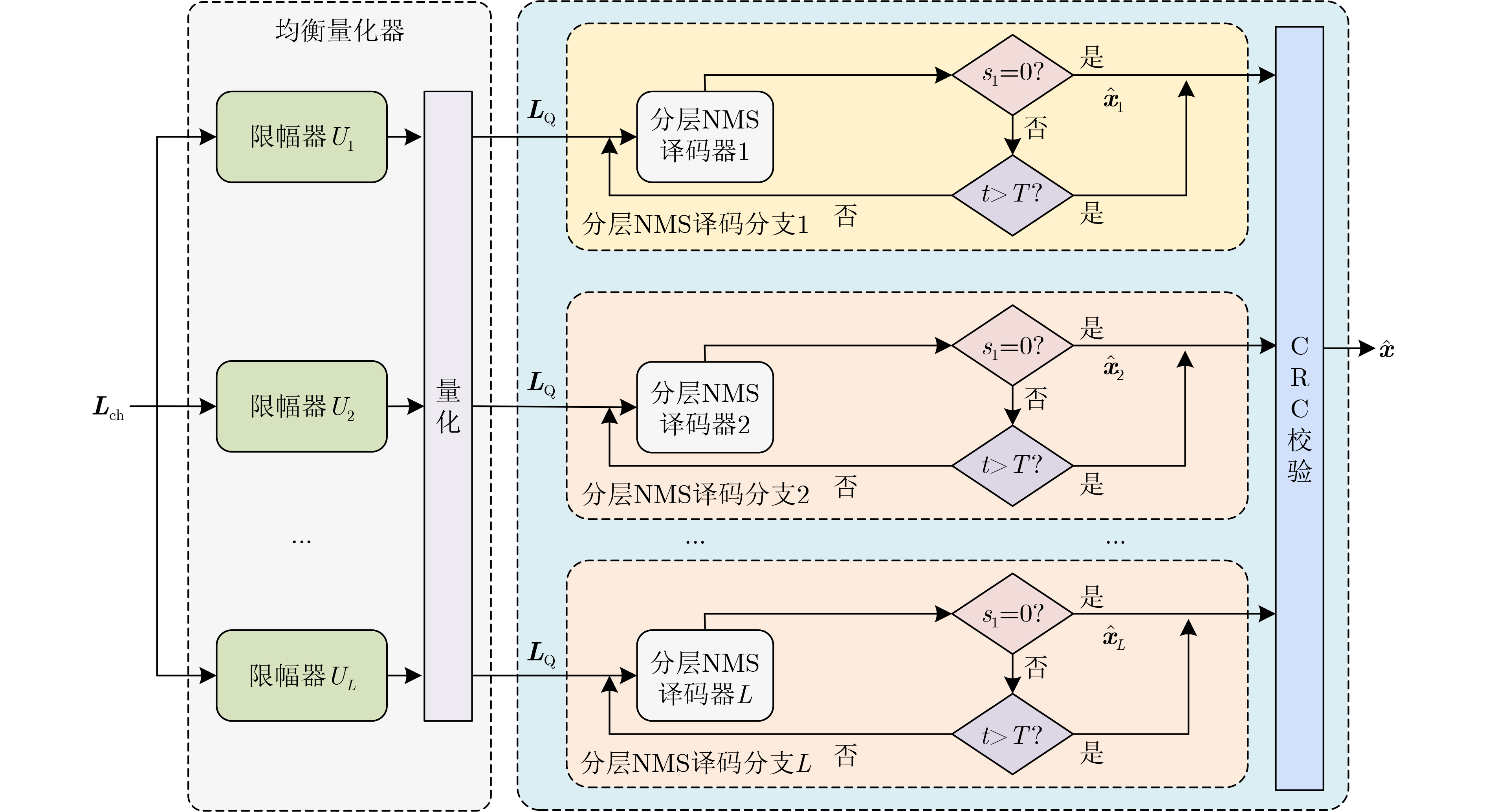
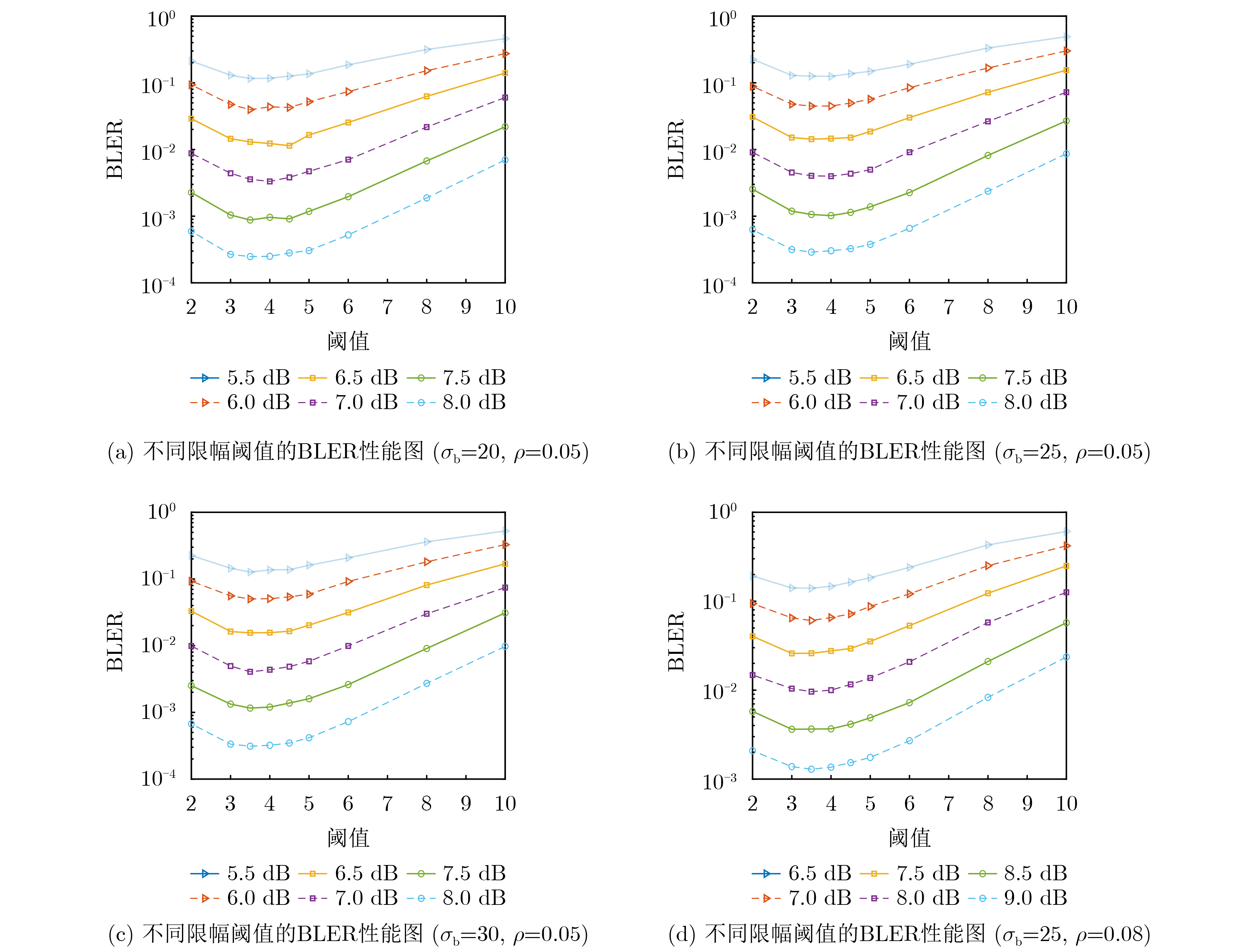
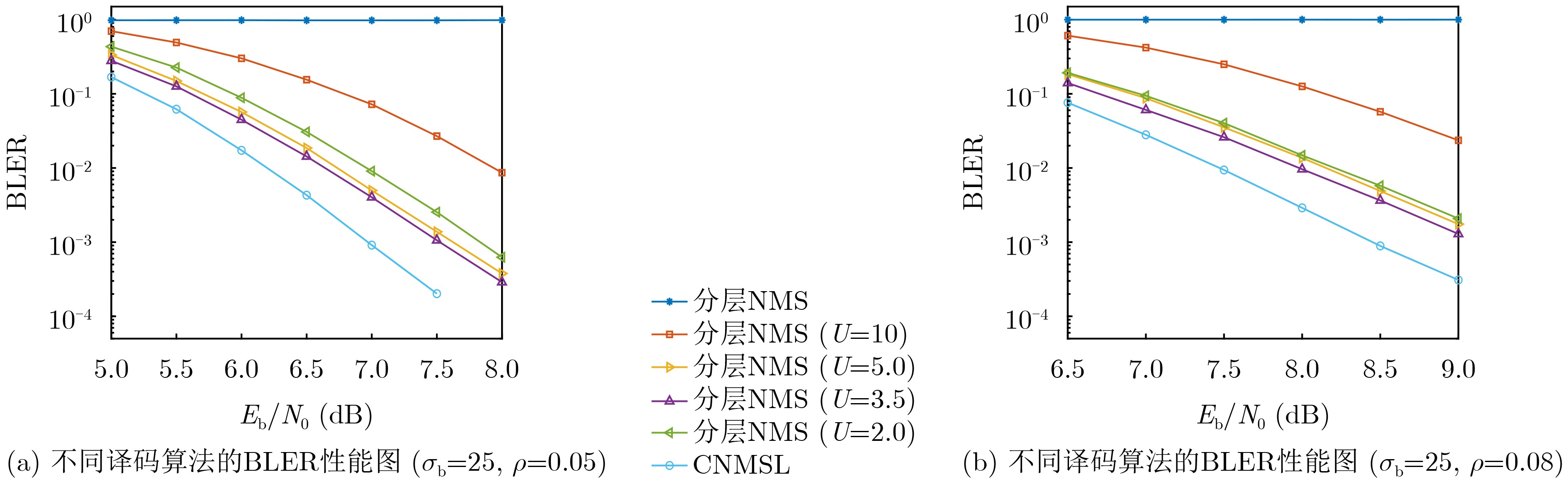
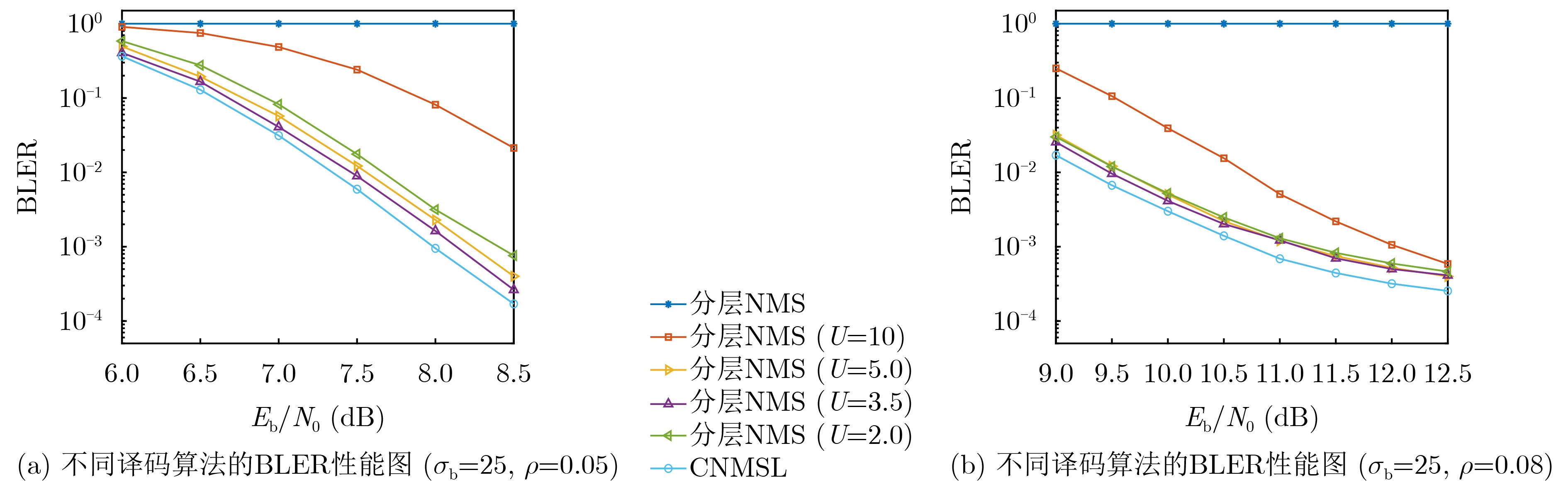
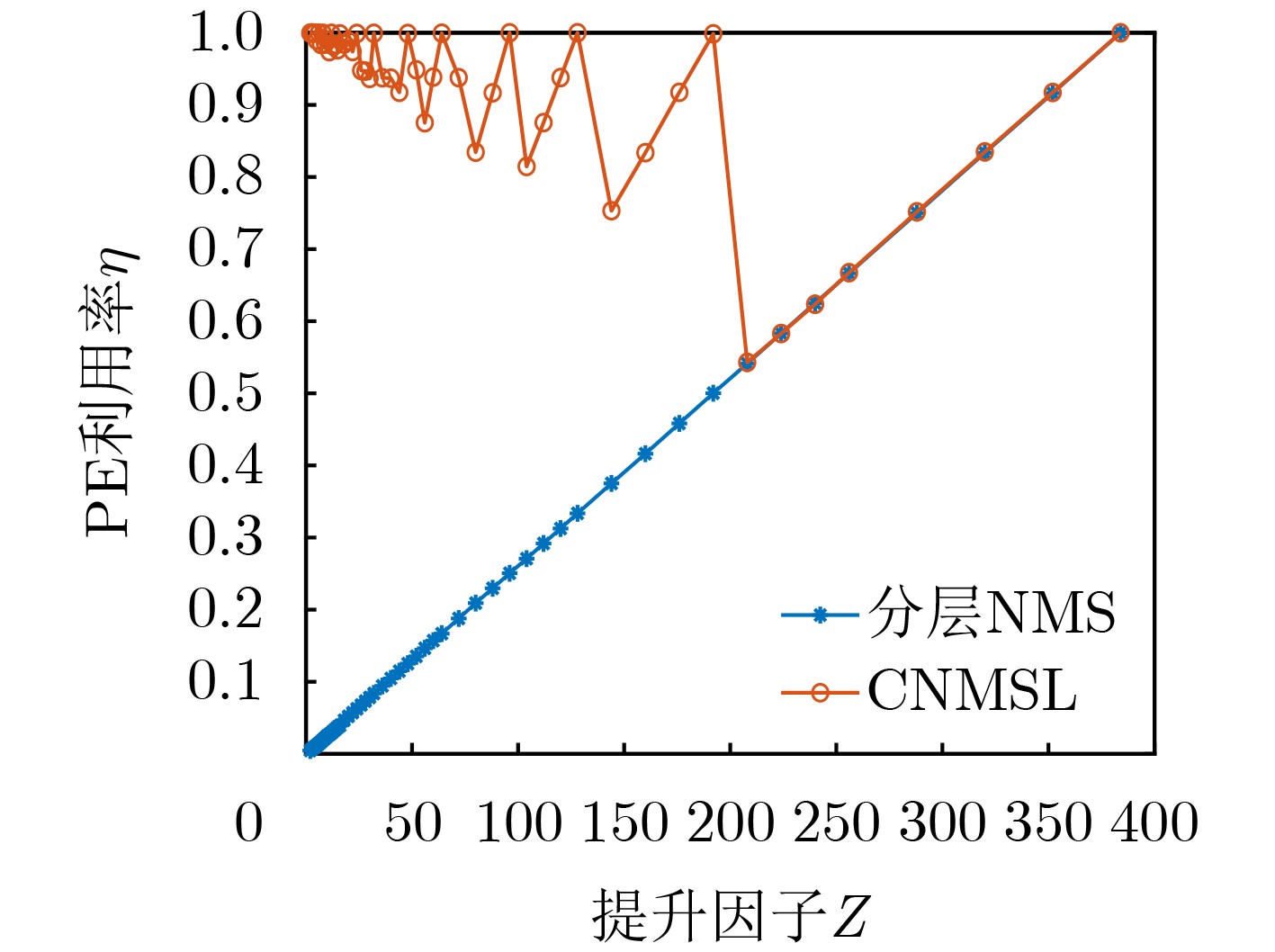
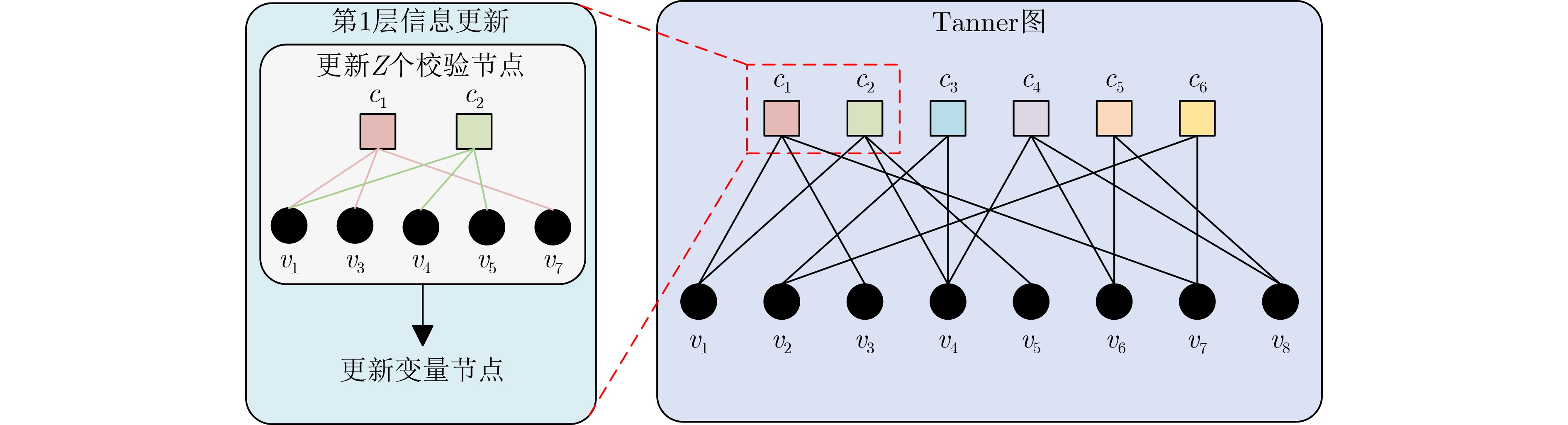
Objective As one of the coding schemes used in Fifth-generation (5G) wireless communication systems, Low-Density Parity-Check (LDPC) codes can achieve performance close to the Shannon limit through iterative decoding. However, in practical wireless transmission environments, the decoding performance of LDPC codes is vulnerable to burst interference in wireless channels. The Normalized Min-Sum (NMS) decoding algorithm is highly sensitive to the distribution characteristics of the input log-likelihood ratios (LLRs). Burst interference causes the LLRs to deviate from a Gaussian distribution, which degrades decoding performance. Meanwhile, 5G LDPC decoders are often configured with a fixed number of Processing Elements (PEs) based on the maximum lifting size to cover the full code-length range. In Ultra-reliable Low-Latency Communications (URLLC) short-code transmission scenarios, the lifting size is much smaller than the maximum lifting size. This condition leaves many PEs idle for long periods and results in low hardware resource utilization. To address these issues, a Clipped Normalized Min-Sum List (CNMSL) decoding algorithm is proposed. By co-designing burst-interference smoothing and idle-resource reuse, the proposed algorithm improves hardware resource utilization and decoding performance. Methods The statistical characteristics of LLRs over Additive White Gaussian Noise (AWGN) and interference channels are first analyzed, and the negative effect of burst interference on decoding performance is qualitatively attributed to the increased proportion of saturated LLRs induced by such interference. The correlation between the optimal clipping threshold and the channel noise variance, burst interference variance, and burst probability is then examined. It is shown that, under limited variations in channel parameters, the optimal clipping threshold converges to a finite interval, referred to as the optimal threshold interval. On this basis, the CNMSL decoding algorithm is proposed. A list-decoding architecture is constructed by reusing idle PEs in 5G LDPC decoders. In this architecture, each decoding path performs independent and synchronous decoding to generate candidate codewords, and the optimal decoding result is selected through a Cyclic Redundancy Check (CRC). Meanwhile, an independent clipper is configured for each path, with parameters determined from the optimal threshold interval, thereby effectively suppressing the adverse effects of burst interference. Results and Discussions Experimental results show that the layered NMS algorithm nearly fails over interference channels when no clipping mechanism is used. With a single clipping threshold, the algorithm operates normally, and its Block Error Rate (BLER) shows a convex downward trend, first decreasing and then increasing as the clipping threshold is reduced. Under various channel conditions for both short and long codes, the single-clipping layered NMS algorithm with a clipping threshold of 3.5 achieves a gain of about 1 dB at $ \mathrm{BLER}=10^{-2} $ compared with a threshold of 10, and the CNMSL algorithm provides a further gain of about 0.5 dB relative to the single-clipping NMS algorithm. In terms of hardware efficiency, when the lifting factor is less than 192, the PE utilization of the CNMSL algorithm is substantially higher than that of the layered NMS algorithm, and the improvement becomes more pronounced as the lifting factor decreases. On average, PE utilization is increased by 69% relative to the layered NMS algorithm. Conclusions A CNMSL decoding algorithm is proposed to improve the error-correction performance of the conventional layered NMS decoding algorithm over interference channels. By reusing idle PEs for list decoding to generate multiple candidate paths, the proposed algorithm introduces no additional hardware overhead. In addition, an optimal threshold interval is defined to configure the clipper for each decoding path. This strategy limits the proportion of saturated LLRs and makes the input LLRs follow a Gaussian or near-Gaussian distribution. Experimental results show that, compared with the layered NMS decoding algorithm with a single clipper, the proposed CNMSL algorithm achieves a gain of approximately 0.5 dB for both short and long codes. Meanwhile, PE utilization is increased by an average of 69%. -
Key words:
- 5G URLLC /
- Burst interference /
- Clipper /
- Normalized min-sum /
- List decoding
-
[1] GALLAGER R. Low-density parity-check codes[J]. IRE Transactions on Information Theory, 1962, 8(1): 21–28. doi: 10.1109/TIT.1962.1057683. [2] 周华, 李子杰. 空间耦合低密度奇偶校验码残差滑窗译码算法[J]. 电子与信息学报, 2024, 46(3): 867–874. doi: 10.11999/JEIT230288.ZHOU Hua and LI Zijie. Residual sliding window decoding algorithm for spatially-coupled low-density parity-check codes[J]. Journal of Electronics & Information Technology, 2024, 46(3): 867–874. doi: 10.11999/JEIT230288. [3] ETSI. 5G NR: 3GPP TS 38.212 Multiplexing and channel coding[S]. ETSI, 2018. [4] LU Teng, HE Xuan, KANG Peng, et al. Parity-check matrix partitioning for efficient layered decoding of QC-LDPC codes[J]. IEEE Transactions on Communications, 2023, 71(6): 3207–3220. doi: 10.1109/TCOMM.2023.3261380. [5] 张国华, 秦煜, 娄蒙娟, 等. 围长为8的较大列重准循环低密度奇偶校验码的行重普适代数构造[J]. 电子与信息学报, 2024, 46(7): 3019–3025. doi: 10.11999/JEIT231111.ZHANG Guohua, QIN Yu, LOU Mengjuan, et al. Row-weight universal algebraic constructions of Girth-8 quasi-cyclic low-density parity-check codes with large column weights[J]. Journal of Electronics & Information Technology, 2024, 46(7): 3019–3025. doi: 10.11999/JEIT231111. [6] FOSSORIER M P C, MIHALJEVIC M, and IMAI H. Reduced complexity iterative decoding of low-density parity check codes based on belief propagation[J]. IEEE Transactions on Communications, 1999, 47(5): 673–680. doi: 10.1109/26.768759. [7] KIM J S and SONG H Y. Reduced complexity decoding algorithm of LDPC codes using node elimination[C]. 2006 10th IEEE Singapore International Conference on Communication Systems, Singapore, Singapore, 2006: 1–3. doi: 10.1109/ICCS.2006.301432. [8] CHEN Jinghu and FOSSORIER M P C. Near optimum universal belief propagation based decoding of low-density parity check codes[J]. IEEE Transactions on Communications, 2002, 50(3): 406–414. doi: 10.1109/26.990903. [9] GOLDBERGER J and KFIR H. Serial schedules for belief-propagation: Analysis of convergence time[J]. IEEE Transactions on Information Theory, 2008, 54(3): 1316–1319. doi: 10.1109/TIT.2007.915702. [10] TIAN Kuangda and WANG Hao. A novel base graph based static scheduling scheme for layered decoding of 5G LDPC codes[J]. IEEE Communications Letters, 2022, 26(7): 1450–1453. doi: 10.1109/LCOMM.2022.3171658. [11] SHAH N and VASAVADA Y. Neural layered decoding of 5G LDPC codes[J]. IEEE Communications Letters, 2021, 25(11): 3590–3593. doi: 10.1109/LCOMM.2021.3113610. [12] 周华, 周鸣, 张立康. 低密度奇偶校验码正则化神经网络归一化最小和译码算法[J]. 电子与信息学报, 2025, 47(5): 1486–1493. doi: 10.11999/JEIT240860.ZHOU Hua, ZHOU Ming, and ZHANG Likang. Regularized neural network-based normalized min-sum decoding for LDPC codes[J]. Journal of Electronics & Information Technology, 2025, 47(5): 1486–1493. doi: 10.11999/JEIT240860. [13] ZHAO Shancheng, MA Xiao, and BAI Baoming. Decoding algorithms for binary LDPC coded Gaussian interference channels[C]. 2013 IEEE/CIC International Conference on Communications in China (ICCC), Xi’an, China, 2013: 39–43. doi: 10.1109/ICCChina.2013.6671086. [14] TSENG D F and LIN Shishun. Robust low density parity check decoding over Markov Gaussian channels[C]. 2019 IEEE 89th Vehicular Technology Conference (VTC2019-Spring), Kuala Lumpur, Malaysia, 2019: 1–5. doi: 10.1109/VTCSpring.2019.8746326. [15] NAKAGAWA H, UMEHARA D, DENNO S, et al. A decoding for low density parity check codes over impulsive noise channels[C]. International Symposium on Power Line Communications and Its Applications, Vancouver, Canada, 2005: 85–89. doi: 10.1109/ISPLC.2005.1430471. [16] XU Zhijiang, MENG Limin, GANG Li, et al. A decoding algorithm for low-density parity-check codes in impulse noise environment[C]. 2008 Third International Conference on Communications and Networking in China, Hangzhou, China, 2008: 922–925. doi: 10.1109/CHINACOM.2008.4685174. [17] ZHANG Yifan, CAO Qiang, WANG Shaohua, et al. HF-LDPC: HLS-friendly QC-LDPC FPGA decoder with high throughput and flexibility[C]. 2023 IEEE 41st International Conference on Computer Design (ICCD), Washington, USA, 2023: 566–573. doi: 10.1109/ICCD58817.2023.00091. [18] ZHONG Xinyu, GONG Shuaicong, JIANG Ming, et al. Low-latency high-throughput decoder of QC-LDPC codes by matrix splitting[C]. 2024 16th International Conference on Wireless Communications and Signal Processing (WCSP), Hefei, China, 2024: 13–17. doi: 10.1109/WCSP62071.2024.10827659. [19] NADAL J and BAGHDADI A. Parallel and flexible 5G LDPC decoder architecture targeting FPGA[J]. IEEE Transactions on Very Large Scale Integration (VLSI) Systems, 2021, 29(6): 1141–1151. doi: 10.1109/TVLSI.2021.3072866. [20] KUDEKAR S, RICHARDSON T, and IYENGAR A R. Analysis of saturated belief propagation decoding of low-density parity-check codes[J]. IEEE Transactions on Information Theory, 2017, 63(9): 5734–5751. doi: 10.1109/TIT.2017.2723484. -

 下载:
下载:

图(8)
计量
- 文章访问数: 649
- HTML全文浏览量: 450
- PDF下载量: 57
- 被引次数: 0
