




A Multi-layer Resilient Control Framework for Networked Microgrids against False Data Injection Attacks
-
摘要: 针对网络化微电网在高渗透可再生能源和开放通信环境下易受虚假数据注入攻击(FDIA)影响、导致频率失稳与通信拥塞的问题,该文提出一种“事件触发通信-攻击观测-深度强化学习补偿”的多层级一体化韧性控制方法。该方法设计了基于频率-积分误差的自适应事件触发机制以削减冗余数据传输,并构建径向基函数未知输入观测器(RBF-UIO)实现对FDIA的高精度检测与状态估计。在此基础上,引入双重回放Q学习(DRQL)开展在线补偿优化,实现攻击抑制与性能恢复。进一步,在典型4节点分布式微电网平台上开展仿真验证,结果表明:所提方法在显著降低通信事件数的同时,有效提升了频率恢复速度与稳态精度,保证了虚假数据攻击下的安全稳定运行。Abstract:
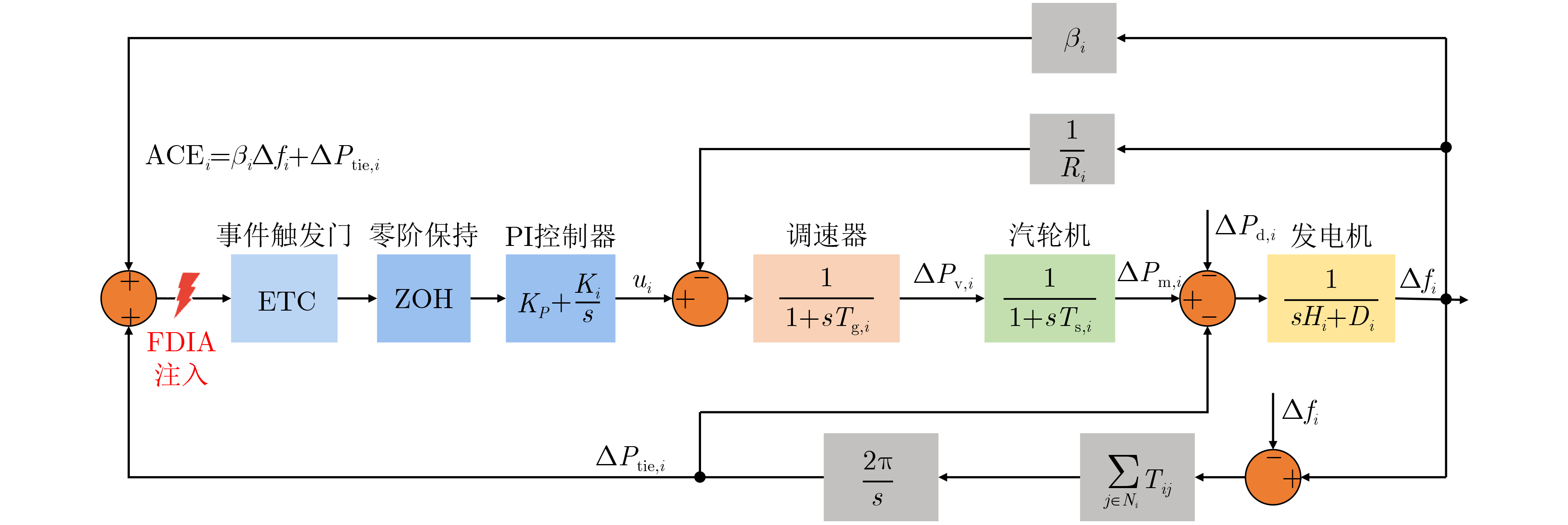
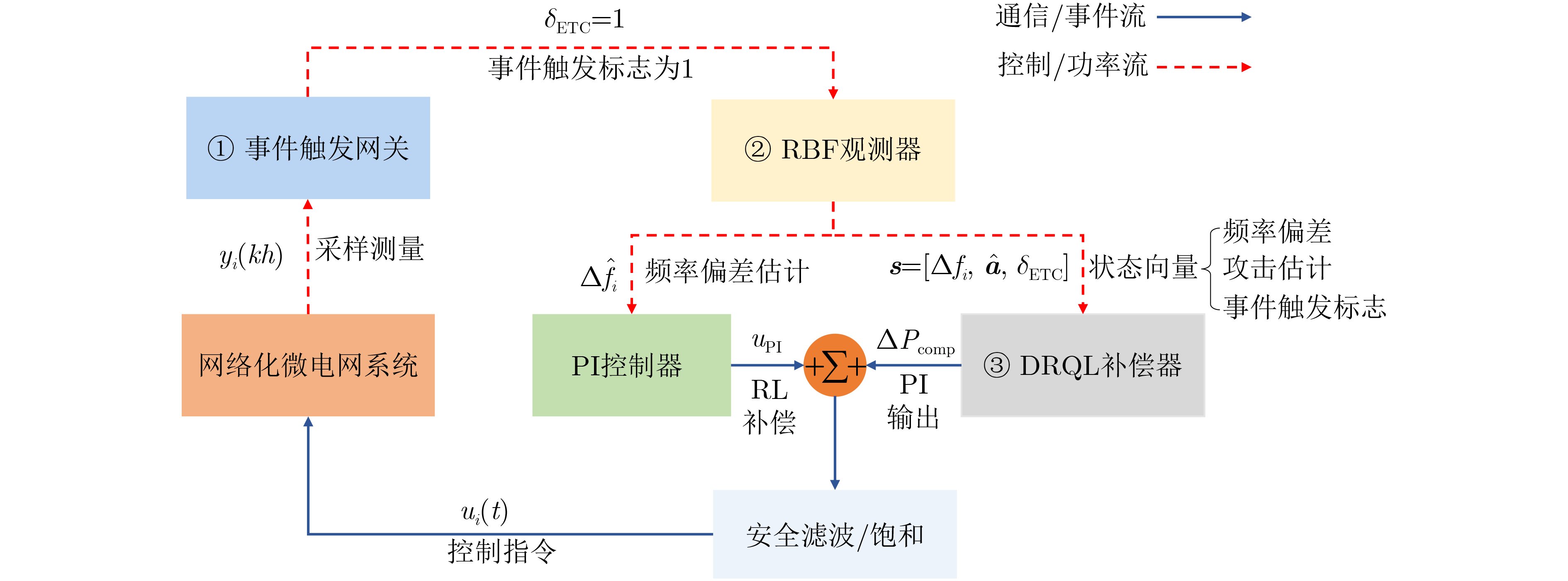
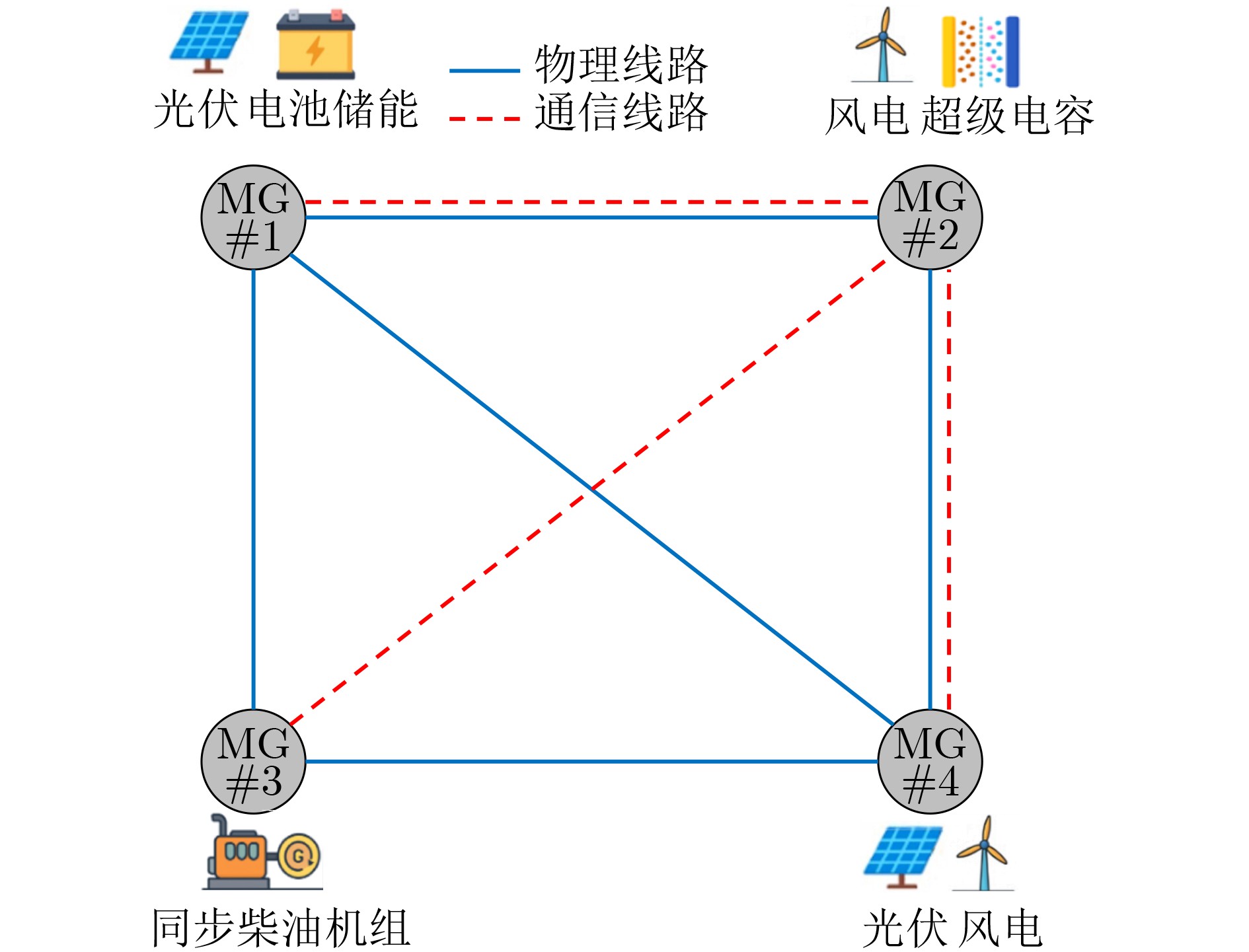
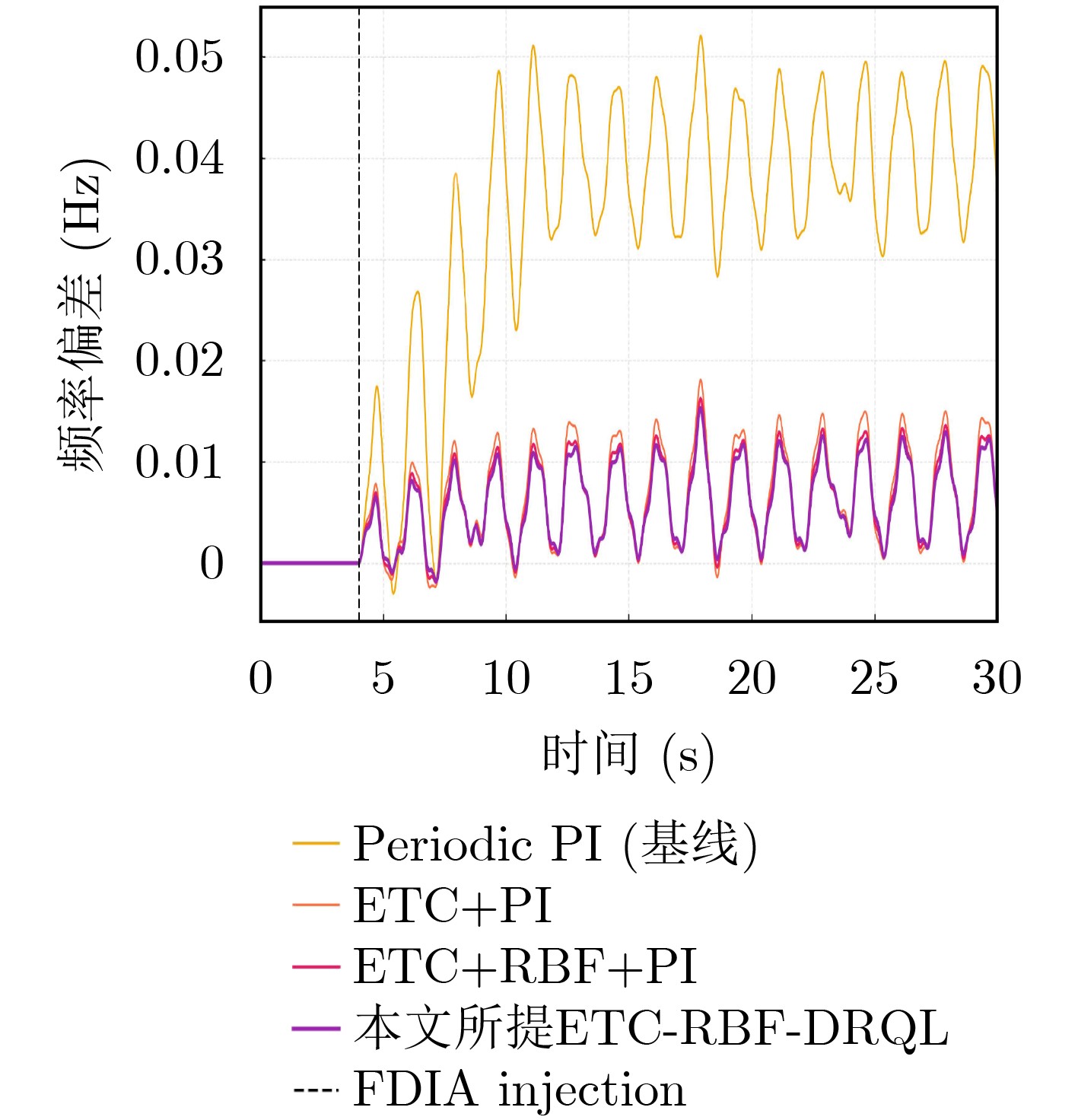
Objective With the increasing penetration of distributed renewable energy and the growing dependence on cyber-physical infrastructure, Networked MicroGrids (NMGs) are increasingly vulnerable to False Data Injection Attacks (FDIAs). These attacks threaten frequency stability and system security. Traditional secondary control methods are limited by constrained communication resources and fixed sampling mechanisms. They often fail to maintain resilient operation under stealthy FDIAs and dynamic disturbances. To address these challenges, this study develops a multi-layer resilient control strategy that integrates event-triggered communication/control, data-driven attack observation, and double-replay Q-learning. The objective is to improve communication efficiency, attack detection, and stability recovery in NMGs under complex cyber threats. Methods The proposed Event-Triggered Control-Radial Basis Function-Double-Replay Q-Learning (ETC-RBF-DRQL) framework integrates an Event-Triggered Control (ETC) mechanism, a Radial Basis Function Unknown Input Observer (RBF-UIO), and a Double-Replay Q-Learning (DRQL) compensator to achieve resilient frequency control in NMGs under FDIAs. The ETC mechanism reduces redundant data transmission while maintaining system stability. The RBF-UIO estimates system states and detects anomalous deviations. After an attack is detected, the DRQL module adaptively generates compensation signals to suppress the attack effect and restore system stability. The framework is formulated using a modular dynamic model of NMGs, which supports stability analysis under communication and attack constraints. Simulation experiments are conducted on a 4-node distributed microgrid testbed in MATLAB/Simulink. The testbed includes different renewable energy sources and realistic communication links to verify the effectiveness and scalability of the proposed approach. Results and Discussions The proposed ETC-RBF-DRQL framework is validated on a 4-node NMG under FDIA scenarios. Simulation results show that the method achieves better overall performance in frequency regulation, communication efficiency, and attack resilience. Specifically, the frequency deviation peak is reduced from 0.021 8 Hz under periodic Proportional-Integral (PI) control to 0.012 1 Hz. The steady-state average deviation and fluctuation standard deviation are reduced to 0.009 7 Hz and 0.007 4 Hz, respectively ( Fig. 4 ,Table 2 ). The average communication event rate decreases to 11.9 pkt/s, corresponding to a 76.2% reduction compared with periodic sampling (Table 2 ). The proposed framework also maintains reliable attack detection performance, with a detection rate of 91.5%, a false alarm rate of 4.8%, and an area under the curve (AUC) of 0.968 (Table 2 ). These results indicate that the proposed method can coordinate frequency recovery, communication overhead reduction, and FDIA mitigation in NMGs.Conclusions This paper investigates a multi-layer resilient control framework for NMGs under FDIAs and communication constraints. The proposed ETC-RBF-DRQL method integrates event-triggered communication/control, RBF-UIO-based attack detection, and DRQL-based adaptive compensation. It therefore enables closed-loop coordination among anomaly detection, attack suppression, and frequency stability recovery. Simulation results on a 4-node NMG show that, compared with conventional PI-based schemes, the proposed approach reduces frequency deviation peaks and shortens recovery time while lowering communication overhead. Theoretical analysis further confirms its feasibility and stability under bounded estimation errors. This study focuses on sensor-side FDIAs and simplified communication conditions. Future work will consider more complex multi-type attacks and hardware-in-the-loop validation to support engineering applications. -
表 1 4节点NMG系统关键物理与控制参数
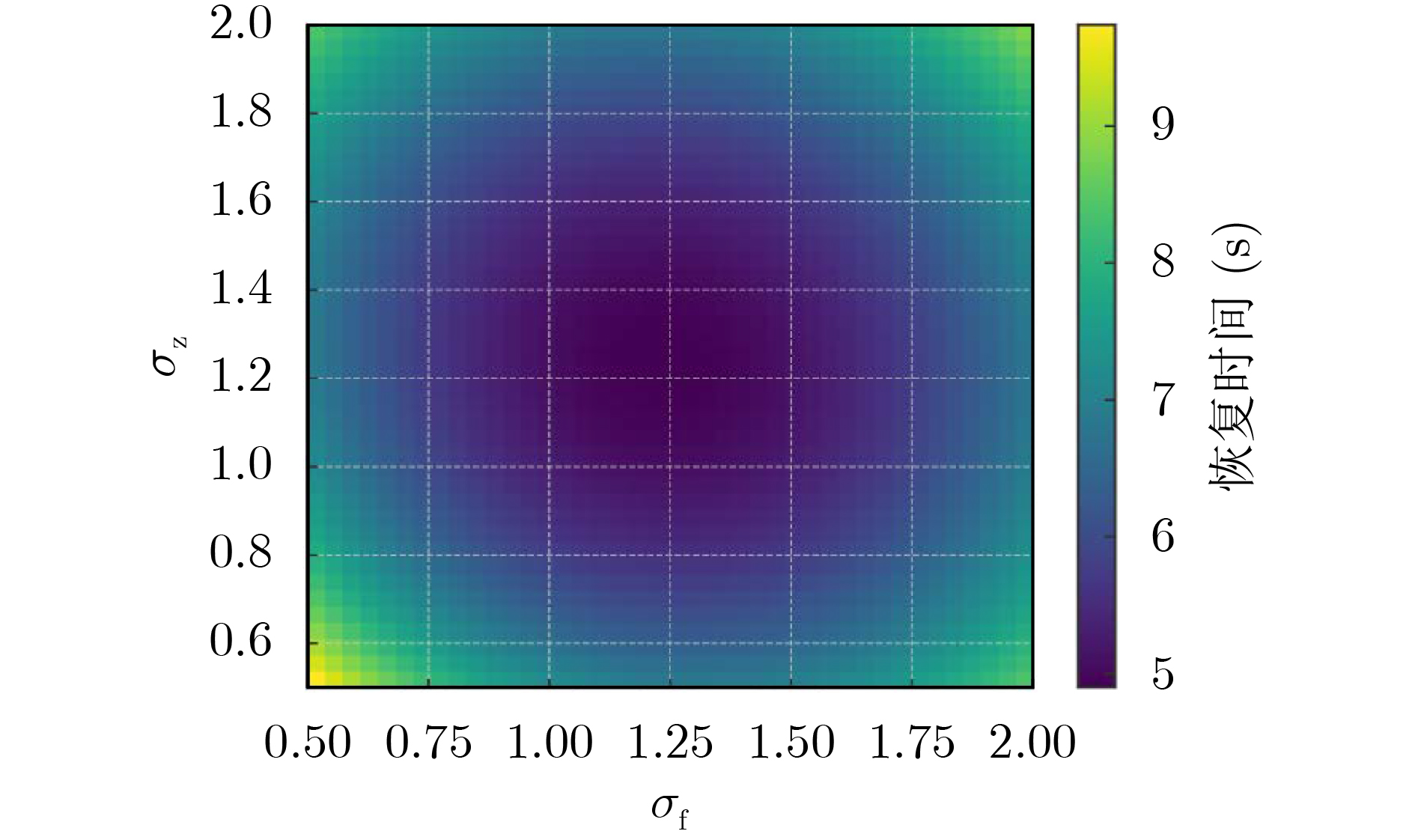
参数 含义 数值 $ {H}_{i} $ 节点惯性常数(同步机/虚拟同步机) 1.5 s(MG1), 2.0 s(MG3), 0.8 s(MG2, MG4) $ {D}_{i} $ 负荷阻尼系数 0.8(各节点) $ {R}_{i} $ 下垂系数 0.04 Hz/p.u.(各节点) $ T_{\mathrm{g},i} $ 调速器时间常数 0.15 s(柴油机),0.08 s(VSG 节点) $ T_{\mathrm{c}} $ 通信采样周期/触发网格 20 ms $ \sigma\mathrm{_f}/\sigma_{\mathrm{z}} $ 事件触发阈值权重(频差/积分差) 1.2/1.2 $ \theta $ 残差检测死区阈值 5×10⁻⁴ p.u. $ \overline{\varepsilon } $ RBF近似误差上界 1×10⁻³ p.u.  下载: 导出CSV
表 2 不同控制策略下的频率性能、通信负载与检测性能对比
策略 峰值超调量$ |\Delta f{|}_{\text{max}} $(Hz) 稳态平均偏差$ |\overline{\Delta f}| $(Hz) 稳态波动标准差$ \sigma $(Hz) 平均通信事件速率(pkt/s) 通信节省率(%) FDIA检测率(%) 误报率(%) AUC 周期采样PI(基准) 0.0218 0.0153 0.0102 50.0 0.0 - - - ETC+PI 0.0165 0.0124 0.0091 16.8 66.4 - - - ETC+RBF+PI 0.0148 0.0109 0.0083 14.3 71.4 91.5 4.8 0.968 所提ETC-RBF-DRQL 0.0121 0.0097 0.0074 11.9 76.2 91.5 4.8 0.968
下载: 导出CSV
-
[1] 刘鑫蕊, 张明超, 王睿, 等. 基于一致性算法的城市微网群分层协同控制[J]. 电力系统自动化, 2022, 46(17): 65–73. doi: 10.7500/AEPS20220228007.LIU Xinrui, ZHANG Mingchao, WANG Rui, et al. Hierarchical collaborative control of urban microgrid cluster based on consensus algorithm[J]. Automation of Electric Power Systems, 2022, 46(17): 65–73. doi: 10.7500/AEPS20220228007. [2] 孟潇潇, 邵冰冰, 韩平平, 等. 基于背靠背变流器柔性互联的微网群分层协同恢复控制策略[J]. 中国电机工程学报, 2023, 43(20): 7812–7826. doi: 10.13334/j.0258-8013.pcsee.221457.MENG Xiaoxiao, SHAO Bingbing, HAN Pingping, et al. Hierarchical cooperative recovery control strategy for flexible interconnected microgrid cluster based on back-to-back converters[J]. Proceedings of the CSEE, 2023, 43(20): 7812–7826. doi: 10.13334/j.0258-8013.pcsee.221457. [3] 苗金钊,刘金良,孙乐,查利娟,田恩刚.基于虚假数据检测的信息物理系统安全学习控制方法[J]. 电子与信息学报, 2026, 48(4):1434-1443. doi: 10.11999/JEIT250537.MIAO Jinzhao,LIU Jinliang,SUN Le,ZHA Lijuan,TIAN Engang. A Learning-Based Security Control Method for Cyber-Physical Systems Based on False Data Detection[J].Journal of Electronics & Information Technology, 2026, 48(4):1434-1443. doi: 10.11999/JEIT250537. [4] 王文婷, 田博彦, 吴法宗, 等. 面向智能电网信息物理融合攻击的建模、检测和防御理论与方法[J]. 电子与信息学报, 2026, 48(4): 1454–1468. doi: 10.11999/JEIT250659.WANG Wenting, TIAN Boyan, WU Fazong, et al. Modeling, Detection, and Defense Theories and Methods for Cyber-Physical Fusion Attacks in Smart Grid[J]. Journal of Electronics & Information Technology, 2026, 48(4): 1454–1468. doi: 10.11999/JEIT250659. [5] JAFARI M, RAHMAN M A, and PAUDYAL S. Optimal false data injection attack against load-frequency control in power systems[J]. IEEE Transactions on Information Forensics and Security, 2023, 18: 5200–5212. doi: 10.1109/TIFS.2023.3305868. [6] BAHARIZADEH M, GOLSORKHI M S, and SAVAGHEBI M. Secondary control with reduced communication requirements for accurate reactive power sharing in AC microgrids[J]. IET Smart Grid, 2023, 6(6): 638–652. doi: 10.1049/stg2.12127. [7] CHENG Zihao, BU Xuhui, LIANG Jiaqi, et al. Indirect–direct secure load frequency control against false data injection attacks[J]. IEEE Transactions on Industrial Informatics, 2024, 20(3): 4850–4862. doi: 10.1109/TII.2023.3330235. [8] DANG Lujuan, CHEN Badong, WANG Shiyuan, et al. Robust power system state estimation with minimum error entropy unscented Kalman filter[J]. IEEE Transactions on Instrumentation and Measurement, 2020, 69(11): 8797–8808. doi: 10.1109/TIM.2020.2999757. [9] 李建华. 能源关键基础设施网络安全威胁与防御技术综述[J]. 电子与信息学报, 2020, 42(9): 2065–2081. doi: 10.11999/JEIT191055.LI Jianhua. Overview of cyber security threats and defense technologies for energy critical infrastructure[J]. Journal of Electronics & Information Technology, 2020, 42(9): 2065–2081. doi: 10.11999/JEIT191055. [10] KHALILI J, DEHKORDI N M, and HAMZEH M. Distributed event-triggered secondary frequency control of islanded AC microgrids under cyber attacks with input time delay[J]. International Journal of Electrical Power & Energy Systems, 2022, 143: 108506. doi: 10.1016/j.ijepes.2022.108506. [11] HOSSAIN M, PENG Chen, SUN Hongtao, et al. Bandwidth allocation-based distributed event-triggered LFC for smart grids under hybrid attacks[J]. IEEE Transactions on Smart Grid, 2022, 13(1): 820–830. doi: 10.1109/TSG.2021.3118801. [12] ZHAO Guanglei, JIN Lanqing, CUI Hailong, et al. Distributed adaptive dynamic event-triggered secondary control for islanded microgrids with disturbances[J]. IEEE Transactions on Smart Grid, 2023, 14(6): 4268–4281. doi: 10.1109/TSG.2023.3264979. [13] MOHAMMADI K, AZIZI E, CHOI J, et al. Asynchronous periodic distributed event-triggered voltage and frequency control of microgrids[J]. IEEE Transactions on Power Systems, 2021, 36(5): 4524–4538. doi: 10.1109/TPWRS.2021.3059158. [14] ZHANG Xianming, HAN Qinglong, GE Xiaohua, et al. An overview of recent advances in event-triggered control[J]. Science China Information Sciences, 2025, 68(6): 161201. doi: 10.1007/s11432-024-4437-9. [15] SHAFEI H, FARHANGI M, LI Li, et al. A novel cyber-attack detection and mitigation for coupled power and information networks in microgrids using distributed sliding mode unknown input observer[J]. IEEE Transactions on Smart Grid, 2025, 16(2): 1667–1681. doi: 10.1109/TSG.2024.3475468. [16] ZHUANG Xincheng, TIAN Yang, WANG Haoping, et al. Neural network adaptive observer design for nonlinear systems with partially and completely unknown dynamics subject to variable sampled and delay output measurement[J]. Neurocomputing, 2023, 561: 126865. doi: 10.1016/j.neucom.2023.126865. [17] 吴阳, 张建成. 同时含有未知输入和测量干扰系统全维和降维观测器设计[J]. 自动化学报, 2022, 48(8): 2108–2118. doi: 10.16383/j.aas.c190505.WU Yang and ZHANG Jiancheng. Full-and reduced-order observer design for systems with both the unknown inputs and measurement disturbances[J]. Acta Automatica Sinica, 2022, 48(8): 2108–2118. doi: 10.16383/j.aas.c190505. [18] CUI Wenqi, JIANG Yan, and ZHANG Baosen. Reinforcement learning for optimal primary frequency control: A Lyapunov approach[J]. IEEE Transactions on Power Systems, 2023, 38(2): 1676–1688. doi: 10.1109/TPWRS.2022.3176525. [19] BARBALHO P I N, LACERDA V A, FERNANDES R A S, et al. Deep reinforcement learning-based secondary control for microgrids in islanded mode[J]. Electric Power Systems Research, 2022, 212: 108315. doi: 10.1016/j.epsr.2022.108315. [20] 张瑞丰,杨荣妮.拒绝服务攻击下信息物理系统的数据驱动安全控制: 一种在线模态依赖的切换-Q-学习策略[J]. 电子与信息学报, 2026, 48(4):1424-1433. doi: 10.11999/JEIT250746.ZHANG Ruifeng,YANG Rongni. Data-Driven Secure Control for Cyber-Physical Systems under Denial-of-Service Attacks: An Online Mode-Dependent Switching-Q-Learning Algorithm[J]. Journal of Electronics & Information Technology, 2026, 48(4):1424-1433. doi: 10.11999/JEIT250746. [21] 齐冬莲,闫玮丹,闫云凤,彭继慎,郭炳延.面向电力调度的事件知识图谱研究现状及发展[J]. 电子与信息学报, 2024, 46(9):3456-3466. doi: 10.11999/JEIT240167.QI Donglian,YAN Weidan,YAN Yunfeng,PENG Jishen,GUO Bingyan.A Review of Research Methods on Event Knowledge Graph for Power Dispatching[J].Journal of Electronics & Information Technology, 2024, 46(9):3456-3466. doi: 10.11999/JEIT240167. [22] 胡子剑, 高晓光, 万开方, 等. 异策略深度强化学习中的经验回放研究综述[J]. 自动化学报, 2023, 49(11): 2237–2256. doi: 10.16383/j.aas.c220648.HU Zijian, GAO Xiaoguang, WAN Kaifang, et al. Research on experience replay of off-policy deep reinforcement learning: a review[J]. Acta Automatica Sinica, 2023, 49(11): 2237–2256. doi: 10.16383/j.aas.c220648. [23] ZHAO Fuyu, GAO Weinan, LIU Tengfei, et al. Adaptive optimal output regulation of linear discrete-time systems based on event-triggered output-feedback[J]. Automatica, 2022, 137: 110103. doi: 10.1016/j.automatica.2021.110103. [24] CHENG Zihao, HU Songlin, YUE Dong, et al. Interval secure event-triggered mechanism for load frequency control active defense against DoS attack[J]. IEEE Transactions on Cybernetics, 2025, 55(2): 981–994. doi: 10.1109/TCYB.2024.3488208. [25] HASSANI H, NIKAN S, and SHAMI A. Traffic navigation via reinforcement learning with episodic-guided prioritized experience replay[J]. Engineering Applications of Artificial Intelligence, 2024, 137: 109147. doi: 10.1016/j.engappai.2024.109147. [26] ZHU Guibing, MA Yong, and HU Songlin. Event-triggered adaptive PID fault-tolerant control of underactuated ASVs under saturation constraint[J]. IEEE Transactions on Systems, Man, and Cybernetics: Systems, 2023, 53(8): 4922–4933. doi: 10.1109/TSMC.2023.3256538. [27] DELIMPALTADAKIS G, LAURENTI L, and MAZO M. Formal analysis of the sampling behavior of stochastic event-triggered control[J]. IEEE Transactions on Automatic Control, 2024, 69(7): 4491–4505. doi: 10.1109/TAC.2023.3333748. [28] 陈红松, 刘新蕊, 陶子美, 等. 基于深度学习的时序数据异常检测研究综述[J]. 信息网络安全, 2025, 25(3): 364–391. doi: 10.3969/j.issn.1671-1122.2025.03.002.CHEN Hongsong, LIU Xinrui, TAO Zimei, et al. A survey of anomaly detection model for time series data based on deep learning[J]. Netinfo Security, 2025, 25(3): 364–391. doi: 10.3969/j.issn.1671-1122.2025.03.002. -

 下载:
下载:

图(6) / 表(2)
计量
- 文章访问数: 878
- HTML全文浏览量: 372
- PDF下载量: 33
- 被引次数: 0
