




Auxiliary Screening for Hypertrophic Cardiomyopathy With Heart Failure with Preserved Ejection Fraction Utilizing Smartphone-Acquired Heart Sound Analysis
-
摘要: 射血分数保留心衰(HFpEF)是一种高度异质性的临床综合征,在肥厚型心肌病患者(HCM)中较为常见。由于其诊断流程复杂,开展初步筛查与早期识别具有重要意义。对此,该文基于患者智能手机所采集的心音信号,提取了梅尔频率倒谱系数和短时傅里叶变换时频谱特征,并基于此分别构建了支持向量机与卷积神经网络两个基分类器。随后将两者预测概率作为新特征,构建并训练了以逻辑回归为元分类器的集成学习模型,用于HCM合并HFpEF的识别。结果显示,集成模型在测试集的曲线下面积(AUC)达到了0.900,准确率、灵敏度和特异度分别达到了0.813, 0.768和0.854,有效提升了预测性能。结果表明,该文设计的分类模型可以基于智能手机采集的心音实现HCM合并HFpEF的高效识别,有望用于HCM患者对自身病情的动态监测和HFpEF初步筛查,从而缩短诊断延迟。Abstract:
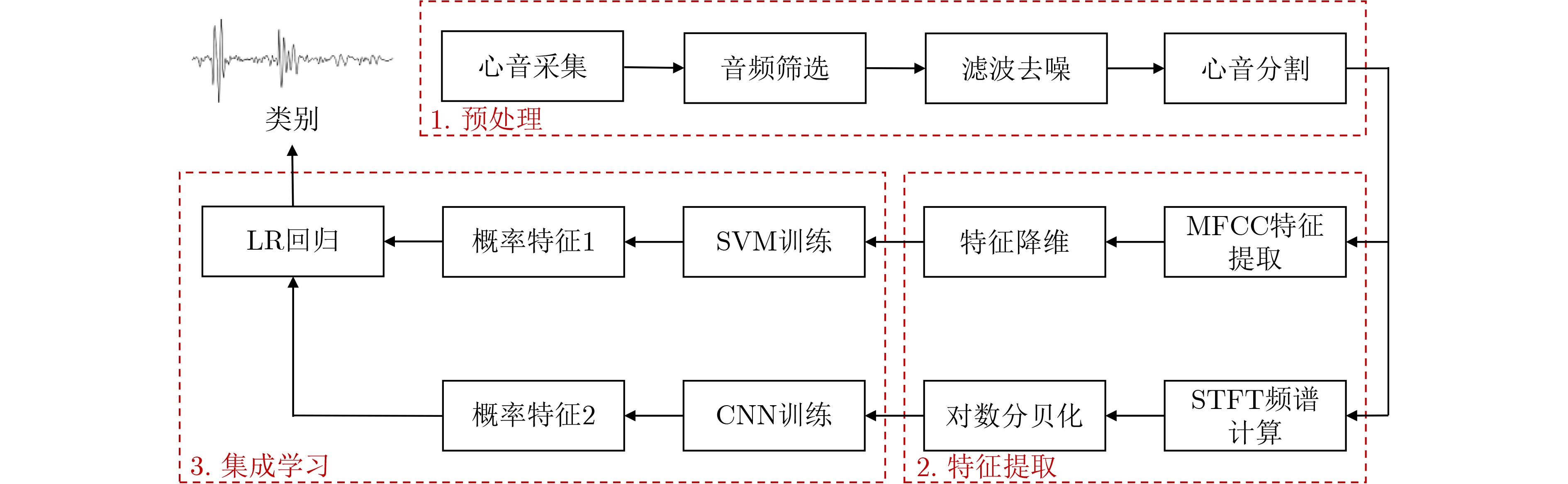
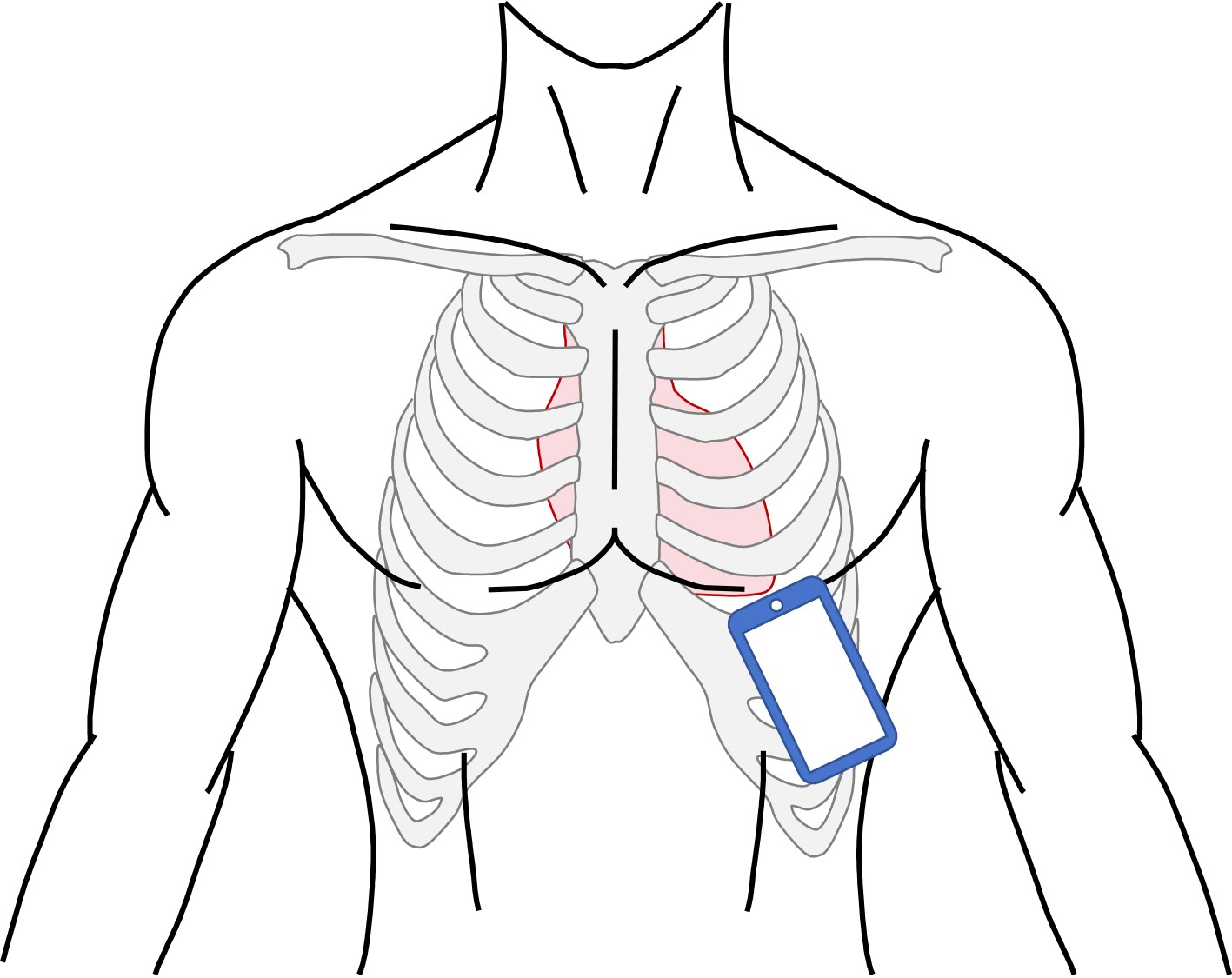
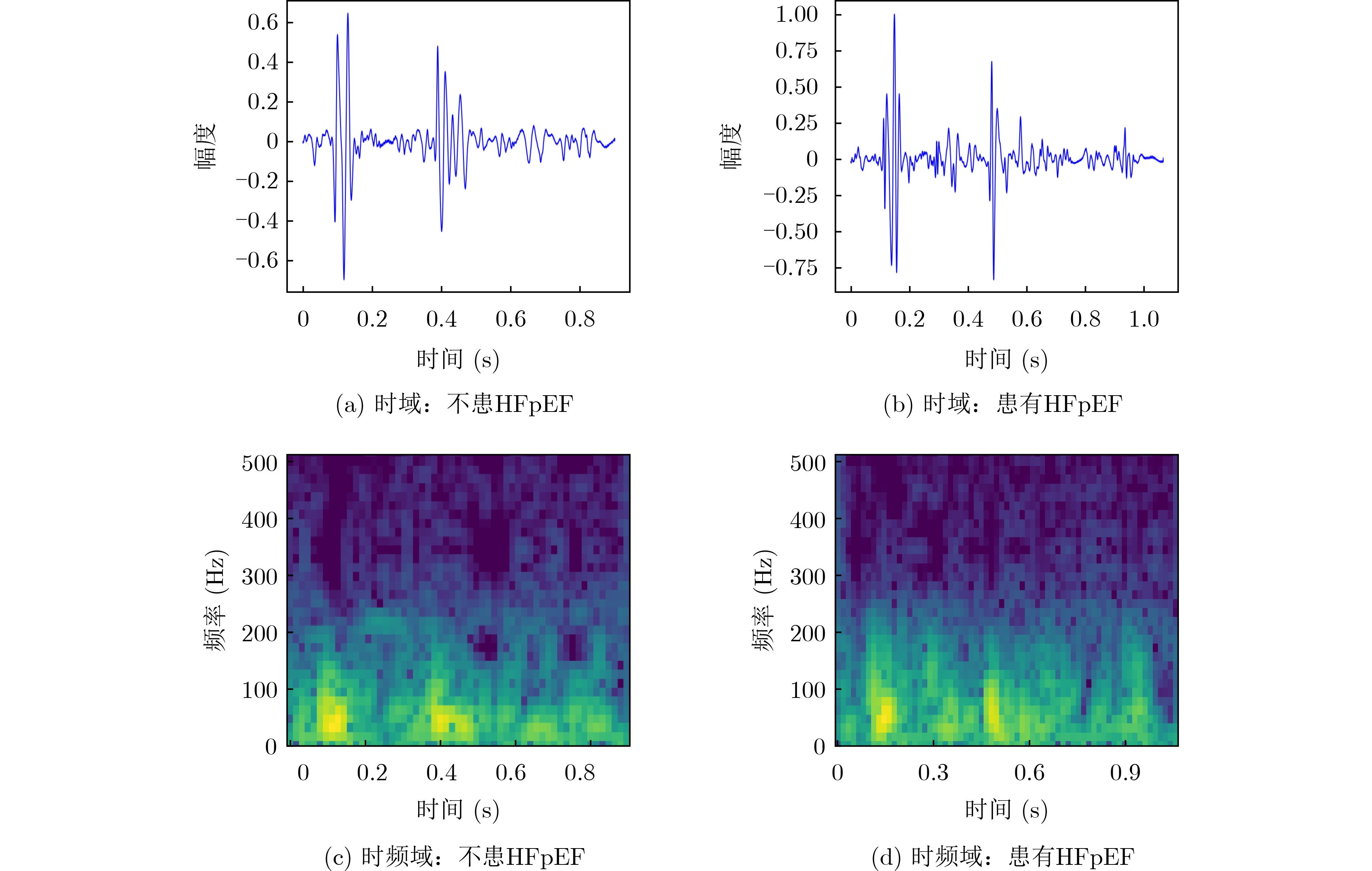
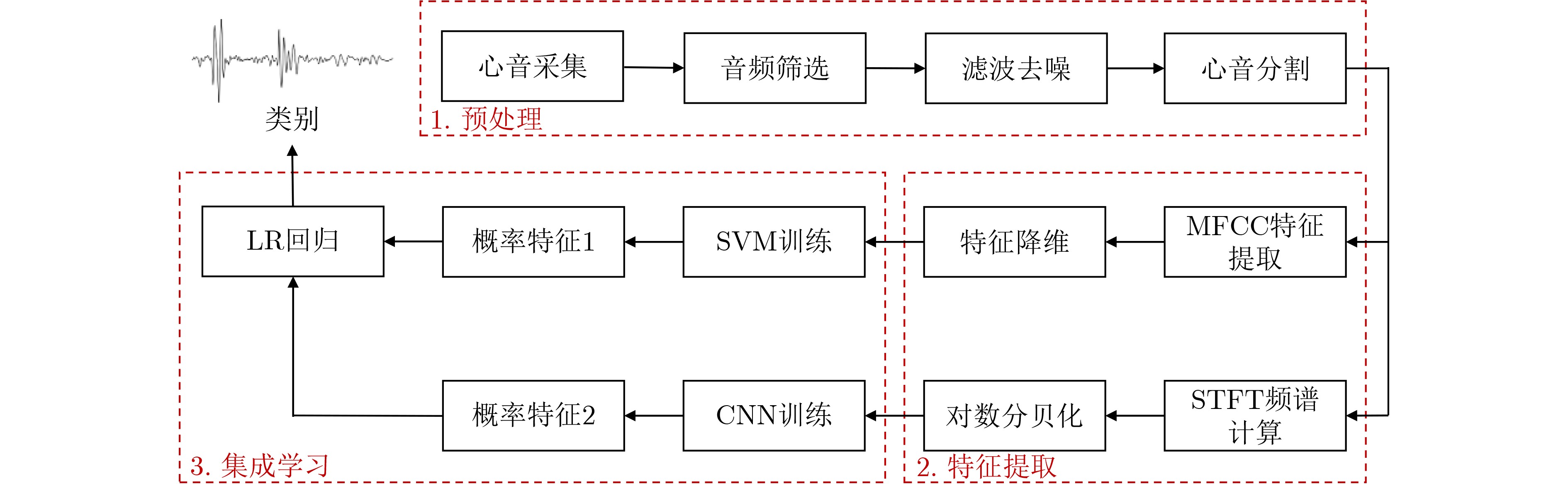
Objective Heart Failure with preserved Ejection Fraction (HFpEF) is highly prevalent among patients with Hypertrophic CardioMyopathy (HCM), and early identification is critical for improving disease management. However, early screening for HFpEF remains challenging because symptoms are non-specific, diagnostic procedures are complex, and follow-up costs are high. Smartphones, owing to their wide accessibility, low cost, and portability, provide a feasible means to support heart sound-based screening. In this study, smartphone-acquired heart sounds from patients with HCM are used to develop and train an ensemble learning classification model for early detection and dynamic self-monitoring of HFpEF in the HCM population. Methods The proposed HFpEF screening framework consists of three components: preprocessing, feature extraction, and model training and fusion based on ensemble learning ( Fig. 1 ). During preprocessing, smartphone-acquired heart sounds are subjected to bandpass filtering and wavelet denoising to improve signal quality, followed by segmentation into individual cardiac cycles. For feature extraction, Mel-Frequency Cepstral Coefficients (MFCCs) and Short-Time Fourier Transform (STFT) time-frequency spectra are calculated (Fig. 3 ). For classification, a stacking ensemble strategy is applied. Base learners, including a Support Vector Machine (SVM) and a Convolutional Neural Network (CNN), are trained, and their predicted probabilities are combined to construct a new feature space. A Logistic Regression (LR) meta-learner is then trained on this feature space to identify HFpEF in patients with HCM.Results and Discussions The classification performance of the three models is evaluated using the same patient-level independent test set. The SVM base learner achieves an Area Under the Curve (AUC) of 0.800, with an accuracy of 0.766, sensitivity of 0.659, and specificity of 0.865 ( Table 5 ). The CNN base learner attains an AUC of 0.850, with an accuracy of 0.789, sensitivity of 0.622, and specificity of 0.944 (Table 5 ). By comparison, the ensemble-based LR classifier demonstrates superior performance, reaching an AUC of 0.900, with an accuracy of 0.813, sensitivity of 0.768, and specificity of 0.854 (Table 5 ). Relative to the base learners, the ensemble model exhibits a significant overall performance improvement after probability-based feature fusion (Fig. 5 ). Compared with existing clinical HFpEF risk scores, the proposed method shows higher predictive performance and stronger dynamic monitoring capability, supporting its suitability for risk stratification and follow-up warning in home settings. Compared with professional heart sound acquisition devices, the smartphone-acquired approach provides greater accessibility and cost efficiency, supporting its application in auxiliary HFpEF screening for high-risk HCM populations.Conclusions The challenges of clinical HFpEF screening in patients with HCM are addressed by proposing a smartphone-acquired heart sound analysis approach combined with an ensemble learning prediction model, resulting in an accessible and easily implemented auxiliary screening pipeline. The effectiveness of smartphone-based heart sound analysis for initial HFpEF screening in patients with HCM is validated, demonstrating its feasibility as an economical auxiliary tool for early HFpEF detection. This approach provides a non-invasive, convenient, and efficient screening strategy for patients with HCM complicated by HFpEF. -
表 1 被纳入HCM患者群体的基本信息和临床特征
患者类别 数量 年龄(岁) 心率(bpm) LVEF(%) E/e' 不患HFpEF 27 40 ± 17 73.5 ± 16.6 66.5 ± 7.2 7.4 ± 2.3 患有HFpEF 29 52 ± 15 67.8 ± 9.7 73.8 ± 7.2 12.9 ± 5.0  下载: 导出CSV
表 2 SVM分类器数据集划分详情
类别 训练集 测试集 患者数 音频数 患者数 音频数 患有HFpEF 24 337 5 82 不患HFpEF 22 333 5 89 合计 46 670 10 171
下载: 导出CSV
表 3 卷积块的具体结构细节
网络层 序号 结构组成 核大小 核数量 步长 参数量 输出大小 卷积块1 1 一维卷积 5 64 1 20544 ×1 2 批标准化 - - - 128 ×1 3 ReLU - - - - ×1 卷积块2 4 一维卷积 5 64 1 20544 ×1 5 批标准化 - - - 128 ×1 6 ReLU - - - - ×1 卷积块3 7 一维卷积 5 64 1 20544 ×1 8 批标准化 - - - 128 ×1 9 ReLU - - - - ×1 卷积块4 10 一维卷积 5 64 2 20544 ×0.5 11 批标准化 - - - 128 ×0.5 12 ReLU - - - - ×0.5
下载: 导出CSV
表 4 CNN分类器数据集划分详情
类别 训练集 验证集 测试集 患者数 音频数 患者数 音频数 患者数 音频数 患有HFpEF 18 254 6 83 5 82 不患HFpEF 17 253 5 80 5 89 合计 35 506 11 164 10 171
下载: 导出CSV
表 5 不同模型在测试集的预测性能对比
分类模型 AUC ACC SEN SPE SVM 0.800 0.766 0.659 0.865 CNN 0.850 0.789 0.622 0.944 集成模型 0.900 0.813 0.768 0.854
下载: 导出CSV
-
[1] ZHAO Mengya, HE Xianzhen, MIN Xinwen, et al. Recent clinical updates of hypertrophic cardiomyopathy and future therapeutic strategies[J]. Reviews in Cardiovascular Medicine, 2025, 26(2): 25132. doi: 10.31083/RCM25132. [2] KRITTANAWONG C, BRITT W M, RIZWAN A, et al. Clinical update in heart failure with preserved ejection fraction[J]. Current Heart Failure Reports, 2024, 21(5): 461–484. doi: 10.1007/s11897-024-00679-5. [3] LIU Jie, WANG Dong, RUAN Jieyun, et al. Identification of heart failure with preserved ejection fraction helps risk stratification for hypertrophic cardiomyopathy[J]. BMC Medicine, 2022, 20(1): 21. doi: 10.1186/s12916-021-02219-7. [4] CHEN Qinfen, HU Jiandong, HU Jie, et al. Clinical characteristics and prognosis of patients with hypertrophic cardiomyopathy and heart failure with preserved ejection fraction[J]. Clinical Research in Cardiology, 2024, 113(5): 761–769. doi: 10.1007/s00392-023-02371-5. [5] YANG Yang, GUO Xingming, WANG Hui, et al. Deep learning-based heart sound analysis for left ventricular diastolic dysfunction diagnosis[J]. Diagnostics, 2021, 11(12): 2349. doi: 10.3390/diagnostics11122349. [6] HUIS IN ’T VELD A E, DE MAN F S, VAN ROSSUM A C, et al. How to diagnose heart failure with preserved ejection fraction: The value of invasive stress testing[J]. Netherlands Heart Journal, 2016, 24(4): 244–251. doi: 10.1007/s12471-016-0811-0. [7] MICHAUD M, MAURIN V, SIMON M, et al. Patients with high left ventricular filling pressure may be missed applying 2016 echo guidelines: A pilot study[J]. The International Journal of Cardiovascular Imaging, 2019, 35(12): 2157–2166. doi: 10.1007/s10554-019-01667-w. [8] BANTHIYA S, CHECK L, and ATKINS J. Hypertrophic cardiomyopathy as a form of heart failure with preserved ejection fraction: Diagnosis, drugs, and procedures[J]. US Cardiology Review, 2024, 18: e17. doi: 10.15420/usc.2023.21. [9] 中华医学会心血管病学分会, 中国医师协会心血管内科医师分会, 中国医师协会心力衰竭专业委员会, 等. 中国心力衰竭诊断和治疗指南2024[J]. 中华心血管病杂志, 2024, 52(3): 235–275. doi: 10.3760/cma.j.cn112148-20231101-00405.Chinese Society of Cardiology, Chinese Medical Association, Chinese College of Cardiovascular Physician, Chinese Heart Failure Association of Chinese Medical Doctor Association, et al. Chinese guidelines for the diagnosis and treatment of heart failure 2024[J]. Chinese Journal of Cardiology, 2024, 52(3): 235–275. doi: 10.3760/cma.j.cn112148-20231101-00405. [10] CAMPBELL P, RUTTEN F H, LEE M M, et al. Heart failure with preserved ejection fraction: Everything the clinician needs to know[J]. The Lancet, 2024, 403(10431): 1083–1092. doi: 10.1016/S0140-6736(23)02756-3. [11] GHARAGOZLOO K, MEHDIZADEH M, HECKMAN G, et al. Heart failure with preserved ejection fraction in the elderly population: Basic mechanisms and clinical considerations[J]. Canadian Journal of Cardiology, 2024, 40(8): 1424–1444. doi: 10.1016/j.cjca.2024.04.006. [12] LUO Hongxing, WEERTS J, BEKKERS A, et al. Association between phonocardiography and echocardiography in heart failure patients with preserved ejection fraction[J]. European Heart Journal - Digital Health, 2023, 4(1): 4–11. doi: 10.1093/ehjdh/ztac073. [13] ALTSTIDL J M, ALTSTIDL T R, ANNEKEN L, et al. Detection of aortic stenosis using built-in microphones of commercially available smartphones[J]. European Heart Journal, 2023, 44(S2): ehad655.2983. doi: 10.1093/eurheartj/ehad655.2983. [14] REN Huiying, QIN Qirong, DONG Quanbin, et al. Smartphone-measured heart sounds for atrial fibrillation screening in community populations[J]. Circulation, 2025, 152(4): 283–285. doi: 10.1161/CIRCULATIONAHA.125.073828. [15] KANG S H, JOE B, YOON Y, et al. Cardiac auscultation using smartphones: Pilot study[J]. JMIR mHealth and uHealth, 2018, 6(2): e49. doi: 10.2196/mhealth.8946. [16] LUO Hongxing, LAMATA P, BAZIN S, et al. Smartphone as an electronic stethoscope: Factors influencing heart sound quality[J]. European Heart Journal - Digital Health, 2022, 3(3): 473–480. doi: 10.1093/ehjdh/ztac044. [17] LI Yun, ZHAO Zhanjiang, AINIWAER A, et al. Smartphone for heart sound measurement in hospital: Feasibility and influencing factors[J]. European Heart Journal - Digital Health, 2025, 6(3): 486–495. doi: 10.1093/ehjdh/ztaf007. [18] GARDEZI S K M, MYERSON S G, CHAMBERS J, et al. Cardiac auscultation poorly predicts the presence of valvular heart disease in asymptomatic primary care patients[J]. Heart, 2018, 104(22): 1832–1835. doi: 10.1136/heartjnl-2018-313082. [19] CHOU J C, YEH C C, and LEE H Y. One-shot voice conversion by separating speaker and content representations with instance normalization[J]. arXiv preprint arXiv: 1904.05742, 2019. [20] MIENYE I D and SUN Yanxia. A survey of ensemble learning: Concepts, algorithms, applications, and prospects[J]. IEEE Access, 2022, 10: 99129–99149. doi: 10.1109/ACCESS.2022.3207287. [21] 射血分数保留的心力衰竭诊断与治疗中国专家共识制定工作组. 射血分数保留的心力衰竭诊断与治疗中国专家共识2023[J]. 中国循环杂志, 2023, 38(4): 375–393. doi: 10.3969/j.issn.1000-3614.2023.04.001.Chinese Expert Consensus Working Group on Diagnosis and Treatment of Heart Failure With Preserved Ejection Fraction. Diagnosis and treatment of heart failure with preserved ejection fraction: Chinese expert consensus 2023[J]. Chinese Circulation Journal, 2023, 38(4): 375–393. doi: 10.3969/j.issn.1000-3614.2023.04.001. [22] PAULUS W J. H2FPEF score: At last, a properly validated diagnostic algorithm for heart failure with preserved ejection fraction[J]. Circulation, 2018, 138(9): 871–873. doi: 10.1161/CIRCULATIONAHA.118.035711. [23] PIESKE B, TSCHÖPE C, DE BOER R A, et al. How to diagnose heart failure with preserved ejection fraction: The HFA-PEFF diagnostic algorithm: A consensus recommendation from the Heart Failure Association (HFA) of the European Society of Cardiology (ESC)[J]. European Heart Journal, 2019, 40(40): 3297–3317. doi: 10.1093/eurheartj/ehz641. [24] 贾晓艳, 刘离香, 王东伟, 等. H2FPEF和HFA-PEFF评分在我国射血分数保留心力衰竭及射血分数保留心力衰竭合并心房颤动患者中的适用性分析[J]. 中国医学科学院学报, 2024, 46(2): 154–160. doi: 10.3881/j.issn.1000-503X.15826.JIA Xiaoyan, LIU Lixiang, WANG Dongwei, et al. Applicability of H2FPEF and HFA-PEFF scores in Chinese patients suffering from heart failure with preserved ejection fraction and heart failure with preserved ejection fraction complicated with atrial fibrillation[J]. Acta Academiae Medicinae Sinicae, 2024, 46(2): 154–160. doi: 10.3881/j.issn.1000-503X.15826. [25] AKERMAN A P, AL-ROUB N, ANGELL-JAMES C, et al. External validation of artificial intelligence for detection of heart failure with preserved ejection fraction[J]. Nature Communications, 2025, 16(1): 2915. doi: 10.1038/s41467-025-58283-7. [26] REDDY Y N V, CARTER R E, SUNDARAM V, et al. An evidence-based screening tool for heart failure with preserved ejection fraction: The HFpEF-ABA score[J]. Nature Medicine, 2024, 30(8): 2258–2264. doi: 10.1038/s41591-024-03140-1. [27] LAENENS D, ZEGKOS T, KAMPERIDIS V, et al. Heart failure risk assessment in patients with hypertrophic cardiomyopathy based on the H2FPEF score[J]. European Journal of Heart Failure, 2024, 26(10): 2173–2182. doi: 10.1002/ejhf.3413. [28] GAO Yipeng, LIU Hongyun, BI Xiaojun, et al. H2FPEF and HFA-PEFF scores for heart failure risk stratification in hypertrophic cardiomyopathy patients[J]. ESC Heart Failure, 2025, 12(3): 2225–2238. doi: 10.1002/ehf2.15247. [29] LIU Yongmin, GUO Xingming, and ZHENG Yineng. An automatic approach using ELM classifier for HFpEF identification based on heart sound characteristics[J]. Journal of Medical Systems, 2019, 43(9): 285. doi: 10.1007/s10916-019-1415-1. [30] ZHENG Yineng, GUO Xingming, YANG Yang, et al. Phonocardiogram transfer learning-based CatBoost model for diastolic dysfunction identification using multiple domain-specific deep feature fusion[J]. Computers in Biology and Medicine, 2023, 156: 106707. doi: 10.1016/j.compbiomed.2023.106707. [31] ZHAO Qinghao, GENG Shijia, WANG Boya, et al. Deep learning in heart sound analysis: From techniques to clinical applications[J]. Health Data Science, 2024, 4: 0182. doi: 10.34133/hds.0182. -

 下载:
下载:


图(5) / 表(5)
计量
- 文章访问数: 836
- HTML全文浏览量: 445
- PDF下载量: 76
- 被引次数: 0
