




Robust Resource Allocation Algorithm for Active Reconfigurable Intelligent Surface-Assisted Symbiotic Secure Communication Systems
-
摘要: 针对有源可重构智能表面(RIS)辅助共生安全通信的系统总功耗问题,该文提出一种基于惩罚的鲁棒资源分配算法。考虑不完美的串行干扰消除,在主系统安全性、次系统可靠性,以及有源RIS的相移与功率约束下,通过联合优化发射机波束赋形向量与有源RIS反射系数矩阵,建立了一个基于线性函数模型的鲁棒系统总功耗最小化资源分配问题。利用交替优化方法将上述变量与约束高度耦合的非凸问题解耦,通过变量替换、等价转换与基于惩罚的连续凸逼近将子问题转换成凸优化问题,最后利用CVX对子问题进行求解。仿真结果表明,所提算法具有良好的收敛性,且相比经典的无源RIS,系统总功耗降低89%。Abstract:
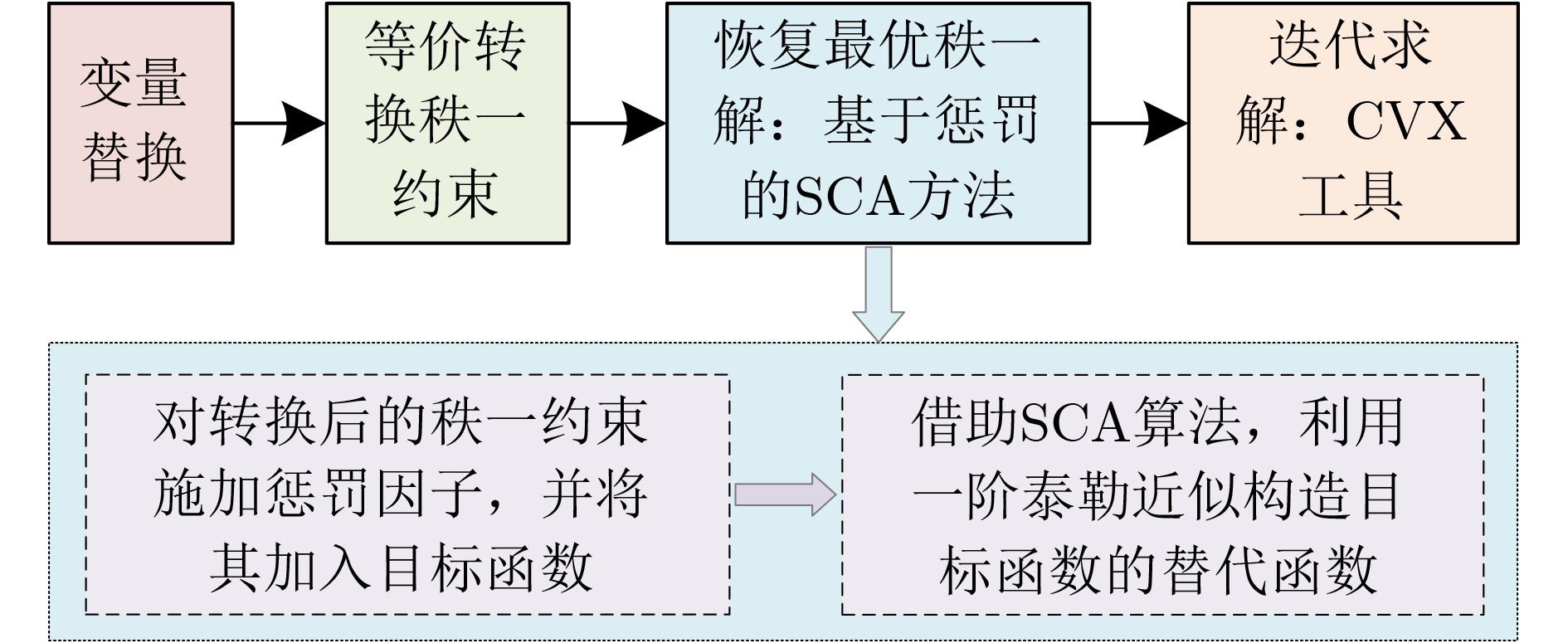
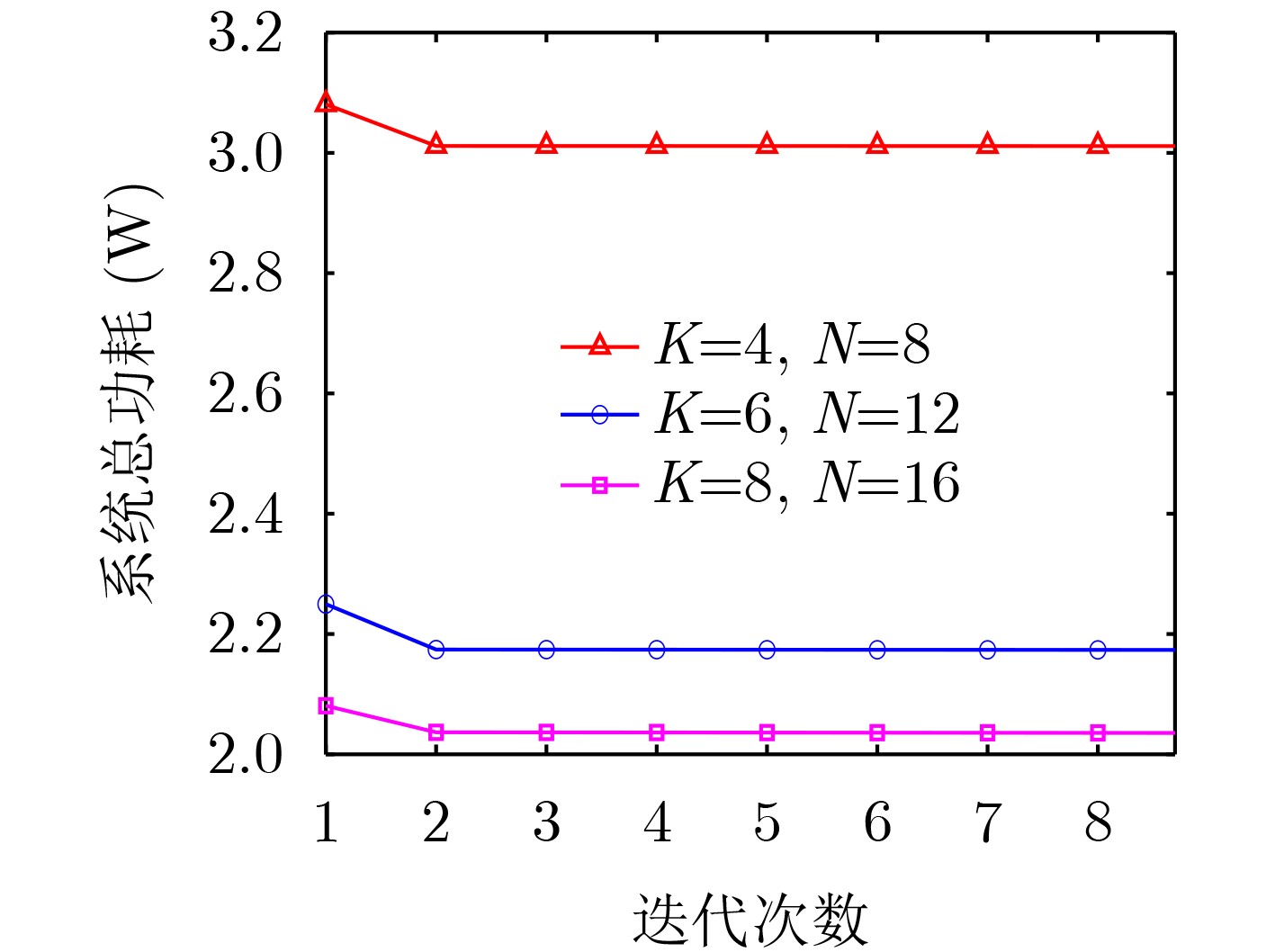
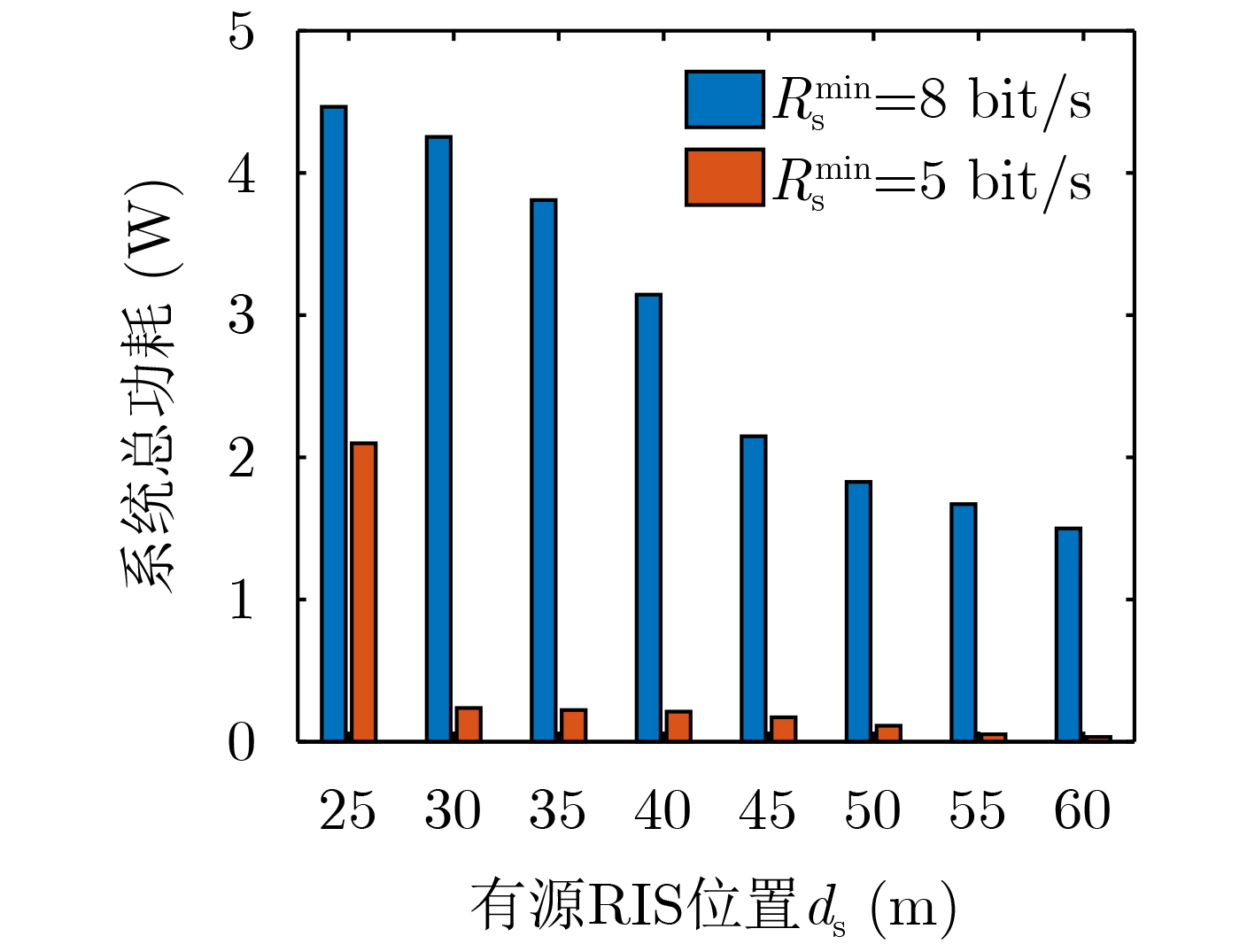
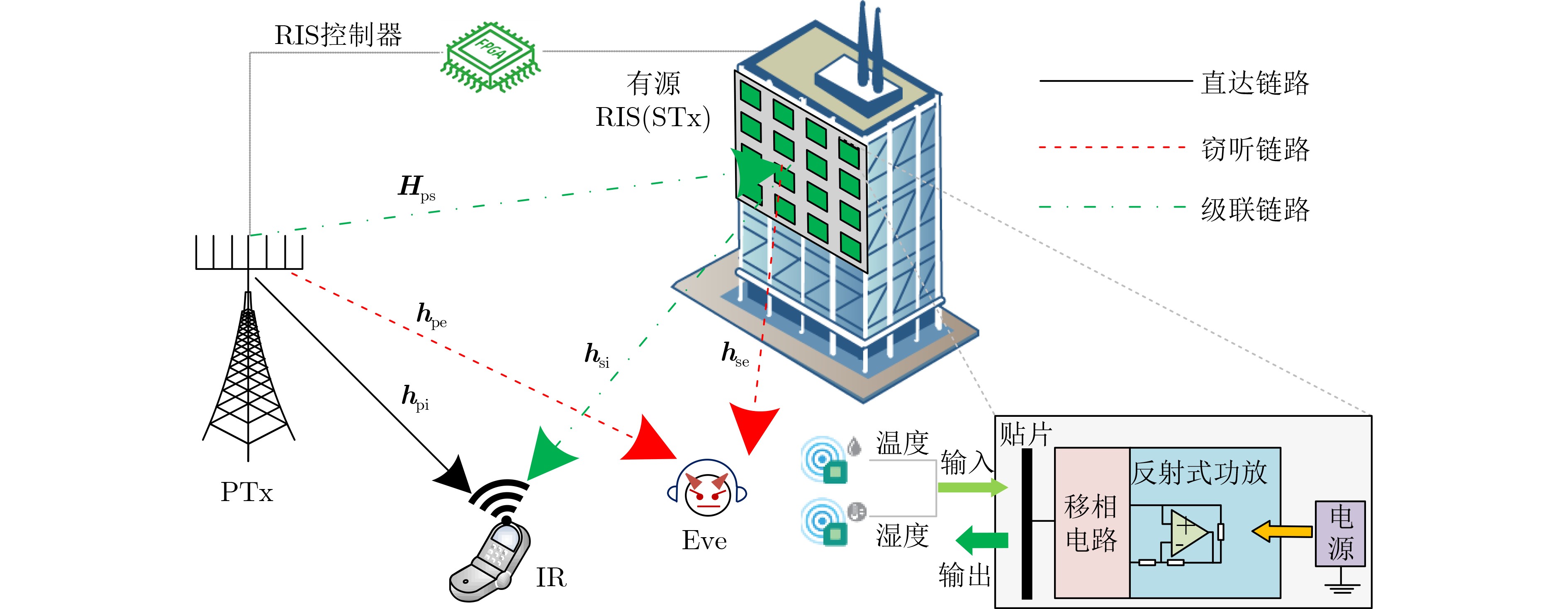
Objective Research on Reconfigurable Intelligent Surface (RIS)-assisted symbiotic radio systems is mainly centered on passive RIS. In practice, passive RIS suffers from a pronounced double-fading effect, which restricts capacity gains in scenarios dominated by strong direct paths. This work examines the use of active RIS, whose amplification capability increases the signal-to-noise ratio of the secondary signal and strengthens the security of the primary signal. Imperfect Successive Interference Cancellation (SIC) is considered, and a penalized Successive Convex Approximation (SCA) algorithm based on alternating optimization is analyzed to enable robust resource allocation. Methods The original optimization problem is difficult to address directly because it contains complex and non-convex constraints. An alternating optimization strategy is therefore adopted to decompose the problem into two subproblems: the design of the transmit beamforming vector at the primary transmitter and the design of the reflection coefficient matrix at the active RIS. Variable substitution, equivalent transformation, and a penalty-based SCA method are then applied in an alternating iterative manner. For the beamforming design, the rank-one constraint is first transformed into an equivalent form. The penalty-based SCA method is used to recover the rank-one optimal solution, after which iterative optimization is carried out to obtain the final result. For the reflection coefficient matrix design, the problem is reformulated and auxiliary variables are introduced to avoid feasibility issues. A penalty-based SCA approach is then used to handle the rank-one constraint, and the solution is obtained using the CVX toolbox. Based on these procedures, a penalty-driven robust resource allocation algorithm is established through alternating optimization. Results and Discussions The convergence curves of the proposed algorithm under different numbers of primary transmitter antennas (K) and RIS reflecting elements (N) is shown ( Fig.3 ). The total system power consumption decreases as the number of iterations increases and converges within a finite number of steps. The relationship between total power consumption and the Signal-to-Interference-and-Noise Ratio (SINR) threshold of the secondary signal is illustrated (Fig. 4 ). As the SINR threshold increases, the system requires more power to maintain the minimum service quality of the secondary signal, which results in higher total power consumption. In addition, as the imperfect interference cancellation factor decreases, the total power consumption is further reduced. To compare performance, three baseline algorithms are examined (Fig. 5 ): the passive RIS, the active RIS with random phase shift, and the non-robust algorithm. The total system power consumption under the proposed algorithm remains lower than that of the passive RIS and the active RIS with random phase shift. Although the active RIS consumes additional power, the corresponding reduction in transmit power is more than that compensates for this consumption, thereby improving overall energy efficiency. When random phase shifts are applied, the active beamforming and amplification capabilities of the RIS cannot be fully utilized. This forces the primary transmitter to compensate alone to meet performance constraints, which increases its power consumption. Furthermore, because imperfect SIC is considered in the proposed algorithm, additional transmit power is required to counter residual interference and satisfy the minimum SINR constraint of the secondary system. Therefore, the total power consumption remains higher than that of the non-robust algorithm. The effect of the secrecy rate threshold of the primary signal on the secure energy efficiency of the primary system under different values of N is shown (Fig. 6 ). The results indicate that an optimal secrecy rate threshold exists that maximizes the secure energy efficiency of the primary system. To investigate the effect of active RIS placement on total system power consumption, the node positions are rearranged (Fig. 7 ). As the active RIS is positioned closer to the receiver, the fading effect weakens and the total system power consumption decreases.Conclusions This paper investigates the total power consumption of an active RIS-assisted symbiotic secure communication system under imperfect SIC. To enhance system energy efficiency, a total power minimization problem is formulated with constraints on the quality of service for both primary and secondary signals and on the power and phase shift of the active RIS. To address the non-convexity introduced by uncertain disturbance parameters, variable substitution, equivalent transformation, and a penalty-based SCA method are applied to convert the original formulation into a convex optimization problem. Simulation results confirm the effectiveness of the proposed algorithm and show that it achieves a notable reduction in total system power consumption compared with benchmark schemes. -
表 1 算法1 基于惩罚的鲁棒资源分配算法
初始化参数:$ {P_{\rm I}} $,K,N, L,$ {C_0} $,$ R_{\rm s}^{\min } $,$ \gamma _{\rm c}^{\min } $,$ \mu $,$ \sigma_{{\mathrm{{i}}}}^2 $,
$ \sigma{_{\rm{e}}^2} $,$ \sigma\mathrm{_A^2} $,$ \eta $,$ {{\boldsymbol{w}}^{(0)}} $,$ {{\boldsymbol{Q}}^{(0)}} $;设置收敛精度$ \varepsilon = {\varepsilon _1} = {\varepsilon _2} \ge 0 $,
内外层最大迭代次数${I_{\max }}$,初始化外层迭代次数$ I = 0 $,内层迭
代次数$ {I_1} = {I_2} = 0 $;(1) While $ \varGamma ({{\boldsymbol{w}}^{(I + 1)}},{{\boldsymbol{Q}}^{(I + 1)}}) - \varGamma ({{\boldsymbol{w}}^{(I)}},{{\boldsymbol{Q}}^{(I)}}) \ge \varepsilon $或$I \le {I_{\max }}$
do(2) While $ |\mathrm{tr}(\boldsymbol{W})^{(I_1)}-\kappa_{\mathrm{max}}(\boldsymbol{W})^{(I_1-1)}|\ge\varepsilon_1 $或${I_1} \le {I_{\max }}$ do (3) 给定$ {{\boldsymbol{w}}^{(I)}} $,$ {{\boldsymbol{Q}}^{(I)}} $,求解问题式(10)获得$ {{\boldsymbol{W}}^{({I_1})}} $,
$ {I_1} = {I_1} + 1 $;(4) End While (5) $ {{\boldsymbol{W}}^{({I_1})}} = {{\boldsymbol{W}}^{({I_1} + 1)}} $; (6) While $ |\mathrm{tr}(\boldsymbol{F}\boldsymbol{U}^{(I_2)})-\mathrm{tr}(\boldsymbol{F}\boldsymbol{U}^{(I_2-1)})|\ge\varepsilon_2 $或${I_2} \le {I_{\max }}$ do (7) 给定$ {{\boldsymbol{W}}^{({I_1})}} $,求解问题式(15)获得$ {{\boldsymbol{Q}}^{({I_2})}} $,$ {I_2} = {I_2} + 1 $; (8) End While (9) $ {{\boldsymbol{Q}}^{({I_2})}} = {{\boldsymbol{Q}}^{({I_2} + 1)}} $; (10) 计算$ \varGamma ({{\boldsymbol{w}}^{(I)}},{{\boldsymbol{Q}}^{(I)}}) $; (11) 设置迭代次数$ I = I + 1 $; (12) End While  下载: 导出CSV
-
[1] ZHANG Qianqian, LIANG Yingchang, YANG Hongchuan, et al. Mutualistic mechanism in symbiotic radios: When can the primary and secondary transmissions be mutually beneficial?[J]. IEEE Transactions on Wireless Communications, 2022, 21(10): 8036–8050. doi: 10.1109/TWC.2022.3163735. [2] WANG Chaowei, PANG Mingliang, CUI Gaofeng, et al. Joint waveform design and detection in symbiotic ambient backscatter NOMA systems[J]. IEEE Internet of Things Journal, 2023, 10(22): 19507–19517. doi: 10.1109/JIOT.2023.3263967. [3] QI Weijing, ZHONG Yiying, SONG Qingyang, et al. Secondary network capacity optimization for IRS- and WPT-assisted symbiotic radio systems[J]. IEEE Internet of Things Journal, 2025, 12(11): 16467–16477. doi: 10.1109/JIOT.2025.3532686. [4] 张倩倩, 王俊, 梁应敞. 面向6G的共生散射通信技术: 原理、方法与应用[J]. 中国科学: 信息科学, 2022, 52(8): 1393–1416. doi: 10.1360/SSI-2022-0153.ZHANG Qianqian, WANG Jun, and LIANG Yingchang. Symbiotic backscatter communications for 6G: Principles, approaches, and applications[J]. SCIENTIA SINICA: Informationis, 2022, 52(8): 1393–1416. doi: 10.1360/SSI-2022-0153. [5] XU Yongjun, TIAN Qinyu, XUE Qing, et al. Robust resource allocation for symbiotic radio systems with imperfect CSI and eavesdropper[J]. IEEE Wireless Communications Letters, 2024, 13(4): 1188–1192. doi: 10.1109/LWC.2024.3364833. [6] WU Qingqing and ZHANG Rui. Towards smart and reconfigurable environment: Intelligent reflecting surface aided wireless network[J]. IEEE Communications Magazine, 2020, 58(1): 106–112. doi: 10.1109/MCOM.001.1900107. [7] TU Zhixing, LONG Ruizhe, PEI Yiyang, et al. RIS-enabled full-duplex backscatter communication in multi-user symbiotic radio[J]. IEEE Transactions on Wireless Communications, 2024, 23(11): 16261–16274. doi: 10.1109/TWC.2024.3439622. [8] ZHANG Qianqian, ZHOU Hu, LIANG Yingchang, et al. Channel capacity of RIS-Assisted symbiotic radios with imperfect knowledge of channels[J]. IEEE Transactions on Cognitive Communications and Networking, 2024, 10(3): 938–952. doi: 10.1109/TCCN.2024.3379406. [9] CAO Kaitian and TANG Qi. Energy efficiency maximization for RIS-assisted MISO symbiotic radio systems based on deep reinforcement learning[J]. IEEE Communications Letters, 2024, 28(1): 88–92. doi: 10.1109/LCOMM.2023.3333324. [10] WANG Chao, LI Zan, ZHENG Tongxing, et al. Intelligent reflecting surface-aided secure broadcasting in millimeter wave symbiotic radio networks[J]. IEEE Transactions on Vehicular Technology, 2021, 70(10): 11050–11055. doi: 10.1109/TVT.2021.3108452. [11] HE Xiuli, XU Hongbo, WANG Ji, et al. Joint active and passive beamforming in RIS-assisted covert symbiotic radio based on deep unfolding[J]. IEEE Transactions on Vehicular Technology, 2024, 73(9): 14021–14026. doi: 10.1109/TVT.2024.3393724. [12] JI Baofeng, ZHANG Jingjing, ZHANG Hui, et al. Performance analysis of RIS-enhanced secure transmission for symbiotic IoV systems[J]. IEEE Transactions on Cognitive Communications and Networking, 2025, 11(1): 454–464. doi: 10.1109/TCCN.2024.3431925. [13] WEN Yingkun, WANG Fengshuan, WANG Huiming, et al. Cooperative jamming aided secure communication for RIS enabled symbiotic radio systems[J]. IEEE Transactions on Communications, 2025, 73(5): 2936–2949. doi: 10.1109/TCOMM.2024.3481038. [14] 吴翠先, 周春宇, 徐勇军, 等. 智能反射面辅助的多入单出共生无线电鲁棒安全资源分配算法[J]. 电子与信息学报, 2024, 46(4): 1203–1211. doi: 10.11999/JEIT230426.WU Cuixian, ZHOU Chunyu, XU Yongjun, et al. Robust secure resource allocation algorithm for multiple input single output symbiotic radio with reconfigurable intelligent surface assistance[J]. Journal of Electronics & Information Technology, 2024, 46(4): 1203–1211. doi: 10.11999/JEIT230426. [15] LIU Tianji, ZHOU Hu, LONG Ruizhe, et al. Improving physical layer security with RIS-assisted symbiotic radio[C]. 2024 IEEE International Conference on Communications, Denver, USA, 2024: 593–598. doi: 10.1109/ICC51166.2024.10622723. [16] LONG Ruizhe, LIANG Yingchang, and DI RENZO M. Active reconfigurable intelligent surface-based symbiotic radio: Boosting mutual benefits[J]. IEEE Transactions on Cognitive Communications and Networking, 2025, 11(1): 423–436. doi: 10.1109/TCCN.2024.3417625. [17] ZHOU Chao, LYU Bin, GONG Shimin, et al. Active STAR-RIS-assisted symbiotic radio communications under hardware impairments[J]. IEEE Communications Letters, 2023, 27(10): 2797–2801. doi: 10.1109/LCOMM.2023.3307723. [18] LYU Bin, ZHOU Chao, GONG Shimin, et al. Robust secure transmission for active RIS enabled symbiotic radio multicast communications[J]. IEEE Transactions on Wireless Communications, 2023, 22(12): 8766–8780. doi: 10.1109/TWC.2023.3265770. [19] 郝万明, 曾齐, 王芳, 等. 耦合相移下有源同时反射和透射智能反射面辅助的多用户安全通信[J]. 电子与信息学报, 2024, 46(9): 3544–3552. doi: 10.11999/JEIT240149.HAO Wanming, ZENG Qi, WANG Fang, et al. Active simultaneously transmitting and reflecting reconfigurable intelligent surface assisted multi-user security communication with coupled phase shift[J]. Journal of Electronics & Information Technology, 2024, 46(9): 3544–3552. doi: 10.11999/JEIT240149. [20] LI Xuehua, PEI Yingjie, YUE Xinwei, et al. Secure communication of active RIS assisted NOMA networks[J]. IEEE Transactions on Wireless Communications, 2024, 23(5): 4489–4503. doi: 10.1109/TWC.2023.3319450. [21] HE Zhenqing and YUAN Xiaojun. Cascaded channel estimation for large intelligent metasurface assisted massive MIMO[J]. IEEE Wireless Communications Letters, 2020, 9(2): 210–214. doi: 10.1109/LWC.2019.2948632. [22] JIN Yu, ZHANG Jiayi, ZHANG Xiaodan, et al. Channel estimation for semi-passive reconfigurable intelligent surfaces with enhanced deep residual networks[J]. IEEE Transactions on Vehicular Technology, 2021, 70(10): 11083–11088. doi: 10.1109/TVT.2021.3109937. [23] XIONG Youzhi, QIN Lang, SUN Sanshan, et al. Joint effective channel estimation and data detection for RIS-aided massive MIMO systems with low-resolution ADCs[J]. IEEE Communications Letters, 2023, 27(2): 721–725. doi: 10.1109/LCOMM.2022.3232217. [24] LV Weigang, BAI Jiale, YAN Qingli, et al. RIS-assisted green secure communications: Active RIS or passive RIS?[J]. IEEE Wireless Communications Letters, 2023, 12(2): 237–241. doi: 10.1109/LWC.2022.3221609. -


 下载:
下载:



图(7) / 表(1)
计量
- 文章访问数: 666
- HTML全文浏览量: 383
- PDF下载量: 100
- 被引次数: 0
