




Research on Load Modulation Enhancement of Quasi-Ideal Doherty Power Amplifier with Equivalent Transconductance Compensation
-
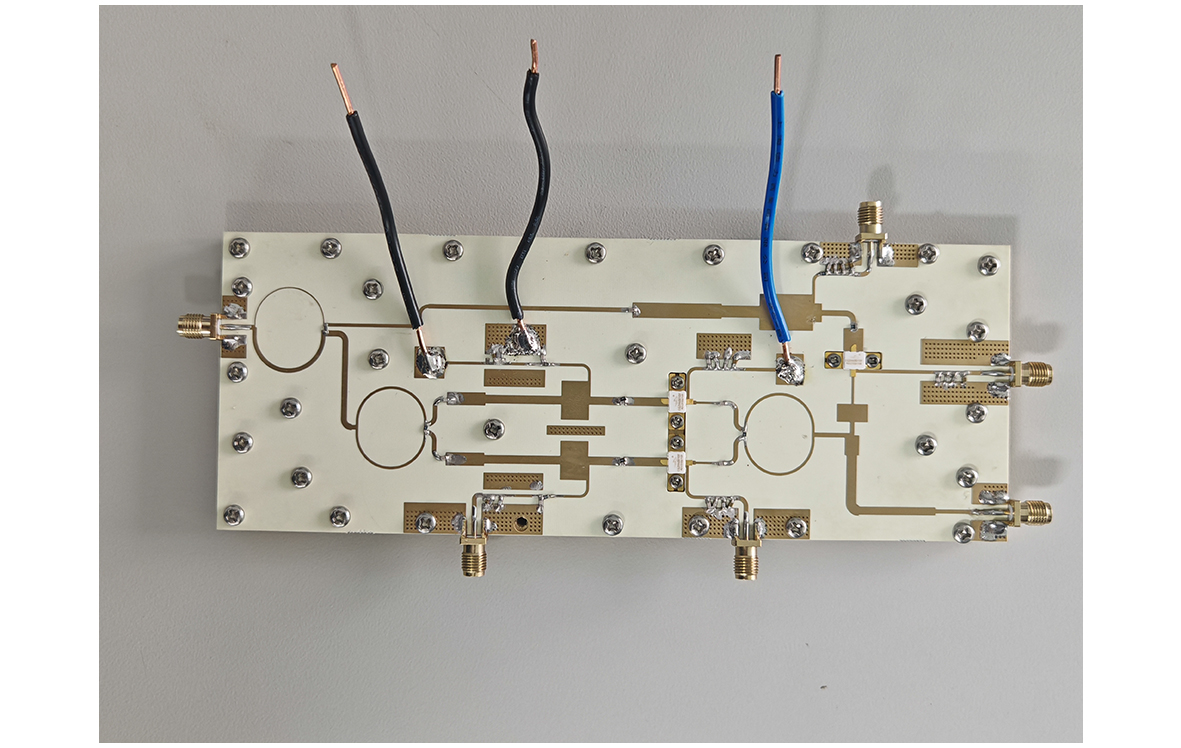
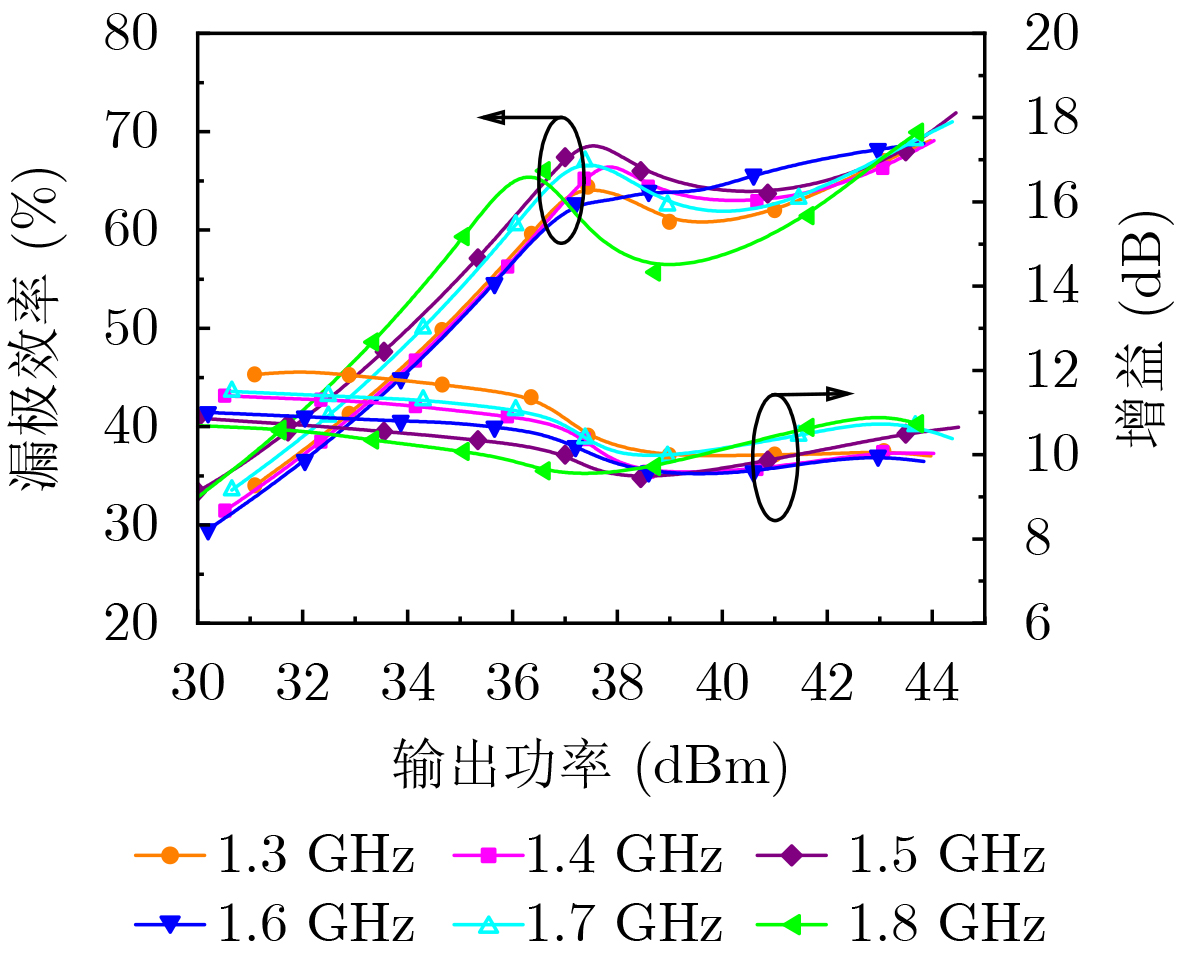
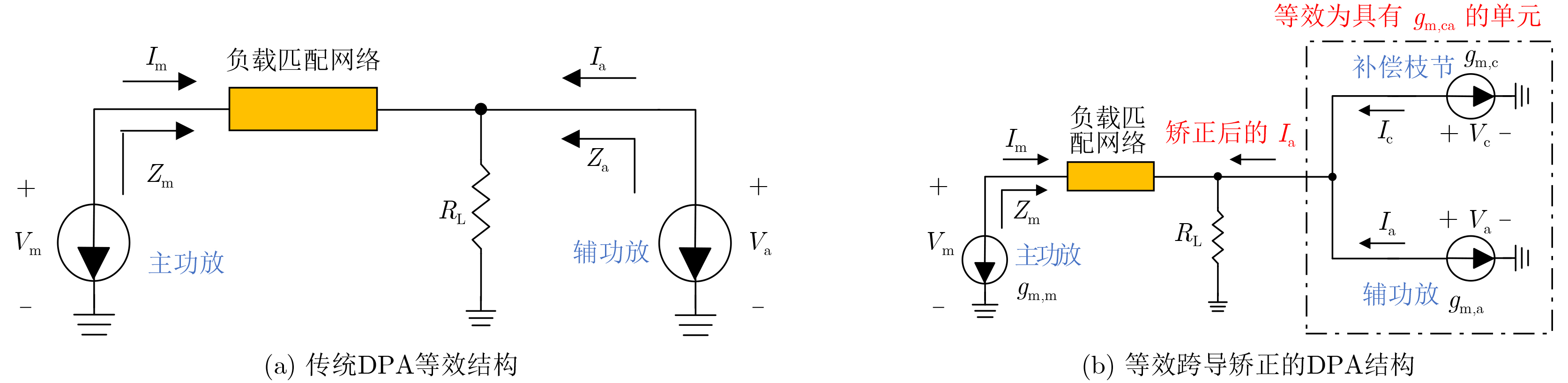
摘要: 现代无线通信系统对射频功率放大器在高动态范围的性能提出了严苛要求。Doherty功率放大器(DPA)虽然通过主功放与辅功放的动态负载调制显著提升了回退功率下的工作效率,但其工作在C类偏置下的辅功放因导通特性不足,导致输出电流受限,从而引发负载调制偏差,进而制约其性能表现。该文针对辅功放电流输出能力受限的问题,提出了等效跨导补偿的概念,通过引入补偿支路,精准矫正了C类偏压下辅功放较弱的输出电流,从而实现准理想的动态有源负载调制过程。为了验证所提方法的有效性,该文使用商用GaN HEMT器件CG2H40010F在1.3$ \sim $1.8 GHz频段内设计并加工了一款负载调制增强的高效率DPA,并给出了可参考的设计过程。实验结果表明:在饱和状态下,放大器输出功率达43.7$ \sim $44.5 dBm,漏极效率(DE)超过69.1%;6 dB回退工作状态下,DE仍保持在62.9%$ \sim $69.4%,增益为9.7$ \sim $10.5 dB;9 dB回退下,DE高达49.5%$ \sim $57%,增益为10.3$ \sim $11.5 dB。所提等效跨导补偿理论通过补偿电流注入机制有效解决了传统DPA的负载调制瓶颈,为高效率的宽带DPA设计提供了新思路。
-
关键词:
- Doherty功率放大器 /
- 有源负载调制 /
- 补偿支路 /
- 高效率
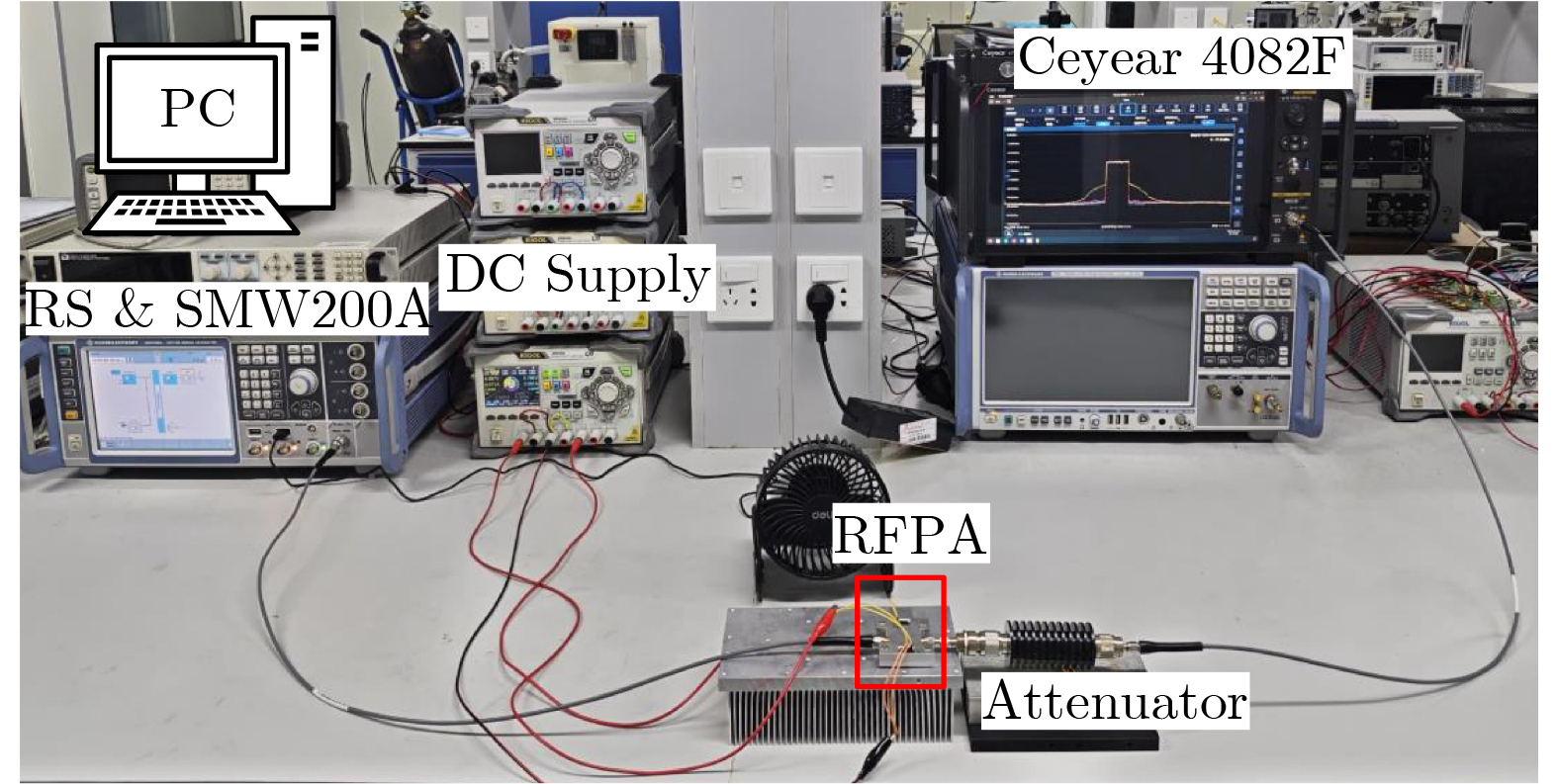
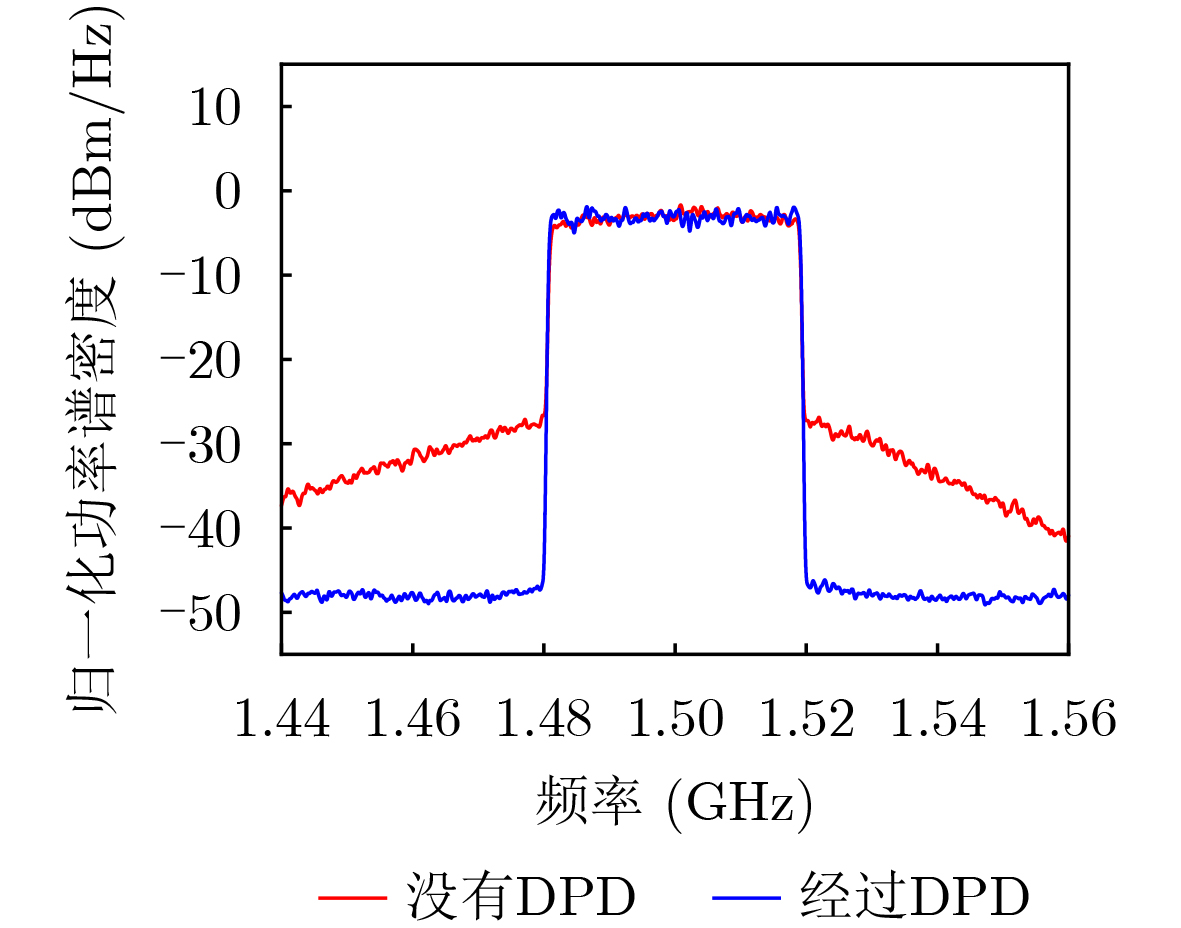
Abstract:Objective Modern wireless communication systems require efficient dynamic-range performance in RF power amplifiers. The Doherty Power Amplifier (DPA), which uses dynamic load modulation between the main and auxiliary paths, achieves high efficiency at power backoff. It is widely applied in multi-carrier 4G and 5G macro base stations. Research on DPAs generally focuses on improving backoff efficiency, backoff range, and bandwidth. However, the architecture has a structural limitation because the auxiliary amplifier, biased in Class C, exhibits weak current output compared with the main amplifier biased in Class AB. The low conduction level and short turn-on period of the auxiliary path create nonlinear imbalance and reduce overall performance. Methods The study addresses insufficient load modulation caused by the weak current output capability of the auxiliary amplifier. An equivalent transconductance compensation theory is proposed. It compensates the current of the auxiliary amplifier under Class C bias by injecting a compensatory current into the branch. A load-modulation-enhanced quasi-ideal high-performance DPA is developed to resolve the inherent current deficiency in the auxiliary path of traditional configurations. Results and Discussions A load-modulation-enhanced DPA was designed and fabricated using the GaN HEMT device CG2H40010F for the 1.3$ \sim $1.8 GHz band. Measurements show that the saturated output power ranges from 43.7 to 44.5 dBm and that the Drain Efficiency (DE) exceeds 69.1%. At a 6 dB backoff, the DE remains between 62.9% and 69.4% and the gain ranges from 9.7 to 10.5 dB. At a 9 dB backoff, the DE ranges from 49.5% to 57% and the gain ranges from 10.3 to 11.5 dB. The equivalent transconductance compensation theory resolves the load modulation bottleneck of traditional DPA structures through the current-injection mechanism. It provides meaningful guidance for broadband RF power-amplifier design with high backoff efficiency. Conclusions The study proposes an equivalent transconductance compensation method by adding a third compensation branch to the traditional DPA structure. This mechanism corrects the weak auxiliary-amplifier current caused by Class C bias and its short turn-on period, thereby achieving a quasi-ideal load-modulation-enhanced DPA. A device operating from 1.3 to 1.8 GHz was designed to validate the method. The measured saturated DE exceeds 69.1%. The DE ranges from 62.9% to 69.4% at a 6 dB backoff and from 49.5% to 57% at a 9 dB backoff. The linearized Adjacent Channel Leakage Ratio (ACLR) is lower than –49 dBc. These results verify the feasibility of the method and show strong application potential. -
Key words:
- Doherty power amplifier /
- Active load modulation /
- Compensation branch /
- High efficiency
-
[1] DOHERTY W H. A new high efficiency power amplifier for modulated waves[J]. Proceedings of the IRE, 1936, 24(9): 1163–1182. doi: 10.1109/JRPROC.1936.228468. [2] CRIPPS S C, TASKER P J, CLARKE A L, et al. On the continuity of high efficiency modes in linear RF power amplifiers[J]. IEEE Microwave and Wireless Components Letters, 2009, 19(10): 665–667. doi: 10.1109/LMWC.2009.2029754. [3] CHEN Kenle and PEROULIS D. Design of broadband highly efficient harmonic-tuned power amplifier using in-band continuous class-F–1/F mode transferring[J]. IEEE Transactions on Microwave Theory and Techniques, 2012, 60(12): 4107–4116. doi: 10.1109/TMTT.2012.2221142. [4] TANG Yixi, FENG Wenjie, ZHOU Xinyu, et al. Broadband high-efficiency dual-mode Doherty power amplifier using hybrid F/F–1 continuous-mode technology[J]. IEEE Transactions on Circuits and Systems I: Regular Papers, 2023, 70(7): 2651–2664. doi: 10.1109/TCSI.2023.3263478. [5] SHI Weimin, SHI Wen, PENG Jun, et al. Design and analysis of continuous-mode Doherty power amplifier with second harmonic control[J]. IEEE Transactions on Circuits and Systems II: Express Briefs, 2021, 68(7): 2247–2251. doi: 10.1109/TCSII.2021.3051734. [6] XIE Jieen, CHENG K K M, FANG Xiaohu, et al. Extension of output backoff range in three-stage load modulated balanced amplifier using asymmetric coupling and non-Z0 load[J]. IEEE Transactions on Microwave Theory and Techniques, 2025, 73(1): 553–567. doi: 10.1109/TMTT.2024.3425168. [7] XIAO Zehua, YOU Fei, SHEN Ce, et al. A Doherty power amplifier based on AM-AM/PM cancellation combining network synthesized by back-off complex load impedance[J]. IEEE Microwave and Wireless Technology Letters, 2023, 33(9): 1333–1336. doi: 10.1109/LMWT.2023.3292571. [8] HUA Jun, XU Gaoming, CHEN Jinghao, et al. Bandwidth-expanded high-linearity Doherty power amplifier with improved AM-AM and AM-PM characteristics[J]. IEEE Transactions on Microwave Theory and Techniques, 2025. doi: 10.1109/TMTT.2025.3609778. [9] NAM J and KIM B. The Doherty power amplifier with on-chip dynamic bias control circuit for handset application[J]. IEEE Transactions on Microwave Theory and Techniques, 2007, 55(4): 633–642. doi: 10.1109/TMTT.2007.892800. [10] LIU Ruijia, ZHU Xiaowei, XIA Jing, et al. A 24-28-GHz GaN MMIC synchronous Doherty power amplifier with enhanced load modulation for 5G mm-wave applications[J]. IEEE Transactions on Microwave Theory and Techniques, 2022, 70(8): 3910–3922. doi: 10.1109/TMTT.2022.3176818. [11] 华均, 许高明, 陆思炀, 等. 负载调制增强型高效连续类Doherty射频功放研究[J/OL]. https://link.cnki.net/urlid/32.1493.TN.20250715.1137.002, 2025.HUA Jun, XU Gaoming, LU Siyang, et al. Design of enhanced load modulation efficient continuous class Doherty power amplifier[J/OL]. https://link.cnki.net/urlid/32.1493.TN.20250715.1137.002, 2025. [12] LV Guansheng, CHEN Wenhua, ZHANG Yu, et al. A highly linear GaN MMIC Doherty power amplifier based on phase mismatch induced AM–PM compensation[J]. IEEE Transactions on Microwave Theory and Techniques, 2022, 70(2): 1334–1348. doi: 10.1109/TMTT.2021.3131199. [13] CHEN Jinghao, XU Gaoming, ZHAO Wenhua, et al. Sparse memory taps-injected neural network for digital predistortion of RF power amplifiers[J]. IEEE Microwave and Wireless Technology Letters, 2025, 35(10): 1450–1453. doi: 10.1109/LMWT.2025.3589798. [14] SHI Weimin, HE Songbai, ZHU Xiaoyu, et al. Broadband continuous-mode Doherty power amplifiers with noninfinity peaking impedance[J]. IEEE Transactions on Microwave Theory and Techniques, 2018, 66(2): 1034–1046. doi: 10.1109/TMTT.2017.2749224. [15] SHEN Ce, HE Songbai, YAO Tingting, et al. A high-gain Doherty power amplifier with harmonic tuning[J]. IEEE Microwave and Wireless Components Letters, 2022, 32(4): 320–323. doi: 10.1109/LMWC.2021.3129179. [16] REN Meng, GAO Ruibin, LIU Shuang, et al. Design of wideband Doherty power amplifier using inverse continuous class-F mode[J]. IEEE Transactions on Circuits and Systems II: Express Briefs, 2024, 71(9): 4176–4180. doi: 10.1109/TCSII.2024.3379992. -


 下载:
下载:



图(11) / 表(1)
计量
- 文章访问数: 942
- HTML全文浏览量: 526
- PDF下载量: 52
- 被引次数: 0
