




Dynamic Wavelet Multi-Directional Perception and Geometry Axis-Solution Guided 3D CT Fracture Image Segmentation
-
摘要: 三维骨折图像分割是临床骨科术前方案量化的关键,其中骨折面分割性能直接影响手术决策的安全性与有效性。针对三维骨折图像分割中存在的深层全局特征捕获不足、骨折面细节方向纹理模糊以及骨折图像几何结构利用不充分的问题,该文提出动态小波多向感知与几何轴解引导的三维CT骨折图像分割方法(Dynamic Wavelet multi-directional perception and geometry Axis-solution Guided Network, DWAG-Net)。首先,为充分提取多维度视角下全局特征,设计动态可学习参数插值重构3平面视角特征,并与全维特征聚合实现多维度提取骨折图像全局信息。其次,引入三维小波变换,通过各方向高频子带的跨子带特征融合,增强模型对模糊骨折面中方向特征的纹理细节感知。最后,根据骨骼结构相似性与骨折面局部突变性设计几何轴解引导模块,通过几何亲和与距离衰减引导模型轴解分割,并重新分配类别权重缓解其不平衡问题,约束损失函数梯度向最优方向下降。在自建胫骨骨折数据集上,DWAG-Net模型相比现有先进模型展现出优越分割性能,平均Dice Score为71.20%,其中骨折面类较基准提升了7.12%,平均HD95为1.38 mm,其中骨折面类降低了3.70 mm,与前沿3D分割算法nnWNet相比,平均Dice Score提升了4.63%。实验结果表明,DWAG-Net模型可有效实现三维骨折图像分割任务,为术前穿钉角度量化与固定位置精确选择提供了图像依据,对辅助医生优化术前方案具有重要意义。Abstract:
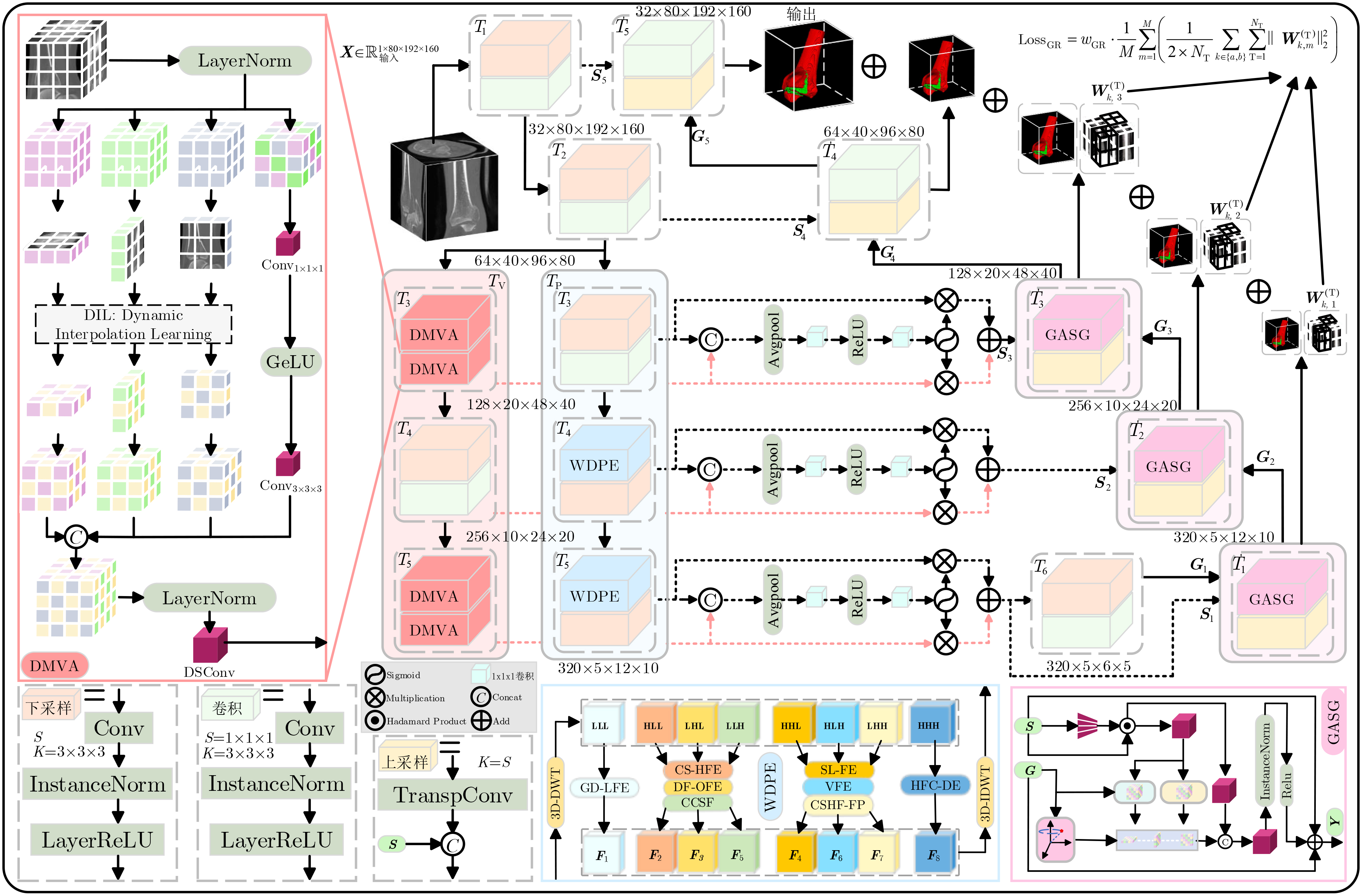
Objective Accurate segmentation of fracture surfaces in three-dimensional computed tomography (3D CT) images is essential for orthopedic surgical planning, particularly for determining nail insertion angles perpendicular to fracture planes. However, existing approaches present three major limitations: limited capture of deep global volumetric context, directional texture ambiguity in low-contrast fracture regions, and insufficient decoding of geometric features. To address these limitations, a Dynamic Wavelet Multi-Directional Perception and Geometry Axis-Solution Guided Network (DWAG-Net) is proposed to improve segmentation accuracy for complex tibial fractures and to provide reliable 3D digital guidance for preoperative planning. Methods The proposed architecture extends 3D nnU-Netv2 through three core components. First, a Dynamic Multi-View Aggregation (DMVA) module adaptively fuses tri-planar views (axial, sagittal, and coronal) with full-volume features using learnable parameter interpolation with an optimized kernel size of 2×2×2 and a channel-wise Hadamard product, thereby strengthening global context representation. Second, a Wavelet Direction Perception Enhancement (WDPE) module applies a 3D Symlets discrete wavelet transform to decompose inputs into eight subbands, followed by direction-specific enhancement. Adaptive convolutional kernels (e.g., [5, 3, 3] for depth-dominant fractures), reinforce texture information in high-frequency subbands, whereas cross-subband fusion integrates complementary features. Third, a Geometry Axis-Solution Guided (GASG) module is embedded in the decoder to maintain anatomical consistency by constructing axis-level affinity maps along depth, height, and width that combine geometric similarity with spatial distance decay, and by refining boundary delineation using rotational positional encoding and multi-axis attention. The network is trained on the YN-TFS dataset, which contains 110 tibial fracture CT scans with spatial resolutions ranging from 0.39 to 1.00 mm. Stochastic gradient descent is used with a learning rate of 0.01 and a momentum of 0.99. A class-weighted loss function with weights of 0.5 for background, 1 for bone, and 5 for fracture is adopted to address severe pixel imbalance. Results and Discussions DWAG-Net achieves state-of-the-art performance, with a mean Dice score of 71.20% ( Table 1 ), exceeding that of nnU-Netv2 by 5.06%. For fracture surfaces, the Dice score reaches 69.48%, corresponding to an improvement of 7.12%. Boundary accuracy improves significantly, with a mean 95th percentile Hausdorff distance (HD95) of 1.38 mm and a fracture surface HD95 of 1.54 mm, representing a reduction of 3.70 mm. Ablation studies (Table 2 ) confirm the contribution of each component. DMVA increases the Dice score by 2.40% through adaptive multi-view fusion. WDPE reduces directional ambiguity and yields a 5.84% gain in fracture surface Dice. GASG provides an additional 1.20% improvement by enforcing geometric consistency. Optimal performance is obtained with a DMVA kernel size of 2×2×2, the use of Symlets wavelets, and sequential axis processing in the order of depth, height, and width. Qualitative comparisons indicate that DWAG-Net preserves fracture continuity in cases where U-Mamba and nnWNet fail, and reduces over-segmentation relative to nnFormer and UNETR++. (Fig. 5 ).Conclusions DWAG-Net establishes a state-of-the-art framework for 3D fracture segmentation by integrating multi-directional wavelet perception with geometry-guided decoding. The coordinated use of DMVA, directional texture enhancement, and geometry axis-solution guidance achieves clinically relevant precision, with a Dice score of 71.20% and an HD95 of 1.38 mm. These results support accurate data-driven surgical planning. Future work will focus on refining loss design to further mitigate severe class imbalance. -
表 1 不同模型的分割性能对比
模型 年份 Dice Score(%) HD95(mm) FLOPs(G) Params(M) Inference(s) Avg 骨骼 骨折面 Avg 骨骼 骨折面 nnU-Netv2 2023 66.14 69.93 62.36 3.68 2.12 5.24 561.92 30.79 124.00 nnFormer 2023 55.13 50.79 59.47 98.99 137.85 60.12 47.70 37.15 218.97 UNETR++ 2024 51.13 46.42 55.84 103.39 137.97 68.80 43.70 66.80 213.56 U-Mamba 2024 68.86 71.38 66.35 5.10 6.19 4.02 1141.86 42.12 115.95 nnWNet 2025 66.57 66.98 66.15 1.94 1.77 2.11 1378.62 60.46 123.09 DWAG-Net 2025 71.20 72.91 69.48 1.38 1.22 1.54 675.22 57.60 159.48 注:加粗数值表示性能最优值。  下载: 导出CSV
表 2 所提出的模块对分割精度的影响
模型 模块 Dice Score (%) HD95 (mm) DMVA WDPE GASG Avg 骨骼 骨折面 Avg 骨骼 骨折面 基准 66.15 69.93 62.36 3.68 2.12 5.24 Ours1 √ 68.55 70.30 66.79 2.04 2.27 1.81 Ours2 √ 67.50 67.21 67.79 1.84 1.92 1.75 Ours3 √ √ 70.00 71.80 68.20 1.53 1.27 1.79 DWAG-Net √ √ √ 71.20 72.91 69.48 1.38 1.22 1.54 注:加粗数值表示性能最优值。
下载: 导出CSV
表 3 DMVA与WDPE编码位置对分割精度的影响
DMVA(√)与WDPE(O)嵌入位置 Dice Score(%) HD95 (mm) 3 4 5 Avg 骨骼 骨折面 Avg 骨骼 骨折面 √ O √ O 69.72 72.51 66.92 1.50 1.22 1.78 √ O √ O 68.75 72.57 64.92 1.77 1.25 2.29 √ √ O O 68.43 70.82 66.03 1.55 1.32 1.77 √ O O √ 67.06 68.59 65.53 2.03 2.15 1.90 √ O √ O 67.92 71.02 64.82 1.71 1.63 1.79 √ O √ O 70.00 71.80 68.20 1.53 1.27 1.79 O √ O √ 67.56 69.92 65.20 1.67 1.58 1.76 O √ √ O 68.49 70.88 66.09 1.55 1.31 1.79 √ O √ O 67.70 69.40 66.00 2.04 2.30 1.78 注:加粗数值表示性能最优值。
下载: 导出CSV
表 4 DMVA模块中动态可学习参数大小对分割精度的影响
动态可学习参数大小 Dice Score (%) HD95 (mm) Avg 骨骼 骨折面 Avg 骨骼 骨折面 1×1×1 65.03 68.09 61.96 4.34 4.23 4.45 2×2×2 68.55 70.30 66.79 2.04 2.27 1.81 3×3×3 66.28 68.76 63.80 3.10 2.81 3.38 4×4×4 65.58 68.30 62.85 3.72 2.66 4.77 5×5×5 66.57 70.09 63.04 3.54 2.31 4.76 注:加粗数值表示性能最优值。
下载: 导出CSV
表 5 不同小波基对分割精度的影响
小波基类型 Dice Score(%) HD95 (mm) Avg 骨骼 骨折面 Avg 骨骼 骨折面 Haar 67.14 67.98 66.29 1.75 1.69 1.80 Daubechies 67.91 68.20 67.62 1.66 1.57 1.75 Coiflets 67.36 69.24 65.47 1.71 1.49 1.92 Biorthogonal 68.33 69.54 67.12 1.69 1.35 2.02 Symlets 67.50 67.21 67.79 1.84 1.92 1.75 Reverse Biorthogonal 69.35 71.64 67.06 1.58 1.27 1.89 注:加粗数值表示性能最优值。
下载: 导出CSV
表 6 GASG中不同轴解顺序对分割精度的影响
轴解顺序 Dice Score (%) HD95 (mm) Avg 骨骼 骨折面 Avg 骨骼 骨折面 D→H→W 71.20 72.91 69.48 1.38 1.22 1.54 D→W→H 69.75 72.10 67.39 1.73 1.69 1.76 H→D→W 69.08 70.89 67.28 1.54 1.36 1.71 H→W→D 68.24 70.12 66.35 1.70 1.60 1.80 W→D→H 67.11 67.28 66.93 3.34 4.90 1.77 W→H→D 69.64 71.13 68.14 1.54 1.36 1.72 注:加粗数值表示性能最优值。
下载: 导出CSV
表 7 不同损失权重比例对分割精度的影响
损失权重比例 Dice Score (%) HD95 (mm) Avg 骨骼 骨折面 Avg 骨骼 骨折面 1:1:1 70.64 73.40 67.88 2.35 1.20 3.50 0.7:1:5 70.27 72.47 68.06 1.44 1.28 1.59 0.5:1:3 70.27 73.06 67.47 1.63 1.47 1.79 0.5:1:5 71.20 72.91 69.48 1.38 1.22 1.54 0.5:1:7 69.70 71.45 67.94 1.65 1.64 1.65 0.3:1:5 71.13 73.07 69.18 1.43 1.28 1.57 注:加粗数值表示性能最优值。
下载: 导出CSV
-
[1] JUTO H, NILSSON H, and MORBERG P. Epidemiology of adult ankle fractures: 1756 cases identified in Norrbotten County during 2009–2013 and classified according to AO/OTA[J]. BMC Musculoskeletal Disorders, 2018, 19(1): 441. doi: 10.1186/s12891-018-2326-x. [2] HARDALAÇ F, UYSAL F, PEKER O, et al. Fracture detection in wrist X-ray images using deep learning-based object detection models[J]. Sensors, 2022, 22(3): 1285. doi: 10.3390/s22031285. [3] BARG A, PAGENSTERT G I, HÜGLE T, et al. Ankle osteoarthritis: Etiology, diagnostics, and classification[J]. Foot and Ankle Clinics, 2013, 18(3): 411–426. doi: 10.1016/j.fcl.2013.06.001. [4] LI Mengnai, COLLIER R C, HILL B W, et al. Comparing different surgical techniques for addressing the posterior malleolus in supination external rotation ankle fractures and the need for syndesmotic screw fixation[J]. The Journal of Foot and Ankle Surgery, 2017, 56(4): 730–734. doi: 10.1053/j.jfas.2017.01.053. [5] ZHANG Qida, CHEN Zhenxian, PENG Yinghu, et al. The novel magnesium–titanium hybrid cannulated screws for the treatment of vertical femoral neck fractures: Biomechanical evaluation[J]. Journal of Orthopaedic Translation, 2023, 42: 127–136. doi: 10.1016/j.jot.2023.08.003. [6] SZYMAŃSKI T and ZDANOWICZ U. Comparison of routine computed tomography and plain X-ray imaging for malleolar fractures—How much do we miss?[J]. Foot and Ankle Surgery, 2022, 28(2): 263–268. doi: 10.1016/j.fas.2021.03.025. [7] ÇIÇEK Ö, ABDULKADIR A, LIENKAMP S S, et al. 3D U-Net: Learning dense volumetric segmentation from sparse annotation[C]. The 19th International Conference on Medical Image Computing and Computer-Assisted Intervention, Athens, Greece, 2016: 424–432. doi: 10.1007/978-3-319-46723-8_49. [8] 白静, 杨瞻源, 彭斌, 等. 三维卷积神经网络及其在视频理解领域中的应用研究[J]. 电子与信息学报, 2023, 45(6): 2273–2283. doi: 10.11999/JEIT220596.BAI Jing, YANG Zhanyuan, PENG Bin, et al. Research on 3D convolutional neural network and its application on video understanding[J]. Journal of Electronics & Information Technology, 2023, 45(6): 2273–2283. doi: 10.11999/JEIT220596. [9] LUO Xiaoling, WANG Wei, XU Yong, et al. A deep convolutional neural network for diabetic retinopathy detection via mining local and long-range dependence[J]. CAAI Transactions on Intelligence Technology, 2024, 9(1): 153–166. doi: 10.1049/cit2.12155. [10] YAN Qingsen, LIU Shengqiang, XU Songhua, et al. 3D medical image segmentation using parallel transformers[J]. Pattern Recognition, 2023, 138: 109432. doi: 10.1016/j.patcog.2023.109432. [11] HUANG Yonghao, CHEN Leiting, ZHOU Chuan, et al. Model long-range dependencies for multi-modality and multi-view retinopathy diagnosis through transformers[J]. Knowledge-Based Systems, 2023, 271: 110544. doi: 10.1016/j.knosys.2023.110544. [12] CHEN Shuchao, LUO Cao, LIU Shanshan, et al. LD-UNet: A long-distance perceptual model for segmentation of blurred boundaries in medical images[J]. Computers in Biology and Medicine, 2024, 171: 108120. doi: 10.1016/j.compbiomed.2024.108120. [13] ZHANG Zhenguang, PENG Bo, and ZHAO Tingyu. An ultra-lightweight network combining Mamba and frequency-domain feature extraction for pavement tiny-crack segmentation[J]. Expert Systems with Applications, 2025, 264: 125941. doi: 10.1016/j.eswa.2024.125941. [14] HE Zhili, CHEN Wang, ZHANG Jian, et al. Crack segmentation on steel structures using boundary guidance model[J]. Automation in Construction, 2024, 162: 105354. doi: 10.1016/j.autcon.2024.105354. [15] CHU Honghu, WANG Wei, and DENG Lu. Tiny‐Crack‐Net: A multiscale feature fusion network with attention mechanisms for segmentation of tiny cracks[J]. Computer‐Aided Civil and Infrastructure Engineering, 2022, 37(14): 1914–1931. doi: 10.1111/mice.12881. [16] HUANG Yaqi, HU Ge, JI Changjin, et al. Glass-cutting medical images via a mechanical image segmentation method based on crack propagation[J]. Nature Communications, 2020, 11(1): 5669. doi: 10.1038/s41467-020-19392-7. [17] SUN Rui, LI Xuming, ZHANG Libing, et al. Wavelet-integrated deep neural network for deblurring and segmentation of crack images[J]. Mechanical Systems and Signal Processing, 2025, 224: 112240. doi: 10.1016/j.ymssp.2024.112240. [18] 李文轩, 冯斌, 吴福理, 等. 基于纹理和几何特征融合的髁突骨微结构分割与预测[J]. 计算机辅助设计与图形学学报, 2025, 37(2): 340–348. doi: 10.3724/SP.J.1089.2023-00173.LI Wenxuan, FENG Bin, WU Fuli, et al. Bone microstructure segmentation and prediction of condyle based on fusion of texture and geometric features[J]. Journal of Computer-Aided Design & Computer Graphics, 2025, 37(2): 340–348. doi: 10.3724/SP.J.1089.2023-00173. [19] WANG Kun, ZHANG Xiaohong, LU Yuting, et al. GSAL: Geometric structure adversarial learning for robust medical image segmentation[J]. Pattern Recognition, 2023, 140: 109596. doi: 10.1016/j.patcog.2023.109596. [20] ISENSEE F, JAEGER P F, KOHL S A A, et al. nnU-Net: A self-configuring method for deep learning-based biomedical image segmentation[J]. Nature Methods, 2021, 18(2): 203–211. doi: 10.1038/s41592-020-01008-z. [21] XIAO Ruoxiu, QI Siyu, REN Huayang, et al. Multi-objective constraints for path planning in screw fixation of scaphoid fractures[J]. Computers in Biology and Medicine, 2024, 182: 109163. doi: 10.1016/j.compbiomed.2024.109163. [22] LIU Jiaxuan, LI Haitao, ZENG Bolun, et al. An end-to-end geometry-based pipeline for automatic preoperative surgical planning of pelvic fracture reduction and fixation[J]. IEEE Transactions on Medical Imaging, 2025, 44(1): 79–91. doi: 10.1109/TMI.2024.3429403. [23] GU Hanxue, COLGLAZIER R, Dong Haoyu, et al. SegmentAnyBone: A universal model that segments any bone at any location on MRI[J]. Medical Image Analysis, 2025, 101: 103469. doi: 10.1016/j.media.2025.103469. [24] LU Xu, CUI Zengzhen, SUN Yihua, et al. Better rough than scarce: Proximal femur fracture segmentation with rough annotations[J]. IEEE Transactions on Medical Imaging, 2024, 43(9): 3240–3252. doi: 10.1109/TMI.2024.3392854. [25] ZHOU Hongyu, GUO Jiansen, ZHANG Yinghao, et al. nnFormer: Volumetric medical image segmentation via a 3D transformer[J]. IEEE Transactions on Image Processing, 2023, 32: 4036–4045. doi: 10.1109/TIP.2023.3293771. [26] SHAKER A, MAAZ M, RASHEED H, et al. UNETR++: Delving into efficient and accurate 3D medical image segmentation[J]. IEEE Transactions on Medical Imaging, 2024, 43(9): 3377–3390. doi: 10.1109/TMI.2024.3398728. [27] MA Jun, LI Feifei, and WANG Bo. U-mamba: Enhancing long-range dependency for biomedical image segmentation[J]. arXiv preprint arXiv: 2401.04722, 2024. doi: 10.48550/arXiv.2401.04722. [28] ZHOU Yanfeng, LI Lingrui, LU Le, et al. nnWNet: Rethinking the use of transformers in biomedical image segmentation and calling for a unified evaluation benchmark[C]. 2025 IEEE/CVF Conference on Computer Vision and Pattern Recognition, Nashville, USA, 2025: 20852–20862. doi: 10.1109/CVPR52734.2025.01942. -


 下载:
下载:


图(5) / 表(7)
计量
- 文章访问数: 878
- HTML全文浏览量: 523
- PDF下载量: 53
- 被引次数: 0
