




Component Placement Algorithm Considering Reagent Type Differences in Cell Reuse for FPVA Biochips
-
摘要: 作为新型流式微流控生物芯片,完全可编程阀门阵列(FPVA)生物芯片拥有出色的灵活性和可编程性,能够满足多种复杂的实验需求。而作为架构综合的重要阶段,FPVA组件布局会影响包括生物测定完成时间、流体运输路径总长度和交叉污染程度在内的多个性能指标。此外,单元复用是FPVA芯片灵活性和可编程性的重要表现。然而,现有的FPVA组件布局相关研究工作均没有考虑单元复用过程中试剂种类的差异对这些重要指标的影响。为此,该文聚焦于FPVA组件布局过程中单元复用的试剂种类差异问题,提出了基于深度强化学习的考虑单元复用中试剂种类差异的FPVA组件布局算法。首先,通过考虑试剂之间的差异和组件重叠对交叉污染的影响,设计了单元复用复杂度和含有相同试剂组件平均距离两个指标,分别用于量化组件布局方案中各个单元的单元复用复杂程度和含有相同试剂组件的聚集程度。其次,引入了包括组件布局区域限制约束和并发组件不重叠约束在内的约束条件,这些约束确保组件布局方案的合法性。最后,通过设计奖励函数最小化单元复用复杂度和减小含有相同种类试剂的组件间距离,从而达成最小化最终组件布局方案的交叉污染程度、流体运输路径总长度和生物测定完成时间的目标。通过仿真实验,对所提组件布局算法进行了评估。实验结果表明,所提算法能够得到高质量的考虑单元复用中试剂种类差异的FPVA组件布局方案,验证了所提算法的有效性。Abstract:
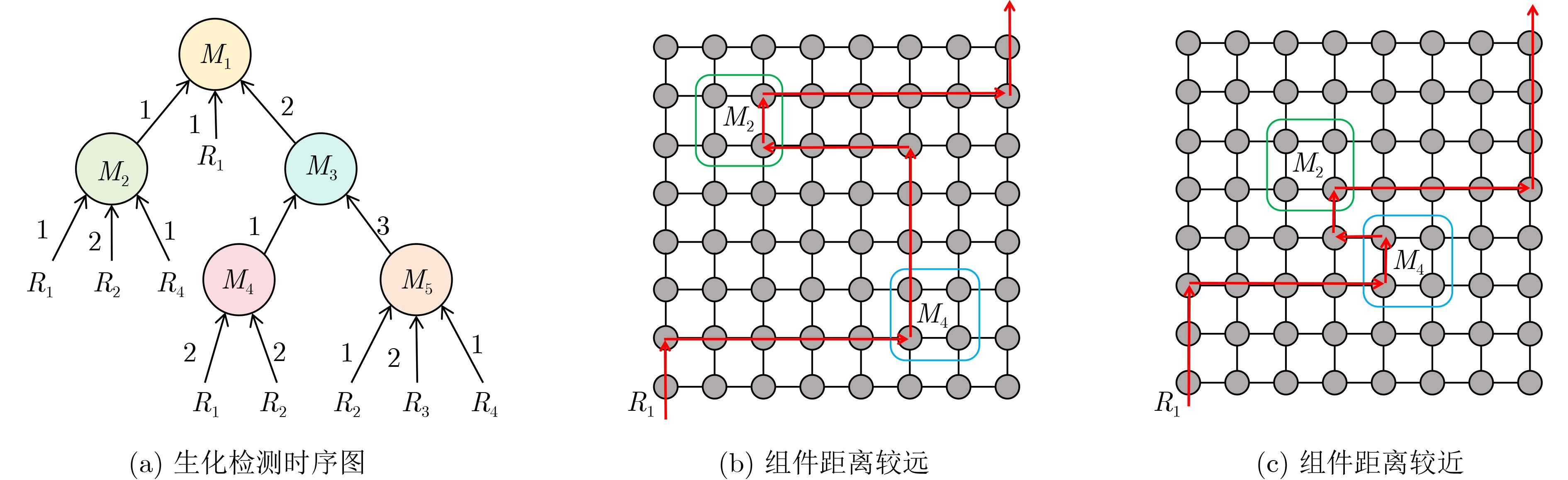
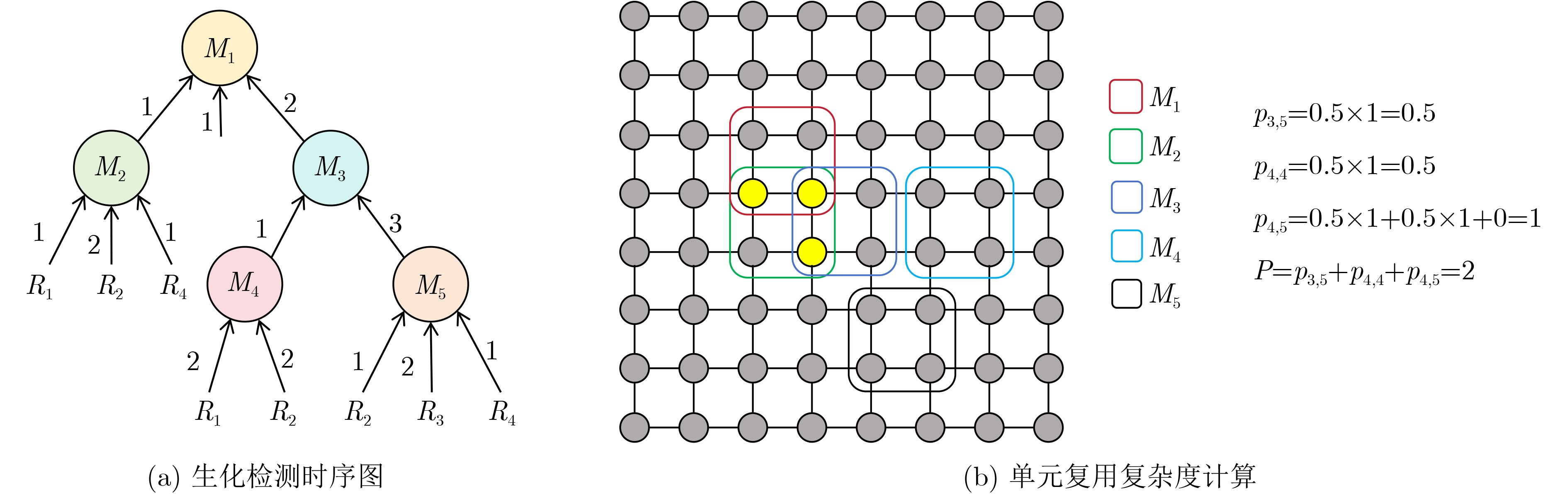
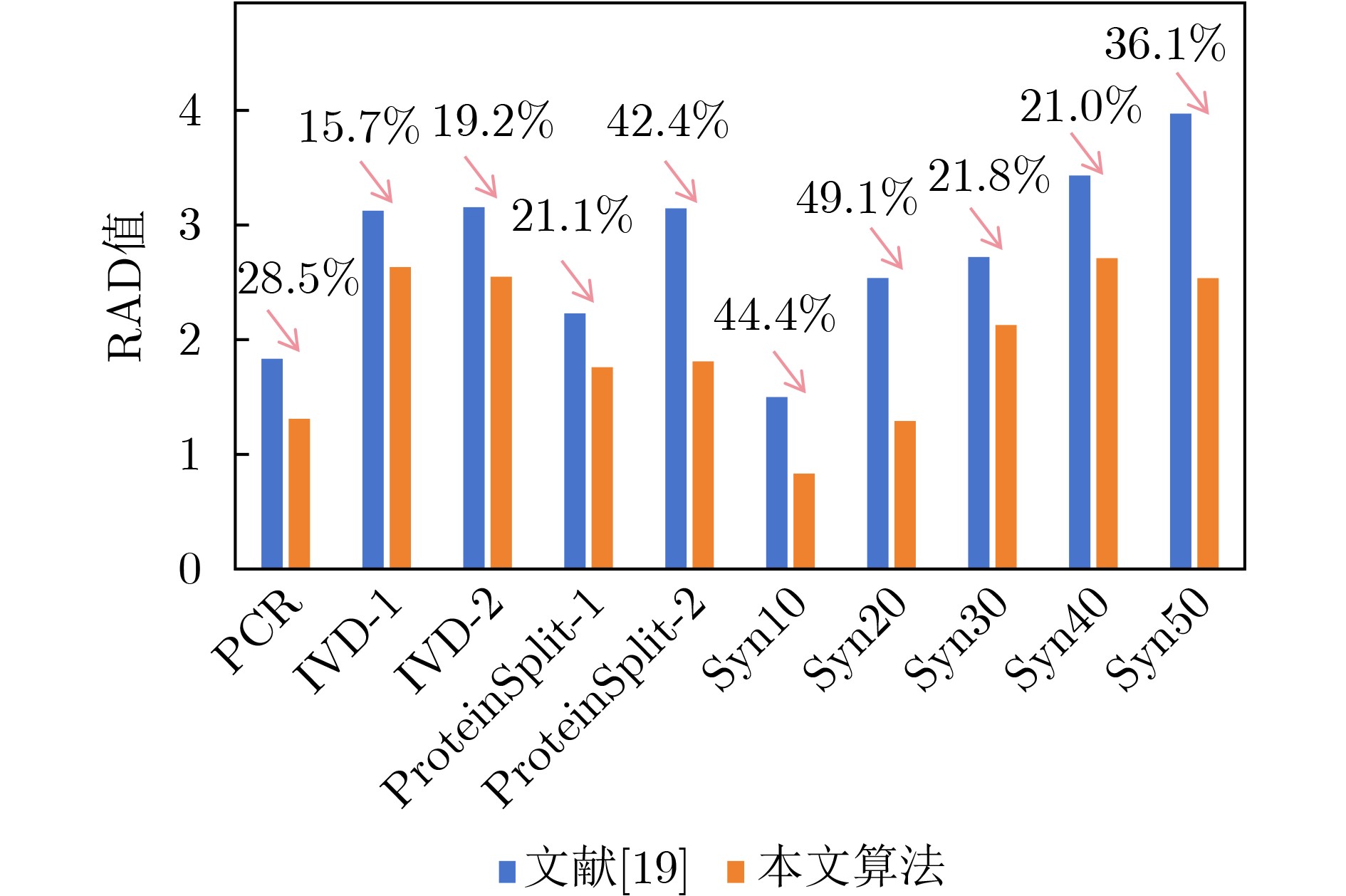
Objective Fully Programmable Valve Array (FPVA) biochips, a recent type of flow-based microfluidic biochip, offer high flexibility and programmability, which enables them to meet different and complex experimental needs. Component placement is a critical stage in FPVA architectural synthesis because it affects several performance metrics, including assay completion time, total fluid-transport length, and cross-contamination. Cell reuse, an essential feature of FPVA programmability, requires special consideration during placement. However, existing studies have largely ignored the effect of reagent type differences in cell reuse on these metrics Methods This study presents a component placement algorithm for FPVA biochips that accounts for reagent type differences during cell reuse. The algorithm first introduces a cell reuse complexity metric that quantifies reuse complexity by considering the effects of reagent-type differences and component overlap on cross-contamination. It then integrates constraints, including placement-area limits and non-overlapping conditions for concurrent components, to ensure valid placement. The reward function is optimized to minimize reuse complexity and reduce the distance between components that use the same reagent type. The goal is to lower cross-contamination, total fluid-transport length, and assay completion time. Results and Discussions The algorithm is evaluated on benchmark FPVA instances with different chip sizes and functional requirements and compared with related methods. It reduces cell reuse complexity by 34.2%, assay completion time by 2.8%, and total fluid-transport length by 9.2% on average ( Table 2 ). It also reduces the reagent-aware distance metric by 29.9% on average (Fig. 6 ). The learning agent’s decision trajectories show clear spatial structure, which reflects global placement awareness.Conclusions This study is the first to investigate FPVA component placement with attention to reagent type differences in cell reuse. The main contributions are as follows: (1) a cell reuse complexity metric is proposed to assess reuse intensity in placement, (2) the FPVA placement problem is modeled as a Markov decision process to enable the use of double deep Q-networks for safe and efficient placement policy learning, and (3) compared with existing work, the model improves FPVA biochemical assay performance and reliability. -
表 1 测试用例具体信息
测试用例 试剂种类数 输入流体数 输入通道分配 输出流体数 混合操作数 FPVA尺寸 PCR 3 8 2-2-4 1 7 8×8 IVD1 4 12 3×4 6 6 8×8 IVD2 6 18 2-2-3×3-5 9 9 10×10 ProteinSplit1 5 14 1-2-3-4-4 2 12 10×10 ProteinSplit2 11 32 1-2×4-3×3-4-5-5 4 23 13×13 Synthetic1 2 5 2-3 1 4 8×8 Synthetic2 5 13 1-1-3-3-5 1 12 10×10 Synthetic3 6 18 1-2-3-3-4-5 1 17 12×12 Synthetic4 8 22 1-2-3×5-4 1 21 13×13 Synthetic5 9 27 1-1-2-2-3-3-4-5-6 1 26 13×13  下载: 导出CSV
表 2 本文算法与文献[19]中算法的对比结果
测试用例 总单元复用复杂度 生物测定完成时间 流体运输路径总长度 文献[19] 本文算法 优化(%) 文献[19](s) 本文算法(s) 优化(%) 文献[19](mm) 本文算法(mm) 优化(%) PCR 8.5 3.7 56.5 17.0 16.3 4.1 30 28 6.7 IVD1 15.0 9.0 40.0 4.5 4.3 4.4 46 43 6.5 IVD2 46.0 32.0 30.4 5.4 4.9 9.3 82 71 13.4 ProteinSplit1 108.4 104.0 4.1 30.2 29.9 1.0 83 80 3.6 ProteinSplit2 2403.9 1317.7 45.2 38.4 37.6 2.1 226 198 12.4 Synthetic1 4.0 1.0 75.0 12.8 12.7 0.8 28 25 10.7 Synthetic2 73.2 65.2 10.9 21.2 20.9 1.4 78 72 7.7 Synthetic3 187.0 135.6 27.5 25.7 25.2 1.9 127 112 11.8 Synthetic4 287.9 179.3 37.7 30.4 29.6 2.6 199 195 2.0 Synthetic5 502.9 429.5 14.6 30.3 30.1 0.7 245 202 17.6 平均 34.2 2.8 9.2
下载: 导出CSV
表 3 本文算法与文献[24]中算法的对比结果
测试用例 总单元复用复杂度 生物测定完成时间 流体运输路径总长度 文献[24] 本文算法 优化(%) 文献[24](s) 本文算法(s) 优化(%) 文献[24](mm) 本文算法(mm) 优化(%) PCR 8.2 3.7 54.9 16.8 16.3 3.0 29 28 3.4 IVD1 14.5 9.0 37.9 4.4 4.3 2.3 45 43 4.4 IVD2 44.5 32.0 28.1 5.3 4.9 7.5 80 71 11.3 ProteinSplit1 107.0 104.0 2.8 30.0 29.9 0.3 82 80 2.4 ProteinSplit2 2380.0 1317.7 44.6 38.2 37.6 1.6 224 198 11.6 Synthetic1 3.9 1.0 74.4 12.7 12.7 0.0 27 25 7.4 Synthetic2 72.0 65.2 9.4 21.0 20.9 0.5 77 72 6.5 Synthetic3 184.0 135.6 26.3 25.5 25.2 1.2 125 112 10.4 Synthetic4 284.0 179.3 36.9 30.2 29.6 2.0 197 195 1.0 Synthetic5 498.0 429.5 13.8 30.2 30.1 0.3 242 202 16.5 平均 32.9 1.9 7.5
下载: 导出CSV
-
[1] MINHASS W H, POP P, MADSEN J, et al. Architectural synthesis of flow-based microfluidic large-scale integration biochips[C]. The International Conference on Compilers, Architectures and Synthesis for Embedded Systems, Tampere, Finland, 2012: 181–190. doi: 10.1145/2380403.2380437. [2] MINHASS W H, POP P, and MADSEN J. Synthesis of biochemical applications on flow-based microfluidic biochips using constraint programming[C]. The Symposium on Design, Test, Integration and Packaging of MEMS/MOEMS, Cannes, France, 2012: 37–41. [3] 朱予涵, 刘博文, 黄兴, 等. 完全可编程阀门阵列生物芯片下容错导向的高阶综合算法[J]. 电子与信息学报, 2024, 46(11): 4141–4150. doi: 10.11999/JEIT240049.ZHU Yuhan, LIU Bowen, HUANG Xing, et al. Fault-tolerance-oriented high-level synthesis algorithm for fully programmable valve array biochips[J]. Journal of Electronics & Information Technology, 2024, 46(11): 4141–4150. doi: 10.11999/JEIT240049. [4] MCDANIEL J, PARKER B, and BRISK P. Simulatedannealing-based placement for microfluidic large scaleintegration (mLSI) chips[C]. The 22nd International Conference on Very Large Scale Integration, Playa delCarmen, Mexico, 2014: 1–6. doi: 10.1109/VLSI-SoC.2014.7004170. [5] HU Kai, HO T Y, and CHAKRABARTY K. Wash optimization and analysis for cross-contamination removal under physical constraints in flow-based microfluidic biochips[J]. IEEE Transactions on Computer-Aided Design of Integrated Circuits and Systems, 2016, 35(4): 559–572. doi: 10.1109/TCAD.2015.2488485. [6] GRIMMER A, WANG Qin, YAO Hailong, et al. Close-to-optimal placement and routing for continuous-flow microfluidic biochips[C]. The 22nd Asia and South Pacific Design Automation Conference, Chiba, Japan, 2017: 530–535. doi: 10.1109/ASPDAC.2017.7858377. [7] CRITES B, KONG K, and BRISK P. Diagonal component expansion for flow-layer placement of flow-based microfluidic biochips[J]. ACM Transactions on Embedded Computing Systems, 2017, 16(5s): 126. doi: 10.1145/3126529. [8] CHEN Zhisheng, HUANG Xing, GUO Wenzhong, et al. Physical synthesis of flow-based microfluidic biochips considering distributed channel storage[C]. The Design, Automation & Test in Europe Conference & Exhibition, Florence, Italy, 2019: 1525–1530. doi: 10.23919/DATE.2019.8715269. [9] 王钦. 微流控生物芯片流体与控制协同物理设计算法研究[D]. [博士论文], 清华大学, 2018. doi: 10.27266/d.cnki.gqhau.2018.000723.WANG Qin. Research on control-fluidic physical CoDesign algorithm for microfluidic biochips[D]. [Ph. D. dissertation], Tsinghua University, 2018. doi: 10.27266/d.cnki.gqhau.2018.000723. [10] 朱予涵, 黄鸿斌, 林泓星, 等. 连续微流控生物芯片下基于序列对的流层物理设计算法[J]. 计算机辅助设计与图形学学报, 2022, 34(4): 535–544. doi: 10.3724/SP.J.1089.2022.19445.ZHU Yuhan, HUANG Hongbin, LIN Hongxing, et al. Sequence-pair-based flow-layer physical design algorithm for continuous-flow microfluidic biochips[J]. Journal of Computer-Aided Design & Computer Graphics, 2022, 34(4): 535–544. doi: 10.3724/SP.J.1089.2022.19445. [11] 刘耿耿, 叶正阳, 朱予涵, 等. 连续微流控生物芯片下一种多阶段启发式的流层物理协同设计算法[J]. 电子与信息学报, 2023, 45(9): 3401–3409. doi: 10.11999/JEIT221155.LIU Genggeng, YE Zhengyang, ZHU Yuhan, et al. A multi-stage heuristic flow-layer physical codesign algorithm for continuous-flow microfluidic biochips[J]. Journal of Electronics & Information Technology, 2023, 45(9): 3401–3409. doi: 10.11999/JEIT221155. [12] FIDALGO L M and MAERKL S J. A software-programmable microfluidic device for automated biology[J]. Lab on a Chip, 2011, 11(9): 1612–1619. doi: 10.1039/C0LC00537A. [13] TSENG T M, LI Bing, HO T Y, et al. Reliability-aware synthesis for flow-based microfluidic biochips by dynamic-device mapping[C]. The 52nd ACM/EDAC/IEEE Design Automation Conference, San Francisco, USA, 2015: 1–6. doi: 10.1145/2744769.2744899. [14] TSENG T M, LI Bing, LI Mengchu, et al. Reliability-aware synthesis with dynamic device mapping and fluid routing for flow-based microfluidic biochips[J]. IEEE Transactions on Computer-Aided Design of Integrated Circuits and Systems, 2016, 35(12): 1981–1994. doi: 10.1109/TCAD.2016.2547902. [15] CHOUDHARY G, PAL S, KUNDU D, et al. Transport-free module binding for sample preparation using microfluidic fully programmable valve arrays[C]. The Design, Automation & Test in Europe Conference & Exhibition, Grenoble, France, 2020: 1335–1338. doi: 10.23919/DATE48585.2020.9116370. [16] DATTA P, CHAKRABORTY A, and PAL R K. Design optimization for programmable microfluidic devices integrating contamination removal and capacity-wastage-aware washing[J]. IETE Journal of Research, 2020, 66(6): 781–796. doi: 10.1080/03772063.2020.1811784. [17] KUNDU D, GIRI J, MARUYAMA S, et al. Fluid-to-cell assignment and fluid loading on programmable microfluidic devices for bioprotocol execution[J]. Integration, 2021, 78: 95–109. doi: 10.1016/j.vlsi.2020.12.004. [18] YU H C, LIN Y H, CHEN Zhiyang, et al. Contamination-aware synthesis for programmable microfluidic devices[J]. IEEE Transactions on Computer-Aided Design of Integrated Circuits and Systems, 2022, 41(11): 5016–5029. doi: 10.1109/TCAD.2021.3134892. [19] LIU Genggeng, ZHU Yuhan, GUO Wenzhong, et al. Fault-tolerance-oriented physical design for fully programmable valve array biochips[C]. The 60th ACM/IEEE Design Automation Conference, San Francisco, USA, 2023: 1–6. doi: 10.1109/DAC56929.2023.10247720. [20] KUMAR M, KHAN A K, ROY S, et al. Accelerating fluid loading in sample preparation with fully programmable valve arrays[C]. The 37th International Conference on VLSI Design and 23rd International Conference on Embedded Systems (VLSID), Kolkata, India, 2024: 402–407. doi: 10.1109/VLSID60093.2024.00073. [21] ZHU Yuhan, LIU Genggeng, GUO Wenzhong, et al. FTCD: Fault-tolerant co-design of flow and control layers for fully programmable valve array biochips[J]. IEEE Transactions on Computer-Aided Design of Integrated Circuits and Systems, 2025, 44(7): 2669–2682. doi: 10.1109/TCAD.2025.3525615. [22] CAI Huayang, LIU Genggeng, GUO Wenzhong, et al. Adaptive control-logic routing for fully programmable valve array biochips using deep reinforcement learning[C]. The 29th Asia and South Pacific Design Automation Conference, Incheon, Korea, 2024: 564–569. doi: 10.1109/ASP-DAC58780.2024.10473962. [23] HUANG Xing, CAI Huayang, GUO Wenzhong, et al. Control-logic synthesis of fully programmable valve array using reinforcement learning[J]. IEEE Transactions on Computer-Aided Design of Integrated Circuits and Systems, 2024, 43(1): 277–290. doi: 10.1109/TCAD.2023.3309740. [24] MNIH V, KAVUKCUOGLU K, SILVER D, et al. Playing Atari with deep reinforcement learning[J]. arXiv preprint arXiv: 1312.5602, 2013. doi: 10.48550/arXiv.1312.5602. -

 下载:
下载:



图(6) / 表(3)
计量
- 文章访问数: 547
- HTML全文浏览量: 222
- PDF下载量: 47
- 被引次数: 0
