




Detection and Parameter Estimation of Quadratic Frequency Modulated Signal Based on Non-uniform Quadrilinear Autocorrelation Function
-
摘要: 该文提出一种新颖的集成式时频分析技术,即非均匀四线性自相关函数(NQAF),用于针对高斯白噪声背景下2次调频(QFM)信号的检测与参数估计。所提方法的核心思路在于利用非均匀采样技术构建高阶自相关函数实现信号在时间-延迟时间域的相参积累与检测,并利用de-chirp技术分步完成信号的参数估计。该方法扩展了自相关处理的框架,降低了核函数的非线性度。理论分析与数值模拟表明,与主流先进算法相比,该文所提方法对于采样样本的处理方法更为灵活,在性能方面拥有较低的计算复杂度与信噪比阈值。Abstract:
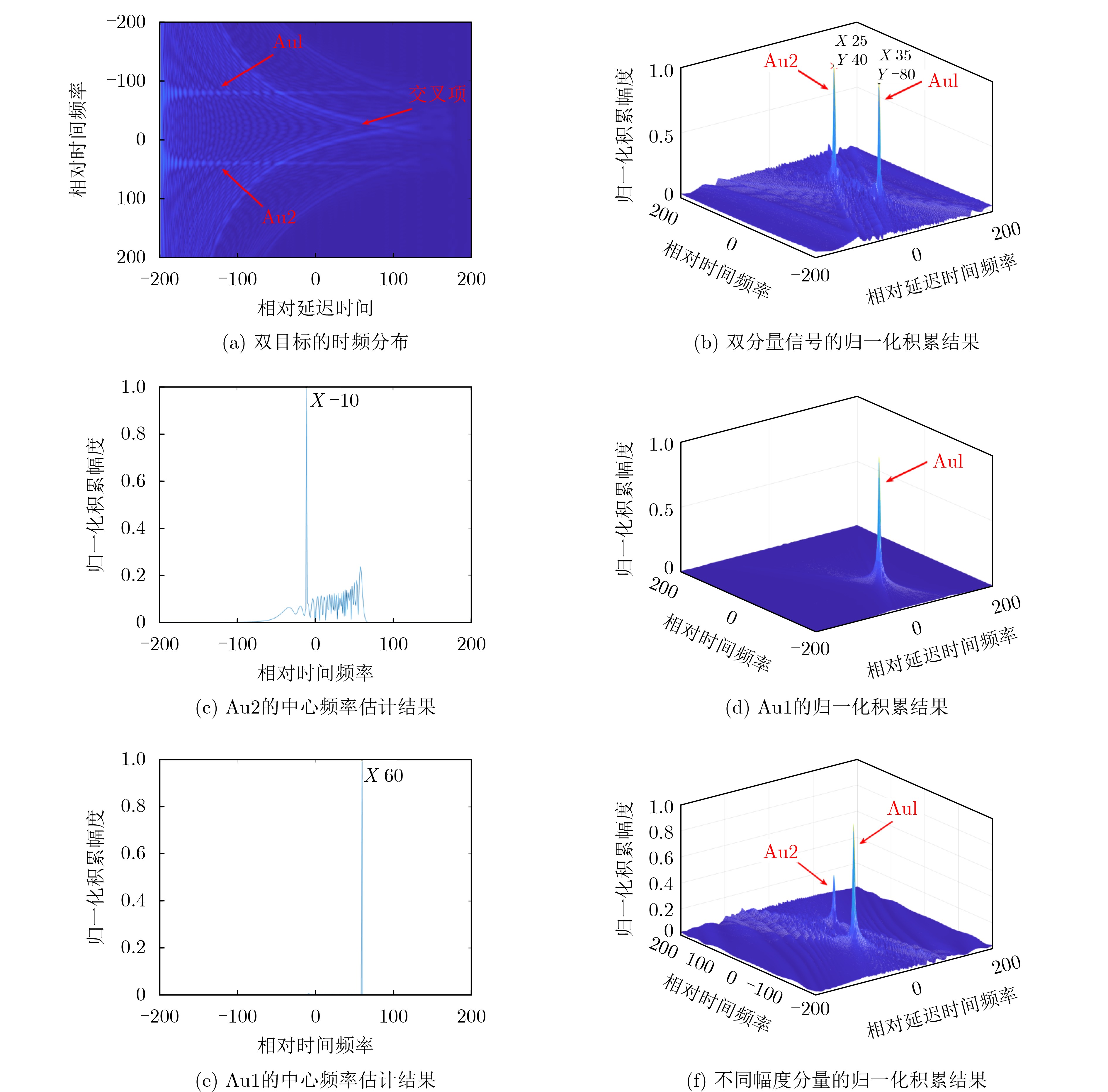
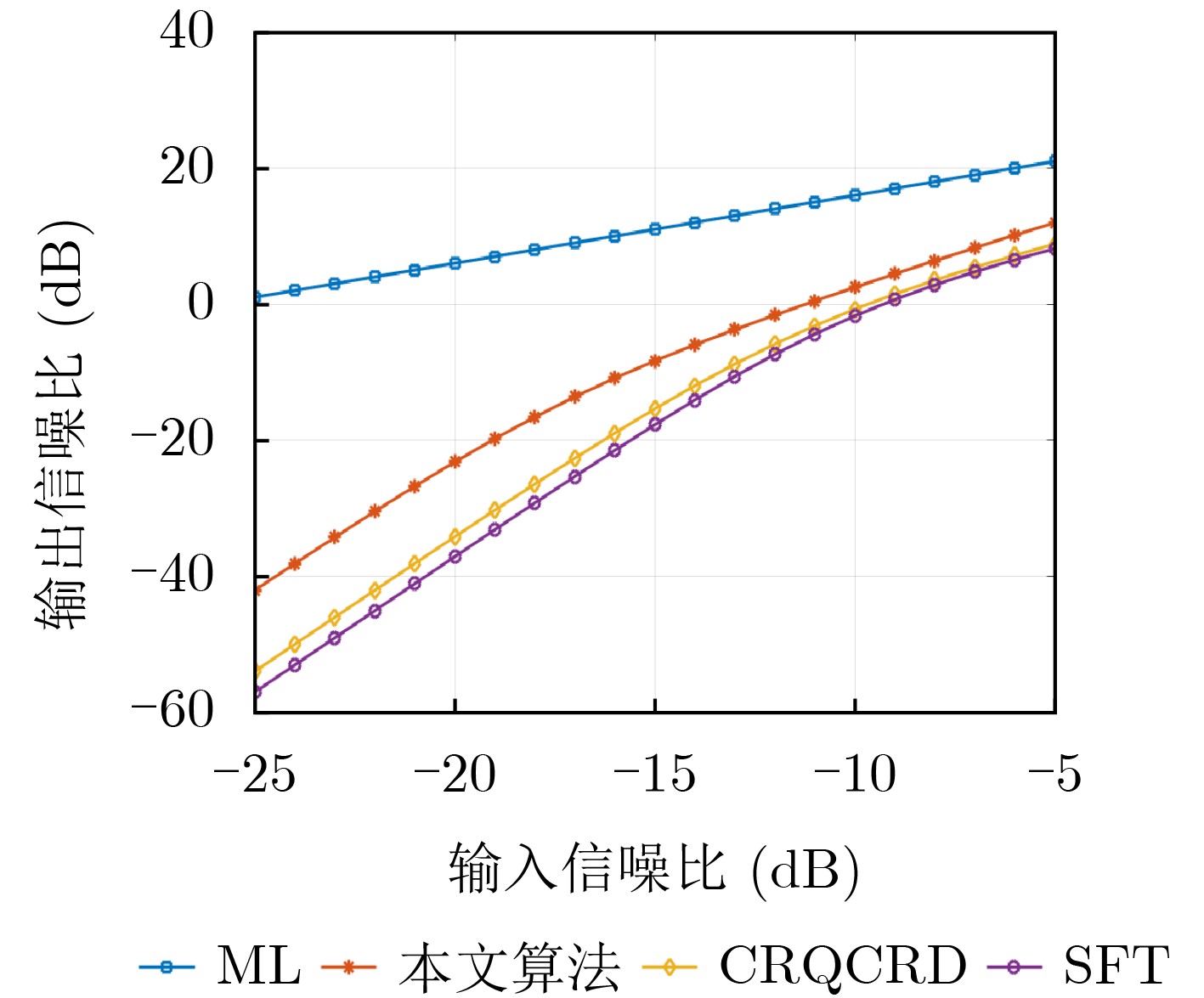
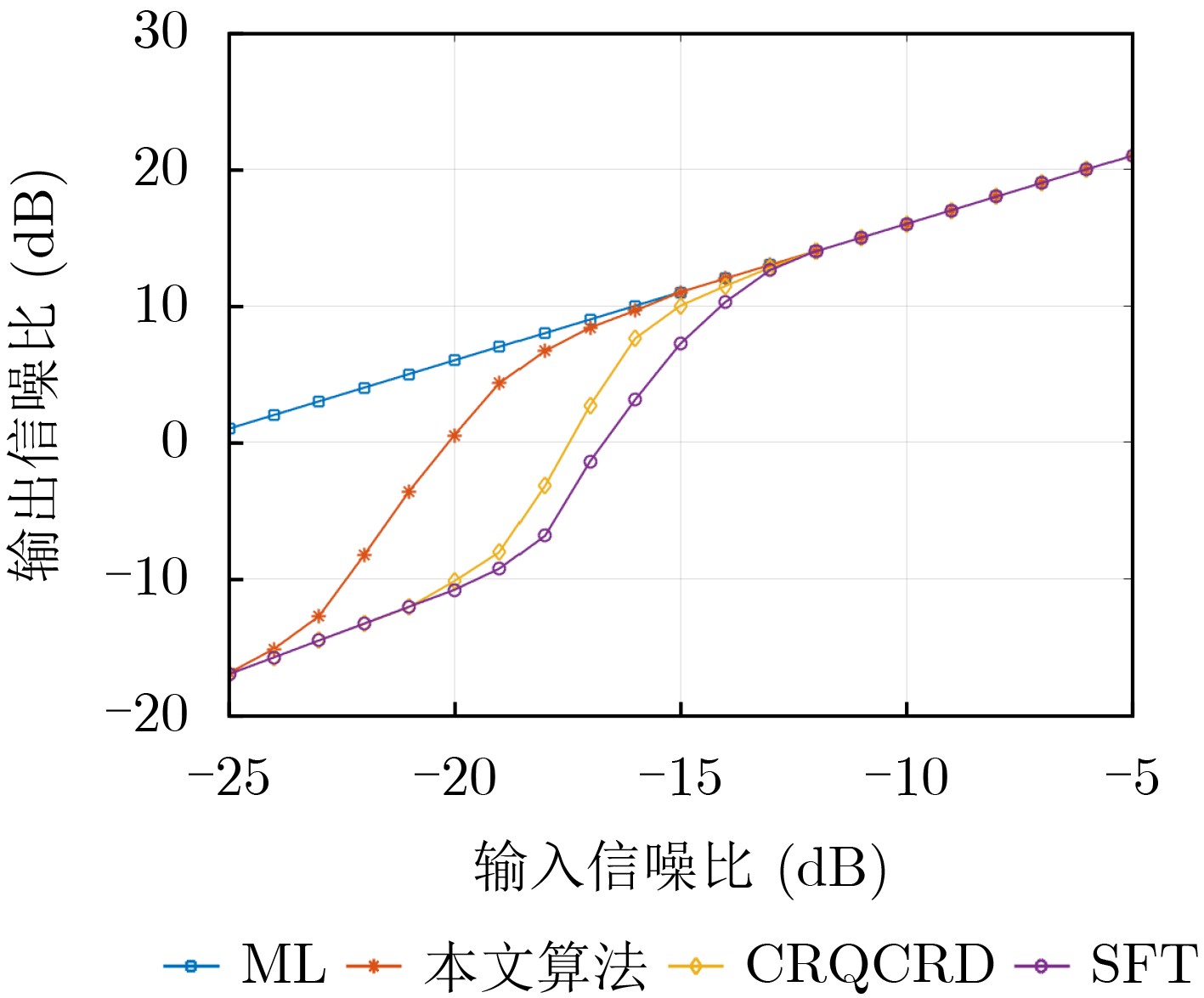
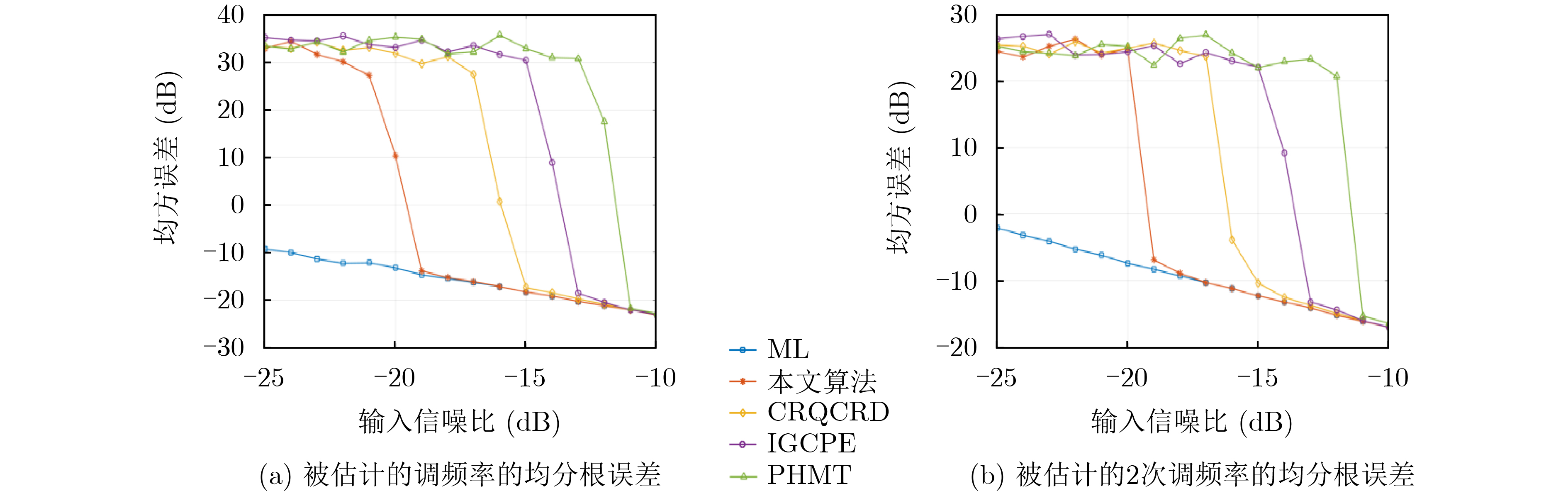
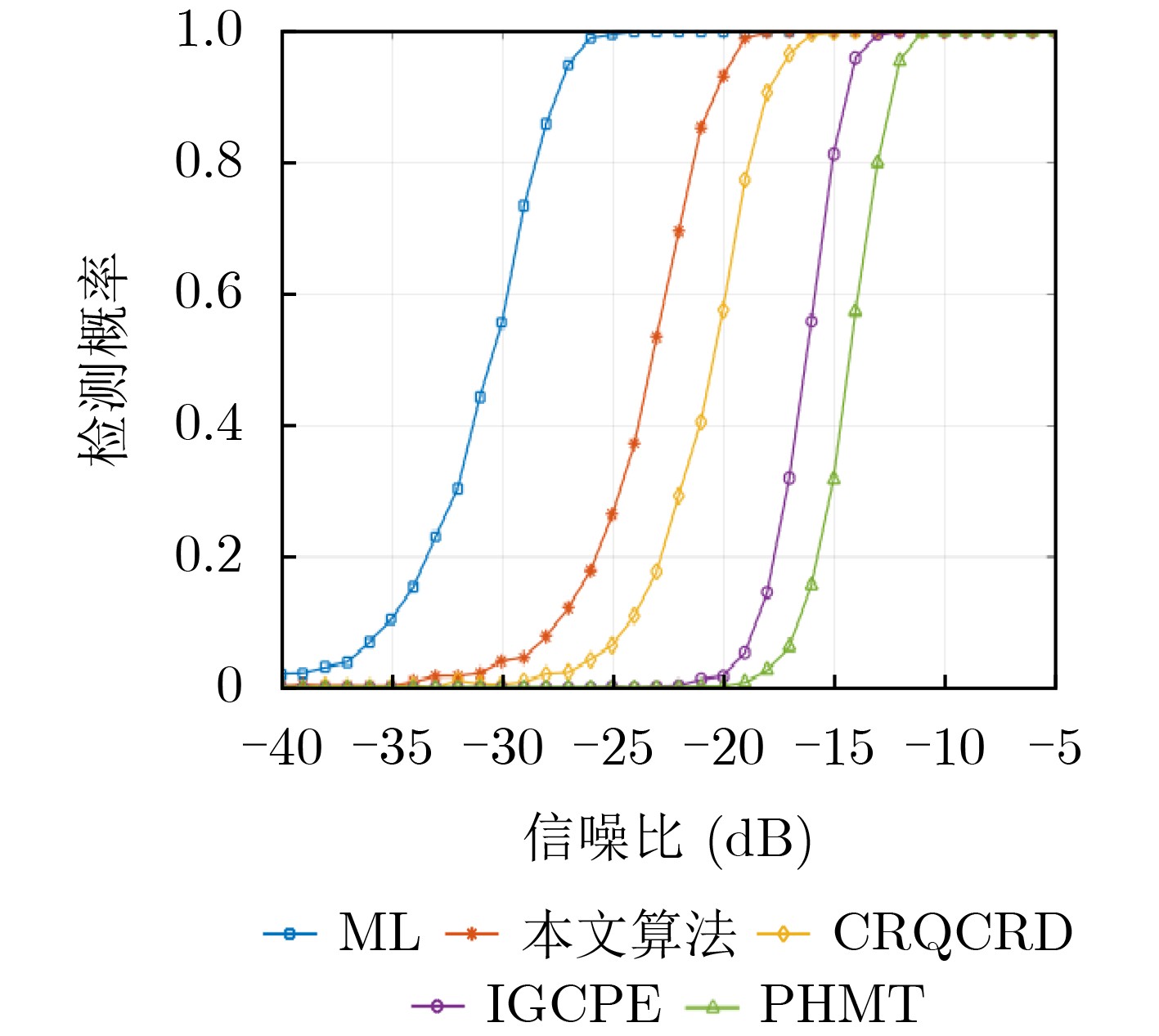
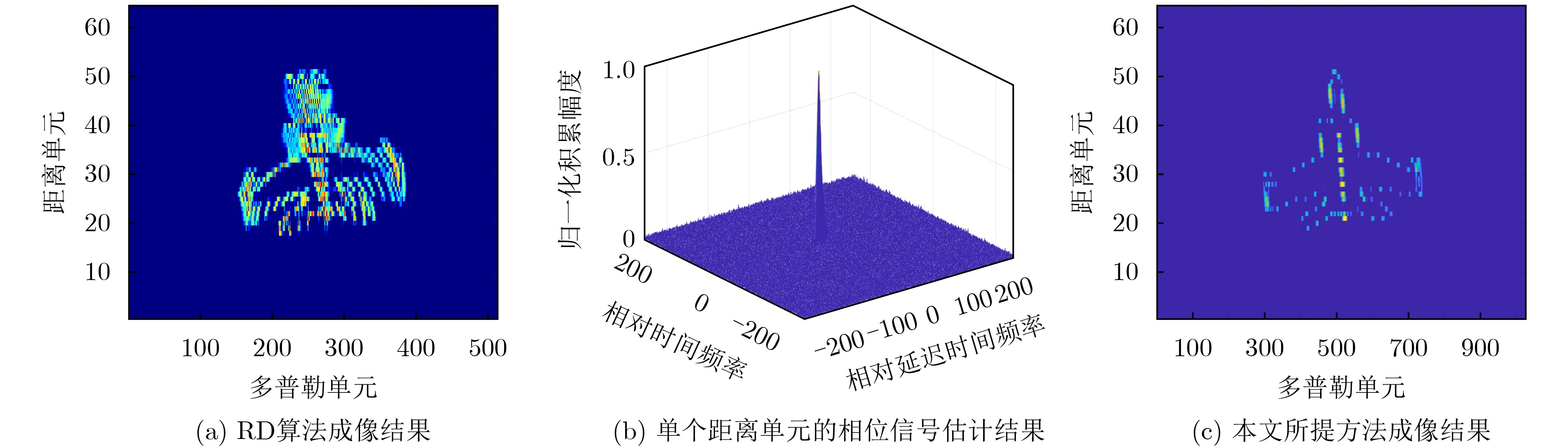
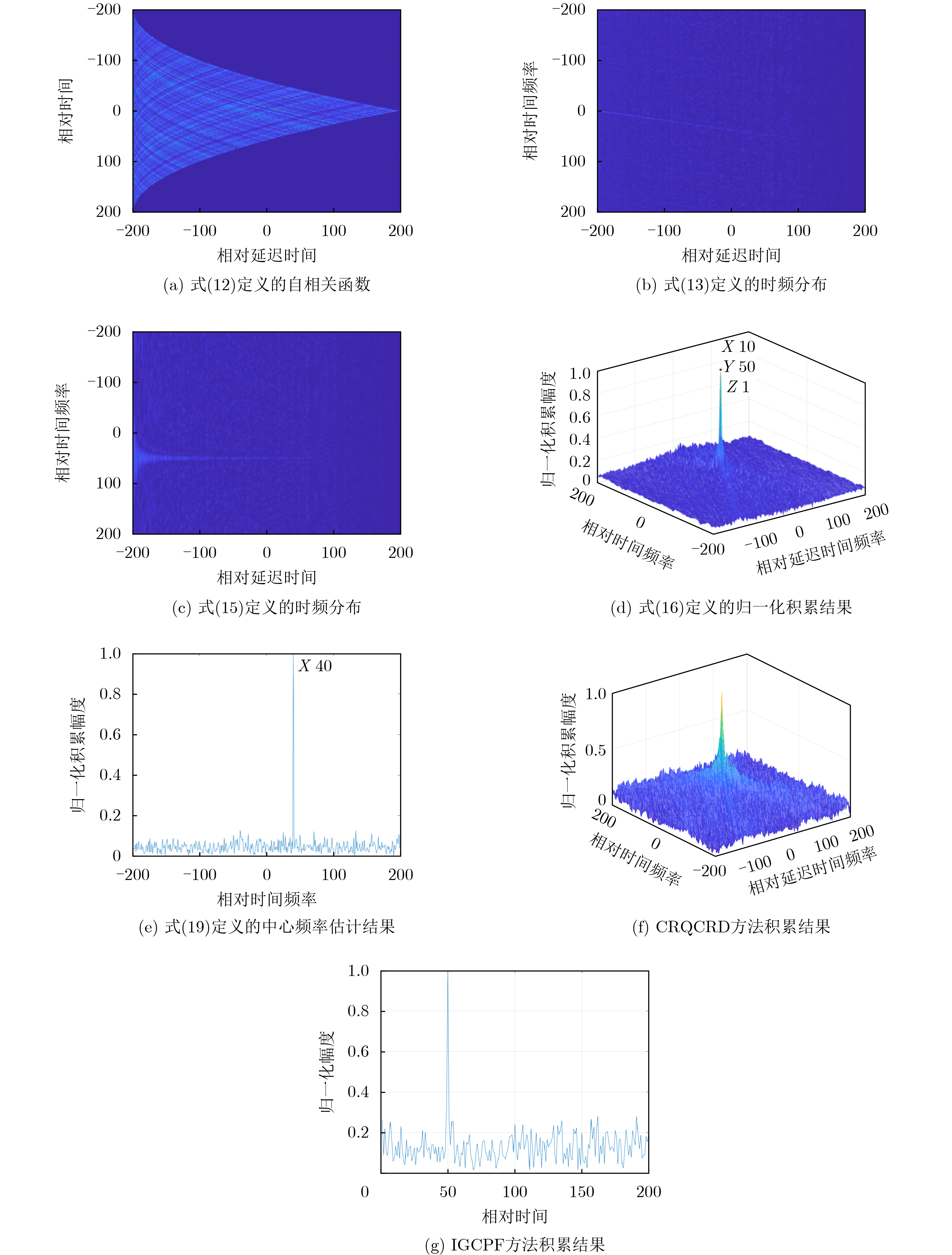
Objective Polynomial Phase Signal (PPS) analysis has attracted broad attention because many radar, sonar, and seismic signals are modeled as PPS of different orders. A first-order PPS can be focused into a frequency bin through the Fourier transform to estimate the center frequency. For higher order PPS, such as a Quadratic Frequency Modulated (QFM) signal, non-coherent characteristics limit the effectiveness of the Fourier transform for energy integration. Existing time–frequency distribution methods, such as the short-time Fourier transform and the Wigner-Ville distribution, do not resolve the conflicts between auto-terms and cross-terms or between time- and frequency-domain resolution. In addition, current algorithms face difficulties in balancing computational complexity and detection performance, which results in reduced parameter estimation accuracy. This study proposes a QFM detection method based on a non-uniform quadrilinear autocorrelation function to provide balanced performance for QFM parameter estimation with controlled computational cost. Methods A time-frequency distribution method for QFM detection and parameter estimation is presented. The method applies non-uniform sampling and maps a one-dimensional signal into a two-dimensional time domain through a forth-order autocorrelation function. A non-uniform fast Fourier transform is used to resolve the time variable and concentrate the energy into a vertical line in the two-dimensional plane. Then, FFT is performed along this line to focuse the signal into a peak, from which the chirp rate and quadratic chirp rate are estimated. Finally, dechirp processing compensates high-order phase terms of the original signal, and FFT yields the center frequency estimation result can be obtaioned through FFT operation. Results and Discussions Theoretical analysis and simulation results show that the method balances computational complexity and detection performance. Under low signal-to-noise ratio conditions, it distinguishes targets effectively and produces accurate parameter estimates ( Fig. 1 ). For multicomponent signals with large amplitude differences, it enables stepwise detection and estimation (Fig. 2 ). Comparative experiments with state-of-the-art algorithms show that the method is quasi-optimal in estimation accuracy and integration gain (Fig. 3 –Fig. 6 ). Compared with the ML estimator, it offers markedly higher computational efficiency.Conclusions A QFM detection and parameter estimation method based on non-uniform quadrilinear autocorrelation functions is proposed. The method maps the QFM signal into a two-dimensional time domain through a new autocorrelation kernel and achieves coherent integration through scaling and FFT. Mathematical analysis and simulation results show that, relative to the ML method, it sacrifices part of the detection performance but substantially reduces computational complexity. When computational efficiency is similar, it outperforms other classical methods in detection and parameter estimation accuracy. The method provides a balanced solution for QFM signal detection and parameter estimation. -
[1] LI Suqi, WANG Yihan, LIANG Yanfeng, et al. Long-time coherent integration for the spatial-based bistatic radar based on dual-scale decomposition and conditioned CPF[J]. Remote Sensing, 2024, 16(10): 1798. doi: 10.3390/rs16101798. [2] NIU Zhiyong, ZHENG Jibin, and SU Tao. Novel motion parameter estimation and coherent integration algorithm for high maneuvering target with jerk motion[J]. Signal Processing, 2024, 221: 109467. doi: 10.1016/j.sigpro.2024.109467. [3] XU Wenwen, WANG Yuhang, HUANG Jidan, et al. SAF-SFT-SRAF-based signal coherent integration method for high-speed target detecting in airborne radar[J]. Progress in Electromagnetics Research C Pier C, 2025, 154(3): 183–190. doi: 10.2528/PIERC25012202. [4] MA Jingtao, XIA Xianggen, HUANG Penghui, et al. An efficient parameter estimation and imaging approach for ground maneuvering targets by mixed symmetric function in SAR imagery[J]. IEEE Transactions on Geoscience and Remote Sensing, 2025, 63: 5206520. doi: 10.1109/TGRS.2025.3548873. [5] MA Jingtao, XIA Xianggen, WANG Jiannan, et al. An efficient refocusing method for ground moving targets in multichannel SAR imagery[J]. IEEE Geoscience and Remote Sensing Letters, 2024, 21: 4014105. doi: 10.1109/LGRS.2024.3437429. [6] MA Jingtao, WANG Jiannan, XIA Xianggen, et al. A novel ISAR imaging algorithm for a maneuvering target based on generalized second-order time-scaled transform[J]. IEEE Transactions on Geoscience and Remote Sensing, 2025, 63: 5102419. doi: 10.1109/TGRS.2025.3540457. [7] DING Jiabao, WANG Jiadong, LI Yachao, et al. An efficient ISAR imaging and scaling method for highly maneuvering targets based on ICPF-PSVA[J]. IEEE Transactions on Geoscience and Remote Sensing, 2024, 62: 5923409. doi: 10.1109/TGRS.2024.3440839. [8] XU Wenwen, WANG Yuhang, CAO Jianyin, et al. KT-SRAF-LVD-based signal coherent integration method for high-speed target detecting in airborne radar[J]. Sensors, 2025, 25(7): 2128. doi: 10.3390/s25072128. [9] MEIGNEN S, OBERLIN T, and MCLAUGHLIN S. A new algorithm for multicomponent signals analysis based on synchrosqueezing: With an application to signal sampling and denoising[J]. IEEE Transactions on Signal Processing, 2012, 60(11): 5787–5798. doi: 10.1109/TSP.2012.2212891. [10] XIA Xianggen, WANG Genyuan, and CHEN V C. Quantitative SNR analysis for ISAR imaging using joint time-frequency analysis-short time Fourier transform[J]. IEEE Transactions on Aerospace and Electronic Systems, 2002, 38(2): 649–649. doi: 10.1109/TAES.2002.1008993. [11] KATKOVNIK V. A new form of the Fourier transform for time-varying frequency estimation[C]. ISSE'95 - International Symposium on Signals, Systems and Electronics, San Francisco, USA, 1995: 179–182. doi: 10.1109/ISSSE.1995.497962. [12] SONG Yu’e, ZHANG Xiaoyan, SHANG Chunheng, et al. The Wigner-Ville distribution based on the linear canonical transform and its applications for QFM signal parameters estimation[J]. Journal of Applied Mathematics, 2014, 2014: 516557. doi: 10.1155/2014/516457. [13] ZHANG Liang, ZHOU Bilei, SONG Rongguo, et al. Wideband Lv’s distribution: A signal processing tool for hyperbolic frequency-modulated signal analysis[J]. IEEE Transactions on Aerospace and Electronic Systems, 2024, 60(5): 6061–6074. doi: 10.1109/TAES.2024.3398611. [14] AMAR A. Efficient estimation of a narrow-band polynomial phase signal impinging on a sensor array[J]. IEEE Transactions on Signal Processing, 2010, 58(2): 923–927. doi: 10.1109/TSP.2009.2030608. [15] LI Yanyan, SU Tao, ZHENG Jibin, et al. ISAR imaging of targets with complex motions based on modified Lv’s distribution for cubic phase signal[J]. IEEE Journal of Selected Topics in Applied Earth Observations and Remote Sensing, 2015, 8(10): 4775–4784. doi: 10.1109/JSTARS.2015.2460734. [16] SU Jia, TAO Haihong, RAO Xuan, et al. Coherently integrated cubic phase function for multiple LFM signals analysis[J]. Electronics Letters, 2015, 51(5): 411–413. doi: 10.1049/el.2014.4164. [17] RHEE K, BAIK J, SONG C, et al. LPI radar waveform recognition based on hierarchical classification approach and maximum likelihood estimation[J]. Entropy, 2024, 26(11): 915. doi: 10.3390/e26110915. [18] WU Liang, WEI Xizhang, YANG Degui, et al. ISAR imaging of targets with complex motion based on discrete chirp Fourier transform for cubic chirps[J]. IEEE Transactions on Geoscience and Remote Sensing, 2012, 50(10): 4201–4212. doi: 10.1109/TGRS.2012.2189220. [19] WANG Yong, KANG Jian, and JIANG Yicheng. ISAR imaging of maneuvering target based on the local polynomial Wigner distribution and integrated high-order ambiguity function for cubic phase signal model[J]. IEEE Journal of Selected Topics in Applied Earth Observations and Remote Sensing, 2014, 7(7): 2971–2991. doi: 10.1109/JSTARS.2014.2301158. [20] BARBAROSSA S, SCAGLIONE A, and GIANNAKIS G B. Product high-order ambiguity function for multicomponent polynomial-phase signal modeling[J]. IEEE Transactions on Signal Processing, 1998, 46(3): 691–708. doi: 10.1109/78.661336. [21] WANG Pu, LI Hongbin, DJUROVIĆ I, et al. Integrated cubic phase function for linear FM signal analysis[J]. IEEE Transactions on Aerospace and Electronic Systems, 2010, 46(3): 963–977. doi: 10.1109/TAES.2010.5545167. [22] WANG Yong and JIANG Yicheng. ISAR imaging of a ship target using product high-order matched-phase transform[J]. IEEE Geoscience and Remote Sensing Letters, 2009, 6(4): 658–661. doi: 10.1109/LGRS.2009.2013876. [23] ZHENG Jibin, SU Tao, ZHANG Long, et al. ISAR imaging of targets with complex motion based on the chirp rate–quadratic chirp rate distribution[J]. IEEE Transactions on Geoscience and Remote Sensing, 2014, 52(11): 7276–7289. doi: 10.1109/TGRS.2014.2310474. [24] EI-DEN B M and RASLAN W. A reversible and robust hybrid image steganography framework using radon transform and integer lifting wavelet transform[J]. Scientific Reports, 2025, 15(1): 15687. doi: 10.1038/s41598-025-98539-2. [25] SONG Hengli, XIONG Yixiang, and ZHAO Qingpu. Topological image reconstruction of regular grounding network based on Hough transform[J]. IEEE Sensors Journal, 2024, 24(17): 27587–27596. doi: 10.1109/JSEN.2024.3428574. [26] ZHAN Muyang, ZHAO Chanjuan, QIN Kun, et al. Subaperture keystone transform matched filtering algorithm and its application for air moving target detection in an SBEWR system[J]. IEEE Journal of Selected Topics in Applied Earth Observations and Remote Sensing, 2023, 16: 2262–2274. doi: 10.1109/JSTARS.2023.3245295. [27] ZHANG Jiancheng, LI Yanyan, SU Tao, et al. Quadratic FM signal detection and parameter estimation using coherently integrated trilinear autocorrelation function[J]. IEEE Transactions on Signal Processing, 2020, 68: 621–633. doi: 10.1109/tsp.2020.2965279. [28] LI Yanyan, ZHANG Jiancheng, ZHOU Yan, et al. ISAR imaging of nonuniformly rotating targets with low SNR based on coherently integrated nonuniform trilinear autocorrelation function[J]. IEEE Geoscience and Remote Sensing Letters, 2021, 18(6): 1074–1078. doi: 10.1109/LGRS.2020.2992513. -


 下载:
下载:

图(7) / 表(1)
计量
- 文章访问数: 816
- HTML全文浏览量: 437
- PDF下载量: 65
- 被引次数: 0
