




Modeling, Detection, and Defense Theories and Methods for Cyber-Physical Fusion Attacks in Smart Grid
-
摘要: 智能电网(Smart Grid, SG)基于大量传感与检测单元,通过先进的网络通信、监测、调度与优化技术,显著提升了传统电网的管理和调节能力。然而,智能电网的开放性和互联性大幅提高的同时,也加剧了遭受恶意攻击的风险。特别是,攻击者可能通过同时干扰信息层和物理层的感知与决策过程,削弱系统的控制和恢复能力。以往研究通常根据攻击的对象或类型进行分类,而该文提出了一种涵盖智能电网主要组件和通信链路的综合性架构,从整体性的抽象视角对涉及智能电网组件的多种攻击类型进行系统性的信息物理风险评估。此外,该文还从多个角度探讨了智能电网中信息物理融合攻击的检测与防御问题。最后,基于现有的研究进展和趋势,该文对未来智能电网信息物理安全的研究方向进行了讨论与展望。Abstract:
Significance Smart Grid (SG), the core of modern power systems, enables efficient energy management and dynamic regulation through cyber-physical integration. However, its high interconnectivity makes it a prime target for cyberattacks, including False Data Injection Attacks (FDIAs) and Denial-of-Service (DoS) attacks. These threats jeopardize the stability of power grids and may trigger severe consequences such as large-scale blackouts. Therefore, advancing research on the modeling, detection, and defense of cyber-physical attacks is essential to ensure the safe and reliable operation of SGs. Progress Significant progress has been achieved in cyber-physical security research for SGs. In attack modeling, discrete linear time-invariant system models effectively capture diverse attack patterns. Detection technologies are advancing rapidly, with physical-based methods (e.g., physical watermarking and moving target defense) complementing intelligent algorithms (e.g., deep learning and reinforcement learning). Defense systems are also being strengthened: lightweight encryption and blockchain technologies are applied to prevention, security-optimized Phasor Measurement Unit (PMU) deployment enhances equipment protection, and response mechanisms are being continuously refined. Conclusions Current research still requires improvement in attack modeling accuracy and real-time detection algorithms. Future work should focus on developing collaborative protection mechanisms between the cyber and physical layers, designing solutions that balance security with cost-effectiveness, and validating defense effectiveness through high-fidelity simulation platforms. This study establishes a systematic theoretical framework and technical roadmap for SG security, providing essential insights for safeguarding critical infrastructure. Prospects Future research should advance in several directions: (1) deepening synergistic defense mechanisms between the information and physical layers; (2) prioritizing the development of cost-effective security solutions; (3) constructing high-fidelity information-physical simulation platforms to support research; and (4) exploring the application of emerging technologies such as digital twins and interpretable Artificial Intelligence (AI). -
表 1 现有文献比较与分析
文献 发表年份 涉及的攻击类型 包含的电网结构 不足 [19] 2020 PMU攻击、状态估计攻击、
负载重分配攻击等变电站、电力市场、发电厂、电力控制单元 未对攻击类型与攻击区域进行分类与总结 [20] 2016 家域网攻击、邻域网攻击、机密性攻击、
完整性攻击等电网通信链路 只考虑智能电网信息层威胁,而忽略了信息
物理协同威胁[21] 2024 机密性攻击、完整性攻击等 SCADA系统 对于智能电网攻击检测方法介绍较为笼统(只有机器学习与区块链) [22] 2020 拒绝服务攻击、中间人攻击、数据注入攻击 SCADA系统、潮流计算
系统等着重智能电网威胁态势,较少考虑攻击的通用性建模与防御 [23] 2022 时间同步攻击、隐私攻击、阻塞攻击 物联网终端、基站、电网通信链路等 主要考虑网络层威胁,对电网针对性不强 [24] 2019 设备攻击、数据攻击、网络可达性攻击等 变电站、电网控制中心、电网通信链路等 对攻击分类过于笼统、没有总结攻击的共性
与特征,防御策略介绍太少[25] 2024 主动攻击、被动攻击 电网通信链路 对于攻击分类较为笼统,检测方法也只分成
已知与未知两种[26] 2019 数据注入攻击 SCADA系统、远程控制单元、新能源发电、电力市场等 只考虑了错误数据注入攻击一种攻击类型  下载: 导出CSV
表 2 攻击类型与模式
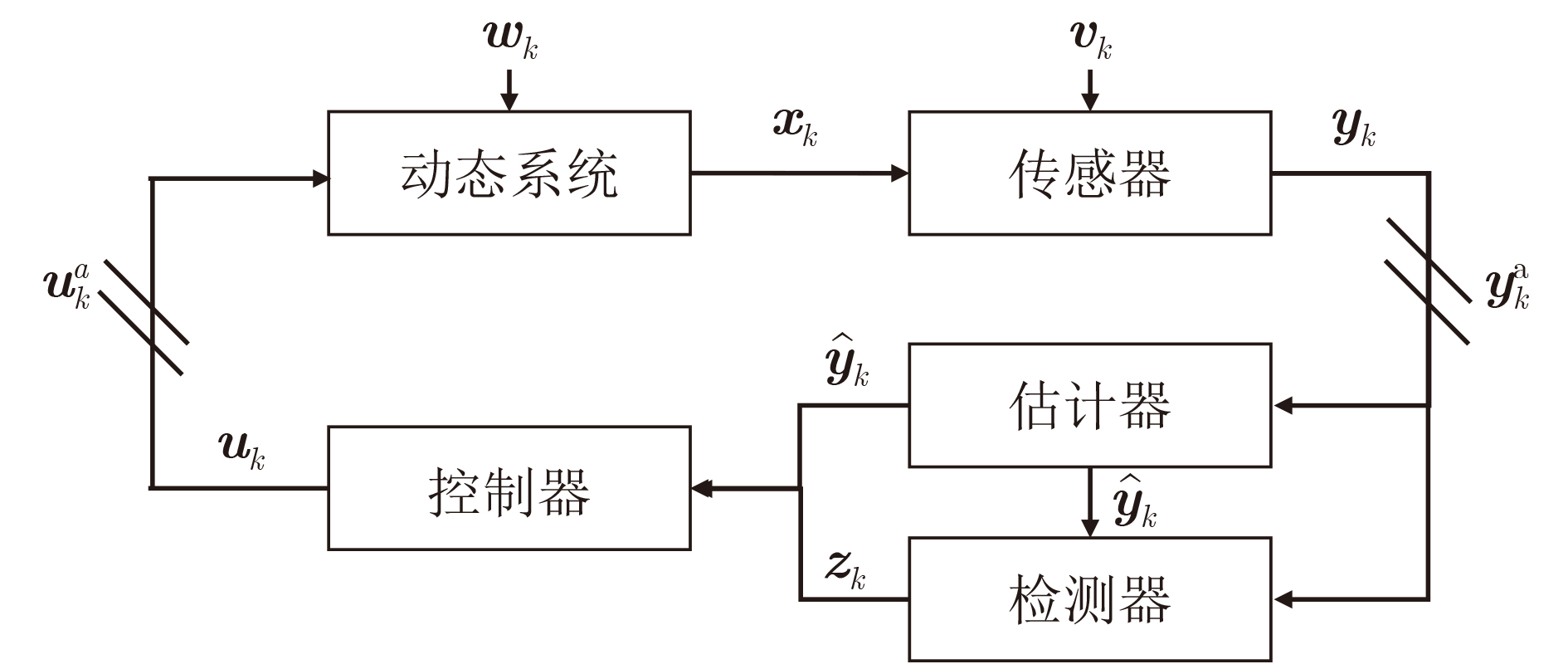
攻击类型 数学模型 错误数据注入攻击 $ {\stackrel{~}{{{\boldsymbol{y}}}}}_{{k}} $=$ {{\boldsymbol{y}}}_{k}+{{\boldsymbol{y}}}_{k}^{\mathrm{a}} $,其中$ {\boldsymbol{y}}_{{k}}^{\mathrm{a}} $表示攻击者设计的错误数据 隐秘攻击 $ {\boldsymbol{u}}_{{k}}^{\mathrm{a}} $$ =M\left({{\boldsymbol{u}}}_{k}\right) $,其中$ M(\cdot ) $表示经过精心设计的攻击模式 重放攻击 $ {{\boldsymbol{y}}}_{k}^{\mathrm{a}}={y}_{k-\tau } $,其中$ \tau $表示重放延迟 拒绝服务攻击 $ \varXi (0,\infty )\triangleq \underset{l\in \mathbb{N}}{\cup }{\mathbb{N}}_{{h}_{l},{h}_{l}+{\tau }_{l}}\in \mathbb{N}$,其中$ {h}_{l} $表示攻击开始时间,$ {\tau }_{l} $表示攻击持续时间
下载: 导出CSV
-
[1] OKS S J, JALOWSKI M, LECHNER M, et al. Cyber-physical systems in the context of industry 4.0: A review, categorization and outlook[J]. Information Systems Frontiers, 2024, 26(5): 1731–1772. doi: 10.1007/s10796-022-10252-x. [2] 王鑫, 王霖, 余芸, 等. 数字孪生电网的特性、架构及应用综述[J]. 电子与信息学报, 2022, 44(11): 3721–3733. doi: 10.11999/JEIT220629.WANG Xin, WANG Lin, YU Yun, et al. Survey on characteristics, architecture and applications of digital twin power grid[J]. Journal of Electronics & Information Technology, 2022, 44(11): 3721–3733. doi: 10.11999/JEIT220629. [3] 穆超, 王鑫, 杨明, 等. 面向物联网设备固件的硬编码漏洞检测方法[J]. 网络与信息安全学报, 2022, 8(5): 98–110. doi: 10.11959/j.issn.2096−109x.2022070.MU Chao, WANG Xin, YANG Ming, et al. Hardcoded vulnerability detection approach for IoT device firmware[J]. Chinese Journal of Network and Information Security, 2022, 8(5): 98–110. doi: 10.11959/j.issn.2096−109x.2022070. [4] SEMERTZIS I, ŞTEFANOV A, PRESEKAL A, et al. Power system stability analysis from cyber attacks perspective[J]. IEEE Access, 2024, 12: 113008–113035. doi: 10.1109/ACCESS.2024.3443061. [5] GABRIEL V and PINHO C. Are clean and black energy exchange-traded funds driven by climate risk?[J]. Journal of Sustainable Finance & Investment, 2024, 1–27. doi: 10.1080/20430795.2024.2303501. [6] LEHMAN G and MARAS P. Cyber-attack against ukrainian power plants. Prykarpattyaoblenergo and Kyivoblenergo[EB/OL]. https://nsarchive.gwu.edu/media/15331/ocr, 2024. [7] Half of Ivano-Frankivsk Oblast lost power due to a hacker attack[EB/OL]. http://ru.tsn.ua/ukrayina/iz-za-hakerskoy-ataki-obestochilo-polovinu-ivano-frankovskoy-oblasti-550406.html. [8] cys-centrum: Cyber Threat Black Energy. History of attacks on Ukraine’s critical IT infrastructure[EB/OL]. https://cys-centrum.com/ru/news/black_energy_2_3. [9] TATIPATRI N and ARUN S L. A comprehensive review on cyber-attacks in power systems: Impact analysis, detection, and cyber security[J]. IEEE Access, 2024, 12: 18147–18167. doi: 10.1109/ACCESS.2024.3361039. [10] SAXENA N and GRIJALVA S. Efficient signature scheme for delivering authentic control commands in the smart grid[J]. IEEE Transactions on Smart Grid, 2018, 9(5): 4323–4334. doi: 10.1109/TSG.2017.2655014. [11] HAIDER M Z, MALI P, RAHMAN M A, et al. Impact analysis of false data injection attacks on automatic voltage regulators of synchronous generators[C]. 2024 IEEE Power & Energy Society General Meeting, Seattle, USA, 2024: 1–5. doi: 10.1109/PESGM51994.2024.10688905. [12] MUHAMMAD S, WIDIATKO S A, PUTRI R H, et al. Distributed Denial of Service (DDoS) attack on smart grid systems: Vulnerabilities and detection strategies[J]. Novice Research Exploration, 2024, 1(1). doi: 10.1016/j.egyr.2023.05.184. [13] ORTEGA-FERNANDEZ I, SESTELO M, BURGUILLO J C, et al. Network intrusion detection system for DDoS attacks in ICS using deep autoencoders[J]. Wireless Networks, 2024, 30(6): 5059–5075. doi: 10.1007/s11276-022-03214-3. [14] ZHAO Zhenghui, SHANG Yingying, QI Buyang, et al. Research on defense strategies for power system frequency stability under false data injection attacks[J]. Applied Energy, 2024, 371: 123711. doi: 10.1016/j.apenergy.2024.123711. [15] GUATO BURGOS M F, MORATO J, and VIZCAINO IMACAÑA F P. A review of smart grid anomaly detection approaches pertaining to artificial intelligence[J]. Applied Sciences, 2024, 14(3): 1194. doi: 10.3390/app14031194. [16] GHADI Y Y, MAZHAR T, AURANGZEB K, et al. Security risk models against attacks in smart grid using big data and artificial intelligence[J]. PeerJ Computer Science, 2024, 10: e1840. doi: 10.7717/peerj-cs.1840. [17] YAPA C, DE ALWIS C, WIJEWARDHANA U, et al. Power line monitoring-based consensus algorithm for performance enhancement of energy blockchain applications in smart grid 2.0[J]. IEEE Transactions on Smart Grid, 2025, 16(1): 277–287. doi: 10.1109/TSG.2024.3445659. [18] 杨超群, 张恒. 基于CBMeMBer滤波器的多攻击检测方法[J]. 控制工程, 2022, 29(6): 1033–1039. doi: 10.14107/j.cnki.kzgc.20210098.YANG Chaoqun and ZHANG Heng. Multi-attack detection approach based on CBMeMBer filter[J]. Control Engineering of China, 2022, 29(6): 1033–1039. doi: 10.14107/j.cnki.kzgc.20210098. [19] 李建华. 能源关键基础设施网络安全威胁与防御技术综述[J]. 电子与信息学报, 2020, 42(9): 2065–2081. doi: 10.11999/JEIT191055.LI Jianhua. Overview of cyber security threats and defense technologies for energy critical infrastructure[J]. Journal of Electronics & Information Technology, 2020, 42(9): 2065–2081. doi: 10.11999/JEIT191055. [20] 刘家男, 翁健. 智能电网安全研究综述[J]. 信息网络安全, 2016(5): 78–84. doi: 10.3969/j.issn.1671-1122.2016.05.012.LIU Jianan and WENG Jian. Survey on smart grid security[J]. Netinfo Security, 2016(5): 78–84. doi: 10.3969/j.issn.1671-1122.2016.05.012. [21] 岳芳, 王雪珍, 姜山. 智能电网的网络安全风险及应对策略[J]. 科技导报, 2024, 42(9): 6–16. doi: 10.3981/j.issn.1000-7857.2023.11.01692.YUE Fang, WANG Xuezhen, and JIANG Shan. Network security risks and new countermeasures under the smart grid environment[J]. Science & Technology Review, 2024, 42(9): 6–16. doi: 10.3981/j.issn.1000-7857.2023.11.01692. [22] 杨至元, 张仕鹏, 孙浩. 电力系统信息物理网络安全综合分析与风险研究[J]. 南方能源建设, 2020, 7(3): 6–22. doi: 10.16516/j.gedi.issn2095-8676.2020.03.002.YANG Zhiyuan, ZHANG Shipeng, and SUN Hao. Integrated cyber-physical contingency analysis and risk estimates[J]. Southern Energy Construction, 2020, 7(3): 6–22. doi: 10.16516/j.gedi.issn2095-8676.2020.03.002. [23] 苏盛, 汪干, 刘亮, 等. 电力物联网终端安全防护研究综述[J]. 高电压技术, 2022, 48(2): 513–525. doi: 10.13336/j.1003-6520.hve.20210150.SU Sheng, WANG Gan, LIU Liang, et al. Review on security of power internet of things terminals[J]. High Voltage Engineering, 2022, 48(2): 513–525. doi: 10.13336/j.1003-6520.hve.20210150. [24] 胡钋, 李莉莉. 智能电网的信息物理安全综述[J]. 信息安全研究, 2019, 5(12): 1068–1075. doi: 10.3969/j.issn.2096-1057.2019.12.003.HU Po and LI Lili. A review of cyber-physical security in smart grids[J]. Journal of Information Security Research, 2019, 5(12): 1068–1075. doi: 10.3969/j.issn.2096-1057.2019.12.003. [25] 文成林, 杨力. 信息物理系统攻击威胁的防御策略综述[J]. 控制理论与应用, 2024, 41(12): 2224–2236. doi: 10.7641/CTA.2023.30195.WEN Chenglin and YANG Li. Research survey on defense strategy of attack threat in cyber physical systems[J]. Control Theory & Applications, 2024, 41(12): 2224–2236. doi: 10.7641/CTA.2023.30195. [26] 王琦, 邰伟, 汤奕, 等. 面向电力信息物理系统的虚假数据注入攻击研究综述[J]. 自动化学报, 2019, 45(1): 72–83. doi: 10.16383/j.aas.2018.c180369.WANG Qi, TAI Wei, TANG Yi, et al. A review on false data injection attack toward cyber-physical power system[J]. Acta Automatica Sinica, 2019, 45(1): 72–83. doi: 10.16383/j.aas.2018.c180369. [27] DIABA S Y, SHAFIE-KHAH M, and ELMUSRATI M. Cyber-physical attack and the future energy systems: A review[J]. Energy Reports, 2024, 12: 2914–2932. doi: 10.1016/j.egyr.2024.08.060. [28] SHANG Tao, LIU Jiayu, GAO Xueqin, et al. Multistage adversarial game for cyber-physical attacks protection of smart grids[J]. IEEE Transactions on Industrial Informatics, 2025, 21(7): 5203–5212. doi: 10.1109/TII.2025.3552699. [29] KHAN M A, SALEH A M, WASEEM M, et al. Smart grid cyber attacks: Overview, threats, and countermeasures[C]. 2024 22nd International Conference on Intelligent Systems Applications to Power Systems, Budapest, Hungary, 2024: 1–5. doi: 10.1109/ISAP63260.2024.10744349. [30] ACHAAL B, ADDA M, BERGER M, et al. Study of smart grid cyber-security, examining architectures, communication networks, cyber-attacks, countermeasure techniques, and challenges[J]. Cybersecurity, 2024, 7(1): 10. doi: 10.1186/s42400-023-00200-w. [31] PILLITTERI V Y and BREWER T L. Guidelines for Smart Grid Cybersecurity[R]. 7628 Rev 1, 2014. doi: 10.6028/NIST.IR.7628r1. [32] ZIBAEIRAD A, KOLEINI F, BI Shengping, et al. A comprehensive survey on the security of smart grid: Challenges, mitigations, and future research opportunities[J]. arXiv preprint arXiv: 2407.07966, 2024. doi: 10.48550/arXiv.2407.07966. [33] SONG E Y, FITZPATRICK G J, LEE K B, et al. A methodology for modeling interoperability of smart sensors in smart grids[J]. IEEE Transactions on Smart Grid, 2022, 13(1): 555–563. doi: 10.1109/TSG.2021.3124490. [34] HABIB A A, HASAN M K, ALKHAYYAT A, et al. False data injection attack in smart grid cyber physical system: Issues, challenges, and future direction[J]. Computers and Electrical Engineering, 2023, 107: 108638. doi: 10.1016/j.compeleceng.2023.108638. [35] AN Dou, ZHANG Feiye, YANG Qingyu, et al. Data integrity attack in dynamic state estimation of smart grid: Attack model and countermeasures[J]. IEEE Transactions on Automation Science and Engineering, 2022, 19(3): 1631–1644. doi: 10.1109/TASE.2022.3149764. [36] PENG Sha, ZHANG Zhenyong, DENG Ruilong, et al. Localizing false data injection attacks in smart grid: A spectrum-based neural network approach[J]. IEEE Transactions on Smart Grid, 2023, 14(6): 4827–4838. doi: 10.1109/TSG.2023.3261970. [37] WU Yi, WANG Qiankuan, GUO Naiwang, et al. Efficient multi-source self-attention data fusion for FDIA detection in smart grid[J]. Symmetry, 2023, 15(5): 1019. doi: 10.3390/sym15051019. [38] ROOMI M M, HUSSAIN S M S, MASHIMA D, et al. Analysis of false data injection attacks against automated control for parallel generators in IEC 61850-based smart grid systems[J]. IEEE Systems Journal, 2023, 17(3): 4603–4614. doi: 10.1109/JSYST.2023.3236951. [39] LI Beibei, LU Rongxing, XIAO Gaoxi, et al. Detection of false data injection attacks on smart grids: A resilience-enhanced scheme[J]. IEEE Transactions on Power Systems, 2022, 37(4): 2679–2692. doi: 10.1109/TPWRS.2021.3127353. [40] KUMAR S, JARANIYA D, CHILIPI R R, et al. Optimal operation of WL-RC-QLMS and Luenberger observer based disturbance rejection controlled grid integrated PV-DSTATCOM system[J]. IEEE Transactions on Industry Applications, 2022, 58(6): 7870–7880. doi: 10.1109/TIA.2022.3199401. [41] WANG Yufeng, ZHANG Zhihao, MA Jianhua, et al. KFRNN: An effective false data injection attack detection in smart grid based on Kalman filter and recurrent neural network[J]. IEEE Internet of Things Journal, 2022, 9(9): 6893–6904. doi: 10.1109/JIOT.2021.3113900. [42] DAYANANDA P, SRIKANTASWAMY M, NAGARAJU S, et al. Efficient detection of faults and false data injection attacks in smart grid using a reconfigurable Kalman filter[J]. International Journal of Power Electronics and Drive Systems (IJPEDS), 2022, 13(4): 2086–2097. doi: 10.11591/ijpeds.v13.i4.pp2086-2097. [43] HOSSAIN M J and NAEINI M. Multi-area distributed state estimation in smart grids using data-driven Kalman filters[J]. Energies, 2022, 15(19): 7105. doi: 10.3390/en15197105. [44] LI Xue, WANG Ziyi, ZHANG Changda, et al. A novel dynamic watermarking-based EKF detection method for FDIAs in smart grid[J]. IEEE/CAA Journal of Automatica Sinica, 2022, 9(7): 1319–1322. doi: 10.1109/JAS.2022.105704. [45] 杨超群, 张恒, 何立栋, 等. 基于随机有限集的信息物理系统状态估计[J]. 控制工程, 2022, 29(8): 1424–1428. doi: 10.14107/j.cnki.kzgc.20200210.YANG Chaoqun, ZHANG Heng, HE Lidong, et al. State estimation of cyber physical system based on random finite set[J]. Control Engineering of China, 2022, 29(8): 1424–1428. doi: 10.14107/j.cnki.kzgc.20200210. [46] AHMED C M, PALLETI V R, and MISHRA V K. A practical physical watermarking approach to detect replay attacks in a CPS[J]. Journal of Process Control, 2022, 116: 136–146. doi: 10.1016/j.jprocont.2022.06.002. [47] MA Lei, CHU Zhong, YANG Chunyu, et al. Recursive watermarking-based transient covert attack detection for the industrial CPS[J]. IEEE Transactions on Information Forensics and Security, 2023, 18: 1709–1719. doi: 10.1109/TIFS.2023.3251857. [48] MIN B and VARADHARAJAN V. Design and analysis of security attacks against critical smart grid infrastructures[C]. 2014 19th International Conference on Engineering of Complex Computer Systems, Tianjin, China, 2014: 59–68. doi: 10.1109/ICECCS.2014.16. [49] TEIXEIRA A, PÉREZ D, SANDBERG H, et al. Attack models and scenarios for networked control systems[C]. The 1st international conference on High Confidence Networked Systems, Beijing, China, 2012: 55–64. doi: 10.1145/2185505.2185515. [50] MURGUIA C and RUTHS J. Characterization of a CUSUM model-based sensor attack detector[C]. 2016 IEEE 55th Conference on Decision and Control, Las Vegas, USA, 2016: 1303–1309. doi: 10.1109/CDC.2016.7798446. [51] GUO Ziyang, SHI Dawei, JOHANSSON K H, et al. Optimal linear cyber-attack on remote state estimation[J]. IEEE Transactions on Control of Network Systems, 2017, 4(1): 4–13. doi: 10.1109/TCNS.2016.2570003. [52] MO Yilin, GARONE E, CASAVOLA A, et al. False data injection attacks against state estimation in wireless sensor networks[C]. 49th IEEE Conference on Decision and Control, Atlanta, USA, 2010: 5967–5972. doi: 10.1109/CDC.2010.5718158. [53] TAN Rui, BADRINATH KRISHNA V, YAU D K Y, et al. Impact of integrity attacks on real-time pricing in smart grids[C]. The 2013 ACM SIGSAC Conference on Computer & Communications Security, Berlin, Germany, 2013: 439–450. doi: 10.1145/2508859.2516705. [54] SANDBERG H, TEIXEIRA A M H, and JOHANSSON K H. On security indices for state estimators in power networks[C]. First Workshop on Secure Control Systems, Stockholm, Sweden, 2010: 20101–6. [55] LONG Men, WU C H, and HUNG J Y. Denial of service attacks on network-based control systems: Impact and mitigation[J]. IEEE Transactions on Industrial Informatics, 2005, 1(2): 85–96. doi: 10.1109/TII.2005.844422. [56] CHEN Yuan, KAR S, and MOURA J M F. Optimal attack strategies subject to detection constraints against cyber-physical systems[J]. IEEE Transactions on Control of Network Systems, 2018, 5(3): 1157–1168. doi: 10.1109/TCNS.2017.2690399. [57] LI Tongxiang, CHEN Bo, YU Li, et al. Active security control approach against DoS attacks in cyber-physical systems[J]. IEEE Transactions on Automatic Control, 2021, 66(9): 4303–4310. doi: 10.1109/TAC.2020.3032598. [58] ZAHID F, FUNCHAL G, MELO V, et al. DDoS attacks on smart manufacturing systems: A cross-domain taxonomy and attack vectors[C]. 2022 IEEE 20th International Conference on Industrial Informatics, Perth, Australia, 2022: 214–219. doi: 10.1109/INDIN51773.2022.9976172. [59] HU Songlin, GE Xiaohua, CHEN Xiaoli, et al. Resilient load frequency control of islanded AC microgrids under concurrent false data injection and denial-of-service attacks[J]. IEEE Transactions on Smart Grid, 2023, 14(1): 690–700. doi: 10.1109/TSG.2022.3190680. [60] BECHTEL M and YUN H. Memory-aware denial-of-service attacks on shared cache in multicore real-time systems[J]. IEEE Transactions on Computers, 2022, 71(9): 2351–2357. doi: 10.1109/TC.2021.3108044. [61] CAI Tianyang, JIA Tao, ADEPU S, et al. ADAM: An adaptive DDoS attack mitigation scheme in software-defined cyber-physical system[J]. IEEE Transactions on Industrial Informatics, 2023, 19(6): 7802–7813. doi: 10.1109/TII.2023.3240586. [62] LI Shi, AHN C K, and XIANG Zhenrong. Decentralized sampled-data control for cyber-physical systems subject to DoS attacks[J]. IEEE Systems Journal, 2021, 15(4): 5126–5134. doi: 10.1109/JSYST.2020.3019939. [63] DE SÁ A O, DA COSTA CARMO L F R, and MACHADO R C S. Covert attacks in cyber-physical control systems[J]. IEEE Transactions on Industrial Informatics, 2017, 13(4): 1641–1651. doi: 10.1109/TII.2017.2676005. [64] OLOWONONI F O, RAWAT D B, and LIU Chunmei. Resilient machine learning for networked cyber physical systems: A survey for machine learning security to securing machine learning for CPS[J]. IEEE Communications Surveys & Tutorials, 2021, 23(1): 524–552. doi: 10.1109/COMST.2020.3036778. [65] HUANG Lingying, WU Junfeng, MO Yilin, et al. Joint sensor and actuator placement for infinite-horizon LQG control[J]. IEEE Transactions on Automatic Control, 2022, 67(1): 398–405. doi: 10.1109/TAC.2021.3055194. [66] KHAZRAEI A, KEBRIAEI H, and SALMASI F R. A new watermarking approach for replay attack detection in LQG systems[C]. 2017 IEEE 56th Annual Conference on Decision and Control (CDC), Melbourne, Australia, 2017: 5143–5148. doi: 10.1109/CDC.2017.8264421. [67] PORTER M, HESPANHOL P, ASWANI A, et al. Detecting generalized replay attacks via time-varying dynamic watermarking[J]. IEEE Transactions on Automatic Control, 2021, 66(8): 3502–3517. doi: 10.1109/TAC.2020.3022756. [68] GHADERI M, GHEITASI K, and LUCIA W. A blended active detection strategy for false data injection attacks in cyber-physical systems[J]. IEEE Transactions on Control of Network Systems, 2021, 8(1): 168–176. doi: 10.1109/TCNS.2020.3024315. [69] GIRALDO J, CARDENAS A, and SANFELICE R G. A moving target defense to detect stealthy attacks in cyber-physical systems[C]. 2019 American Control Conference (ACC), Philadelphia, USA, 2019: 391–396. doi: 10.23919/ACC.2019.8815274. [70] GRIFFIOEN P, WEERAKKODY S, and SINOPOLI B. An optimal design of a moving target defense for attack detection in control systems[C]. 2019 American Control Conference, Philadelphia, USA, 2019: 4527–4534. doi: 10.23919/ACC.2019.8814689. [71] MANANDHAR K, CAO Xiaojun, HU Fei, et al. Detection of faults and attacks including false data injection attack in smart grid using Kalman filter[J]. IEEE Transactions on Control of Network Systems, 2014, 1(4): 370–379. doi: 10.1109/TCNS.2014.2357531. [72] PANG Zhonghua, LIU Guoping, ZHOU Donghua, et al. Two-channel false data injection attacks against output tracking control of networked systems[J]. IEEE Transactions on Industrial Electronics, 2016, 63(5): 3242–3251. doi: 10.1109/TIE.2016.2535119. [73] RAWAT D B and BAJRACHARYA C. Detection of false data injection attacks in smart grid communication systems[J]. IEEE Signal Processing Letters, 2015, 22(10): 1652–1656. doi: 10.1109/LSP.2015.2421935. [74] YE Dan and ZHANG Tianyu. Summation detector for false data-injection attack in cyber-physical systems[J]. IEEE Transactions on Cybernetics, 2020, 50(6): 2338–2345. doi: 10.1109/TCYB.2019.2915124. [75] KURT M N, YILMAZ Y, and WANG Xiaodong. Distributed quickest detection of cyber-attacks in smart grid[J]. IEEE Transactions on Information Forensics and Security, 2018, 13(8): 2015–2030. doi: 10.1109/TIFS.2018.2800908. [76] YANG Chao, YAO Wei, WANG Ying, et al. Resilient event-triggered load frequency control for multi-area power system with wind power integrated considering packet losses[J]. IEEE Access, 2021, 9: 78784–78798. doi: 10.1109/ACCESS.2021.3083609. [77] SUN Yuancheng and YANG Guanghong. Event-triggered resilient control for cyber-physical systems under asynchronous DoS attacks[J]. Information Sciences, 2018, 465: 340–352. doi: 10.1016/j.ins.2018.07.030. [78] GIL T M and POLETTO M. MULTOPS: A data-structure for bandwidth attack detection[C]. The 10th Conference on USENIX Security Symposium - Volume 10, Washington, USA, 2001: 3. doi: 10.5555/1267612.1267615. [79] MAHMOOD H, MAHMOOD D, SHAHEEN Q, et al. S‐DPS: An SDN‐based DDoS protection system for smart grids[J]. Security and Communication Networks, 2021, 2021(1): 6629098. doi: 10.1155/2021/6629098. [80] RASHED M, GONDAL I, KAMRUZZAMAN J, et al. State estimation within IED based smart grid using Kalman estimates[J]. Electronics, 2021, 10(15): 1783. doi: 10.3390/electronics10151783. [81] SUN Yao, MAO Yashan, LIU Ting, et al. A dynamic secret-based encryption method in smart grids wireless communication[C]. IEEE PES Innovative Smart Grid Technologies, Tianjin, China, 2012: 1–5. doi: 10.1109/ISGT-Asia.2012.6303199. [82] SAXENA N and GRIJALVA S. Dynamic secrets and secret keys based scheme for securing last mile smart grid wireless communication[J]. IEEE Transactions on Industrial Informatics, 2017, 13(3): 1482–1491. doi: 10.1109/TII.2016.2610950. [83] LIANG Gaoqi, WELLER S R, LUO Fengji, et al. Distributed blockchain-based data protection framework for modern power systems against cyber attacks[J]. IEEE Transactions on Smart Grid, 2019, 10(3): 3162–3173. doi: 10.1109/TSG.2018.2819663. [84] MBAREK B, CHREN S, ROSSI B, et al. An enhanced blockchain-based data management scheme for microgrids[M]. BAROLLI L, AMATO F, MOSCATO F, et al. Web, Artificial Intelligence and Network Applications: Proceedings of the Workshops of the 34th International Conference on Advanced Information Networking and Applications. Cham: Springer, 2020: 766–775. doi: 10.1007/978-3-030-44038-1_70. [85] KESHK M, TURNBULL B, MOUSTAFA N, et al. A privacy-preserving-framework-based blockchain and deep learning for protecting smart power networks[J]. IEEE Transactions on Industrial Informatics, 2020, 16(8): 5110–5118. doi: 10.1109/TII.2019.2957140. [86] ALJARRAH E. AI-based model for Prediction of Power consumption in smart grid-smart way towards smart city using blockchain technology[J]. Intelligent Systems with Applications, 2024, 24: 200440. doi: 10.1016/j.iswa.2024.200440. [87] CHEN Jian and ABUR A. Placement of PMUs to enable bad data detection in state estimation[J]. IEEE Transactions on Power Systems, 2006, 21(4): 1608–1615. doi: 10.1109/TPWRS.2006.881149. [88] GÖL M and ABUR A. PMU placement for robust state estimation[C]. 2013 North American Power Symposium, Manhattan, USA, 2013: 1–5. doi: 10.1109/NAPS.2013.6666868. [89] MANOUSAKIS N M and KORRES G N. Optimal PMU placement for numerical observability considering fixed channel capacity—A semidefinite programming approach[J]. IEEE Transactions on Power Systems, 2016, 31(4): 3328–3329. doi: 10.1109/TPWRS.2015.2490599. [90] GIANI A, BENT R, and PAN Feng. Phasor measurement unit selection for unobservable electric power data integrity attack detection[J]. International Journal of Critical Infrastructure Protection, 2014, 7(3): 155–164. doi: 10.1016/j.ijcip.2014.06.001. [91] BOBBA R B, ROGERS K M, WANG Qiyan, et al. Detecting false data injection attacks on dc state estimation[C]. The First Workshop on Secure Control Systems, Stockholm, Sweden, 2010: 2010. [92] DÁN G and SANDBERG H. Stealth attacks and protection schemes for state estimators in power systems[C]. 2010 First IEEE International Conference on Smart Grid Communications, Gaithersburg, USA, 2010: 214–219. doi: 10.1109/SMARTGRID.2010.5622046. [93] DEMIR K, ISMAIL H, VATEVA-GUROVA T, et al. Securing the cloud-assisted smart grid[J]. International Journal of Critical Infrastructure Protection, 2018, 23: 100–111. doi: 10.1016/j.ijcip.2018.08.004. [94] RAHIMINEJAD A, PLOTNEK J, ATALLAH R, et al. A resilience-based recovery scheme for smart grid restoration following cyberattacks to substations[J]. International Journal of Electrical Power & Energy Systems, 2023, 145: 108610. doi: 10.1016/j.ijepes.2022.108610. [95] WEI Fanrong, WAN Zhiqiang, and HE Haibo. Cyber-attack recovery strategy for smart grid based on deep reinforcement learning[J]. IEEE Transactions on Smart Grid, 2020, 11(3): 2476–2486. doi: 10.1109/TSG.2019.2956161. [96] LIAO Shiwu, YAO Wei, HAN Xingning, et al. An improved two-stage optimization for network and load recovery during power system restoration[J]. Applied Energy, 2019, 249: 265–275. doi: 10.1016/j.apenergy.2019.04.176. [97] PANDEY Y, HASAN N, HUSAIN M A, et al. An environment friendly energy-saving dispatch using mixed integer linear programming relaxation in the smart grid with renewable energy sources[J]. Distributed Generation & Alternative Energy Journal, 2022, 37(4): 1239–1258. doi: 10.13052/dgaej2156-3306.37414. [98] DING Jianguo, QAMMAR A, ZHANG Zhimin, et al. Cyber threats to smart grids: Review, taxonomy, potential solutions, and future directions[J]. Energies, 2022, 15(18): 6799. doi: 10.3390/en15186799. [99] KAWOOSA A I and PRASHAR D. A review of cyber securities in smart grid technology[C]. 2021 2nd International Conference on Computation, Automation and Knowledge Management, Dubai, United Arab Emirates, 2021: 151–156. doi: 10.1109/ICCAKM50778.2021.9357698. [100] SANDE-RÍOS J, CANAL-SÁNCHEZ J, MANZANO-HERNÁNDEZ C, et al. Threat analysis and adversarial model for smart grids[C] 2024 IEEE European Symposium on Security and Privacy Workshops, Vienna, Austria, 2024: 130–145. doi: 10.1109/EuroSPW61312.2024.00020. [101] HASAN M K, HABIB A A, SHUKUR Z, et al. Review on cyber-physical and cyber-security system in smart grid: Standards, protocols, constraints, and recommendations[J]. Journal of Network and Computer Applications, 2023, 209: 103540. doi: 10.1016/j.jnca.2022.103540. [102] HASAN M K, HABIB A A, ISLAM S, et al. Smart grid communication networks for electric vehicles empowering distributed energy generation: Constraints, challenges, and recommendations[J]. Energies, 2023, 16(3): 1140. doi: 10.3390/en16031140. [103] ORLANDO M, ESTEBSARI A, PONS E, et al. A smart meter infrastructure for smart grid IoT applications[J]. IEEE Internet of Things Journal, 2022, 9(14): 12529–12541. doi: 10.1109/JIOT.2021.3137596. [104] LIN I C, LIN K Y, WU N I, et al. A quantum key distribution for securing smart grids[J]. Cryptography, 2025, 9(2): 28. doi: 10.3390/cryptography9020028. [105] GRICE W, OLAMA M, LEE A, et al. Quantum key distribution applicability to smart grid cybersecurity systems[J]. IEEE Access, 2025, 13: 17398–17413. doi: 10.1109/ACCESS.2025.3533942. -

 下载:
下载:

图(3) / 表(2)
计量
- 文章访问数: 1288
- HTML全文浏览量: 926
- PDF下载量: 111
- 被引次数: 0
