




Cell-Free Joint Beamforming and AP-User/Target AssociationOptimization for Integrated Sensing and Communication
-
摘要: 通信感知一体化(ISAC)是未来6G的关键技术场景。区别于现有小区体制,基于Cell-free架构的ISAC系统需要对接入点(AP)的波束成形与AP-用户/目标匹配进行联合优化。针对上述问题,该文提出一种基于二进制无线电地图(BRM)的联合通信感知一体化波束成形与AP匹配优化方法。首先,利用BRM提供的环境信息对AP与用户/目标之间的信道进行预测,提供AP-用户/目标匹配所需的全局信道信息。在此基础上,建立基于ISAC满意度的优化模型,进而借助遗传算法设计了AP波束成形与AP-用户/目标匹配的迭代优化算法。仿真表明,相比于现有方案,所提方法能够有效提升Cell-free架构下系统的通信感知一体化性能。
-
关键词:
- Cell-free架构 /
- 通信感知一体化 /
- 波束成形 /
- 接入点-用户/目标匹配 /
- 二进制无线电地图
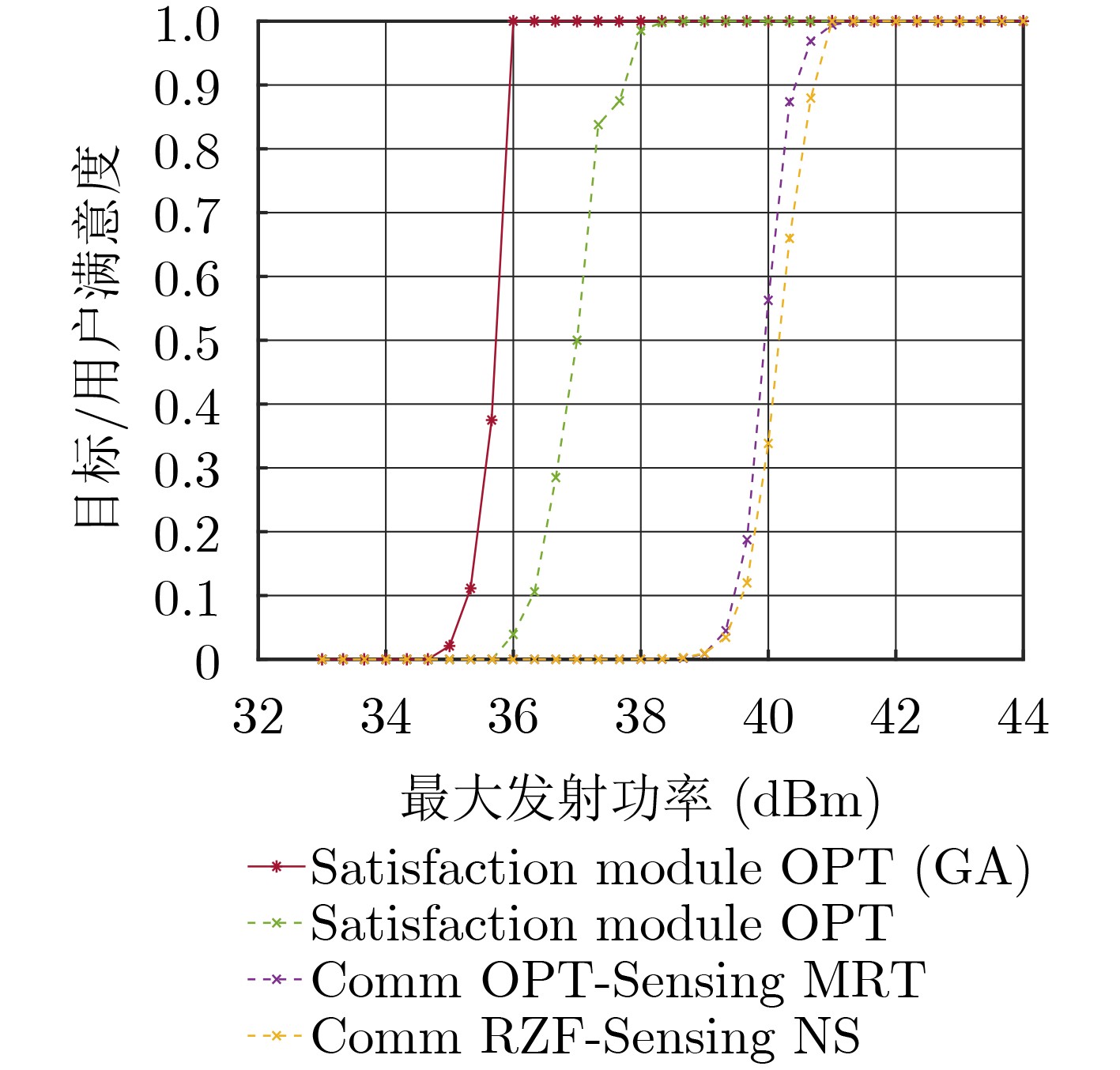
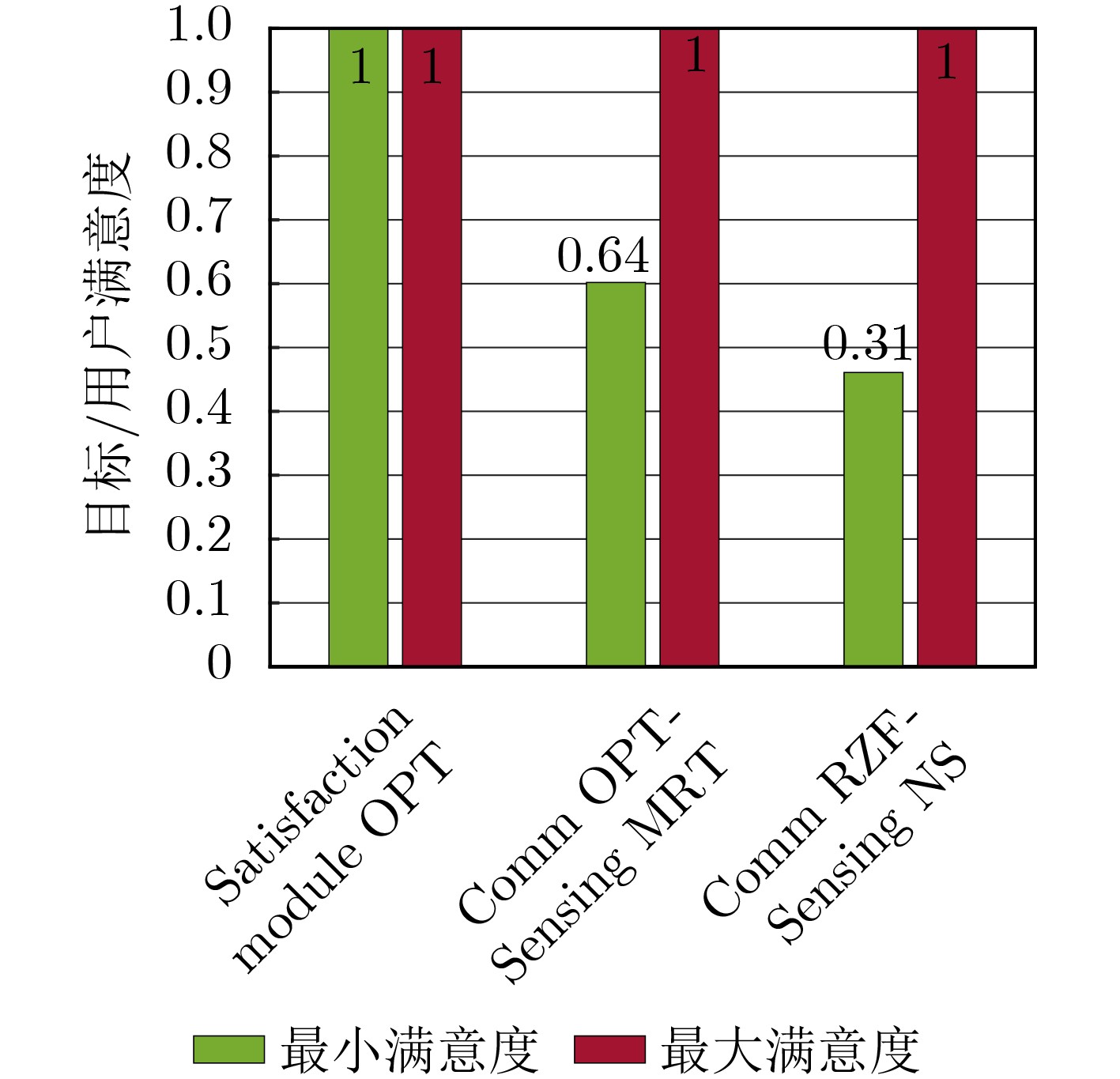
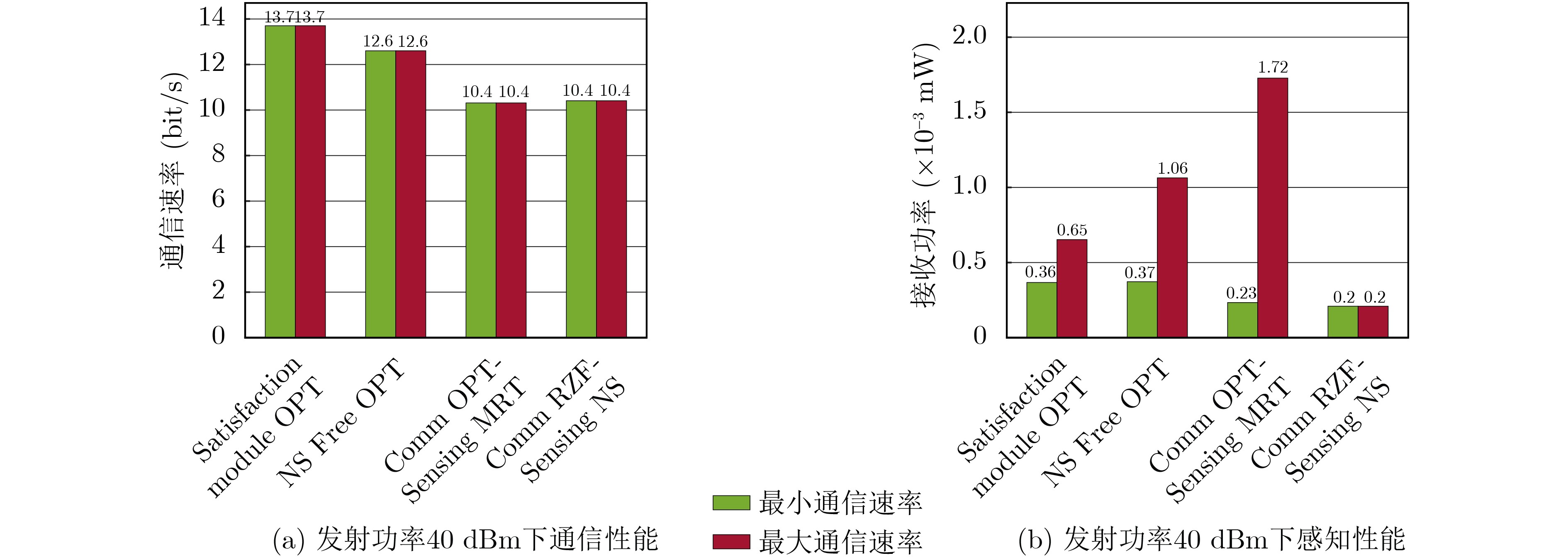
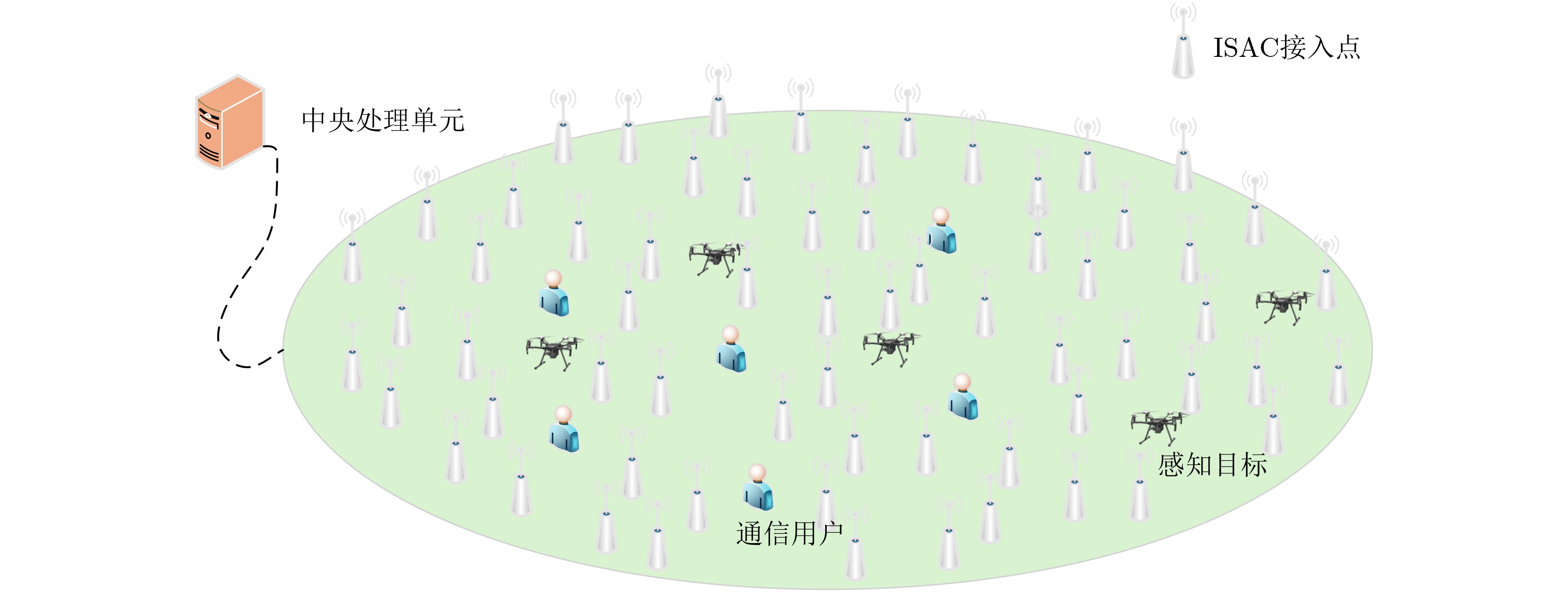
Abstract:Objective Integrated Sensing And Communication (ISAC) is a key technology for Sixth-Generation (6G) networks. The cell-free architecture is a promising regional coverage paradigm for 6G. Cooperation among Access Points (APs) mitigates coverage imbalance, interference, and capacity limitations in conventional cellular systems, while enabling communication and sensing services for low-altitude targets with wide-area continuous coverage. However, existing studies on cell-free systems often rely on statistical channel models, which fail to capture realistic propagation characteristics in complex environments. The global Channel State Information (CSI) required for transmission optimization is difficult to obtain, and instantaneous CSI cannot be guaranteed due to the high mobility of low-altitude targets. To address these issues, a joint beamforming and AP-user/target association optimization method based on a Binary Radio Map (BRM) is proposed. The environmental information provided by the BRM is used to predict channels between APs and users/targets, thereby providing global channel information for joint optimization. On this basis, an ISAC satisfaction-based optimization model is constructed, and an iterative optimization algorithm for beamforming design and AP-user/target association is developed using a genetic algorithm. Methods First, the channels between APs and users/targets are predicted using environmental information derived from the BRM. An ISAC satisfaction-based optimization model is then established to unify communication and sensing performance. Due to the coupling between communication and sensing and the non-convex nature of the problem, the optimization problem is decomposed into two subproblems corresponding to communication and sensing beamforming. In each iteration, the beamforming design is reformulated as a Second-Order Cone Program (SOCP) to obtain beamforming matrices that maximize the satisfaction function. An iterative solution algorithm is applied to compute the communication and sensing beamforming matrices efficiently. Subsequently, based on the optimized satisfaction function, an AP-user/target association optimization method is designed using a genetic algorithm. Results and Discussions Simulation results verify the effectiveness of the BRM-assisted channel prediction and association optimization method. Compared with the conventional AP association method based on the shortest path, the proposed approach reduces the required transmission power by approximately 5 dBm while achieving higher user/target satisfaction ( Fig. 7 ). As the transmission power increases, the satisfaction of users/targets gradually improves and approaches 1. In contrast, under the conventional scheme, a large gap remains between the maximum and minimum satisfaction values at the same transmission power (Fig. 8 ). When the transmission power is 40 dBm, the proposed method effectively reduces this disparity and balances performance among different users/targets. Although the null-space projection scheme leads to some degradation in sensing performance, the minimum received sensing power remains stable. This indicates that the overall system satisfaction is not affected and that sensing requirements are still satisfied (Fig. 9 ).Conclusions This study addresses the AP-user/target association problem in low-altitude airspace. The BRM is used to predict channels between APs and users/targets and to provide global channel information for joint optimization. By maximizing the minimum user/target satisfaction, ISAC beamforming is optimized, and AP-user/target association is iteratively refined using a genetic algorithm. Simulation results show that the proposed method effectively improves AP-user/target association and enhances integrated communication and sensing performance compared with existing approaches. -
1 问题$ {\mathcal{P}}_{2} $的求解算法
输入:初始化迭代精度$ {\varepsilon }_{0} $, $ {\varepsilon }_{1} $,最大发射功率$ {P}_{{m}}^{m\mathrm{ax}} $,CU满意
度范围$ {\mathcal{F}}_{{u}}\left({\boldsymbol{b}}_{\mathcal{D}}\right)\in \left[\mathcal{F}_{\mathrm{C}}^{\mathrm{min}},\mathcal{F}_{\mathrm{C}}^{\mathrm{max}}\right] $,ST满意度范围$ {\mathcal{F}}_{{v}}\left({\boldsymbol{b}}_{\mathcal{D}}\right)\in $
$ \left[\mathcal{F}_{\mathrm{S}}^{\mathrm{min}},\mathcal{F}_{\mathrm{S}}^{\mathrm{max}}\right] $,通信与感知传输链路$ {\boldsymbol{h}}_{{mk}} $,噪声方差$ {\sigma }^{2} $。输出:最佳通信波束$ {\boldsymbol{W}}_{{m}} $;最佳功率分配因子$ {\alpha }_{{mv}} $;综合满意
度$ \mathcal{F}\left({\boldsymbol{b}}_{\mathcal{D}}\right)=\mathrm{min}\left\{{\mathcal{F}}_{{u}}\left({\boldsymbol{b}}_{{{\mathcal{D}}_{{u}}}}\right),{\mathcal{F}}_{{v}}\left({\boldsymbol{b}}_{{{\mathcal{D}}_{{v}}}}\right)\right\} $。(1) WHILE$ \left| {\mathcal{F}}_{{v}}\left({\boldsymbol{b}}_{\mathcal{D}}\right)-{\mathcal{F}}_{{u}}\left({\boldsymbol{b}}_{\mathcal{D}}\right)\right| \lt {\varepsilon }_{0} $DO: (2) 令$ {\mathcal{F}}_{{v}}\left({\boldsymbol{b}}_{\mathcal{D}}\right)=\dfrac{1}{2}\left(\mathcal{F}_{\mathrm{C}}^{\mathrm{min}}+\mathcal{F}_{\mathrm{C}}^{\mathrm{max}}\right) $; (3) 解决通信优化问题$ {\tilde{\mathcal{P}}}_{2.1} $中,满意度$ {\mathcal{F}}_{{u}}\left({\boldsymbol{b}}_{\mathcal{D}}\right) $约束下的凸问
题,并得到最佳通信功率$ P_{m,\mathrm{C}} $;(4) 若$ P_{m,\mathrm{C}}\ge P_m^{m\mathrm{ax}} $,令$ \mathcal{F}_{\mathrm{C}}^{\mathrm{max}}={\mathcal{F}}_{{u}}\left({\boldsymbol{b}}_{\mathcal{D}}\right) $并执行步骤(5);否
则,令$ P_{m,\mathrm{S}}=P_m^{m\mathrm{ax}}-P_{m,\mathrm{C}} $;(5) 由满意度效用函数(11)映射得到$ {\mathcal{T}}_{{v}}\left({\boldsymbol{b}}_{\mathcal{D}}\right) \in \left[\mathcal{T}_{\mathrm{S}}^{\mathrm{min}},\mathcal{T}_{\mathrm{S}}^{\mathrm{max}}\right] $; (6) WHILE$ \left|\mathcal{T}_{\mathrm{S}}^{\mathrm{max}}-\mathcal{T}_{\mathrm{S}}^{\mathrm{min}}\right| \lt \varepsilon_1 $DO: (7) 求解感知优化问题,$ \mathcal{T}_{\mathrm{S}}^{\mathrm{min}}=\dfrac{1}{2}\left(\mathcal{T}_{\mathrm{S}}^{\mathrm{min}}+\mathcal{T}_{\mathrm{S}}^{\mathrm{max}}\right) $,否则
$ \mathcal{T}_{\mathrm{S}}^{\mathrm{max}}=\dfrac{1}{2}\left(\mathcal{T}_{\mathrm{S}}^{\mathrm{min}}+\mathcal{T}_{\mathrm{S}}^{\mathrm{max}}\right) $;(8) END (9) 若$ {\mathcal{F}}_{{v}}\left({\boldsymbol{b}}_{\mathcal{D}}\right) \gt {\mathcal{F}}_{{u}}\left({\boldsymbol{b}}_{\mathcal{D}}\right) $,使$ \mathcal{F}_{\mathrm{C}}^{\mathrm{min}}={\mathcal{F}}_{{u}}\left({\boldsymbol{b}}_{\mathcal{D}}\right) $, 其他情
况,设置$ \mathcal{F}_{\mathrm{C}}^{\mathrm{max}}={\mathcal{F}}_{{u}}\left({\boldsymbol{b}}_{\mathcal{D}}\right) $;(10) END  下载: 导出CSV
表 1 满意度模型的仿真参数
模型 数值 满意度评估模型 $ {\varGamma }_{{u}}=12 $ bit/(s·Hz) $ {{P}}_{{u}}=-35 $ dBm $ \left\{{\lambda }_{{u}}{,c}\right\} $={4,7}
下载: 导出CSV
-
[1] IMT-2030推进组. IMT-2030(6G)推进组正式发布《6G总体愿景与潜在关键技术》白皮书[J]. 互联网天地, 2021(6): 8–9.IMT-2030 Promotion Group. White paper: “Overall vision and potential key technologies of 6G”[J]. China Internet, 2021(6): 8–9. [2] LIU Fan, MASOUROS C, PETROPULU A P, et al. Joint radar and communication design: Applications, state-of-the-art, and the road ahead[J]. IEEE Transactions on Communications, 2020, 68(6): 3834–3862. doi: 10.1109/TCOMM.2020.2973976. [3] LIU Xiangnan, ZHANG Haijun; LONG Keping, et al. Proximal policy optimization-based transmit beamforming and phase-shift design in an IRS-aided ISAC system for the THz band[J]. IEEE Journal on Selected Areas in Communications, 2022, 40(7): 2056–2069. doi: 10.1109/JSAC.2022.3158696. [4] LIU Juan, LIU Wenjia, HOU Xiaolin, et al. An OFDM compatible sensing waveform design for 6G ISAC system[C]. 2024 IEEE 29th Asia Pacific Conference on Communications (APCC), BALI, Indonesia, 2024: 71–76. doi: 10.1109/APCC62576.2024.10767937. [5] CHENG Xiang, DUAN Dongliang, GAO Shijian, et al. Integrated sensing and communications (ISAC) for vehicular communication networks (VCN)[J]. IEEE Internet of Things Journal, 2022, 9(23): 23441–23451. doi: 10.1109/JIOT.2022.3191386. [6] LIU Rang, LI Ming, and LIU Qian. Joint space-time adaptive processing and beamforming design for cell-free ISAC systems[C]. ICASSP 2025–2025 IEEE International Conference on Acoustics, Speech and Signal Processing (ICASSP), Hyderabad, India, 2025: 1–5. doi: 10.1109/ICASSP49660.2025.10887688. [7] BJÖRNSON E and SANGUINETTI L. Cell-free versus cellular massive MIMO: What processing is needed for cell-free to win?[C]. 2019 IEEE 20th International Workshop on Signal Processing Advances in Wireless Communications, Cannes, France, 2019: 1–5. doi: 10.1109/SPAWC.2019.8815488. [8] DEMIRHAN U and ALKHATEEB A. Learning beamforming in cell-free massive MIMO ISAC systems[C]. 2024 IEEE 25th International Workshop on Signal Processing Advances in Wireless Communications (SPAWC), Lucca, Italy, 2024: 326–330. doi: 10.1109/SPAWC60668.2024.10694569. [9] WANG Zihuan and WONG V W S. Cooperative ISAC for localization and velocity estimation using OFDM waveforms in cell-free MIMO systems[C]. ICASSP 2025 - 2025 IEEE International Conference on Acoustics, Speech and Signal Processing (ICASSP), Hyderabad, India, 2025: 1–5. doi: 10.1109/ICASSP49660.2025.10888115. [10] WANG Lifu and ZHANG Qi. Cell-free massive MIMO with UAV access points: UAV location optimization[C]. 2022 IEEE/CIC International Conference on Communications in China (ICCC), Foshan, China, 2022: 262–267, doi: 10.1109/ICCC55456.2022.9880734. [11] SHI Ke, DAI Zhuoyin, and ZENG Yong. Dynamic AP association for UAV-centric aerial-ground communication with cell-free massive MIMO[C]. 2023 International Conference on Communications, Computing and Artificial Intelligence (CCCAI), Shanghai, China, 2023: 139–144. doi: 10.1109/CCCAI59026.2023.00033. [12] LIU Xiao, LIU Yuanwei, and CHEN Yue. Reinforcement learning in multiple-UAV networks: Deployment and movement design[J]. IEEE Transactions on Vehicular Technology, 2019, 68(8): 8036–8049. doi: 10.1109/TVT.2019.2922849. [13] SAMIR M, SHARAFEDDINE S, and ASSI C M. UAV trajectory planning for data collection from time-constrained IoT devices[J]. IEEE Transactions on Wireless Communications, 2020, 19(1): 34–46. doi: 10.1109/TWC.2019.2940447. [14] KUMAR N, SINGH S P, and PRADHAN P M. Scalable cell-free massive MIMO systems with graph coloring based pilot assignment[C]. 2024 27th International Symposium on Wireless Personal Multimedia Communications (WPMC), Greater Noida, India, 2024: 1–6. doi: 10.1109/WPMC63271.2024.10863435. [15] CHEN Junting, YATNALLI U, and GESBERT D. Learning radio maps for UAV-aided wireless networks: A segmented regression approach[C]. 2017 IEEE International Conference on Communications (ICC), Paris, France, 2017: 1–6. doi: 10.1109/ICC.2017.7997333. [16] ZENG Yong and XU Xiaoli. Toward environment-aware 6G communications via channel knowledge map[J]. IEEE Wireless Communications, 2021, 28(3): 84–91. doi: 10.1109/MWC.001.2000327. [17] YANG Bin, WANG Wei, and ZHANG Wei. Cell-free massive MIMO beamforming based on radio map[C]. ICC 2024 - IEEE International Conference on Communications, Denver, USA, 2024: 4506–4511. doi: 10.1109/ICC51166.2024.10622568. [18] XIA Xiaochen, XU Kui, and XIE Wei. Multiple aerial base station deployment and user association based on binary radio map[J]. IEEE Internet of Things Journal, 2023, 10(19): 17206–17219. doi: 10.1109/JIOT.2023.3272555. [19] CHEN Li, WANG Bin, CHEN Xiaohang, et al. Utility-based resource allocation for mixed traffic in wireless networks[C]. 2011 IEEE Conference on Computer Communications Workshops (INFOCOM WKSHPS), Shanghai, China, 2011: 91–96. doi: 10.1109/INFCOMW.2011.5928944. [20] LEE K H, FISCHER I, WU Y H, et al. Evolving deeper LLM thinking[J]. arXiv: 2501.09891, 2025. [21] NGUYEN T, NGUYEN V D, NGUYEN H V, et al. Massive MIMO joint communications and sensing with MRT beamforming[C]. 2024 IEEE Radar Conference (RadarConf24), Denver, USA, 2024: 1–6. doi: 10.1109/RadarConf2458775.2024.10549340. [22] DEMIRHAN U and ALKHATEEB A. Cell-free joint sensing and communication MIMO: A max-min fair beamforming approach[C]. 2023 57th Asilomar Conference on Signals, Systems, and Computers, Pacific Grove, USA, 2023: 381–386. doi: 10.1109/IEEECONF59524.2023.10477011. -

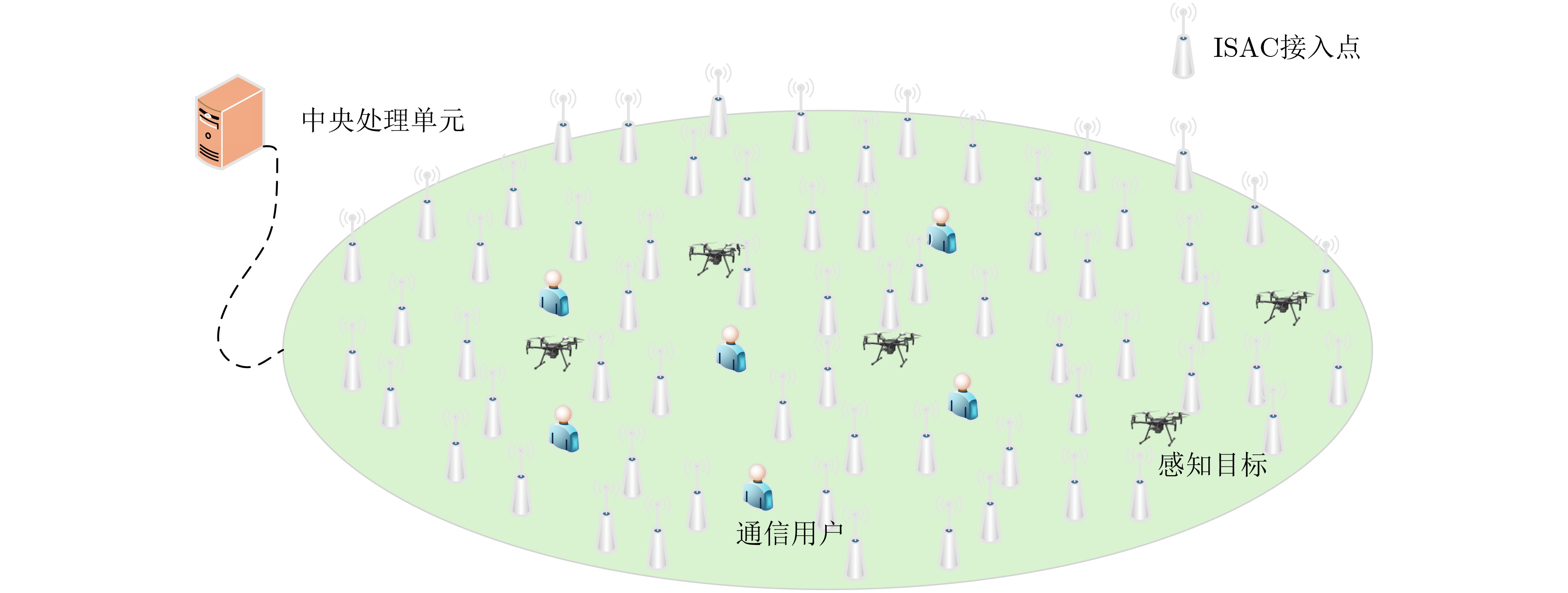
 下载:
下载:
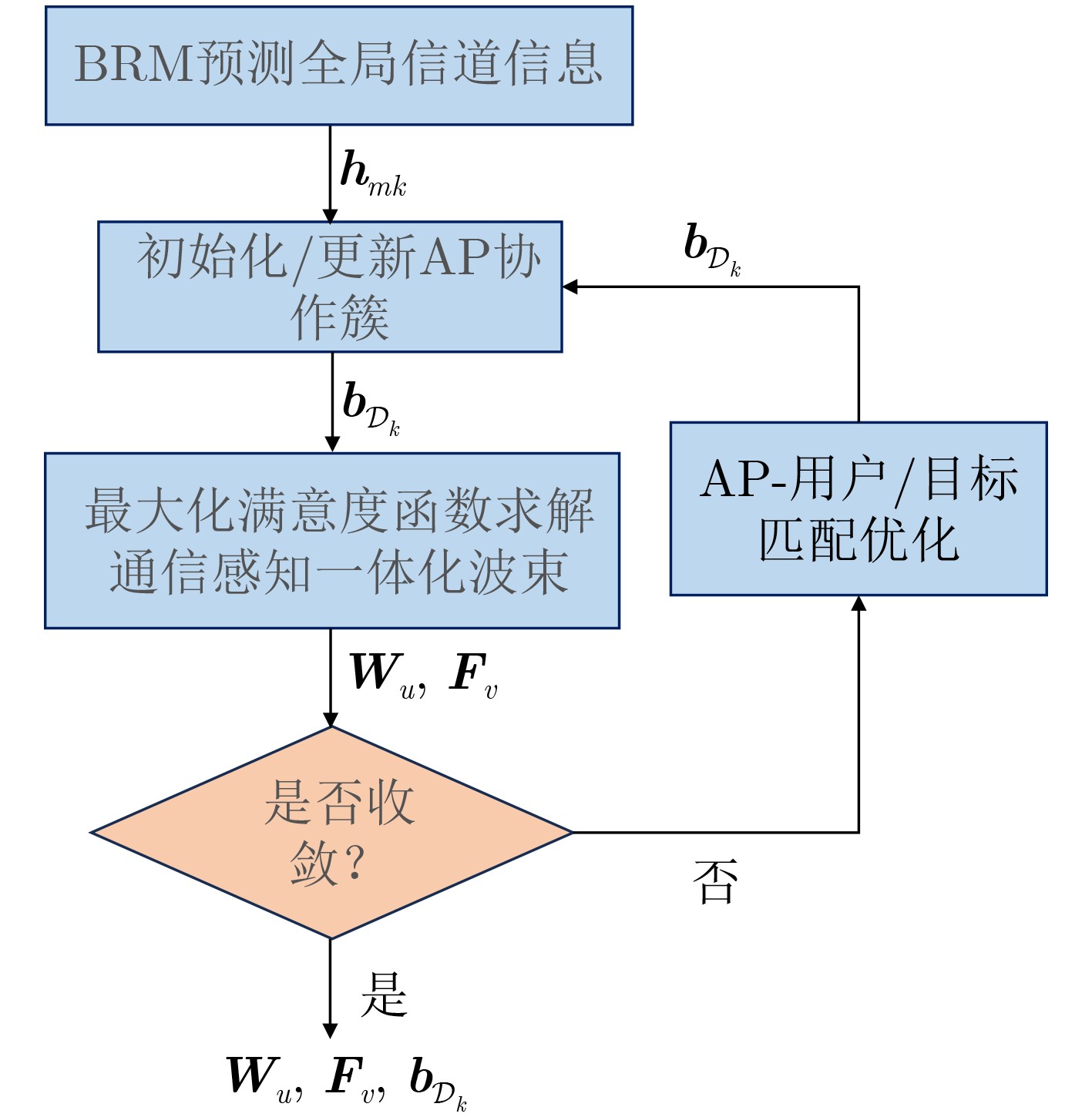
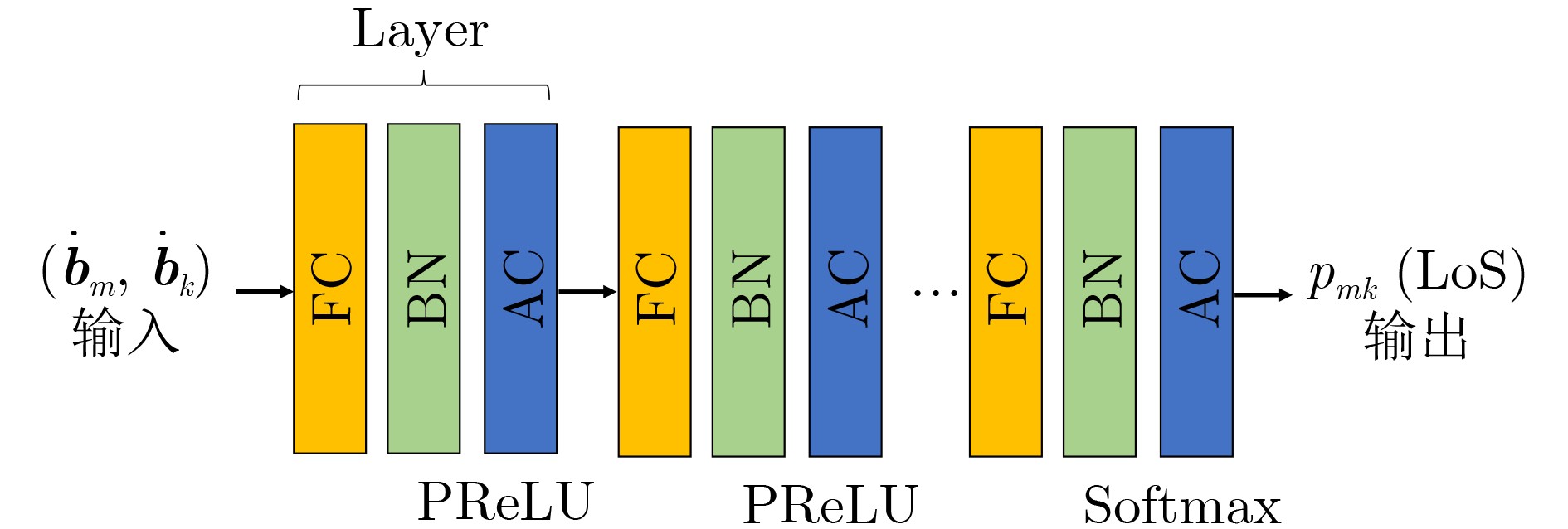
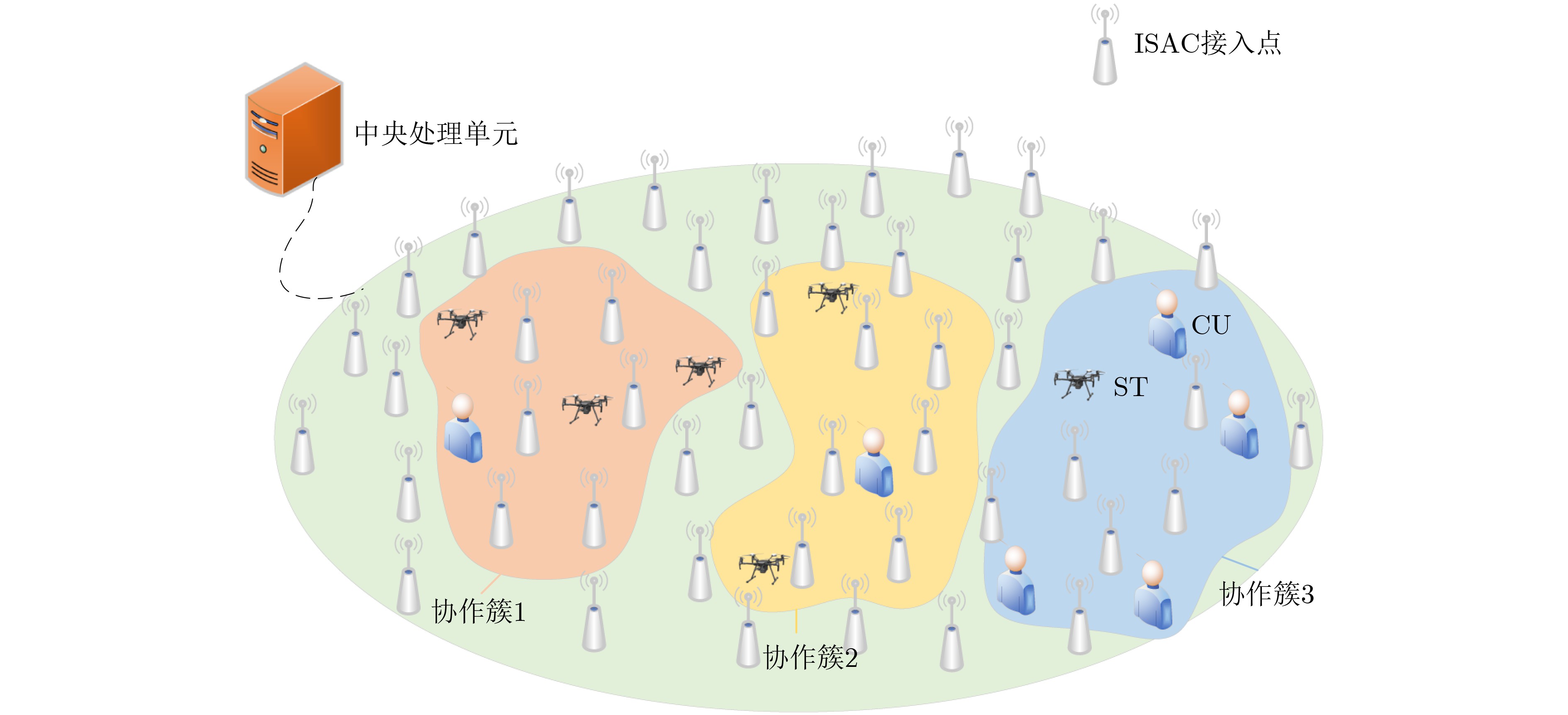


图(10) / 表(3)
计量
- 文章访问数: 851
- HTML全文浏览量: 436
- PDF下载量: 63
- 被引次数: 0
