




Research on Inverse QR Decomposition Optimization for Sparse Adaptive System Identification Algorithms
-
摘要: 传统稀疏正则化递归最小二乘算法 L1/L0 Norm Recursive Least Squares (L1/L0-RLS)在稀疏参数空间估计中展现出理论的优越性,已成为系统辨识和信道均衡领域的重要方法。但在有限数值精度条件下其协方差矩阵迭代计算过程易导致舍入误差逐次累积,诱发最小二乘解发散失稳现象。为解决该问题,该文提出基于逆QR分解(IQRD)框架的改进算法,不仅有效抑制传统正则化RLS算法中舍入误差的积累,而且省去传统QR分解中权重系数回代的计算环节,从而显著提升算法在有限精度环境下的数值鲁棒性与系统辨识效率。具体而言,首先,系统构建L1/L0约束逆QR分解架构下的L1-IQRD-RLS与L0-IQRD-RLS算法,通过理论推导得到具有普适性的权重系数递推表达式,创新性地将自动参数选择机制引入算法框架,解决了稀疏正则化参数的动态优化难题。为验证所提算法在稀疏约束与鲁棒性方面的效果,该文采用蒙特卡罗仿真实验对算法性能进行定量评估,结果表明L1-IQRD-RLS与L0-IQRD-RLS在系统稀疏表征、参数估计方差以及协方差矩阵条件数等关键指标上均展现出显著的性能优势。实测数据验证进一步证实,改进算法在精度受限环境下仍能保持数值稳定性,较传统方法鲁棒性显著提升。Abstract:
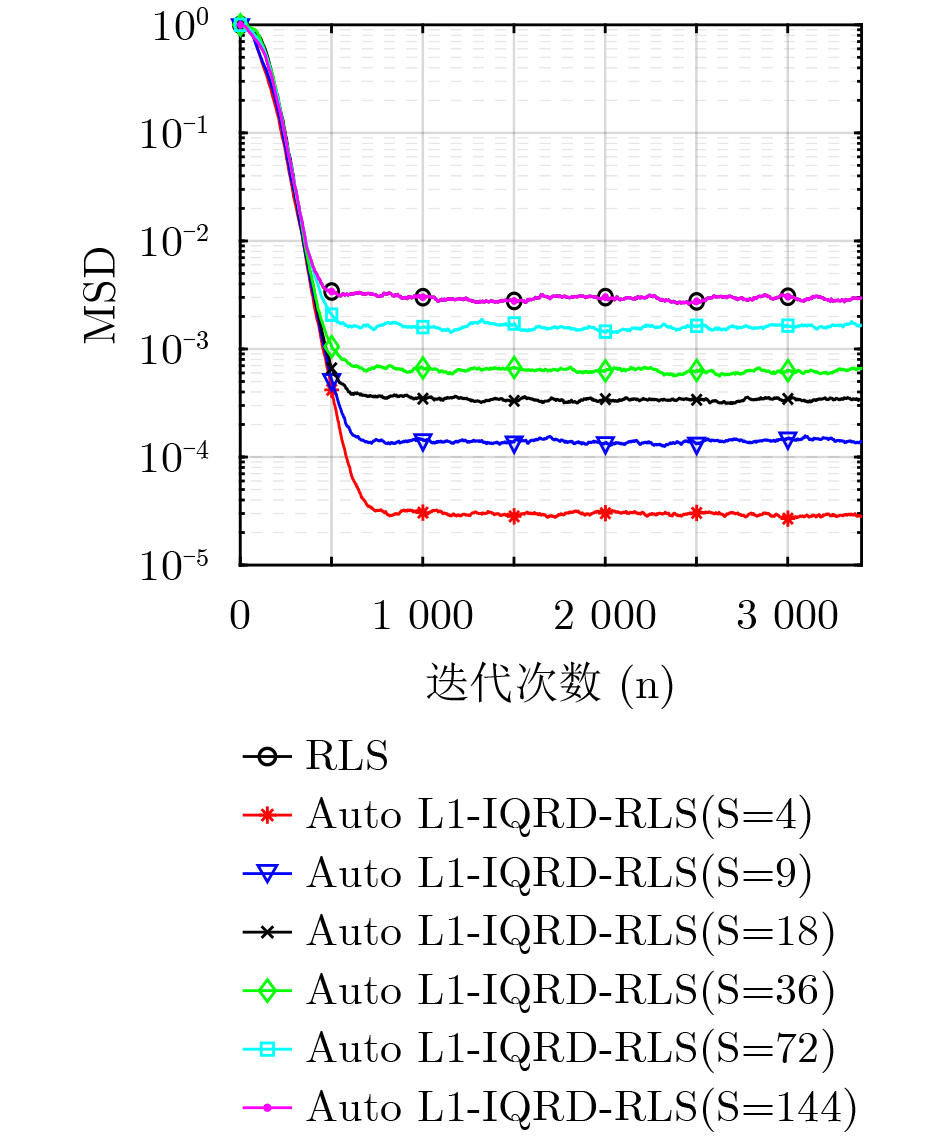
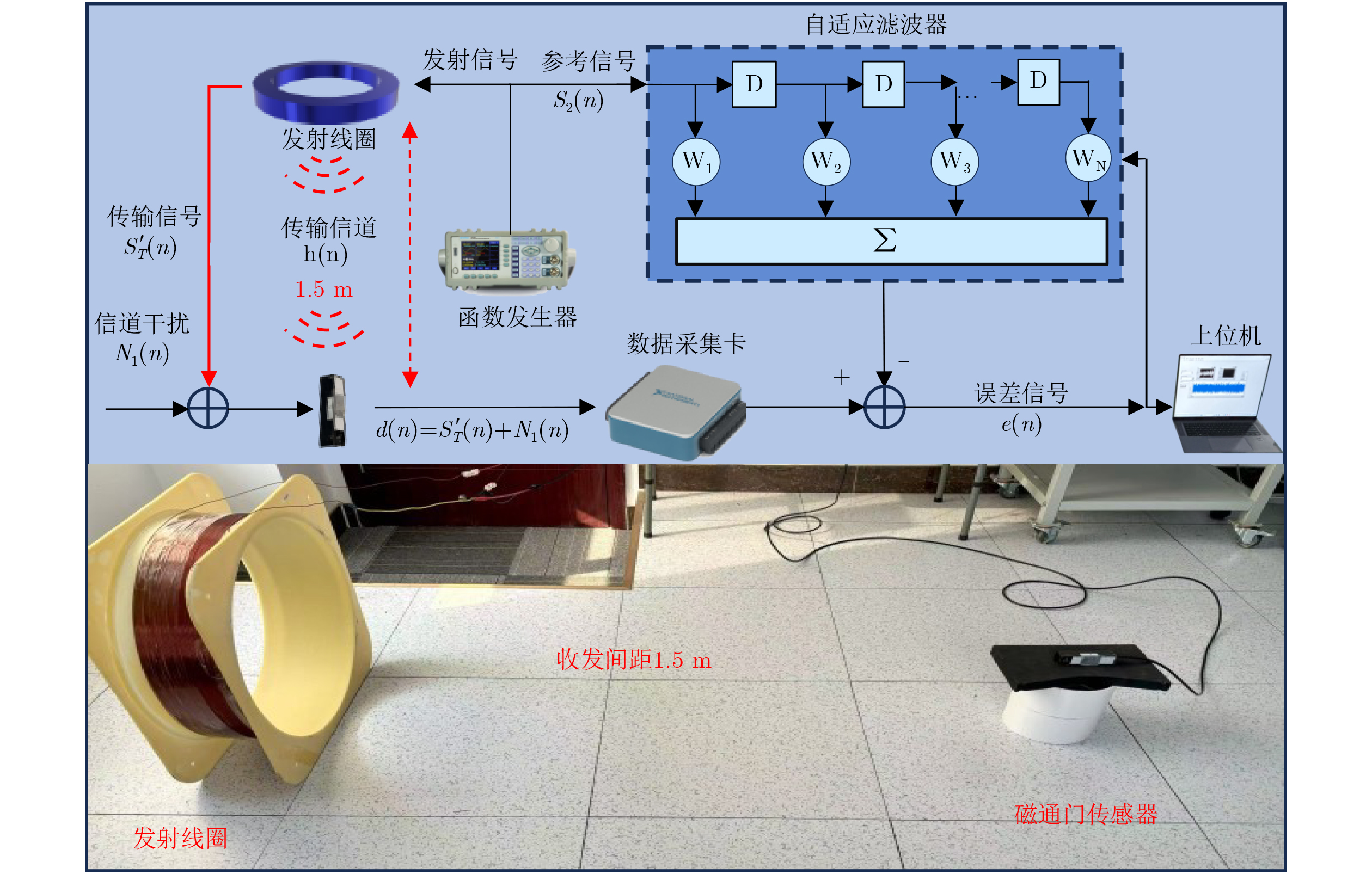
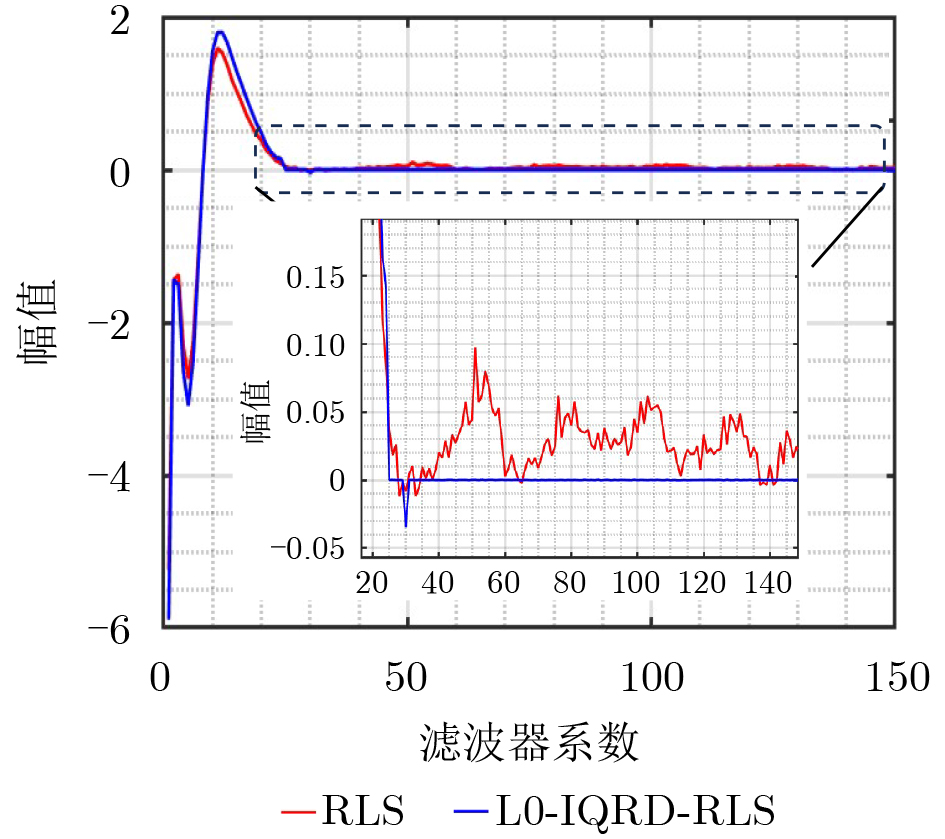
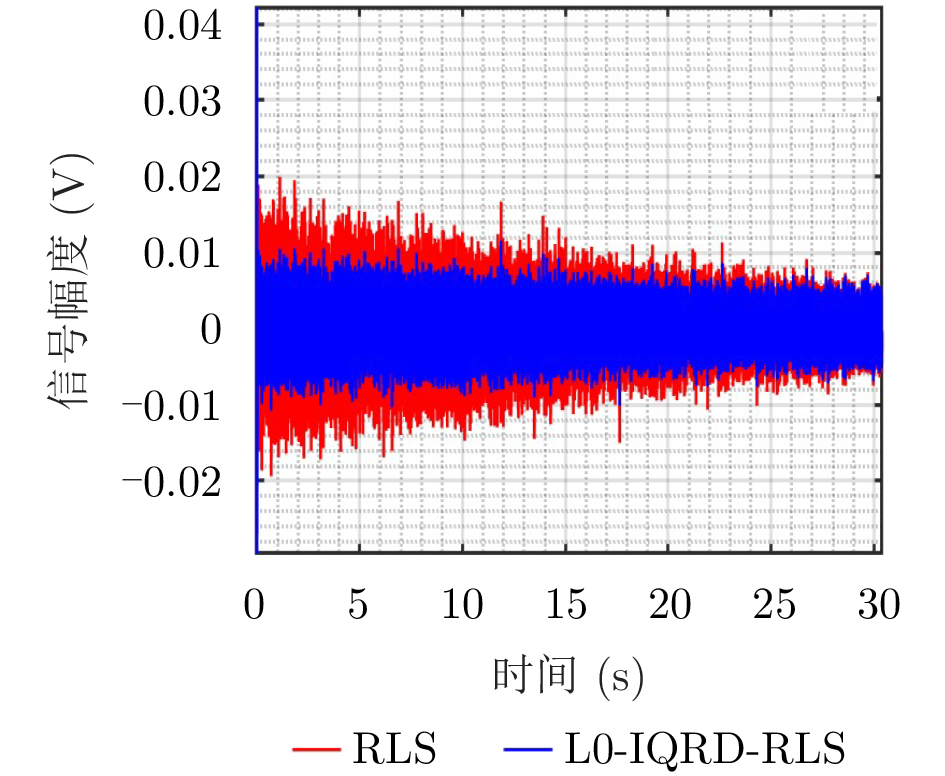
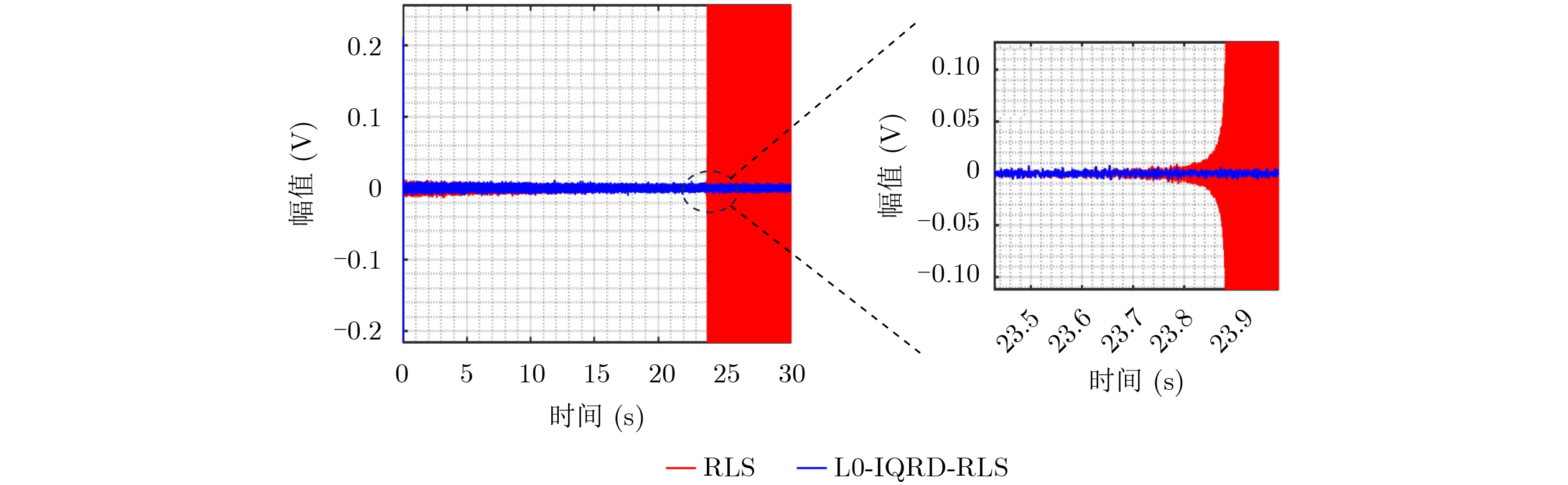
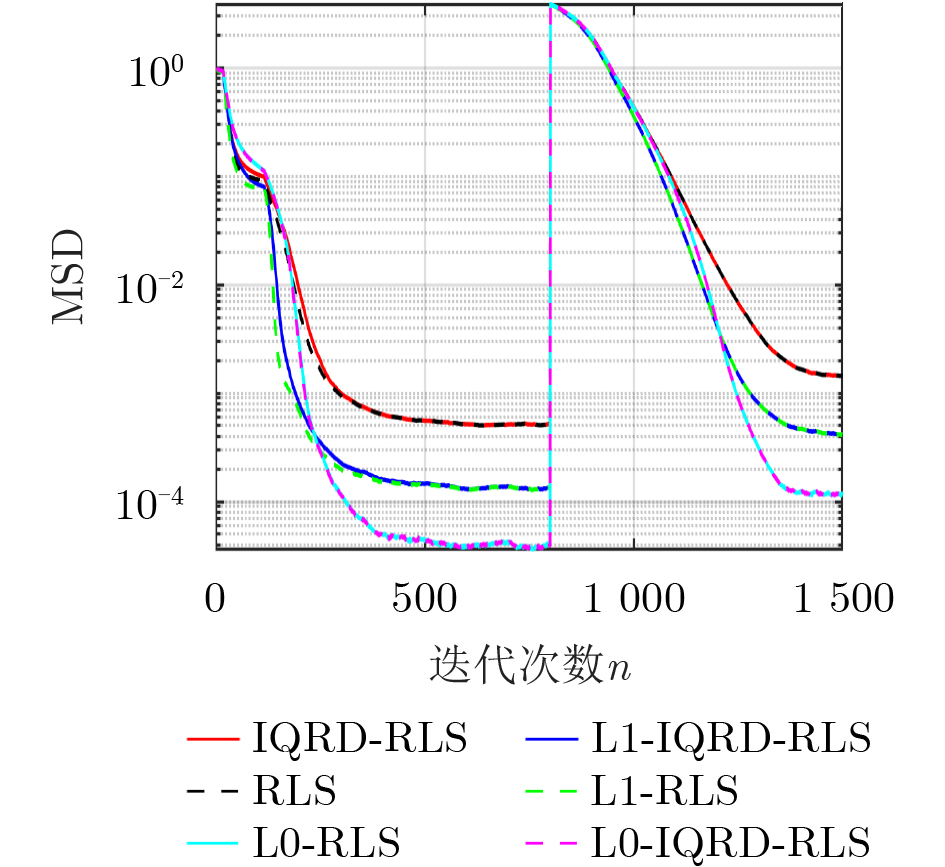
Objective Traditional sparse-regularized Recursive Least Squares (RLS) algorithms, namely L1/L0-norm Recursive Least Squares (L1/L0-RLS), have theoretical advantages in sparse parameter-space estimation and are widely used in system identification and channel equalization. However, under limited numerical precision, iterative covariance matrix computation may cause rounding errors to accumulate. This can lead to divergence and instability in the least-squares solution. Methods To address this problem, an improved algorithm based on the Inverse QR Decomposition (IQRD) framework is proposed. The framework suppresses rounding-error accumulation in traditional regularized RLS algorithms. It also removes the back-substitution step for weight coefficients required in conventional QR decomposition. These features improve numerical robustness and system identification efficiency in finite-precision environments. Specifically, L1-IQRD-RLS and L0-IQRD-RLS algorithms are constructed under an L1/L0-constrained IQRD architecture. A general recursive expression for the weight coefficients is derived. An automatic parameter selection mechanism is also incorporated into the algorithm framework to solve the dynamic optimization problem of the sparse regularization parameter. Results and Discussions Monte Carlo simulations are conducted to evaluate the sparse constraints and robustness of the proposed algorithms. The results show that L1-IQRD-RLS and L0-IQRD-RLS maintain long-term numerical stability in an 11-decimal-place fixed-point computing environment. Compared with traditional algorithms, the proposed algorithms show clear advantages in system sparsity representation, parameter estimation variance, and covariance matrix condition number. Measured-data verification further confirms that the improved algorithms maintain numerical stability under limited-precision conditions and are more robust than traditional methods. The measured-data results also show that the regularized RLS algorithms optimized by the IQRD framework have advantages in system sparsity representation, parameter estimation, and numerical stability. Their iterative convergence success rate is higher than that of traditional methods. Conclusions This paper addresses sparse system identification in adaptive filtering. Traditional sparse-regularized RLS algorithms still face numerical stability problems under limited numerical precision. To solve this problem, an IQRD framework is constructed to reduce the numerical ill-conditioning caused by accumulated rounding errors in sparse-regularized RLS algorithms. The proposed method improves numerical robustness in low-precision environments. In addition, an automatic parameter selection mechanism is incorporated into the algorithm framework. This reduces repeated parameter tuning and supports stable performance optimization under sparse constraints. In practical electromagnetic signal processing, system identification and beamforming are limited by the finite precision of hardware implementation and often exhibit inherent system sparsity. The proposed algorithm provides a targeted solution. Its finite-word-length robustness suppresses numerical divergence during adaptive weight updates and supports stable implementation on fixed-point processors. The sparse constraints also match the physical characteristics of sparse systems and improve estimation accuracy. This study provides a practical algorithm for high-performance and high-stability sparse-constrained systems on precision-limited hardware platforms. -
[1] WIDROW B and STEARNS S D. Adaptive Signal Processing[M]. Englewood Cliffs: Prentice-Hall, 1985. [2] HAYKIN S. Adaptive Filter Theory[M]. 3rd ed. Upper Saddle River: Prentice-Hall, Inc. , 1996. [3] PALEOLOGU C, BENESTY J, and CIOCHINA S. A robust variable forgetting factor recursive least-squares algorithm for system identification[J]. IEEE Signal Processing Letters, 2008, 15: 597–600. doi: 10.1109/LSP.2008.2001559. [4] CHOWDHURY N M M and ULLAH M A. An efficient channel equalization scheme with multi-layer of adaptation[C]. 2025 International Conference on Electrical, Computer and Communication Engineering (ECCE), Chittagong, Bangladesh, 2025: 1–6. doi: 10.1109/ECCE64574.2025.11013831. [5] LIU Di, BALDI S, LIU Quan, et al. A recursive least squares algorithm with ℓ1 regularization for sparse representation[J]. Science China Information Sciences, 2023, 66(2): 129202. doi: 10.1007/s11432-022-3546-5. [6] ALEXANDER S T and GHIMIKAR A L. A method for recursive least squares filtering based upon an inverse QR decomposition[J]. IEEE Transactions on Signal Processing, 1993, 41(1): 20. doi: 10.1109/TSP.1993.193124. [7] GHIRNIKAR A L, ALEXANDER S T, and PLEMMONS R J. A parallel implementation of the inverse QR adaptive filter[J]. Computers & Electrical Engineering, 1992, 18(3/4): 291–300. doi: 10.1016/0045-7906(92)90021-5. [8] QIN Zhen, TAO Jun, XIA Yili, et al. Proportionate RLS with l1 norm regularization: Performance analysis and fast implementation[J]. Digital Signal Processing, 2022, 122: 103366. doi: 10.1016/j.dsp.2021.103366. [9] WANG Yu, QIN Zhen, TAO Jun, et al. Sparse adaptive channel estimation based on l0-PRLS algorithm for underwater acoustic communications[C]. OCEANS 2022-Chennai, Chennai, India, 2022: 1–5. doi: 10.1109/OCEANSChennai45887.2022.9775337. [10] LIU Haotian, MA Lu, WANG Zhaohui, et al. Channel prediction for underwater acoustic communication: A review and performance evaluation of algorithms[J]. Remote Sensing, 2024, 16(9): 1546. doi: 10.3390/rs16091546. [11] YIN Jingwei, ZHU Guangjun, HAN Xiao, et al. Temporal correlation and message-passing-based sparse Bayesian learning channel estimation for underwater acoustic communications[J]. IEEE Journal of Oceanic Engineering, 2024, 49(2): 522–541. doi: 10.1109/JOE.2023.3330523. [12] CHAVAN S D, KANASE D B, JADHAV S P, et al. Underwater wireless communication network by magnetic field using sparse sensing[C]. 2024 International Conference on Intelligent Systems and Advanced Applications (ICISAA), Pune, India, 2024: 1–5. doi: 10.1109/ICISAA62385.2024.10829175. [13] THADIKAMALLA N R and AMARA P R. Synthesis of elliptical cylindrical antenna array using craziness particle swarm optimization for suppressing sidelobe level[J]. Journal of Electromagnetic Waves and Applications, 2024, 38(14): 1592–1604. doi: 10.1080/09205071.2024.2385502. [14] ZORKUN A E, SALAS-NATERA M A, and RODRÍGUEZ-OSORIO R M. An improved hybrid beamforming algorithm for fast target tracking in satellite and V2X communication[J]. Remote Sensing, 2024, 16(1): 13. doi: 10.3390/rs16010013. [15] HONG Jingxi, CHU Yijing, CHAN S C, et al. A robust RLS-based generalized sidelobe canceller using spatial regularization[J]. Digital Signal Processing, 2025, 164: 105273. doi: 10.1016/j.dsp.2025.105273. [16] 曲庆, 金坚, 谷源涛. 用于稀疏系统辨识的改进l0-LMS算法[J]. 电子与信息学报, 2011, 33(3): 604–609. doi: 10.3724/SP.J.1146.2010.00417.QU Qing, JIN Jian, and GU Yuantao. An improved l0-LMS algorithm for sparse system identification[J]. Journal of Electronics & Information Technology, 2011, 33(3): 604–609. doi: 10.3724/SP.J.1146.2010.00417. [17] SALMAN M, YOUSSEF A A F, ELSAYED F, et al. A sparse variable step-size least-mean-square algorithm for impulsive noise in a code-division multiple access system[J]. IEEE Access, 2025, 13: 86026–86031. doi: 10.1109/ACCESS.2025.3570122. [18] EKŞIOĞLU E M. RLS adaptive filtering with sparsity regularization[C]. The 10th International Conference on Information Science, Signal Processing and their Applications (ISSPA 2010), Kuala Lumpur, Malaysia, 2010: 550–553. doi: 10.1109/ISSPA.2010.5605592. [19] EKSIOGLU E M and TANC A K. RLS algorithm with convex regularization[J]. IEEE Signal Processing Letters, 2011, 18(8): 470–473. doi: 10.1109/LSP.2011.2159373. [20] GILL P E, GOLUB G H, MURRAY W, et al. Methods for modifying matrix factorizations[J]. Mathematics of Computation, 1974, 28(126): 505–535. doi: 10.1090/S0025-5718-1974-0343558-6. [21] CHU Y J and MAK C M. A new QR decomposition-based RLS algorithm using the split Bregman method for L1-regularized problems[J]. Signal Processing, 2016, 128: 303–308. doi: 10.1016/j.sigpro.2016.04.013. [22] CHEN Badong, ZHENG Nanning, and PRINCIPE J C. Sparse kernel recursive least squares using L1 regularization and a fixed-point sub-iteration[C]. 2014 IEEE International Conference on Acoustics, Speech and Signal Processing (ICASSP), Florence, Italy, 2014: 5257–5261. doi: 10.1109/ICASSP.2014.6854606. [23] STANCIU C L, ANGHEL C, and ELISEI-ILIESCU C. Regularized RLS adaptive algorithm with conjugate gradient method[C]. 2023 International Conference on Speech Technology and Human-Computer Dialogue (SpeD), Bucharest, Romania, 2023: 18–23. doi: 10.1109/SpeD59241.2023.10314893. [24] HUANG Yanjie, WANG Weijiang, XUE Chengbo, et al. Scalable hardware architecture for high-throughput implementation of ESPRIT algorithm[J]. IEEE Sensors Journal, 2025, 25(13): 24812–24828. doi: 10.1109/JSEN.2025.3568483. [25] LIU Quan, LIU Di, and BALDI S. A new recursive approach to sparse representation[C]. 2023 IEEE International Conference on Development and Learning (ICDL), Macau, China, 2023: 461–466. doi: 10.1109/ICDL55364.2023.10364401. [26] XING Jinling, GE Songhu, HE Fangmin, et al. RF cancellation system based on inverse QRD_RLS weight extraction[C]. 2023 IEEE 6th International Conference on Electronic Information and Communication Technology (ICEICT), Qingdao, China, 2023: 154–158. doi: 10.1109/ICEICT57916.2023.10245523. [27] DJIGAN V and KURGANOV V. Antenna arrays calibration using recursive least squares adaptive filtering algorithms based on inverse QR decomposition[C]. 2020 IEEE East-West Design & Test Symposium (EWDTS), Varna, Bulgaria, 2020: 1–5. doi: 10.1109/EWDTS50664.2020.9224860. [28] NEOH H S, DUHAMEL P, and PYE W. MVDR adaptive beamforming using oneAPI SYCL HLS targeting direct RF FPGA[C]. 2024 IEEE International Symposium on Phased Array Systems and Technology (ARRAY), Boston, USA, 2024: 1–5. doi: 10.1109/ARRAY58370.2024.10880432. [29] DJIGAN V. Adaptive arrays based on real-valued arithmetic linearly-constrained IQRD RLS adaptive filtering algorithms[C]. 2021 IEEE 3rd Ukraine Conference on Electrical and Computer Engineering (UKRCON), Lviv, Ukraine, 2021: 196–201. doi: 10.1109/UKRCON53503.2021.9575646. [30] 鲁伟俊, 李斌. 主动磁探测叠加信号的自适应对消技术研究[J]. 中国仪器仪表, 2019(6): 55–59. doi: 10.11993/j.issn.2096-3920.2019.04.009.LU Weijun and LI Bin. Study of the active magnetic detection based on adaptive cancelltion for superposed signal[J]. China Instrumentation, 2019(6): 55–59. doi: 10.11993/j.issn.2096-3920.2019.04.009. [31] 谭思炜,赵军,张萌,等. 一种宽带电磁引信直接耦合干扰的快速补偿方法[J]. 水下无人系统学报, 2019, 27(4):8. doi: doi: 10.11993/j.issn.2096-3920.2019.04.009.TAN Siwei, ZHAO Jun, ZHANG Meng, et al. A Fast Compensation Method for Direct Coupling Interference of Wideband Electromagnetic Fuzes [J]. Journal of Underwater Unmanned Systems, 2019, 27(4):8. doi: doi: 10.11993/j.issn.2096-3920.2019.04.009. -

 下载:
下载:

图(9)
计量
- 文章访问数: 401
- HTML全文浏览量: 139
- PDF下载量: 30
- 被引次数: 0
