




Multi-Channel Switching Array DOA Estimation Algorithm Based on FRIDA
-
摘要: 针对波达方向(Direction Of Arrival, DOA)估计在实际测向系统中系统复杂度受接收通道数目影响的问题,该文提出一种基于FRIDA(Finite Rate of Innovation Direction-of-Arrival)的多通道切换阵列DOA估计算法。该算法首先利用开关将特定子阵接收的数据传输至通道从而减少测向系统中使用的通道数目,然后通过切换不同的子阵接入通道并采样得到多个少通道接收数据协方差矩阵,利用这些协方差矩阵重构出全通道接收数据向量,以此来构建基于有限新息率(Finite Rate of Innovation, FRI)的DOA估计模型,最后通过近端梯度下降算法获得信号入射方向的估计结果。仿真实验与对实测数据的实验验证了该算法优于同等条件下的其它算法。Abstract:
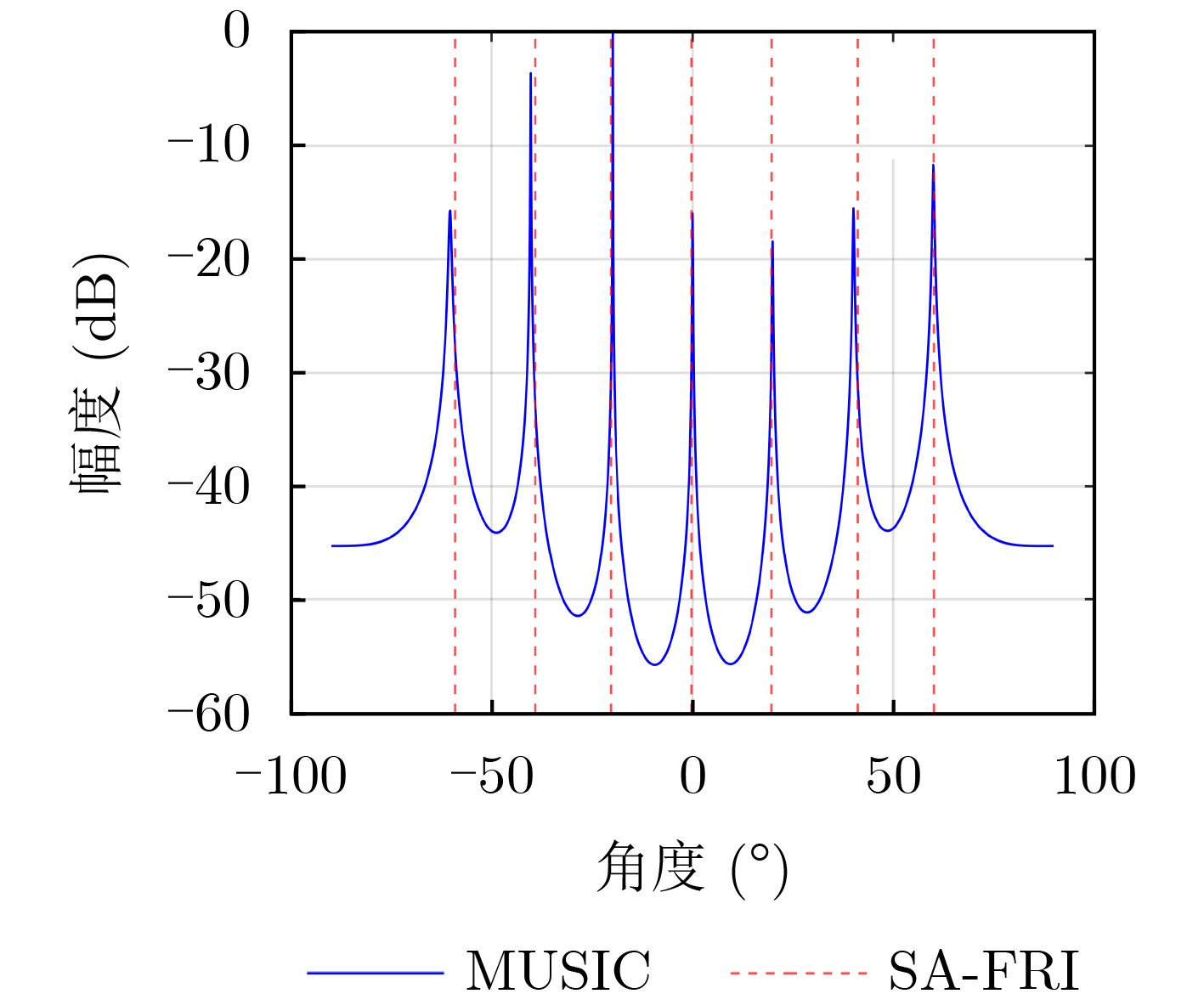
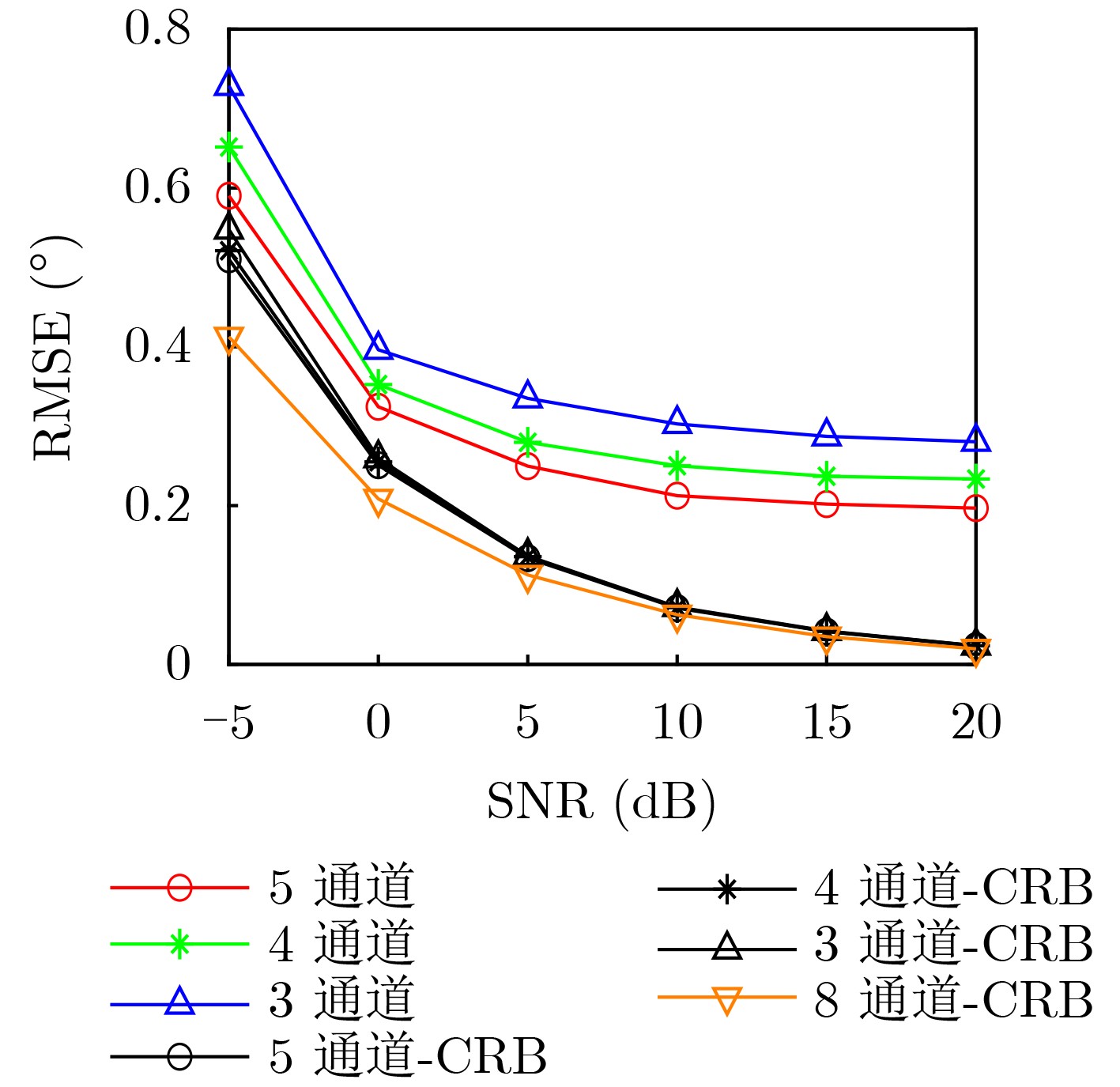
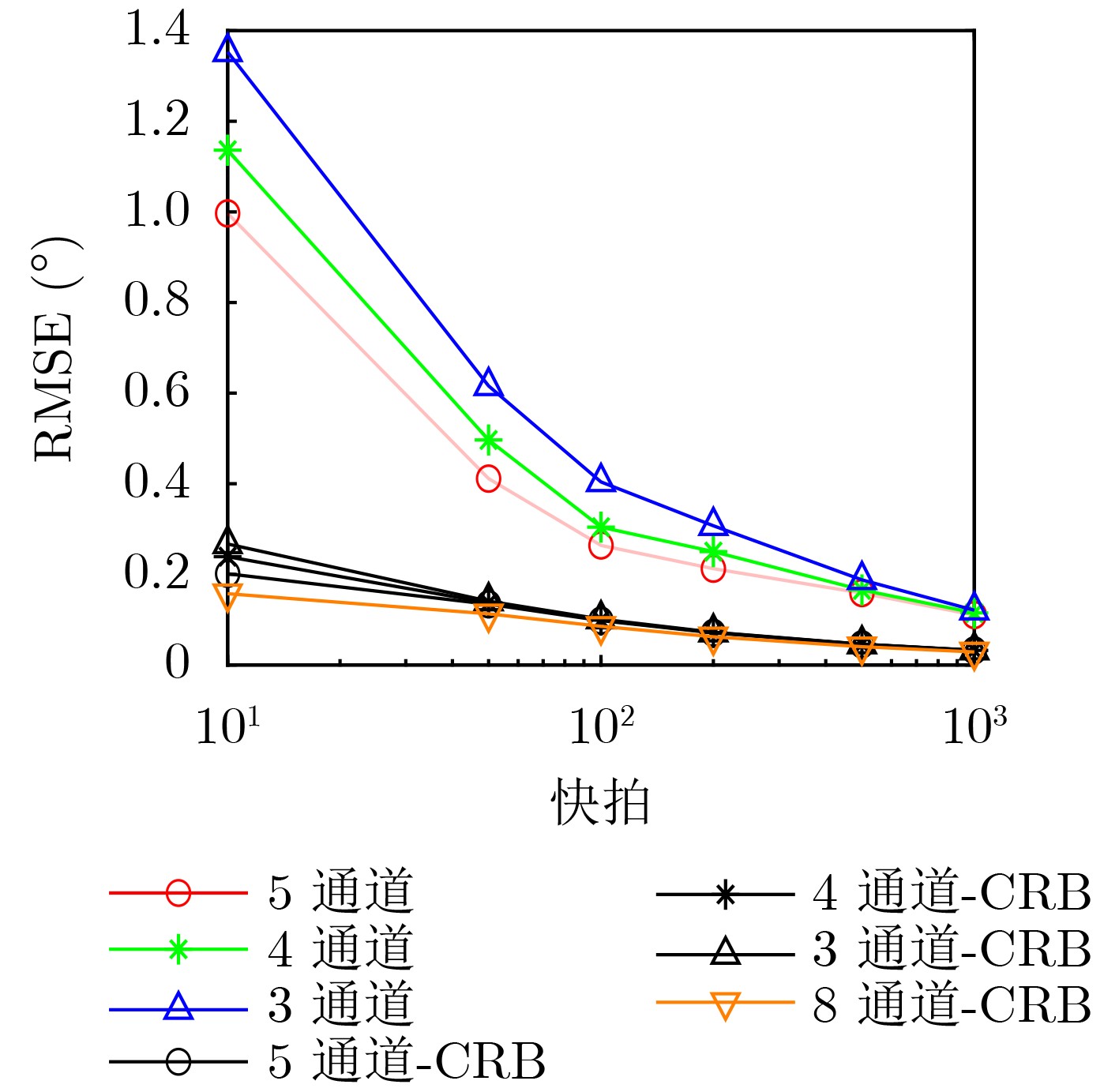
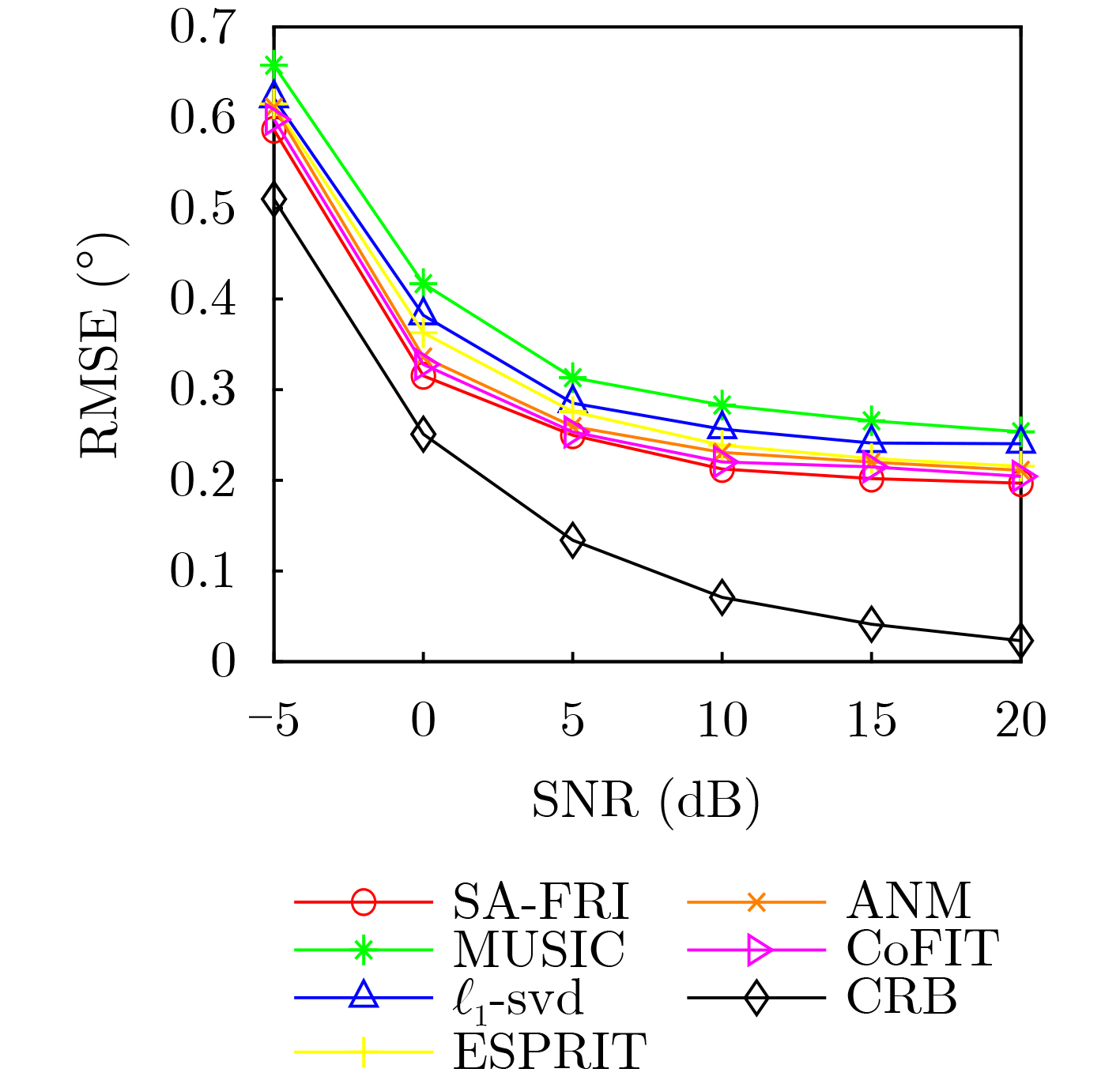
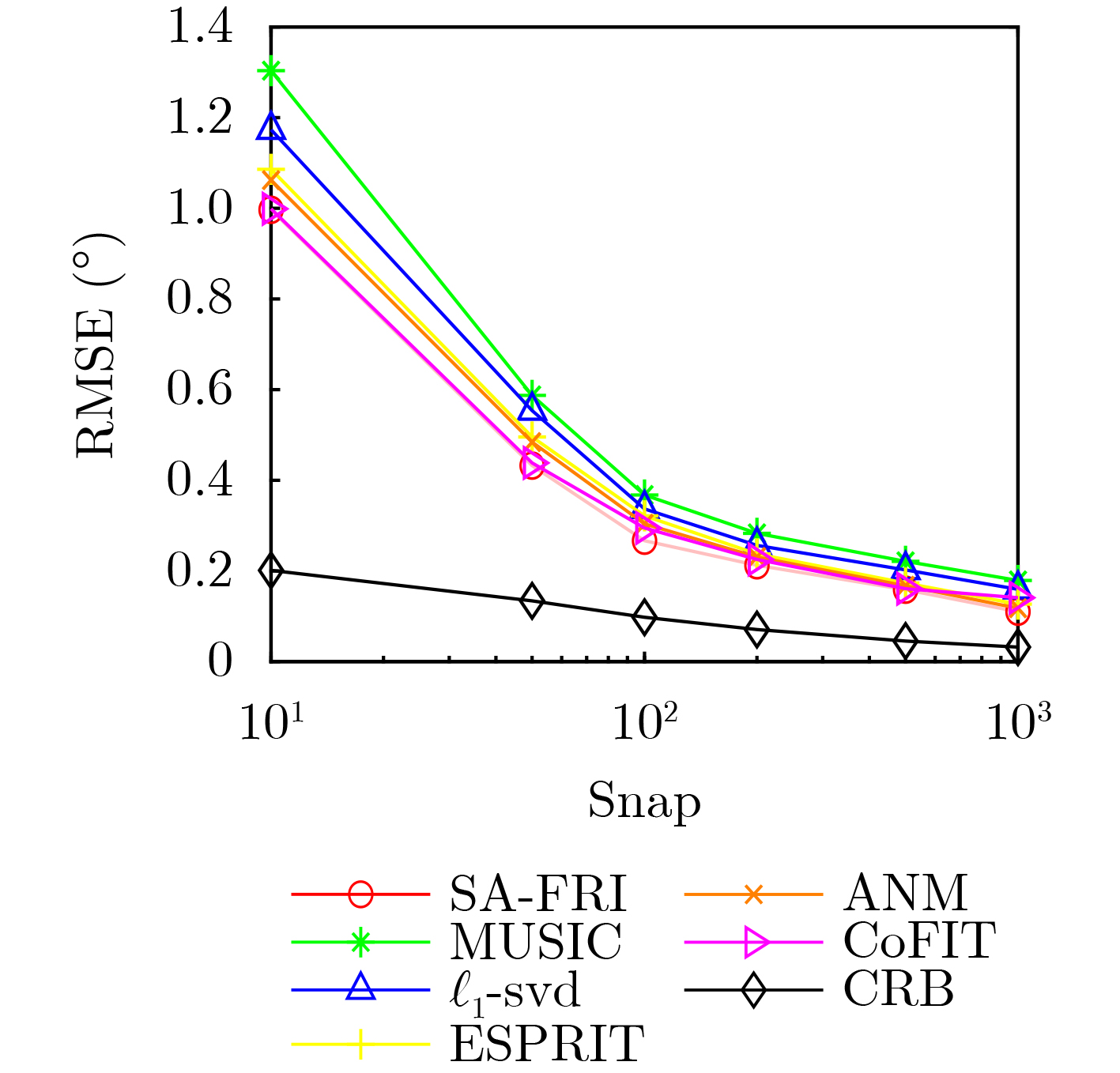
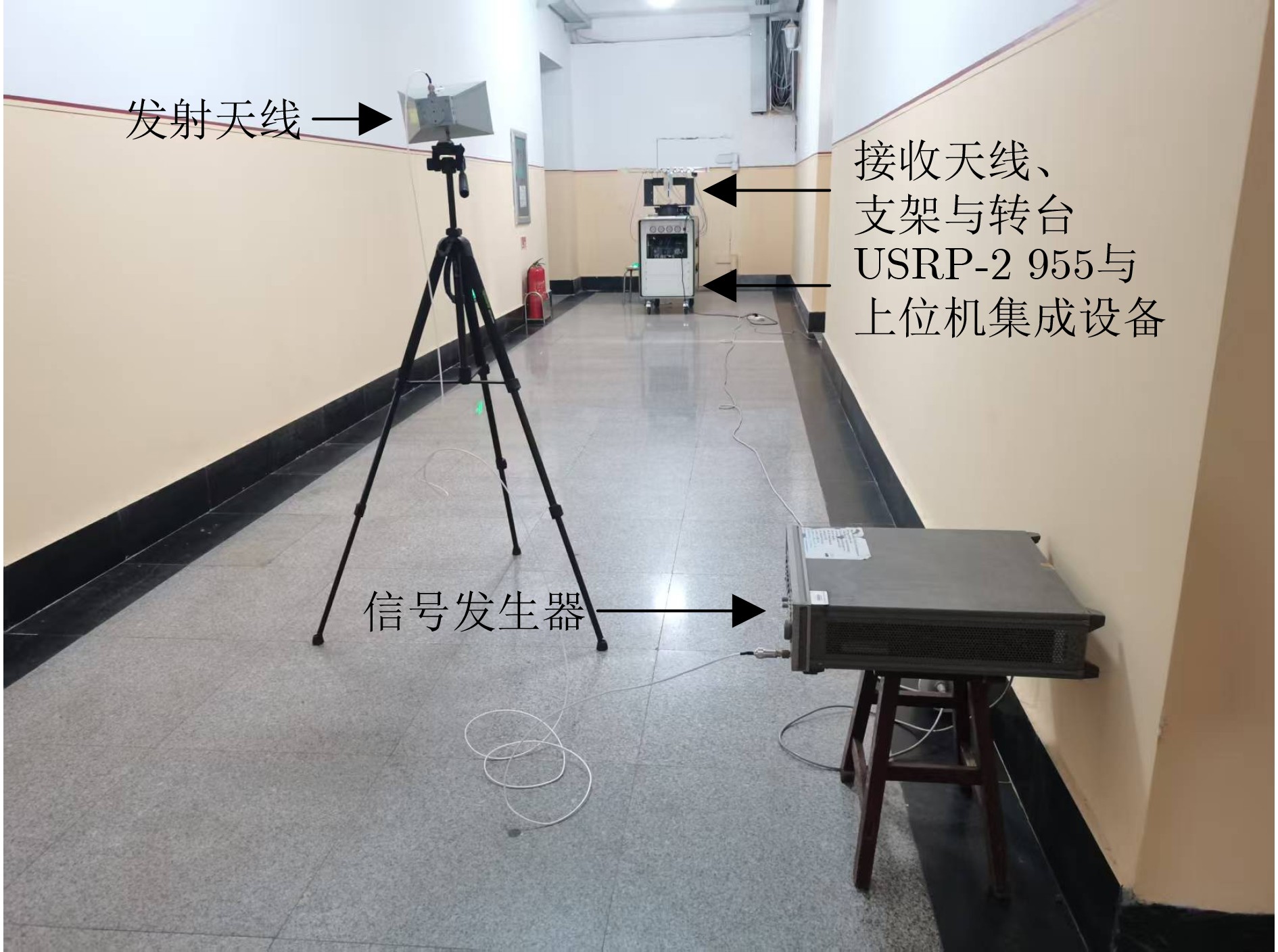
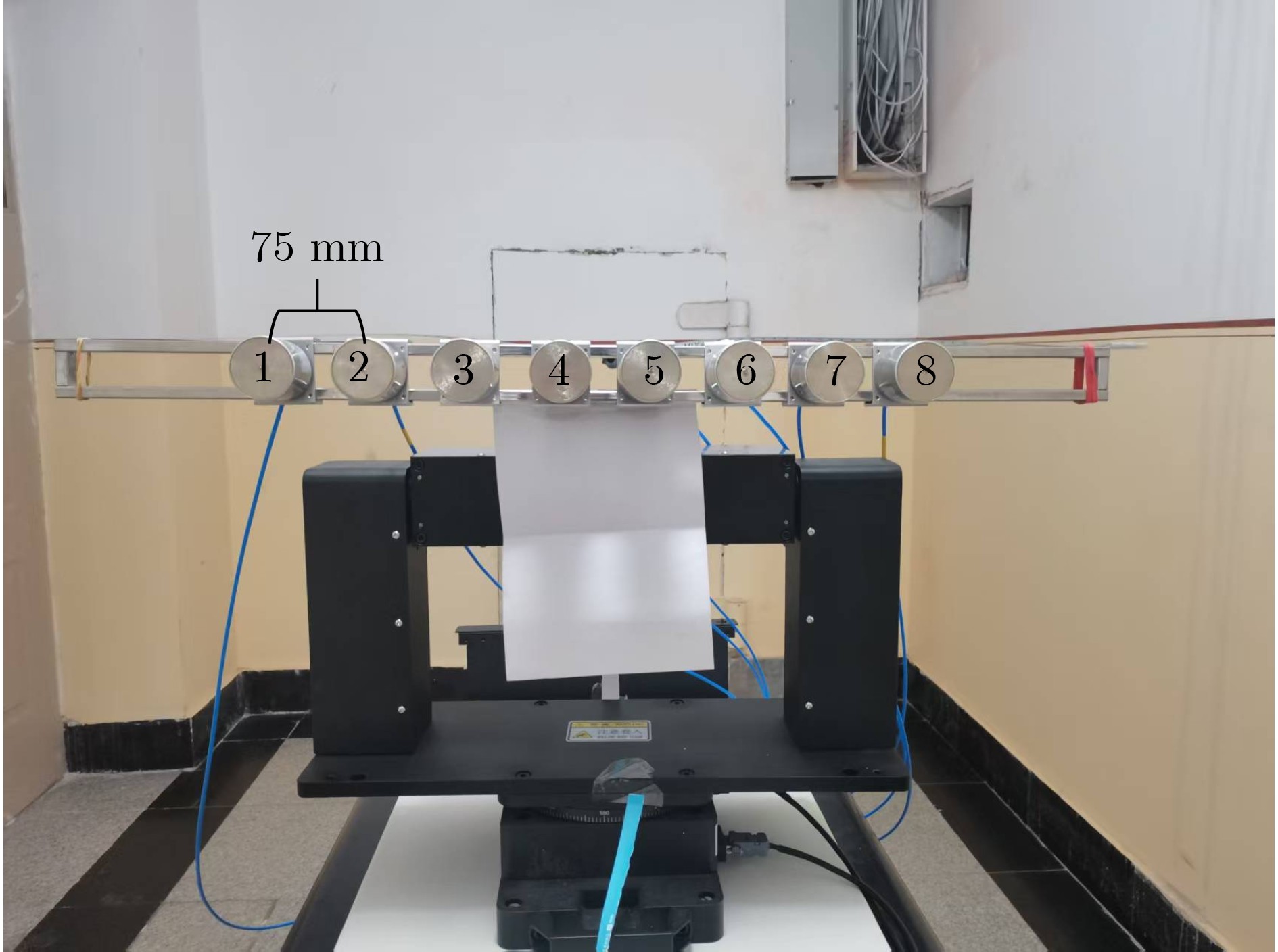
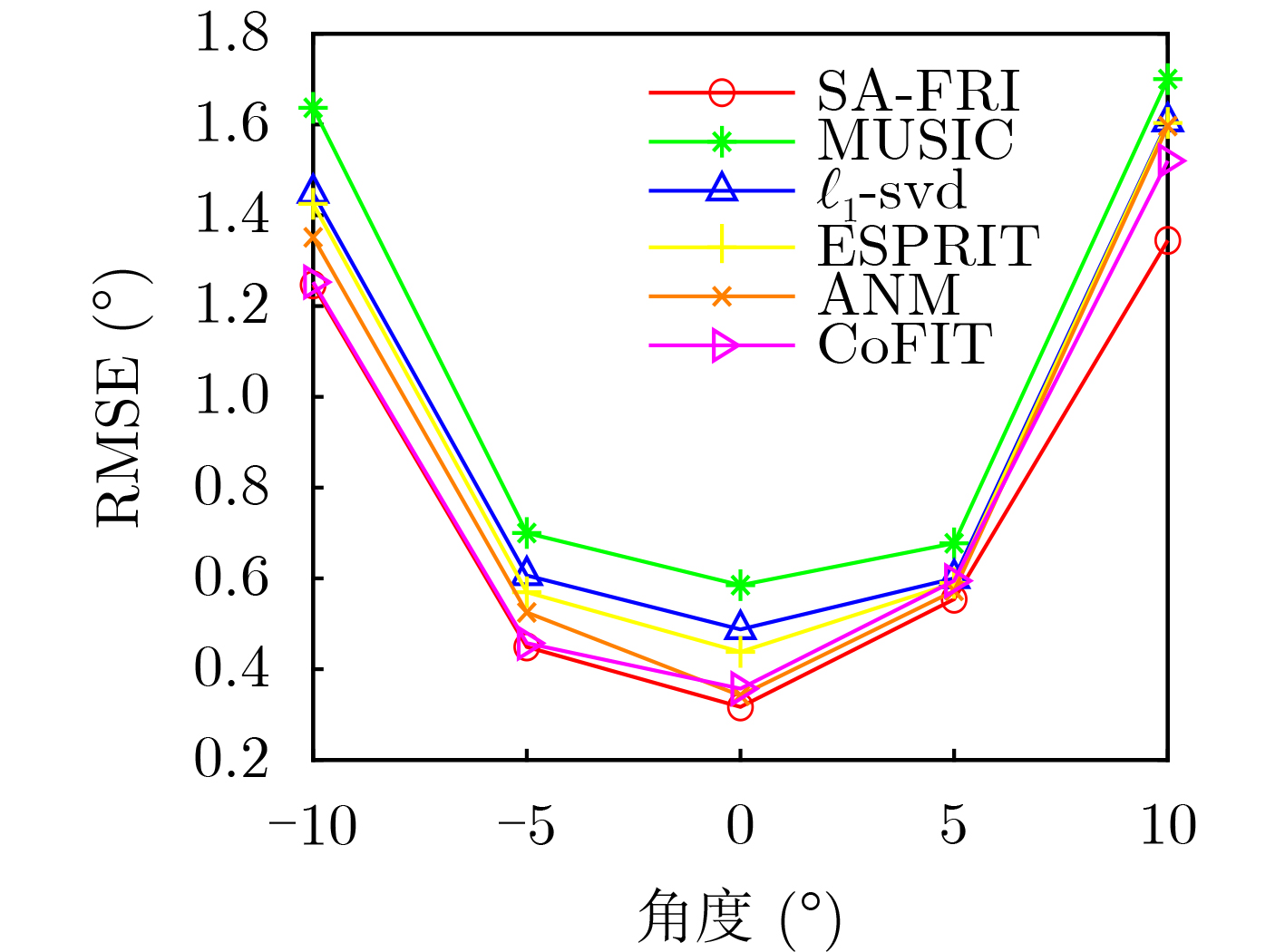
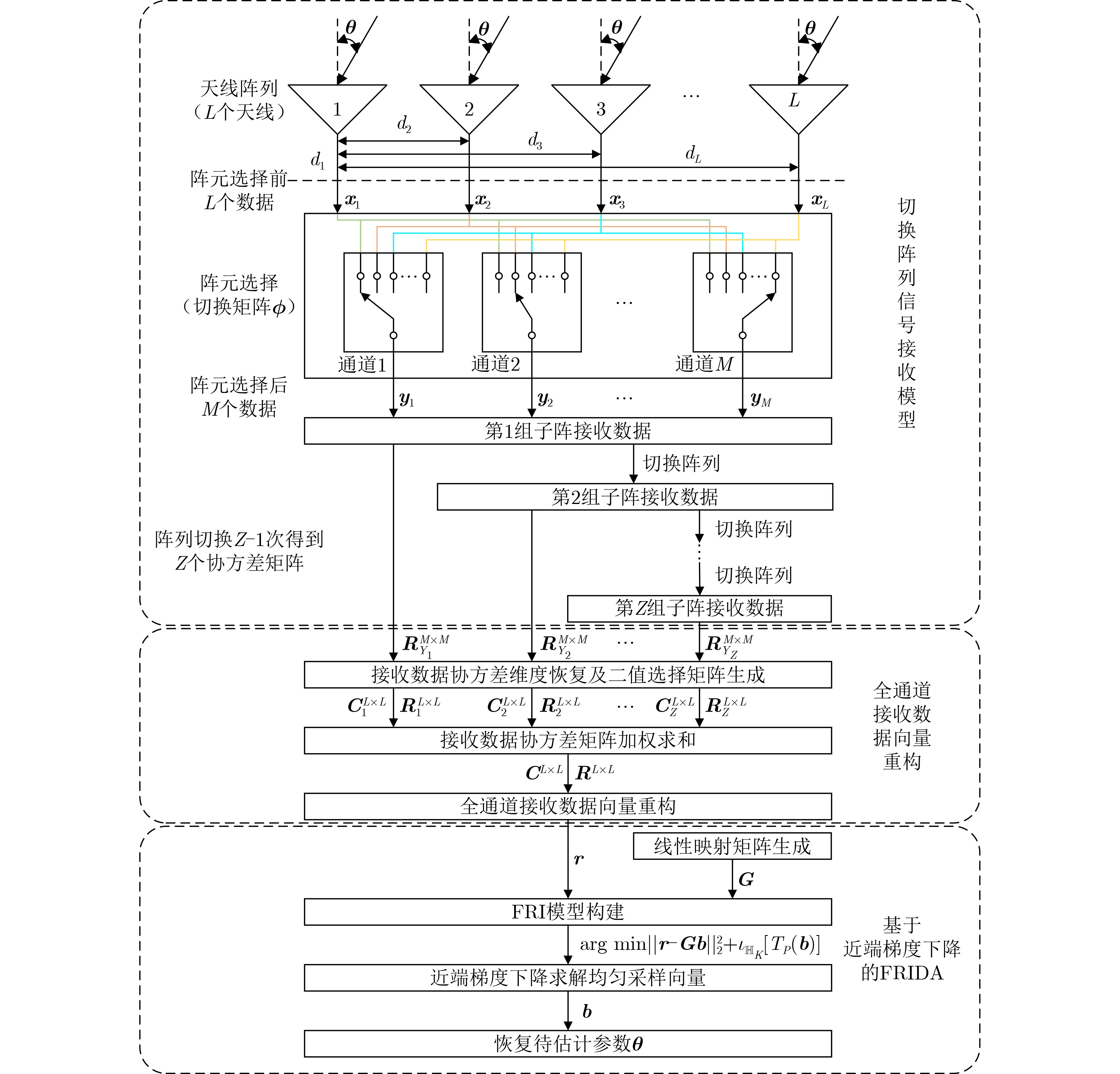
Objective With the increasing complexity of electromagnetic environments, the demand for higher estimation accuracy in practical direction-finding systems is rising. Enlarging the antenna array is an effective approach to improve estimation accuracy; however, it also significantly increases system complexity. This study aims to reduce the number of channels required while preserving the Direction-Of-Arrival (DOA) estimation performance achievable with full-channel data. By combining the channel compression algorithm, which reduces channel usage, with the time-modulated array structure that incorporates RF front-end switches, this paper proposes a multi-channel switching array DOA estimation algorithm based on FRIDA. Methods The algorithm introduces a selection matrix composed of switches between the antenna array and the channels. This matrix directs the signal received by a selected antenna into the corresponding channel, thereby enabling a specific subarray to capture the data. By switching across different subarrays, multiple reduced-channel received data covariance matrices are collected. To ensure phase consistency within these covariance matrices, common array elements are specified for each subarray. After weighted summation, these covariance matrices are combined to restore the dimensionality of the covariance matrix, producing the total covariance matrix. Next, the elements of the total covariance matrix that correspond to identical array-element spacings are weighted and summed, yielding the full-channel received data vector. Using this vector, an FRI reconstruction model is established. Finally, the incident angle is estimated through the combination of the proximal gradient descent algorithm and the parameter recovery algorithm. Results and Discussions Simulation results of DOA estimation for SA-FRI under multiple source incidence demonstrate that the full-channel received data vectors reconstructed from multiple covariance matrices of reduced-channel data can successfully discriminate multi-source incident signals, achieving performance comparable to that of full-channel data ( Fig. 2 ). Further simulations evaluating estimation accuracy with varying numbers of snapshots and Signal-to-Noise Ratios (SNRs) show that the accuracy of the proposed algorithm improves with increasing snapshots and SNR. Under identical conditions, the use of more channels yields higher DOA estimation accuracy (Figs. 3 and4 ). Comparisons of five different algorithms under varying SNRs and snapshot numbers indicate that estimation accuracy increases with both parameters. The proposed algorithm consistently outperforms the other algorithms under the same conditions (Figs. 5 and6 ). Finally, verification with measured data produces results consistent with the simulations (Fig. 9 ), further confirming the effectiveness of the proposed algorithm.Conclusions To address the challenge of reducing the number of channels in practical DOA estimation systems, this study proposes an array-switching DOA estimation method based on proximal gradient descent. The algorithm first reduces channel usage through a switching matrix, then generates multiple covariance matrices by sequentially switching different subarray access channels. These covariance matrices are combined to reconstruct the full-channel received data covariance matrix. Finally, the DOA parameters of incident signals are estimated using the proximal gradient descent algorithm. Simulation results confirm that the proposed algorithm achieves reduced channel usage while maintaining reliable estimation accuracy. Moreover, validation with measured data collected from an actual DOA estimation system demonstrates results consistent with the simulations, further verifying the algorithm’s effectiveness. -
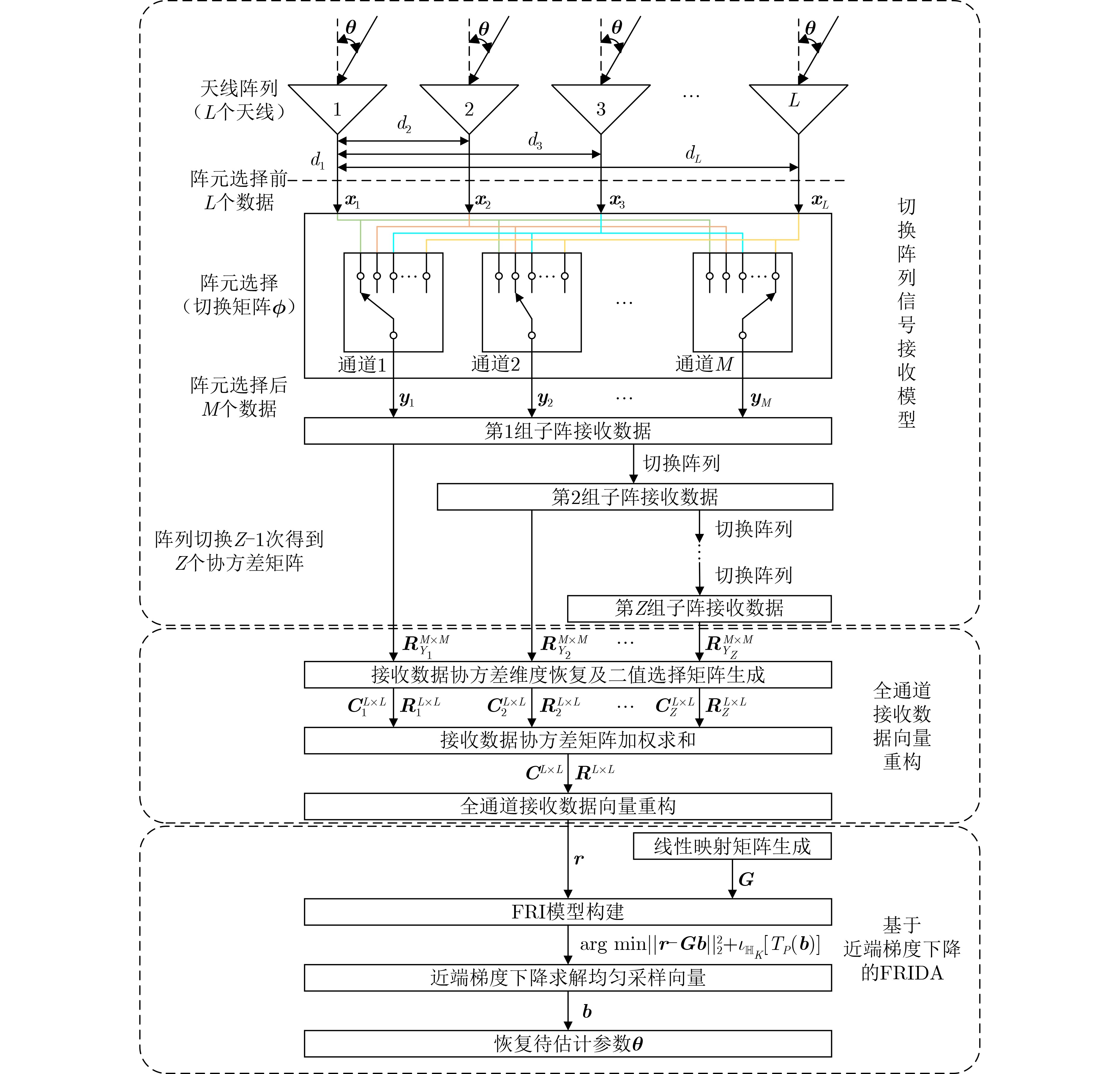
1 基于FRIDA的多通道切换阵列DOA估计算法流程
输入: 接收数据$ {Y_1},{Y_2}, \cdots ,{Y_Z} $。 输出: 入射信号的DOA估计结果${\widehat \theta _k}$,$k = 1,2,\cdots,K$。 初始化:Toeplitz算子维度参数$P$,正则化参数$\tau > 0$,参数$n \in {\mathbb{Z}_{ + + }}$,迭代停止阈值$\varepsilon \ge 0$, 一类Bessel函数最大阶数参数$Q$,线性映射矩阵${\boldsymbol{G}}$,迭代次数$k = 0$,以及初始化向量${{\boldsymbol{b}}^{\left( 0 \right)}} \in {\mathbb{C}^{2Q + 1}}$; 步骤1:根据${{\boldsymbol{R}}_{{Y_z}}} = \displaystyle\sum\nolimits_{u = 1}^U {{\boldsymbol{y}}(u){\boldsymbol{y}}{{(u)}^{\rm H}}/U} $计算各接受数据协方差矩阵${{\boldsymbol{R}}_{{Y_1}}},{{\boldsymbol{R}}_{{Y_2}}}, \cdots ,{{\boldsymbol{R}}_{{Y_Z}}}$; 步骤2:根据式(5)将计算出的$M \times M$维矩阵${{\boldsymbol{R}}_{{Y_1}}},{{\boldsymbol{R}}_{{Y_2}}}, \cdots ,{{\boldsymbol{R}}_{{Y_Z}}}$转化为$L \times L$维矩阵${{\boldsymbol{R}}_1},{{\boldsymbol{R}}_2}, \cdots ,{{\boldsymbol{R}}_Z}$, 根据式(6)、式(7)计算出二值选择矩阵${\boldsymbol{C}}$; 步骤3:根据式(8)将矩阵${{\boldsymbol{R}}_1},{{\boldsymbol{R}}_2}, \cdots ,{{\boldsymbol{R}}_Z}$加权求和为$ {\boldsymbol{R}} $,根据式(9)、式(10)、式(11)计算全通道接收数据向量${\boldsymbol{r}}$; 步骤4:根据式(20)计算$ {{\boldsymbol{b}}^{\left( {k + 1} \right)}} = {{\mathrm{prox}}_{\tau H}}\left( {{{\boldsymbol{b}}^{\left( k \right)}} - 2\tau {{\boldsymbol{G}}^{\rm H}}\left( {{\boldsymbol{G}}{{\boldsymbol{b}}^{\left( k \right)}} - {\boldsymbol{r}}} \right)} \right) $; 步骤5:判断$\left\| {{{\boldsymbol{b}}^{\left( {k + 1} \right)}} - {{\boldsymbol{b}}^{\left( k \right)}}} \right\|_2^2$与$\varepsilon $的大小关系,若$\left\| {{{\boldsymbol{b}}^{\left( {k + 1} \right)}} - {b^{\left( k \right)}}} \right\|_2^2 \le \varepsilon $,停止迭代,进入步骤6,否则$k = k + 1$,返回步骤4; 步骤6:对得到的${{\boldsymbol{b}}^{\left( {k + 1} \right)}}$计算$ {T_P}\left( {{{\boldsymbol{b}}^{(k + 1)}}} \right) $并计算其SVD分解结果$ {T_P}\left( {{{\boldsymbol{b}}^{(k + 1)}}} \right) = {{\boldsymbol U}_b}{{\boldsymbol{S}}_b}{\boldsymbol{V}}{\boldsymbol{S}}_b^{\rm H} $; 步骤7:以矩阵${\boldsymbol{V}}$的最后一列为系数,构造多项式$ {\boldsymbol{F}} $,并计算其零点,记为${\lambda _k}$; 步骤8:计算信号的DOA参数$ {\theta _k} = - {\mathrm{angle}}\left( {{\lambda _k}} \right) $,其中${\mathrm{angle}}\left( \cdot \right)$表示复数的幅角。  下载: 导出CSV
表 1 各算法计算复杂度比较
算法 复杂度 SA-FRI $O\left( {n{T_{{\text{SA-FRI}}}}{{(2Q + 1 - P)}^2}P} \right)$ MUSIC $O\left( {{L^3} + {L^2}U + {N_{{\mathrm{grid}}}}{L^2}} \right)$ ${\ell _1}$-svd $O\left( {{L^3}N_{{\mathrm{grid}}}^3} \right)$ ESPRIT $O\left( {{L^3} + {L^2}U} \right)$ ANM $O\left( {{L^3}\log \left( {{1 \mathord{\left/ {\vphantom {1 \varepsilon }} \right. } \varepsilon }} \right)} \right)$ CoFIT $O\left( {{T_{{\mathrm{SBL}}}}\left( {{N_{{\mathrm{grid}}}}{L^2} + {L^3}} \right) + {T_{{\mathrm{iter}}}}{L^3}} \right)$
下载: 导出CSV
表 2 各算法运行时间比较(s)
算法 SA-FRI MUSIC ${\ell _1}$-svd ESPRIT ANM CoFIT 运行时间 52.79 2.62 140.81 0.13 169.77 179.37
下载: 导出CSV
-
[1] 马健钧, 魏少鹏, 马晖, 等. 基于ADMM的低仰角目标二维DOA估计算法[J]. 电子与信息学报, 2022, 44(8): 2859–2866. doi: 10.11999/JEIT210582.MA Jianjun, WEI Shaopeng, MA Hui, et al. Two-dimensional DOA estimation for low-angle target based on ADMM[J]. Journal of Electronics & Information Technology, 2022, 44(8): 2859–2866. doi: 10.11999/JEIT210582. [2] WANG Zhuying, YAN Yongsheng, HE Ke, et al. Augmented matrix construction based DOA estimation of coherent underwater acoustic signals[C]. 2023 IEEE International Conference on Signal Processing, Communications and Computing, Zhengzhou, China, 2023: 1–5. doi: 10.1109/ICSPCC59353.2023.10400250. [3] WEN Fangqing, WANG Han, GUI Guan, et al. Polarized intelligent reflecting surface aided 2D-DOA estimation for NLoS sources[J]. IEEE Transactions on Wireless Communications, 2024, 23(7): 8085–8098. doi: 10.1109/TWC.2023.3348520. [4] SCHMIDT R. Multiple emitter location and signal parameter estimation[J]. IEEE Transactions on Antennas and Propagation, 1986, 34(3): 276–280. doi: 10.1109/TAP.1986.1143830. [5] ROY R, PAULRAJ A, and KAILAYH T. ESPRIT--A subspace rotation approach to estimation of parameters of cisoids in noise[J]. IEEE Transactions on Acoustics, Speech, and Signal Processing, 1986, 34(5): 1340–1342. doi: 10.1109/TASSP.1986.1164935. [6] LIU Liang, LI Zhouchen, AN Jiancheng, et al. DOA estimation for switch-element arrays based on sparse representation[C]. 2024 IEEE International Conference on Acoustics, Speech and Signal Processing, Seoul, Korea, 2024: 8506–8510. doi: 10.1109/ICASSP48485.2024.10446599. [7] ALLMANN C, SPRINGE J, Oispuu M, et al. Experimental direction finding results using a time-multiplexed co-array approach[C]. 2023 IEEE 9th International Workshop on Computational Advances in Multi-Sensor Adaptive Processing, Herradura, Costa Rica, 2023: 336–340. doi: 10.1109/CAMSAP58249.2023.10403472. [8] 陈涛, 申梦雨, 史林, 等. 基于通道压缩的原子范数最小化DOA估计算法[J]. 仪器仪表学报, 2022, 43(4): 246–253. doi: 10.19650/j.cnki.cjsi.J2108691.CHEN Tao, SHEN Mengyu, SHI Lin, et al. A channel compression DOA estimation algorithm based on atomic norm minimization[J]. Chinese Journal of Scientific Instrument, 2022, 43(4): 246–253. doi: 10.19650/j.cnki.cjsi.J2108691. [9] IBRAHIM M, RAMIREDDY V, LAVRENKO A, et al. Design and analysis of compressive antenna arrays for direction of arrival estimation[J]. Signal Processing, 2017, 138: 35–47. doi: 10.1016/j.sigpro.2017.03.013. [10] GU Yujie, ZHANG Y D, and GOODMAN N A. Optimized compressive sensing-based direction-of-arrival estimation in massive MIMO[C]. 2017 IEEE International Conference on Acoustics, Speech and Signal Processing, New Orleans, USA, 2017: 3181–3185. doi: 10.1109/ICASSP.2017.7952743. [11] JING Zhehan, CAO Bingxia, MENG Xiangtian, et al. Noniterative DOA Estimation in time-modulated array under unidirectional phase center motion[J]. IEEE Antennas and Wireless Propagation Letters, 2024, 23(8): 2416–2420. doi: 10.1109/LAWP.2024.3394610. [12] KIM G U and KIM J P. Measurement of phase difference and direction of arrival using time-modulated array with general modulation parameters[J]. IEEE Antennas and Wireless Propagation Letters, 2023, 22(7): 1557–1561. doi: 10.1109/LAWP.2023.3251322. [13] NIU Chuniie, LV Tingting, LIU Yulong, et al. A DOA estimation method for coherent signals based on weighted l1-SVD[C]. 2023 IEEE 6th International Conference on Electronic Information and Communication Technology, Qingdao, China, 2023: 694–699. doi: 10.1109/ICEICT57916.2023.10245436. [14] CHEN Zhimin and CHEN Peng. Compressed sensing-based DOA and DOD estimation in bistatic co-prime MIMO arrays[C]. 2017 IEEE Conference on Antenna Measurements & Applications, Tsukuba, Japan, 2017: 297–300. doi: 10.1109/CAMA.2017.8273431. [15] 陈涛, 李敏行, 郭立民, 等. 基于原子范数最小化的极化敏感阵列DOA估计[J]. 电子学报, 2023, 51(4): 835–842. doi: 10.12263/DZXB.20220429.CHEN Tao, LI Minxing, GUO Limin, et al. DOA estimation of polarization sensitive array based on atomic norm minimization[J]. Acta Electronica Sinica, 2023, 51(4): 835–842. doi: 10.12263/DZXB.20220429. [16] 陈涛, 史林, 黄桂根, 等. 适用于任意几何结构平面阵列的无网格DOA估计算法[J]. 电子与信息学报, 2022, 44(3): 1052–1058. doi: 10.11999/JEIT210038.CHEN Tao, SHI Lin, HUANG Guigen, et al. Gridless DOA estimation algorithm for planar arrays with arbitrary geometry[J]. Journal of Electronics & Information Technology, 2022, 44(3): 1052–1058. doi: 10.11999/JEIT210038. [17] 陈涛, 赵立鹏, 史林, 等. 基于有限新息率的正交偶极子阵列信号参数估计算法[J]. 电子与信息学报, 2022, 44(7): 2469–2477. doi: 10.11999/JEIT210357.CHEN Tao, ZHAO Lipeng, SHI Lin, et al. Signal parameter estimation algorithm for orthogonal dipole array based on finite rate of innovation[J]. Journal of Electronics & Information Technology, 2022, 44(7): 2469–2477. doi: 10.11999/JEIT210357. [18] FU Ning, YUN Shuangxing, and QIAO Liyan. An efficient estimation method for the model order of FRI signal based on sub-Nyquist sampling[J]. IEEE Transactions on Instrumentation and Measurement, 2023, 72: 6505513. doi: 10.1109/TIM.2023.3320730. [19] PAN Hanjie, SCHEIBLER R, BEZZAM E, et al. FRIDA: FRI-based DOA estimation for arbitrary array layouts[C]. 2017 IEEE International Conference on Acoustics, Speech and Signal Processing, New Orleans, USA, 2017: 3186–3190. doi: 10.1109/ICASSP.2017.7952744. [20] SIMEONI M, BESSON A, HURLEY P, et al. CPGD: Cadzow plug-and-play gradient descent for generalised FRI[J]. IEEE Transactions on Signal Processing, 2021, 69: 42–57. doi: 10.1109/TSP.2020.3041089. [21] WEISS A J and FRIEDLANDER B. Performance analysis of diversely polarized antenna arrays[J]. IEEE Transactions on Signal Processing, 1991, 39(7): 1589–1603. doi: 10.1109/78.134397. [22] PARK Y, GERSTOFT P, and MECKLENBRÄUKER C F. Atom-constrained gridless DOA refinement with wirtinger gradients[J]. IEEE Open Journal of Signal Processing, 2024, 5: 1134–1146. doi: 10.1109/OJSP.2024.3496815. -

 下载:
下载:

图(9) / 表(3)
计量
- 文章访问数: 750
- HTML全文浏览量: 287
- PDF下载量: 47
- 被引次数: 0
