




Deep Side-Channel Attack Method Integrating Convolutional Block Attention Mechanism and Triplet Metric Learning
-
摘要: 侧信道攻击是密码芯片物理安全的主要威胁之一,利用深度学习技术恢复密钥已成为侧信道攻击领域内研究热点。然而,现有基于深度学习的攻击方法在特征提取阶段往往缺乏对关键泄露区间的聚焦能力。特别是在长波形和高维噪声场景下,模型容易被无关背景噪声干扰,导致特征提取效率低下、猜测熵收敛缓慢。针对上述问题,该文提出一种融合卷积块注意力机制与3元组度量学习的侧信道攻击方法。该方法从泄露特征提取入手,在卷积神经网络中嵌入通道注意力与空间注意力模块,对不同特征通道和时域位置进行自适应加权,以增强泄露相关特征并减弱噪声干扰。在此基础上,引入3元组损失作为优化目标,用于引导注意力加权后的特征在嵌入空间中形成可分的簇结构。实验结果表明,该文方法在公开数据集上均优于度量学习及深度学习方法,其中在ASCAD_f(HW)场景下,攻击性能提升9.4%以上;在ASCAD_r(HW)场景下,该文方法实现猜测熵收敛所需的攻击轨迹数量减少10.7%以上。此外,去同步实验与消融实验进一步证实了该方法具备鲁棒性,并验证了核心组件协同设计的合理性。Abstract:
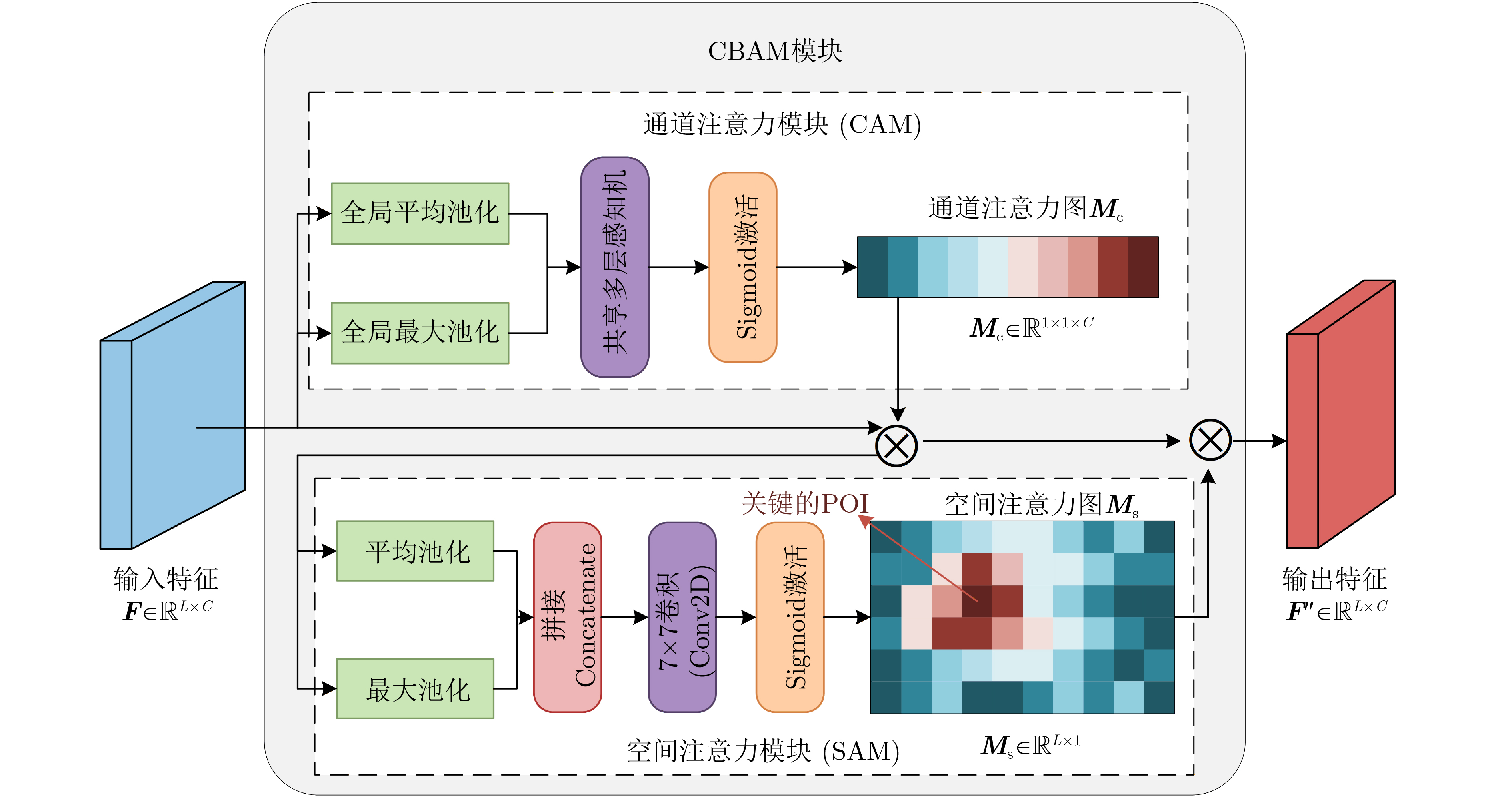
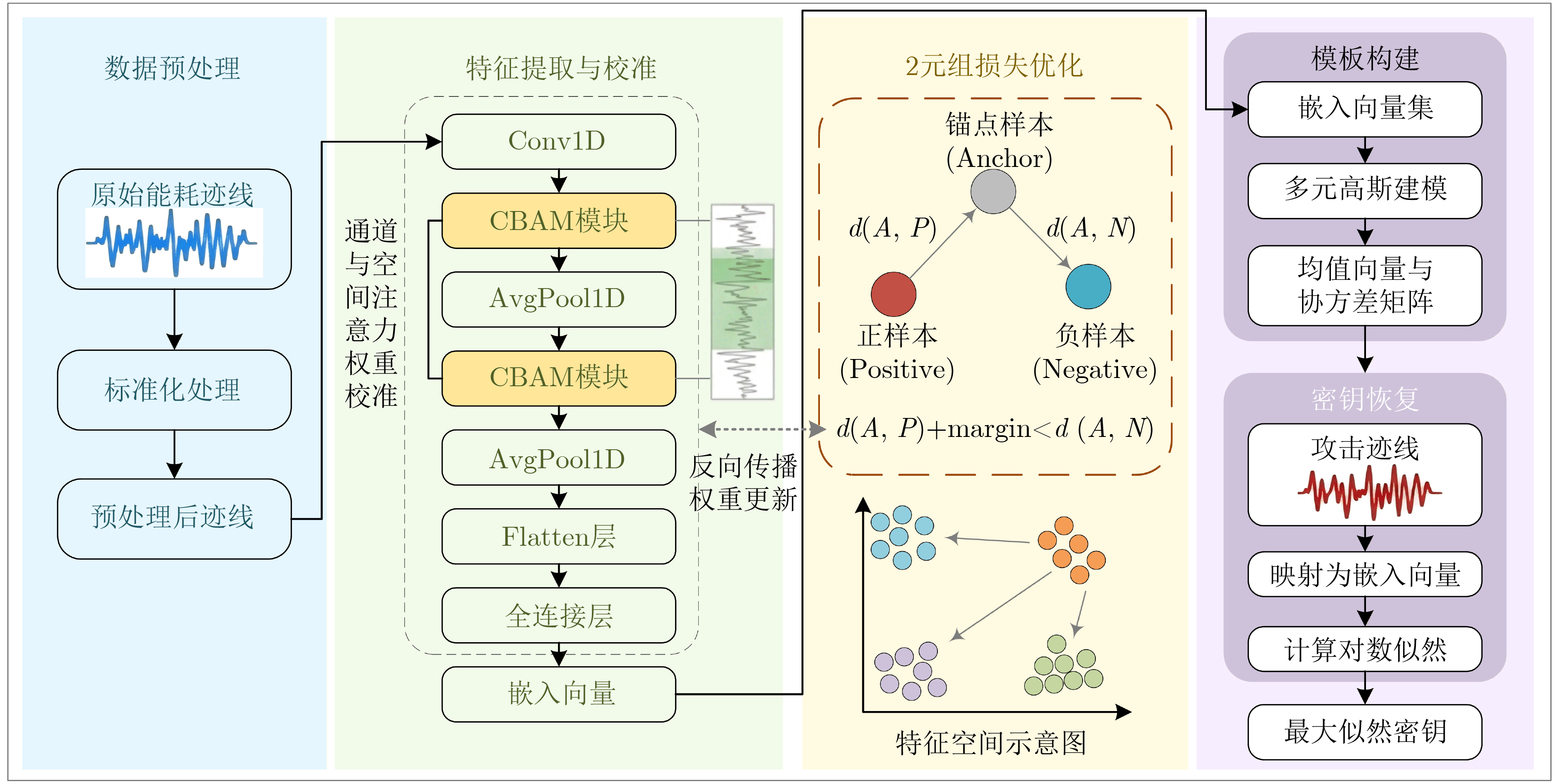
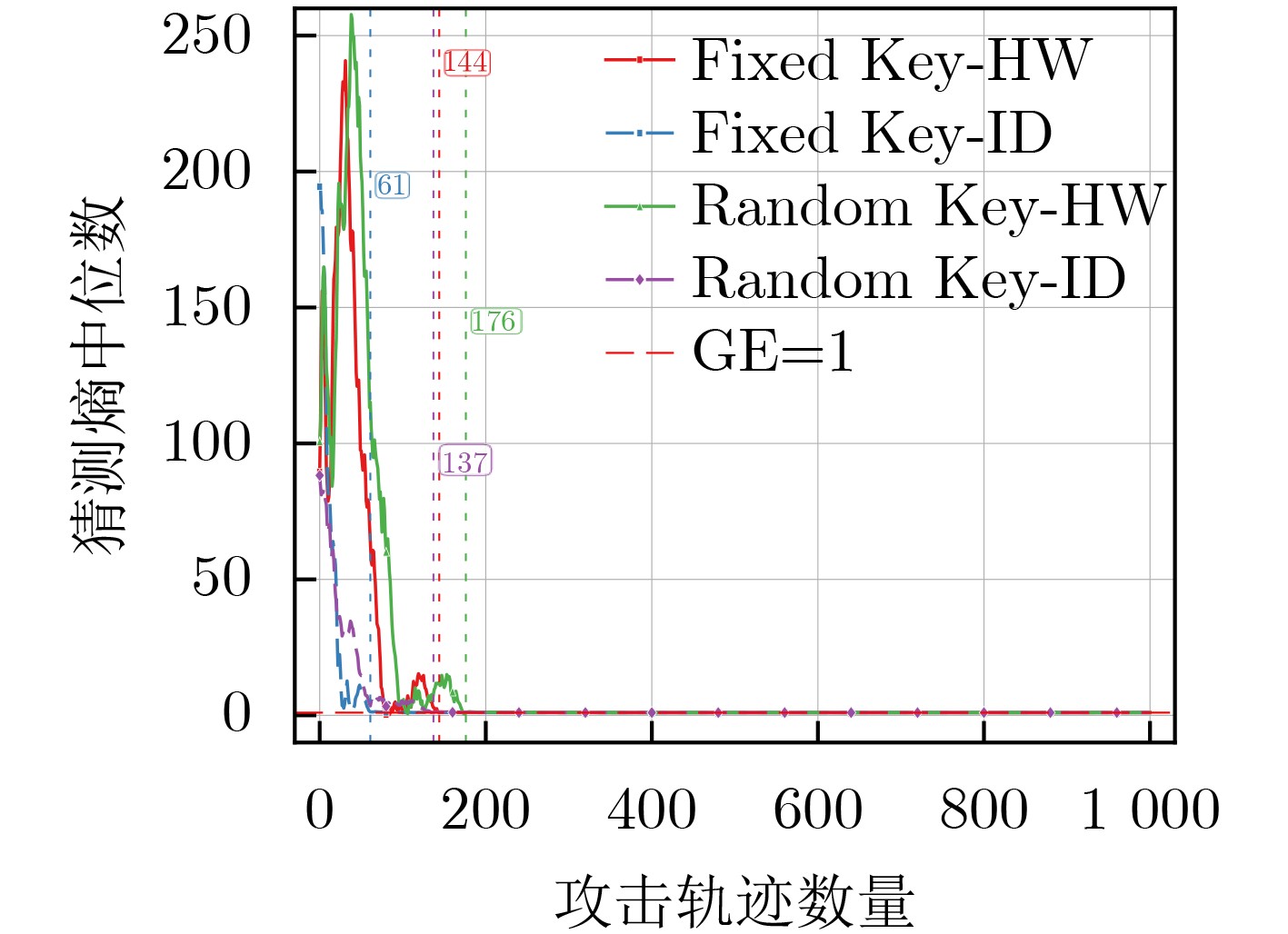
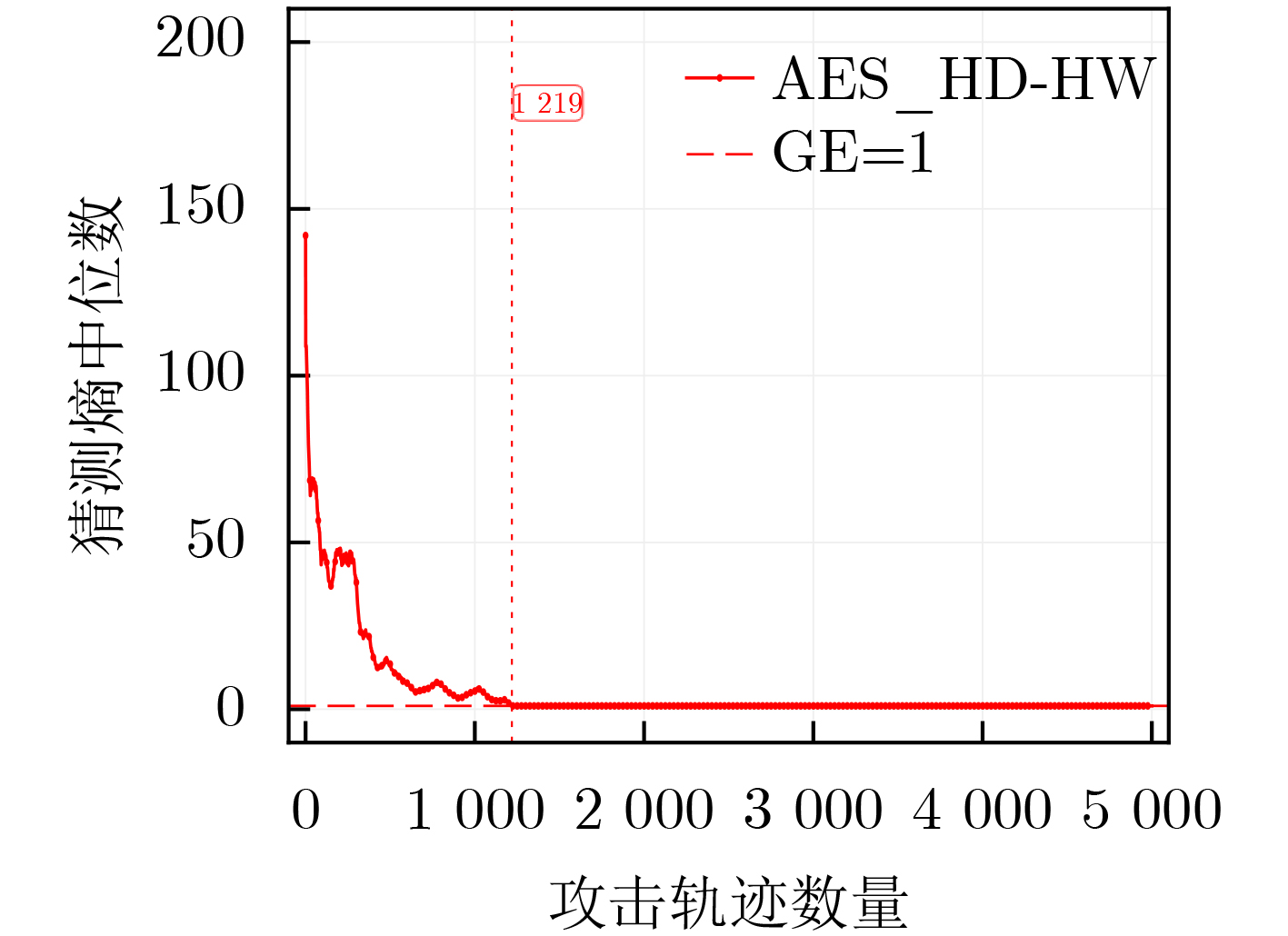
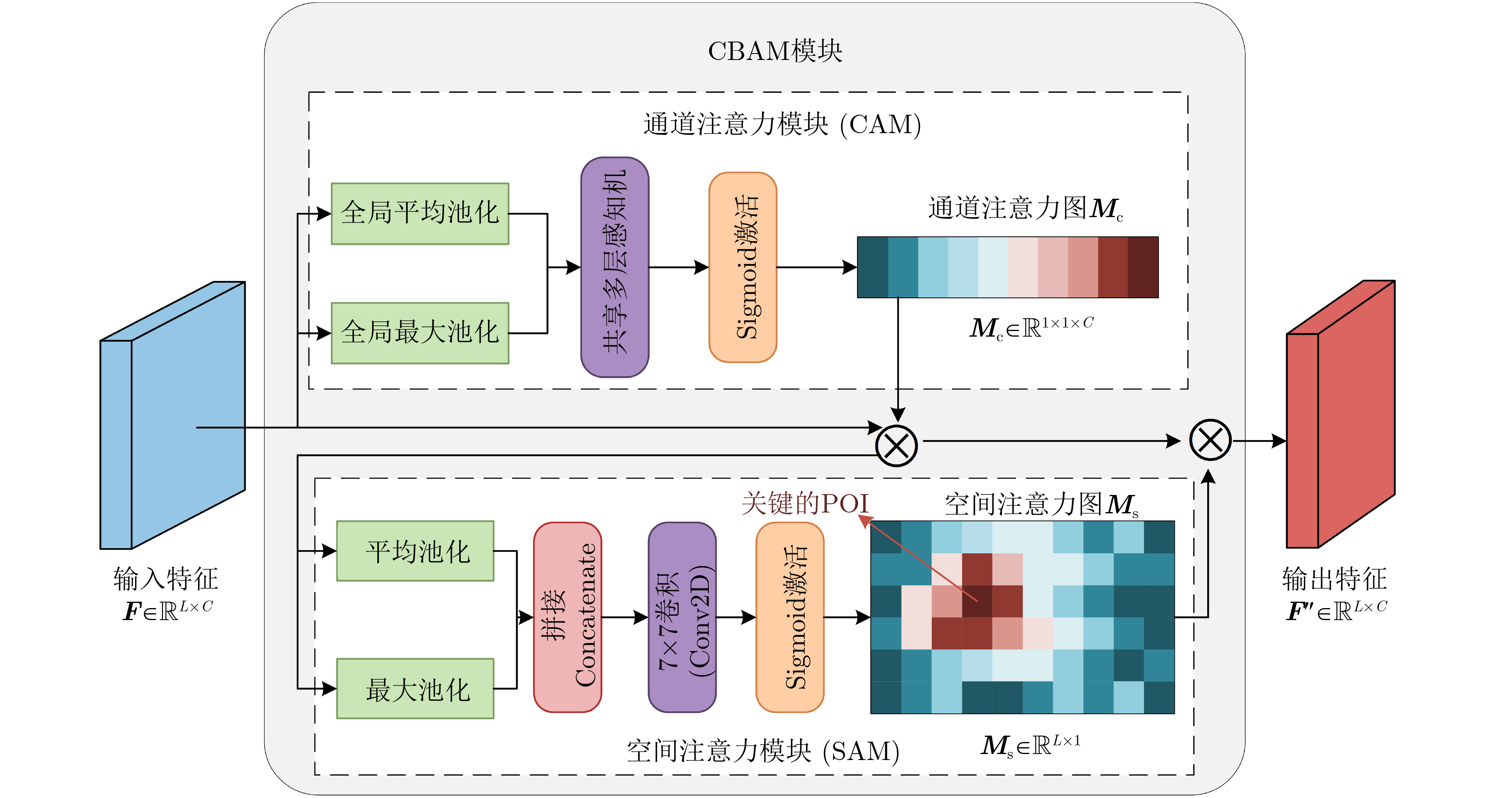
Objective Side-Channel Attack (SCA) is one of the primary threats to the physical security of cryptographic chips, and deep learning methods for secret key recovery have attracted considerable attention in the field of SCA. However, existing deep learning-based side-channel attack methods have limited capability to focus on critical leakage intervals during feature extraction, particularly for long traces with high-dimensional noise. Therefore, irrelevant background noise interferes with feature extraction, leading to reduced attack efficiency and slower convergence of Guessing Entropy (GE). To address these limitations, a deep side-channel attack method integrating the Convolutional Block Attention Module (CBAM) and triplet loss is proposed to improve the extraction of weak leakage features under complex noise conditions and enhance secret key recovery efficiency. Methods CBAM is embedded into a Convolutional Neural Network (CNN) to construct an adaptive feature extraction network. CBAM consists of a Channel Attention Module (CAM) and a Spatial Attention Module (SAM). CAM adaptively recalibrates feature-channel weights to emphasize leakage-related features with a high Signal-to-Noise Ratio (SNR), whereas SAM identifies Points Of Interest (POI) in the temporal domain and suppresses background noise outside the leakage intervals. After attention-based feature refinement, triplet loss is adopted as the optimization objective to optimize the distribution of embedding features, encouraging compact intra-class clusters while maximizing inter-class separation in the embedding space. Finally, a multivariate Gaussian template attack is performed using the optimized embedding features to recover the secret key. The overall framework is illustrated in ( Fig. 2 ).Results and Discussions The proposed method is evaluated on two public benchmark datasets, ASCAD and AES_HD, using GE and the minimum number of attack traces required for GE to converge to 1 ($ {T}_{{\mathrm{GE0}}} $) as evaluation metrics. On the ASCAD dataset, the proposed method requires only 144 attack traces in the ASCAD_f (HW) scenario, representing a 51.0% reduction compared with the conventional CNN model. In the ASCAD_f (ID) scenario, only 61 attack traces are required, corresponding to a 68.0% reduction. In the ASCAD_r dataset, GE converges with 176 attack traces under the HW leakage model and 137 attack traces under the ID leakage model, outperforming representative methods, including RL-SCA and Metric Learning ( Table 2 andFig. 3 ). On the low-SNR AES_HD dataset, the proposed method requires 1 219 attack traces, outperforming MHA and NLS while maintaining smooth and stable GE convergence (Table 2 andFig. 4 ). Furthermore, desynchronization experiments demonstrate that the proposed method maintains accurate localization of effective leakage points under severe desynchronization noise, indicating strong robustness to time-domain jitter (Table 3 ). Ablation studies further verify the synergistic effect of the proposed architecture and confirm the effectiveness of its core components (Table 4 ).Conclusions A deep side-channel attack method integrating CBAM and triplet-loss-based metric learning is proposed. The CBAM module enables the network to adaptively focus on leakage-related features, improving feature extraction over conventional CNN-based methods. Triplet loss enhances the discriminability of embedding features, thereby improving template matching accuracy. Experimental results on the ASCAD and AES_HD datasets demonstrate that the proposed method substantially reduces the number of attack traces required for successful secret key recovery and accelerates GE convergence. The proposed method consistently outperforms existing mainstream approaches under fixed-key, random-key, and low-SNR conditions. Future work will focus on improving robustness under more severe desynchronization conditions and enhancing generalization in small-sample scenarios. -
表 1 融合CBAM的特征提取网络结构参数
块 层级 输出尺寸 参数配置 设计动机 Input Input $ (L,1) $ - 接收原始迹线,L为迹线长度;
输入按通道维扩展为一维序列。Block 1 Conv1D $ (L,64) $ Filters: 64, Kernel: 15,
Padding: same, Activation: SELU,
Initializer: LeCun Normal大卷积核捕捉波形整体轮廓;SELU保持数值稳定。 CBAM $ (L,64) $ Ratio: 8 关键层:在降采样前对特征进行通道与空间维度的加权校准。 AvgPool1D $ (L/15,64) $ Pool size: 15, Stride: 15 平均池化保留能量特征,大幅压缩时间维度。 Block 2 Conv1D $ (L/15,128) $ Filters: 128, Kernel: 3, Padding: same, Stride: 1, Activation: SELU, Initializer: LeCun Normal 小卷积核提取深层局部细节;增加通道数丰富特征语义。 CBAM $ (L/15,128) $ Ratio: 8 关键层:进一步聚焦高层语义特征中的有效成分。 AvgPool1D $ (L/30,128) $ Pool size: 2, Stride: 2 进一步降维。 Embedding Flatten $ (N\mathrm{_{flat}}) $ - 展平特征图。 Dense $ \left(16/32\right) $ Activation: Linear 映射至32维嵌入空间,作为度量学习的输入。  下载: 导出CSV
表 2 攻击性能对比
方法 ASCAD_f ASCAD_r AES_HD HW ID HW ID HW MHA[5] - - - - 2174 DCMHA[5] - - - - 2068 CNN[8] 294 191 - - - RL-SCA[10] 906 242 911 490 4415 FS-SCA[11] 532 - 538 78 - LMA-SCA[19] - 87 - 78 - Metric Learning[22] 159 64 197 188 1768 NLS[23] - - - - 1252 SACNN[28] 298 - 212 - - AutoSCA-MLP[29] 447 120 617 3481 - AutoSCA-CNN[29] 539 257 496 2975 - EL-SCA[30] - - 470 105 - CCE[31] >2000 963 2840 > 3000 - FLR+SoftNN[32] 832 716 2592 > 10000 - FLR+Center[32] 790 728 3867 9681 - CNN-fusion[33] - 149 - - 1116 本文 144 61 176 137 1219
下载: 导出CSV
表 4 消融实验结果
方法 ASCAD_f ASCAD_r AES_HD HW ID HW ID HW Baseline 2064 506 5841 > 10000 3051 Baseline+CBAM 1534 448 4926 > 10000 2656 Baseline+Triplet 153 67 197 276 4059 Ours_post-pool 157 92 284 360 2805 Ours_Relu 281 904 825 1171 4844 Ours_dim2 > 10000 > 10000 > 10000 > 10000 5994 Ours_dim128 2631 357 9287 4140 > 10000 本文 144 61 176 137 1219
下载: 导出CSV
-
[1] MANGARD S, OSWALD E, and POPP T. Power Analysis Attacks: Revealing the Secrets of Smart Cards[M]. New York: Springer, 2007. [2] CHARI S, RAO J R, and ROHATGI P. Template attacks[C]. 4th International Workshop on Cryptographic Hardware and Embedded Systems, Redwood Shores, USA, 2002: 13–28. doi: 10.1007/3-540-36400-5_3. [3] 郑帅, 徐向荣, 肖利民, 等. 面向缓存侧信道攻击防护的快速刷写技术[J]. 电子与信息学报, 2025, 47(9): 3178–3186. doi: 10.11999/JEIT250471.ZHENG Shuai, XU Xiangrong, XIAO Limin, et al. Mitigating cache side-channel attacks via fast flushing mechanism[J]. Journal of Electronics & Information Technology, 2025, 47(9): 3178–3186. doi: 10.11999/JEIT250471. [4] LERMAN L, POUSSIER R, BONTEMPI G, et al. Template attacks vs. machine learning revisited (and the curse of dimensionality in side-channel analysis)[C]. 6th International Workshop on Constructive Side-Channel Analysis and Secure Design, Berlin, Germany, 2015: 20–33. doi: 10.1007/978-3-319-21476-4_2. [5] 蒋玲腊, 陈文, 孙伟, 等. 融合动态可组合多头注意力的深度学习侧信道分析方法研究[J/OL]. 计算机科学, 2025: 1–15. https://link.cnki.net/urlid/50.1075.TP.20251129.1824.004, 2025.JIANG Lingla, CHEN Wen, SUN Wei, et al. Research on a deep learning-based side-channel analysis method with dynamically composable multi-head attention[J/OL]. Computer Science, 2025: 1–15 https://link.cnki.net/urlid/50.1075.TP.20251129.1824.004, 2025. [6] 金诚斌, 高宜文, 高锐, 等. 嵌入式AI硬件单元的侧信道分析方法概述[J]. 密码学报(中英文), 2025, 12(4): 729–751. doi: 10.13868/j.cnki.jcr.000791.JIN Chengbin, GAO Yiwen, GAO Rui, et al. Systematic study on physical side-channel attack against embedded AI hardware units[J]. Journal of Cryptologic Research, 2025, 12(4): 729–751. doi: 10.13868/j.cnki.jcr.000791. [7] WU Lichao and PICEK S. Remove some noise: On pre-processing of side-channel measurements with autoencoders[J]. IACR Transactions on Cryptographic Hardware and Embedded Systems, 2020, 2020(4): 389–415. doi: 10.13154/tches.v2020.i4.389-415. [8] ZAID G, BOSSUET L, HABRARD A, et al. Methodology for efficient CNN architectures in profiling attacks[J]. IACR Transactions on Cryptographic Hardware and Embedded Systems, 2020, 2020(1): 1–36. doi: 10.13154/tches.v2020.i1.1-36. [9] LU Xiangjun, ZHANG Chi, CAO Pei, et al. Pay attention to raw traces: A deep learning architecture for end-to-end profiling attacks[J]. IACR Transactions on Cryptographic Hardware and Embedded Systems, 2021, 2021(3): 235–274. doi: 10.46586/tches.v2021.i3.235-274. [10] RIJSDIJK J, WU Lichao, PERIN G, et al. Reinforcement learning for hyperparameter tuning in deep learning-based side-channel analysis[J]. IACR Transactions on Cryptographic Hardware and Embedded Systems, 2021, 2021(4): 677–707. doi: 10.46586/tches.v2021.i3.677-707. [11] PERIN G, WU Lichao, and PICEK S. Exploring feature selection scenarios for deep learning-based side-channel analysis[J]. IACR Transactions on Cryptographic Hardware and Embedded Systems, 2022, 2022(4): 828–861. doi: 10.46586/tches.v2022.i4.828-861. [12] HE Pengfei, ZHANG Ying, GAN Han, et al. Side-channel attacks based on attention mechanism and multi-scale convolutional neural network[J]. Computers and Electrical Engineering, 2024, 119: 109515. doi: 10.1016/j.compeleceng.2024.109515. [13] 张倩, 高宜文, 刘月君, 等. 基于循环展开结构的抗侧信道攻击SM4 IP核设计[J]. 密码学报(中英文), 2025, 12(3): 645–661. doi: 10.13868/j.cnki.jcr.000786.ZHANG Qian, GAO Yiwen, LIU Yuejun, et al. Design of SM4 IP cores against side-channel attacks based on loop unrolling architecture[J]. Journal of Cryptologic Research, 2025, 12(3): 645–661. doi: 10.13868/j.cnki.jcr.000786. [14] PICEK S, HEUSER A, JOVIC A, et al. Side-channel analysis and machine learning: A practical perspective[C]. 2017 International Joint Conference on Neural Networks (IJCNN), Anchorage, USA, 2017: 4095–4102. doi: 10.1109/IJCNN.2017.7966373. [15] 罗玉玲, 徐海洋, 欧阳雪, 等. 高效侧信道分析: 从协同去噪到自适应B样条降维[J]. 电子与信息学报, 2026, 48(3): 1354–1365. doi: 10.11999/JEIT251047.LUO Yuling, XU Haiyang, OUYANG Xue, et al. High-efficiency side-channel analysis: From collaborative denoising to adaptive B-spline dimension reduction[J]. Journal of Electronics & Information Technology, 2026, 48(3): 1354–1365. doi: 10.11999/JEIT251047. [16] LI Kaibin, LIANG Yihuai, ZHOU Zhengchun, et al. HypSCA: A hyperbolic embedding method for enhanced side-channel attack[R]. Paper 2025/1199, 2025. [17] CAGLI E, DUMAS C, and PROUFF E. Convolutional neural networks with data augmentation against jitter-based countermeasures: Profiling attacks without pre-processing[C]. The 19th International Conference on Cryptographic Hardware and Embedded Systems, Taipei, China, 2017: 45–68. doi: 10.1007/978-3-319-66787-4_3. [18] KARAYALCIN S, KRČEK M, and PICEK S. SoK: Deep learning-based side-channel analysis trends and challenges[OL]. IACR Cryptology ePrint Archive, 2025. https://eprint.iacr.org/2025/1309. [19] KULKARNI P, VERNEUIL V, PICEK S, et al. Order vs. chaos: A language model approach for side-channel attacks[OL]. IACR Cryptology ePrint Archive, 2023. https://eprint.iacr.org/2023/1615. [20] HUANG Hai, WU Jinming, TANG Xinling, et al. Deep learning-based improved side-channel attacks using data denoising and feature fusion[J]. PLoS One, 2025, 20(4): e0315340. doi: 10.1371/journal.pone.0315340. [21] KARAYALCIN S, KRČEK M, and PICEK S. Interpreting emergent features in deep learning-based side-channel analysis[C]. The Thirty-ninth Annual Conference on Neural Information Processing Systems, San Diego, USA, 2025. [22] WU Lichao, PERIN G, and PICEK S. The best of two worlds: Deep learning-assisted template attack[J]. IACR Transactions on Cryptographic Hardware and Embedded Systems, 2022, 2022(3): 413–437. doi: 10.46586/tches.v2022.i3.413-437. [23] LI Kaibin, LIANG Yihuai, MENG Hua, et al. Deep metric learning-based side-channel analysis with improved robustness and efficiency[J]. Applied Intelligence, 2025, 55(10): 712. doi: 10.1007/s10489-025-06586-z. [24] 谢豪, 田曦, 廖威, 等. 基于射频侧信道的密码芯片安全测评方法[J]. 密码学报(中英文), 2024, 11(3): 706–718. doi: 10.13868/j.cnki.jcr.000703.XIE Hao, TIAN Xi, LIAO Wei, et al. Cryptographic chip security evaluation method based on radio frequency side channel[J]. Journal of Cryptologic Research, 2024, 11(3): 706–718. doi: 10.13868/j.cnki.jcr.000703. [25] WOO S, PARK J, LEE J Y, et al. CBAM: Convolutional block attention module[C]. 15th European Conference on Computer Vision, Munich, Germany, 2018: 3–19. doi: 10.1007/978-3-030-01234-2_1. [26] LECUN Y, BOTTOU L, ORR G B, et al. Efficient backProp[M]. ORR G B and MÜLLER K R. Neural Networks: Tricks of the Trade. Berlin: Springer, 1998: 9–50. doi: 10.1007/3-540-49430-8_2. [27] BENADJILA R, PROUFF E, STRULLU R, et al. Deep learning for side-channel analysis and introduction to ASCAD database[J]. Journal of Cryptographic Engineering, 2020, 10(2): 163–188. doi: 10.1007/s13389-019-00220-8. [28] HAJRA S, ALAM M, SAHA S, et al. On the instability of softmax attention-based deep learning models in side-channel analysis[J]. IEEE Transactions on Information Forensics and Security, 2024, 19: 514–528. doi: 10.1109/TIFS.2023.3326667. [29] WU Lichao, PERIN G, and PICEK S. I choose you: Automated hyperparameter tuning for deep learning-based side-channel analysis[J]. IEEE Transactions on Emerging Topics in Computing, 2024, 12(2): 546–557. doi: 10.1109/TETC.2022.3218372. [30] PERIN G, CHMIELEWSKI Ł, and PICEK S. Strength in numbers: Improving generalization with ensembles in machine learning-based profiled side-channel analysis[J]. IACR Transactions on Cryptographic Hardware and Embedded Systems, 2020, 2020(4): 337–364. doi: 10.13154/tches.v2020.i4.337-364. [31] KERKHOF M, WU Lichao, PERIN G, et al. No (good) loss no gain: Systematic evaluation of loss functions in deep learning-based side-channel analysis[J]. Journal of Cryptographic Engineering, 2023, 13(3): 311–324. doi: 10.1007/s13389-023-00320-6. [32] YAP T, PICEK S, and BHASIN S. Beyond the last layer: Deep feature loss functions in side-channel analysis[C]. The 2023 Workshop on Attacks and Solutions in Hardware Security, Copenhagen, Denmark, 2023: 73–82. doi: 10.1145/3605769.3623996. [33] NI Lei, WANG Pengjun, ZHANG Yuejun, et al. Profiling side-channel attacks based on CNN model fusion[J]. Microelectronics Journal, 2023, 139: 105901. doi: 10.1016/j.mejo.2023.105901. -

 下载:
下载:

图(4) / 表(4)
计量
- 文章访问数: 688
- HTML全文浏览量: 326
- PDF下载量: 67
- 被引次数: 0
