Advanced Search
Turn off MathJax
Article Contents
LIU Huwei, ZHAO Junhui, LIANG Kaibo, YANG Jianglong, ZHOU Li. Task Reconfiguration and Congestion Self-Healing Decisions for Warehouse Robot Fleets under Communication-Failure Disturbances[J]. Journal of Electronics & Information Technology. doi: 10.11999/JEIT261058
Citation: LIU Huwei, ZHAO Junhui, LIANG Kaibo, YANG Jianglong, ZHOU Li. Task Reconfiguration and Congestion Self-Healing Decisions for Warehouse Robot Fleets under Communication-Failure Disturbances[J]. Journal of Electronics & Information Technology. doi: 10.11999/JEIT261058

Task Reconfiguration and Congestion Self-Healing Decisions for Warehouse Robot Fleets under Communication-Failure Disturbances

doi: 10.11999/JEIT261058 cstr: 32379.14.JEIT261058
Funds:  The National Social Science Fund of China (24FGLB047)
  • Received Date: 2026-07-30
  • Accepted Date: 2026-10-16
  • Rev Recd Date: 2026-10-16
  • Available Online: 2026-10-29
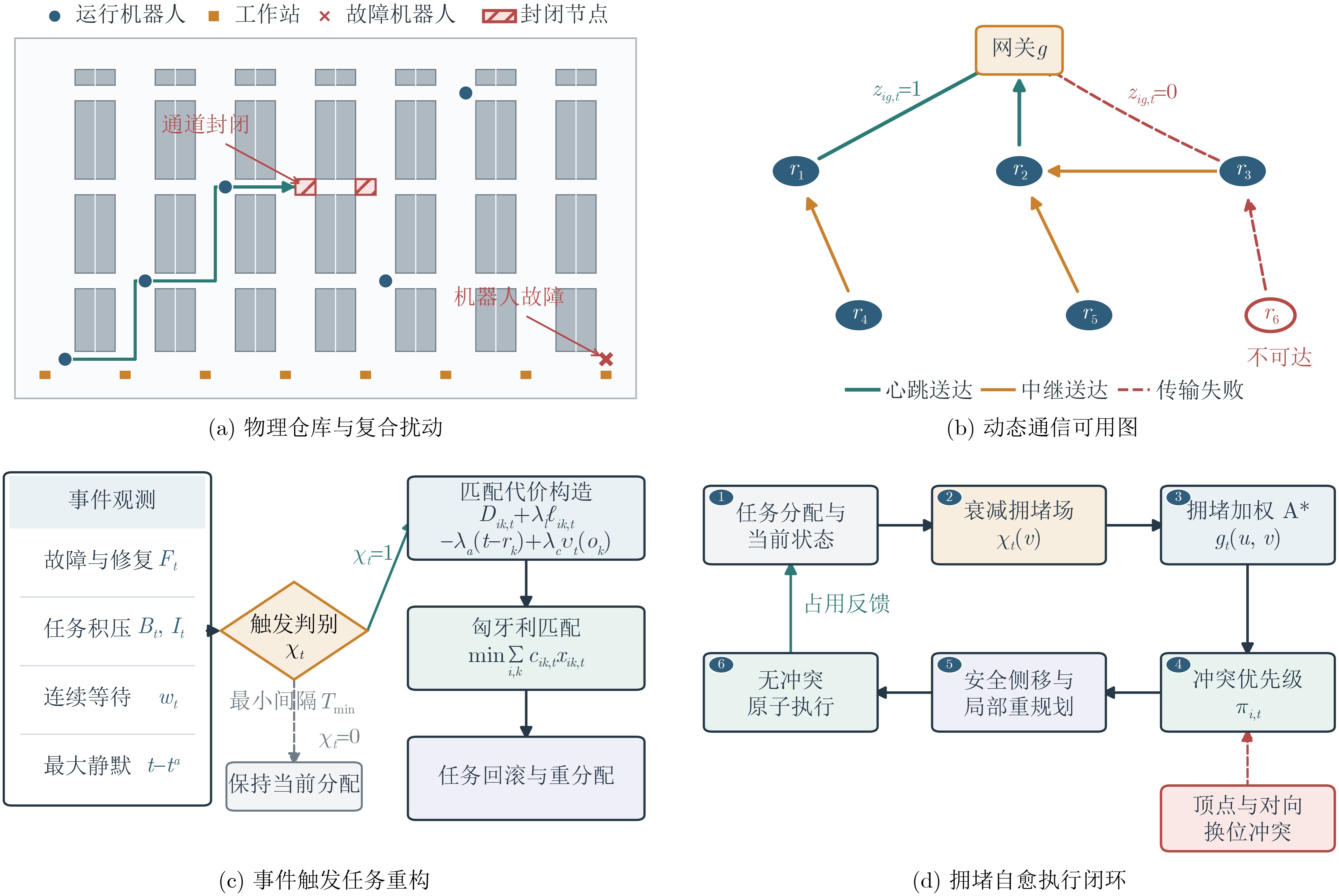
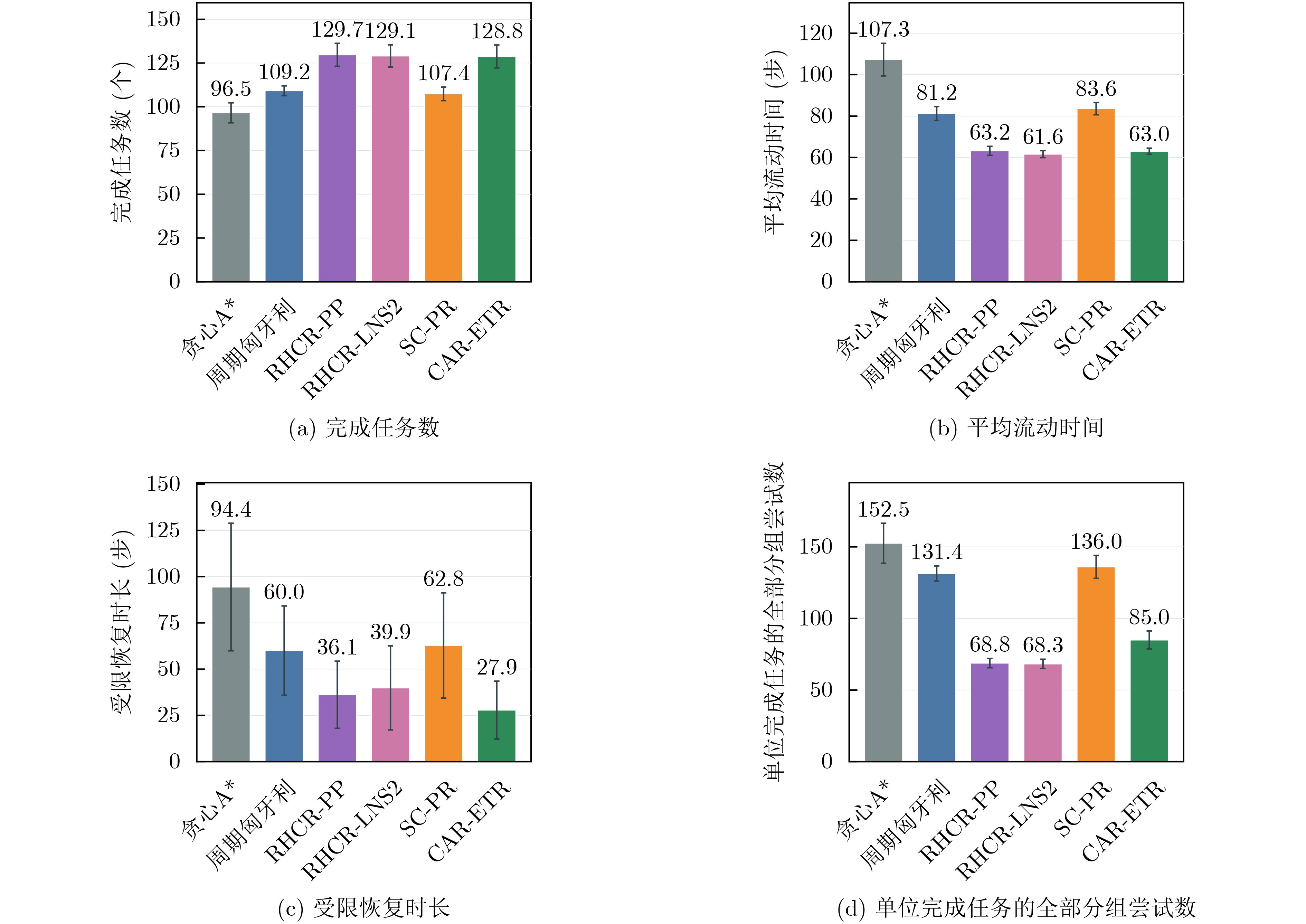
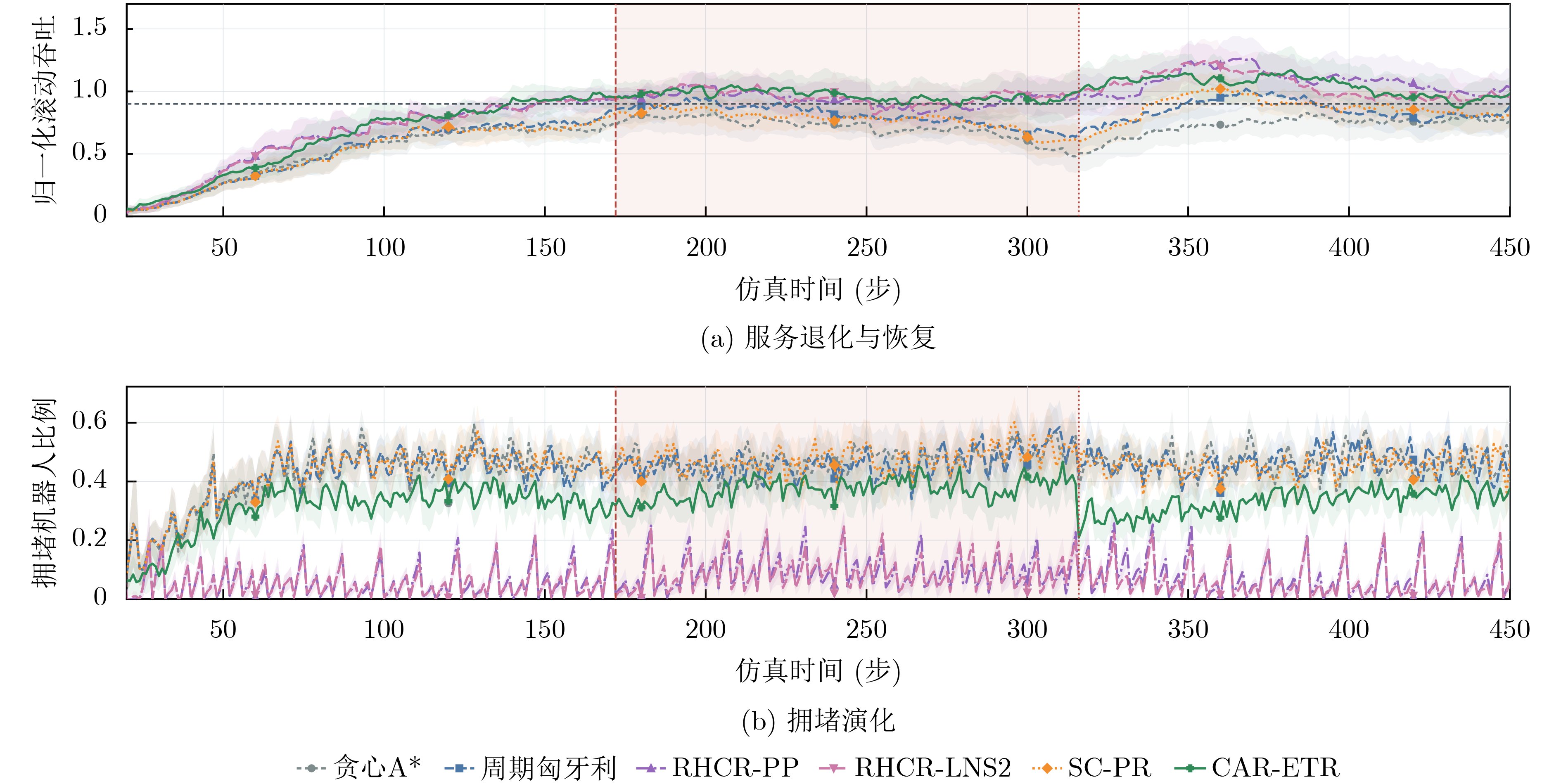
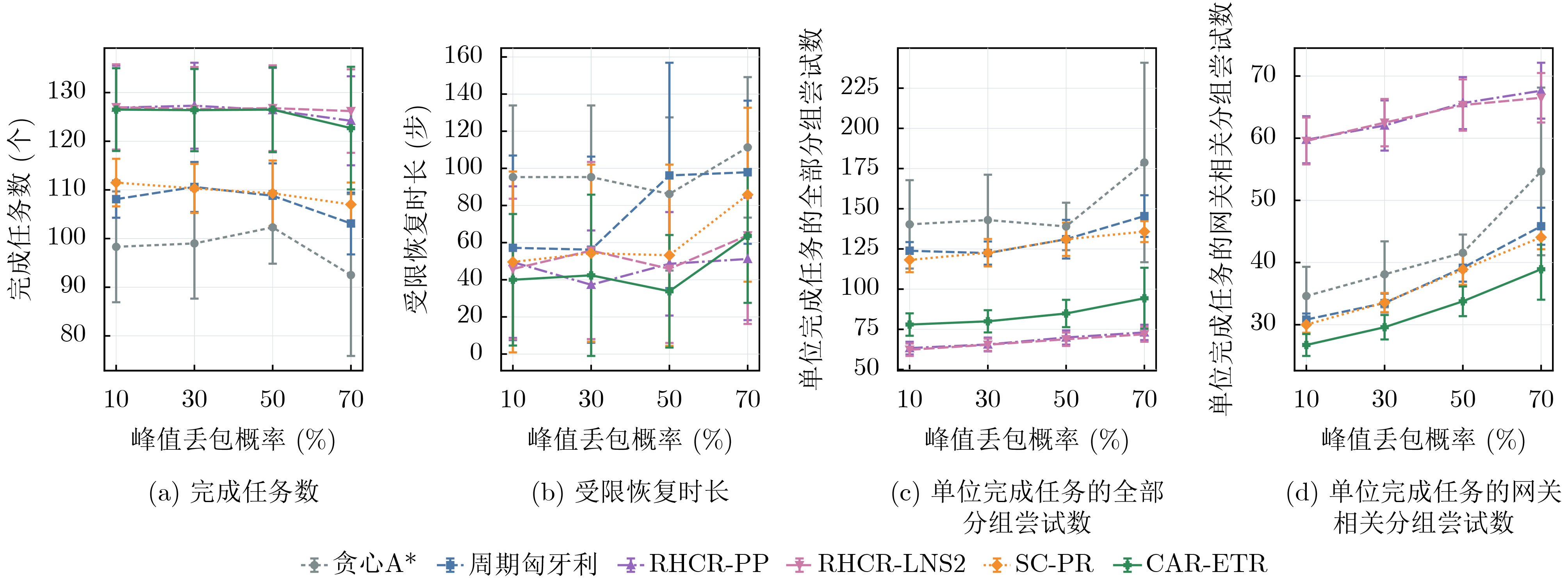
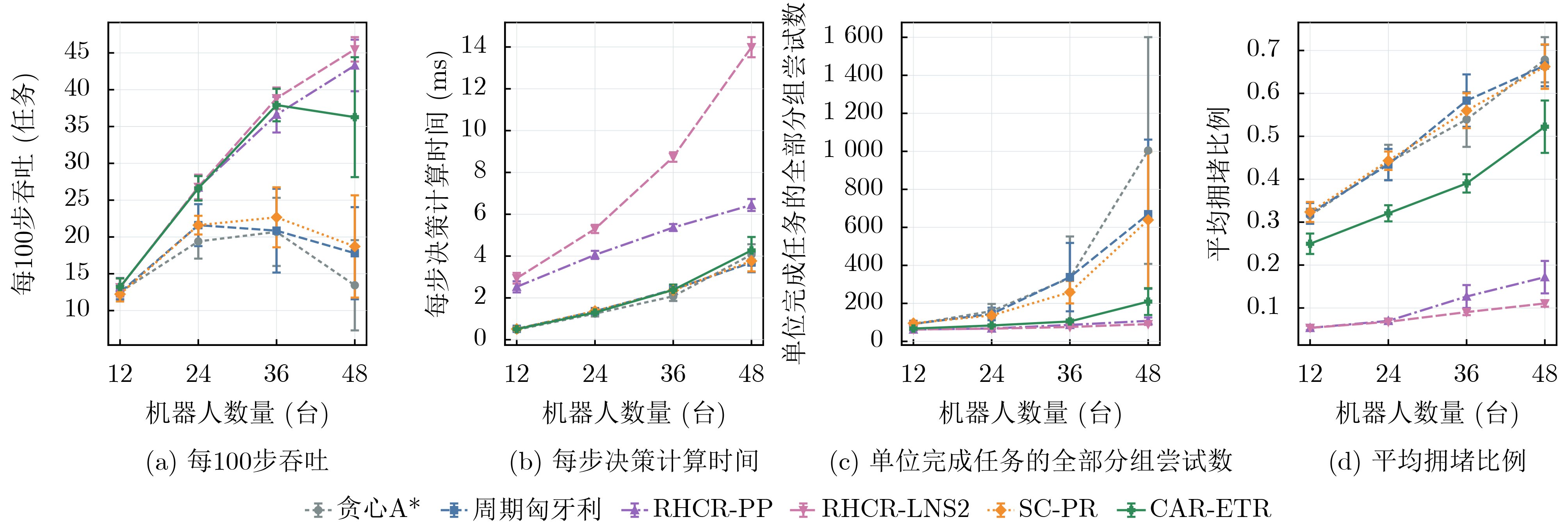
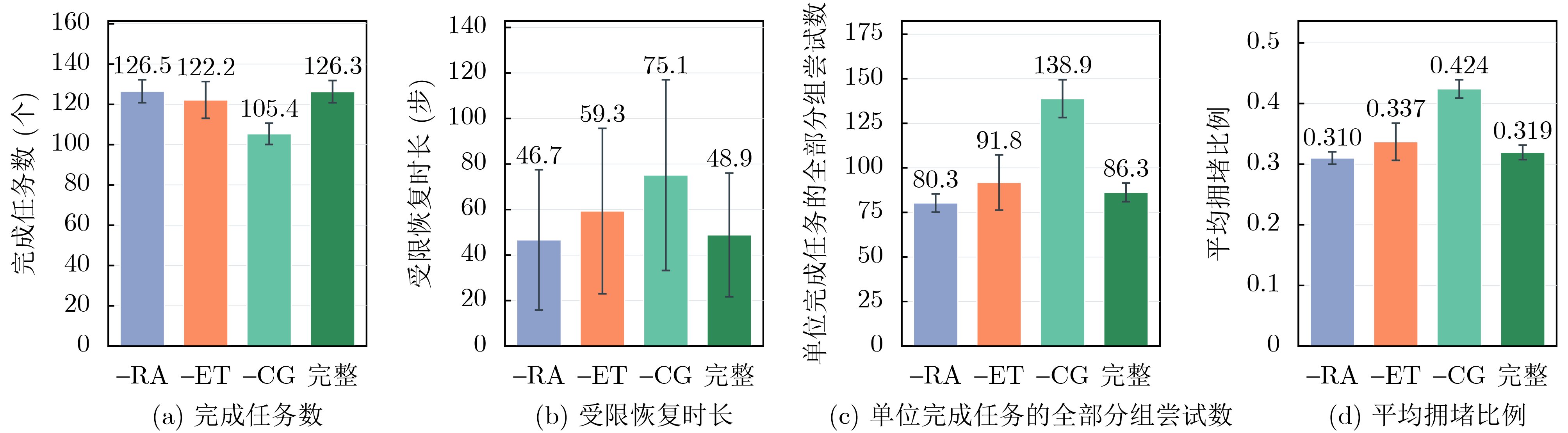
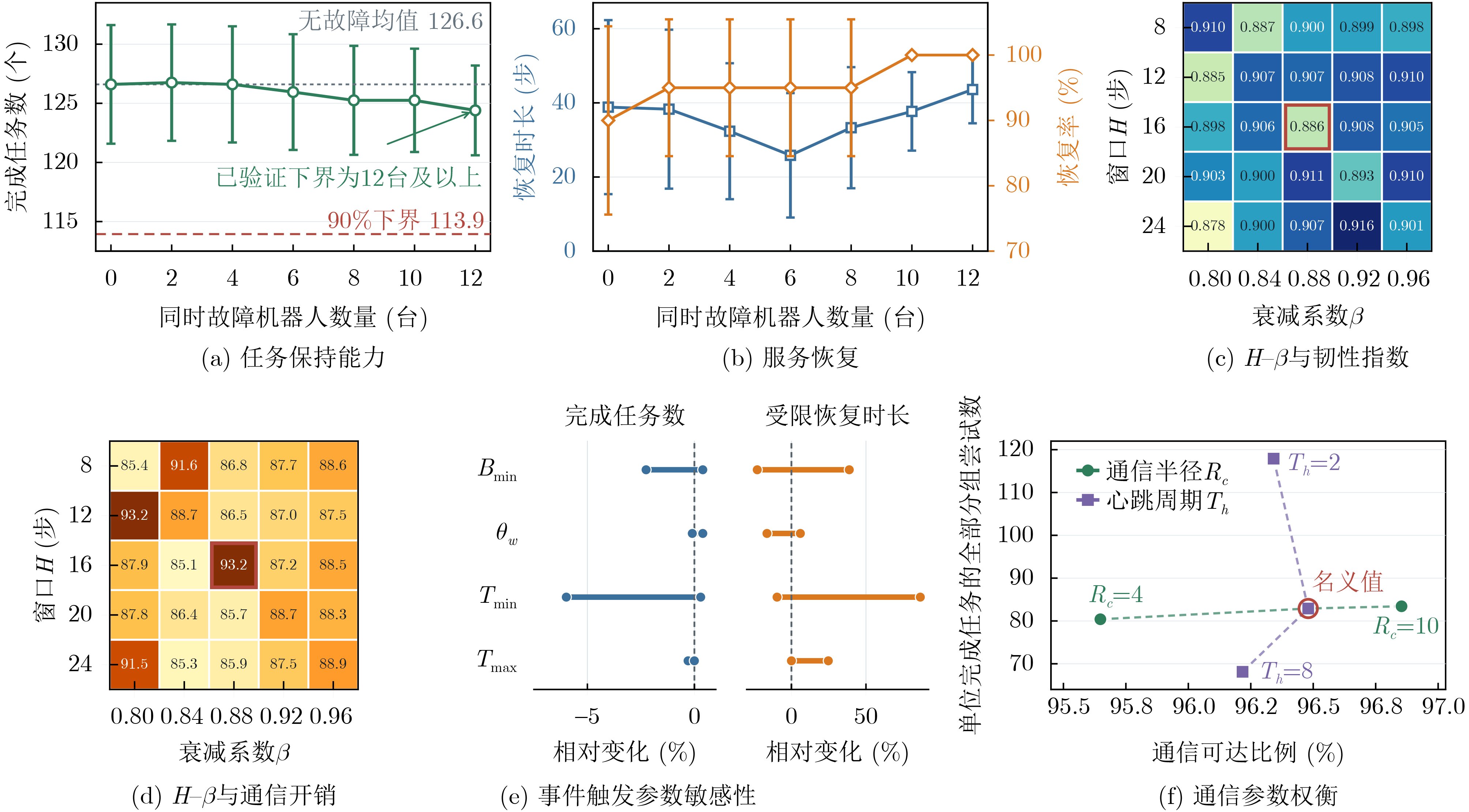
  •   Objective  Warehouse robot fleets allocate streaming pickup-and-delivery tasks in narrow aisles. Packet loss can hide a healthy robot, a physical failure can invalidate its assignment, and a blockage can propagate queues. Existing studies often separate communication, task allocation, and multi-agent path finding. Scheduling may therefore use simulator-side states that were never delivered, while evaluation may omit failed transmissions, retries, or relay hops. This inconsistent information boundary obscures whether recovery is deployable. This study develops a method whose reconfiguration feasible domain is constrained by delivered-packet evidence.  Methods  A communication-availability-constrained event-triggered reconfiguration method, termed CAR-ETR, is proposed. Its central contribution is a cross-layer hard gate rather than a new event trigger, Hungarian matcher, congestion weight, or conflict resolver. Delivered heartbeat, retransmission, or relay packets form the availability set $ {\mathcal{A}}_{t} $; this set determines the assignable-robot set $ \mathcal{R}_{t}^{a} $, which determines which variables $ {x}_{ik,t} $ may enter task reconfiguration. Undelivered or unprobed states cannot be restored from simulator truth. The mechanism therefore changes the feasible domain instead of only modifying a matching cost or update frequency. An occupancy-history congestion field and a fixed-point executor support traffic redirection and discrete safety without being claimed as independent innovations.The warehouse is a grid graph, and each task has a release time, pickup node, delivery node, and due time. Availability is updated during heartbeat rounds. Direct delivery permits one retry; after failure, the nearest reachable robot within radius $ {R}_{c} $ may relay the packet. Source-to-relay loss increases with normalized Manhattan distance, relay-to-gateway delivery is sampled independently, and each hop permits one retry. A source enters $ {\mathcal{A}}_{t} $ only after end-to-end delivery. Every attempted heartbeat, retry, relay hop, assignment command, acknowledgement, centralized-planning packet, and local-conflict packet is counted.Reconfiguration uses fresh snapshots and is triggered by fault changes, backlog, prolonged waiting, or a maximum silent interval. The matching cost combines cached distance, projected lateness, task age, and an exponentially decayed occupancy field. The window $ H=16 $ covers four heartbeat periods and two minimum reconfiguration intervals; $ \beta =0.88 $ gives a 5.42-step half-life and retains 87.1% of the infinite-kernel mass. A fixed-point resolver keeps one priority winner for duplicate targets and removes moves into failed or stationary robots and opposite-edge swaps. Runtime assertions check vertex, swap, and failed-node invariants after every step.Experiments use a $ 31\times 23 $ warehouse with 24 robots, eight stations, and 480 steps. Compound disturbances combine correlated packet loss, four temporary blockages, and robot failures. Baselines are Greedy-A*, periodic Hungarian assignment, selective-conflict prioritized replanning, RHCR-PP with space-time reservations, and RHCR-LNS2 with large-neighborhood conflict repair. All methods share task, disturbance, communication, and safety settings. The primary experiment uses 20 paired seeds, Student-$ t $-based 95% confidence intervals, paired Wilcoxon tests, and global Holm correction over 40 comparisons. Additional experiments vary peak loss, fleet size, component removal, 0-12 simultaneous failures, a $ 5\times 5 $ $ H $-$ \beta $ grid, event thresholds, communication radius, and heartbeat period.  Results and Discussions  CAR-ETR completes $ 128.75\pm 6.55 $ tasks, with a mean flow time of $ 62.99\pm 1.50 $ steps, a restricted recovery duration of $ 27.85\pm 15.65 $ steps, and a recovery rate of 0.95. Relative to selective-conflict prioritized replanning, completed tasks increase by 19.88%, mean flow time decreases by 24.61%, service loss decreases by 42.83%, and all packet attempts per task decrease by 37.54%; these differences remain significant after global Holm correction. The 55.65% lower mean recovery duration is not significant after correction and is not treated as a confirmed advantage.Relative to RHCR-LNS2, the completed-task difference is -0.23%, and completed tasks, flow time, service loss, and resilience do not differ significantly. CAR-ETR reduces gateway-related packet attempts by 48.85% and decision time by 74.75%, while increasing all packet attempts by 24.47%. Relative to RHCR-PP, completed tasks are 0.73% lower, gateway-related attempts are 48.74% lower, and decision time is 66.35% lower, while all packet attempts are 23.48% higher. CAR-ETR therefore exchanges robot-to-robot local messages for lower centralized coordination and online computation rather than universally dominating rolling-horizon planning.When peak packet loss rises from 10% to 70%, completed tasks decrease by 3.00%, while all packet attempts increase by 20.96% and retry-plus-relay attempts increase sevenfold. The operational fault-tolerance criterion requires a recovery rate of at least 0.80 and completed tasks of at least 90% of the no-failure mean. All tested levels through 12 simultaneous temporary failures satisfy it, establishing a verified lower bound of 12 of 24 robots for the tested 96-step duration. Service loss nevertheless rises from 35.00 to 62.51, so this is not a theoretical threshold and cannot be extrapolated to permanent failures. An overly long minimum reconfiguration interval degrades throughput and recovery; removing congestion feedback produces the largest ablation loss. Weak scaling remains effective through 36 robots, but saturation and local-message amplification appear at 48 robots. No vertex collision, opposite-edge swap, or active-to-failed-robot overlap occurs in 1476 runs.  Conclusions  CAR-ETR establishes a communication-evidence gate from delivered packets to task-reconfiguration feasibility, with congestion guidance and fixed-point conflict resolution supporting execution. It improves service over local periodic replanning and reduces gateway coordination and online computation relative to strong rolling-horizon baselines, at the cost of more total packet attempts. Evidence remains limited to discrete-event simulation; continuous dynamics, wireless contention, localization error, energy constraints, permanent failures, and component interactions require hardware-in-the-loop and physical-platform validation.
  • loading
  • [1]
    SHARON G, STERN R, FELNER A, et al. Conflict-based search for optimal multi-agent pathfinding[J]. Artificial Intelligence, 2015, 219: 40–66. doi: 10.1016/j.artint.2014.11.006.
    [2]
    LI Jiaoyang, TINKA A, KIESEL S, et al. Lifelong multi-agent path finding in large-scale warehouses[C]. Proceedings of the 35th AAAI Conference on Artificial Intelligence, Vancouver, Canada, 2021: 11272–11281. doi: 10.1609/aaai.v35i13.17344. (查阅网上资料,无法确认出版地信息是否正确).
    [3]
    CHEN Zhe, HARABOR D, LI Jiaoyang, et al. Traffic flow optimisation for lifelong multi-agent path finding[C]. Proceedings of the 38th AAAI Conference on Artificial Intelligence, Vancouver, Canada, 2024: 20674–20682. doi: 10.1609/aaai.v38i18.30054.
    [4]
    ZHENG Han, MA Yining, ARAKI B, et al. Learning-guided prioritized planning for lifelong multi-agent path finding in warehouse automation[J]. Journal of Artificial Intelligence Research, 2026, 85: 28. doi: 10.1613/jair.1.20611.
    [5]
    WANG Yutong, DUHAN T, LI Jiaoyang, et al. LNS2+RL: Combining multi-agent reinforcement learning with large neighborhood search in multi-agent path finding[C]. Proceedings of the 39th AAAI Conference on Artificial Intelligence, Philadelphia, USA, 2025: 23343–23350. doi: 10.1609/aaai.v39i22.34501.
    [6]
    王昱, 张旭秀. 一种结合选择性通信与冲突解决的多智能体路径规划方法[J]. 电子与信息学报, 2025, 47(8): 2830–2840. doi: 10.11999/JEIT250122.

    WANG Yu and ZHANG Xuxiu. A multi-agent path finding strategy combining selective communication and conflict resolution[J]. Journal of Electronics & Information Technology, 2025, 47(8): 2830–2840. doi: 10.11999/JEIT250122.
    [7]
    MAOUDJ A and CHRISTENSEN A L. Improved decentralized cooperative multi-agent path finding for robots with limited communication[J]. Swarm Intelligence, 2024, 18(2): 167–185. doi: 10.1007/s11721-023-00230-7.
    [8]
    VERMA A, GAUTAM A, SHEKHAWAT V S, et al. Empirical study on multi-robot task allocation under communication range restrictions[J]. IEEE Access, 2025, 13: 171818–171830. doi: 10.1109/ACCESS.2025.3614892.
    [9]
    GIELIS J, SHANKAR A, and PROROK A. A critical review of communications in multi-robot systems[J]. Current Robotics Reports, 2022, 3(4): 213–225. doi: 10.1007/s43154-022-00090-9.
    [10]
    SHIBATA K, JIMBO T, and MATSUBARA T. Deep reinforcement learning of event-triggered communication and consensus-based control for distributed cooperative transport[J]. Robotics and Autonomous Systems, 2023, 159: 104307. doi: 10.1016/j.robot.2022.104307.
    [11]
    AZNAR F, PUJOL M, and DÍEZ Á. Event-triggered adaptive consensus for multi-robot task allocation[J]. Computer Communications, 2026, 251: 108499. doi: 10.1016/j.comcom.2026.108499.
    [12]
    MAYYA S, D’ANTONIO D S, SALDAÑA D, et al. Resilient task allocation in heterogeneous multi-robot systems[J]. IEEE Robotics and Automation Letters, 2021, 6(2): 1327–1334. doi: 10.1109/LRA.2021.3057559.
    [13]
    SHEN Danqing, CHEN Xiaoming, QI Wenhai, et al. Task allocation for UAV swarms under communication attacks: An approach based on game theory and negotiation mechanism[J]. Journal of the Franklin Institute, 2025, 362(1): 107417. doi: 10.1016/j.jfranklin.2024.107417.
    [14]
    连远锋, 田天, 陈晓禾, 等. 数字孪生辅助强化学习的燃气站场巡检任务分配算法[J]. 电子与信息学报, 2025, 47(7): 2285–2297. doi: 10.11999/JEIT241027.

    LIAN Yuanfeng, TIAN Tian, CHEN Xiaohe, et al. Gas station inspection task allocation algorithm in digital twin-assisted reinforcement learning[J]. Journal of Electronics & Information Technology, 2025, 47(7): 2285–2297. doi: 10.11999/JEIT241027.
    [15]
    黄高勇, 宋俊, 方旭明, 等. 面向铁路双无人机协同巡检轨迹优化的多智能体强化学习方法[J]. 电子与信息学报, 2026, 48(5): 1936–1947. doi: 10.11999/JEIT251321.

    HUANG Gaoyong, SONG Jun, FANG Xuming, et al. Multi-agent reinforcement learning method for trajectory optimization in dual-UAV cooperative railway inspection[J]. Journal of Electronics & Information Technology, 2026, 48(5): 1936–1947. doi: 10.11999/JEIT251321.
    [16]
    FARUQ F, LACERDA B, HAWES N, et al. A framework for simultaneous task allocation and planning under uncertainty[J]. ACM Transactions on Autonomous and Adaptive Systems, 2024, 19(4): 21. doi: 10.1145/3665499.
    [17]
    MA Ziyuan, LUO Yudong, and PAN Jia. Learning selective communication for multi-agent path finding[J]. IEEE Robotics and Automation Letters, 2022, 7(2): 1455–1462. doi: 10.1109/LRA.2021.3139145.
    [18]
    WANG Yutong, XIANG Bairan, HUANG Shinan, et al. SCRIMP: Scalable communication for reinforcement- and imitation-learning-based multi-agent pathfinding[C]. 2023 IEEE/RSJ International Conference on Intelligent Robots and Systems, Detroit, USA, 2023: 9301–9308. doi: 10.1109/IROS55552.2023.10342305.
    [19]
    SARTORETTI G, KERR J, SHI Yunfei, et al. PRIMAL: Pathfinding via reinforcement and imitation multi-agent learning[J]. IEEE Robotics and Automation Letters, 2019, 4(3): 2378–2385. doi: 10.1109/LRA.2019.2903261.
    [20]
    CHOI H L, BRUNET L, and HOW J P. Consensus-based decentralized auctions for robust task allocation[J]. IEEE Transactions on Robotics, 2009, 25(4): 912–926. doi: 10.1109/TRO.2009.2022423.
    [21]
    司明, 邬伯藩, 胡灿, 等. 智能仓储交通信号与多AGV路径规划协同控制方法[J]. 计算机工程与应用, 2024, 60(11): 290–297. doi: 10.3778/j.issn.1002-8331.2310-0113.

    SI Ming, WU Bofan, HU Can, et al. Collaborative control method of intelligent warehouse traffic signal and multi-AGV path planning[J]. Computer Engineering and Applications, 2024, 60(11): 290–297. doi: 10.3778/j.issn.1002-8331.2310-0113.
    [22]
    WANG Zhaofei, WENG Zihao, WANG Jing, et al. An original medical logistics robot system design for the complex environment of hospitals with dynamic obstacles[J]. Robotic Intelligence and Automation, 2025, 45(2): 210–227. doi: 10.1108/RIA-03-2023-0029.
    [23]
    LI Jiaoyang, CHEN Zhe, HARABOR D, et al. MAPF-LNS2: Fast repairing for multi-agent path finding via large neighborhood search[C]. Proceedings of the 36th AAAI Conference on Artificial Intelligence, 2022: 10256–10265. doi: 10.1609/aaai.v36i9.21266. (查阅网上资料,未找到对应的出版地信息,请确认).
  • 加载中

Catalog

    通讯作者: 陈斌, bchen63@163.com
    • 1. 

      沈阳化工大学材料科学与工程学院 沈阳 110142

    1. 本站搜索
    2. 百度学术搜索
    3. 万方数据库搜索
    4. CNKI搜索

    Figures(7)  / Tables(4)

    Article Metrics

    Article views (21) PDF downloads(5) Cited by()
    Proportional views
    Related

    /

    DownLoad:  Full-Size Img  PowerPoint
    Return
    Return