Advanced Search
Turn off MathJax
Article Contents
WAN Dehuan, HUANG Ronglan, JI Fei, LIU Jingxian, LIANG Yaokun, LÜ Lu, LI Xingwang, YUE Xinwei. Efficient Non-Orthogonal Multiple Access Scheme Based on Modified Alamouti Code Design[J]. Journal of Electronics & Information Technology. doi: 10.11999/JEIT260567
Citation: WAN Dehuan, HUANG Ronglan, JI Fei, LIU Jingxian, LIANG Yaokun, LÜ Lu, LI Xingwang, YUE Xinwei. Efficient Non-Orthogonal Multiple Access Scheme Based on Modified Alamouti Code Design[J]. Journal of Electronics & Information Technology. doi: 10.11999/JEIT260567

Efficient Non-Orthogonal Multiple Access Scheme Based on Modified Alamouti Code Design

doi: 10.11999/JEIT260567 cstr: 32379.14.JEIT260567
Funds:  The National Natural Science Foundation of China (61971149, 62501176, 62271368, 62571182)
  • Accepted Date: 2026-08-10
  • Rev Recd Date: 2026-08-10
  • Available Online: 2026-08-12
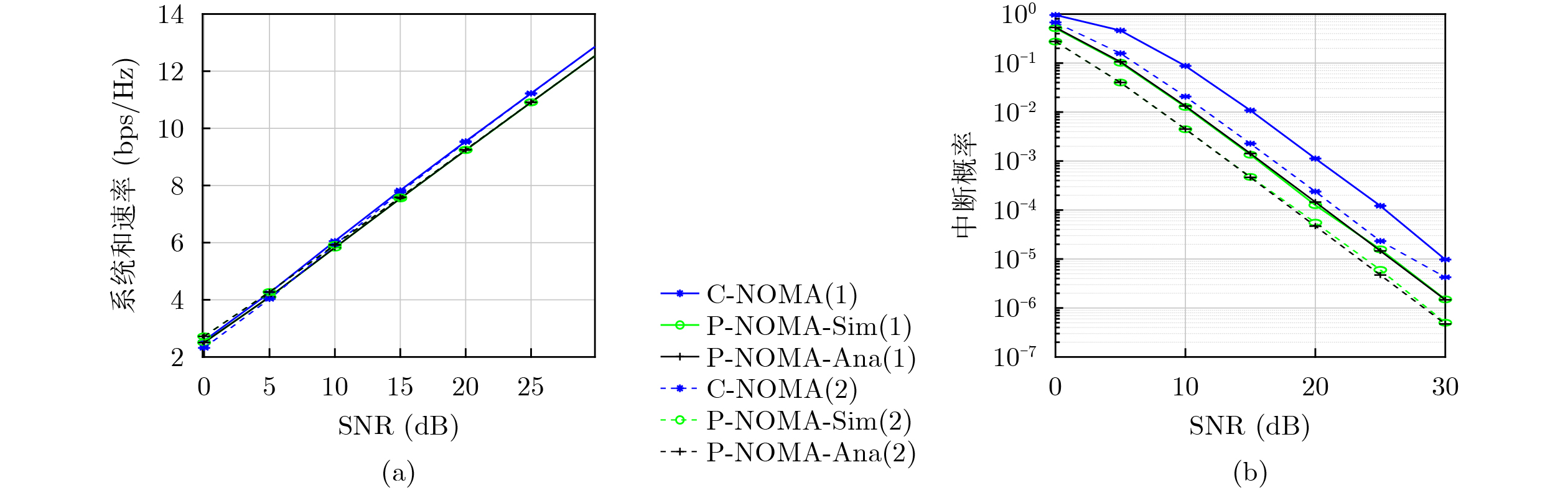
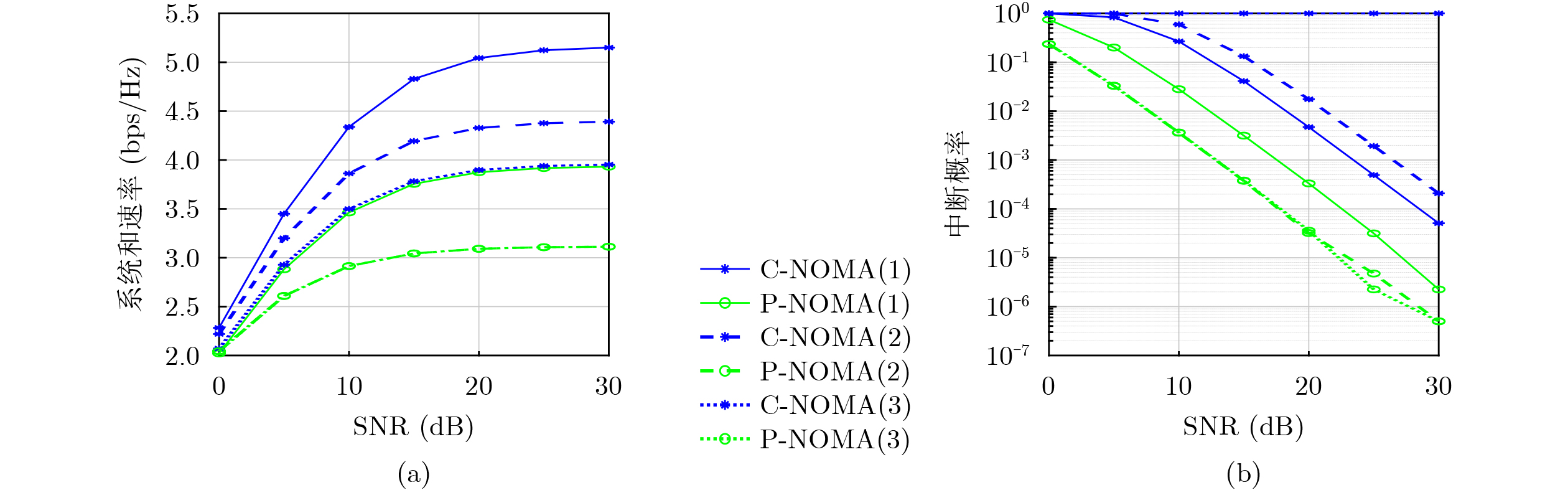
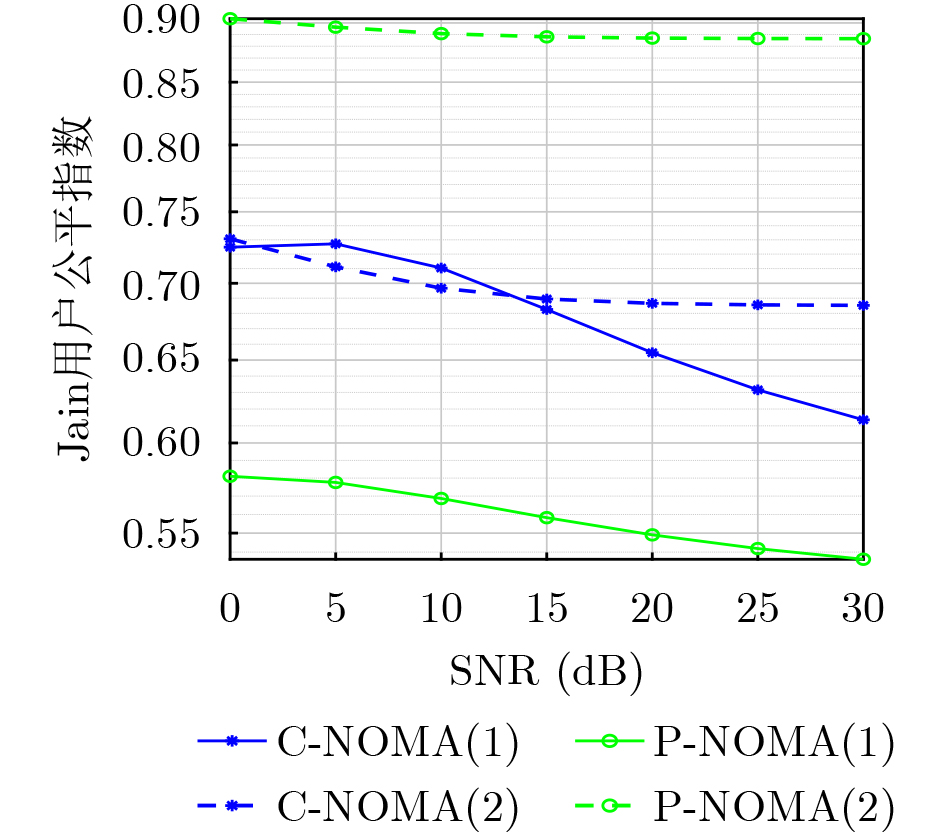
  •   Objective  Existing Alamouti-coding-based Non-Orthogonal Multiple Access (NOMA) schemes adopt an equal-number symbol transmission mode for both cell-center and cell-edge users, which overlooks the significant channel disparity between the two types of users. This leads to two drawbacks: on one hand, the superior channel condition of cell-center users is not fully exploited, resulting in wasted transmission resources; on the other hand, the equal-number transmission inevitably weakens the performance of Space-Time Block Coding (STBC) in suppressing intra-group multi-user interference. Therefore, a novel design that adapts to user channel differences is urgently needed to improve spectral efficiency and interference mitigation capability.  Methods  In light of the significant channel disparity between cell-center and cell-edge users, this paper proposes an unequal-number symbol transmission scheme for Alamouti coding in NOMA. Specifically, when constructing Alamouti group transmission codes, the number of symbols required for the cell-edge user is made smaller than that for the cell-center user. By reducing the number of transmitted symbols for the cell-edge user, two benefits are achieved: first, the multi-user interference imposed on the cell-center user is directly reduced; second, under a total power constraint, reducing the number of symbols for the cell-edge user equivalently increases the per-symbol transmission power, thereby significantly improving the received signal-to-interference-plus-noise ratio (SINR). Furthermore, the paper derives perfect closed-form solutions for the achievable sum rate and outage probability of the proposed scheme, and validates its effectiveness via numerical simulations.  Results and Discussions  The theoretical derivations yield closed-form analytical expressions for the achievable sum rate and outage probability, providing an accurate basis for system performance evaluation. Numerical simulation results demonstrate that, compared with existing equal-symbol Alamouti coding schemes, the proposed unequal-symbol Alamouti coding scheme effectively reduces the intra-group interference from the cell-edge user to the cell-center user, while significantly enhancing the SINR of the cell-edge user through power reallocation. Under typical channel parameters, the system achieves a notable sum-rate gain and a substantial reduction in outage probability, confirming the high efficiency of the proposed scheme.  Conclusions  The proposed unequal-number symbol transmission scheme based on Alamouti coding for cell-edge and cell-center users fully exploits the potential benefits arising from channel disparity. By reducing the number of symbols transmitted by the cell-edge user, the scheme achieves both suppression of intra-group interference and enhancement of the edge user’s transmission power. The theoretical closed-form solutions and simulation results consistently show that the proposed scheme outperforms conventional equal-number transmission schemes, providing an effective new approach for mitigating multi-user interference and optimizing resource allocation in NOMA systems.
  • loading
  • [1]
    WANG Chengxiang, YOU Xiaohu, GAO Xiqi, et al. On the road to 6G: Visions, requirements, key technologies, and testbeds[J]. IEEE Communications Surveys & Tutorials, 2023, 25(2): 905–974. doi: 10.1109/COMST.2023.3249835.
    [2]
    AHMED M, MIRZA M A, RAZA S, et al. Vehicular communication network enabled CAV data offloading: A review[J]. IEEE Transactions on Intelligent Transportation Systems, 2023, 24(8): 7869–7897. doi: 10.1109/TITS.2023.3263643.
    [3]
    DAI Linglong, WANG Bichai, YUAN Yifei, et al. Non-orthogonal multiple access for 5G: Solutions, challenges, opportunities, and future research trends[J]. IEEE Communications Magazine, 2015, 53(9): 74–81. doi: 10.1109/MCOM.2015.7263349.
    [4]
    陈健, 马天瑞, 杨龙, 等. 面向移动边缘计算的协作NOMA安全卸载能耗优化[J]. 电子与信息学报, 2026, 48(2): 534–544. doi: 10.11999/JEIT250606.

    CHEN Jian, MA Tianrui, YANG Long, et al. Energy consumption optimization of cooperative NOMA secure offload for mobile edge computing[J]. Journal of Electronics & Information Technology, 2026, 48(2): 534–544. doi: 10.11999/JEIT250606.
    [5]
    余礼苏, 钟润, 吕欣欣, 等. 压缩感知辅助的低复杂度SCMA系统优化设计[J]. 电子与信息学报, 2024, 46(5): 2011–2017. doi: 10.11999/JEIT231226.

    YU Lisu, ZHONG Run, LÜ Xinxin, et al. Optimized design of low complexity SCMA system assisted by compressed sensing[J]. Journal of Electronics & Information Technology, 2024, 46(5): 2011–2017. doi: 10.11999/JEIT231226.
    [6]
    CHEN Yuang, LU Hancheng, QIN Langtian, et al. When xURLLC meets NOMA: A stochastic network calculus perspective[J]. IEEE Communications Magazine, 2024, 62(6): 90–96. doi: 10.1109/MCOM.020.2300156.
    [7]
    李俊辉, 侯兴松. 基于伪监督注意力短期记忆与多尺度去伪影网络的图像分块压缩感知[J]. 电子与信息学报, 2024, 46(2): 472–480. doi: 10.11999/JEIT231069.

    LI Junhui and HOU Xingsong. Pseudo supervised attention short-term memory and multi-scale deartifacting network based on image block compressed sensing[J]. Journal of Electronics & Information Technology, 2024, 46(2): 472–480. doi: 10.11999/JEIT231069.
    [8]
    DING Zhiguo, FAN Pingzhi, and POOR H V. Impact of user pairing on 5G nonorthogonal multiple-access downlink transmissions[J]. IEEE Transactions on Vehicular Technology, 2016, 65(8): 6010–6023. doi: 10.1109/TVT.2015.2480766.
    [9]
    ZENG Jie, LV Tiejun, LIU Renping, et al. Investigation on evolving single-carrier NOMA into multi-carrier NOMA in 5G[J]. IEEE Access, 2018, 6: 48268–48288. doi: 10.1109/ACCESS.2018.2868093.
    [10]
    DING Zhiguo, SCHOBER R, and POOR H V. A general MIMO framework for NOMA downlink and uplink transmission based on signal alignment[J]. IEEE Transactions on Wireless Communications, 2016, 15(6): 4438–4454. doi: 10.1109/TWC.2016.2542066.
    [11]
    YUE Hanxue, HU Changjie, GUO Cheng, et al. MIMO OFDM-NOMA downlink systems with weak and strong beam division[J]. IEEE Transactions on Wireless Communications, 2026, 25: 10746–10758. doi: 10.1109/TWC.2026.3653983.
    [12]
    TRUONG T P, TRAN P N, OH J, et al. Energy efficiency in quantized MIMO-NOMA communication systems[J]. IEEE Transactions on Cognitive Communications and Networking, 2026, 12: 6629–6642. doi: 10.1109/TCCN.2026.3670130.
    [13]
    LI Meiling, YUAN Hu, YUE Xinwei, et al. Secrecy outage analysis for alamouti space-time block coded non-orthogonal multiple access[J]. IEEE Communications Letters, 2020, 24(7): 1405–1409. doi: 10.1109/LCOMM.2020.2980825.
    [14]
    POCHA N K R and BANAVATHU N R. Secrecy performance of UAV-Assisted overlay cognitive STBC-NOMA system with imperfect SIC[J]. IEEE Internet of Things Journal, 2025, 12(24): 55003–55016. doi: 10.1109/JIOT.2025.3622324.
    [15]
    LI Meiling, EL BOUANANI F, MUHAIDAT S, et al. Secure STBC-aided NOMA in cognitive IIoT networks[J]. IEEE Internet of Things Journal, 2024, 11(1): 1256–1271. doi: 10.1109/JIOT.2023.3288452.
  • 加载中

Catalog

    通讯作者: 陈斌, bchen63@163.com
    • 1. 

      沈阳化工大学材料科学与工程学院 沈阳 110142

    1. 本站搜索
    2. 百度学术搜索
    3. 万方数据库搜索
    4. CNKI搜索

    Figures(3)  / Tables(1)

    Article Metrics

    Article views (152) PDF downloads(9) Cited by()
    Proportional views
    Related

    /

    DownLoad:  Full-Size Img  PowerPoint
    Return
    Return