Advanced Search
Turn off MathJax
Article Contents
SHU Feng, LIN Zhiyuan, ZHENG Weihai, WANG Yan, JIANG Hao, WANG Jiangzhou. Energy Efficiency Analysis of Discrete Phase-Shifted Active RIS Enhanced Communication Systems[J]. Journal of Electronics & Information Technology. doi: 10.11999/JEIT260462
Citation: SHU Feng, LIN Zhiyuan, ZHENG Weihai, WANG Yan, JIANG Hao, WANG Jiangzhou. Energy Efficiency Analysis of Discrete Phase-Shifted Active RIS Enhanced Communication Systems[J]. Journal of Electronics & Information Technology. doi: 10.11999/JEIT260462

Energy Efficiency Analysis of Discrete Phase-Shifted Active RIS Enhanced Communication Systems

doi: 10.11999/JEIT260462 cstr: 32379.14.JEIT260462
Funds:  The National Natural Science Foundation of China (U22A2002), Hainan Provincial Natural Science Foundation of China (626ZD0993, 526QN0542, 626QN0553), Hainan Province Science and Technology Special Fund (ZDYF2024GXJS292)
  • Received Date: 2026-04-16
  • Accepted Date: 2026-07-13
  • Rev Recd Date: 2026-07-13
  • Available Online: 2026-07-23
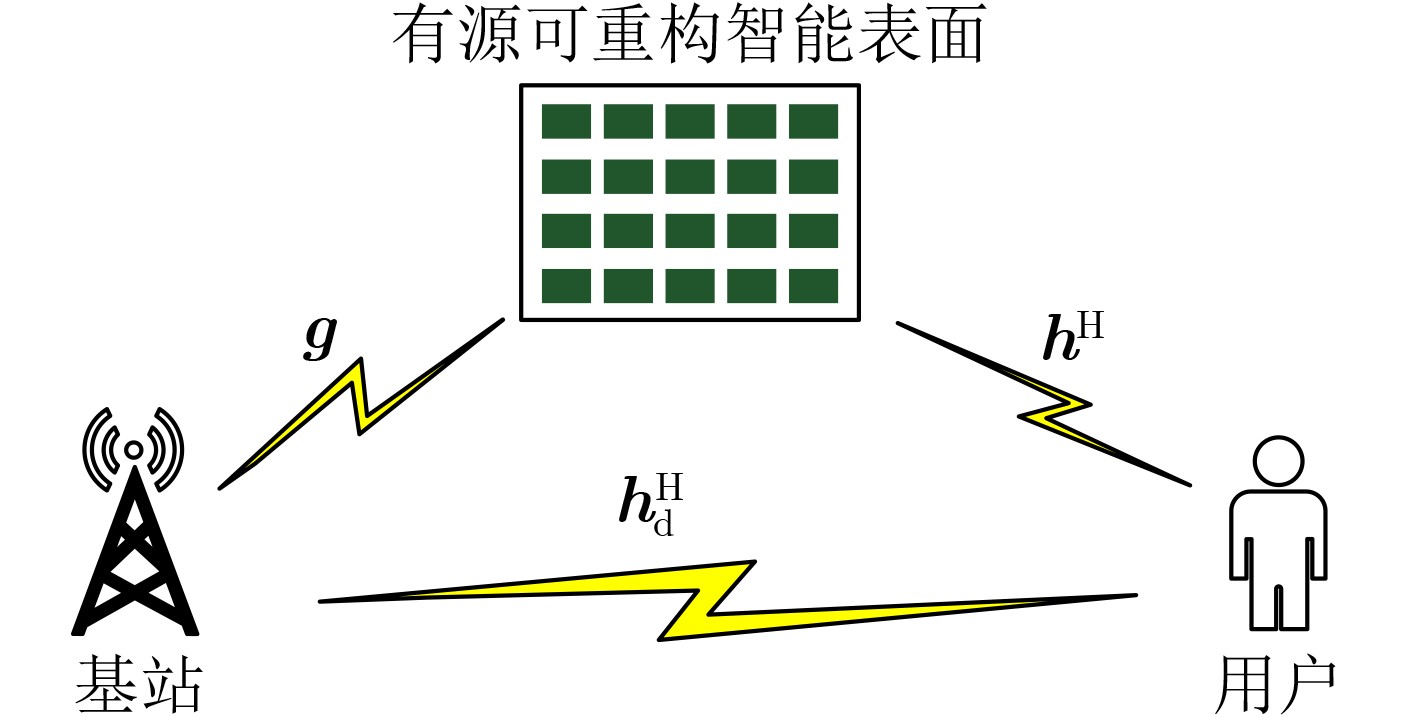
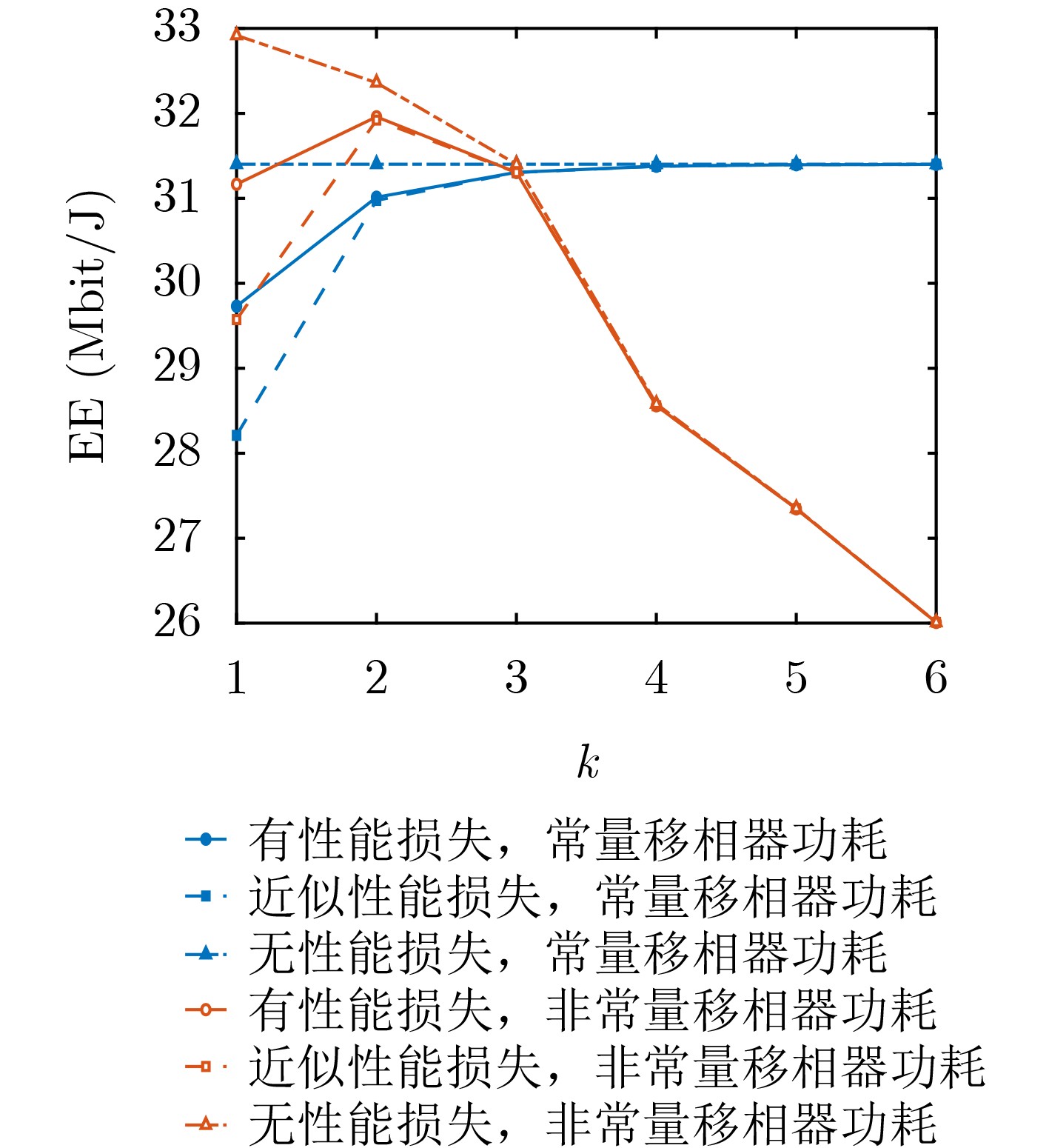
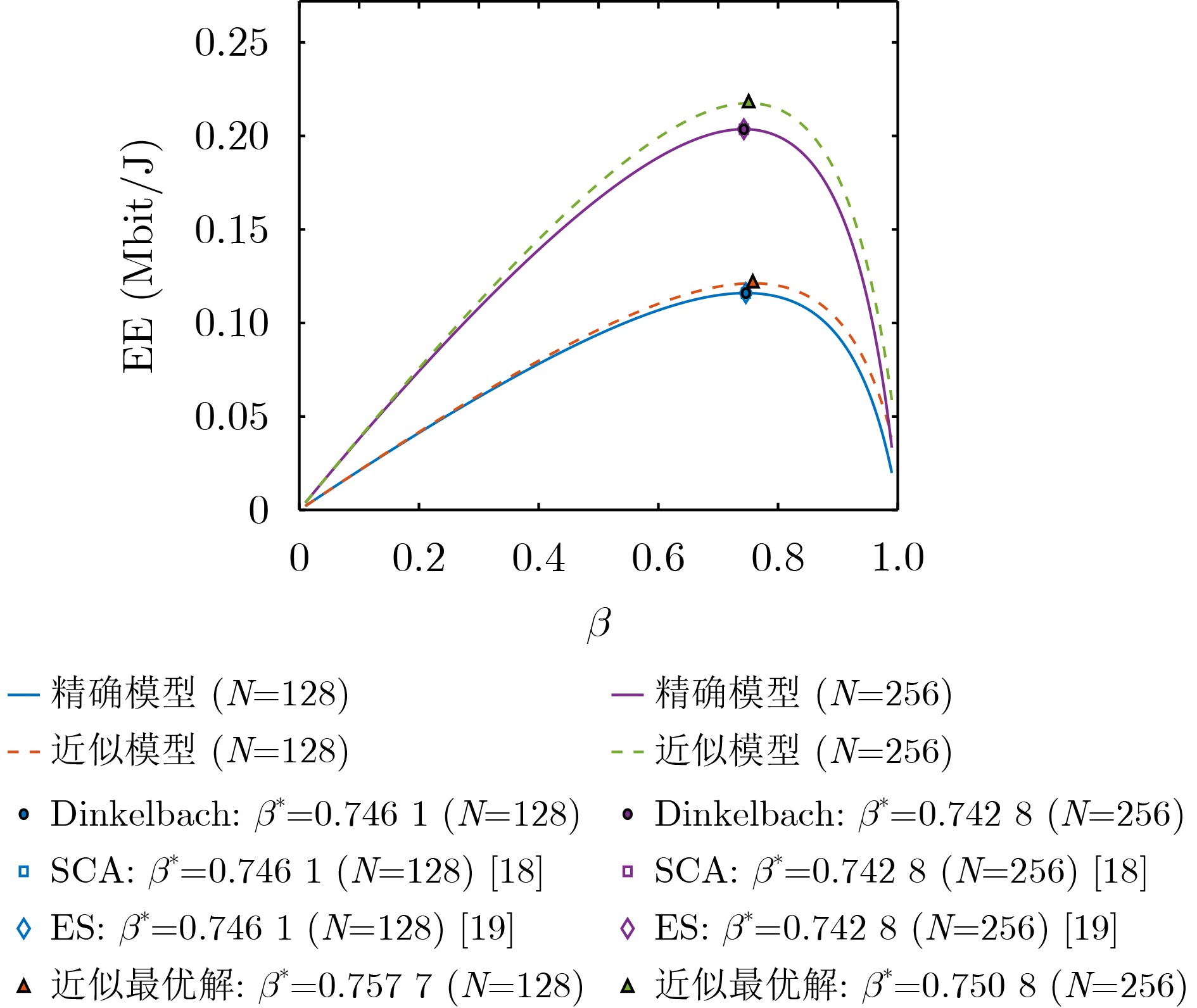
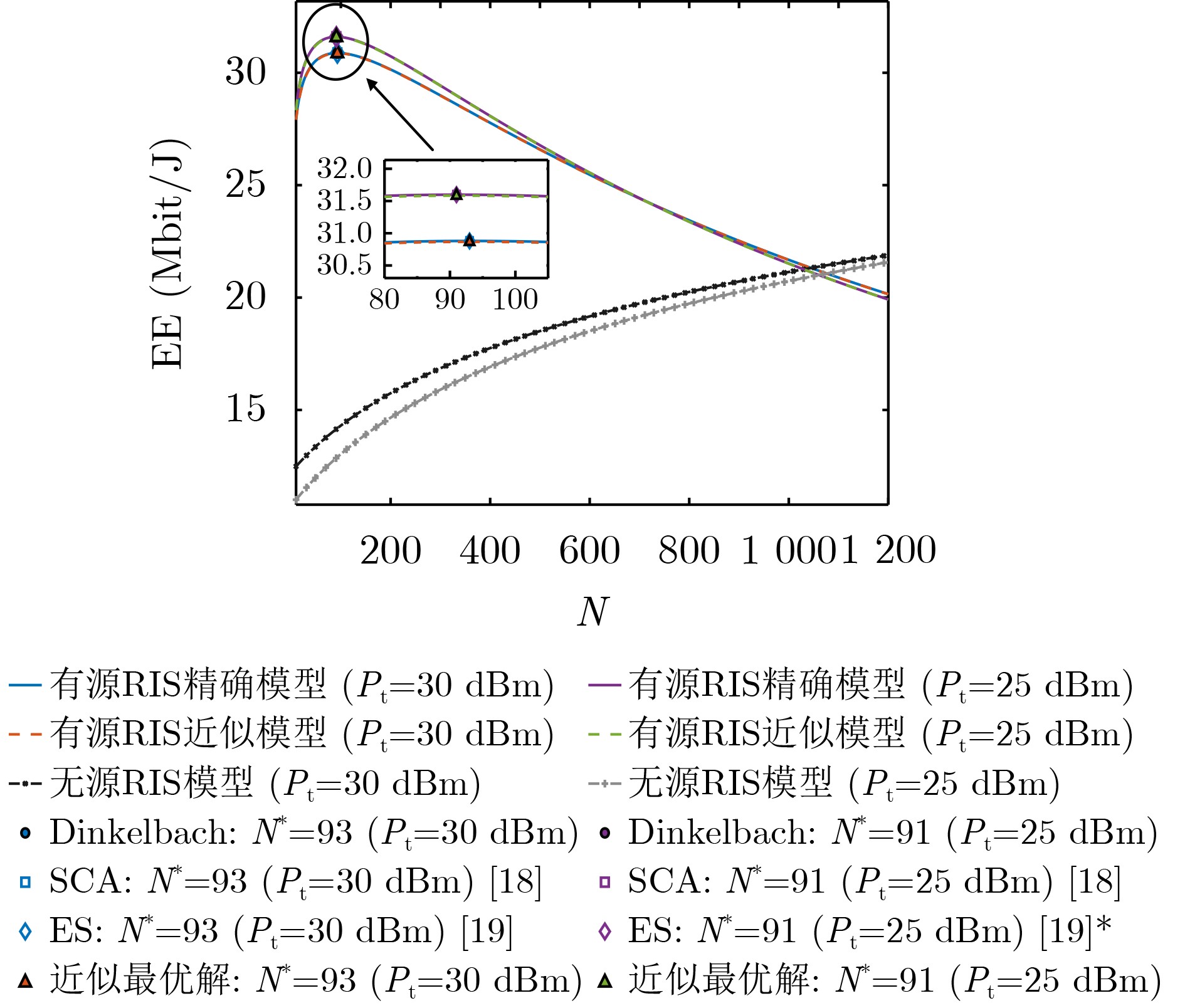
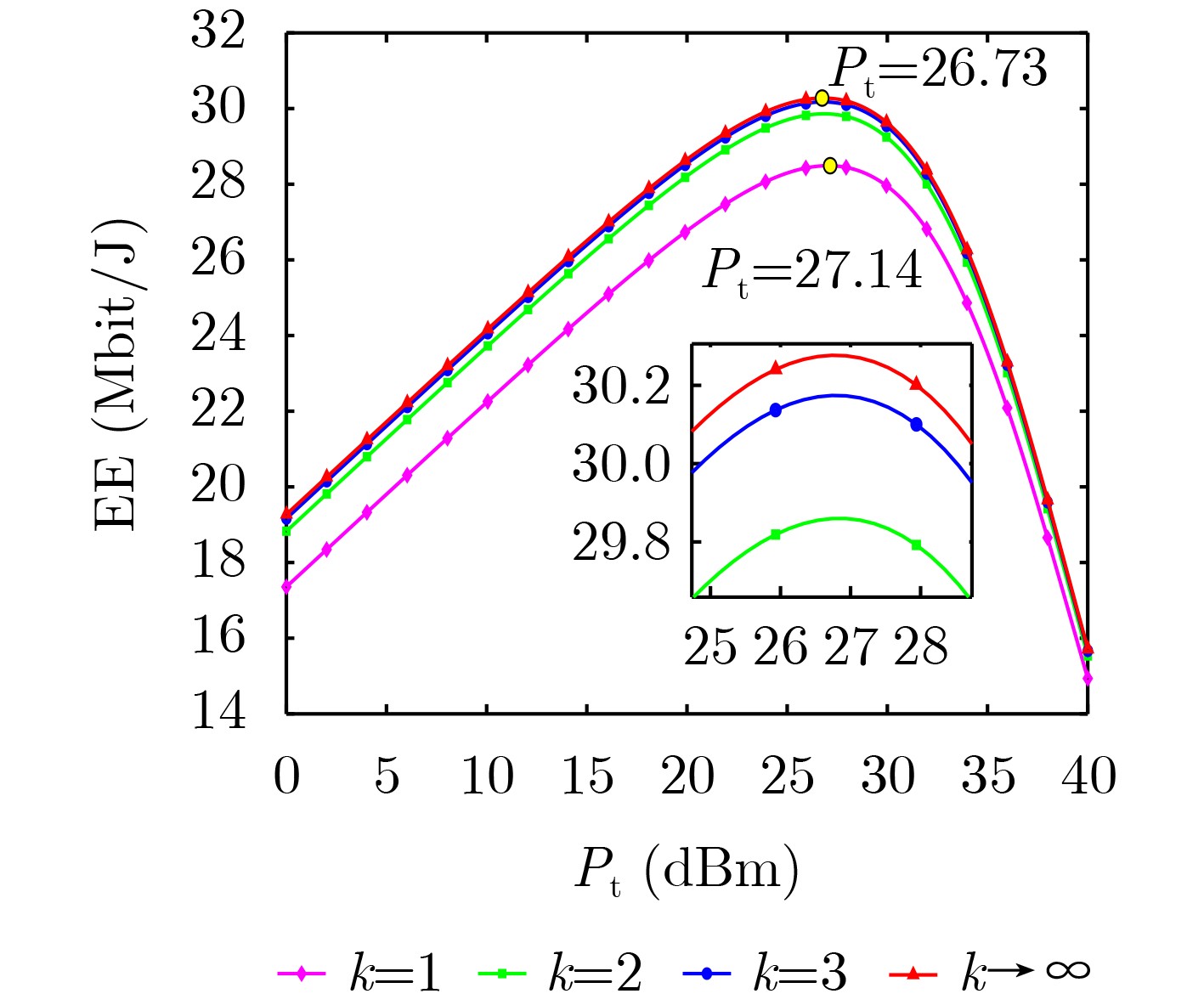
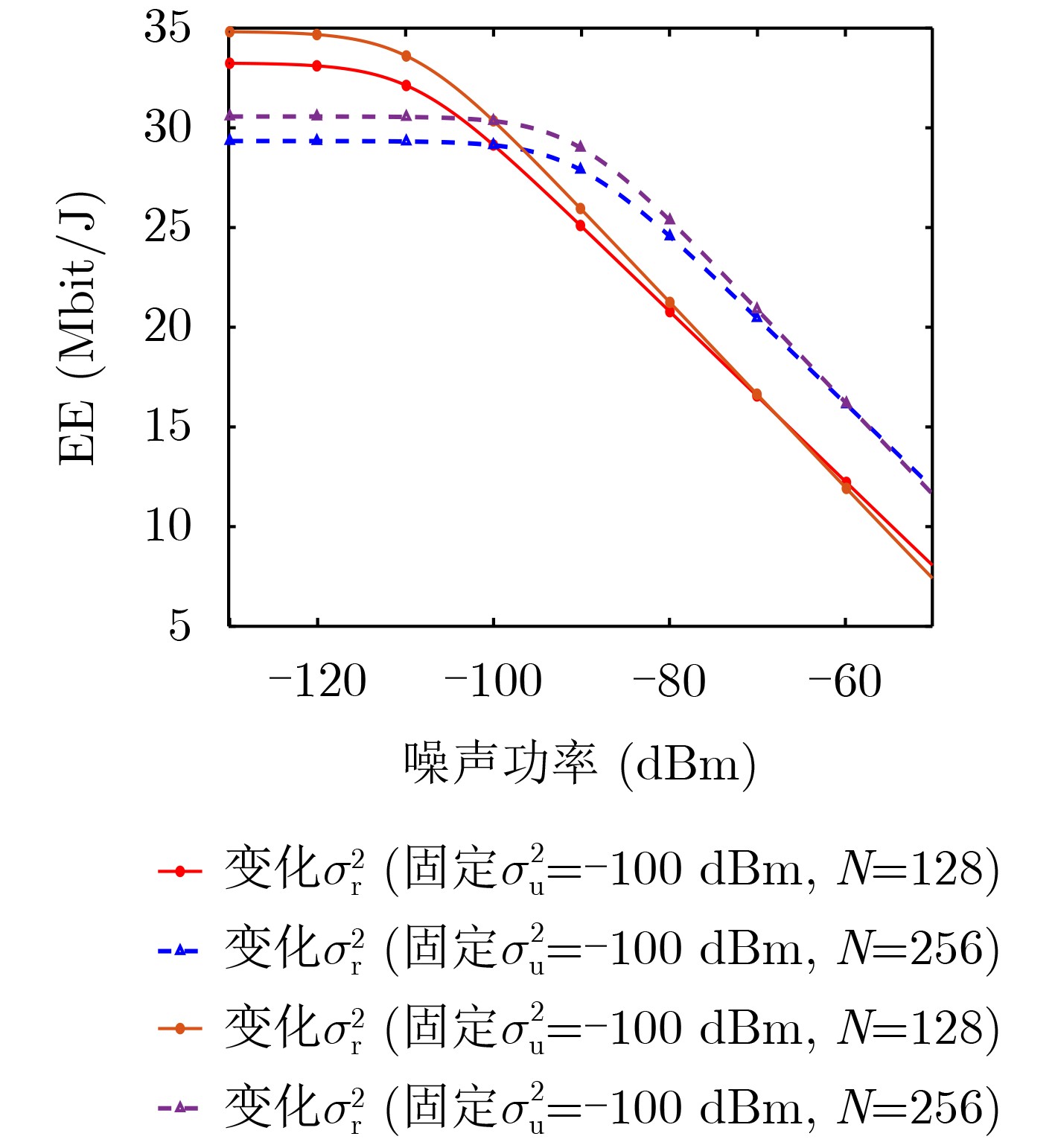
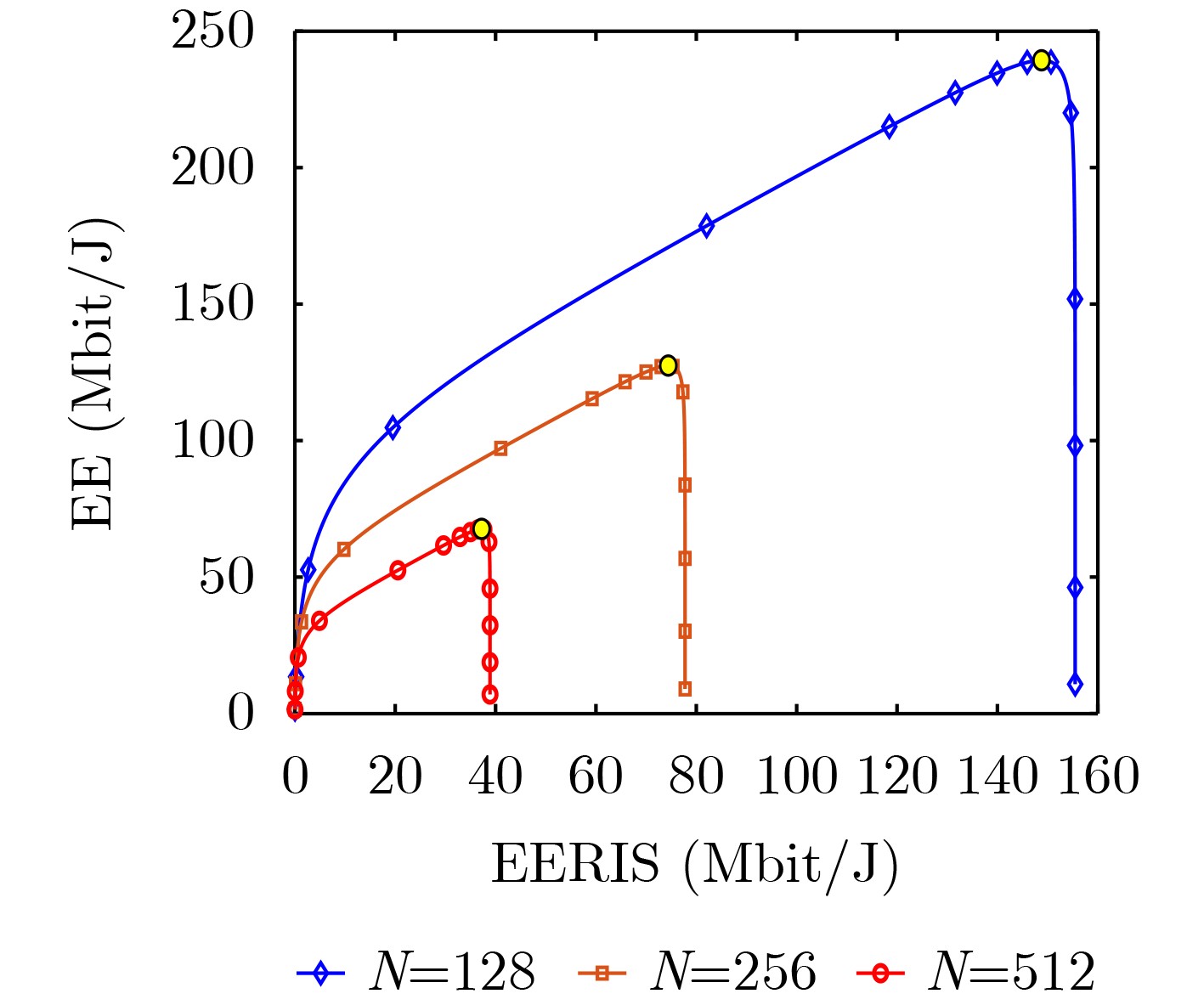
  •   Objective  Active Reconfigurable Intelligent Surface (RIS) enhances wireless communication performance by integrating radio frequency amplifiers to mitigate the multiplicative fading inherent to passive RIS. However, amplification noise and additional power consumption are introduced. Furthermore, high-precision digital phase control at the base station incurs considerable communication overhead. Employing low-precision phase shifters is therefore an effective approach for practical RIS deployment. Therefore, characterizing the Energy Efficiency (EE) performance of active RIS-assisted communication systems and quantifying the effect of finite-bit phase quantization errors on EE are essential for system design and practical implementation. To this end, a discrete phase-shifted active RIS-assisted communication system over Rayleigh fading channels is investigated. The EE loss caused by phase quantization errors is analyzed, approximate optimal solutions for the power allocation factor and the number of RIS elements that maximize EE are derived, and the relationship between RIS EE and user EE is established, providing theoretical guidance for the practical deployment of active RIS.  Methods  Based on the law of large numbers and Taylor series expansion, closed-form expressions for the user EE loss and its approximation are derived. The effects of system parameters on EE are investigated by expressing EE as explicit univariate functions. Ferrari’s method and the Lambert W function are then employed to derive approximate optimal solutions for the power allocation factor and the number of RIS elements that maximize EE. Finally, the relationship between RIS EE and user EE is established using the law of large numbers and the Lambert W function.  Results and Discussions  User EE is expressed as a function of six parameters: the number of quantization bit ($ k $), power allocation factor ($ \beta $), the number of RIS elements ($ N $), the total power sum of base station and active RIS ($ {P}_{\text{t}} $), the noise at active RIS ($ \sigma _{\text{r}}^{2} $), and the noise at user ($ \sigma _{\text{u}}^{2} $). First, the EE loss decreases as $ k $ increases. When $ k $=3, the difference between the approximate EE loss and the lossless case is less than 0.026 8 Mbit/J, while the difference between the EE loss and the lossless case is less than 0.026 5 Mbit/J (Fig. 3). Therefore, 3- to 4-bit discrete phase shifters achieve performance close to that of continuous phase shifters. Second, user EE exhibits a unimodal dependence on both $ \beta $ and $ N $. The approximate optimal solution for $ \beta $ differs from the exact optimal solution obtained by the Dinkelbach algorithm by less than 0.01 (Fig. 4), whereas the approximate and exact optimal solutions for $ N $ are identical (Fig. 5), demonstrating the high accuracy of the proposed approximations. Third, user EE exhibits a unimodal trend as $ {P}_{\text{t}} $ increases. Higher phase quantization precision produces a higher EE peak while requiring a lower optimal $ {P}_{\text{t}} $ to achieve the maximum EE (Fig. 6). In addition, user EE decreases as both $ \sigma _{\text{r}}^{2} $ and $ \sigma _{\text{u}}^{2} $ increase. User EE is more sensitive to the amplification noise introduced at the RIS, indicating that reducing the RIS noise power yields a greater EE improvement (Fig. 7). Finally, user EE first increases and then decreases sharply to zero as RIS EE increases. The signal-to-noise ratio at the RIS is identified as the key factor governing the relationship between RIS EE and user EE (Fig. 8).  Conclusions  The EE performance of active RIS-assisted wireless networks employing discrete phase shifters over Rayleigh fading channels is investigated. First, closed-form expressions are derived for the user EE in the lossless case, the lossy case, and the approximate-loss case. Simulation results demonstrate that 3- to 4-bit discrete phase shifters closely approach the performance of continuous phase shifters. Next, explicit functions describing the effects of key system parameters on user EE are established. Ferrari’s method and the Lambert W function are employed to derive approximate optimal solutions for the power allocation factor and the number of RIS elements that maximize EE, and both exhibit negligible errors relative to the exact solutions. Finally, the relationship between RIS EE and user EE is established, demonstrating that user EE initially increases and subsequently decreases to zero as RIS EE increases.
  • loading
  • [1]
    LIU Ruiqi, ZHANG Leyi, LI R Y N, et al. The ITU vision and framework for 6G: Scenarios, capabilities, and enablers[J]. IEEE Vehicular Technology Magazine, 2025, 20(2): 114–122. doi: 10.1109/MVT.2025.3532887.
    [2]
    WU Qingqing and ZHANG Rui. Towards smart and reconfigurable environment: Intelligent reflecting surface aided wireless network[J]. IEEE Communications Magazine, 2020, 58(1): 106–112. doi: 10.1109/MCOM.001.1900107.
    [3]
    PAN Cunhua, REN Hong, WANG Kezhi, et al. Reconfigurable intelligent surfaces for 6G systems: Principles, applications, and research directions[J]. IEEE Communications Magazine, 2021, 59(6): 14–20. doi: 10.1109/MCOM.001.2001076.
    [4]
    WANG Yan, SHU Feng, WANG Xianpeng, et al. Block CSI sensing for large-scale active IRS-enhanced hybrid-field wireless network via a large model mixture of CAE and transformer[J]. IEEE Journal on Selected Areas in Communications, 2026, 44: 2302–2317. doi: 10.1109/JSAC.2025.3641094.
    [5]
    TANG Wankai, DAI Junyan, CHEN Mingzheng, et al. MIMO transmission through reconfigurable intelligent surface: System design, analysis, and implementation[J]. IEEE Journal on Selected Areas in Communications, 2020, 38(11): 2683–2699. doi: 10.1109/JSAC.2020.3007055.
    [6]
    HE Xin, HUANG Lei, and WANG Jiangzhou. Novel relax-and-retract algorithm for intelligent reflecting surface design[J]. IEEE Transactions on Vehicular Technology, 2021, 70(2): 1995–2000. doi: 10.1109/TVT.2021.3054516.
    [7]
    ZHANG Zijian, DAI Linglong, CHEN Xibi, et al. Active RIS vs. passive RIS: Which will prevail in 6G?[J]. IEEE Transactions on Communications, 2023, 71(3): 1707–1725. doi: 10.1109/TCOMM.2022.3231893.
    [8]
    ZHOU Gui, PAN Cunhua, REN Hong, et al. A framework for transmission design for active RIS-aided communication with partial CSI[J]. IEEE Transactions on Wireless Communications, 2024, 23(1): 305–320. doi: 10.1109/TWC.2023.3277514.
    [9]
    束锋, 赖斯豪, 刘川, 等. 智能反射面辅助无线网络性能及最优位置分析[J]. 电子与信息学报, 2025, 47(2): 324–333. doi: 10.11999/JEIT240488.

    SHU Feng, LAI Sihao, LIU Chuan, et al. Performance and optimal placement analysis of intelligent reflecting surface-assisted wireless networks[J]. Journal of Electronics & Information Technology, 2025, 47(2): 324–333. doi: 10.11999/JEIT240488.
    [10]
    WANG Yan, SHU Feng, ZHUANG Zhihong, et al. Asymptotic performance analysis of large-scale active IRS-aided wireless network[J]. IEEE Open Journal of the Communications Society, 2023, 4: 2684–2696. doi: 10.1109/OJCOMS.2023.3324064.
    [11]
    董榕恩, 谢中毅, 马海波, 等. 离散相移IRS辅助放大转发中继网络的性能分析[J]. 电子与信息学报, 2025, 47(1): 138–146. doi: 10.11999/JEIT240236.

    DONG Rongen, XIE Zhongyi, MA Haibo, et al. Performance analysis of discrete-phase-shifter IRS-aided amplify-and-forward relay network[J]. Journal of Electronics & Information Technology, 2025, 47(1): 138–146. doi: 10.11999/JEIT240236.
    [12]
    ZHU Fenghao, WANG Xinquan, HUANG Chongwen, et al. Robust beamforming for RIS-aided communications: Gradient-based manifold meta learning[J]. IEEE Transactions on Wireless Communications, 2024, 23(11): 15945–15956. doi: 10.1109/TWC.2024.3435023.
    [13]
    WANG Xinquan, ZHU Fenghao, ZHOU Qianyun, et al. Energy-efficient beamforming for RISs-aided communications: Gradient based meta learning[C]. ICC 2024-IEEE International Conference on Communications, Denver, USA, 2024: 3464–3469. doi: 10.1109/ICC51166.2024.10622978.
    [14]
    张洋译, 管新荣, 王权, 等. 智能反射面辅助短包通信中时效与能效间的折衷[J]. 电子与信息学报, 2025, 47(2): 315–323. doi: 10.11999/JEIT240666.

    ZHANG Yangyi, GUAN Xinrong, WANG Quan, et al. Tradeoff between age of information and energy efficiency for intelligent reflecting surface assisted short packet communications[J]. Journal of Electronics & Information Technology, 2025, 47(2): 315–323. doi: 10.11999/JEIT240666.
    [15]
    WANG Dawei, WANG Zijun, ZHAO Hongbo, et al. Secure energy efficiency for ARIS networks with deep learning: Active beamforming and position optimization[J]. IEEE Transactions on Wireless Communications, 2025, 24(6): 5282–5296. doi: 10.1109/TWC.2025.3546611.
    [16]
    XIN Jingdie, WANG Yan, SHU Feng, et al. Energy efficiency analysis of active RIS-enhanced wireless network under power-sum constraint[J]. IEEE Transactions on Green Communications and Networking, 2026, 10: 1654–1665. doi: 10.1109/TGCN.2025.3648117.
    [17]
    WASSERMAN L. All of Statistics: A Concise Course in Statistical Inference[M]. New York: Springer, 2004: 76. doi: 10.1007/978-0-387-21736-9.
    [18]
    YANG Zhaohui, CHEN Mingzhe, SAAD W, et al. Energy-efficient wireless communications with distributed reconfigurable intelligent surfaces[J]. IEEE Transactions on Wireless Communications, 2022, 21(1): 665–679. doi: 10.1109/TWC.2021.3098632.
    [19]
    ZHAO Yifan, WANG Xiaoyu, ZHOU Kaibo, et al. Joint power allocation and beamforming design for active IRS-aided secure directional modulation systems[J]. IEEE Open Journal of the Communications Society, 2025, 6: 2853–2865. doi: 10.1109/OJCOMS.2024.3489053.
  • 加载中

Catalog

    通讯作者: 陈斌, bchen63@163.com
    • 1. 

      沈阳化工大学材料科学与工程学院 沈阳 110142

    1. 本站搜索
    2. 百度学术搜索
    3. 万方数据库搜索
    4. CNKI搜索

    Figures(8)  / Tables(1)

    Article Metrics

    Article views (276) PDF downloads(10) Cited by()
    Proportional views
    Related

    /

    DownLoad:  Full-Size Img  PowerPoint
    Return
    Return