Advanced Search
Turn off MathJax
Article Contents
LIU Lei, JIN Wenkai, ZHANG Qingqing, LI Yuzhou, JIANG Fan. Analysis of Age upon Decisions and Distortion at Decisions in IoT Status Update Systems with Batch Arrivals[J]. Journal of Electronics & Information Technology. doi: 10.11999/JEIT260359
Citation: LIU Lei, JIN Wenkai, ZHANG Qingqing, LI Yuzhou, JIANG Fan. Analysis of Age upon Decisions and Distortion at Decisions in IoT Status Update Systems with Batch Arrivals[J]. Journal of Electronics & Information Technology. doi: 10.11999/JEIT260359

Analysis of Age upon Decisions and Distortion at Decisions in IoT Status Update Systems with Batch Arrivals

doi: 10.11999/JEIT260359 cstr: 32379.14.JEIT260359
Funds:  The National Natural Science Foundation of China (62471195, 62331010, 62201456)
  • Received Date: 2026-03-30
  • Accepted Date: 2026-06-24
  • Rev Recd Date: 2026-06-23
  • Available Online: 2026-07-02
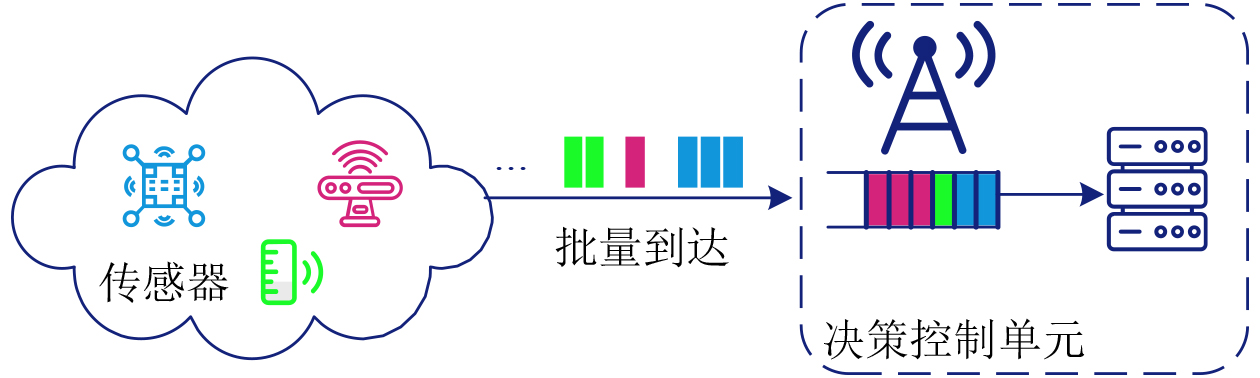
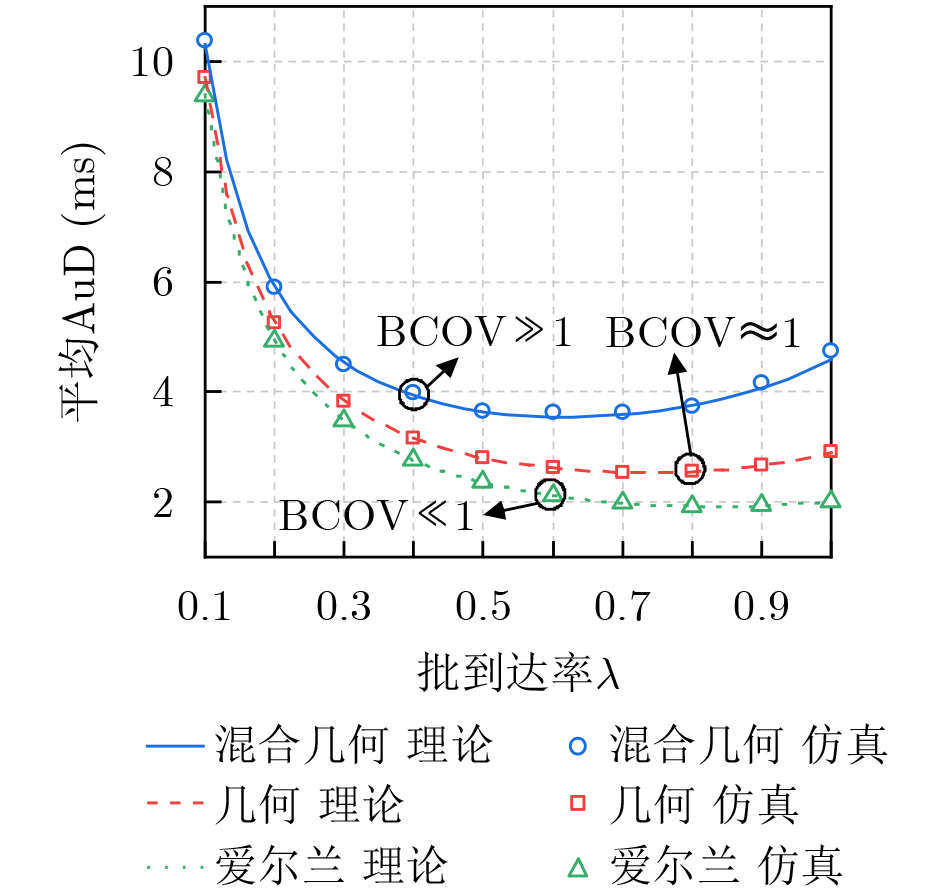
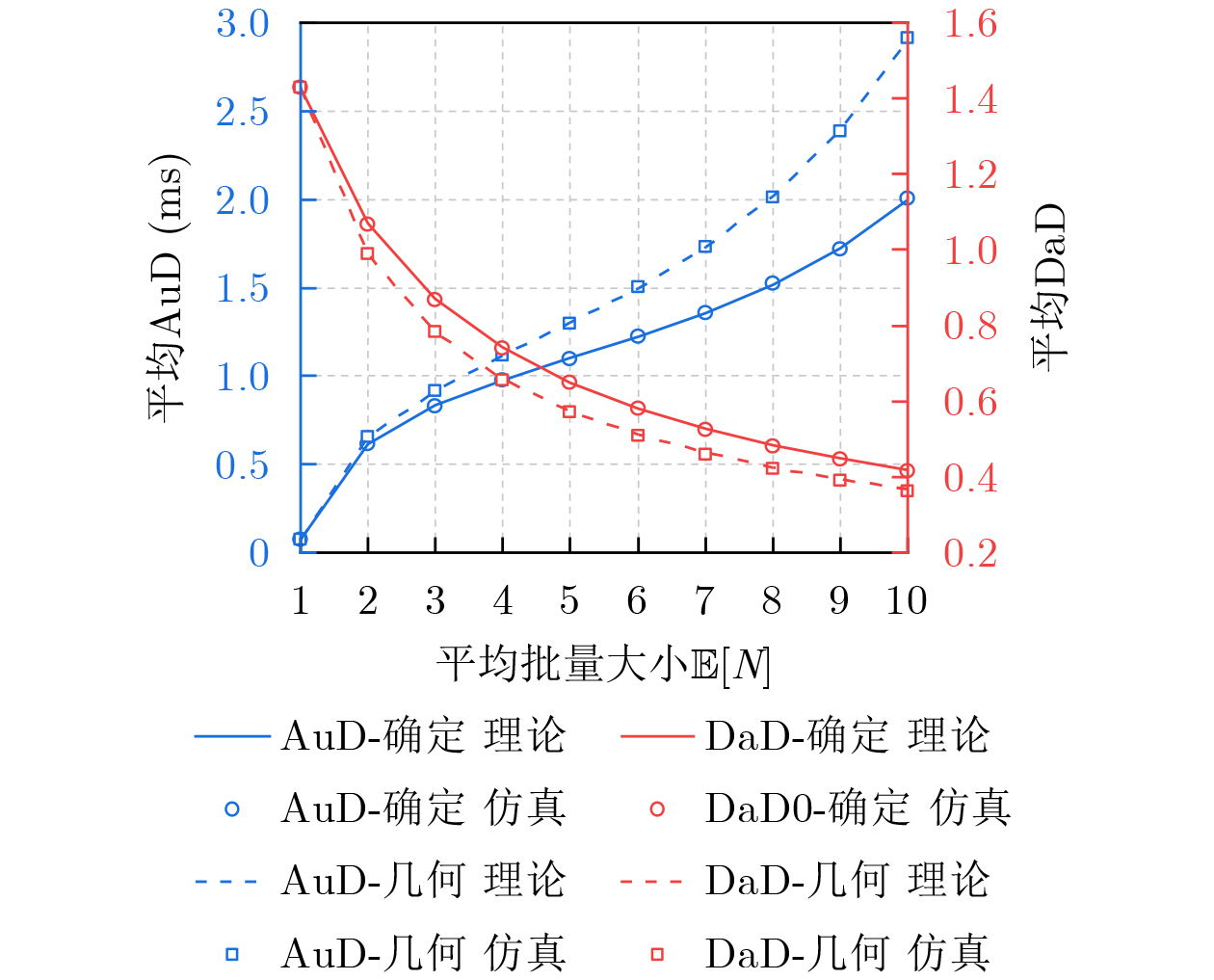
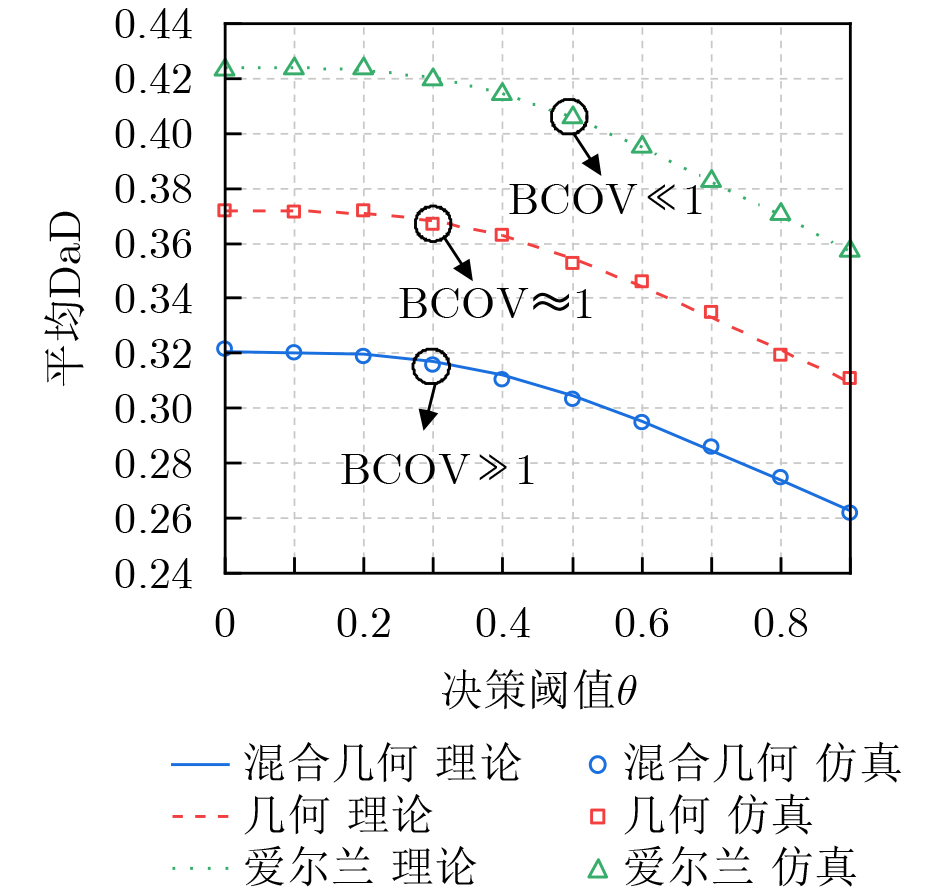
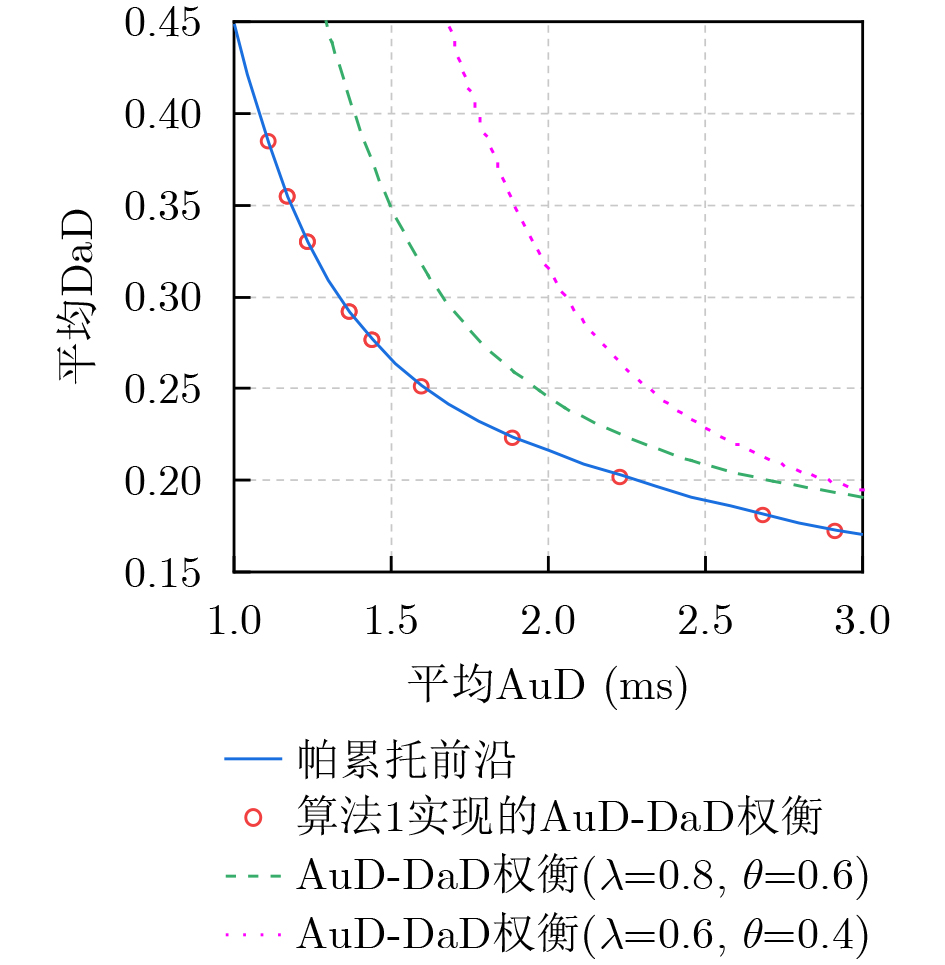
  •   Objective  The rapid development of the Internet of Things (IoT) makes the timely transmission and processing of status updates essential for modern systems, where information freshness at decision epochs plays a critical role. In many IoT applications, such as smart grid fault detection and Industrial Internet of Things (IIoT) cluster monitoring, status updates typically arrive in batches rather than individually. However, most existing studies on Age of Information (AoI) assume single-update arrivals and therefore cannot accurately characterize the queueing dynamics caused by batch arrivals. Besides information freshness, distortion at decision epochs is another key factor because it directly affects decision quality. A fundamental tradeoff therefore exists between information freshness and distortion. Waiting for more complete status update information allows more completed status updates to be incorporated into joint estimation, but increases queueing and transmission delays, thereby reducing information freshness. In contrast, triggering decisions earlier reduces delay but increases distortion because fewer completed status updates are available for joint estimation. To address this problem, this paper investigates the tradeoff between information freshness and distortion in an IoT status update system with batch arrivals by adopting Age upon Decisions (AuD) and Distortion at Decisions (DaD) as performance metrics. Analytical expressions for the average AuD and average DaD are derived under a general batch-size distribution. Furthermore, for the typical case of geometrically distributed batch sizes, an alternating iterative optimization algorithm is developed to jointly optimize the batch arrival rate, average batch size, and decision threshold, thereby minimizing the weighted sum of the average AuD and average DaD. The results provide theoretical insight and practical guidance for the design of IoT status update systems with batch arrivals.  Methods  Information freshness and distortion at decision epochs are analyzed for an IoT status update system with batch arrivals. AuD and DaD are adopted to quantify information freshness and distortion, respectively. Based on queueing theory, analytical expressions for the average AuD and average DaD are derived under a general batch-size distribution. A typical case with geometrically distributed batch sizes is then investigated. An alternating iterative optimization algorithm is further developed to jointly optimize the batch arrival rate, average batch size, and decision threshold to minimize the weighted sum of the average AuD and average DaD.  Results and Discussions  Simulation results validate the theoretical analysis. The average AuD exhibits a nonmonotonic trend as the batch arrival rate increases, first decreasing and then increasing. In addition, the Batch-size Coefficient Of Variation (BCOV) has a significant effect on the average AuD, with a smaller BCOV providing better information freshness performance. Under high-load conditions, queue backlogs become more severe, and stochastic fluctuations in batch arrivals have a greater effect on the queueing process. This increases service-time variability and amplifies the effect of BCOV on the average AuD (Fig. 2). As the average batch size increases, the system queue length and queueing delay increase, leading to a larger average AuD. At the same time, the decision control unit can utilize more completed status updates for joint estimation, thereby reducing the average DaD (Fig. 3). Moreover, the average DaD decreases as the decision threshold increases because more completed status updates are incorporated into the joint estimation process, improving estimation accuracy. A larger BCOV also increases the number of completed status updates available for joint estimation and therefore further reduces the average DaD (Fig. 4). The optimization results show that the solutions obtained by the proposed algorithm lie on the Pareto frontier, demonstrating its effectiveness. By comparison, fixed batch arrival rates and decision thresholds produce performance that is considerably farther from the Pareto frontier, demonstrating the advantage of jointly optimizing system parameters (Fig. 5).  Conclusions  This paper investigates an IoT status update system with batch arrivals by adopting AuD and DaD to quantify information freshness and distortion, respectively. Analytical expressions for the average AuD and average DaD are derived under a general batch-size distribution. For the typical case of geometrically distributed batch sizes, an alternating iterative optimization algorithm is developed to jointly optimize the batch arrival rate, average batch size, and decision threshold, thereby minimizing the weighted sum of the average AuD and average DaD. Simulation results verify the theoretical analysis and reveal the effects of the batch arrival rate, average batch size, and decision threshold on the average AuD and average DaD. The results also demonstrate that the proposed low-complexity algorithm effectively identifies Pareto-optimal solutions for the AuD-DaD tradeoff. This study considers only the batch arrival characteristics of status updates. Future work will incorporate batch service mechanisms to further examine their effects on the tradeoff between AuD and DaD. Flexible decision mechanisms can also be developed to achieve adaptive AuD-DaD tradeoffs according to the heterogeneous requirements for information freshness and distortion across applications with different batch characteristics.
  • loading
  • [1]
    YATES R D, SUN Yin, BROWN D R, et al. Age of information: An introduction and survey[J]. IEEE Journal on Selected Areas in Communications, 2021, 39(5): 1183–1210. doi: 10.1109/JSAC.2021.3065072.
    [2]
    陈泳, 蔡跃明, 王萌. 认知物联网短包通信中双向中继系统的信息年龄分析[J]. 电子与信息学报, 2023, 45(12): 4254–4261. doi: 10.11999/JEIT221377.

    CHEN Yong, CAI Yueming, and WANG Meng. Age of information for short-packet two-way relay system in cognitive IoT network[J]. Journal of Electronics & Information Technology, 2023, 45(12): 4254–4261. doi: 10.11000/JEIT221377. doi: 10.11999/JEIT221377.
    [3]
    肖舒予, 孙兴华, 袁岸珊, 等. 能量收集型短包通信LoRa网络的信息年龄建模与优化[J]. 电子与信息学报, 2026, 48(1): 145–156. doi: 10.11999/JEIT250814.

    XIAO Shuyu, SUN Xinghua, YUAN Anshan, et al. Age of information for energy harvesting-driven LoRa short-packet communication network[J]. Journal of Electronics & Information Technology, 2026, 48(1): 145–156. doi: 10.11999/JEIT250814.
    [4]
    DONG Yunquan, CHEN Zhengchuan, LIU Shanyun, et al. Age of information upon decisions[C]. 2018 IEEE 39th Sarnoff Symposium, Newark, USA, 2018: 1–5. doi: 10.1109/SARNOF.2018.8720507.
    [5]
    FAHIM T E, RABIA S I, ABD EL-MALEK A H, et al. Age of information optimization using a hybrid preemptive/non-preemptive discipline[C]. 2024 IEEE 100th Vehicular Technology Conference (VTC2024-Fall), Washington, USA, 2024: 1–5. doi: 10.1109/VTC2024-Fall63153.2024.10758006.
    [6]
    AKAR N, DOGAN O, and ATAY E U. Finding the exact distribution of (Peak) age of information for queues of PH/PH/1/1 and M/PH/1/2 type[J]. IEEE Transactions on Communications, 2020, 68(9): 5661–5672. doi: 10.1109/TCOMM.2020.3002994.
    [7]
    DONG Yunquan, CHEN Zhengchuan, LIU Shanyun, et al. Age-upon-decisions minimizing scheduling in internet of things: To be random or to be deterministic?[J]. IEEE Internet of Things Journal, 2020, 7(2): 1081–1097. doi: 10.1109/JIOT.2019.2950054.
    [8]
    CHEN Shutong, ZHANG Tianci, CHEN Zhengchuan, et al. Minimizing age-upon-decisions in bufferless system: Service scheduling and decision interval[J]. IEEE Transactions on Vehicular Technology, 2023, 72(1): 1017–1031. doi: 10.1109/TVT.2022.3202790.
    [9]
    BAO Zhiwei, DONG Yunquan, CHEN Zhengchuan, et al. Age-optimal service and decision processes in internet of things[J]. IEEE Internet of Things Journal, 2021, 8(4): 2826–2841. doi: 10.1109/JIOT.2020.3020875.
    [10]
    BAO Zhiwei, HU Yulin, GAN Ming, et al. Timeliness of CSMA/CA-based wireless networks with HARQ in the FBL regime: Explicit age characterizations and resource allocation[J]. IEEE Internet of Things Journal, 2025, 12(13): 23614–23626. doi: 10.1109/JIOT.2025.3554242.
    [11]
    GUO Chongtao, LIU Songtao, LIAO Bin, et al. AoI-driven power allocation and batch sampling control for V2V status update communications[J]. IEEE Transactions on Industrial Informatics, 2024, 20(1): 291–302. doi: 10.1109/TII.2023.3261888.
    [12]
    MOLTCHANOV D and GAYDAMAKA A. The impact of tagged and competing traffic properties on peak AoI in 5G systems[J]. IEEE Internet of Things Journal, 2025, 12(23): 51761–51771. doi: 10.1109/JIOT.2025.3616508.
    [13]
    BASTOPCU M and ULUKUS S. Age of information for updates with distortion: Constant and age-dependent distortion constraints[J]. IEEE/ACM Transactions on Networking, 2021, 29(6): 2425–2438. doi: 10.1109/TNET.2021.3091493.
    [14]
    LI Jun and ZHANG Wenyi. Asymptotically optimal joint sampling and compression for timely status updates: Age–distortion tradeoff[J]. IEEE Transactions on Vehicular Technology, 2025, 74(2): 2338–2352. doi: 10.1109/TVT.2024.3479242.
    [15]
    王艳芳, 王伟, 董云泉. 面向实时决策的物联网时效与失真性能研究[J]. 浙江大学学报(工学版), 2024, 58(4): 664–673,771. doi: 10.3785/j.issn.1008-973X.2024.04.002.

    WANG Yanfang, WANG Wei, and DONG Yunquan. Study of timeliness and distortion performance for real-time decision making in IoT[J]. Journal of Zhejiang University (Engineering Science), 2024, 58(4): 664–673,771. doi: 10.3785/j.issn.1008-973X.2024.04.002.
    [16]
    CHEN Zhengchuan, XU Mingjun, SHE Changyang, et al. Improving timeliness-fidelity tradeoff in wireless sensor networks: Waiting for all and waiting for partial sensor nodes[J]. IEEE Transactions on Communications, 2023, 71(7): 4151–4164. doi: 10.1109/TCOMM.2023.3277001.
    [17]
    ZHANG Yang and HO K C. Localization of transmitters and scatterers by single receiver[J]. IEEE Transactions on Signal Processing, 2023, 71: 2267–2282. doi: 10.1109/TSP.2023.3284366.
    [18]
    ZHENG Xi, ZHOU Sheng, and NIU Zhisheng. Urgency of information for context-aware timely status updates in remote control systems[J]. IEEE Transactions on Wireless Communications, 2020, 19(11): 7237–7250. doi: 10.1109/TWC.2020.3009881.
  • 加载中

Catalog

    通讯作者: 陈斌, bchen63@163.com
    • 1. 

      沈阳化工大学材料科学与工程学院 沈阳 110142

    1. 本站搜索
    2. 百度学术搜索
    3. 万方数据库搜索
    4. CNKI搜索

    Figures(5)  / Tables(1)

    Article Metrics

    Article views (128) PDF downloads(9) Cited by()
    Proportional views
    Related

    /

    DownLoad:  Full-Size Img  PowerPoint
    Return
    Return