Advanced Search
Turn off MathJax
Article Contents
ZHANG Long, HUANG wenbo, LEI Zhen, FENG Xuanming, WANG Ying. A Hierarchical Cross-layer Closed-loop Learning Framework andCoordination Mechanism for Complex Multi-agent Systems[J]. Journal of Electronics & Information Technology. doi: 10.11999/JEIT260143
Citation: ZHANG Long, HUANG wenbo, LEI Zhen, FENG Xuanming, WANG Ying. A Hierarchical Cross-layer Closed-loop Learning Framework andCoordination Mechanism for Complex Multi-agent Systems[J]. Journal of Electronics & Information Technology. doi: 10.11999/JEIT260143

A Hierarchical Cross-layer Closed-loop Learning Framework andCoordination Mechanism for Complex Multi-agent Systems

doi: 10.11999/JEIT260143 cstr: 32379.14.JEIT260143
  • Received Date: 2026-02-03
  • Accepted Date: 2026-06-15
  • Rev Recd Date: 2026-06-04
  • Available Online: 2026-06-19
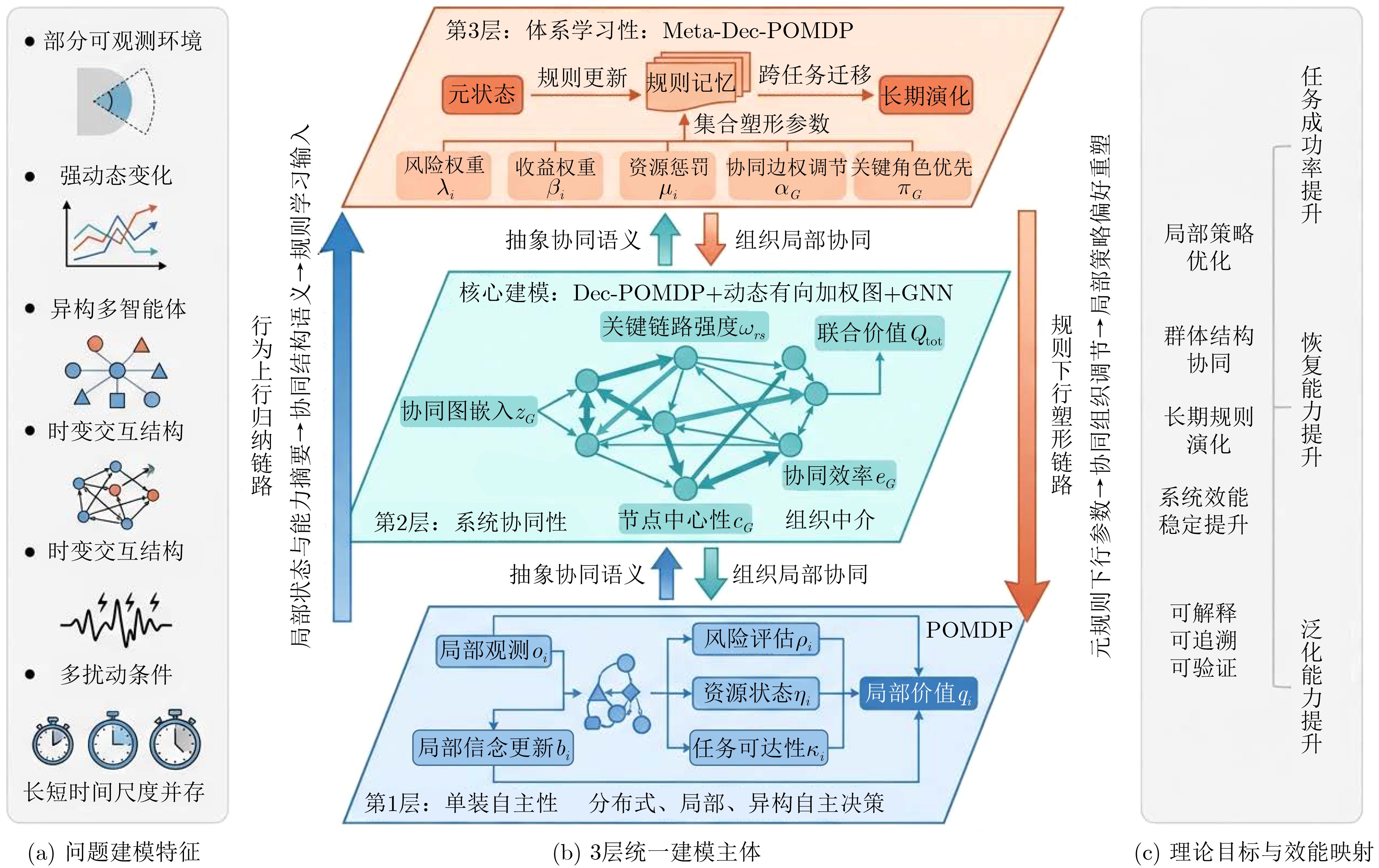
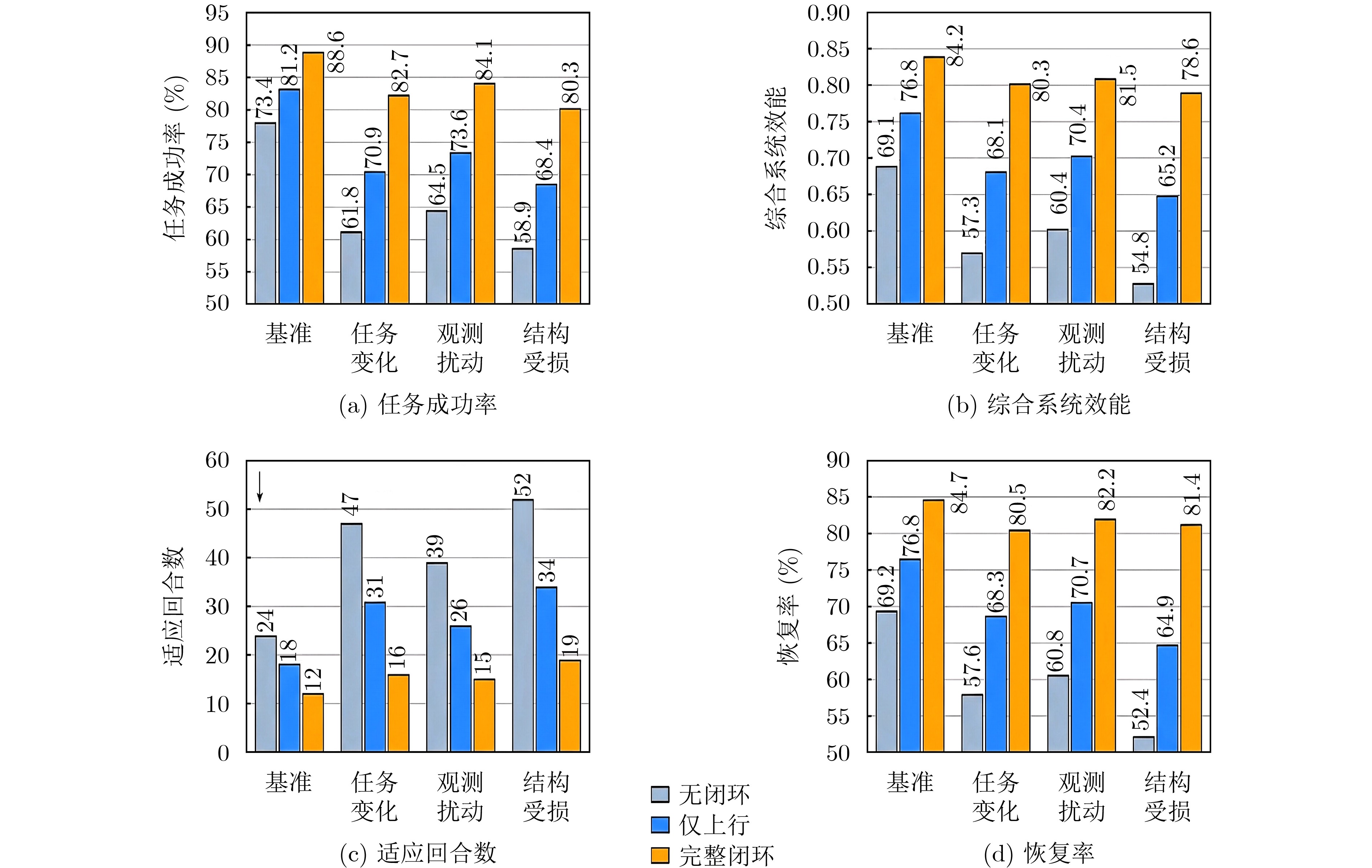
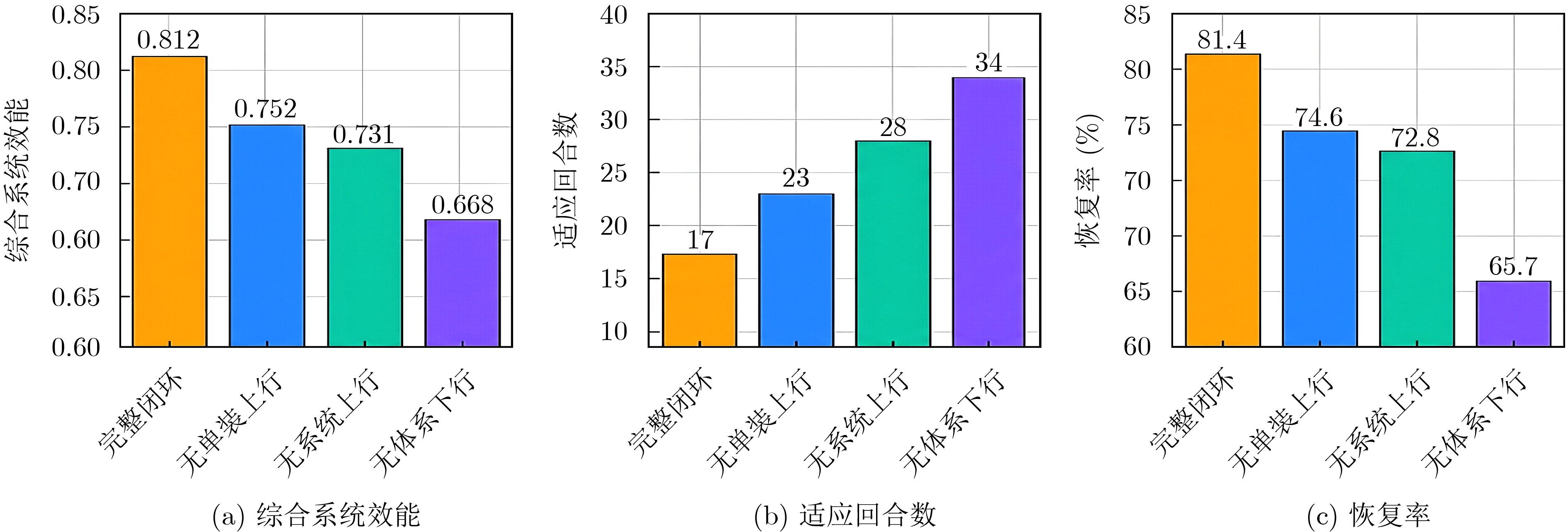
  • Objective Complex Multi-Agent Systems (MAS) in dynamic and uncertain environments face challenges in unified modeling, adaptive coordination, and interpretable effectiveness evaluation. Existing methods usually address individual decision-making, inter-agent coordination, and high-level policy evolution separately. This separation leads to fragmented decision chains and weak cross-layer coupling. It also makes it difficult to explain how local learning gains are transformed into global effectiveness improvements under mission variation, observation disturbance, and structural damage. To address this issue, a Hierarchical Cross-layer Closed-loop Learning (HCCL) framework is proposed. The framework couples individual autonomy, system-level coordination, and system-of-systems learning to build a computable path from local policy optimization to overall effectiveness enhancement. Methods HCCL adopts a unified three-layer architecture. At the individual autonomy layer, each agent is modeled as a Partially Observable Markov Decision Process (POMDP) to describe decision-making under partial observability. At the system-level coordination layer, multi-agent coordination is formulated as a Decentralized Partially Observable Markov Decision Process (Dec-POMDP) and represented by a dynamic directed weighted coordination graph. A Graph Neural Network (GNN) is used to encode interaction dependencies, structural coupling, and joint value information. At the system-of-systems learning layer, a Meta-Decentralized Partially Observable Markov Decision Process (Meta-Dec-POMDP) is established to describe task-context adaptation and rule evolution. A cross-layer closed-loop mechanism is further designed. In the bottom-up behavior induction pathway, local state and capability features are aggregated into graph-level structural representations and supplied to the upper rule-learning process. In the top-down rule-shaping pathway, learned high-level rules are converted into control parameters and fed back to lower layers to regulate local policies and coordination relationships. Simulations are conducted under baseline, mission-variation, observation-disturbance, and structural-damage scenarios. The full HCCL model is compared with a non-closed-loop model and an upward-induction-only model. Interface ablation studies are also performed to analyze the contributions of cross-layer feature reporting, structural induction, and rule shaping. Results and Discussions The full HCCL model consistently outperforms the comparison models and ablated variants. In the baseline scenario, it achieves a task success rate of 88.6% and a comprehensive system effectiveness of 0.842. Under mission variation, it reduces the adaptation process to 16±2 rounds. Under structural damage, it achieves a recovery rate of 81.4% and restores coordination-structure stability to 0.742 within 20 steps. These results indicate that HCCL improves task performance, adaptation speed, and structural recovery. Ablation results show that removing any cross-layer interface reduces performance, while removing the top-down rule-shaping pathway causes the largest loss. This result indicates that upward structural perception alone is insufficient for sustained system-level improvement. The effectiveness gain mainly arises from closed-loop coupling between bottom-up behavior induction and top-down rule shaping, rather than from simple hierarchical stacking. Conclusions The HCCL framework is proposed for complex MAS by integrating POMDP-based individual autonomy modeling, Dec-POMDP- and graph-based coordination modeling, and Meta-Dec-POMDP-based rule evolution. Through bottom-up behavior induction and top-down rule shaping, HCCL provides a computable and interpretable path from local learning to overall effectiveness enhancement. Experimental results verify its advantages in task completion, adaptation, recovery, and coordination stability under multiple disturbances. Future work will focus on larger-scale heterogeneous systems, communication-constrained networking, online continual adaptation, and data-driven evaluation in realistic environments.
  • loading
  • [1]
    ANNE T, SYRKIS N, ELHOSNI M, et al. Harnessing language for coordination: A framework and benchmark for LLM-driven multi-agent control[EB/OL]. https://arxiv.org/abs/2412.11761, 2024.
    [2]
    KOIFMAN Y, BAREL A, and BRUCKSTEIN A M. Distributed and decentralized task allocation for heterogeneous swarms[J]. Artificial Life and Robotics, 2026, 31(1): 302–316. doi: 10.1007/s10015-025-01104-3.
    [3]
    MARTIN F, KIM H J, SILKA L, et al. Artbotics: Challenges and opportunities for multi-disciplinary, community-based learning in computer science, robotics, and art[J]. 2007.
    [4]
    MEULEMANS A, KOBAYASHI S, VON OSWALD J, et al. Multi-agent cooperation through learning-aware policy gradients[C]. The 13th International Conference on Learning Representations, Singapore, Singapore, 2025.
    [5]
    KHUSHIYANT. Emergent collective memory in decentralized multi-agent AI systems[EB/OL]. https://arxiv.org/abs/2512.10166, 2025.
    [6]
    HADY M A, HU Siyi, PRATAMA M, et al. Multi-agent reinforcement learning for resources allocation optimization: A survey[J]. Artificial Intelligence Review, 2025, 58(11): 354. doi: 10.1007/s10462-025-11340-5.
    [7]
    ZHU Changxi, DASTANI M, and WANG Shihan. A survey of multi-agent deep reinforcement learning with communication[J]. Autonomous Agents and Multi-Agent Systems, 2024, 38(1): 4. doi: 10.1007/s10458-023-09633-6.
    [8]
    GUPTA N, HARE J Z, MILZMAN J, et al. Action-graph policies: Learning action co-dependencies in multi-agent reinforcement learning[EB/OL]. https://arxiv.org/abs/2602.17009, 2026.
    [9]
    REN Tianyu, YAO Xuan, LI Yang, et al. Bottom-up reputation promotes cooperation with multi-agent reinforcement learning[C]. The 24th International Conference on Autonomous Agents and Multiagent Systems, Detroit, USA, 2025: 1745–1754. doi: 10.65109/fdxo1013.
    [10]
    HU Tianmeng, LUO Biao, YANG Chunhua, et al. MO-MIX: Multi-objective multi-agent cooperative decision-making with deep reinforcement learning[J]. IEEE Transactions on Pattern Analysis and Machine Intelligence, 2023, 45(10): 12098–12112. doi: 10.1109/tpami.2023.3283537.
    [11]
    鲁旭涛, 智超群, 张丽娜, 等. 应急搜索UAV集群协同任务规划策略[J]. 电子与信息学报, 2022, 44(1): 187–194. doi: 10.11999/JEIT210219.

    LU Xutao, ZHI Chaoqun, ZHANG Lina, et al. Multi-UAV regional patrol mission planning strategy[J]. Journal of Electronics & Information Technology, 2022, 44(1): 187–194. doi: 10.11999/JEIT210219.
    [12]
    PAOLO G, BENECHEHAB A, CHERKAOUI H, et al. TAG: A decentralized framework for multi-agent hierarchical reinforcement learning[EB/OL]. https://arxiv.org/abs/2502.15425, 2025.
    [13]
    LIU Biyuan, XU Daigang, JIANG Lei, et al. Modeling the mental world for embodied AI: A comprehensive review[EB/OL]. https://arxiv.org/abs/2601.02378, 2025.
    [14]
    徐俊杰, 李斌, 杨敬松. 禁飞区约束下的无人机可重构智能表面辅助通信网络性能优化[J]. 电子与信息学报, 2026, 48(2): 743–751. doi: 10.11999/JEIT250681.

    XU Junjie, LI Bin, and YANG Jingsong. Performance optimization of UAV-RIS-assisted communication networks under no-fly zone constraints[J]. Journal of Electronics & Information Technology, 2026, 48(2): 743–751. doi: 10.11999/JEIT250681.
    [15]
    NATH S, PERIDIS C, BENJAMIN E, et al. Policy search, retrieval, and composition via task similarity in collaborative agentic systems[C]. The 40th AAAI Conference on Artificial Intelligence, Singapore, Singapore, 2026: 24504–24512. doi: 10.1609/aaai.v40i29.39633.
    [16]
    唐伦, 蒲昊, 汪智平, 等. 基于注意力机制ConvLSTM的UAV节能预部署策略[J]. 电子与信息学报, 2022, 44(3): 960–968. doi: 10.11999/JEIT211368.

    TANG Lun, PU Hao, WANG Zhiping, et al. Energy-efficient predictive deployment strategy of UAVs based on ConvLSTM with attention mechanism[J]. Journal of Electronics & Information Technology, 2022, 44(3): 960–968. doi: 10.11999/JEIT211368.
    [17]
    LIU Yanli, FENG Haonan, and HATZIARGYRIOU N D. Multi-stage collaborative resilient enhancement strategy for coupling faults in distribution cyber physical systems[J]. Applied Energy, 2023, 348: 121560. doi: 10.1016/j.apenergy.2023.121560.
    [18]
    DEVLIN J and CHANG M W. AI-assisted pipeline for dynamic generation of trustworthy health supplement content at scale[EB/OL]. https://openalex.org/works/w2896457183, 2018.
    [19]
    ZHAI Lidong, QIU Zhijie, ZHANG Lvyang, et al. The Athenian academy: A seven-layer architecture model for multi-agent systems[EB/OL]. https://arxiv.org/abs/2504.12735, 2025.
    [20]
    BARONI M, DESSI R, and LAZARIDOU A. Emergent language-based coordination in deep multi-agent systems[C]. 2022 Conference on Empirical Methods in Natural Language Processing: Tutorial Abstracts, Abu Dubai, UAE, 2022: 11–16. doi: 10.18653/v1/2022.emnlp-tutorials.3.
  • 加载中

Catalog

    通讯作者: 陈斌, bchen63@163.com
    • 1. 

      沈阳化工大学材料科学与工程学院 沈阳 110142

    1. 本站搜索
    2. 百度学术搜索
    3. 万方数据库搜索
    4. CNKI搜索

    Figures(3)

    Article Metrics

    Article views (186) PDF downloads(30) Cited by()
    Proportional views
    Related

    /

    DownLoad:  Full-Size Img  PowerPoint
    Return
    Return