Advanced Search
Turn off MathJax
Article Contents
ZHU Jianyong, CHEN Kun, YANG Hui, NIE Feiping. Joint Optimization Method for Pairwise Constrained Projection Clustering Integrating Two-row Update Strategy[J]. Journal of Electronics & Information Technology. doi: 10.11999/JEIT260111
Citation: ZHU Jianyong, CHEN Kun, YANG Hui, NIE Feiping. Joint Optimization Method for Pairwise Constrained Projection Clustering Integrating Two-row Update Strategy[J]. Journal of Electronics & Information Technology. doi: 10.11999/JEIT260111

Joint Optimization Method for Pairwise Constrained Projection Clustering Integrating Two-row Update Strategy

doi: 10.11999/JEIT260111 cstr: 32379.14.JEIT260111
Funds:  National Natural Science Foundation of China (No. 62363010), Key Project of Jiangxi Provincial Natural Science Foundation (20252BAC250019), Jiangxi Double Thousand Plan (SSQ2023018), National Science and Technology Major Project (2026ZD16010302).
  • Accepted Date: 2026-05-12
  • Rev Recd Date: 2026-05-12
  • Available Online: 2026-05-29
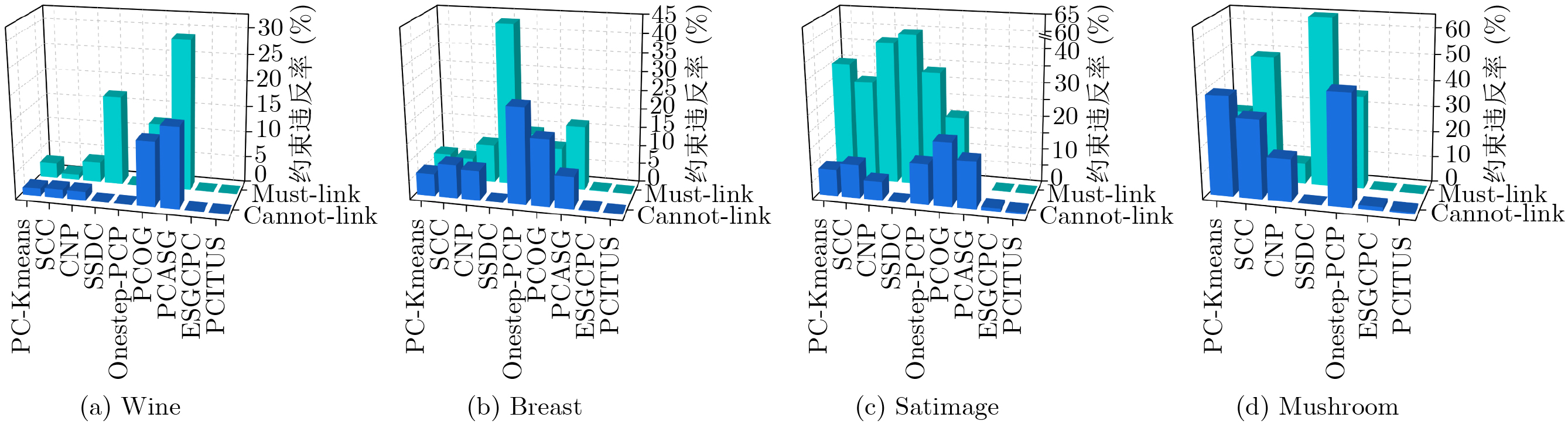
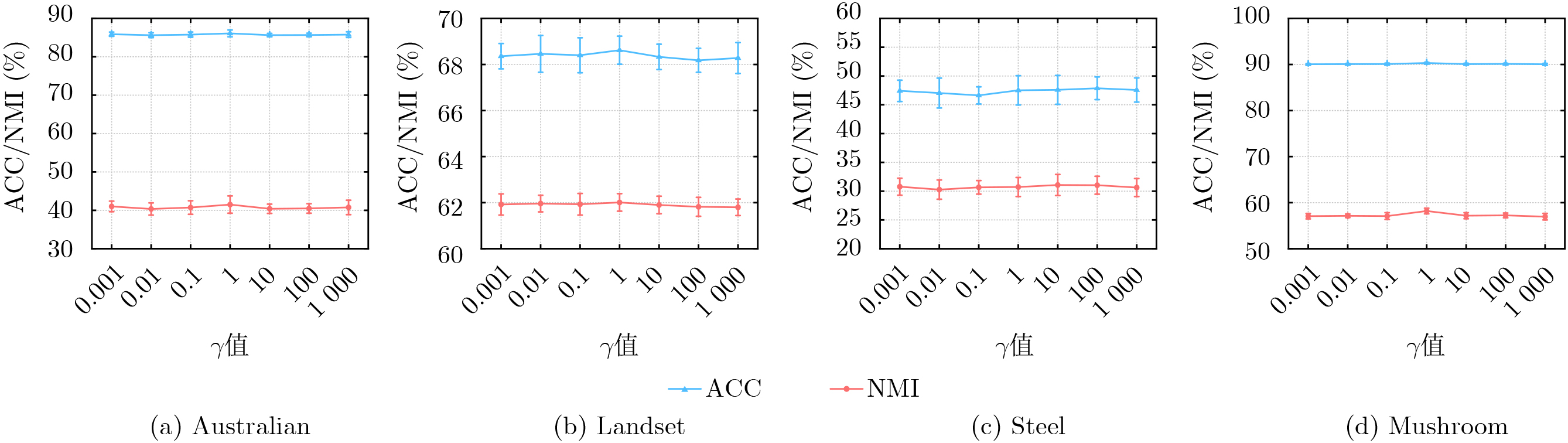
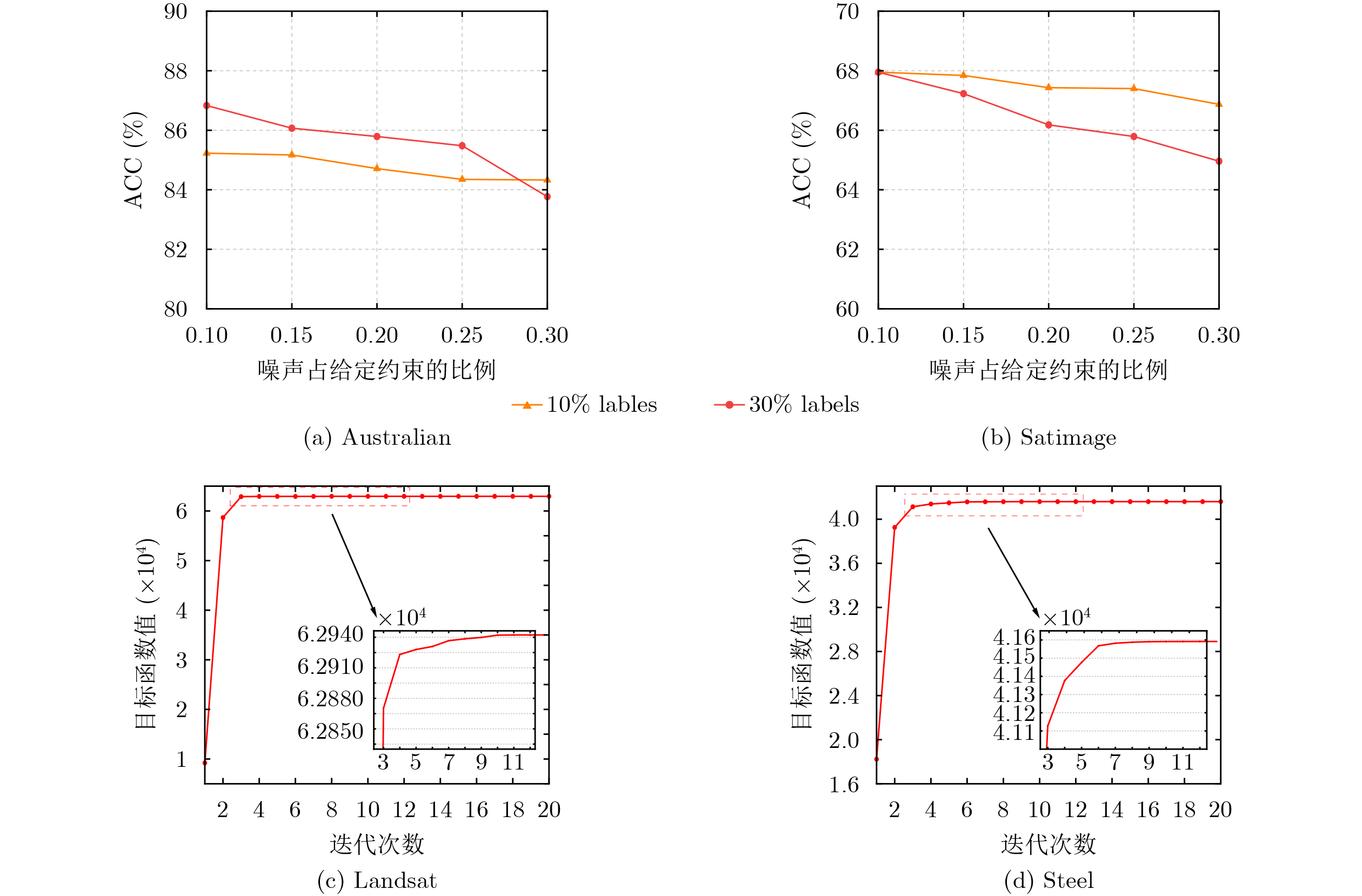
  •   Objective  As data structures grow increasingly complex, conventional unsupervised clustering techniques often fail to achieve satisfactory performance. Semi-supervised clustering, which leverages limited prior information, has thus become increasingly popular due to its ability to improve clustering quality. While existing methods have made progress, they suffer from two critical drawbacks. First, traditional constrained projection clustering algorithms typically adopt a two-step independent strategy: learning the projection matrix first and then performing kmeans clustering. This separation causes the projection deviation to propagate directly to the clustering process without correction, leading to the accumulation of learning errors. Moreover, applying pairwise constraints only at the projection stage deviates from the core principle of using prior information to guide the clustering process. Second, many current methods, such as those based on spectral clustering, handle pairwise constraints implicitly (e.g., through eigen-decomposition of a modified similarity matrix). This implicit handling often fails to strictly satisfy constraints, particularly Cannot-Link constraints which are non-transitive, resulting in high constraint violation rates. To this end, this paper proposes a Joint Optimization Method for Pairwise Constrained Projection Clustering Integrating Two-row Update Strategy (PCITUS). The primary objective is to unify dimensionality reduction and clustering into a single framework to avoid information loss and to design an explicit optimization strategy that minimizes constraint violations while enhancing computational efficiency.  Methods  The proposed PCITUS model integrates constraint projection and clustering into a unified objective function to achieve collaborative optimization, while directly optimizing pairwise constraints. First, the algorithm utilizes the transitive property of Must-Link (ML) constraints, where all samples belonging to the same ML connected component are merged into a single "hyper-point" in the feature space. This preprocessing step naturally ensures that all ML constraints are satisfied. Subsequently, a trade-off parameter is introduced to incorporate projection learning as a regularization term within the clustering framework, enabling the two components to be jointly optimized within a unified objective. Moreover, prior information is embedded into the clustering process by transforming pairwise constraints into row-wise constraints on the indicator matrix. Subsequently, this paper employs an improved coordinate descent method to solve the discrete indicator matrix directly, effectively enhances computational efficiency and find better results. Furthermore, a core innovation is the two-row simultaneous optimization strategy designed for handling Cannot-Link (CL) constraints. PCITUS explicitly checks for CL conflicts by simultaneously evaluating the objective function values for swapping conflicting rows to sub-optimal classes and selects the scenario yielding the higher value.  Results and Discussions  Extensive experiments were conducted on 8 benchmark datasets and compared against 9 state-of-the-art semi-supervised clustering algorithms. The quantitative results in terms of Accuracy (ACC) and Normalized Mutual Information (NMI) demonstrate the superiority of PCITUS (Table 4 and Table 5). PCITUS achieves the highest performance on most datasets. Notably, on the Mushroom dataset, the NMI metric improved by 7.2% compared to the second-best algorithms. The comparison with CNP (a two-step projection method) confirms that the unified framework effectively mitigates error propagation and information loss, this also stems from the fact that a better projection space can lead to a clearer clustering structure, while a more reasonable clustering structure, in turn, guides the formation of a more discriminative projection space. The effectiveness of the explicit constraint handling is further illustrated (Fig. 1), PCITUS exhibits no ML constraint violations due to the hyper-point merging strategy. For CL constraints, because of the two-row simultaneous optimization strategy, PCITUS maintains an extremely low violation rate (e.g., 0.57% on Mushroom and 0.41% on Satimage), significantly outperforming methods that handle constraints implicitly. Additionally, parameter sensitivity analysis (Fig. 2) indicates that the performance of PCITUS is stable across a wide range of the trade-off parameter, and noise sensitivity experiments (Fig. 3a and Fig. 3b) highlights its robustness. The convergence curves (Fig. 3c and Fig. 3d) and runtime comparisons (Table 7) validate its computational efficiency, showing rapid convergence and typically reaching a stable objective function value within approximately 10 iterations.  Conclusions  To tackle the difficulties in optimizing cannot-link constraints, as well as the inherent limitations of traditional constraint projection clustering frameworks based on a two-step separation scheme, this paper presents PCITUS, a novel semi-supervised clustering framework that jointly optimizes pairwise constraint projection and clustering structures. By integrating the projection objective into the clustering framework as a regularizer, the proposed method ensures that the subspace learning and data partitioning processes mutually enhance each other, jointly approaching the global optimum. Furthermore, pairwise constraints are integrated throughout the entire learning process, ensuring that prior knowledge is fully utilized during optimization. The introduction of the coordinate descent method with a specific "two-row simultaneous update strategy" allows for the direct and precise allocation of Cannot-Link constraints, significantly reducing constraint violations. Experimental results validate that PCITUS not only outperforms existing algorithms in clustering performance but also exhibits strong robustness to parameter variations.
  • loading
  • [1]
    张朋飞, 程俊, 张治坤, 等. 满足本地差分隐私的混合噪音感知的模糊C均值聚类算法[J]. 电子与信息学报, 2025, 47(3): 739–757. doi: 10.11999/JEIT241067.

    ZHANG Pengfei, CHENG Jun, ZHANG Zhikun, et al. Fuzzy C-means clustering algorithm based on mixed noise-aware under local differential privacy[J]. Journal of Electronics & Information Technology, 2025, 47(3): 739–757. doi: 10.11999/JEIT241067.
    [2]
    金极栋, 卢宛萱, 孙显, 等. 分布采样对齐的遥感半监督要素提取框架及轻量化方法[J]. 电子与信息学报, 2024, 46(5): 2187–2197. doi: 10.11999/JEIT240220.

    JIN Jidong, LU Wanxuan, SUN Xian, et al. Remote sensing semi-supervised feature extraction framework and lightweight method integrated with distribution-aligned sampling[J]. Journal of Electronics & Information Technology, 2024, 46(5): 2187–2197. doi: 10.11999/JEIT240220.
    [3]
    霍纬纲, 朱旭, 张盼. 基于约束传递的深度主动时序聚类方法[J]. 电子与信息学报, 2025, 47(4): 1172–1181. doi: 10.11999/JEIT240855.

    HUO Weigang, ZHU Xu, and ZHANG Pan. Deep active time-series clustering based on constraint transitivity[J]. Journal of Electronics & Information Technology, 2025, 47(4): 1172–1181. doi: 10.11999/JEIT240855.
    [4]
    CHEN Jingwei, XIE Shiyu, YANG Hui, et al. Effective semi-supervised graph clustering with pairwise constraints[J]. Information Sciences, 2024, 681: 121249. doi: 10.1016/j.ins.2024.121249.
    [5]
    WAGSTAFF K, CARDIE C, ROGERS S, et al. Constrained K-means clustering with background knowledge[C]. The 18th International Conference on Machine Learning, San Francisco, USA, 2001: 577–584.
    [6]
    KAMVAR S D, KAMVAR D, and MANNING C DKAMVAR S D, KAMVAR D, and MANNING C DSpectral learning[C]. The 18th International Joint Conference on Artificial Intelligence, San Francisco, USA, 2003: 561–566.
    [7]
    JIA Yuheng, WU Wenhui, WANG Ran, et al. Joint optimization for pairwise constraint propagation[J]. IEEE Transactions on Neural Networks and Learning Systems, 2021, 32(7): 3168–3180. doi: 10.1109/TNNLS.2020.3009953.
    [8]
    NIE Feiping, ZHANG Han, WANG Rong, et al. Semi-supervised clustering via pairwise constrained optimal graph[C]. The 29th International Joint Conferences on Artificial Intelligence, Yokohama, Japan, 2021: 3160–3166. doi: 10.24963/IJCAI.2020/437.
    [9]
    ZHANG Jing, FAN Ruidong, TAO Hong, et al. Constrained clustering with weak label prior[J]. Frontiers of Computer Science, 2024, 18(3): 183338. doi: 10.1007/s11704-023-3355-7.
    [10]
    ZHOU Jie, HUANG Chucheng, GAO Can, et al. Weighted subspace fuzzy clustering with adaptive projection[J]. International Journal of Intelligent Systems, 2024, 2024: 6696775. doi: 10.1155/2024/6696775.
    [11]
    TANG Wei, XIONG Hui, ZHONG Shi, et al. Enhancing semi-supervised clustering: A feature projection perspective[C]. The 13th ACM SIGKDD International Conference on Knowledge Discovery and Data Mining, San Jose, USA, 2007: 707–716. doi: 10.1145/1281192.1281268.
    [12]
    WANG Hongjun, LI Tao, LI Tianrui, et al. Constraint neighborhood projections for semi-supervised clustering[J]. IEEE Transactions on Cybernetics, 2014, 44(5): 636–643. doi: 10.1109/TCYB.2013.2263383.
    [13]
    YU Zhiwen, LUO Peinan, LIU Jiming, et al. Semi-supervised ensemble clustering based on selected constraint projection[J]. IEEE Transactions on Knowledge and Data Engineering, 2018, 30(12): 2394–2407. doi: 10.1109/TKDE.2018.2818729.
    [14]
    NIE Feiping, XUE Jingjing, WU Danyang, et al. Coordinate descent method for k-means[J]. IEEE Transactions on Pattern Analysis and Machine Intelligence, 2022, 44(5): 2371–2385. doi: 10.1109/TPAMI.2021.3085739.
    [15]
    ZHANG Chao, XU Deng, CHEN Chunlin, et al. Semi-supervised multi-view clustering with active constraints[C]. The 31st ACM SIGKDD Conference on Knowledge Discovery and Data Mining V. 1, Toronto, Canada, 2025: 1903–1912. doi: 10.1145/3690624.3709204.
    [16]
    BASU S, BANERJEE A, and MOONEY R J. Active semi-supervision for pairwise constrained clustering[C]. The 2004 SIAM International Conference on Data Mining, Lake Buena Vista, USA, 2004: 333–344.
    [17]
    REN Yazhou, HU Xiaohui, SHI Ke, et al. Semi-supervised DenPeak clustering with pairwise constraints[C]. The 15th Pacific RIM International Conference on Artificial Intelligence, Nanjing, China, 2018: 837–850. doi: 10.1007/978-3-319-97304-3_64.
    [18]
    CHEN Long and ZHONG Zhi. Adaptive and structured graph learning for semi-supervised clustering[J]. Information Processing & Management, 2022, 59(4): 102949. doi: 10.1016/j.ipm.2022.102949.
  • 加载中

Catalog

    通讯作者: 陈斌, bchen63@163.com
    • 1. 

      沈阳化工大学材料科学与工程学院 沈阳 110142

    1. 本站搜索
    2. 百度学术搜索
    3. 万方数据库搜索
    4. CNKI搜索

    Figures(3)  / Tables(9)

    Article Metrics

    Article views (19) PDF downloads(2) Cited by()
    Proportional views
    Related

    /

    DownLoad:  Full-Size Img  PowerPoint
    Return
    Return