| Citation: | CAI Shuo, SHUAI Wei, HU Xing, LIANG Xinjie, HUANG Zhu, YU Fei. Design of an Aerospace-grade Radiation-hardened SRAM Cell for High-speed Read/Write Applications[J]. Journal of Electronics & Information Technology, 2026, 48(5): 1894-1904. doi: 10.11999/JEIT251287

|

| [1] |
魏肖彤, 许浩博, 尹春笛, 等. 天基计算芯片: 现状、趋势与关键技术[J]. 电子与信息学报, 2025, 47(9): 2963–2978. doi: 10.11999/JEIT250633.
WEI Xiaotong, XU Haobo, YIN Chundi, et al. Space-based computing chips: Current status, trends and key technique[J]. Journal of Electronics & Information Technology, 2025, 47(9): 2963–2978. doi: 10.11999/JEIT250633.
|
| [2] |
黄正峰, 李雪筠, 杨潇, 等. 一种新型低功耗加固SRAM存储单元[J]. 微电子学, 2021, 51(2): 157–162. doi: 10.13911/j.cnki.1004-3365.200196.
HUANG Zhengfeng, LI Xueyun, YANG Xiao, et al. A novel low power radiation hardened SRAM memory cell[J]. Microelectronics, 2021, 51(2): 157–162. doi: 10.13911/j.cnki.1004-3365.200196.
|
| [3] |
帅威, 蔡烁, 陈俊伊, 等. 宇航环境下基于RHBD的SRAM抗双节点翻转研究综述[J]. 集成电路与嵌入式系统, 2026, 26(3): 20–33. doi: 10.20193/j.ices2097-4191.2025.0097.
SHUAI Wei, CAI Shuo, CHEN Junyi, et al. A review of RHBD-based SRAM design against double node upsets in space environment[J]. Integrated Circuits and Embedded Systems, 2026, 26(3): 20–33. doi: 10.20193/j.ices2097-4191.2025.0097.
|
| [4] |
ZHANG Deming, YANG Jiaxin, LUO Dingyi, et al. A 32 kb 55 nm radiation-hardened SRAM chip with SEU≤ 1.1 E-11 upsets/bit-day, SEL> 107.1 MeV⋅ cm2/mg, and TID> 100 Krad (Si) for space applications[J]. IEEE Transactions on Circuits and Systems I: Regular Papers, 2025, 72(11): 6389–6398. doi: 10.1109/TCSI.2025.3565838.
|
| [5] |
闫爱斌, 李坤, 黄正峰, 等. 两种面向宇航应用的高可靠性抗辐射加固技术静态随机存储器单元[J]. 电子与信息学报, 2024, 46(10): 4072–4080. doi: 10.11999/JEIT240082.
YAN Aibin, LI Kun, HUANG Zhengfeng, et al. Two highly reliable radiation hardened by design static random access memory cells for aerospace applications[J]. Journal of Electronics & Information Technology, 2024, 46(10): 4072–4080. doi: 10.11999/JEIT240082.
|
| [6] |
柏娜, 李钢, 许耀华, 等. 应用于航空航天领域的低功耗多节点抗辐射静态随机存取存储器设计[J]. 电子与信息学报, 2025, 47(3): 850–858. doi: 10.11999/JEIT240294.
BAI Na, LI Gang, XU Yaohua, et al. Low-power multi-node radiation-hardened SRAM design for aerospace applications[J]. Journal of Electronics & Information Technology, 2025, 47(3): 850–858. doi: 10.11999/JEIT240294.
|
| [7] |
CALIN T, NICOLAIDIS M, and VELAZCO R. Upset hardened memory design for submicron CMOS technology[J]. IEEE Transactions on Nuclear Science, 1996, 43(6): 2874–2878. doi: 10.1109/23.556880.
|
| [8] |
BAI Na, XIAO Xin, XU Yaohua, et al. Soft-error-aware SRAM with multinode upset tolerance for aerospace applications[J]. IEEE Transactions on Very Large Scale Integration (VLSI) Systems, 2024, 32(1): 128–136. doi: 10.1109/TVLSI.2023.3328717.
|
| [9] |
JIANG Jiawei, XU Yiran, ZHU Wenyi, et al. Quadruple cross-coupled latch-based 10T and 12T SRAM bit-cell designs for highly reliable terrestrial applications[J]. IEEE Transactions on Circuits and Systems I: Regular Papers, 2019, 66(3): 967–977. doi: 10.1109/TCSI.2018.2872507.
|
| [10] |
PAL S, KI W H, and TSUI C Y. Soft-error-aware read-stability-enhanced low-power 12T SRAM with multi-node upset recoverability for aerospace applications[J]. IEEE Transactions on Circuits and Systems I: Regular Papers, 2022, 69(4): 1560–1570. doi: 10.1109/TCSI.2022.3147675.
|
| [11] |
BAI Na, ZHAO Weihao, XU Yaohua, et al. A low-energy critical charge-enhanced SRAM for aerospace applications[C]. 2024 IEEE International Test Conference in Asia (ITC-Asia), Changsha, China, 2024: 1–6. doi: 10.1109/ITC-Asia62534.2024.10661345.
|
| [12] |
YAN Aibin, XIANG Jing, HUANG Zhengfeng, et al. Design of a highly reliable and low-power SRAM with double-node upset recovery for safety-critical applications[C]. 2023 IEEE International Test Conference in Asia (ITC-Asia), Matsue, Japan, 2023: 1–6. doi: 10.1109/ITC-Asia58802.2023.10301170.
|
| [13] |
CAI Shuo, LIANG Xinjie, WEN Yan, et al. A radiation-hardened 20T SRAM Cell with high reliability and low power consumption[C]. 2024 IEEE International Test Conference in Asia (ITC-Asia), Changsha, China, 2024: 1–6. doi: 10.1109/ITC-Asia62534.2024.10661354.
|
| [14] |
CAI Shuo, LIANG Xinjie, HUANG Zhu, et al. Low-power and high-speed SRAM cells with double-node upset self-recovery for reliable applications[J]. IEEE Transactions on Very Large Scale Integration (VLSI) Systems, 2025, 33(2): 475–487. doi: 10.1109/TVLSI.2024.3466897.
|
| [15] |
BLACK D A, ROBINSON W H, WILCOX I Z, et al. Modeling of single event transients with dual double-exponential current sources: Implications for logic cell characterization[J]. IEEE Transactions on Nuclear Science, 2015, 62(4): 1540–1549. doi: 10.1109/TNS.2015.2449073.
|
| [16] |
ZHAO Qiang, PENG Chunyu, CHEN Junning, et al. Novel write-enhanced and highly reliable RHPD-12T SRAM cells for space applications[J]. IEEE Transactions on Very Large Scale Integration (VLSI) Systems, 2020, 28(3): 848–852. doi: 10.1109/TVLSI.2019.2955865.
|
| [17] |
PAL S, MOHAPATRA S, KI W H, et al. Design of soft-error-aware SRAM with multi-node upset recovery for aerospace applications[J]. IEEE Transactions on Circuits and Systems I: Regular Papers, 2021, 68(6): 2470–2480. doi: 10.1109/TCSI.2021.3064870.
|
| [18] |
BHARTI P K, PRASAD G, KUMAR M P, et al. DTQ-16T: Double node upset tolerant quadruple SRAM for space applications[C]. 2025 IEEE International Symposium on Circuits and Systems (ISCAS), London, United Kingdom, 2025: 1–5. doi: 10.1109/ISCAS56072.2025.11044171.
|
| [19] |
RAJI M and GHAVAMI B. Soft error rate reduction of combinational circuits using gate sizing in the presence of process variations[J]. IEEE Transactions on Very Large Scale Integration (VLSI) Systems, 2017, 25(1): 247–260. doi: 10.1109/TVLSI.2016.2569562.
|
| [20] |
REDDY B N K, SARANGAM K, VEERAIAH T, et al. SRAM cell with better read and write stability with Minimum area[C]. TENCON 2019–2019 IEEE Region 10 Conference (TENCON), Kochi, India, 2019: 2164–2167. doi: 10.1109/TENCON.2019.8929593.
|
| [21] |
HU V P H, FAN M L, SU P, et al. Analysis of GeOI FinFET 6T SRAM cells with variation-tolerant WLUD read-assist and TVC write-assist[J]. IEEE Transactions on Electron Devices, 2015, 62(6): 1710–1715. doi: 10.1109/TED.2015.2412973.
|
| [22] |
PENG Chunyu, HUANG Jiati, LIU Changyong, et al. Radiation-hardened 14T SRAM bitcell with speed and power optimized for space application[J]. IEEE Transactions on Very Large Scale Integration (VLSI) Systems, 2019, 27(2): 407–415. doi: 10.1109/TVLSI.2018.2879341.
|
| [23] |
WEI Feng, CUI Xiaole, ZHANG Qixue, et al. Design of highly reliable 14T and 16T SRAM cells combined with layout harden technique[J]. IEEE Transactions on Device and Materials Reliability, 2024, 24(3): 390–400. doi: 10.1109/TDMR.2024.3417961.
|
| [24] |
PAL S, SRI D D, KI W H, et al. Soft-error resilient read decoupled SRAM with multi-node upset recovery for space applications[J]. IEEE Transactions on Electron Devices, 2021, 68(5): 2246–2254. doi: 10.1109/TED.2021.3061642.
|
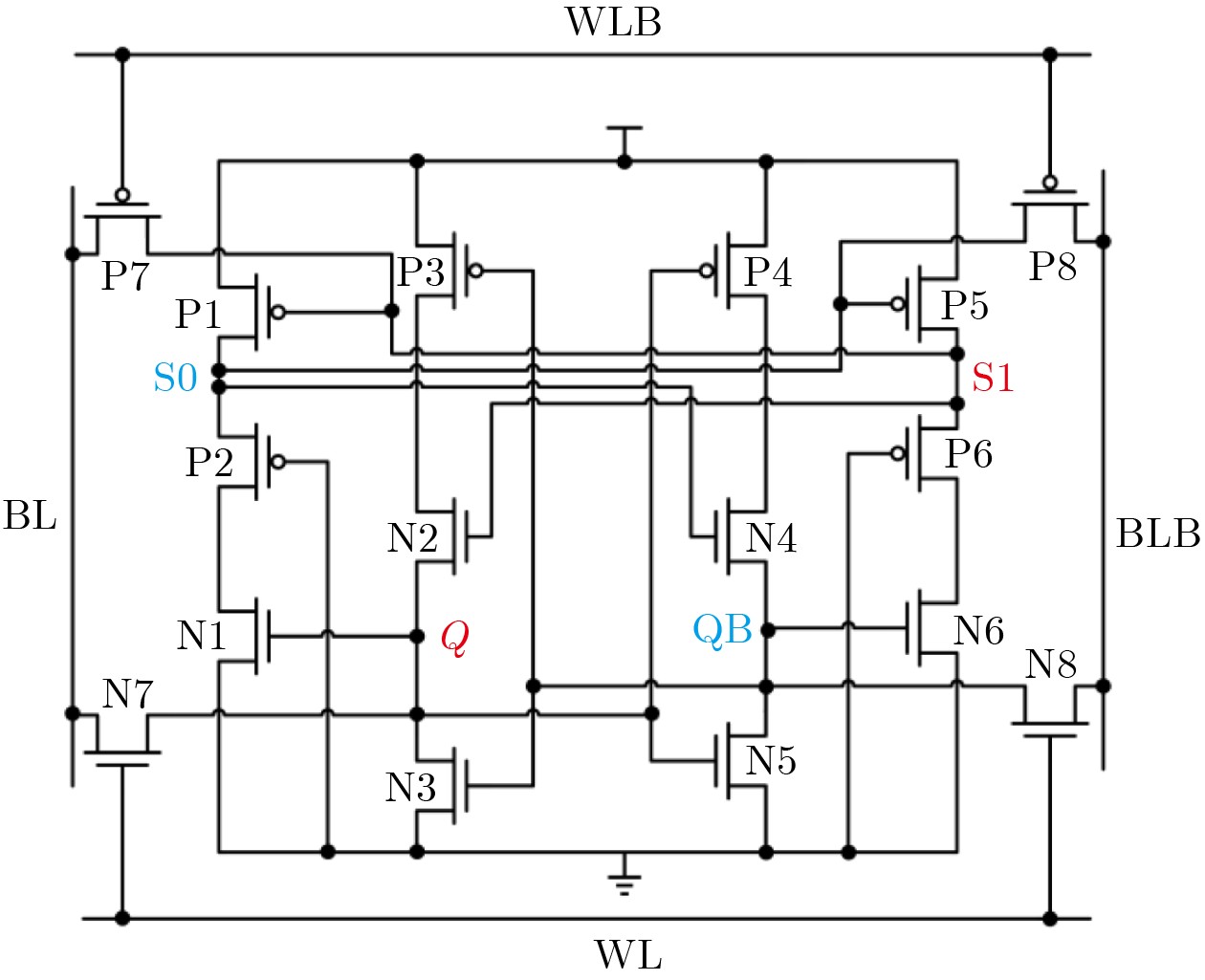
Figures(9) / Tables(4)




 DownLoad: