Advanced Search
Turn off MathJax
Article Contents
LIU Huanlin, AN Dongxin, CHEN Yong, CHEN Haonan, MA Bing, ZOU Jiachen. Multi-path resource allocation for confidential services based on network coding and fragmentation awareness of EONs[J]. Journal of Electronics & Information Technology. doi: 10.11999/JEIT251222
Citation: LIU Huanlin, AN Dongxin, CHEN Yong, CHEN Haonan, MA Bing, ZOU Jiachen. Multi-path resource allocation for confidential services based on network coding and fragmentation awareness of EONs[J]. Journal of Electronics & Information Technology. doi: 10.11999/JEIT251222

Multi-path resource allocation for confidential services based on network coding and fragmentation awareness of EONs

doi: 10.11999/JEIT251222 cstr: 32379.14.JEIT251222
Funds:  The National Natural Science Foundation of China (NSFC 51977021), 2025 Scientific Research Fund for High-level Talents by Chongqing Institute of Engineering(2025gcky01)
  • Received Date: 2025-11-16
  • Accepted Date: 2026-02-05
  • Rev Recd Date: 2026-02-05
  • Available Online: 2026-02-16
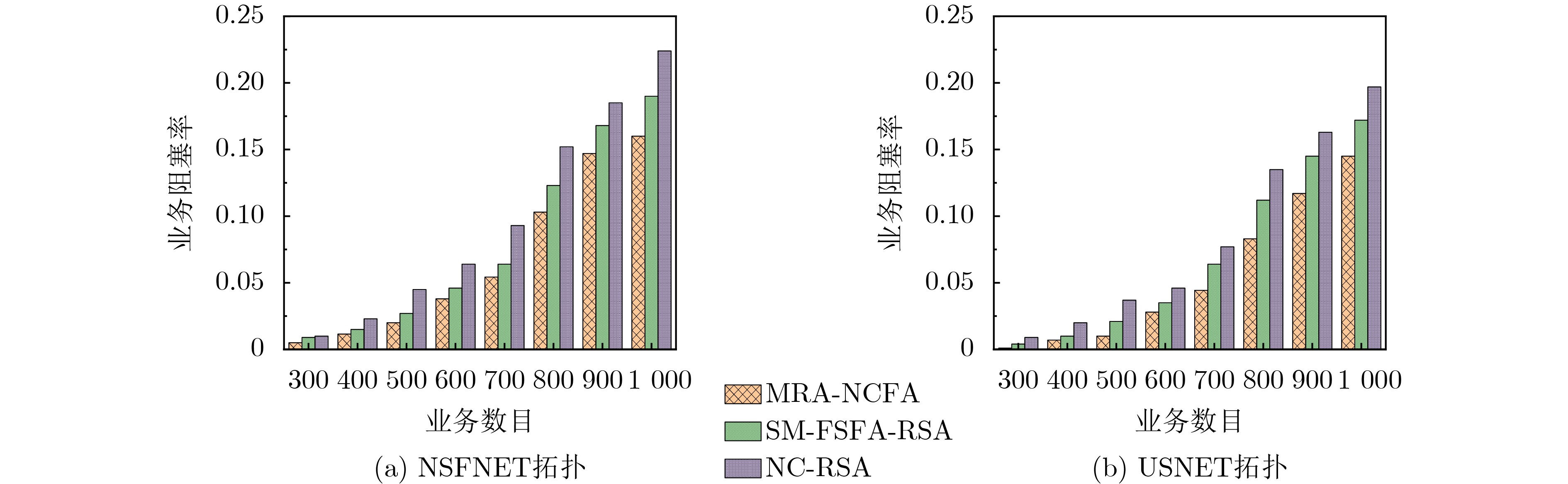
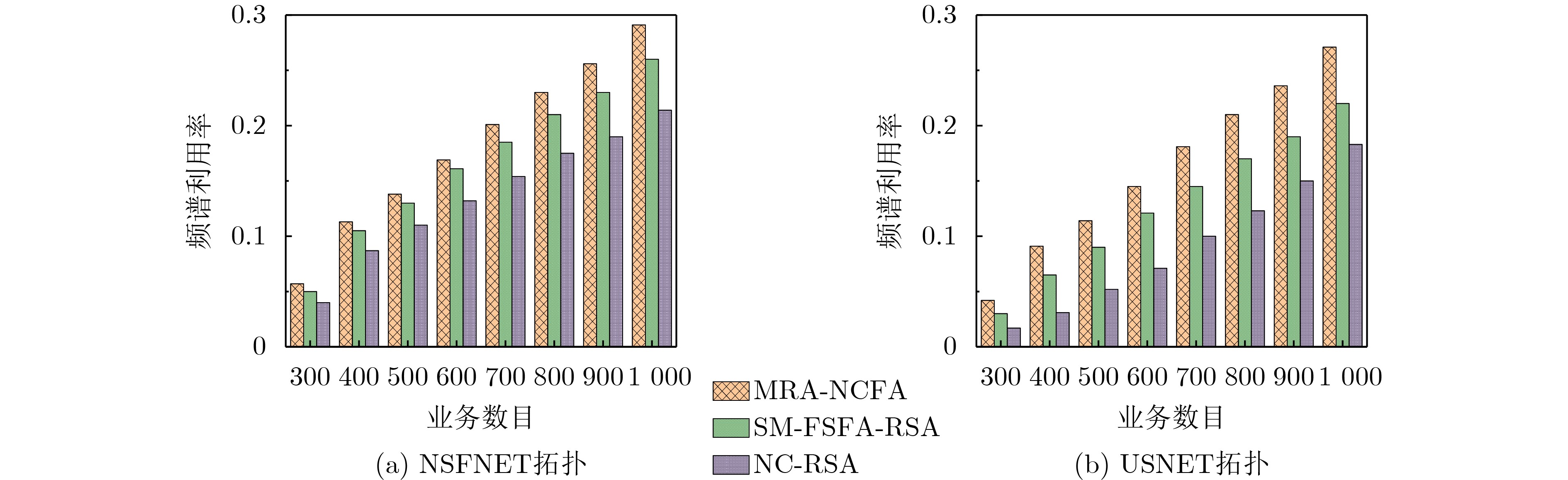
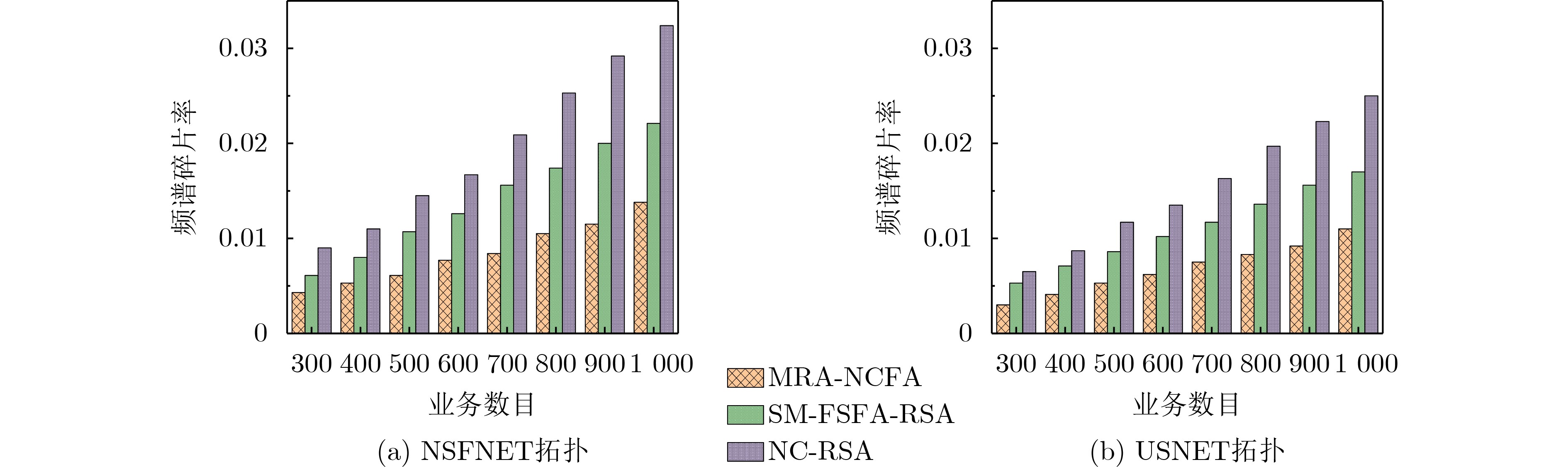
  •   Objective  Each fiber in Elastic Optical Networks (EONs) provides enormous bandwidth capacity and carries a large amount of services and data. Even if one of elements in EONs is eavesdropped or attacked in a short period of time, it will cause a large amount of data leakage or loss, resulting in a significant decrease in network performance. At the same time, more and more confidential are more sensitive to data leakage or loss on the path, and network attacks will damage the date of a large number of confidential services. Network Coding (NC) combines data from different services through XOR operation and transmits them over EONs. Then, it performs decoding operation at the receiving end to recover the original data information, opening up a new idea to avoid data eavesdropping on the path. However, the condition for NC is that there are encryption constraints in the EONs where the routing and Frequency Slot (FS) allocation of other services overlap with the routing and FS of the confidential service to be encrypted. Therefore, the routing and spectrum allocation of confidential services need to consider network coding constraints and the efficiency of routing and spectrum resource allocation.  Methods  A Multi-Path Resource Allocation based on Network Coding and Fragmentation Aware (MRA-NCFA) method is proposed to address the security and reliable transmission for confidential services in response to eavesdropping attacks. Firstly, the MRA-NCFA method uses network coding for data encryption in terms of services security, and employs the multi-path protection method for reliable services transmission. Secondly, in the routing stage, for non-confidential services, the focus is on balancing network payload and improving network resource utilization. So, a path weight function for non-confidential services is mainly designed based on path payload. And a path weight function includes the path hop, maximum idle spectrum block on the path, and the required FS of the service. The path corresponding to the maximum value of this function is selected as the transmission path for non-confidential services. For confidential services, in the routing selection stage, emphasis should be placed on whether information has been leaked, while also considering the availability of path resources. Therefore, a path cost function based on eavesdropping probability and a routing strategy considering eavesdropping probability have been designed. Finally, in the resource allocation stage, the purpose of non-confidential services is to maximize network spectrum efficiency. And it is necessary to avoid the generation of spectrum fragments as much as possible and maintain the continuity and consistency of resources. To this end, we have designed a fragment-sensing spectrum allocation strategy for non-confidential services. Through the designed fragment measurement formula, we measure the impact of service resource allocation on link resources. For confidential services, considering the constraints of encrypted transmission and FS matching, a spectrum allocation strategy based on FS and fragment sensing functions has been designed. This FS and fragment sensing function not only consider the impact of resource fragments, but also the impact of established services resources, providing high security for confidential services.  Results and Discussions  The proposed MRA-NCFA algorithm can get the lowest service blocking probability (Figure 2) because both confidential and non-confidential services consider the impact of path resources in routing selection, and the impact of fragmentation is also taken into account in resource allocation, which can leave idle resources for subsequent services as much as possible. In addition, confidential services also adopt multi-path transmission methods, which can divide larger services into multiple sub services, which is conducive to the utilization of spectrum resources. With the increase of services, the spectrum utilization of MRA-NCFA algorithm has significantly improved. This is because the algorithm adopts multi-path transmission method, which can divide large services into small services and effectively utilize some small spectrum fragments. In addition, confidential and non-confidential services not only consider the number of resources in the path in routing selection, but also choose the path with less spectrum consumption. When allocating resources, both services consider the impact of fragments, avoiding the generation of fragments on the path and thus improving spectrum utilization (Figure 3). As the number of services increases, compared to other two algorithms, the proposed MRA-NCFA algorithm has the slowest and smallest increase in spectrum fragmentation ratio. This is because the MRA-NCFA algorithm adopts multi-path transmission method and fragment-sensing resource allocation method, which can improve the utilization of small-sized spectrum resource fragments and reduce the spectrum fragmentation ratio in EONs. Moreover, both confidential and non-confidential services consider the impact of fragmentation in resource allocation and take measures to reduce fragmentation rates. Therefore, its performance is better than that of compared Survivable Multipath Fragmentation-Sensitive Fragmentation-Aware Routing and Spectrum Assignment (SM-FSFA-RSA) and (Network Coding based Routing and Spectrum Allocation, NC-RSA) algorithms (Figure 4).  Conclusions  The resource allocation of protecting services against eavesdropping attacks in elastic optical networks is studied to guarantee the requirements of confidential services and reduce spectrum fragmentation. The MRA-NCFA is proposed. The MRA-NCFA algorithm employs network coding to encrypt confidential services and adopts multi-path protection to safeguard confidential services. For non-confidential services, a path weight function based on path resources is designed to select routes, and spectrum fragment metric values based on fragment aware are used to allocate resources. For confidential services, a path cost function considering path resources and eavesdropping probability is designed to select routes, a bandwidth segmentation function based on eavesdropping probability is used for multi-path transmission, and a frequency slot and fragment sensing function based on encryption constraints is used to allocate spectrum resources to ensure the reliability and security for confidential services. With the growth of security services in the Internet, the proposed MRA-NCFA can effectively reduce the traffic blocking probability and improve spectrum resource utilization.
  • loading
  • [1]
    徐勇军, 李晶, 骆东鑫, 等. 近场通信物理层安全技术综述[J]. 电子与信息学报, 2025, 47(11): 4129–4143. doi: 10.11999/JEIT250336.

    XU Yongjun, LI Jing, LUO Dongxin, et al. A survey on physical layer security in near-field communication[J]. Journal of Electronics & Information Technology, 2025, 47(11): 4129–4143. doi: 10.11999/JEIT250336.
    [2]
    黄蔚亮, 李锦煊, 余志文, 等. 确定性网络: 架构、关键技术和应用[J]. 重庆邮电大学学报: 自然科学版, 2025, 37(1): 1–16. doi: 10.3979/j.issn.1673-825X.202409020229.

    HUANG Weiliang, LI Jinxuan, YU Zhiwen, et al. Deterministic networks: Standards, architectures and applications[J]. Journal of Chongqing University of Posts and Telecommunications: Natural Science Edition, 2025, 37(1): 1–16. doi: 10.3979/j.issn.1673-825X.202409020229.
    [3]
    刘焕淋, 张建剑, 陈勇, 等. 弹性光网络中基于频谱窗滑动的时变业务共享保护方法[J]. 电子与信息学报, 2023, 45(10): 3694–3701. doi: 10.11999/JEIT221406.

    LIU Huanlin, ZHANG Jianjian, CHEN Yong, et al. A time-varying traffic sharing protection based on spectrum window sliding in elastic optical networks[J]. Journal of Electronics & Information Technology, 2023, 45(10): 3694–3701. doi: 10.11999/JEIT221406.
    [4]
    刘焕淋, 谭明明, 任杰, 等. 基于频谱切片的弹性光网络中可调度请求资源分配算法[J]. 重庆邮电大学学报: 自然科学版, 2023, 35(2): 286–293. doi: 10.3979/j.issn.1673-825X.202201050007.

    LIU Huanlin, TAN Mingming, REN Jie, et al. Resource allocation algorithm for scheduled lightpath demands in elastic optical networks based on spectrum slicing[J]. Journal of Chongqing University of Posts and Telecommunications: Natural Science Edition, 2023, 35(2): 286–293. doi: 10.3979/j.issn.1673-825X.202201050007.
    [5]
    SAVVA G, MANOUSAKIS K, and ELLINAS G. Confidentiality meets protection in elastic optical networks[J]. Optical Switching and Networking, 2021, 42: 100620. doi: 10.1016/j.osn.2021.100620.
    [6]
    ZOU Yucong, CAI Xiaofeng, ZHU Min, et al. Nonlinear impairment-aware RMSA under the sliding scheduled traffic model for EONs based on deep reinforcement learning[J]. Journal of Lightwave Technology, 2023, 41(22): 6854–6864. doi: 10.1109/JLT.2023.3299272.
    [7]
    SAVVA G, MANOUSAKIS K, and ELLINAS G. A network coding optimization approach for physical layer security in elastic optical networks[J]. IEEE Transactions on Network and Service Management, 2025, 22(2): 1145–1159. doi: 10.1109/TNSM.2024.3498108.
    [8]
    LIU Huanlin, TANG Chang, CHEN Yong, et al. A survivable multipath resource allocation strategy based on fragmentation-sensitive fragmentation-aware in space division multiplexing elastic optical networks[J]. Computer Communications, 2023, 204: 78–88. doi: 10.1016/j.comcom.2023.03.025.
    [9]
    XU He, WANG Hongxiang, and JI Yuefeng. Secure and efficient resource allocation for anti-eavesdropping in MCF-based SDM-EONs[C]. Proceedings of 2021 Asia Communications and Photonics Conference, Shanghai, China, 2021: 1–3.
    [10]
    赵夙, 王伟, 朱晓荣, 等. 基于自适应网络编码的异构无线链路并发传输控制方法研究[J]. 电子与信息学报, 2022, 44(8): 2777–2784. doi: 10.11999/JEIT210520.

    ZHAO Su, WANG Wei, ZHU Xiaorong, et al. Research on concurrent transmission control of heterogeneous wireless links based on adaptive network coding[J]. Journal of Electronics & Information Technology, 2022, 44(8): 2777–2784. doi: 10.11999/JEIT210520.
    [11]
    ARABUL E, OLIVEIRA R D, EMAMI A, et al. 100 Gbps quantum-secured and O-RAN-enabled programmable optical transport network for 5G fronthaul[J]. Journal of Optical Communications and Networking, 2023, 15(8): C223–C231. doi: 10.1364/JOCN.483644.
    [12]
    HAI D T. On routing, wavelength, network coding assignment, and protection configuration problem in optical-processing-enabled networks[J]. IEEE Transactions on Network and Service Management, 2023, 20(3): 2504–2514. doi: 10.1109/TNSM.2023.3283880.
    [13]
    HU Liyazhou, WANG Wei, PAN Yuanyuan, et al. Security enhanced routing and spectrum allocation against crosstalk attacks for confidential lightpath in elastic optical networks[J]. Optics Express, 2024, 32(5): 7254–7275. doi: 10.1364/OE.511055.
    [14]
    刘焕淋, 邓棣, 陈勇, 等. 基于网络编码的机密业务多路径光传输方法[J]. 电子学报, 2024, 52(9): 3272–3277. doi: 10.12263/DZXB.20230856.

    LIU Huanlin, DENG Di, CHEN Yong, et al. A network coding-based multipath optical transmission method for secret traffic[J]. Acta Electronica Sinica, 2024, 52(9): 3272–3277. doi: 10.12263/DZXB.20230856.
    [15]
    LIU Huanlin, HUO Xingji, CHEN Yong, et al. Shared protection survivable multipath-based VONE in EONs integrated with QKD[J]. Journal of Lightwave Technology, 2024, 42(17): 5800–5807. doi: 10.1109/JLT.2024.3406349.
    [16]
    YU Mingxuan, JIANG Jing, SHANG T, et al. A load balancing and time-frequency fragmentation-aware algorithm for elastic optical network[C]. Proceedings of 2023 Asia Communications and Photonics Conference/2023 International Photonics and Optoelectronics Meetings, Wuhan, China, 2023: 1–5. doi: 10.1109/ACP/POEM59049.2023.10369171.
    [17]
    SRIVASTAVA R and SINGH Y N. A novel fragmentation metric and fragmentation-aware adaptive routing and spectrum allocation algorithm in elastic optical network[J]. Optical Fiber Technology, 2025, 94: 104318. doi: 10.1016/j.yofte.2025.104318.
    [18]
    张盛峰, 陈会丹, 彭樱. SDM-EON中基于串扰避免的多纤芯分配算法[J]. 重庆邮电大学学报: 自然科学版, 2023, 35(1): 23–30. doi: 10.3979/j.issn.1673-825X.202109190334.

    ZHANG Shengfeng, CHEN Huidan, and PENG Ying. Multi-core assignment algorithm based on crosstalk-avoiding in space division multiplexing elastic optical networks[J]. Journal of Chongqing University of Posts and Telecommunications: Natural Science Edition, 2023, 35(1): 23–30. doi: 10.3979/j.issn.1673-825X.202109190334.
  • 加载中

Catalog

    通讯作者: 陈斌, bchen63@163.com
    • 1. 

      沈阳化工大学材料科学与工程学院 沈阳 110142

    1. 本站搜索
    2. 百度学术搜索
    3. 万方数据库搜索
    4. CNKI搜索

    Figures(3)  / Tables(4)

    Article Metrics

    Article views (92) PDF downloads(8) Cited by()
    Proportional views
    Related

    /

    DownLoad:  Full-Size Img  PowerPoint
    Return
    Return