Advanced Search
Turn off MathJax
Article Contents
WU Wei, WANG Wennai. Neighboring Mutual-Coupling Channel Model and Tunable-Impedance Optimization Method for Reconfigurable-Intelligent-Surface Aided Communications[J]. Journal of Electronics & Information Technology. doi: 10.11999/JEIT251109
Citation: WU Wei, WANG Wennai. Neighboring Mutual-Coupling Channel Model and Tunable-Impedance Optimization Method for Reconfigurable-Intelligent-Surface Aided Communications[J]. Journal of Electronics & Information Technology. doi: 10.11999/JEIT251109

Neighboring Mutual-Coupling Channel Model and Tunable-Impedance Optimization Method for Reconfigurable-Intelligent-Surface Aided Communications

doi: 10.11999/JEIT251109 cstr: 32379.14.JEIT251109
Funds:  Natural Science Research Start-up Foundation of Recruiting Talents of Nanjing University of Posts and Telecommunications (NY222118)
  • Accepted Date: 2025-12-02
  • Rev Recd Date: 2025-12-02
  • Available Online: 2025-12-10
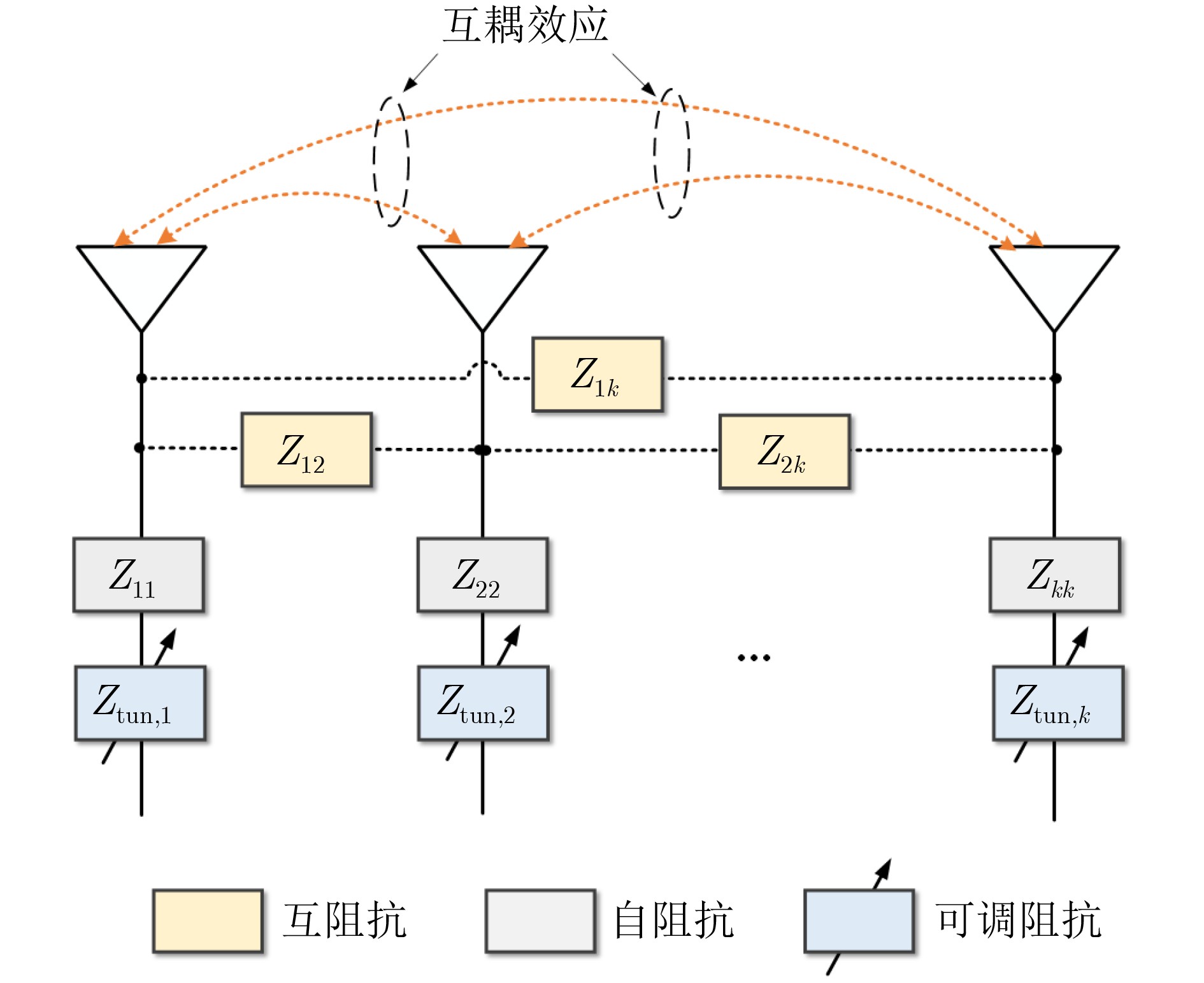
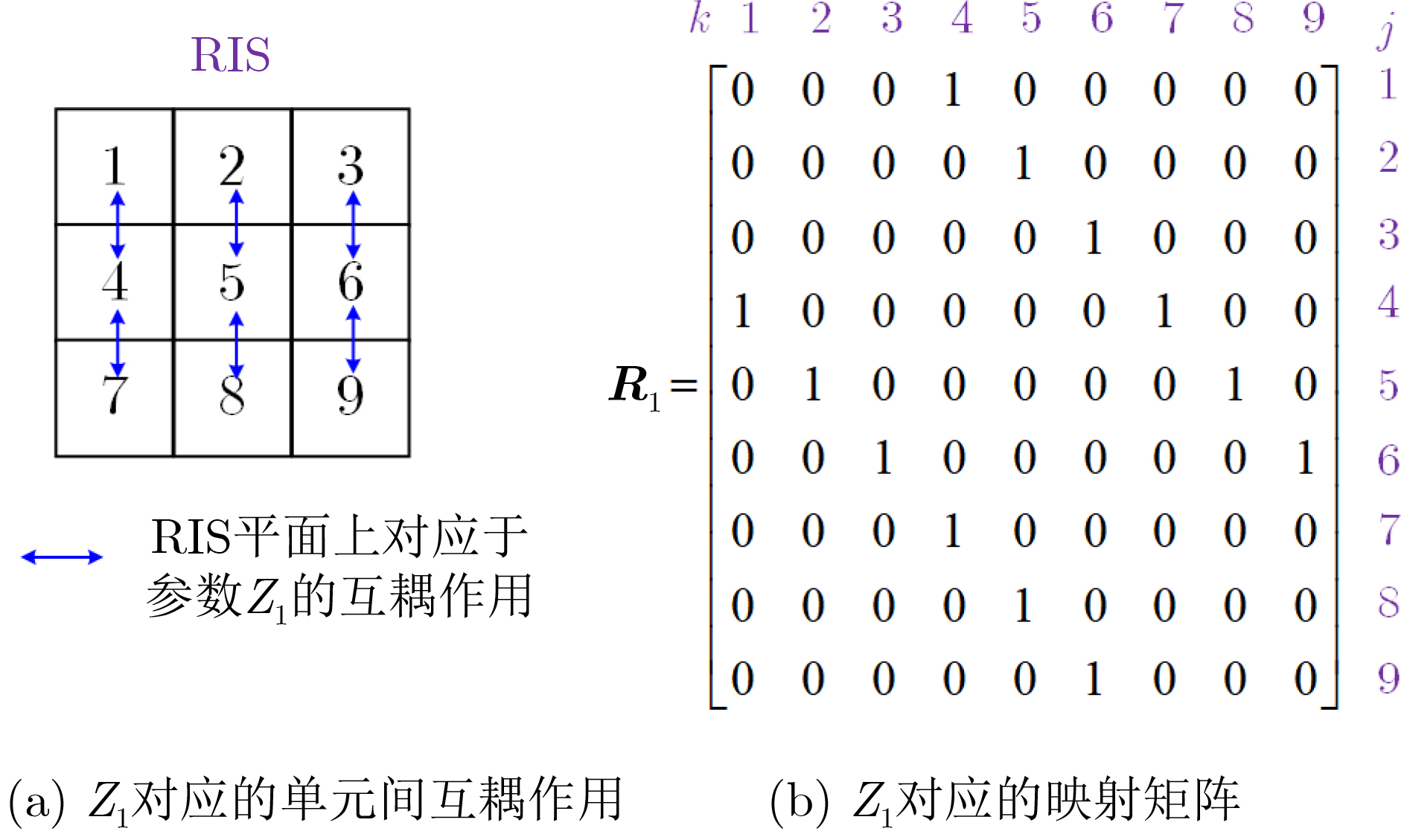
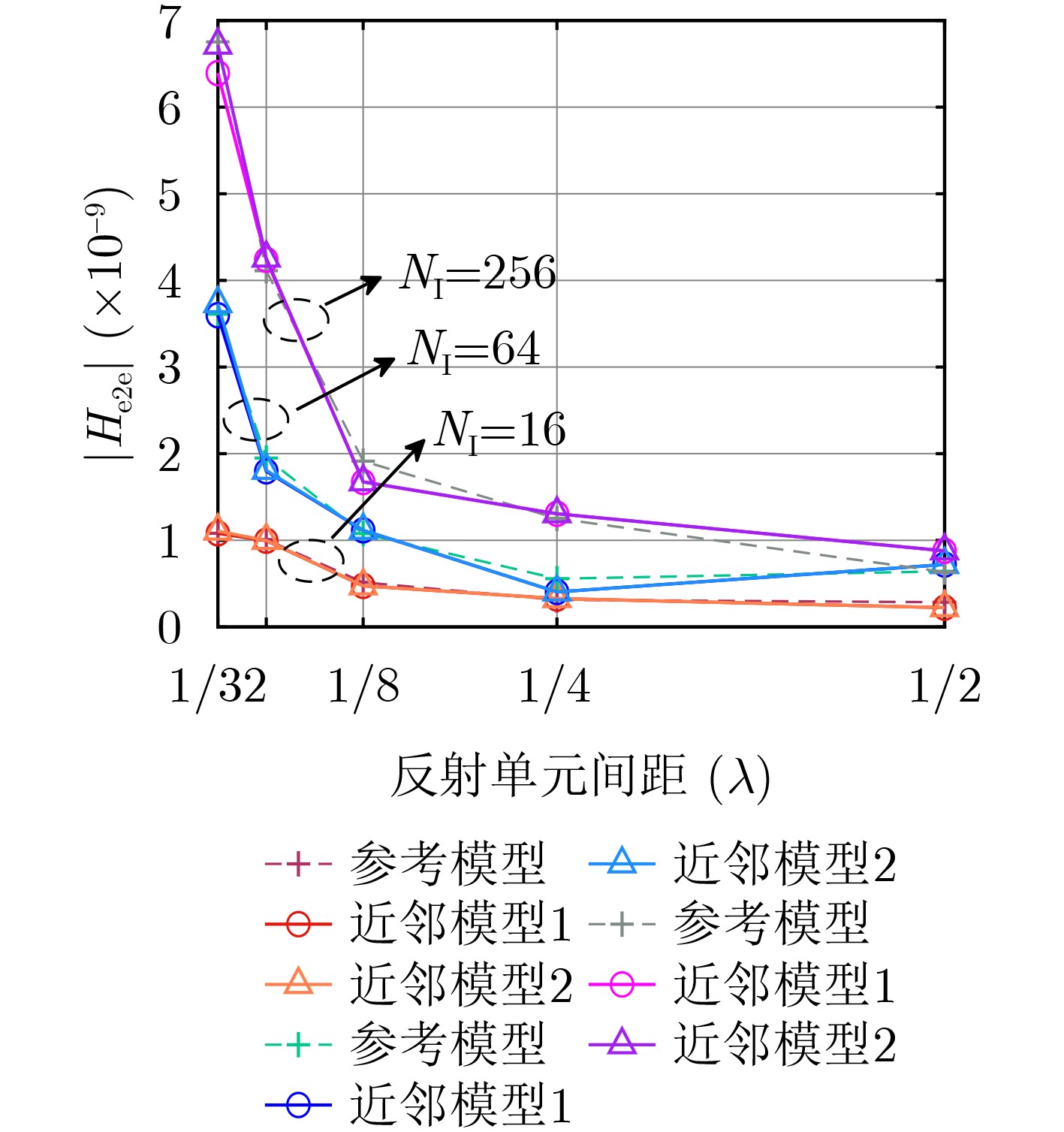
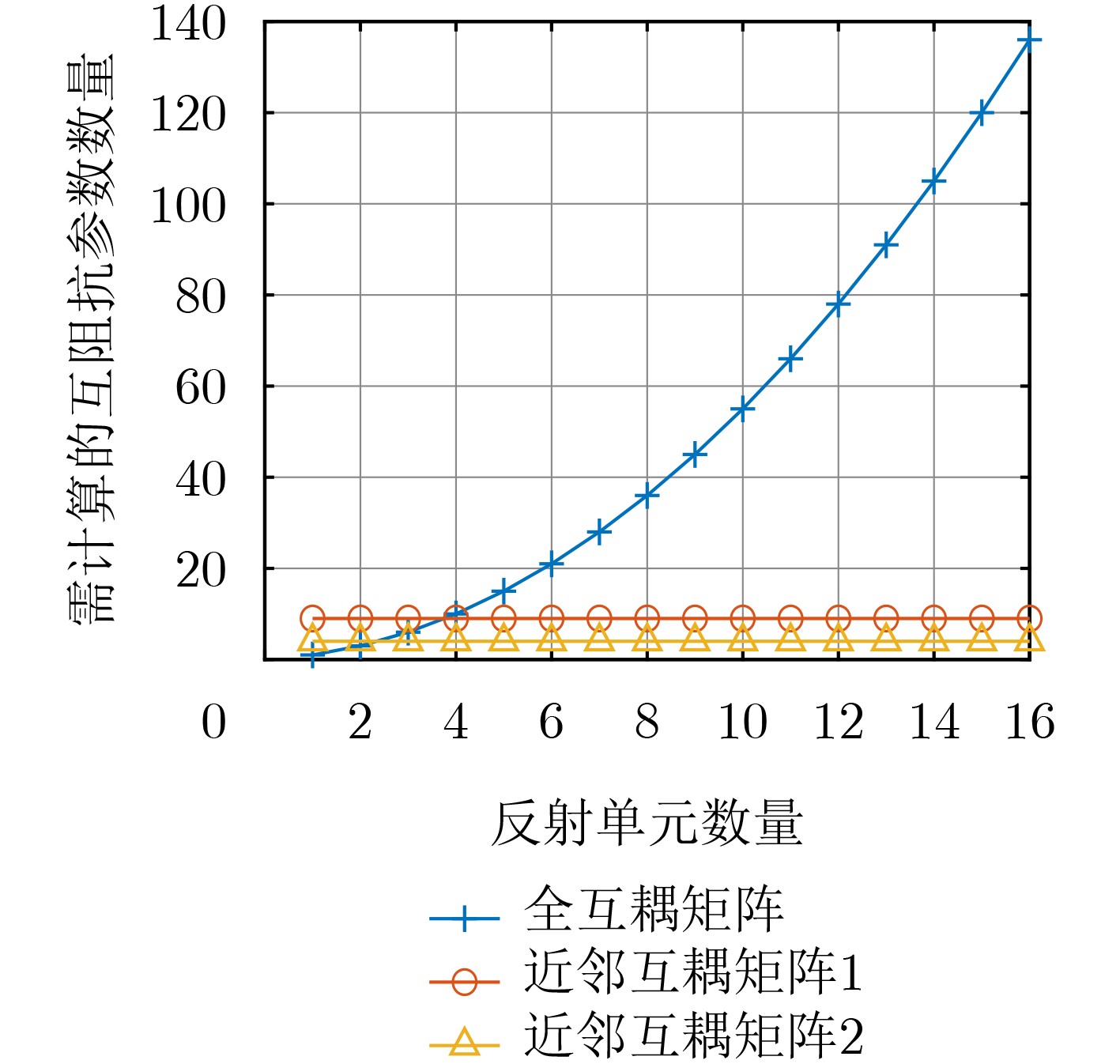
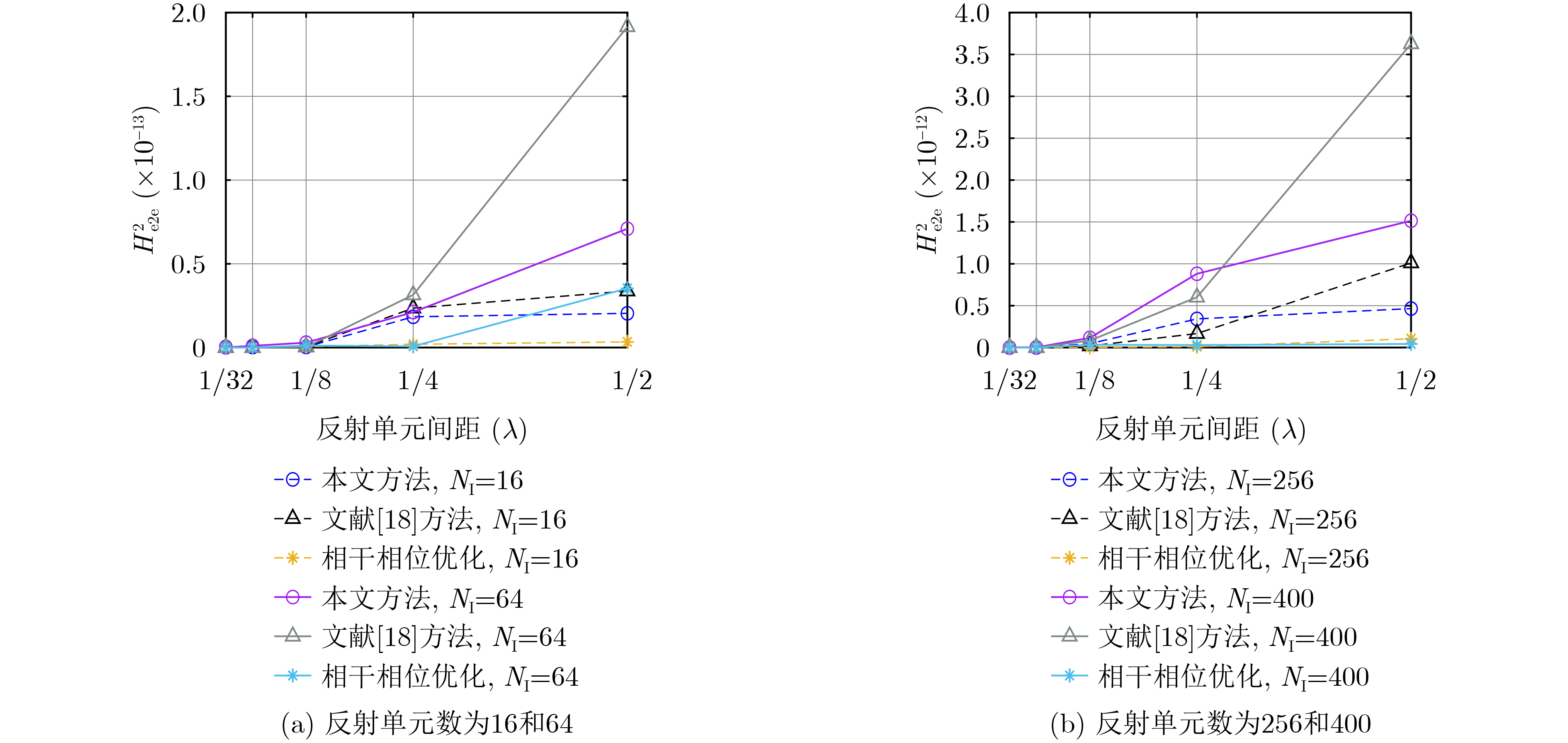
  •   Objective  Reconfigurable Intelligent Surfaces (RIS) have attracted significant attention due to their capability to intelligently manipulate electromagnetic wave propagation. A typical RIS comprises a dense array of reflecting elements (REs) spaced no more than half a wavelength apart, where electromagnetic mutual-coupling inevitably arises between adjacent REs. This mutual-coupling effect becomes particularly pronounced when the RE spacing is less than half the wavelength, substantially influencing the performance and efficiency of RIS-assisted systems. Therefore, accurate modeling of mutual-coupling is crucial for RIS optimization. However, existing mutual-coupling-aware channel models often incur high computational complexity owing to the large dimensionality of the mutual impedance matrix, which limits their practical applicability. To address this issue, this paper proposes a simplified mutual-coupling-aware channel model based on a sparse neighboring mutual-coupling matrix, together with an efficient optimization method for configuring the tunable impedances of the RIS.  Methods  First, a simplified mutual-coupling-aware channel model is developed through two key steps: (1) constructing a neighboring mutual-coupling matrix based on the exponentially decaying nature of mutual impedance with distance, and (2) deriving a closed-form approximation for mutual impedance between the transmitter/receiver and reflecting elements under far-field conditions. Specifically, by leveraging the rapid decay of mutual impedance with increasing inter-element spacing, only eight or three mutual-coupling parameters are retained, along with one self-impedance parameter. These parameters are systematically organized into a neighboring mutual-coupling matrix using predefined support matrices. Furthermore, to reduce the computational complexity in evaluating mutual impedance, the distance term is approximated by a central value under far-field assumptions, allowing the integral expression to be simplified into a compact analytical form. Building upon this simplified channel model, we then propose an efficient optimization scheme for the RIS tunable impedances. Using an impedance decomposition approach, we analytically derive a closed-form expression for the optimal tunable impedance matrix. This enables low-complexity configuration of the RIS, with a computational cost independent of the number of RIS elements.  Results and Discussions  The accuracy and computational efficiency of the proposed simplified models, together with the effectiveness of the proposed impedance optimization method, are verified through numerical simulations. First, the two proposed simplified models are compared with the reference model. The first simplified model employs a neighboring mutual-coupling matrix that accounts for interactions among elements separated by no more than one intermediate unit, whereas the second model considers only the immediately adjacent elements. Results show that the channel gain increases as the RE spacing decreases, with more rapid growth observed at smaller spacings (Fig. 4). The modeling error between the simplified models and the reference model remains below 0.1 when the RE spacing does not exceed $ \lambda /4 $; however, the error increases noticeably when the spacing reaches a larger value. In addition, the error curves indicate that the modeling errors of both simplified models become negligible when the spacing is below $ \lambda /4 $, suggesting that the second model can be adopted to further reduce complexity (Fig. 6). Second, the computational complexity of the proposed models is compared with that of the reference model. It is shown that when the number of REs exceeds 4, the complexity of computing the mutual-coupling matrix in the reference model begins to exceed that of the proposed adjacent mutual-coupling matrix. Moreover, as the number of REs increases, the complexity of the reference model grows rapidly, whereas that of the proposed model remains constant (Fig. 5). Finally, the proposed impedance optimization method is compared with two benchmark approaches (Fig. 7, Fig. 8). Results show that when the RE spacing is no more than $ \lambda /4 $, the channel gain achieved by the proposed method is close to that of the algorithm introduced in [18]. However, as the spacing increases beyond that range, a noticeable performance gap emerges between the two methods. Furthermore, the performance of the proposed method consistently exceeds that of the coherent phase-shift optimization method.  Conclusions  The integration of numerous densely arranged REs in a RIS introduces significant mutual-coupling effects. These effects can considerably impact system performance and therefore should be accounted for in channel modeling and impedance optimization. To address this challenge, this paper has proposed a simplified mutual-coupling-aware channel model based on a neighboring mutual-coupling matrix, together with an efficient optimization method for configuring the tunable impedances. Specifically, a low-complexity channel model has been developed by incorporating the neighboring mutual-coupling matrix and a simplified mutual-impedance expression derived under far-field assumptions. Furthermore, based on this model and through an impedance decomposition approach, a closed-form solution for the optimal RIS tunable impedances has been derived. Simulation results demonstrate that the proposed channel model and impedance optimization method maintain satisfactory accuracy and effectiveness when the element spacing does not exceed $ \lambda /4 $. This work provides a practical theoretical framework and useful design insights for analyzing and optimizing RIS-assisted systems in the presence of mutual-coupling effects.
  • loading
  • [1]
    MU Xidong, XU Jiaqi, LIU Yuanwei, et al. Reconfigurable intelligent surface-aided near-field communications for 6G: Opportunities and challenges[J]. IEEE Vehicular Technology Magazine, 2024, 19(1): 65–74. doi: 10.1109/MVT.2023.3345608.
    [2]
    BASAR E, ALEXANDROPOULOS G C, LIU Yuanwei, et al. Reconfigurable intelligent surfaces for 6G: Emerging hardware architectures, applications, and open challenges[J]. IEEE Vehicular Technology Magazine, 2024, 19(3): 27–47. doi: 10.1109/MVT.2024.3415570.
    [3]
    WANG Jinghe, TANG Wankai, LIANG Jingcheng, et al. Reconfigurable intelligent surface: Power consumption modeling and practical measurement validation[J]. IEEE Transactions on Communications, 2024, 72(9): 5720–5734. doi: 10.1109/TCOMM.2024.3382332.
    [4]
    费丹, 陈晨, 郑鹏, 等. 基于智能超表面的室内覆盖增强技术研究与实验验证[J]. 电子与信息学报, 2022, 44(7): 2374–2381. doi: 10.11999/JEIT220068.

    FEI Dan, CHEN Chen, ZHENG Peng, et al. Research and experimental verification of reconfigurable intelligent surface in indoor coverage enhancement[J]. Journal of Electronics & Information Technology, 2022, 44(7): 2374–2381. doi: 10.11999/JEIT220068.
    [5]
    SIDDIKY M N A, RAHMAN M E, UZZAL M S, et al. A comprehensive exploration of 6G wireless communication technologies[J]. Computers, 2025, 14(1): 15. doi: 10.3390/computers14010015.
    [6]
    KUMAR A, SHARMA S, KUMAR M H, et al. RIS-assisted terahertz communications for 6G networks: A comprehensive overview[J]. IEEE Access, 2025, 13: 96337–96364. doi: 10.1109/ACCESS.2025.3574476.
    [7]
    BALANIS C A. Antenna Theory: Analysis and Design[M]. 4th ed. Hoboken: Wiley, 2016. (查阅网上资料, 未找到对应的页码信息, 请确认).
    [8]
    DI RENZO M, DANUFANE F H, and TRETYAKOV S. Communication models for reconfigurable intelligent surfaces: From surface electromagnetics to wireless networks optimization[J]. Proceedings of the IEEE, 2022, 110(9): 1164–1209. doi: 10.1109/JPROC.2022.3195536.
    [9]
    TANG Wankai, CHEN Mingzheng, CHEN Xiangyu, et al. Wireless communications with reconfigurable intelligent surface: Path loss modeling and experimental measurement[J]. IEEE Transactions on Wireless Communications, 2021, 20(1): 421–439. doi: 10.1109/TWC.2020.3024887.
    [10]
    LI Dong. How many reflecting elements are needed for energy- and spectral-efficient intelligent reflecting surface-assisted communication[J]. IEEE Transactions on Communications, 2022, 70(2): 1320–1331. doi: 10.1109/TCOMM.2021.3128544.
    [11]
    GRADONI G and DI RENZO M. End-to-end mutual coupling aware communication model for reconfigurable intelligent surfaces: An electromagnetic-compliant approach based on mutual impedances[J]. IEEE Wireless Communications Letters, 2021, 10(5): 938–942. doi: 10.1109/LWC.2021.3050826.
    [12]
    MURSIA P, PHANG S, SCIANCALEPORE V, et al. SARIS: Scattering aware reconfigurable intelligent surface model and optimization for complex propagation channels[J]. IEEE Wireless Communications Letters, 2023, 12(11): 1921–1925. doi: 10.1109/LWC.2023.3299304.
    [13]
    SHEN Shanpu, CLERCKX B, and MURCH R. Modeling and architecture design of reconfigurable intelligent surfaces using scattering parameter network analysis[J]. IEEE Transactions on Wireless Communications, 2022, 21(2): 1229–1243. doi: 10.1109/TWC.2021.3103256.
    [14]
    ABRARDO A, TOCCAFONDI A, and DI RENZO M. Design of reconfigurable intelligent surfaces by using S-parameter multiport network theory—optimization and full-wave validation[J]. IEEE Transactions on Wireless Communications, 2024, 23(11): 17084–17102. doi: 10.1109/TWC.2024.3450722.
    [15]
    NERINI M, SHEN Shanpu, LI Hongyu, et al. Beyond diagonal reconfigurable intelligent surfaces utilizing graph theory: Modeling, architecture design, and optimization[J]. IEEE Transactions on Wireless Communications, 2024, 23(8): 9972–9985. doi: 10.1109/TWC.2024.3367631.
    [16]
    NERINI M, SHEN Shanpu, LI Hongyu, et al. A universal framework for multiport network analysis of reconfigurable intelligent surfaces[J]. IEEE Transactions on Wireless Communications, 2024, 23(10): 14575–14590. doi: 10.1109/TWC.2024.3416825.
    [17]
    ZHENG Pinjun, WANG Ruiqi, SHAMIM A, et al. Mutual coupling in RIS-aided communication: Model training and experimental validation[J]. IEEE Transactions on Wireless Communications, 2024, 23(11): 17174–17188. doi: 10.1109/TWC.2024.3451548.
    [18]
    QIAN Xuewen and DI RENZO M. Mutual coupling and unit cell aware optimization for reconfigurable intelligent surfaces[J]. IEEE Wireless Communications Letters, 2021, 10(6): 1183–1187. doi: 10.1109/LWC.2021.3061449.
    [19]
    ABRARDO A, DARDARI D, DI RENZO M, et al. MIMO interference channels assisted by reconfigurable intelligent surfaces: Mutual coupling aware sum-rate optimization based on a mutual impedance channel model[J]. IEEE Wireless Communications Letters, 2021, 10(12): 2624–2628. doi: 10.1109/LWC.2021.3109017.
    [20]
    MURSIA P, PHANG S, SCIANCALEPORE V, et al. SARIS: Scattering aware reconfigurable intelligent surface model and optimization for complex propagation channels[J]. IEEE Wireless Communications Letters, 2023, 12(11): 1921–1925. doi: 10.1109/LWC.2023.3299304. .
    [21]
    PEROVIć N S, TRAN L N, DI RENZO M, et al. Optimization of RIS-aided SISO systems based on a mutually coupled loaded wire dipole model[C]. 2023 57th Asilomar Conference on Signals, Systems, and Computers, Pacific Grove, USA, 2023: 145–150. doi: 10.1109/IEEECONF59524.2023.10476915.
    [22]
    LI Hongyu, SHEN Shanpu, NERINI M, et al. Beyond diagonal reconfigurable intelligent surfaces with mutual coupling: Modeling and optimization[J]. IEEE Communications Letters, 2024, 28(4): 937–941. doi: 10.1109/LCOMM.2024.3361648.
    [23]
    SUN Wenlong, SUN Shaohui, SHI Tong, et al. A new model of beyond diagonal reconfigurable intelligent surfaces (BD-RIS) for the corresponding quantization and optimization[J]. IEEE Transactions on Wireless Communications, 2024, 23(9): 11521–11534. doi: 10.1109/TWC.2024.3382750.
    [24]
    LI Hongyu, NERINI M, SHEN Shanpu, et al. Beyond diagonal reconfigurable intelligent surfaces in wideband OFDM communications: Circuit-based modeling and optimization[J]. IEEE Transactions on Wireless Communications, 2025, 24(4): 3623–3636. doi: 10.1109/TWC.2025.3532616.
    [25]
    LI Dong. Ergodic capacity of intelligent reflecting surface-assisted communication systems with phase errors[J]. IEEE Communications Letters, 2020, 24(8): 1646–1650. doi: 10.1109/LCOMM.2020.2997027.
  • 加载中

Catalog

    通讯作者: 陈斌, bchen63@163.com
    • 1. 

      沈阳化工大学材料科学与工程学院 沈阳 110142

    1. 本站搜索
    2. 百度学术搜索
    3. 万方数据库搜索
    4. CNKI搜索

    Figures(8)

    Article Metrics

    Article views (21) PDF downloads(1) Cited by()
    Proportional views
    Related

    /

    DownLoad:  Full-Size Img  PowerPoint
    Return
    Return