Advanced Search
Turn off MathJax
Article Contents
LIU Genggeng, JIAO Xinyue, PAN Youlin, HUANG Xing. One-Pass Architectural Synthesis for Continuous-Flow Microfluidic Biochips Based on Deep Reinforcement Learning[J]. Journal of Electronics & Information Technology. doi: 10.11999/JEIT251058
Citation: LIU Genggeng, JIAO Xinyue, PAN Youlin, HUANG Xing. One-Pass Architectural Synthesis for Continuous-Flow Microfluidic Biochips Based on Deep Reinforcement Learning[J]. Journal of Electronics & Information Technology. doi: 10.11999/JEIT251058

One-Pass Architectural Synthesis for Continuous-Flow Microfluidic Biochips Based on Deep Reinforcement Learning

doi: 10.11999/JEIT251058 cstr: 32379.14.JEIT251058
Funds:  National Natural Science Foundation of China (62372109, 62572396), Fujian Natural Science Funds (2023J06017)
  • Accepted Date: 2025-12-22
  • Rev Recd Date: 2025-12-22
  • Available Online: 2026-01-04
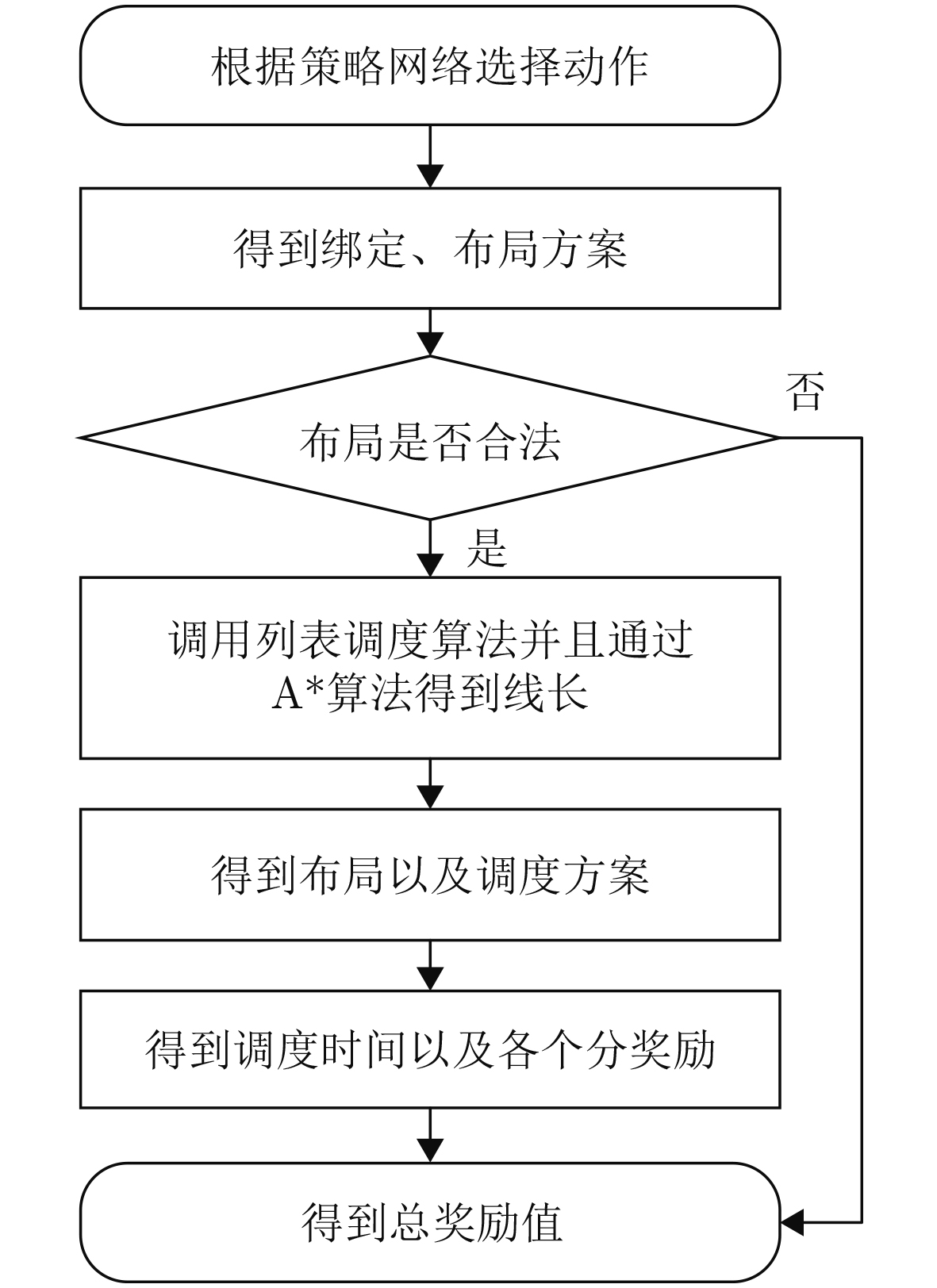
  • Continuous microfluidic biochips are widely used in the biomedical field due to their miniaturisation, high reliability, and low sample consumption. However, as chip integration levels increase, design complexity significantly rises. Traditional stepwise design methods process tasks such as bonding, scheduling, layout, and routing in separate steps, with insufficient information exchange between stages, leading to low-quality solutions and prolonged design cycles. To address this, this paper proposes a one-step architecture synthesis method for continuous microfluidic biochips based on deep reinforcement learning. First, graph convolutional neural networks are used to extract state features, effectively capturing the underlying patterns and characteristics of nodes and their relationships. Second, the proximal policy optimisation algorithm combines the A* algorithm and list scheduling algorithm to ensure the rationality of layout and routing, as well as precise information for operation scheduling, thereby obtaining a specific architectural design solution. Finally, a multi-objective reward function is designed, normalising and weighting the total length of biochemical reaction channels, total channel length, and valve count, and employs the policy gradient update mechanism of the near-term policy optimisation algorithm to efficiently explore the complex decision space. Experimental results demonstrate that, compared to existing methods, the proposed method achieves a 2.1% optimisation in biochemical reaction time, a 21.3% reduction in total channel length, and a 65.0% reduction in valve count on benchmark test cases, while still generating feasible solutions for larger-scale chips.  Objective  Continuous-flow microfluidic biochips (CFMBs) have gained significant attention in biomedical applications due to their miniaturization, high reliability, and low sample consumption. However, as the integration density of CFMBs increases, the design complexity escalates substantially. Traditional stepwise design methods suffer from performance gaps, resulting in suboptimal solutions, prolonged design cycles, and even feasibility issues in large-scale implementations. To address these challenges, this study proposes a novel one-stage architectural synthesis framework for CFMBs by integrating deep reinforcement learning (DRL). The framework leverages graph convolutional neural networks (GCNs) to extract high-dimensional state features and employs the proximal policy optimization (PPO) algorithm to iteratively refine strategies, achieving joint optimization of binding, scheduling, layout, and routing. Experimental results demonstrate that the proposed method outperforms existing approaches in terms of biochemical reaction time, channel length, and valve count, while maintaining scalability for larger chip sizes.  Methods  The algorithm in this paper integrates all the design tasks of CFMBs into an optimisation framework that is modelled as a Markov decision process, which results in a better solution for the CFMBs architecture than the traditional approach. In this framework, the state space includes the device binding information of all operations, the location of the device, the priority, and other parameters, while the action space can be adjusted for the location of the device, the device to which the operation is bound, and the priority of the operation. The reward function is crucial for the quality of the architectural solution of CFMBs, which takes into account the total biochemical reaction time, the total length of the flow paths, and the number of additional valves introduced to optimise the decision, and these rewards are mainly obtained by combining them with the A* algorithm and the list scheduling algorithm. In addition, the weights influence the quality between the metrics, and each sub-award is normalised and the appropriate weights are set to balance the metrics.  Results and Discussions  In this paper, the algorithm is based on the current state space as well as the A* algorithm and the list scheduling algorithm to get the architectural solutions of CFMBs, and then new architectural solutions are continuously obtained through the selection of the action space. By defining appropriate reward functions to get more aspectual and better quality CFMBs architecture solutions. The experimental results show that the biochemical reaction time is reduced by an average of 2.1%, the total length of the flow path is reduced by an average of 21.3%, with a maximum reduction of 57.1% in ProteinSplit, and the number of additional valves introduced is reduced by an average of 65.0% compared with the existing methods, which greatly reduces the manufacturing cost and the risk of failure.  Conclusions  Addressing the design challenges of flow layer architecture for continuous microfluidic biochips, this paper proposes a one-step architecture synthesis method for continuous microfluidic biochips based on deep reinforcement learning. By using graph convolutional neural networks to extract state features, the method effectively captures the underlying connections and characteristics of nodes and their relationships in chip design, transforming the multi-objective optimisation problem in chip design into a sequential decision-making problem. It then employs a proximal policy optimisation algorithm to iteratively update the policy and find the optimal solution, achieving joint optimisation of binding, scheduling, layout, and routing. Experimental results on multiple test cases demonstrate that this method outperforms existing methods in terms of biochemical reaction completion time, total channel length, and the number of additional valves introduced, and can still generate feasible solutions on larger-scale chips.
  • loading
  • [1]
    CONVERY N and GADEGAARD N. 30 years of microfluidics[J]. Micro and Nano Engineering, 2019, 2: 76–91. doi: 10.1016/j.mne.2019.01.003.
    [2]
    CHOU H P, UNGER M A, SCHERER A, et al. Integrated elastomer fluidic lab-on-a-chip-surface patterning and DNA diagnostics[C]. Proceedings of the Solid State Actuator and Sensor Workshop, Hilton Head, South Carolina, 2000: 111–114. doi: 10.31438/trf.hh2000.27.
    [3]
    KINCSES A, VIGH J P, PETROVSZKI D, et al. The use of sensors in blood-brain barrier-on-a-chip devices: Current practice and future directions[J]. Biosensors, 2023, 13(3): 357. doi: 10.3390/bios13030357.
    [4]
    ARACI I E and QUAKE S R. Microfluidic very large scale integration (mVLSI) with integrated micromechanical valves[J]. Lab on a Chip, 2012, 12(16): 2803–2806. doi: 10.1039/c2lc40258k.
    [5]
    TSENG K H, YOU S C, LIOU J Y, et al. A top-down synthesis methodology for flow-based microfluidic biochips considering valve-switching minimization[C]. Proceedings of the 2013 ACM International Symposium on Physical Design, Nevada, USA, 2013: 123–129. doi: 10.1145/2451916.2451948.
    [6]
    陈志盛, 朱予涵, 刘耿耿, 等. 考虑流端口数量约束下的连续微流控生物芯片流路径规划算法[J]. 电子与信息学报, 2023, 45(9): 3321–3330. doi: 10.11999/JEIT221168.

    CHEN Zhisheng, ZHU Yuhan, LIU Genggeng, et al. Flow-path planning algorithm for continuous-flow microfluidic biochips with strictly constrained flow ports[J]. Journal of Electronics & Information Technology, 2023, 45(9): 3321–3330. doi: 10.11999/JEIT221168.
    [7]
    HUANG Huichang, YANG Zhongliao, ZHONG Jiayuan, et al. Genetic-A* algorithm-based routing for continuous-flow microfluidic biochip in intelligent digital healthcare[C]. Proceedings of 18th International Conference on Green, Pervasive, and Cloud Computing, Harbin, China, 2023: 209–223.
    [8]
    KESZOCZE O, WILLE R, HO T Y, et al. Exact one-pass synthesis of digital microfluidic biochips[C]. Proceedings of the 51st ACM/EDAC/IEEE Design Automation Conference, San Francisco, USA, 2014: 1–6. doi: 10.1145/2593069.2593135.
    [9]
    WILLE R, KESZOCZE O, DRECHSLER R, et al. Scalable one-pass synthesis for digital microfluidic biochips[J]. IEEE Design & Test, 2015, 32(6): 41–50. doi: 10.1109/MDAT.2015.2455344.
    [10]
    MOHAMMADZADEH N, WILLE R, and KESZOCZE O. Efficient one-pass synthesis for digital microfluidic biochips[J]. ACM Transactions on Design Automation of Electronic Systems (TODAES), 2021, 26(4): 27. doi: 10.1145/3446880.
    [11]
    HUANG Xing, PAN Youlin, CHEN Zhen, et al. BigIntegr: One-pass architectural synthesis for continuous-flow microfluidic lab-on-a-chip systems[C]. 2021 IEEE/ACM International Conference on Computer Aided Design, Munich, Germany, 2021: 1–8. doi: 10.1109/ICCAD51958.2021.9643576.
    [12]
    HUANG Xing, PAN Youlin, CHEN Zhen, et al. Design automation for continuous-flow lab-on-a-chip systems: A one-pass paradigm[J]. IEEE Transactions on Computer-Aided Design of Integrated Circuits and Systems, 2023, 42(1): 327–331. doi: 10.1109/TCAD.2022.3166105.
    [13]
    MIRHOSEINI A, GOLDIE A, YAZGAN M, et al. A graph placement methodology for fast chip design[J]. Nature, 2021, 594(7862): 207–212. doi: 10.1038/s41586-021-03544-w.
    [14]
    蔡华洋, 黄兴, 刘耿耿. 基于深度强化学习的连续微流控生物芯片控制逻辑布线[J]. 计算机研究与发展, 2025, 62(4): 950–962. doi: 10.7544/issn1000-1239.202440034.

    CAI Huayang, HUANG Xing, and LIU Genggeng. Control logic routing for continuous-flow microfluidic biochips based on deep reinforcement learning[J]. Journal of Computer Research and Development, 2025, 62(4): 950–962. doi: 10.7544/issn1000-1239.202440034.
    [15]
    KAWAKAMI T, SHIRO C, NISHIKAWA H, et al. A deep reinforcement learning approach to droplet routing for erroneous digital microfluidic biochips[J]. Sensors, 2023, 23(21): 8924. doi: 10.3390/s23218924.
    [16]
    LIM Y C, KOUZANI A Z, and DUAN W. Lab-on-a-chip: A component view[J]. Microsystem Technologies, 2010, 16(12): 1995–2015. doi: 10.1007/s00542-010-1141-6.
  • 加载中

Catalog

    通讯作者: 陈斌, bchen63@163.com
    • 1. 

      沈阳化工大学材料科学与工程学院 沈阳 110142

    1. 本站搜索
    2. 百度学术搜索
    3. 万方数据库搜索
    4. CNKI搜索

    Figures(6)  / Tables(5)

    Article Metrics

    Article views (17) PDF downloads(4) Cited by()
    Proportional views
    Related

    /

    DownLoad:  Full-Size Img  PowerPoint
    Return
    Return