Advanced Search
Turn off MathJax
Article Contents
ZHANG Xiaojun, SONG Xin, GAO Jian, MI Yonghao, NIU kai. A Clipped NMS List Decoding Algorithm of LDPC Codes for 5G URLLC[J]. Journal of Electronics & Information Technology. doi: 10.11999/JEIT250853
Citation: ZHANG Xiaojun, SONG Xin, GAO Jian, MI Yonghao, NIU kai. A Clipped NMS List Decoding Algorithm of LDPC Codes for 5G URLLC[J]. Journal of Electronics & Information Technology. doi: 10.11999/JEIT250853

A Clipped NMS List Decoding Algorithm of LDPC Codes for 5G URLLC

doi: 10.11999/JEIT250853 cstr: 32379.14.JEIT250853
Funds:  National Key Research and Development Program of China (2022ZD0119501),Natural Science Foundation of Shandong Province (ZR2022LZH001)
  • Accepted Date: 2026-02-24
  • Rev Recd Date: 2026-02-24
  • Available Online: 2026-03-06
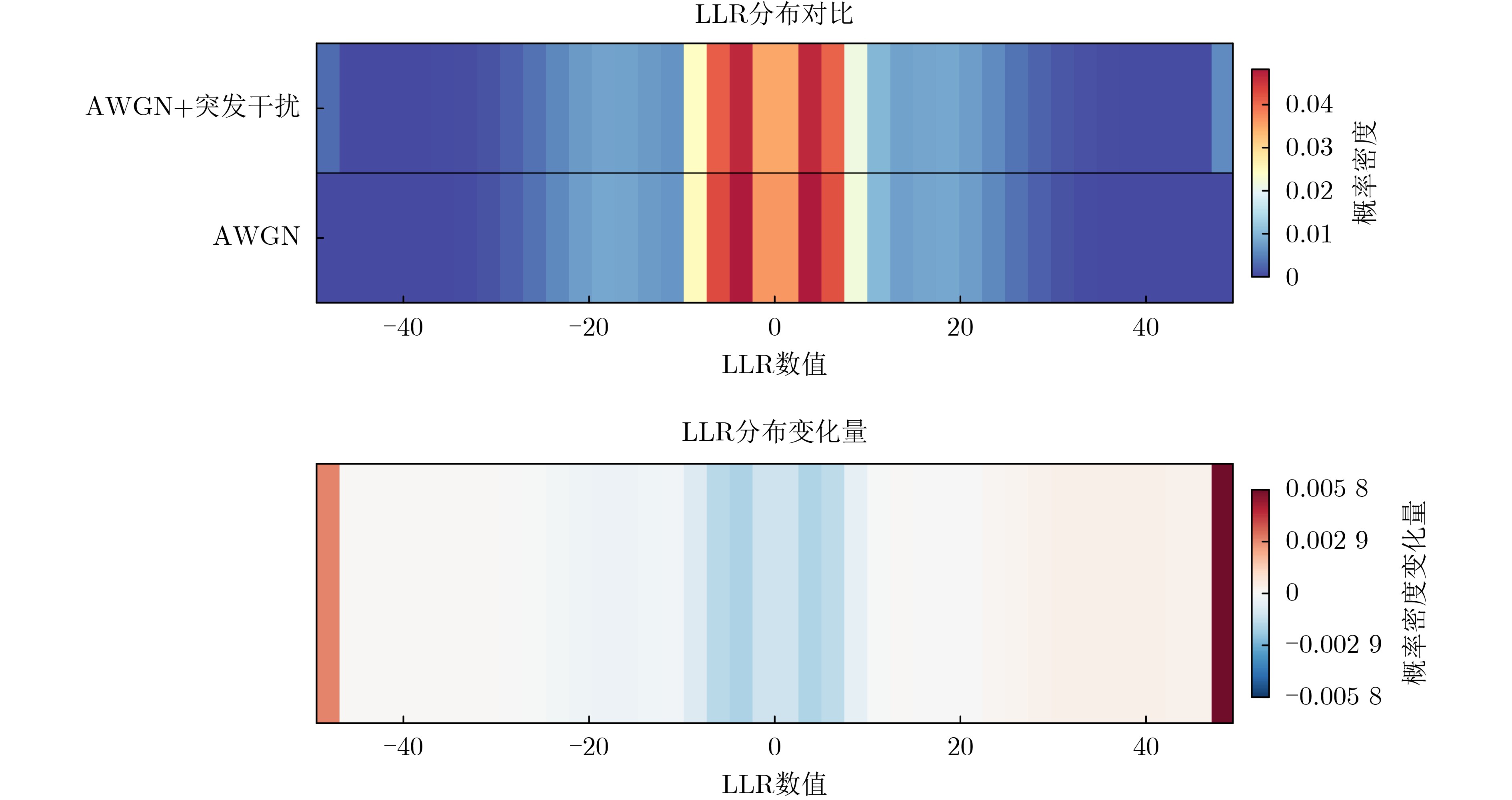
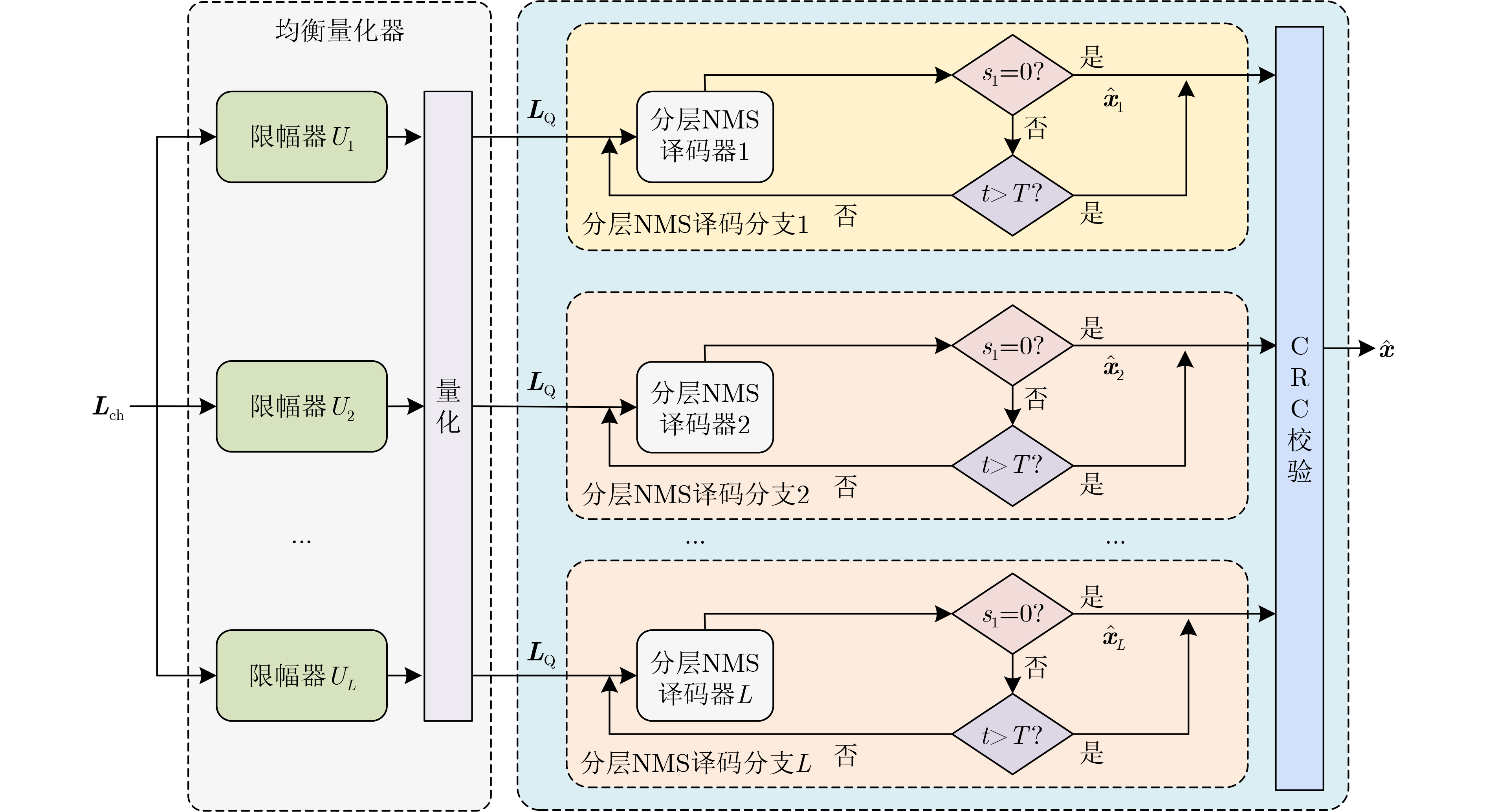
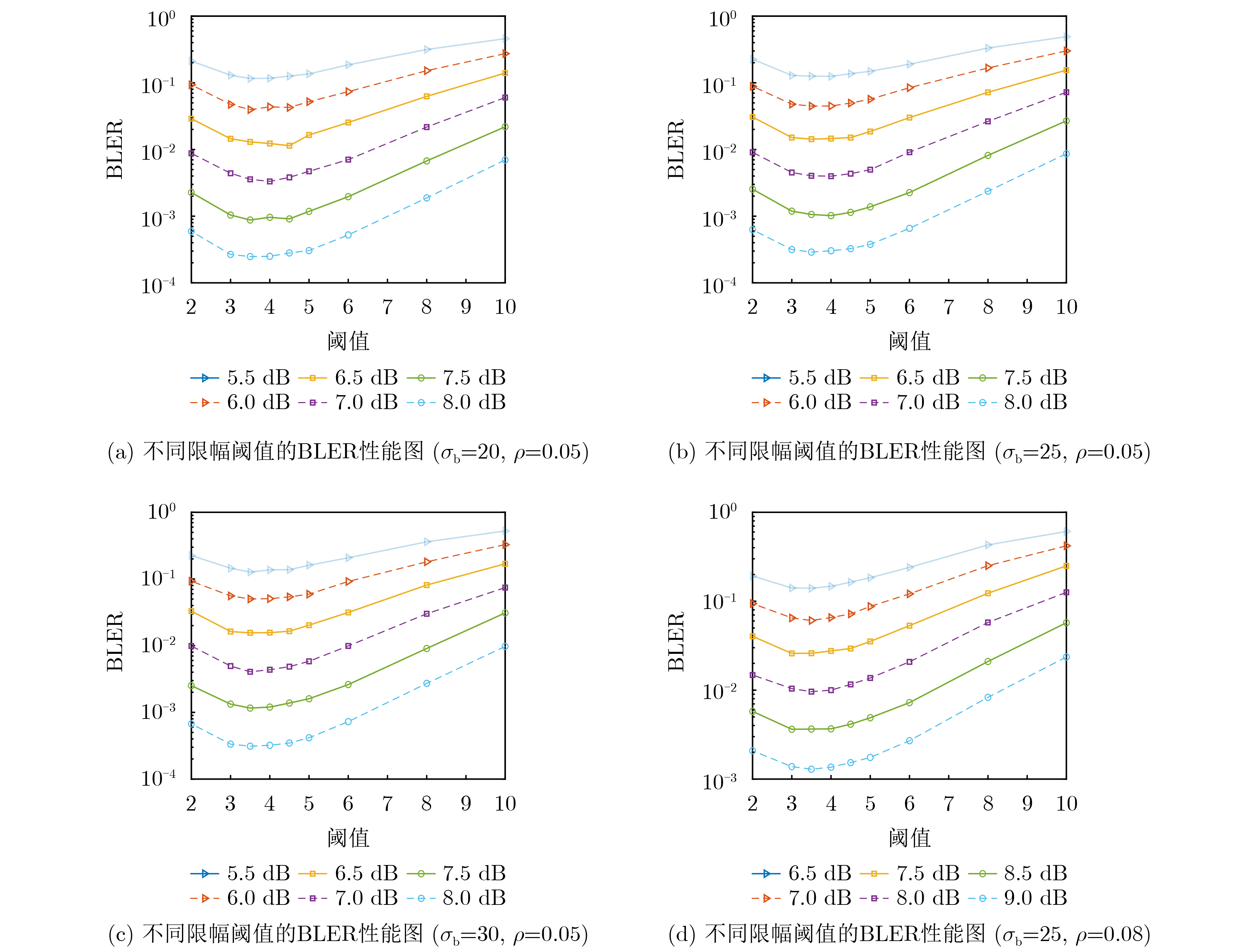
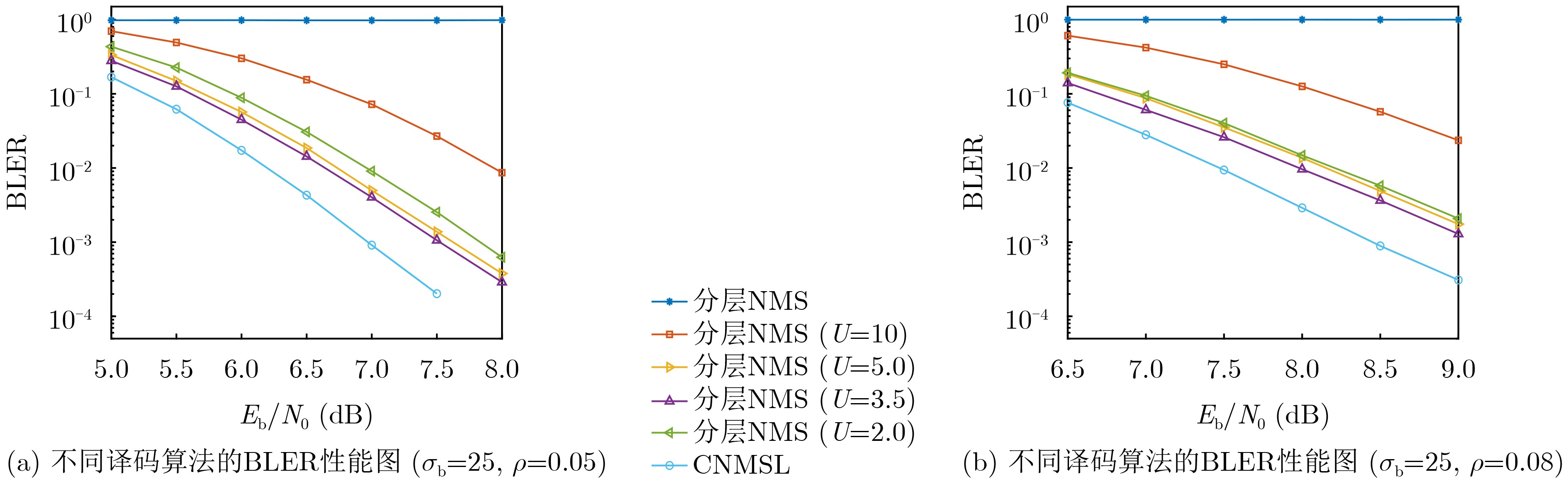
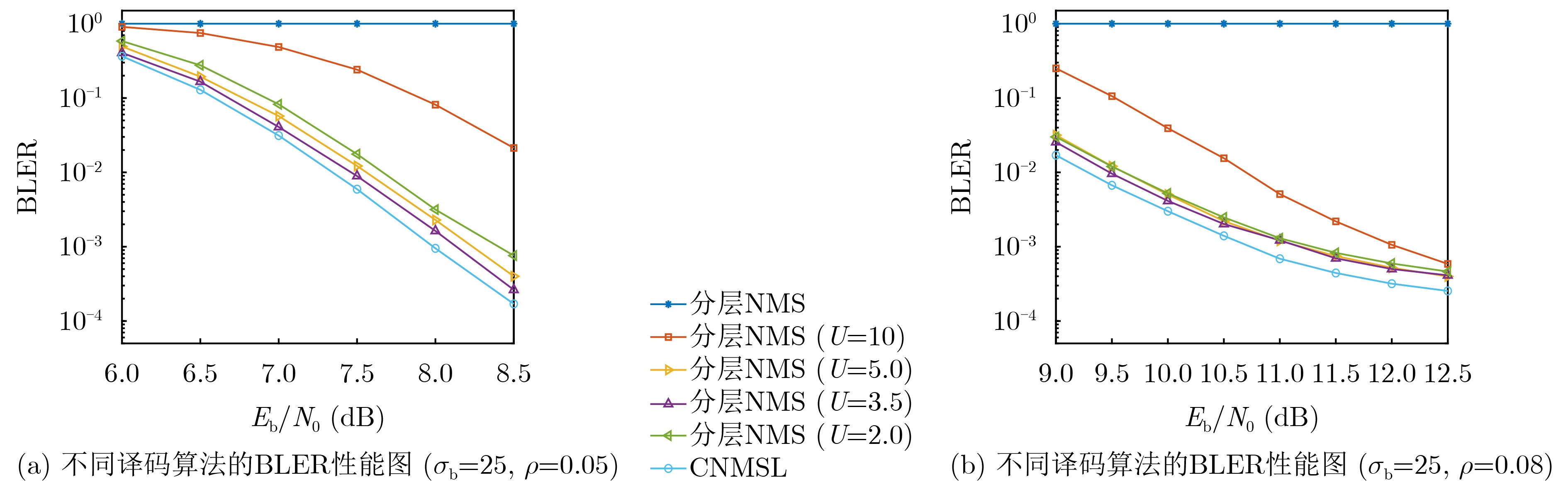
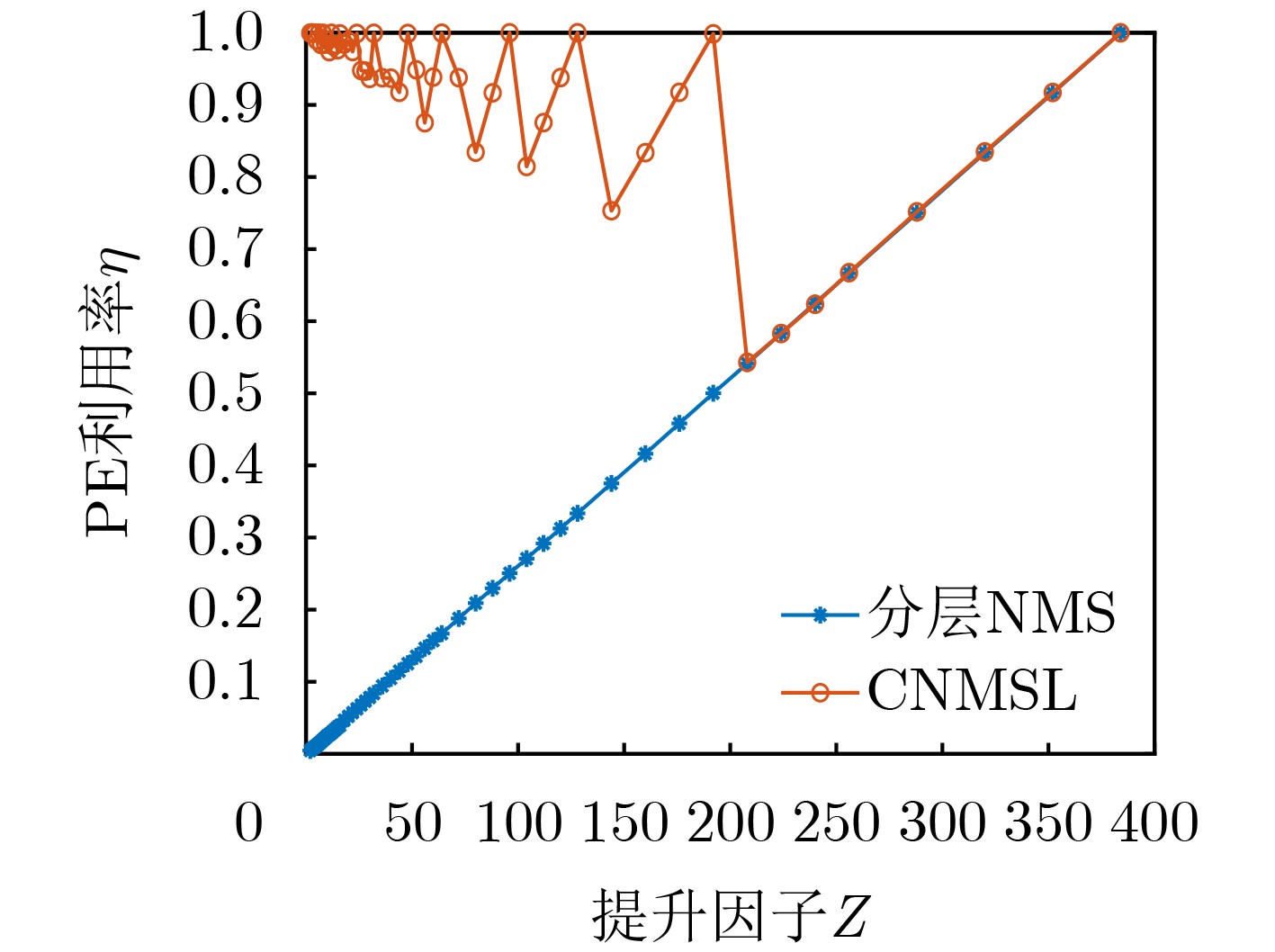
  •   Objective  As one of the coding schemes in the fifth-generation (5G) wireless communication systems, Low-Density Parity-Check (LDPC) codes can achieve performance close to the Shannon limit through iterative decoding. However, in practical wireless transmission environments, the decoding performance of LDPC codes is susceptible to burst interference in wireless channels. The NMS decoding algorithm is highly sensitive to the distribution characteristics of input log-likelihood ratios (LLRs). Burst interference will cause LLRs to deviate from the Gaussian distribution, resulting in degradation in decoding performance. Meanwhile, 5G LDPC decoders are often equipped with a fixed number of processing units (PEs) according to the maximum lifting size to cover the full code length range. In URLLC (Ultra-Reliable Low-Latency Communications) short code transmission scenarios, the lifting size is much smaller than the maximum lifting size, leading to long-term idleness of a large number of processing units and insufficient utilization of hardware resources. To address the above issues, this paper proposes a Clipped Normalized Min-Sum List (CNMSL) decoding algorithm. By co-designing burst interference smoothing and idle resource reuse, it improves hardware resource utilization while enhancing decoding performance.  Methods  The statistical characteristics of LLRs over AWGN and interference channels are first analyzed, and the negative impact of burst interference on decoding performance is qualitatively illustrated to stem from the increased proportion of saturated LLRs induced by such interference. Next, the correlation between the optimal clipping threshold and channel noise variance, burst interference variance as well as burst probability is verified, which converges to a finite interval, the optimal threshold interval, when channel parameters undergo limited variations. On this basis, the CNMSL decoding algorithm is proposed. This algorithm constructs a list decoding architecture by reusing idle processing units in 5G LDPC decoders, where each decoding path performs independent and synchronous decoding to generate candidate codewords, and the optimal decoding result is screened out via CRC check. Meanwhile, an independent clipper is configured for each path with parameters set according to the optimal threshold interval, thereby effectively suppressing and mitigating the adverse effects of burst interference.  Results and Discussions  Experimental results show that the layered NMS algorithm almost fails to decode over interference channels without clipping mechanism. With a single clipping threshold, the algorithm works normally, and its BLER exhibits a convex-down trend of first decreasing and then increasing as the clipping threshold reduces. Under various channel conditions for both short and long codes, the single-clipping layered NMS algorithm with a clipping threshold of 3.5 achieves a gain of about 1 dB at $ BLER={10}^{-2} $ compared with that of 10, and the CNMSL algorithm further yields an additional gain of about 0.5 dB relative to the single-clipping NMS algorithm. In terms of hardware efficiency, when the lifting factor is less than 192, the PE utilization of the CNMSL algorithm is significantly higher than that of the layered NMS algorithm, with more remarkable improvement as the lifting factor decreases, and the average PE utilization of the CNMSL algorithm is increased by 69% compared with the layered NMS algorithm.  Conclusions  The CNMSL decoding algorithm is proposed in this paper, aiming to improve the error correction performance of the traditional layered NMS decoding algorithm over interference channels. By reusing idle PEs for list decoding to generate multiple candidate paths, the algorithm incurs no additional hardware overhead. In addition, an optimal threshold interval is defined to configure the clipper for each decoding path, which limits the proportion of saturated LLRs and makes the input LLRs follow a Gaussian or near-Gaussian distribution. Experimental results show that compared with the layered NMS decoding algorithm with a single clipper, the proposed CNMSL algorithm achieves a gain of approximately 0.5 dB for both short and long codes. Meanwhile, it increases the PE utilization by an average of 69%.
  • loading
  • [1]
    GALLAGER R. Low-density parity-check codes[J]. IRE Transactions on Information Theory, 1962, 8(1): 21–28. doi: 10.1109/TIT.1962.1057683.
    [2]
    周华, 李子杰. 空间耦合低密度奇偶校验码残差滑窗译码算法[J]. 电子与信息学报, 2024, 46(3): 867–874. doi: 10.11999/JEIT230288.

    ZHOU Hua and LI Zijie. Residual sliding window decoding algorithm for spatially-coupled low-density parity-check codes[J]. Journal of Electronics & Information Technology, 2024, 46(3): 867–874. doi: 10.11999/JEIT230288.
    [3]
    ETSI. 5G NR: 3GPP TS 38.212 Multiplexing and channel coding[S]. ETSI, 2018. (查阅网上资料, 未找到本条文献出版地信息, 请确认).
    [4]
    LU Teng, HE Xuan, KANG Peng, et al. Parity-check matrix partitioning for efficient layered decoding of QC-LDPC codes[J]. IEEE Transactions on Communications, 2023, 71(6): 3207–3220. doi: 10.1109/TCOMM.2023.3261380.
    [5]
    张国华, 秦煜, 娄蒙娟, 等. 围长为8的较大列重准循环低密度奇偶校验码的行重普适代数构造[J]. 电子与信息学报, 2024, 46(7): 3019–3025. doi: 10.11999/JEIT231111.

    ZHANG Guohua, QIN Yu, LOU Mengjuan, et al. Row-weight universal algebraic constructions of Girth-8 quasi-cyclic low-density parity-check codes with large column weights[J]. Journal of Electronics & Information Technology, 2024, 46(7): 3019–3025. doi: 10.11999/JEIT231111.
    [6]
    FOSSORIER M P C, MIHALJEVIC M, and IMAI H. Reduced complexity iterative decoding of low-density parity check codes based on belief propagation[J]. IEEE Transactions on Communications, 1999, 47(5): 673–680. doi: 10.1109/26.768759.
    [7]
    KIM J S and SONG H Y. Reduced complexity decoding algorithm of LDPC codes using node elimination[C]. 2006 10th IEEE Singapore International Conference on Communication Systems, Singapore, Singapore, 2006: 1–3. doi: 10.1109/ICCS.2006.301432.
    [8]
    CHEN Jinghu and FOSSORIER M P C. Near optimum universal belief propagation based decoding of low-density parity check codes[J]. IEEE Transactions on Communications, 2002, 50(3): 406–414. doi: 10.1109/26.990903.
    [9]
    GOLDBERGER J and KFIR H. Serial schedules for belief-propagation: Analysis of convergence time[J]. IEEE Transactions on Information Theory, 2008, 54(3): 1316–1319. doi: 10.1109/TIT.2007.915702.
    [10]
    TIAN Kuangda and WANG Hao. A novel base graph based static scheduling scheme for layered decoding of 5G LDPC codes[J]. IEEE Communications Letters, 2022, 26(7): 1450–1453. doi: 10.1109/LCOMM.2022.3171658.
    [11]
    SHAH N and VASAVADA Y. Neural layered decoding of 5G LDPC codes[J]. IEEE Communications Letters, 2021, 25(11): 3590–3593. doi: 10.1109/LCOMM.2021.3113610.
    [12]
    周华, 周鸣, 张立康. 低密度奇偶校验码正则化神经网络归一化最小和译码算法[J]. 电子与信息学报, 2025, 47(5): 1486–1493. doi: 10.11999/JEIT240860.

    ZHOU Hua, ZHOU Ming, and ZHANG Likang. Regularized neural network-based normalized min-sum decoding for LDPC codes[J]. Journal of Electronics & Information Technology, 2025, 47(5): 1486–1493. doi: 10.11999/JEIT240860.
    [13]
    ZHAO Shancheng, MA Xiao, and BAI Baoming. Decoding algorithms for binary LDPC coded Gaussian interference channels[C]. 2013 IEEE/CIC International Conference on Communications in China (ICCC), Xi’an, China, 2013: 39–43. doi: 10.1109/ICCChina.2013.6671086.
    [14]
    TSENG D F and LIN Shishun. Robust low density parity check decoding over Markov Gaussian channels[C]. 2019 IEEE 89th Vehicular Technology Conference (VTC2019-Spring), Kuala Lumpur, Malaysia, 2019: 1–5. doi: 10.1109/VTCSpring.2019.8746326.
    [15]
    NAKAGAWA H, UMEHARA D, DENNO S, et al. A decoding for low density parity check codes over impulsive noise channels[C]. International Symposium on Power Line Communications and Its Applications, Vancouver, Canada, 2005: 85–89. doi: 10.1109/ISPLC.2005.1430471.
    [16]
    XU Zhijiang, MENG Limin, GANG Li, et al. A decoding algorithm for low-density parity-check codes in impulse noise environment[C]. 2008 Third International Conference on Communications and Networking in China, Hangzhou, China, 2008: 922–925. doi: 10.1109/CHINACOM.2008.4685174.
    [17]
    ZHANG Yifan, CAO Qiang, WANG Shaohua, et al. HF-LDPC: HLS-friendly QC-LDPC FPGA decoder with high throughput and flexibility[C]. 2023 IEEE 41st International Conference on Computer Design (ICCD), Washington, USA, 2023: 566–573. doi: 10.1109/ICCD58817.2023.00091.
    [18]
    ZHONG Xinyu, GONG Shuaicong, JIANG Ming, et al. Low-latency high-throughput decoder of QC-LDPC codes by matrix splitting[C]. 2024 16th International Conference on Wireless Communications and Signal Processing (WCSP), Hefei, China, 2024: 13–17. doi: 10.1109/WCSP62071.2024.10827659.
    [19]
    NADAL J and BAGHDADI A. Parallel and flexible 5G LDPC decoder architecture targeting FPGA[J]. IEEE Transactions on Very Large Scale Integration (VLSI) Systems, 2021, 29(6): 1141–1151. doi: 10.1109/TVLSI.2021.3072866.
    [20]
    KUDEKAR S, RICHARDSON T, and IYENGAR A R. Analysis of saturated belief propagation decoding of low-density parity-check codes[J]. IEEE Transactions on Information Theory, 2017, 63(9): 5734–5751. doi: 10.1109/TIT.2017.2723484.
  • 加载中

Catalog

    通讯作者: 陈斌, bchen63@163.com
    • 1. 

      沈阳化工大学材料科学与工程学院 沈阳 110142

    1. 本站搜索
    2. 百度学术搜索
    3. 万方数据库搜索
    4. CNKI搜索

    Figures(8)

    Article Metrics

    Article views (13) PDF downloads(1) Cited by()
    Proportional views
    Related

    /

    DownLoad:  Full-Size Img  PowerPoint
    Return
    Return