




An Overlapping Coalition Game-Driven Anti-Jamming Satellite Selection Method for LEO Integrated Communication and Navigation
-
摘要: 针对定向干扰条件下低轨通导一体化网络中星地链路质量下降、导航观测退化及多用户优质卫星竞争耦合的问题,该文研究面向关键用户的多用户多卫星抗干扰选星方法。首先,建立通导联合选星模型,刻画干扰对通信速率和定位精度的耦合影响。然后,将多用户多卫星抗干扰选星问题建模为可重叠联盟形成博弈,基于此,构造兼顾通导性能和联盟负载的势函数,采用局部势函数增益驱动的联盟切换准则,提出干扰感知选星重构算法。理论分析表明,所构造博弈为有限精确势博弈,联盟切换过程能够收敛至稳定可重叠联盟结构。仿真结果表明,相较典型选星方法,所提方法在干扰条件下能够有效规避受扰链路,提高用户平均归一化和速率并降低定位误差。Abstract:
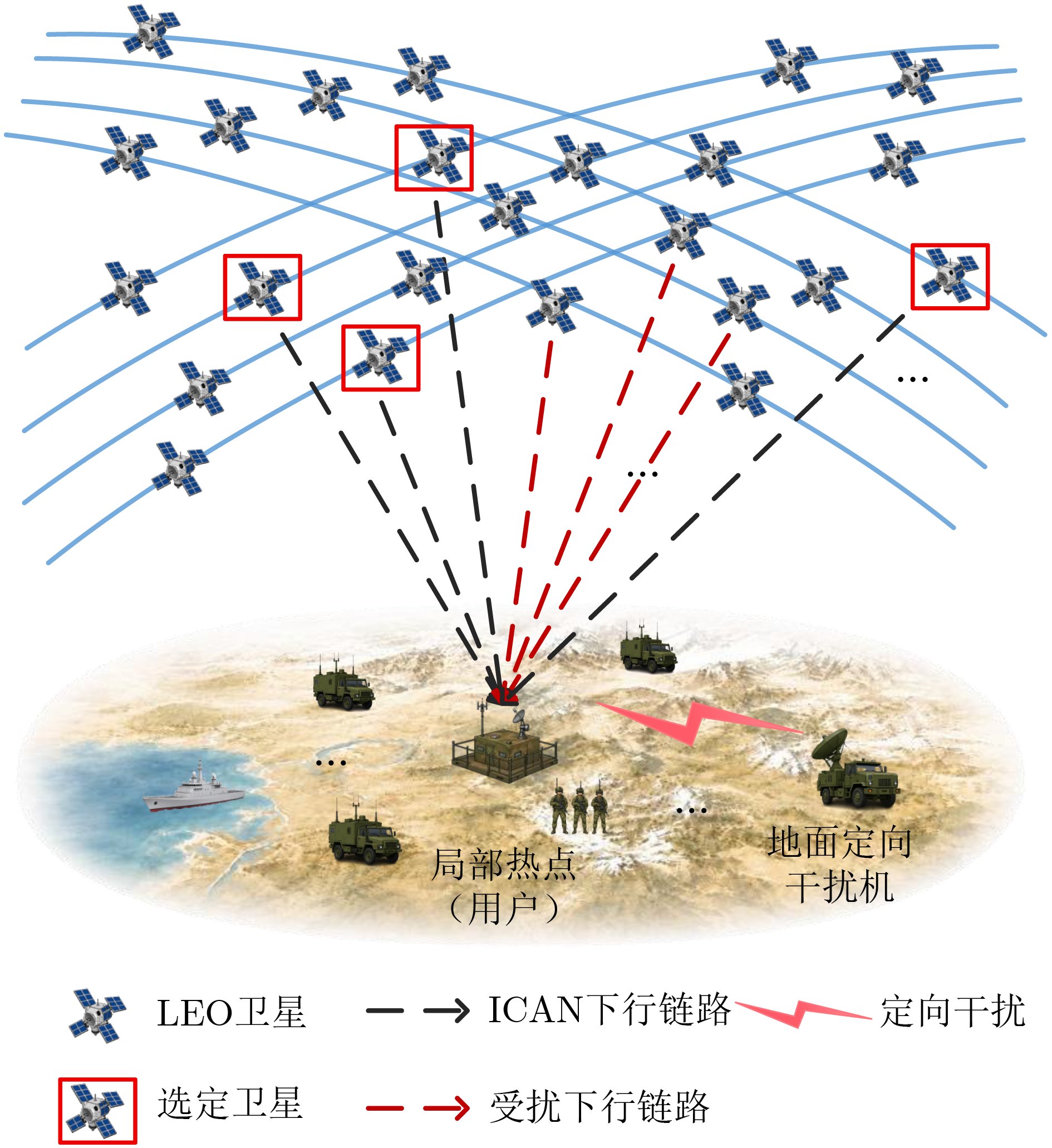
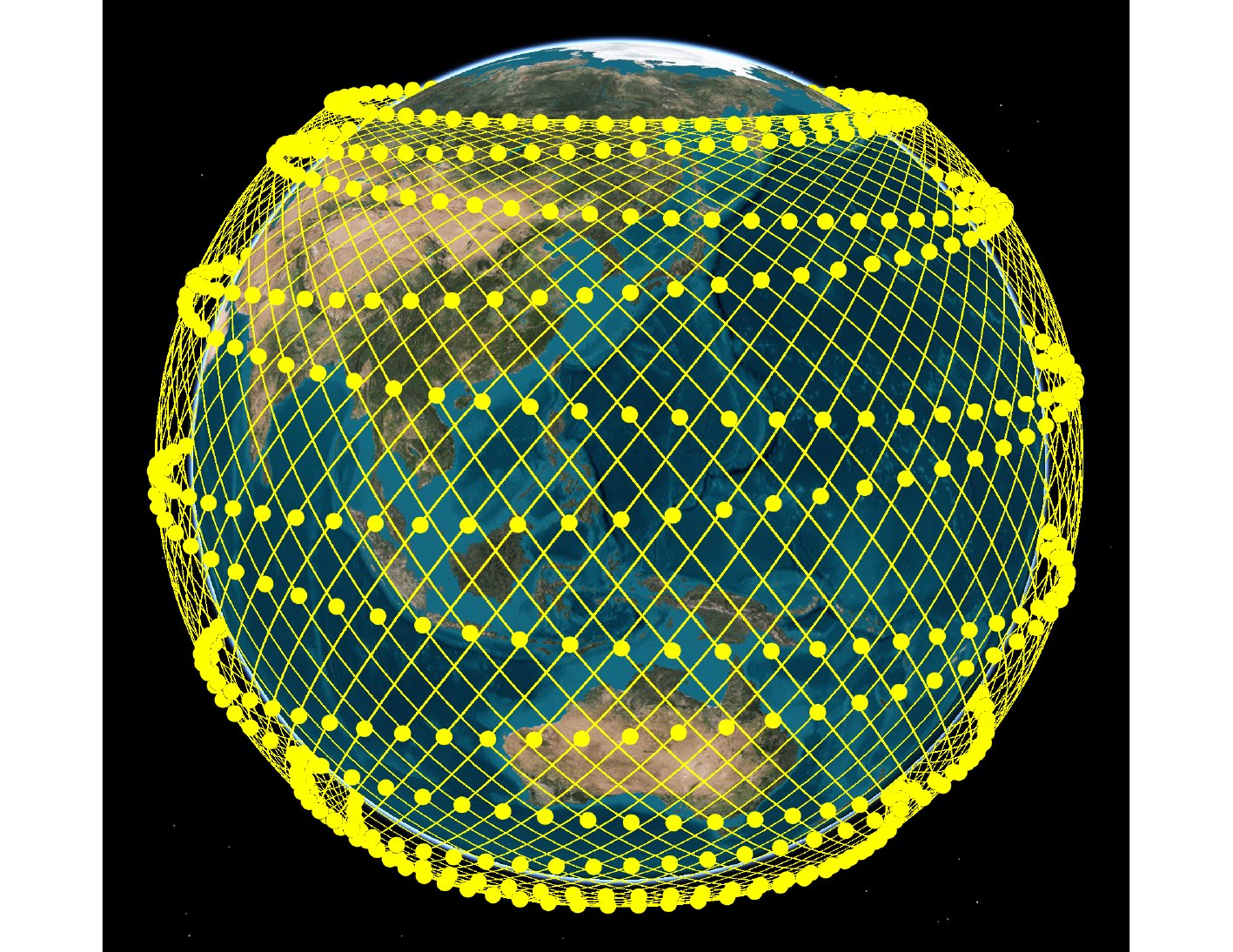
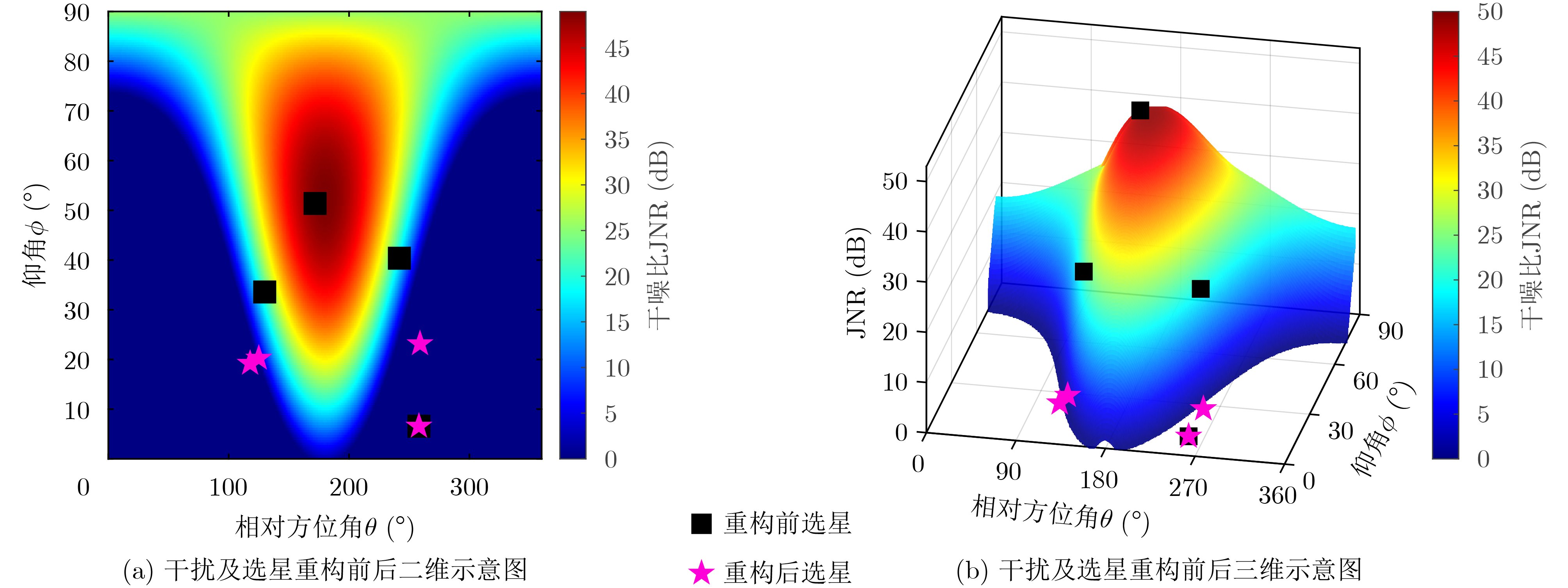
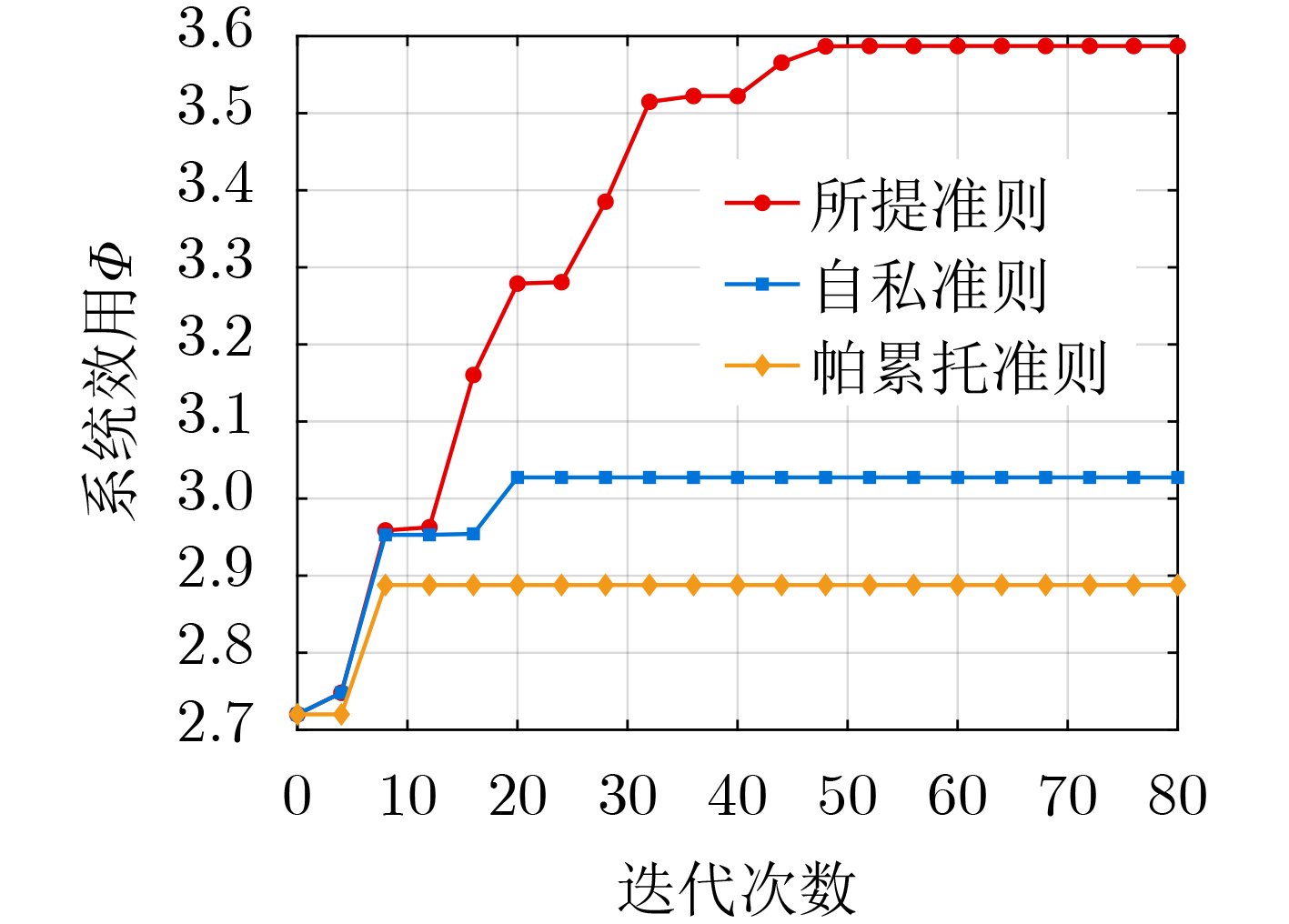
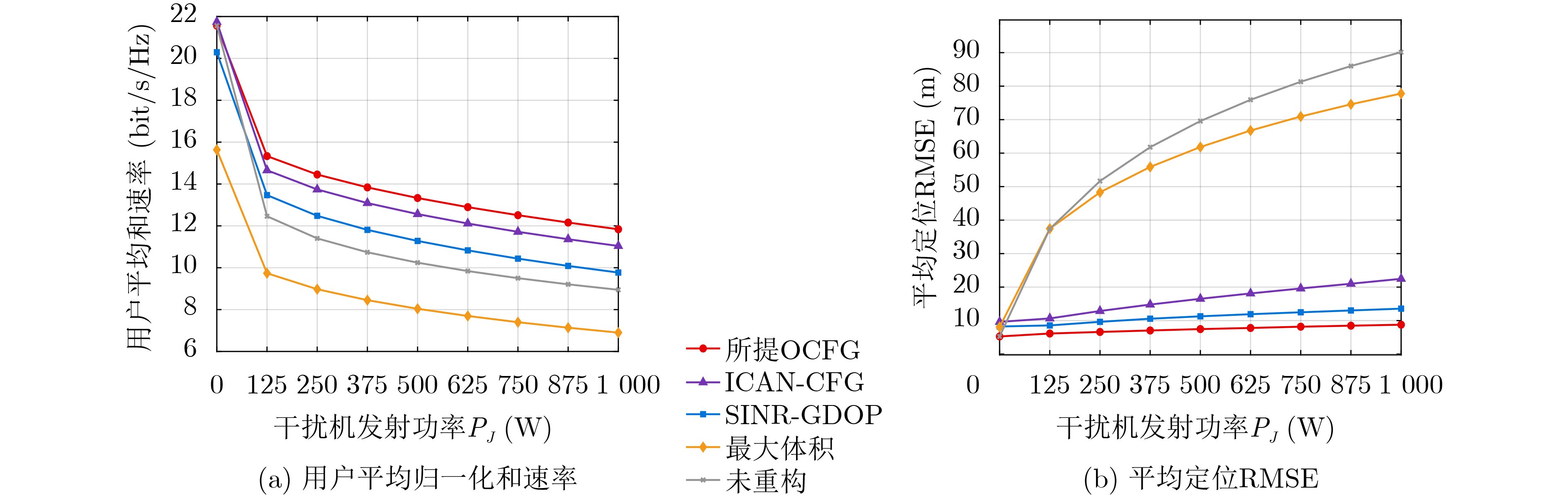
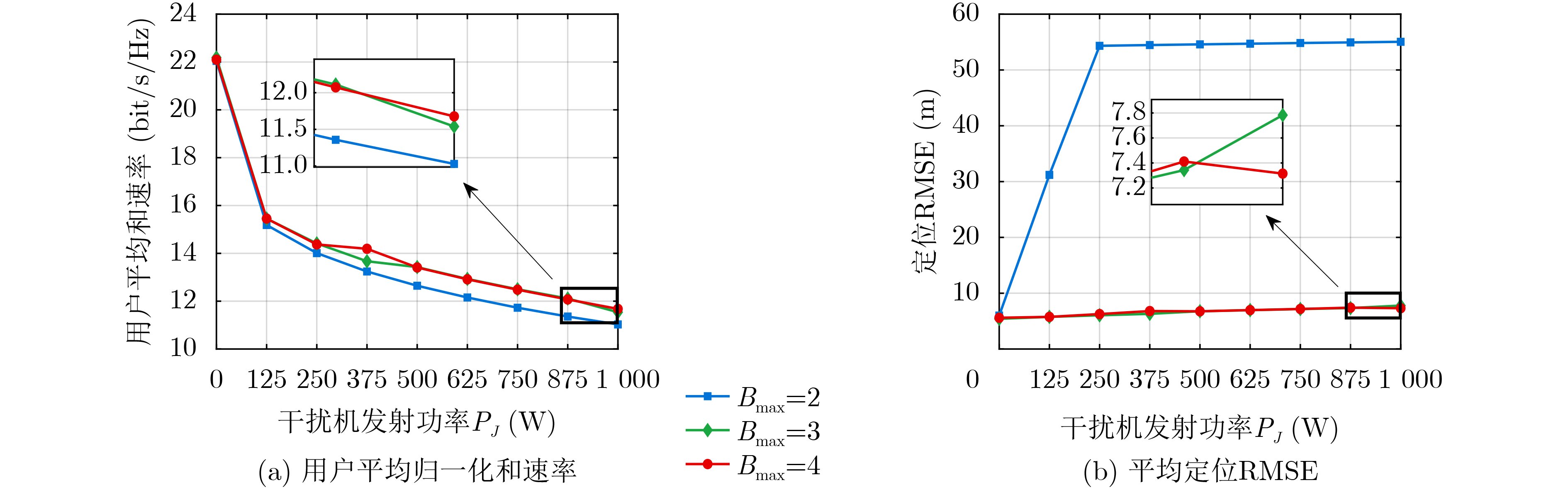
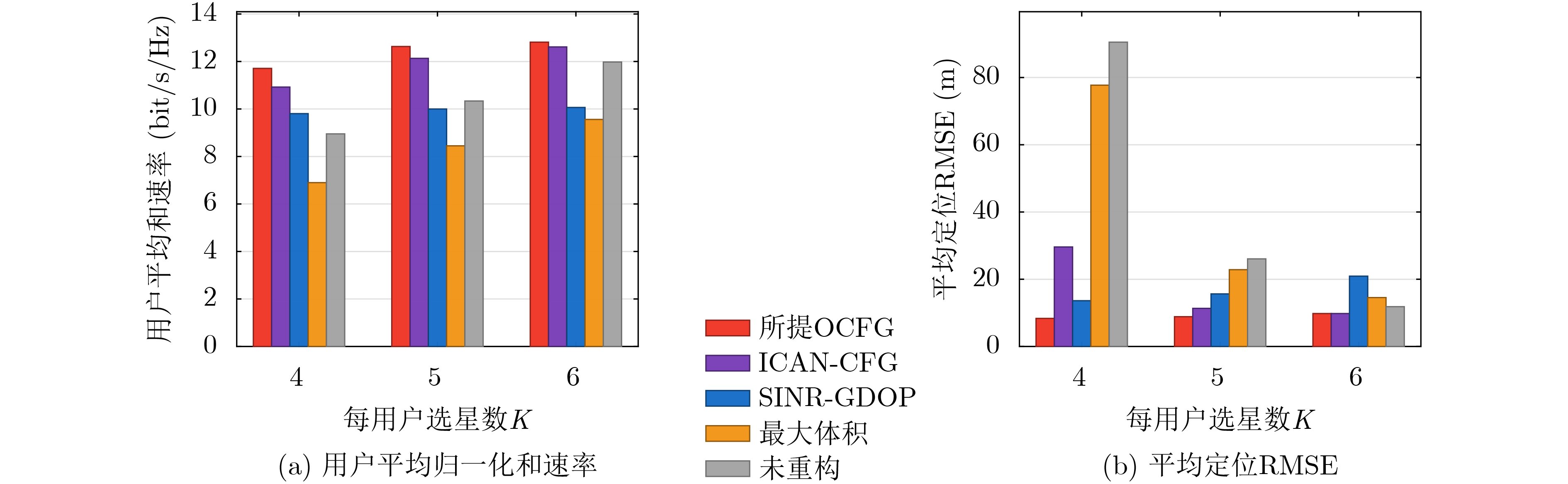
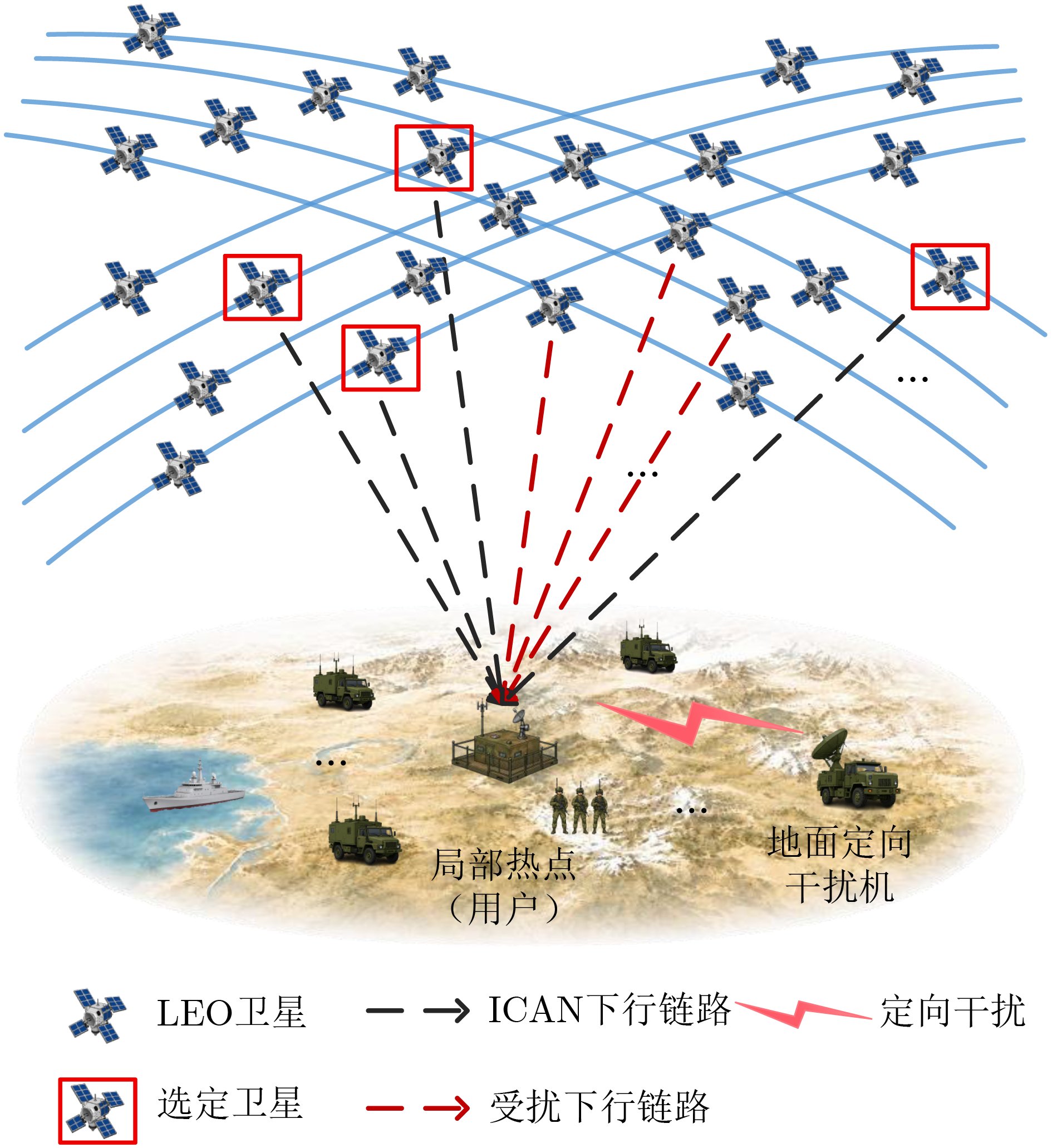
Objective Low Earth orbit (LEO) integrated communication and navigation (ICAN) networks can provide simultaneous communication and positioning services through shared satellite resources. In regions subject to directional jamming, however, interference affects satellite-ground links unevenly. A reduction in signal-to-interference-plus-noise ratio (SINR) lowers the achievable communication rate and increases pseudorange measurement uncertainty, thereby degrading positioning accuracy. This coupling is particularly consequential for mission-critical users, who require simultaneous access to multiple satellites for communication redundancy and navigation. Satellite selection is further complicated by competition for low-interference satellites with favorable observation geometry, as each satellite has limited capacity to serve multiple users. Existing approaches based on link quality, geometric dilution of precision (GDOP), or joint communication-navigation utility do not fully account for the combined effects of directional interference, observation degradation, and shared-resource constraints. Moreover, conventional nonoverlapping coalition models cannot adequately represent users participating in multiple satellite service relationships. To address these issues, this paper proposes an anti-jamming satellite selection method based on an overlapping coalition formation game (OCFG). The objective is to reconstruct satellite associations in response to interference while balancing communication performance and positioning accuracy and accounting for competition for satellite resources. Methods A snapshot-based LEO-ICAN model is developed for mission-critical ground users in a localized region exposed to directional jamming. Satellite geometry and interference conditions are treated as fixed within each scheduling interval, while binary association variables describe multisatellite access under per-satellite service-capacity limits. The interference model accounts for the directional coverage of the jammer and satellite-ground channel conditions to determine link SINR and jamming-to-noise ratio (JNR). Communication performance is measured by the sum of bandwidth-normalized rates over selected links. For navigation, SINR-dependent pseudorange error variances determine the observation weights used to evaluate weighted geometric dilution of precision (WGDOP) and positioning root-mean-square error (RMSE). The model thus captures the coupled effects of jamming on link throughput and navigation observation quality while retaining the influence of satellite geometry. A joint satellite selection problem is formulated to maximize normalized communication benefits while penalizing positioning error, jamming exposure, and satellite coalition load. Feasible associations must satisfy visibility, the prescribed number of satellites per user, satellite service capacity, minimum link SINR, and maximum positioning-error requirements. The selection problem is then modeled as an OCFG, in which each satellite and its served users form a coalition and users may belong to multiple coalitions. The joint objective serves as the system potential function, with user payoffs defined by their marginal contributions. A jamming-aware reconfiguration algorithm (Algorithm 1) employs feasible single-satellite replacements guided by local potential gains. Each candidate switch is evaluated based on changes in the utilities of affected users and the loads of the outgoing and incoming satellite coalitions. Only switches with strictly positive potential gains are accepted, and the candidate with the largest gain is preferred. At each scheduling interval, the algorithm updates link and positioning metrics and repairs infeasible associations inherited from the preceding interval. Initial selection involves all users, whereas post-jamming reconstruction focuses on users meeting the SINR, JNR, or positioning-error trigger conditions. Iteration terminates when no improving switch remains or the prescribed iteration limit is reached. The marginal-contribution payoff definition yields an exact potential game because each unilateral payoff change equals the corresponding change in system potential. As the feasible strategy space is finite and each accepted switch strictly increases this potential, the switching process converges in finitely many steps to an exchange-stable coalition structure if continued until no improving move remains. During event-triggered reconstruction, stability applies only to the affected-user search set. Local replacement evaluation also avoids exhaustive enumeration of complete satellite subsets. Simulations are performed using Satellite Tool Kit (STK) and MATLAB with a 792-satellite Walker constellation and eight ground users. Jammer power ranges from 0 to 1000 W, with four to six selected satellites per user and service capacities of two to four users per satellite. The comparison methods comprise an integrated communication-navigation coalition formation game (ICAN-CFG) baseline, a joint SINR-GDOP heuristic, a maximum tetrahedral-volume method, and a non-reconfiguration strategy. Apart from representative snapshots and convergence plots, results are averaged over5000 independent Monte Carlo trials.Results and Discussions The representative jammed snapshot shows that the proposed OCFG method replaces heavily interfered links with lower-interference links to visible satellites while maintaining favorable navigation geometry ( Fig. 3 ). The potential-gain switching criterion achieves a higher system utility at convergence than self-interested and Pareto-constrained switching rules (Fig. 4 ), indicating the benefit of accounting for shared-resource competition while retaining sufficient switching flexibility. As jammer transmit power increases, the user-average bandwidth-normalized sum rate decreases and positioning RMSE increases for all evaluated methods. Nevertheless, the proposed method consistently achieves the highest communication rate and lowest positioning RMSE, with its communication advantage becoming more pronounced under strong interference (Fig. 5 ). These improvements reflect its joint consideration of communication link quality, interference-dependent navigation observations, and satellite sharing constraints. Satellite service capacity also influences reconstruction performance. Increasing the maximum number of users served per satellite from two to three improves both communication and positioning performance, whereas further increasing it to four yields diminishing benefits (Fig. 6 ). Increasing the number of selected satellites generally improves communication performance, but does not necessarily produce a corresponding improvement in positioning accuracy because the latter also depends on observation geometry, link quality, and resource competition (Fig. 7 ). These results demonstrate the importance of coordinating interference avoidance and satellite resource sharing in joint communication-navigation selection.Conclusions This paper develops an OCFG-based anti-jamming satellite selection method for multiuser LEO-ICAN networks under directional jamming. By incorporating interference-dependent communication and navigation performance together with satellite-load penalties, the proposed method enables association reconstruction through local potential-gain switching. The finite exact potential-game formulation establishes the convergence of strictly improving switching sequences to an exchange-stable coalition structure. Simulation results demonstrate improved communication rates and positioning accuracy compared with the evaluated baselines. Future work will investigate robust satellite reconstruction under time-varying interference, user mobility, and delayed state information. -
1 基于OCFG的干扰感知抗干扰选星算法
输入:星座星历、用户位置、干扰状态、$ K $、$ {B}_{\max } $、$ {\gamma }_{\min } $、$ {J}_{\text{th}} $、$ {E}_{\text{max}} $、效用参数、$ {I}_{\text{max}} $ 输出:稳定选星矩阵$ {\boldsymbol{A}}^{*}(t) $和可重叠联盟结构$ {\Omega }^{*}(t) $。 1. 循环:对$ t=1,2,\cdots ,T $执行 2. 更新$ {\mathcal{V}}_{u}(t) $、$ {\gamma }_{u,s}(t) $、$ {\text{JNR}}_{u,s}(t) $和$ {E}_{u}(t) $ 3. 若$ t=1 $,构造初始可行选星矩阵;否则继承$ {\boldsymbol{A}}^{*}(t-1) $并删除不可见或失效链路 4. 对不满足选星数目或卫星联盟最大重叠度约束的选星状态执行可行性修复 5. 根据式(21)得到受扰用户集合$ {\mathcal{U}}_{\text{jam}}(t) $,并确定当前搜索用户集合 6. 重复 7. 设置$ \text{flag}=0 $ 8. 循环:搜索集合中的用户$ u $按受扰程度降序执行 9. 构造$ {\mathcal{X}}_{u}(t) $,计算各候选换星的$ {\Delta }_{u}({s}^{-},{s}^{+}) $; 10. 若存在$ {\Delta }_{u}({s}^{-},{s}^{+}) \gt 0 $,执行最大增益换星并更新$ \boldsymbol{A}(t) $、$ \Omega (t) $,令$ \text{flag}=1 $ 11. 结束循环 12. 直到$ \text{flag}=0 $或迭代次数达到$ {I}_{\text{max}} $ 13. 若仍存在不可行用户,执行全局修复;输出$ {\boldsymbol{A}}^{*}(t)=\boldsymbol{A}(t) $、$ {\Omega }^{*}(t)=\Omega (t) $ 14. 结束循环  下载: 导出CSV
表 1 主要仿真参数表
参数 值 参数 值 低轨星座卫星数$ {N}_{\text{sat}} $ 792 选星数目$ K $ 4, 5, 6 轨道面数$ P $ 72 用户数$ U $ 8 轨道高度$ H $ 550 km 星地链路中心频率$ {f}_{c} $ 2 GHz 轨道倾角$ \iota $ 53° 等效链路带宽$ W $ 10 MHz 最小可见仰角$ {\theta }_{\min } $ 10° 卫星发射功率$ {P}_{s} $ 40 W 卫星联盟最大重叠度$ {B}_{\max } $ 2, 3, 4 干扰机发射功率$ {P}_{J} $ 0– 1000 W标称链路SINR$ {\gamma }_{\text{nom}} $ 100 定位性能参考尺度$ {E}_{\text{ref}} $ 5 m 定位误差惩罚系数$ {\lambda }_{E} $ 1 干扰规避系数$ {\lambda }_{J} $ 0.5
下载: 导出CSV
-
[1] XIAO Yue, YE Ziqiang, WU Mingming, et al. Space-air-ground integrated wireless networks for 6G: Basics, key technologies, and future trends[J]. IEEE Journal on Selected Areas in Communications, 2024, 42(12): 3327–3354. doi: 10.1109/JSAC.2024.3492720. [2] 吴子君, 张海君, 马旭, 等. 6G通感算一体化体系架构与关键技术[J]. 电子与信息学报, 2025, 47(4): 876–887. doi: 10.11999/JEIT241151.WU Zijun, ZHANG Haijun, MA Xu, et al. System architecture and key technologies of 6G integrated sensing, communication, and computing[J]. Journal of Electronics & Information Technology, 2025, 47(4): 876–887. doi: 10.11999/JEIT241151. [3] 孙耀华, 彭木根, 赵亚飞, 等. 低轨卫星互联网: 从星地融合迈向通导遥一体化[J]. 北京邮电大学学报, 2024, 47(6): 69–98. doi: 10.13190/j.jbupt.2024-100.SUN Yaohua, PENG Mugen, ZHAO Yafei, et al. Low earth orbit satellite network: From satellite-terrestrial convergence to the integration of communication, navigation and sensing[J]. Journal of Beijing University of Posts and Telecommunications, 2024, 47(6): 69–98. doi: 10.13190/j.jbupt.2024-100. [4] WANG Mingyi, NARDIN A, MA Ruofei, et al. Integrated communication and navigation based on LEO satellite networks: A survey[J]. IEEE Internet of Things Journal, 2025, 12(22): 46244–46268. doi: 10.1109/JIOT.2025.3601137. [5] 郭重涛, 原哲, 盛敏. 低轨巨星座通导遥一体化关键技术研究与展望[J]. 宇航学报, 2025, 46(12): 2437–2449. doi: 10.3873/j.issn.1000-1328.2025.12.002.GUO Chongtao, YUAN Zhe, and SHENG Min. Research progress and prospects for key technologies of integrated communication, navigation, and remote sensing based on LEO mega-constellations[J]. Journal of Astronautics, 2025, 46(12): 2437–2449. doi: 10.3873/j.issn.1000-1328.2025.12.002. [6] LIU Binghong, PENG Mugen, LI Jiajing, et al. Integrated communication and navigation enabled low earth orbit satellite systems[J]. IEEE Network, 2025, 39(5): 254–262. doi: 10.1109/MNET.2025.3534198. [7] PROL F S, FERRE R M, SALEEM Z, et al. Position, navigation, and timing (PNT) through low earth orbit (LEO) satellites: A survey on current status, challenges, and opportunities[J]. IEEE Access, 2022, 10: 83971–84002. doi: 10.1109/ACCESS.2022.3194050. [8] LIU Jiyang, TANG Xiaomei, WANG Feixue, et al. Information-theoretic bounds on transmission rates for integrated communication and navigation systems[J]. IEEE Transactions on Vehicular Technology, 2026, 75(8): 18820–18825. doi: 10.1109/TVT.2026.3677262. [9] LI Jiajing, LIU Binghong, SUN Yaohua, et al. Beamforming design and satellite selection for realizing the integrated communication and navigation in LEO satellite networks[J]. IEEE Transactions on Wireless Communications, 2026, 25: 9500–9514. doi: 10.1109/TWC.2025.3646811. [10] KO K, KABIR M H, KIM J, et al. GDOP-based low-complexity LEO satellite subset selection for positioning[J]. IEEE Systems Journal, 2024, 18(2): 989–996. doi: 10.1109/JSYST.2024.3383092. [11] WANG Danyao, QIN Honglei, ZHANG Yu, et al. Fast clustering satellite selection based on Doppler positioning GDOP lower bound for LEO constellation[J]. IEEE Transactions on Aerospace and Electronic Systems, 2024, 60(6): 9401–9410. doi: 10.1109/TAES.2024.3443021. [12] 辛洁, 章林锋, 李晓杰, 等. 俄乌冲突下的导航信号受扰分析[J]. 导航定位学报, 2023, 11(2): 196–202. doi: 10.16547/j.cnki.10-1096.20230223.XIN Jie, ZHANG Linfeng, LI Xiaojie, et al. Analysis of navigation jamming in conflict between Russia and Ukraine[J]. Journal of Navigation and Positioning, 2023, 11(2): 196–202. doi: 10.16547/j.cnki.10-1096.20230223. [13] HAN Chen, LIU Aijun, HUO Liangyu, et al. Distributed resource management framework for IoS against malicious jamming[J]. IEEE Transactions on Communications, 2021, 69(12): 8271–8286. doi: 10.1109/TCOMM.2021.3109947. [14] LI Wei, CHEN Kexin, LIU Xiaolu, et al. A distributed multi-agent deep reinforcement learning-based anti-jamming approach for mega LEO constellations[J]. IEEE Transactions on Information Forensics and Security, 2026, 21: 3602–3614. doi: 10.1109/TIFS.2026.3675852. [15] ZHANG Senbei, LIU Aijun, HAN Chen, et al. Antijamming routing-based graph neural network for satellite constellation defense[J]. IEEE Transactions on Aerospace and Electronic Systems, 2026, 62: 8707–8713. doi: 10.1109/TAES.2026.3677860. [16] YANG S G, LEE J U, and WON J H. Performance analysis of integrated navigation algorithm based on GNSS-VTL and INS for jamming robustness under dynamic condition[J]. IEEE Access, 2026, 14: 7557–7564. doi: 10.1109/ACCESS.2026.3652004. [17] ZHOU Jianwei, WANG Wenjie, and ZHANG Chenhao. A GNSS anti-jamming method in multi-UAV cooperative system[J]. IEEE Transactions on Vehicular Technology, 2026, 75(1): 535–547. doi: 10.1109/TVT.2025.3590138. [18] ZHANG Yi, XIE Yajing, WANG Lijia, et al. Reconfigurable intelligent surface enhanced wireless localization: Phase optimization for malicious interference mitigation[J]. IEEE Transactions on Communications, 2025, 73(10): 8824–8839. doi: 10.1109/TCOMM.2025.3565572. [19] LIN Xin, LIU Aijun, HAN Chen, et al. Secure beamforming and anti-jamming coalition formation for air-terrestrial integrated ad-hoc networks[J]. IEEE Transactions on Wireless Communications, 2025, 24(8): 6722–6736. doi: 10.1109/TWC.2025.3555600. [20] 夏玮玮, 胡静, 宋铁成. 低地球轨道卫星边缘计算场景中任务卸载与资源分配联合优化算法[J]. 通信学报, 2024, 45(7): 48–60. doi: 10.11959/j.issn.1000-436x.2024135.XIA Weiwei, HU Jing, and SONG Tiecheng. Joint optimization algorithm for task offloading and resource allocation in low earth orbit satellites edge computing scenario[J]. Journal on Communications, 2024, 45(7): 48–60. doi: 10.11959/j.issn.1000-436x.2024135. [21] SHEN Xinxin, JI Zhi, ZHAO Kanglian, et al. QoE-centric resource management for NOMA-based LEO satellite–terrestrial integrated networks[J]. IEEE Transactions on Aerospace and Electronic Systems, 2025, 61(2): 2369–2382. doi: 10.1109/TAES.2024.3469911. [22] 高志祥, 刘爱军, 韩晨, 等. 状态更新卫星物联网中基于联盟形成博弈的用户组网方法[J]. 电子与信息学报, 2026, 48(1): 157–167. doi: 10.11999/JEIT250838.GAO Zhixiang, LIU Aijun, HAN Chen, et al. Coalition formation game based user and networking method for status update satellite internet of things[J]. Journal of Electronics & Information Technology, 2026, 48(1): 157–167. doi: 10.11999/JEIT250838. [23] GAO Zhixiang, LIU Aijun, XU Xin, et al. Sum data minimization in LEO satellite-UAV integrated multi-tier computing networks: A game-theoretic multiple access approach[J]. IEEE Transactions on Communications, 2024, 72(3): 1701–1715. doi: 10.1109/TCOMM.2023.3332932. [24] XU Xin, ZHANG Senbei, and LIU Aijun. Topology dynamic of mega-constellation networks[J]. IEEE Internet of Things Journal, 2025, 12(13): 22975–22988. doi: 10.1109/JIOT.2025.3550920. [25] PACHLER N, CRAWLEY E F, and CAMERON B G. Avoiding self-interference in megaconstellations through cooperative satellite routing and frequency assignment[J]. IEEE Journal on Selected Areas in Communications, 2024, 42(11): 3188–3203. doi: 10.1109/JSAC.2024.3431571. [26] 苏昭阳, 刘留, 艾渤, 等. 面向低轨卫星的星地信道模型综述[J]. 电子与信息学报, 2024, 46(5): 1684–1702. doi: 10.11999/JEIT230941.SU Zhaoyang, LIU Liu, AI Bo, et al. Survey of satellite-ground channel models for low earth orbit satellites[J]. Journal of Electronics & Information Technology, 2024, 46(5): 1684–1702. doi: 10.11999/JEIT230941. [27] HAN Rui, LIU Meiqi, WANG Jiaxing, et al. Anti-jamming strategy for satellite internet of things: Beam switching and optimization[J]. IEEE Internet of Things Journal, 2023, 10(23): 20254–20263. doi: 10.1109/JIOT.2023.3283399. -

 下载:

图(7) / 表(2)
计量
- 文章访问数: 11
- HTML全文浏览量: 1
- PDF下载量: 0
- 被引次数: 0
