




A Cooperative Control Method for Multi-UAV Encirclement of a High-Speed Evader under Perception Constraints
-
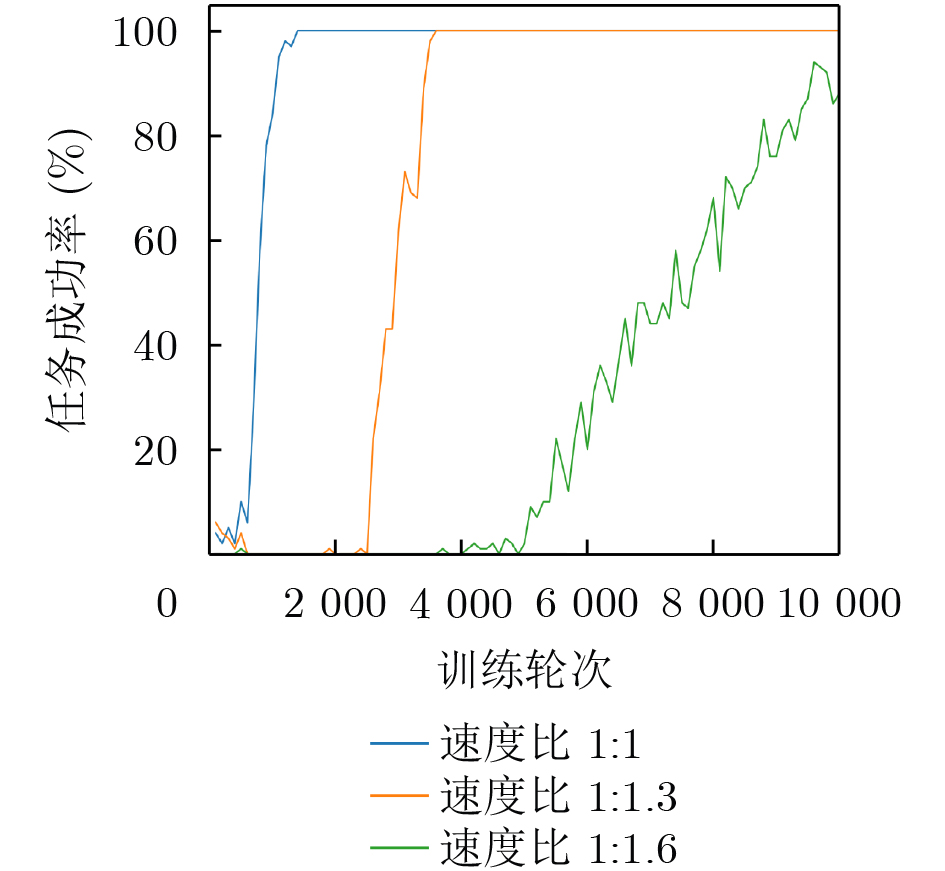
摘要: 随着低空具身智能的快速发展,低空空域安全问题日益凸显,多无人机协同围捕非法无人机成为一种重要的反制手段。针对局部环境感知受限条件下多架追捕无人机对高速逃逸者的协同围捕问题,提出一种协同围捕策略及渐进式对抗模仿学习训练框架。首先,构建带阻尼双积分器的无人机动力学模型,并据此建立马尔可夫决策模型。其次,为提升围捕性能,设计融合接近引导、包围构型、距离一致性、角度约束与安全约束的多尺度奖励函数,并采用多智能体软演员评论家算法开展协同围捕训练。针对复杂动力学模型导致的训练收敛困难问题,提出渐进式对抗模仿学习训练框架:一方面设计模仿奖励衰减机制,使专家引导作用随着训练进程指数衰减并自动退出;另一方面,针对逃逸无人机速度优势导致的策略训练难以收敛问题,通过动态调整逃逸无人机速度实现训练难度的逐步提升,使追捕策略由易到难逐步适应高机动目标。仿真结果表明,本文所提方法收敛速度提升约25%;在训练1万轮的情况下,追逃双方速度比1:1和1:1.3时,围捕成功率高达100%,速度比1:1.6时,围捕成功率可保持在85%以上。
-
关键词:
- 无人机通信网络 /
- 追逃博弈 /
- 多智能体深度强化学习 /
- 资源分配
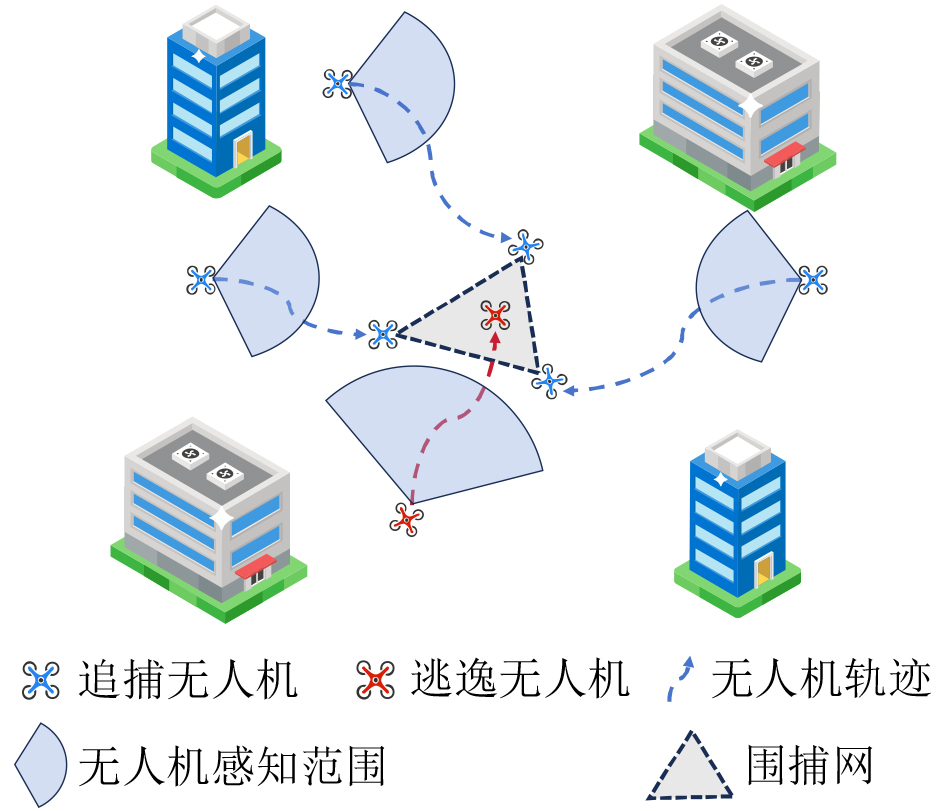
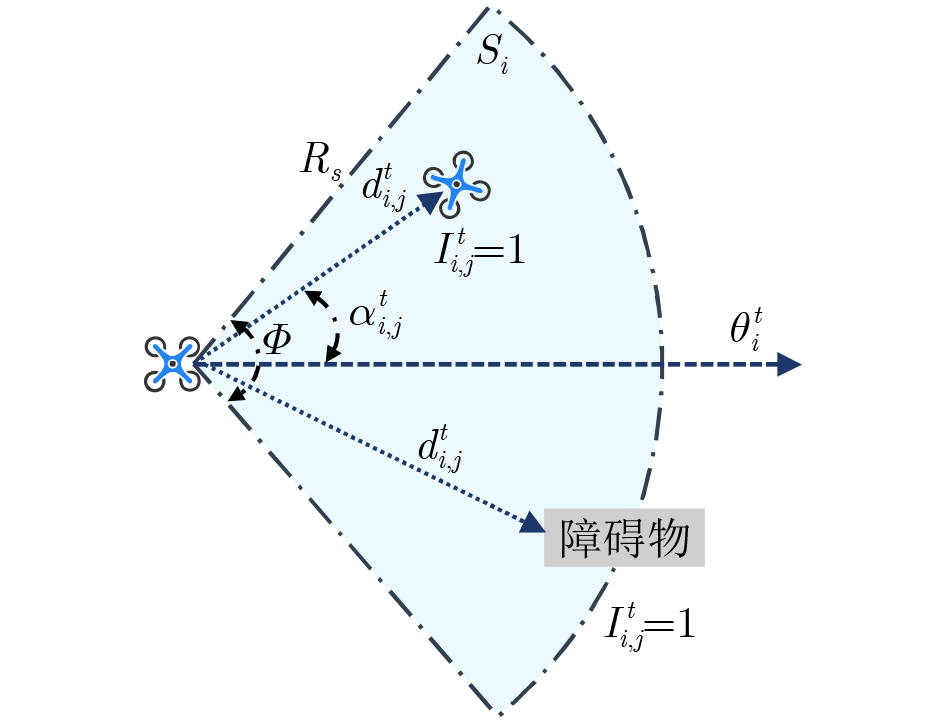
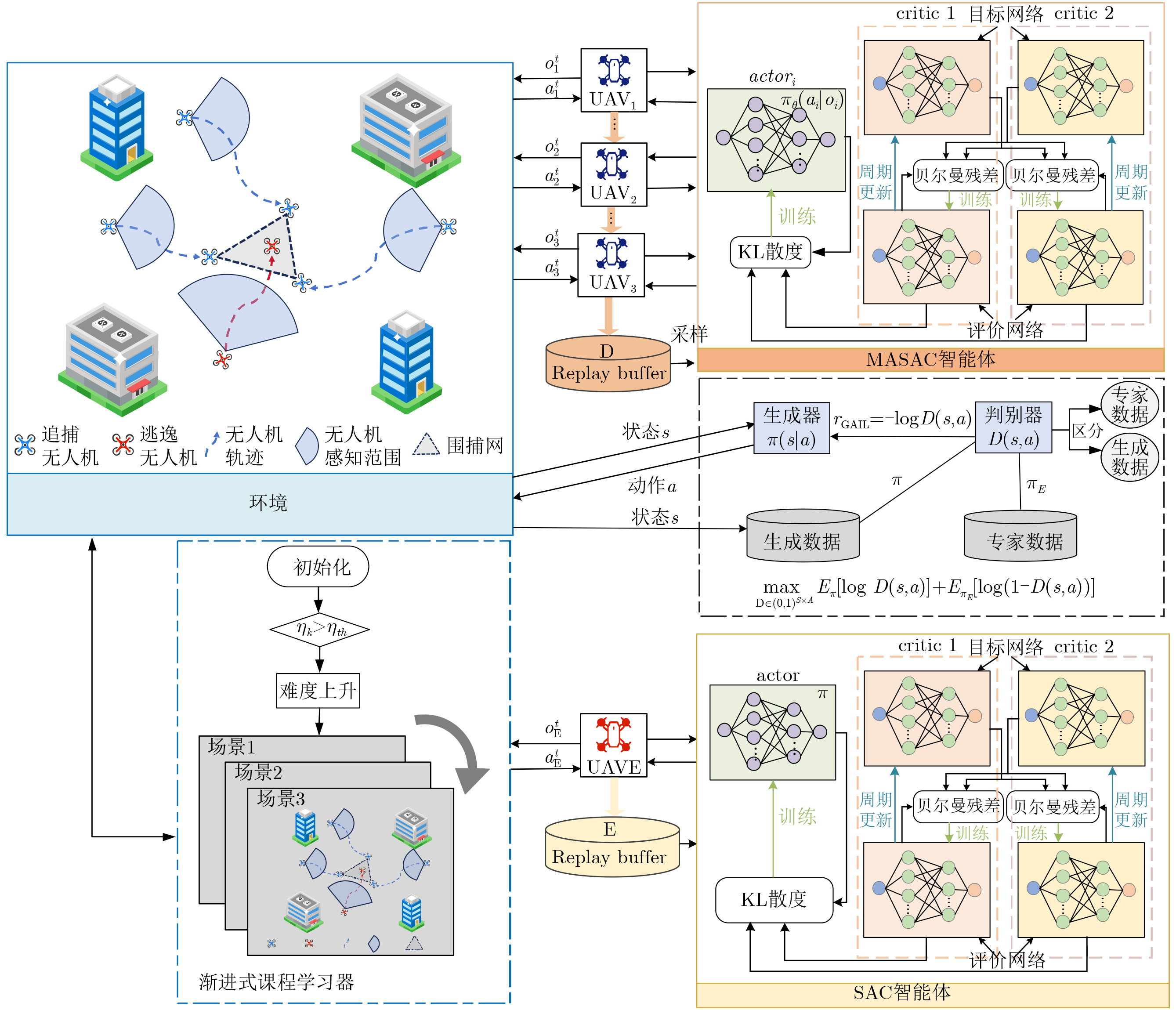
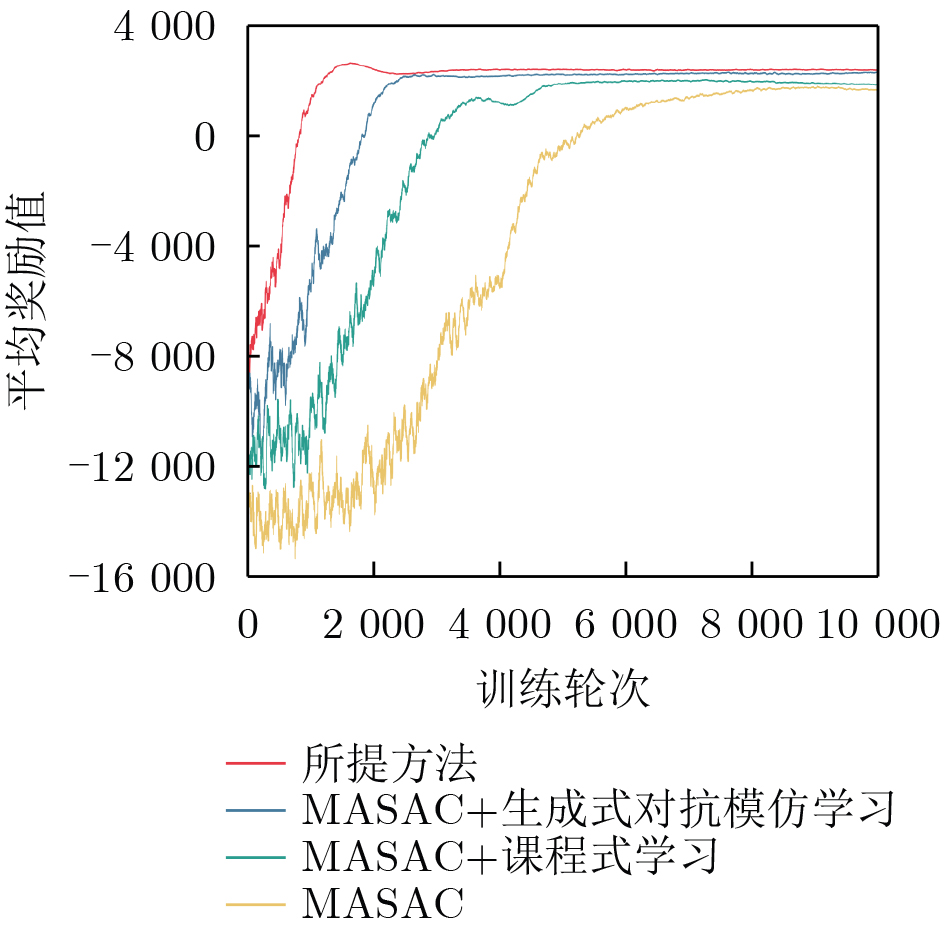
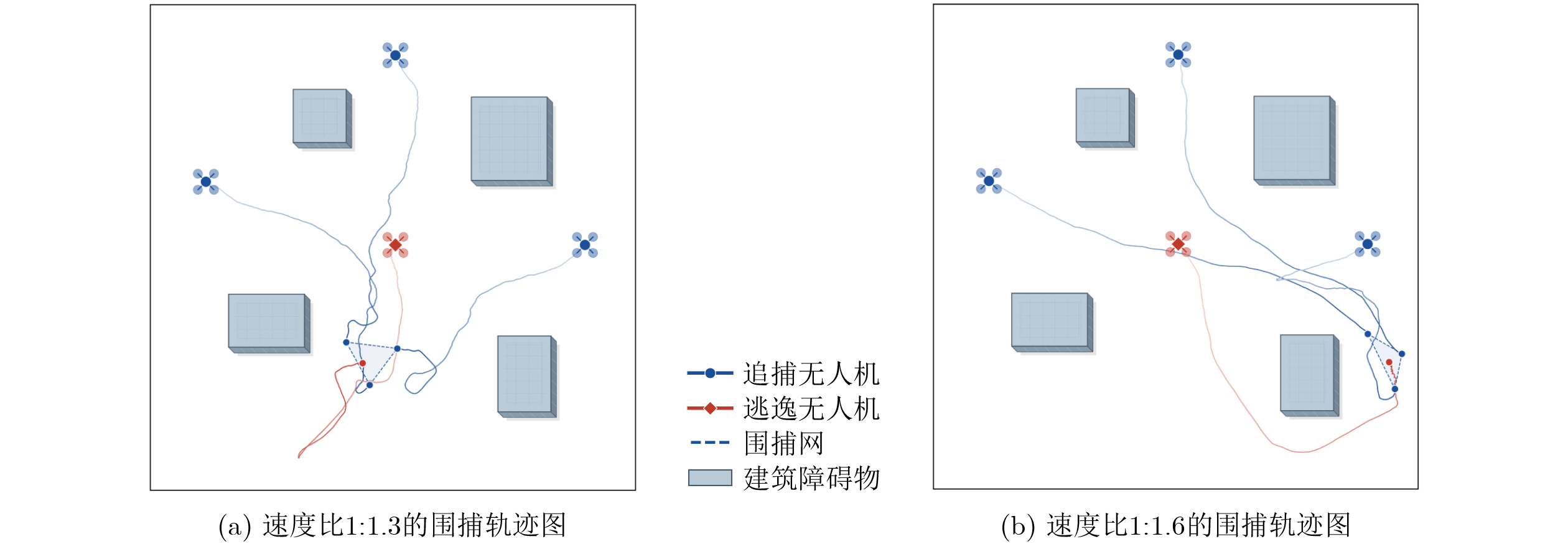
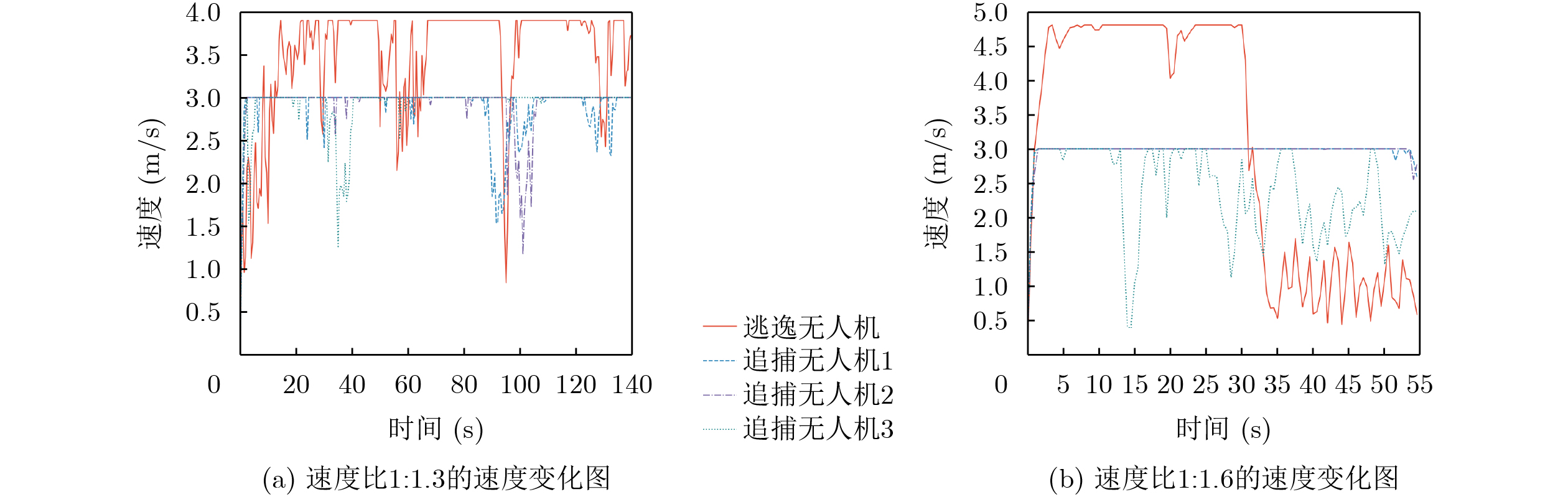
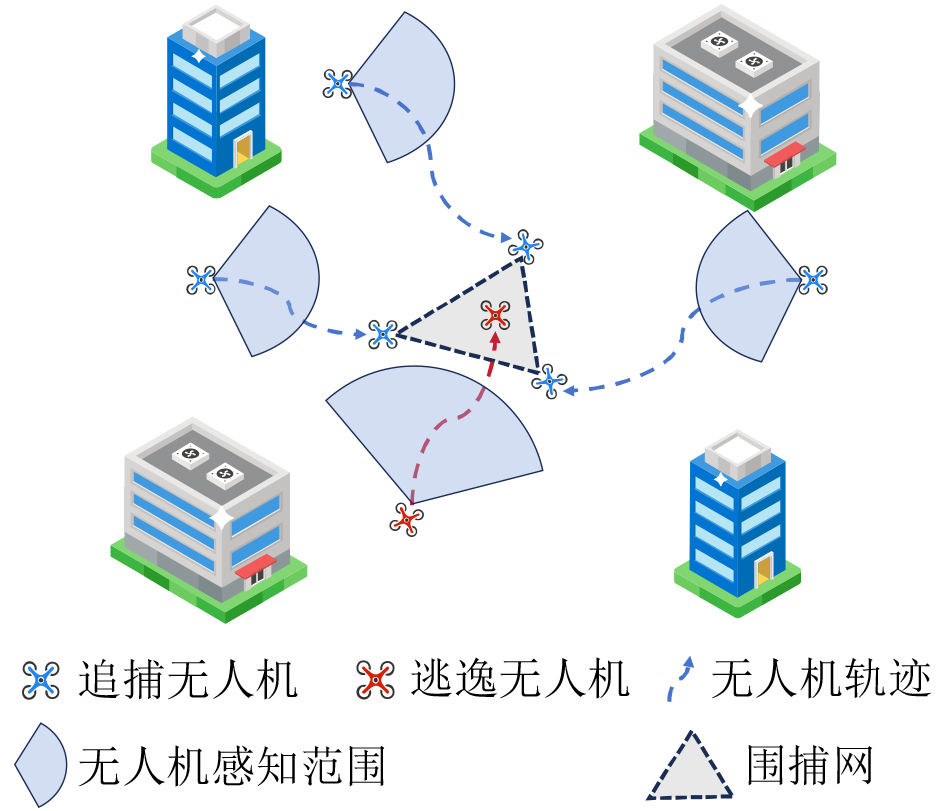
Abstract:Objective This paper investigates the cooperative pursuit-evasion problem of multiple unmanned aerial vehicles (UAVs) against a highly maneuverable evader in low-altitude urban environments. With the rapid growth of low-altitude UAV applications, unauthorized UAVs pose increasing threats to airspace security. Compared with conventional counter-UAV measures, cooperative pursuit by multiple UAVs offers a more flexible solution; however, when the evader outperforms each pursuer in maneuverability, capture can only be achieved through coordinated decision-making that restricts the evader's escape space. The objective is therefore to develop an efficient multi-UAV cooperative pursuit strategy achieving robust capture under dynamics constraints, obstacle interference, and speed disadvantage. Methods To address this problem, a cooperative pursuit-evasion scenario is constructed in a bounded urban area with static rectangular obstacles, where the motion of all UAVs is described by a damped double-integrator model that captures the inertia and velocity-attenuation characteristics of UAV dynamics. The pursuit problem is then formulated as a Markov decision process in which each UAV acts on local observations. The pursuers are trained with the Multi-Agent Soft Actor-Critic (MASAC) algorithm under the centralized training and decentralized execution framework, while the evader is trained simultaneously with Soft Actor-Critic (SAC), forming an adversarial learning process. To improve exploration efficiency, a progressive adversarial imitation learning framework is introduced: expert demonstrations are generated offline via Apollonius-circle analysis under speed disadvantage, Generative Adversarial Imitation Learning provides intrinsic imitation rewards in early training, and an exponential decay mechanism gradually shifts the pursuer policy from imitation-driven to autonomous reinforcement learning. Furthermore, a velocity-ratio-based curriculum progressively increases the evader's maximum speed, enhancing policy adaptability against highly maneuverable targets. Results and Discussions Simulation experiments are conducted on a Python-based multi-UAV pursuit-evasion platform, where the urban airspace contains static rectangular buildings, three pursuer UAVs (maximum speed 3 m/s), and one evader UAV (3.9 m/s). Results show that the proposed framework outperforms baseline reinforcement learning methods and converges to a stable reward level after approximately 2000 episodes. Ablation studies demonstrate that Apollonius-circle based expert demonstrations significantly accelerate early-stage learning, while velocity-ratio curriculum learning enhances final pursuit performance; their combination yields a synergistic improvement in both convergence speed and policy quality. Experiments under speed ratios of 1:1, 1:1.3, and 1:1.6 further verify robustness: the capture success rate approaches 100% without a speed disadvantage and remains high as the evader's speed advantage increases. Conclusions This paper proposes a progressive adversarial imitation learning framework for multi-UAV cooperative pursuit of a highly maneuverable evader. By integrating MASAC-based cooperative decision-making, adversarial evader training, Apollonius-circle expert demonstrations with GAIL imitation rewards, and velocity-ratio curriculum learning, the framework significantly improves learning efficiency and capture performance. Simulation results verify faster convergence, higher capture success rates, and stronger adaptability across different evader speeds, providing an effective learning-based solution for low-altitude cooperative interception of highly maneuverable targets. -
[1] 许越越, 杜华军, 郭尚伟. 低空无人机具身导航研究进展[J]. 航天控制, 2025, 43(4): 7–14. doi: 10.16804/j.cnki.issn1006-3242.2025.04.004.XU Yueyue, DU Huajun, and GUO Shangwei. Research progress on embodied navigation of low-altitude UAV[J]. Aerospace Control, 2025, 43(4): 7–14. doi: 10.16804/j.cnki.issn1006-3242.2025.04.004. [2] 王云涛, 苏洲, 高源, 等. 低空智联网架构、安全与优化关键技术[J]. 电子与信息学报, 2026, 48(3): 889–913. doi: 10.11999/JEIT250947.WANG Yuntao, SU Zhou, GAO Yuan, et al. Key technologies for low-altitude intelligent networks: Architecture, security, and optimization[J]. Journal of Electronics & Information Technology, 2026, 48(3): 889–913. doi: 10.11999/JEIT250947. [3] CHENG Nan, WU Shen, WANG Xiucheng, et al. AI for UAV-assisted IoT applications: A comprehensive review[J]. IEEE Internet of Things Journal, 2023, 10(16): 14438–14461. doi: 10.1109/JIOT.2023.3268316. [4] CHAUHAN D, KAGATHARA H, MEWADA H, et al. Nation’s defense: A comprehensive review of anti-drone systems and strategies[J]. IEEE Access, 2025, 13: 53476–53505. doi: 10.1109/ACCESS.2025.3550338. [5] CHEN Jinchao, WANG Yang, ZHANG Ying, et al. Extrinsic-and-intrinsic reward-based multi-agent reinforcement learning for multi-UAV cooperative target encirclement[J]. IEEE Transactions on Intelligent Transportation Systems, 2025, 26(10): 17653–17665. doi: 10.1109/TITS.2024.3524562. [6] CHEN Nuo, LI Linjing, and MAO Wenji. Equilibrium strategy of the pursuit-evasion game in three-dimensional space[J]. IEEE/CAA Journal of Automatica Sinica, 2024, 11(2): 446–458. doi: 10.1109/JAS.2023.123996. [7] FANG Xu, WANG Chen, XIE Lihua, et al. Cooperative pursuit with multi-pursuer and one faster free-moving evader[J]. IEEE Transactions on Cybernetics, 2022, 52(3): 1405–1414. doi: 10.1109/TCYB.2019.2958548. [8] ZHOU Meng, WANG Zihao, WANG Jing, et al. Multi-robot collaborative hunting in cluttered environments with obstacle-avoiding Voronoi cells[J]. IEEE/CAA Journal of Automatica Sinica, 2024, 11(7): 1643–1655. doi: 10.1109/JAS.2023.124041. [9] 唐伦, 李质萱, 蒲昊, 等. 基于多智能体深度强化学习的无人机动态预部署策略[J]. 电子与信息学报, 2023, 45(6): 2007–2015. doi: 10.11999/JEIT220513.TANG Lun, LI Zhixuan, PU Hao, et al. A dynamic pre-deployment strategy of UAVs based on multi-agent deep reinforcement learning[J]. Journal of Electronics & Information Technology, 2023, 45(6): 2007–2015. doi: 10.11999/JEIT220513. [10] 冯斯梦, 张云弈, 刘凯, 等. 低空混合障碍下无人机协同多智能体航迹规划[J]. 电子与信息学报, 2025, 47(5): 1291–1300. doi: 10.11999/JEIT250012.FENG Simeng, ZHANG Yunyi, LIU Kai, et al. Collaborative multi-agent trajectory optimization for unmanned aerial vehicles under low-altitude mixed-obstacle airspace[J]. Journal of Electronics & Information Technology, 2025, 47(5): 1291–1300. doi: 10.11999/JEIT250012. [11] ZHANG Yaozhong, DING Meiyan, ZHANG Jiandong, et al. Multi-UAV pursuit-evasion gaming based on PSO-M3DDPG schemes[J]. Complex & Intelligent Systems, 2024, 10(5): 6867–6883. doi: 10.1007/s40747-024-01504-1. [12] YANG Zhengzhi, CUI Yuanhao, DU Wenbo, et al. Cooperative pursuit-evasion with low altitude wireless network: A hierarchical reinforcement learning approach[J]. IEEE Transactions on Mobile Computing, 2026, 25(4): 5716–5729. doi: 10.1109/TMC.2025.3632863. [13] 薛健, 赵琳, 向贤财, 等. 非完全信息下无人机集群对抗研究综述[J]. 电子与信息学报, 2024, 46(4): 1157–1172. doi: 10.11999/JEIT230544.XUE Jian, ZHAO Lin, XIANG Xiancai, et al. A review of the research on UAV swarm confrontation under incomplete information[J]. Journal of Electronics & Information Technology, 2024, 46(4): 1157–1172. doi: 10.11999/JEIT230544. [14] XIANG Yuming, LI Sizhao, LI Rongpeng, et al. Decentralized consensus inference-based hierarchical reinforcement learning for multiconstrained UAV pursuit-evasion game[J]. IEEE Transactions on Neural Networks and Learning Systems, 2025, 36(10): 18229–18243. doi: 10.1109/TNNLS.2025.3582909. [15] CHEN Jiayu, YU Chao, LI Guosheng, et al. Online planning for multi-UAV pursuit-evasion in unknown environments using deep reinforcement learning[J]. IEEE Robotics and Automation Letters, 2025, 10(8): 8196–8203. doi: 10.1109/LRA.2025.3583620. -

 下载:


图(8)
计量
- 文章访问数: 28
- HTML全文浏览量: 2
- PDF下载量: 7
- 被引次数: 0
