




Intelligent Resource Allocation for Multi-UAV Communication Systems: Architectures, Models, and Challenges
-
摘要: 随着低空经济、应急通信等行业的快速发展,多无人机通信系统在广域覆盖、灾害救援等场景中具有重要应用价值。然而,该系统面临链路强耦合、拓扑高动态等挑战,使无线资源分配呈现高维、时变和协同等特征。传统模型驱动优化方法在复杂动态环境下难以满足实时、自适应决策需求。为此,本文围绕多无人机通信系统智能资源分配展开综述。首先,梳理可重构智能表面、通感一体化和移动边缘计算等技术赋能多无人机通信网络架构,并阐明传输过程;其次,研究多无人机系统智能资源分配典型模型的作用机制与适用特点;再次,分析不同通信网络架构下的无线资源智能分配研究现状;最后,给出未来挑战与发展方向。本文可为低空智联网资源分配提供参考。Abstract:
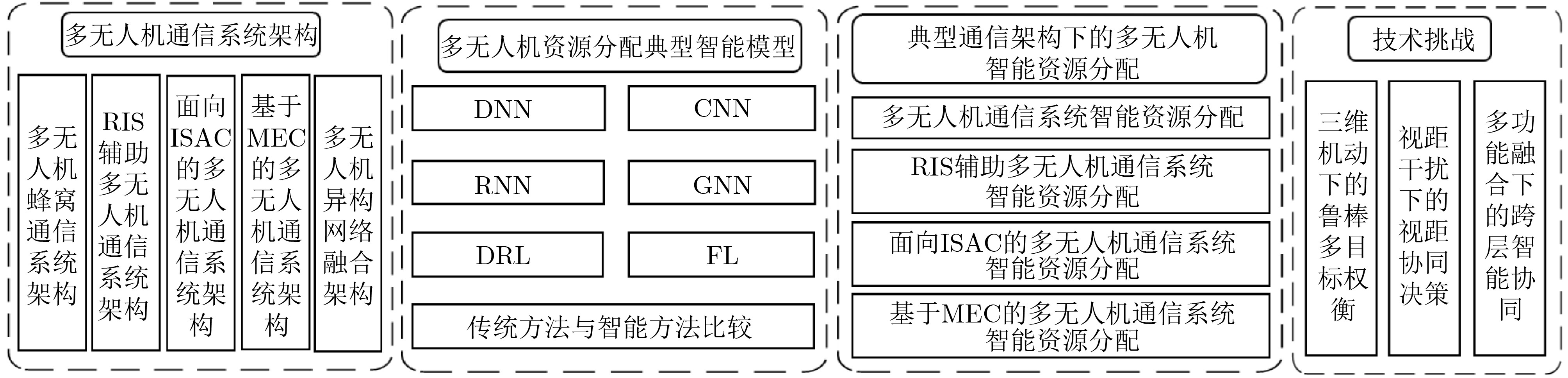
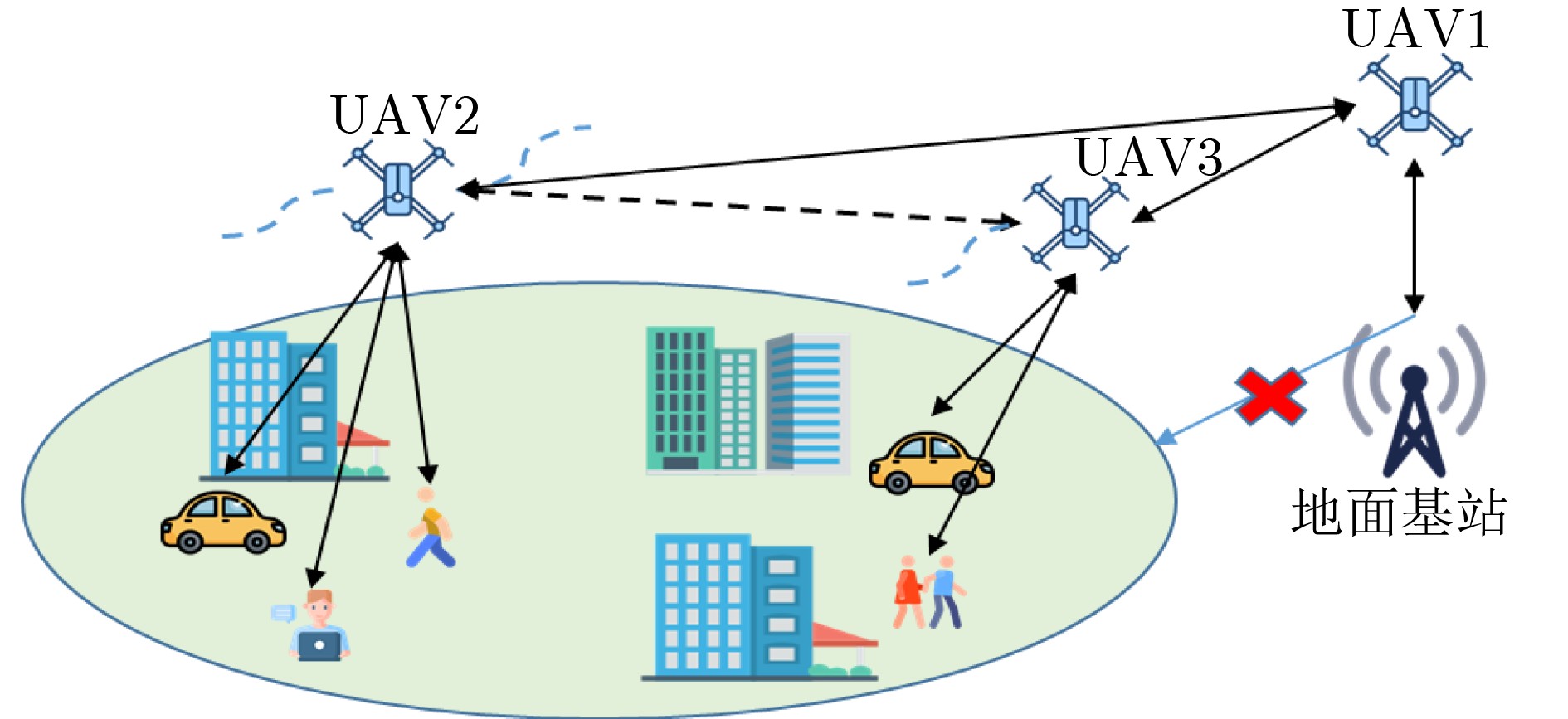
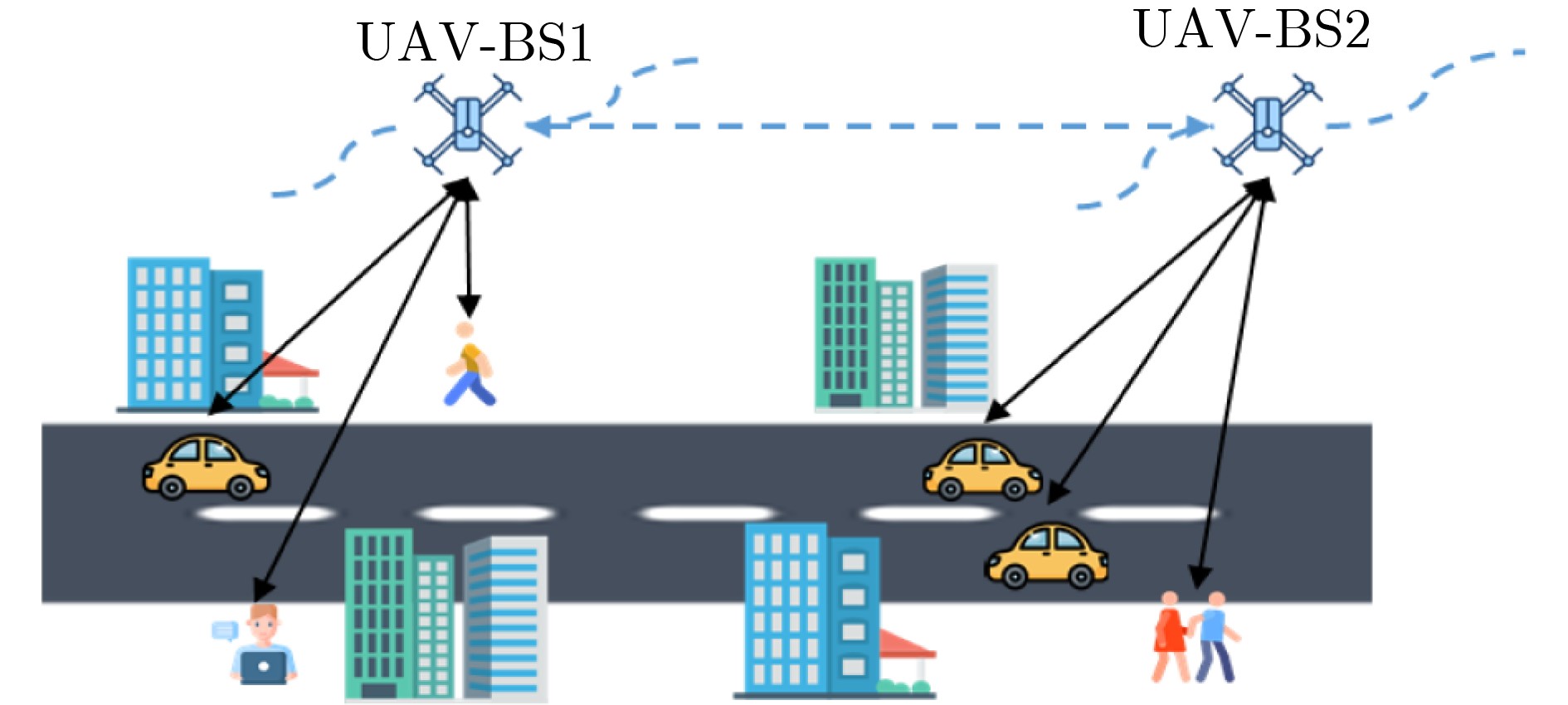
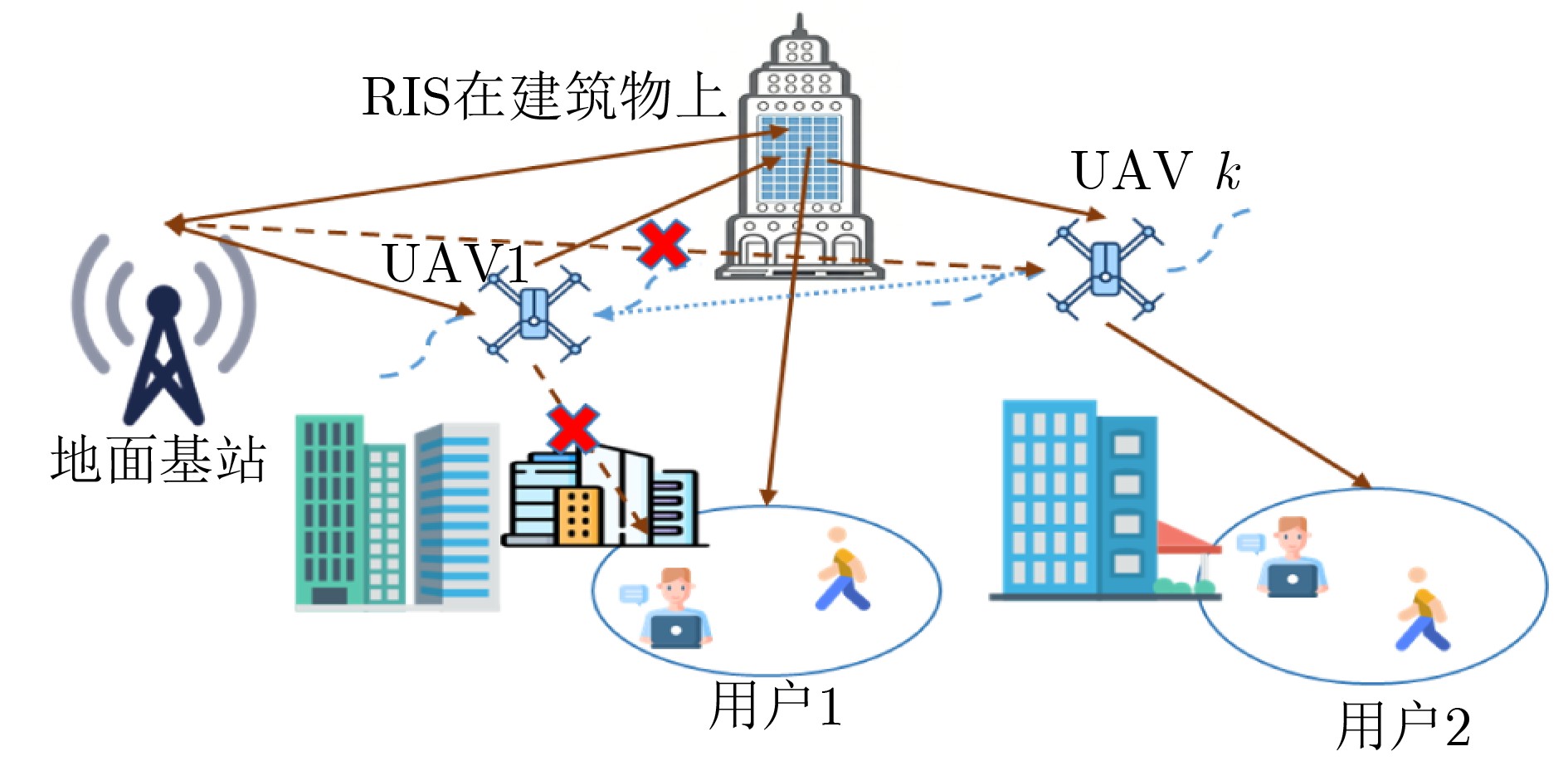
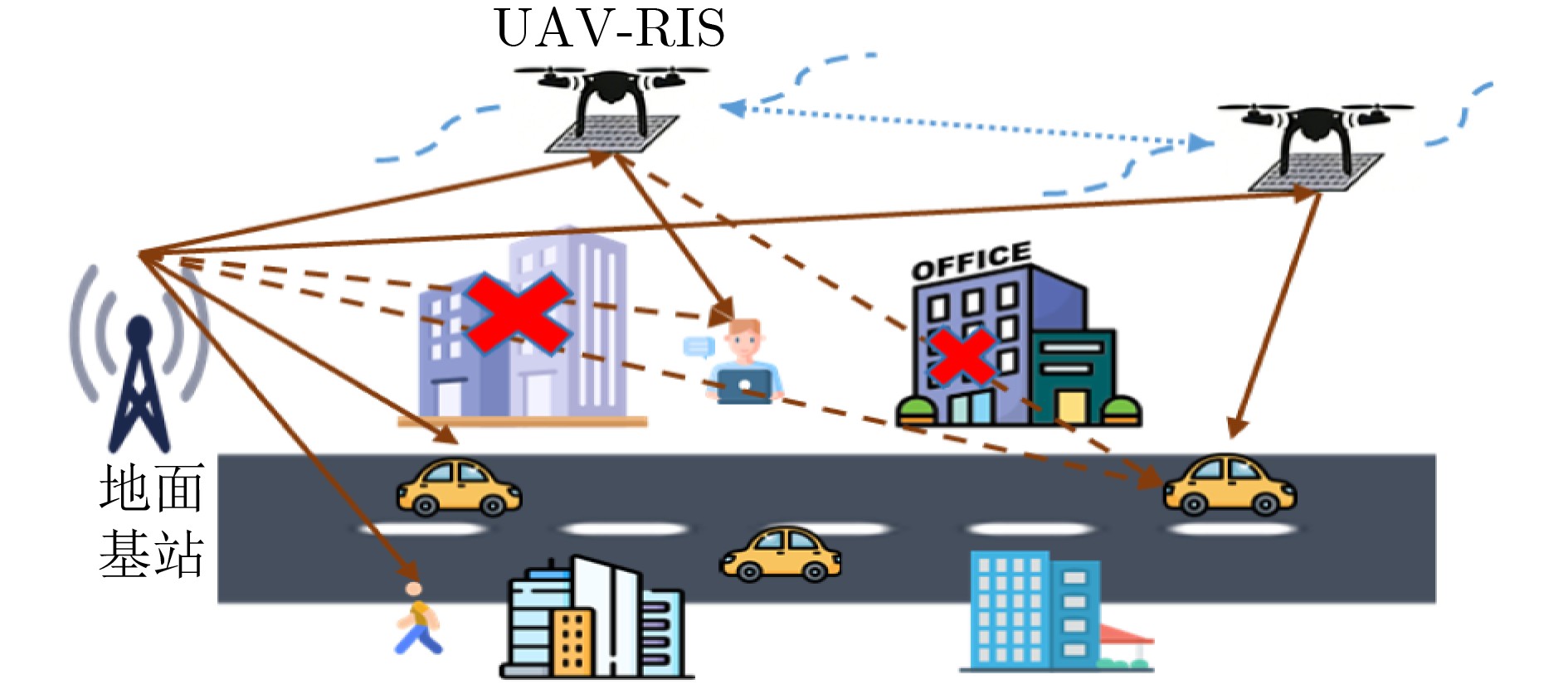
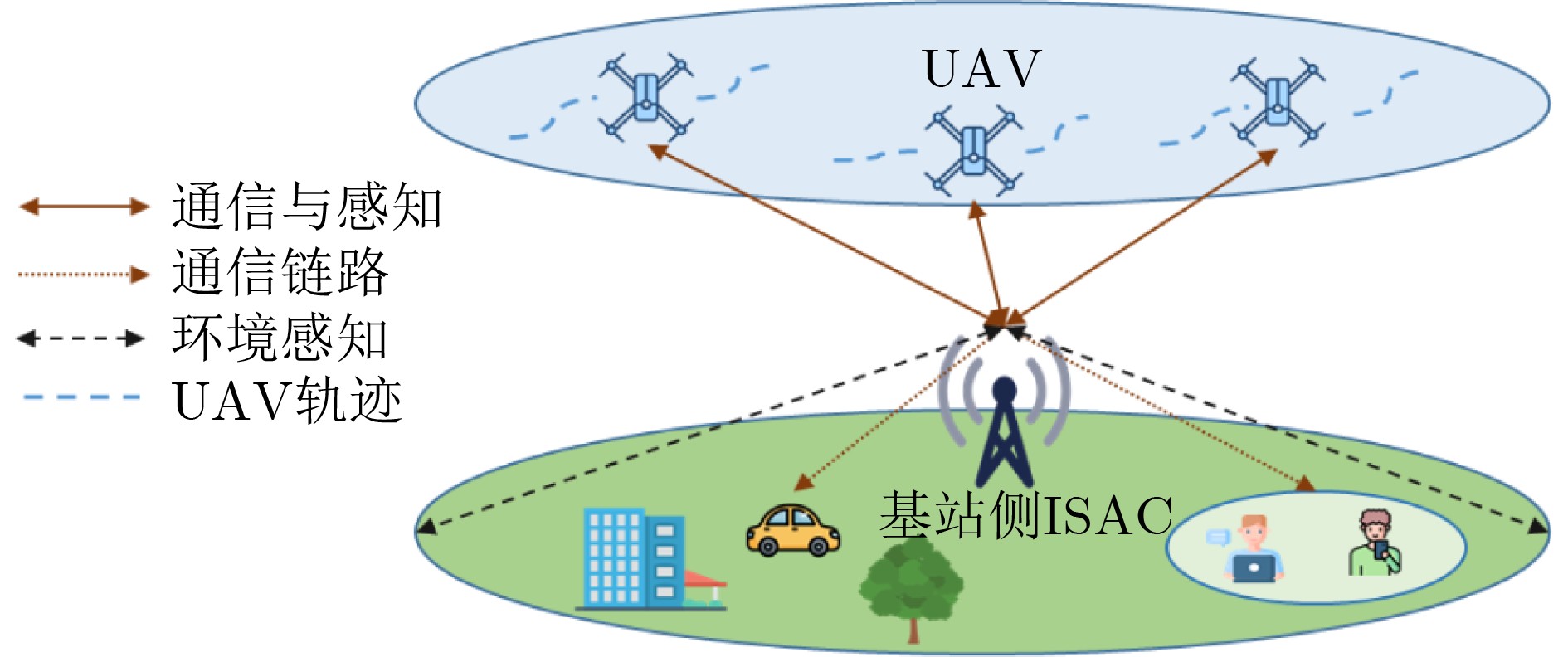
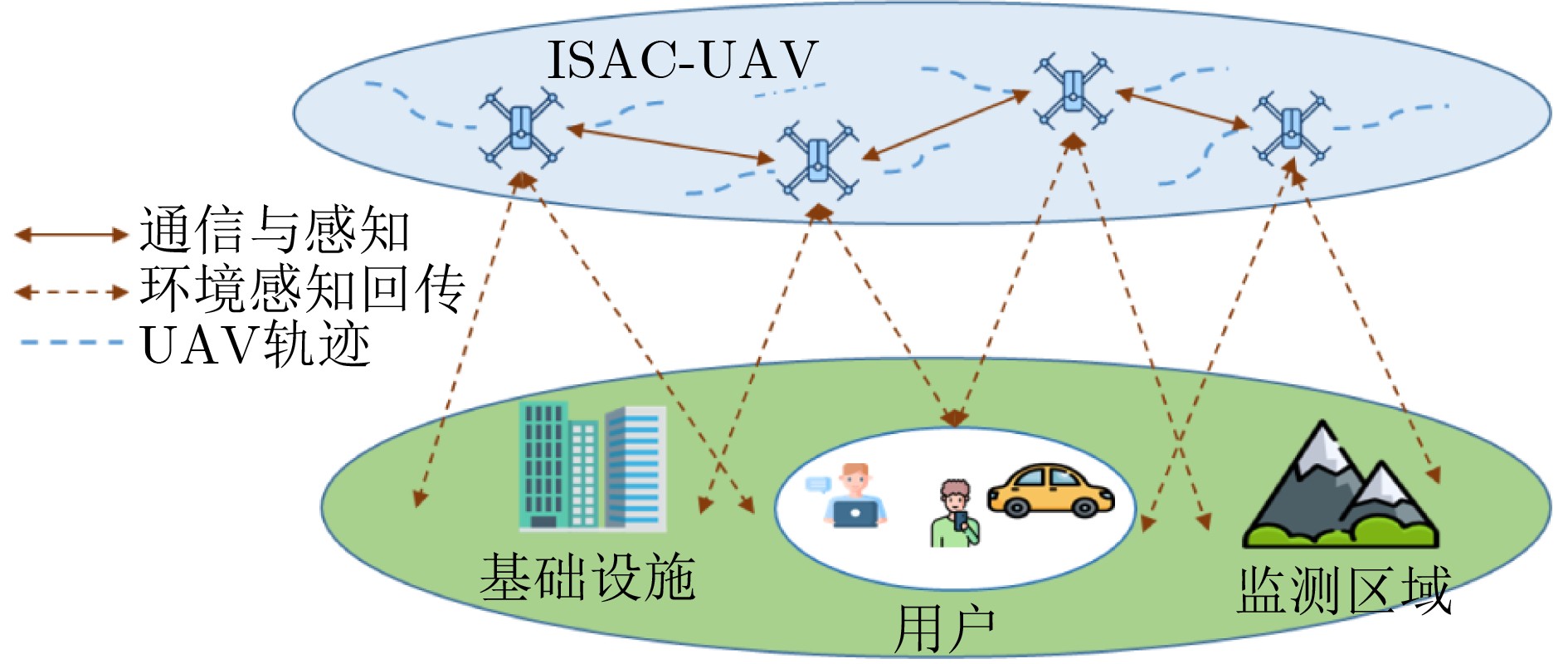
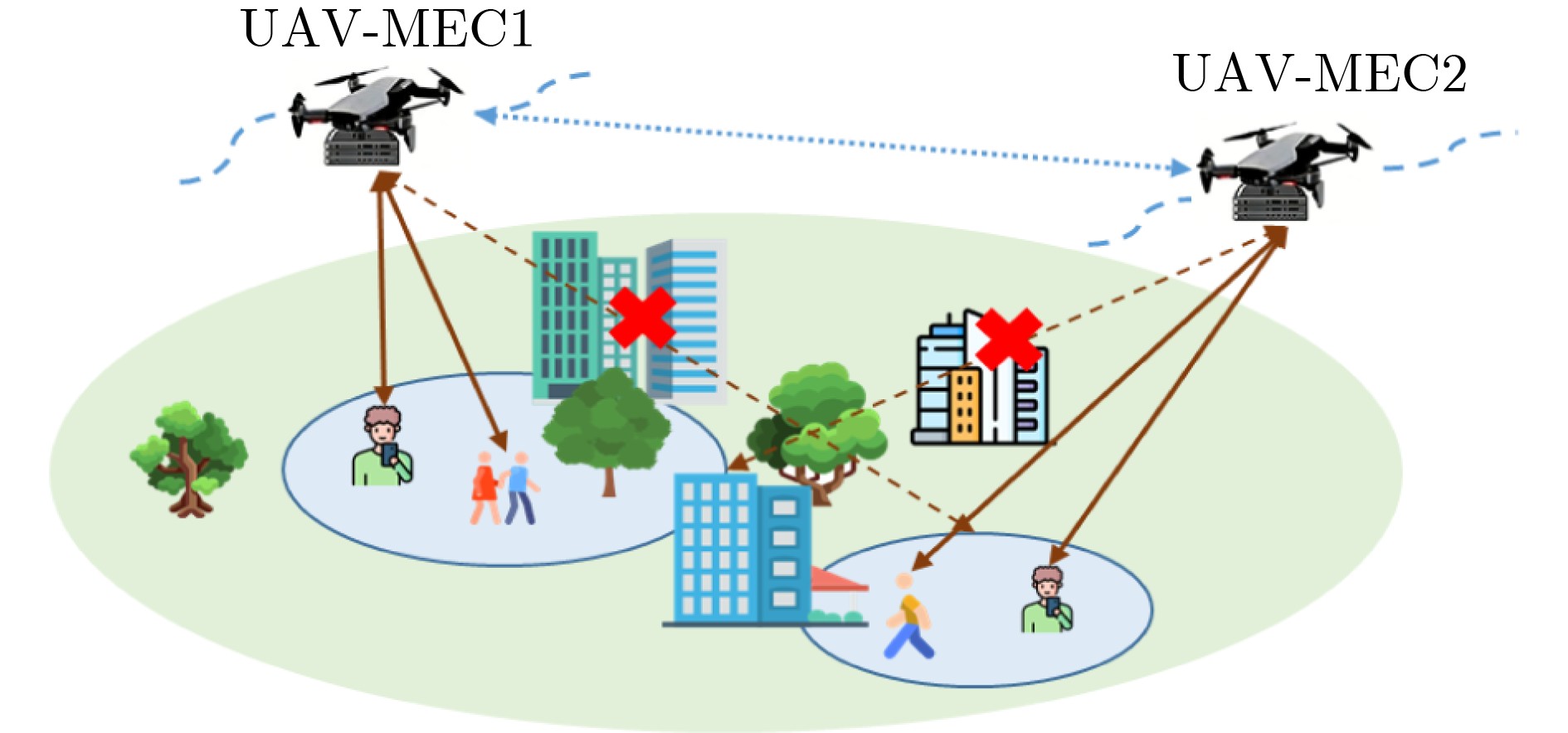
Significance With the rapid development of the low-altitude economy, emergency communications, and related industries, multi-Unmanned Aerial Vehicle (UAV) communication systems have shown significant application value in disaster rescue, low-altitude monitoring, and other scenarios, owing to their advantages in wide-area coverage and link compensation. However, affected by strong link coupling, dynamic topology variation, and enlarged Line-of-Sight (LoS) interference ranges, resource allocation in multi-UAV systems is characterized by high dimensionality, time variation, and multi-agent cooperation. Traditional model-driven optimization methods, such as convex optimization and game theory, are difficult to satisfy the requirements of real-time adaptive decision-making in complex dynamic environments. Therefore, Artificial Intelligence (AI)-enabled intelligent resource allocation has become an important direction for improving robust transmission, autonomous decision-making, and collaborative optimization in multi-UAV communication systems. Based on this, a survey is presented on the architectures, models, and challenges of intelligent resource allocation for multi-UAV communication systems. Progress This paper presents a comprehensive survey of recent advances in intelligent resource allocation for multi-UAV communication systems, with an in-depth discussion of typical network architectures, including cellular cooperative communication, Reconfigurable Intelligent Surface (RIS)-assisted communication, Integrated Sensing and Communication (ISAC), and Mobile Edge Computing (MEC). Among them, cellular cooperative architectures enhance coverage and link connectivity through UAV-enabled aerial relays or aerial base stations. RIS-assisted architectures improve blocked link quality by reconstructing the wireless propagation environment. ISAC architectures support the coordination of communication coverage, target localization, and environmental sensing. MEC architectures deploy computing resources at ground edge servers or UAV nodes to support task offloading and proximate computing. Different architectures vary in node functions, link forms, and resource coupling relationships, thereby determining different optimization variables and intelligent decision-making requirements. Then, typical intelligent models for multi-UAV resource allocation are introduced. Deep Neural Networks (DNNs) can learn nonlinear mappings from system states to continuous resource variables. Convolutional neural networks are suitable for extracting spatial features from channels, topologies, and user distributions. Recurrent neural networks can characterize temporal variations in channel states and UAV positions. Deep Reinforcement Learning (DRL) is applicable to long-term sequential decision-making problems, such as UAV trajectory control and power optimization. Federated Learning (FL) enables distributed collaborative training without sharing raw data. Furthermore, traditional optimization methods and intelligent methods are compared in terms of their applicable characteristics, and it is indicated that these methods should be selected according to scenario dynamics, model availability, real-time requirements, and cooperation scale. Finally, existing studies on intelligent resource allocation are compared across typical architectures, including cellular communication, RIS-assisted communication, ISAC, and MEC. In cellular communication systems, multi-agent proximal policy optimization, multi-agent Deep Deterministic Policy Gradient (DDPG), and other methods are used for trajectory control, frequency allocation, routing optimization, and power allocation. In RIS-assisted systems, double deep Q-network, DDPG, and other methods are used for the joint optimization of UAV trajectories, RIS phase shifts, beamforming, and task offloading. In ISAC systems, generative diffusion-driven multi-agent DRL and adaptive DNN splitting mechanisms are used for sensing-communication resource coordination, robust scheduling, and integrated sensing-communication-computation task processing. In MEC systems, DRL and FL are applied to task offloading, user association, power control, device selection, and priority-aware task scheduling. Conclusions This paper provides a comprehensive survey of intelligent resource allocation for multi-UAV communication systems, with particular emphasis on typical architectures, intelligent models, and current research progress. First, typical architectures of multi-UAV communication systems are systematically reviewed, and the node functions under different architectures are analyzed. Then, typical intelligent models for multi-UAV communication systems are summarized in terms of their mechanisms and applicable characteristics in state representation, feature extraction, sequential decision-making, and distributed cooperation. Furthermore, intelligent resource allocation studies for multi-UAV communication systems are compared across different architectures. Finally, existing challenges are identified, including difficulties in multi-objective tradeoffs under three-dimensional mobility, complex cooperative decision-making under LoS interference, and cross-layer resource coupling under multifunctional integration. Relevant research directions are also proposed. These directions are expected to provide valuable references for future research on intelligent resource allocation in multi-UAV communication systems. Prospects Although intelligent resource allocation methods have made progress in link recovery, coverage enhancement, RIS-assisted link optimization, sensing-communication resource coordination, and MEC task offloading, several challenges still remain in complex dynamic multi-UAV scenarios. First, the three-dimensional mobility of UAVs dynamically couples coverage range, service delay, and energy consumption. Existing methods with fixed reward weights are difficult to adapt to changes in task priorities. Therefore, multi-objective Reinforcement Learning (RL) and dynamic reward weighting can be combined to construct adaptive tradeoff mechanisms. Second, air-to-air and air-to-ground LoS links enlarge the interference propagation range, making spectrum reuse and user association more complex. Graph neural networks and interference prediction mechanisms can be introduced to improve the representation capability of dynamic interference topology. Finally, with the integration of RIS, ISAC, and MEC, UAVs are gradually evolving into multifunctional nodes. Hierarchical RL and cross-layer joint modeling can be further explored to realize the collaborative optimization of communication, sensing, computing, and flight-control resources. -
Key words:
- Multi-UAV communication /
- Artificial intelligence /
- Resource allocation
-
表 1 典型架构对比
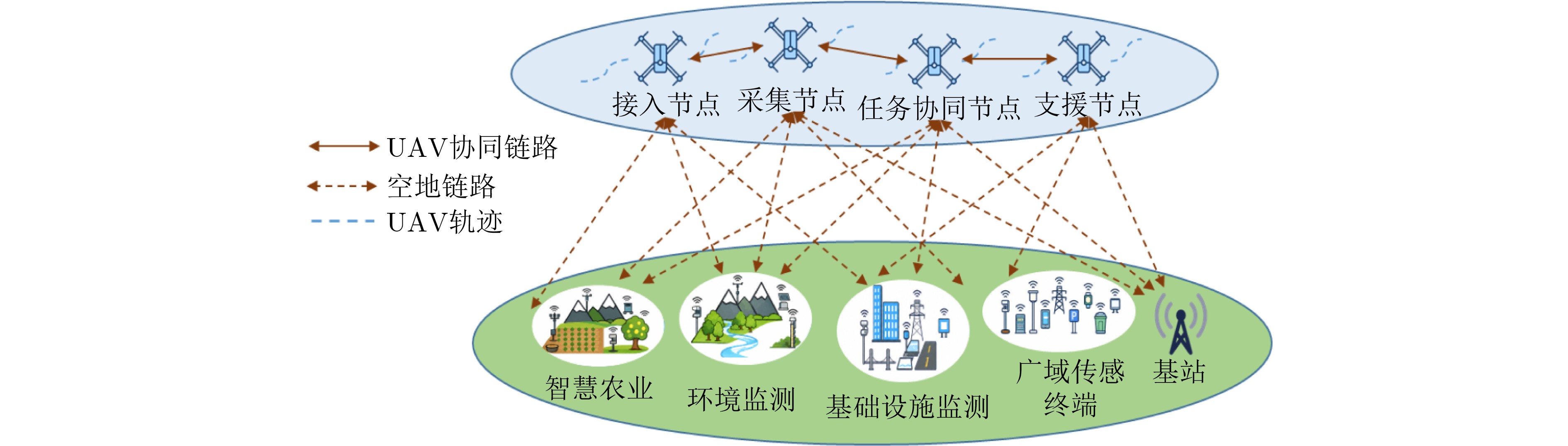
架构类型 特点 优点 资源分配关键挑战 应用场景 多无人机空中基站 直接接入服务 部署灵活、响应快速 用户关联、频谱与功率耦合 应急通信、偏远地区覆盖 多无人机空中中继 多跳中继转发 多跳转发、增强网络连通性 时延约束下路由与功率协同 盲区覆盖、灾后网络恢复 固定RIS辅助无人机 依赖地面建筑 低功耗、无源反射 轨迹和RIS相位高度耦合 城市高楼区、复杂遮挡场景 多无人机搭载RIS 具备智能反射 机动性强、按需链路增强 轨迹、相位与调度协同复杂 热点区域跟随、移动中继 基站侧ISAC节点 依赖地面基站 成本低、频谱共享效率高 通信和感知精度难以兼顾 高可靠通信、覆盖区域感知 无人机侧ISAC节点 移动感知通信 可动态调整通信与感知区域 通感资源与轨迹协同困难 区域精细扫描、灾害搜救 地面基站部署MEC 依赖地面基站 降低任务处理时延 任务卸载、通信与轨迹耦合 区域高清测绘、活动监控 空中MEC 具备计算能力 降低对基础设施依赖 通算与飞行能耗难协调 灾害处理、实时任务卸载 空天地一体化网络 多层协同 广域覆盖、链路可靠 节点关联、频谱与功率耦合 偏远地区覆盖、灾后通信 面向物联网的空地网络 服务大规模终端 终端关联,动态数据采集 终端关联、调度与轨迹耦合 智慧农业、环境监测  下载: 导出CSV
表 2 多无人机资源分配典型智能模型类别对比
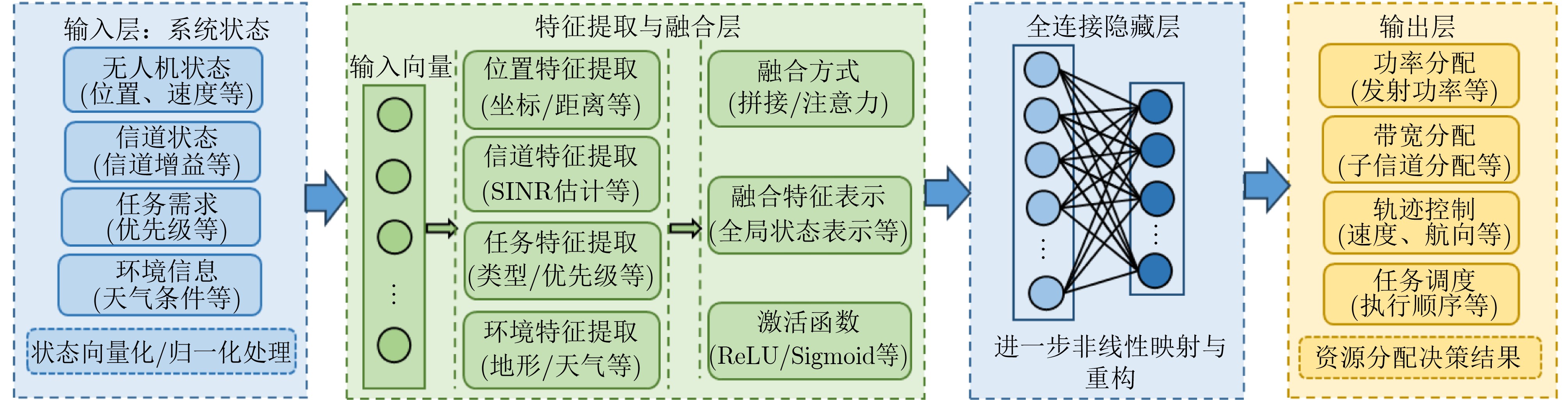
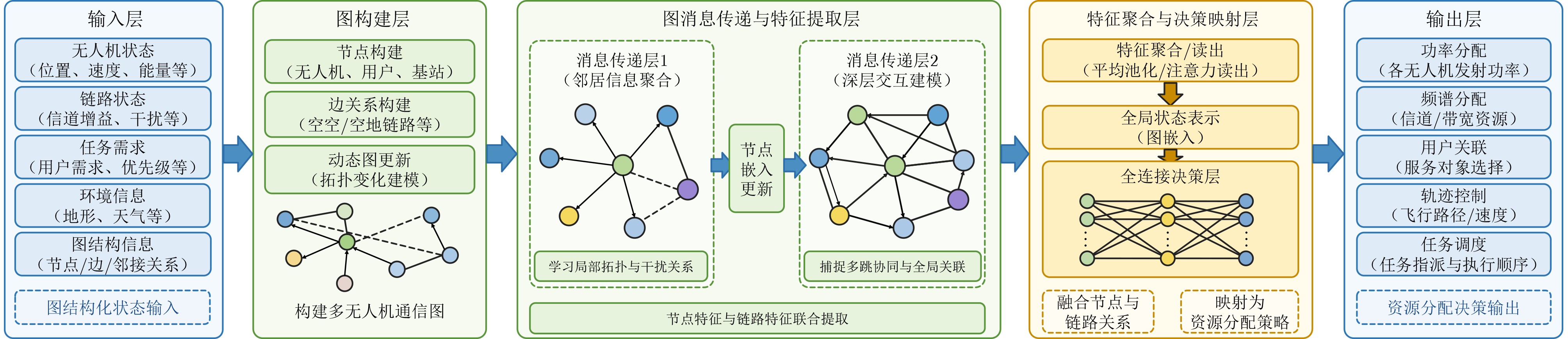
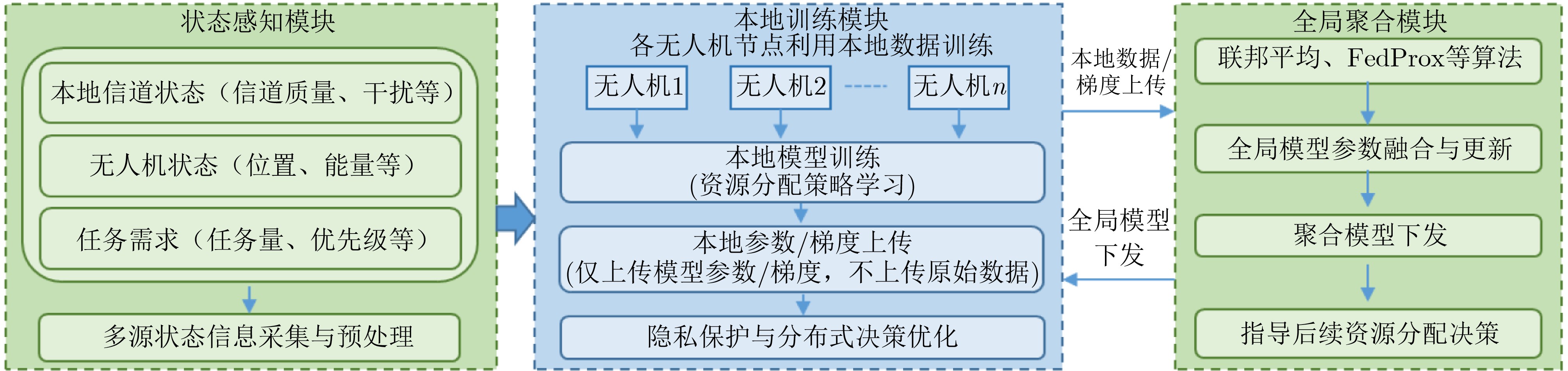
智能模型类别 优势 劣势 适用场景 DNN 系统状态到连续资源变量的非线性映射 动态拓扑变化和离散决策的适应能力不足 网络规模稳定、状态映射明确 CNN 提取信道、拓扑和用户分布的空间特征 长距离拓扑依赖和时序变化建模能力不足 特征明显、规模固定 RNN 能够刻画信道、位置和任务需求的时序变化 递归效率较低,长时间依赖建模能力有限 状态时序相关性较强的场景 GNN 建模不规则拓扑并适应无人机变化 网络规模与连接密度增加时传递开销大 节点规模变化场景 DRL 适合轨迹、功率、频谱和任务卸载等动态决策问题 收敛开销较高,奖励设计比较依赖经验 动态环境下的长期决策 FL 数据隐私性高,隐私保护下的分布式资源分配训练 通信开销高,异构数据下聚合稳定性不足 数据分散、敏感场景
下载: 导出CSV
表 4 传统优化方法与智能方法对比
方法类型 代表方法 适用条件 优势 局限 凸优化 SCA、BCD等 信道模型明确、变量规模可控 可解释性强,收敛过程清晰 依赖精确模型,实时响应不足 博弈论 非合作/合作博弈等 多无人机间的竞争或协作关系 易刻画多主体竞争与协同 均衡解求解复杂,全局最优性难保证 启发式算法 遗传算法、粒子群 模型复杂但问题规模相对可控 对问题凸性和精度要求低 计算开销高,最优性和稳定性困难 深度学习 DNN、CNN、RNN 训练样本充分,需学习状态映射 适合高维表征和快速推理 依赖训练数据,跨场景泛化能力有限 深度强化学习 PPO、DDPG等 环境动态变化,需长期序列决策 适合多变量动态协同优化 训练收敛慢,奖励函数设计依赖经验 联邦学习 FedAvg、FedProx等 数据在无人机节点且有隐私需求 支持分布式训练与隐私保护 通信开销高,异构数据下聚合不稳
下载: 导出CSV
表 9 技术挑战及潜在解决方向
技术挑战 产生原因 现有不足 潜在解决方向 三维机动下的鲁棒多目标权衡 三维机动与状态误差影响多维指标 固定权重与理想状态假设适应性差 多目标RL、动态权重调整 视距干扰下的多机协同决策 视距干扰扩散加剧多机策略耦合 局部观测难以刻画动态干扰拓扑 图神经网络、干扰预测等 多功能融合下的跨层智能协同 多技术融合导致通感算与飞行耦合 联合动作空间大,模型部署开销高 分层RL、跨层联合建模
下载: 导出CSV
-
[1] 陈新颖, 盛敏, 李博, 等. 面向6G的无人机通信综述[J]. 电子与信息学报, 2022, 44(3): 781–789. doi: 10.11999/JEIT210789.CHEN Xinying, SHENG Min, LI Bo, et al. Survey on unmanned aerial vehicle communications for 6G[J]. Journal of Electronics & Information Technology, 2022, 44(3): 781–789. doi: 10.11999/JEIT210789. [2] XU Yongjun, GUI Guan, GACANIN H, et al. A survey on resource allocation for 5G heterogeneous networks: Current research, future trends, and challenges[J]. IEEE Communications Surveys & Tutorials, 2021, 23(2): 668–695. doi: 10.1109/COMST.2021.3059896. [3] 王侃, 曹铁林, 李旭杰, 等. 无人机辅助边缘计算网络轨迹规划与资源分配研究综述[J]. 电子与信息学报, 2025, 47(5): 1266–1281. doi: 10.11999/JEIT241071.WANG Kan, CAO Tielin, LI Xujie, et al. A survey on trajectory planning and resource allocation in unmanned aerial vehicle-assisted edge computing networks[J]. Journal of Electronics & Information Technology, 2025, 47(5): 1266–1281. doi: 10.11999/JEIT241071. [4] XU Yongjun, XIE Hao, WU Qingqing, et al. Robust max-min energy efficiency for RIS-aided HetNets with distortion noises[J]. IEEE Transactions on Communications, 2022, 70(2): 1457–1471. doi: 10.1109/TCOMM.2022.3141798. [5] REN Yuan, WANG Jieyu, XIAO Yulong, et al. Energy efficiency optimization for UAV distribution and resource allocation in NOMA and multi-UAV assisted wireless networks[J]. IEEE Open Journal of the Communications Society, 2025, 6: 6142–6155. doi: 10.1109/OJCOMS.2025.3590795. [6] YUAN Zimeng, BI Yuanguo, FAN Yanbo, et al. Trajectory optimization and power allocation for multi-UAV wireless networks: A communication-based multi-agent deep reinforcement learning approach[J]. IEEE Transactions on Computers, 2025, 74(10): 3404–3418. doi: 10.1109/TC.2025.3587976. [7] XU Yongjun, LIU Zijian, HUANG Chongwen, et al. Robust resource allocation algorithm for energy-harvesting-based D2D communication underlaying UAV-assisted networks[J]. IEEE Internet of Things Journal, 2021, 8(23): 17161–17171. doi: 10.1109/JIOT.2021.3078264. [8] XU Yongjun, XU Juan, LI Xingwang, et al. RIS-assisted heterogeneous backscatter communications: A robust design[J]. IEEE Transactions on Communications, 2025, 73(12): 13214–13225. doi: 10.1109/TCOMM.2025.3588574. [9] 徐勇军, 符加劲, 黄琼, 等. 智能反射面辅助的多天线通信系统鲁棒安全资源分配算法[J]. 电子与信息学报, 2024, 46(1): 165–174. doi: 10.11999/JEIT221554.XU Yongjun, FU Jiajin, HUANG Qiong, et al. Robust secure resource allocation algorithm for intelligent reflecting surface-assisted multi-antenna communication systems[J]. Journal of Electronics & Information Technology, 2024, 46(1): 165–174. doi: 10.11999/JEIT221554. [10] 徐勇军, 李晶, 骆东鑫, 等. 近场通信物理层安全技术综述[J]. 电子与信息学报, 2025, 47(11): 4129–4143. doi: 10.11999/JEIT250336.XU Yongjun, LI Jing, LUO Dongxin, et al. A survey on physical layer security in near-field communication[J]. Journal of Electronics & Information Technology, 2025, 47(11): 4129–4143. doi: 10.11999/JEIT250336. [11] 徐勇军, 徐娟, 田秦语, 等. 基于统计信道状态信息的智能反射面辅助反向散射通信系统鲁棒资源分配算法[J]. 电子与信息学报, 2024, 46(5): 1986–1995. doi: 10.11999/JEIT231169.XU Yongjun, XU Juan, TIAN Qinyu, et al. Robust resource allocation algorithm for reconfigurable intelligent surface-assisted backscatter communication systems based on statistical channel state information[J]. Journal of Electronics & Information Technology, 2024, 46(5): 1986–1995. doi: 10.11999/JEIT231169. [12] NI Hao, XU Yongjun, ZHANG Haibo, et al. Two-layer resource allocation for RIS-enhanced MA systems with imperfect CSI and HWIs[J]. IEEE Transactions on Wireless Communications, 2026, 25: 24314–24331. doi: 10.1109/TWC.2026.3737859. [13] SALIM M M, RABIE K M, and MUQAIBEL A H. Energy-efficient irregular RIS-aided UAV-assisted optimization: A deep reinforcement learning approach[J]. IEEE Internet of Things Journal, 2025, 12(24): 55196–55210. doi: 10.1109/JIOT.2025.3623306. [14] XU Yongjun, TIAN Qinyu, CHEN Qianbin, et al. Robust secure beamforming design for multi-RIS-aided MISO systems with hardware impairments and channel uncertainties[J]. IEEE Transactions on Communications, 2025, 73(3): 1517–1530. doi: 10.1109/TCOMM.2024.3451617. [15] ZHENG Yufeng, LI Lixin, LIN Wensheng, et al. Optimal transport framework for ISAC in low-altitude networks: Joint resource allocation for cooperative communication and non-cooperative localization[J]. IEEE Transactions on Communications, 2026, 74: 1984–2000. doi: 10.1109/TCOMM.2025.3642742. [16] RAN Xinyi, XU Yongjun, CHEN Qianbin, et al. Robust secure beamforming algorithm for RIS-assisted NOMA-ISAC systems[J]. IEEE Sensors Journal, 2025: 1–1. doi: 10.1109/JSEN.2025.3624266. [17] WANG Zhaowei, ZHAO Jianwei, HE Fang, et al. A hierarchical MADRL framework for joint resource allocation and trajectory design in UAV enabled multi-static ISAC networks[J]. IEEE Wireless Communications Letters, 2026, 15: 1325–1329. doi: 10.1109/LWC.2026.3651444. [18] YU Zihang, ZHANG Zhenjiang, ZEADALLY S, et al. Energy-efficient computing offloading with trajectory optimization and resource allocation in UAVs aided industrial IoT[J]. IEEE Internet of Things Journal, 2025, 12(17): 34780–34792. doi: 10.1109/JIOT.2025.3582091. [19] LIN Na, HAN Xiao, HAWBANI A, et al. Deep reinforcement learning-based dual-timescale service caching and computation offloading for multi-UAV assisted MEC systems[J]. IEEE Transactions on Network and Service Management, 2025, 22(1): 605–617. doi: 10.1109/TNSM.2024.3468312. [20] TANG Rui, MA Liao, ZHANG Ruizhi, et al. Fairness-based resource allocation in space-air-ground integrated internet-of-remote-things systems[J]. IEEE Transactions on Communications, 2025, 73(12): 15818–15834. doi: 10.1109/TCOMM.2025.3615779. [21] LI Jiahui, SUN Geng, DUAN Lingjie, et al. Multi-objective optimization for UAV swarm-assisted IoT with virtual antenna arrays[J]. IEEE Transactions on Mobile Computing, 2024, 23(5): 4890–4907. doi: 10.1109/TMC.2023.3298888. [22] LIU Ying, YIN Jianhui, ZHANG Weiting, et al. Integration of federated learning and AI-generated content: A survey of overview, opportunities, challenges, and solutions[J]. IEEE Communications Surveys & Tutorials, 2025, 27(5): 3308–3338. doi: 10.1109/COMST.2024.3523350. [23] SUN Geng, HE Long, SUN Zemin, et al. Joint task offloading and resource allocation in aerial-terrestrial UAV networks with edge and fog computing for post-disaster rescue[J]. IEEE Transactions on Mobile Computing, 2024, 23(9): 8582–8600. doi: 10.1109/TMC.2024.3350886. [24] CHEN Nanhua, ZHANG Dongshuo, JIANG Kai, et al. SHAA: Spatial hybrid attention network with adaptive cross-entropy loss function for UAV-view geo-localization[J]. IEEE Transactions on Circuits and Systems for Video Technology, 2025, 35(9): 9398–9413. doi: 10.1109/TCSVT.2025.3560637. [25] TANG Rui, ZHANG Ruizhi, XU Yongjun, et al. Deep reinforcement learning-based resource allocation for multi-UAV-assisted full-duplex wireless-powered IoT networks[J]. IEEE Transactions on Cognitive Communications and Networking, 2024, 10(6): 2236–2251. doi: 10.1109/TCCN.2024.3407096. [26] TANG Rui, ZHANG Ruizhi, XU Yongjun, et al. Resource allocation for underwater acoustic sensor networks with partial spectrum sharing: When optimization meets deep reinforcement learning[J]. IEEE Transactions on Network and Service Management, 2025, 22(3): 2715–2730. doi: 10.1109/TNSM.2025.3556498. [27] ABDI N, ALBASEER A, and ABDALLAH M. The role of deep learning in advancing proactive cybersecurity measures for smart grid networks: A survey[J]. IEEE Internet of Things Journal, 2024, 11(9): 16398–16421. doi: 10.1109/JIOT.2024.3354045. [28] RODRÍGUEZ E, OTERO B, GUTIÉRREZ N, et al. A survey of deep learning techniques for cybersecurity in mobile networks[J]. IEEE Communications Surveys & Tutorials, 2021, 23(3): 1920–1955. doi: 10.1109/COMST.2021.3086296. [29] SUN Haoyun, ZHAO Hongwei, XU Liang, et al. FedDGA: Federated multitask learning based on dynamic guided attention[J]. IEEE Transactions on Artificial Intelligence, 2025, 6(2): 268–280. doi: 10.1109/TAI.2024.3350538. [30] GENG Xue, WANG Zhe, CHEN Chunyun, et al. From algorithm to hardware: A survey on efficient and safe deployment of deep neural networks[J]. IEEE Transactions on Neural Networks and Learning Systems, 2025, 36(4): 5837–5857. doi: 10.1109/TNNLS.2024.3394494. [31] GUO Qi, ZHAO Baolin, SONG Mingchen, et al. A survey of deep learning for time series forecasting: Taxonomy, analysis and future directions[J]. IEEE Transactions on Knowledge and Data Engineering, 2026, 38(5): 2541–2560. doi: 10.1109/TKDE.2026.3671378. [32] WANG Yunqi, LI Yang, SHI Qingjiang, et al. ENGNN: A general edge-update empowered GNN architecture for radio resource management in wireless networks[J]. IEEE Transactions on Wireless Communications, 2024, 23(6): 5330–5344. doi: 10.1109/TWC.2023.3325735. [33] HAO Hao, XU Changqiao, ZHANG Wei, et al. Joint task offloading, resource allocation, and trajectory design for multi-UAV cooperative edge computing with task priority[J]. IEEE Transactions on Mobile Computing, 2024, 23(9): 8649–8663. doi: 10.1109/TMC.2024.3350078. [34] TANG Jianhang, NIE Jiangtian, ZHANG Yang, et al. Multi-UAV-assisted federated learning for energy-aware distributed edge training[J]. IEEE Transactions on Network and Service Management, 2024, 21(1): 280–294. doi: 10.1109/TNSM.2023.3298220. [35] GUAN Yue, ZOU Sai, PENG Haixia, et al. Cooperative UAV trajectory design for disaster area emergency communications: A multiagent PPO method[J]. IEEE Internet of Things Journal, 2024, 11(5): 8848–8859. doi: 10.1109/JIOT.2023.3320796. [36] ALAM M M and MOH S. Joint trajectory control, frequency allocation, and routing for UAV swarm networks: A multi-agent deep reinforcement learning approach[J]. IEEE Transactions on Mobile Computing, 2024, 23(12): 11989–12005. doi: 10.1109/TMC.2024.3403890. [37] FU Shu, FENG Xue, SULTANA A, et al. Joint power allocation and 3D deployment for UAV-BSs: A game theory based deep reinforcement learning approach[J]. IEEE Transactions on Wireless Communications, 2024, 23(1): 736–748. doi: 10.1109/TWC.2023.3281812. [38] XU Fanfei, RUAN Yuhan, and LI Yongzhao. Soft actor-critic based 3-D deployment and power allocation in cell-free unmanned aerial vehicle networks[J]. IEEE Wireless Communications Letters, 2023, 12(10): 1692–1696. doi: 10.1109/LWC.2023.3288273. [39] TANG Ruizhi, WANG Junxuan, ZHANG Yanyan, et al. Throughput maximization in NOMA enhanced RIS-assisted multi-UAV networks: A deep reinforcement learning approach[J]. IEEE Transactions on Vehicular Technology, 2025, 74(1): 730–745. doi: 10.1109/TVT.2024.3452979. [40] UMAR A R, ALBINSAID H, WEI C P, et al. Deep reinforcement learning for RIS-assisted multi-UAV MU-MISO communication networks: Sum-rate and energy efficiency maximization[J]. IEEE Open Journal of Vehicular Technology, 2025, 6: 2033–2047. doi: 10.1109/OJVT.2025.3589661. [41] TRUONG T P, TUONG V D, DAO N N, et al. FlyReflect: Joint flying IRS trajectory and phase shift design using deep reinforcement learning[J]. IEEE Internet of Things Journal, 2023, 10(5): 4605–4620. doi: 10.1109/JIOT.2022.3218740. [42] CHEN Wei, ZOU Yulong, ZHU Jia, et al. Energy-efficiency optimization of active flying-RIS-assisted mobile-edge computing networks: A deep-reinforcement-learning approach[J]. IEEE Internet of Things Journal, 2025, 12(13): 23563–23576. doi: 10.1109/JIOT.2025.3556246. [43] LIU Congcong, XIA Minghua, ZHAO Junhui, et al. Optimal resource allocation for integrated sensing and communications in internet of vehicles: A deep reinforcement learning approach[J]. IEEE Transactions on Vehicular Technology, 2025, 74(2): 3028–3038. doi: 10.1109/TVT.2024.3480277. [44] 李斌, 彭思聪, 费泽松. 基于边缘计算的无人机通感融合网络波束成形与资源优化[J]. 通信学报, 2023, 44(9): 228–237. doi: 10.11959/j.issn.1000-436x.2023172.LI Bin, PENG Sicong, and FEI Zesong. Beamforming and resource optimization in UAV integrated sensing and communication network with edge computing[J]. Journal on Communications, 2023, 44(9): 228–237. doi: 10.11959/j.issn.1000-436x.2023172. [45] WU Yihao, YU Hanxiao, ZHOU Yiqing, et al. Sensing-error-aware UAV scheduling based on generative diffusion-driven MADRL for ISAC-enabled multi-UAV systems[J]. IEEE Transactions on Wireless Communications, 2026, 25: 9782–9798. doi: 10.1109/TWC.2025.3638787. [46] DENG Cailian, FANG Xuming, and WANG Xianbin. Integrated sensing, communication, and computation with adaptive DNN splitting in multi-UAV networks[J]. IEEE Transactions on Wireless Communications, 2024, 23(11): 17429–17445. doi: 10.1109/TWC.2024.3453650. [47] 徐思雅, 邢逸斐, 郭少勇, 等. 基于深度强化学习的能源互联网智能巡检任务分配机制[J]. 通信学报, 2021, 42(5): 191–204. doi: 10.11959/j.issn.1000-436x.2021071.XU Siya, XING Yifei, GUO Shaoyong, et al. Deep reinforcement learning based task allocation mechanism for intelligent inspection in energy Internet[J]. Journal on Communications, 2021, 42(5): 191–204. doi: 10.11959/j.issn.1000-436x.2021071. [48] CHEN Jingxuan, CAO Xianbin, YANG Peng, et al. Deep reinforcement learning based resource allocation in multi-UAV-aided MEC networks[J]. IEEE Transactions on Communications, 2023, 71(1): 296–309. doi: 10.1109/TCOMM.2022.3226193. -

 下载:







图(17) / 表(9)
计量
- 文章访问数: 13
- HTML全文浏览量: 1
- PDF下载量: 2
- 被引次数: 0
