




Research on Double-Layer Multi-Mode Index Modulation Techniques for Orthogonal Time Sequency Multiplexing
-
摘要: 为兼顾不同业务数据的传输可靠性与频谱效率,该文提出一种双层多模正交时间序列复用索引调制(DLMM-OTSM)方案。在OTSM系统时延-序列域采用双层传输结构,基础层采用稀疏单模索引调制(IM),以保障重要信息的可靠传输,增强层采用全载波双模IM,以提高信息传输效率。接收端在最大似然(ML)检测基础上,介绍了一种基于对数似然比(LLR)的低复杂度分层检测方法。进一步提出一种基于Top-K候选的检测算法,通过保留多个高可靠索引候选并进行欧氏距离校正,改善LLR单次判决造成的误码性能损失。文章对所提系统的检测复杂度、频谱效率和误比特率上界进行了理论分析和仿真。结果表明,在4-QAM调制条件下,所提方案频谱效率达到1.75 bit/(s·Hz),较以往算法最高提高75%,同时误码性能优于现有方案。Abstract:
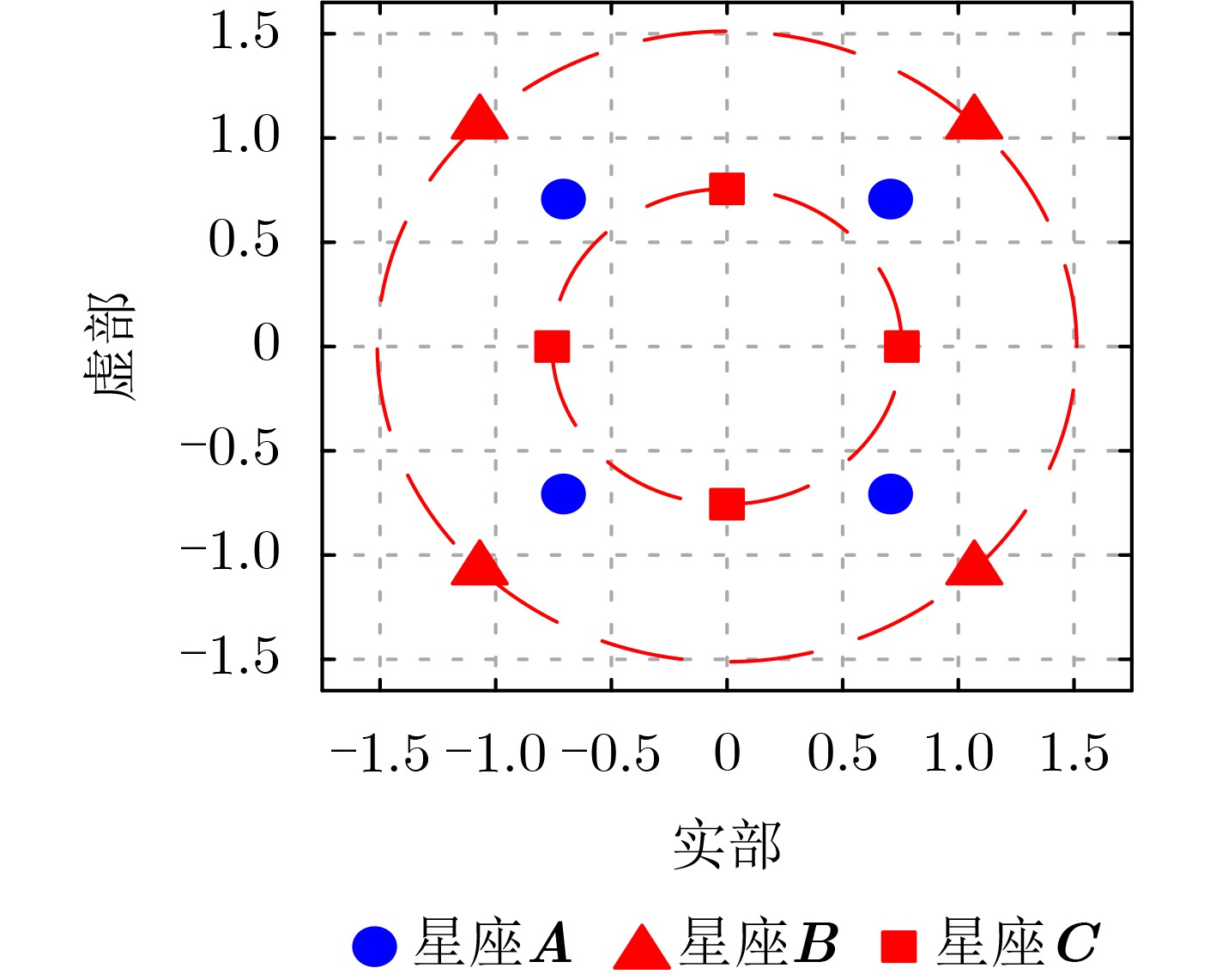
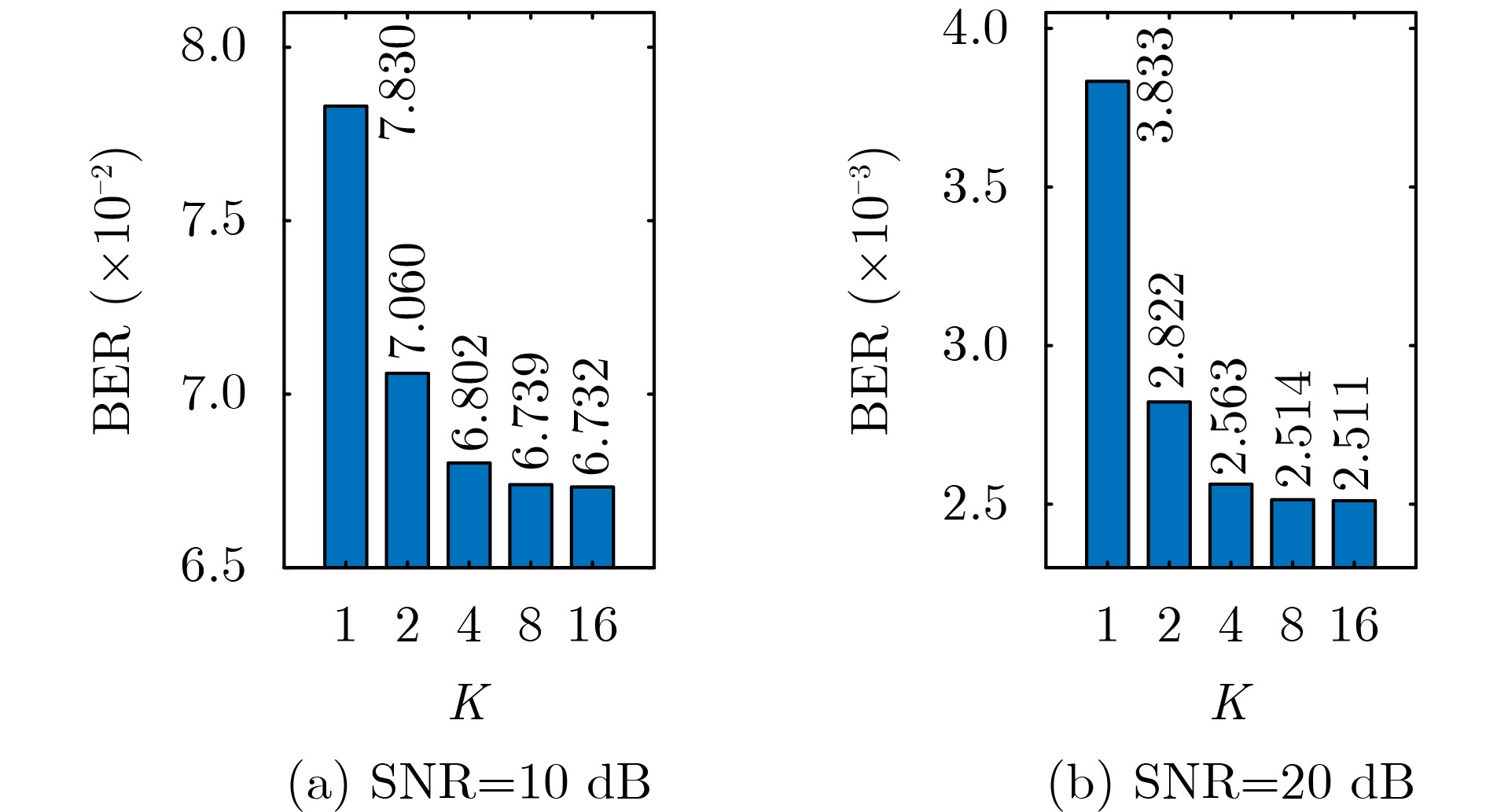
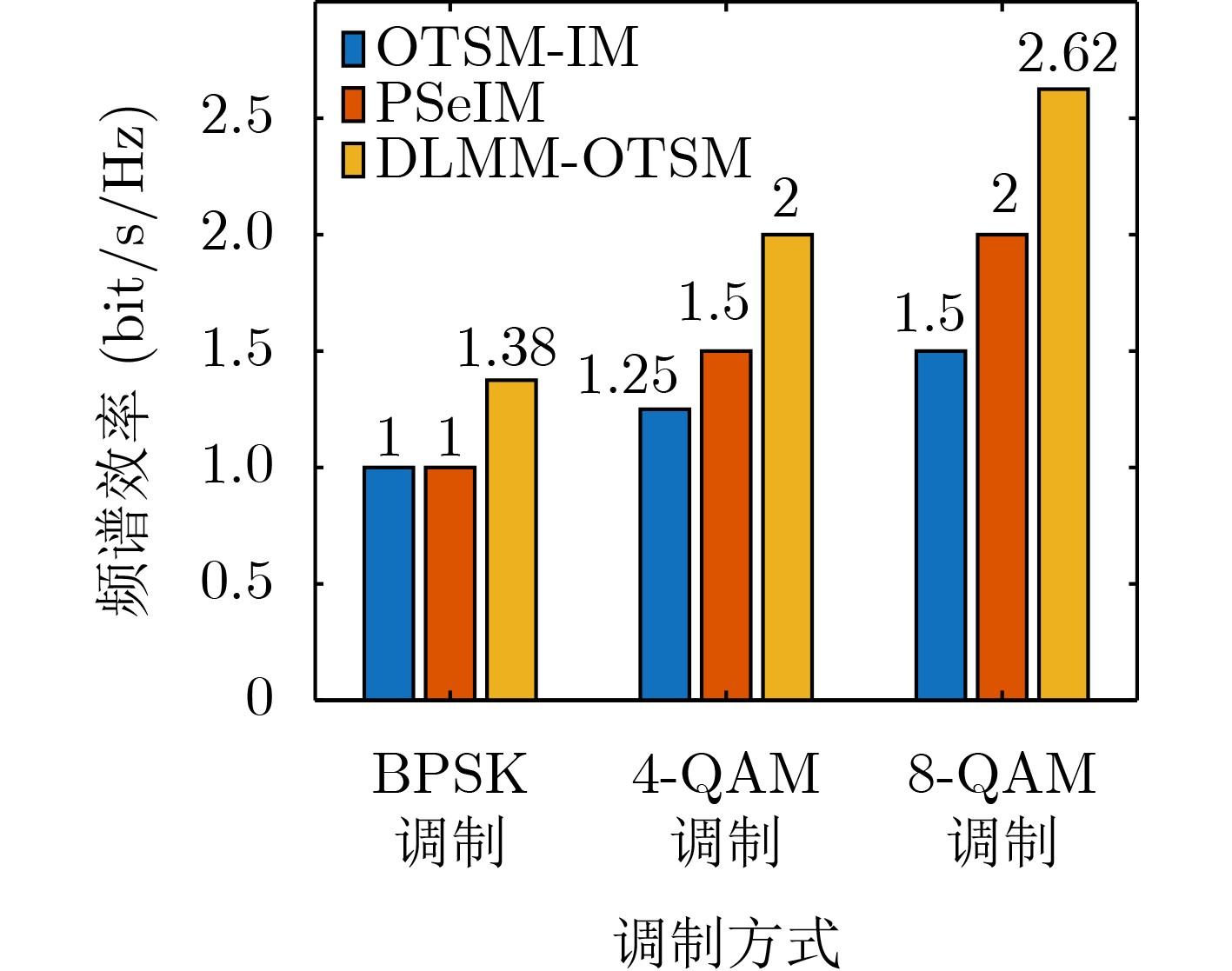
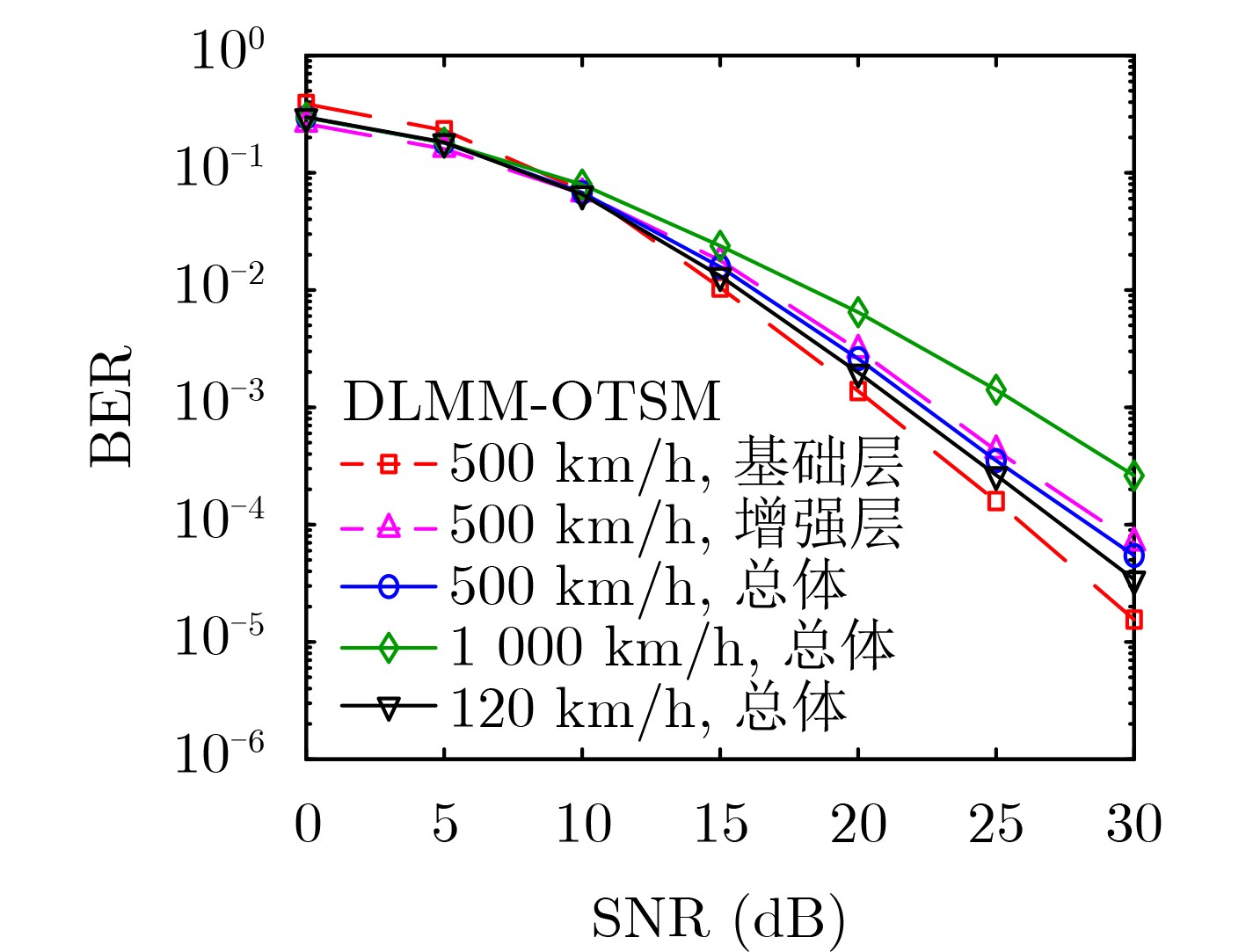
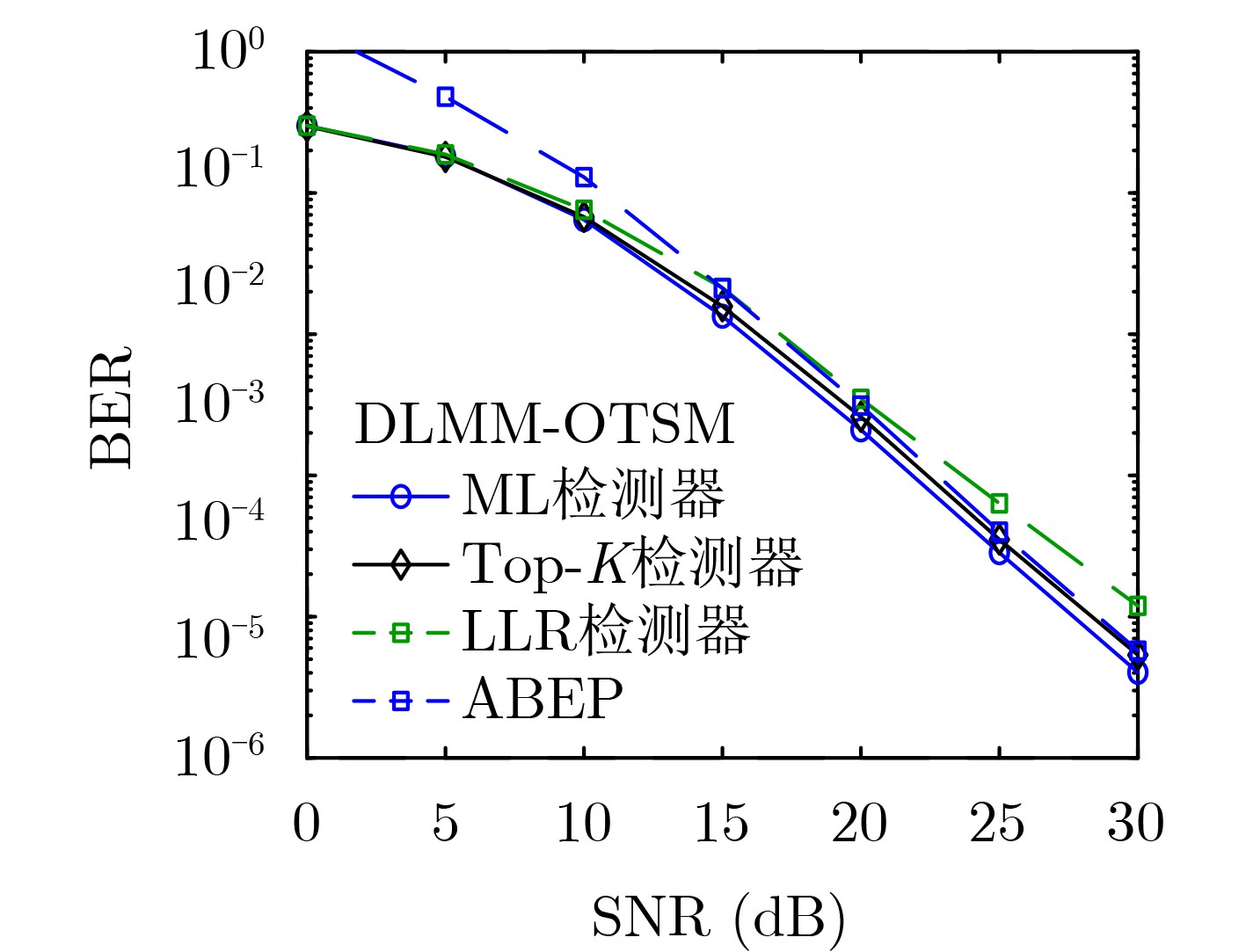
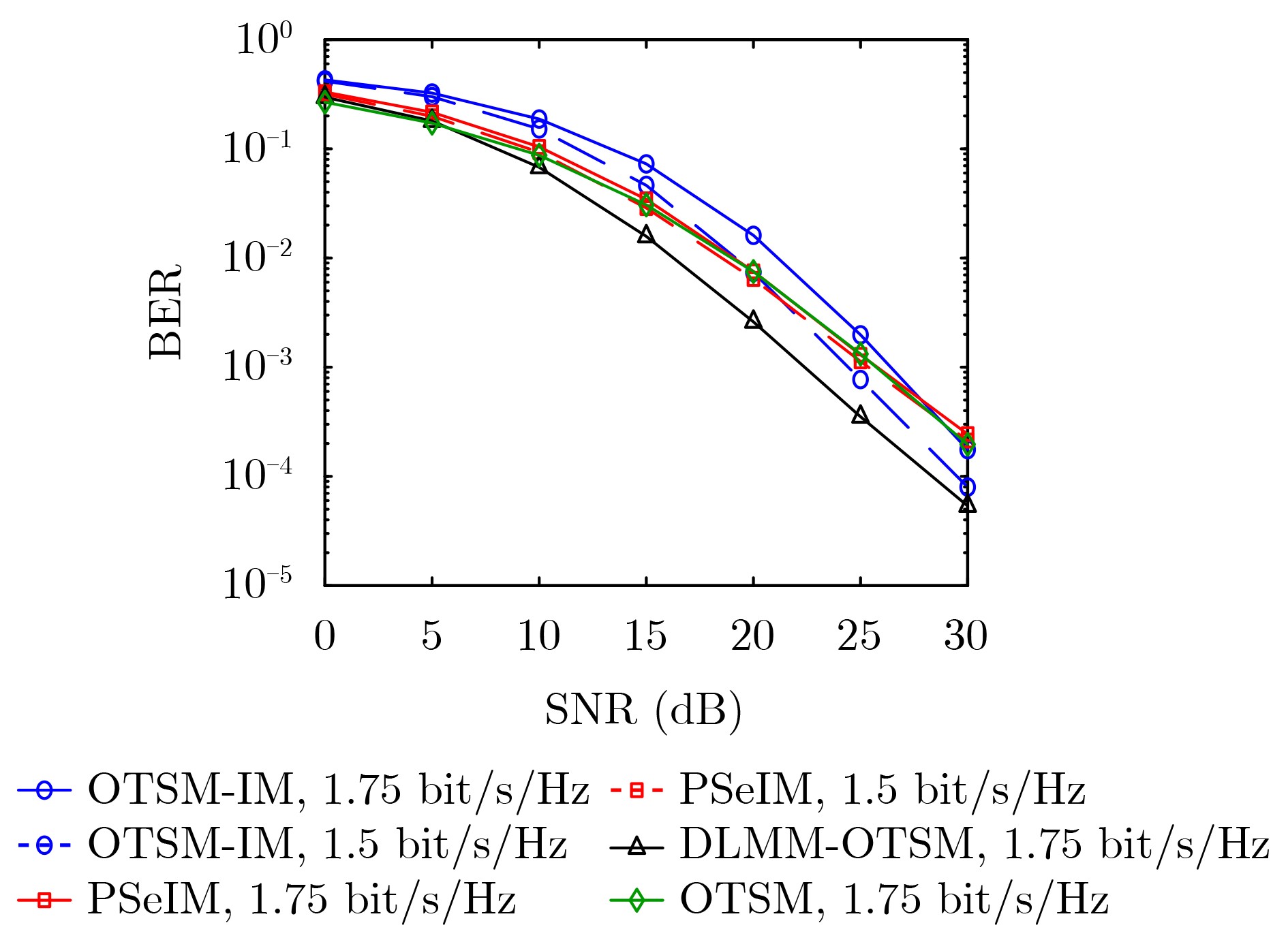
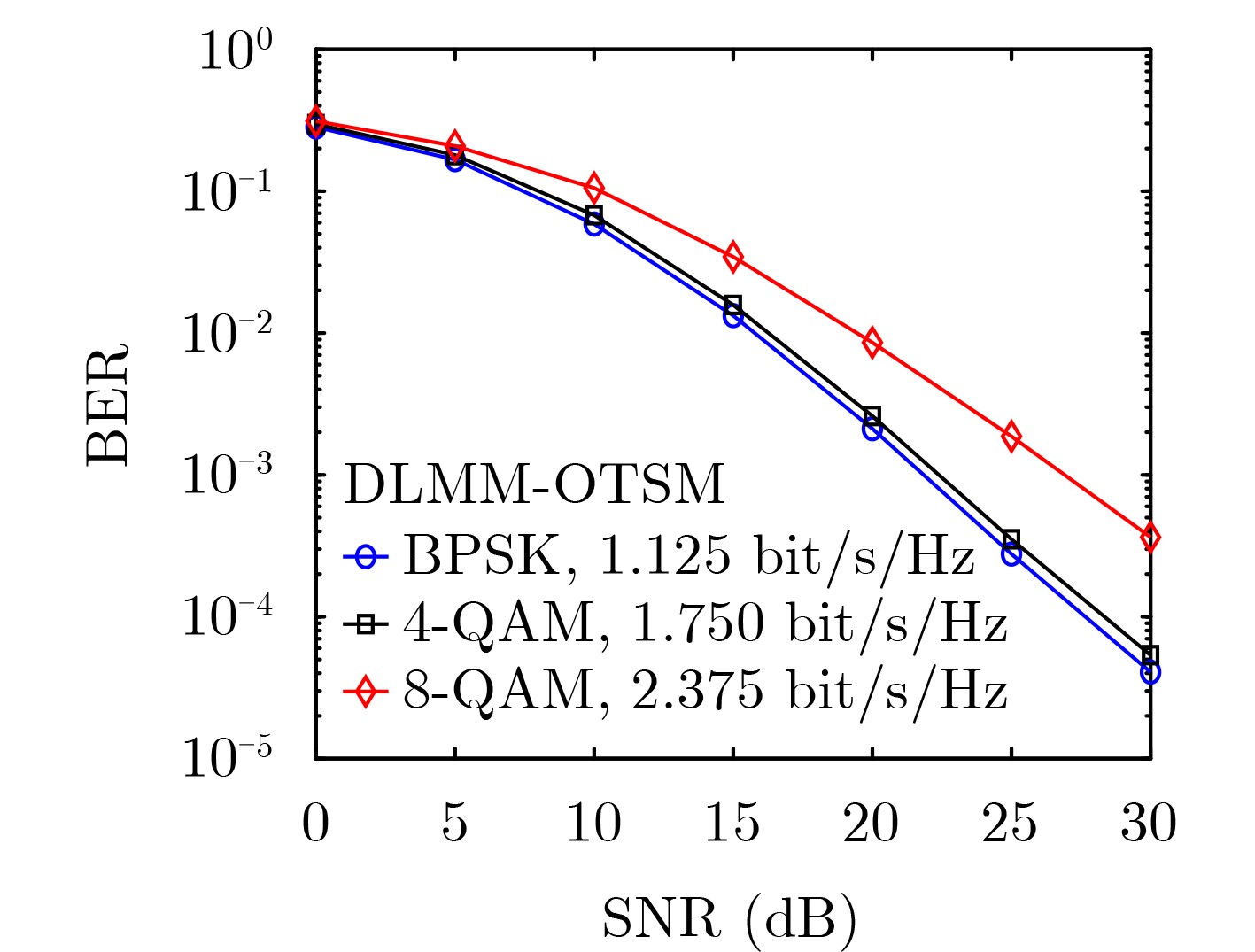
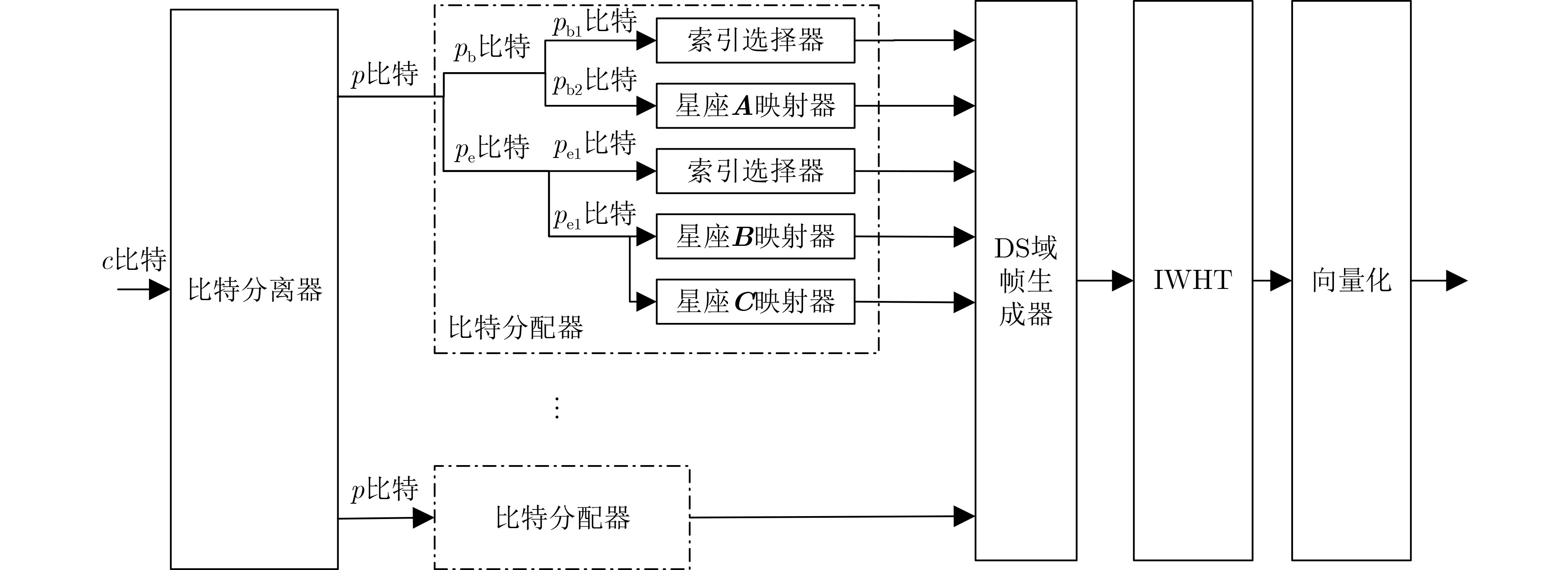
Objective High-mobility communication scenarios, including low-Earth-orbit satellite links, high-speed railway communications, and unmanned aerial vehicle networks, require reliable transmission of control information and efficient delivery of service data. Because different services have different reliability and throughput requirements, a single information-mapping structure may not adequately meet all these requirements. Orthogonal Time Sequency Multiplexing (OTSM) operates in the Delay-Sequency (DS) domain and uses the Walsh-Hadamard Transform (WHT) to support transmission over doubly dispersive channels with low implementation complexity. Index Modulation (IM) conveys information through resource indices in addition to constellation symbols. Existing OTSM-based IM schemes improve transmission reliability through sparse activation, but inactive resources limit spectral efficiency. Moreover, applying the same mapping strategy to all information bits does not account for differences in their importance. To address these limitations, a Double-Layer Multi-Mode OTSM scheme with IM, termed DLMM-OTSM, is proposed. The scheme combines a sparse base layer with a fully active enhancement layer to support differentiated transmission. Its receiver design balances detection complexity and error performance through layer-specific detection strategies and a limited number of index candidates. Methods Each group of information bits is divided between a base layer and an enhancement layer, which occupy two adjacent rows of the DS-domain grid ( Fig. 1 ). The base layer carries reliability-sensitive information using sparse single-mode IM. Its index bits select a subset of available carriers, and its symbol bits are mapped to constellation A on the selected carriers. The remaining carriers are inactive. The enhancement layer carries throughput-oriented information using full-carrier dual-mode IM. Its index bits determine which carriers use constellation B, while the remaining carriers use constellation C. Because both carrier subsets transmit symbols, all enhancement-layer carriers remain active. Constellations B and C are disjoint to distinguish their modes, and their power allocation and relative rotation help separate the constellation points (Fig. 2 ). For each layer, index patterns are selected from a shared legal mapping table, establishing a one-to-one correspondence between index bits and transmission patterns. The resulting DS-domain symbols undergo the inverse WHT and vectorization before transmission. For eight available carriers and two selected carriers, 28 carrier-position combinations are possible. Sixteen valid combinations are used to encode four index bits, and the same mapping table is used at both the transmitter and receiver (Table 1 ). With 4-ary Quadrature Amplitude Modulation (4-QAM) in all three constellations, each group carries eight base-layer bits and twenty enhancement-layer bits. Applying the legal-pattern constraint during detection prevents the receiver from selecting combinations that do not correspond to transmitted index bits. At the receiver, Maximum Likelihood (ML) detection searches legal index patterns and constellation-symbol combinations and serves as a performance benchmark. To reduce computational complexity, a Log-Likelihood Ratio (LLR) detector is developed following Minimum Mean Square Error (MMSE) equalization. The detector calculates per-carrier metrics to determine carrier activation in the base layer and constellation membership in the enhancement layer. These metrics are accumulated over legal index patterns, followed by pattern selection and symbol decisions. A single-pattern LLR decision may exclude the correct transmitted vector when individual LLR metrics are unreliable. To address this limitation, a Top-K candidate detector retains the K legal patterns with the largest accumulated metrics for each layer. Candidate signal vectors are constructed, and their Euclidean distances are evaluated using the received signal and equivalent channel matrix. The candidate with the minimum distance is selected (Algorithm 1). When K = 1, the method reduces to LLR detection. The additional computational cost is controlled by the number of retained candidate patterns. Detection complexity and spectral efficiency are analyzed, and an analytical approximation to the union bound on the Average Bit Error Probability (ABEP) is derived.Results and Discussions Simulations are conducted using an Extended Vehicular A (EVA) multipath Rayleigh fading channel with nine propagation paths, a carrier frequency of 4 GHz, and a subcarrier spacing of 15 kHz. The equivalent channel matrix is assumed to be known at the receiver. Unless otherwise specified, the relative speed is 500 km/h. Spectral efficiency is calculated from the information bits carried by the data grid, excluding cyclic-prefix overhead, using the same convention for all schemes. For M=N=8, Jb=Je =2, and 4-QAM, DLMM-OTSM achieves a spectral efficiency of 1.75 bit/(s·Hz). This value is 75% higher than that of OTSM-IM and approximately 16.7% higher than that of Pairwise Sequency Index Modulation with OTSM (PSeIM). With the carrier-selection ratios Jb/N= Je/N maintained, its spectral efficiency reaches 2 bit/(s·Hz) for a 64 × 64 DS-domain grid ( Table 2 ). At a Signal-to-Noise Ratio (SNR) of 25 dB, the Bit Error Rate (BER) is approximately 1.59 × 10⁻⁴ for the base layer and 4.29 × 10⁻⁴ for the enhancement layer. Thus, the base-layer BER is approximately 37% of the enhancement-layer BER, demonstrating differentiated reliability through the two IM structures (Fig. 5 ). Increasing K from 1 to 4 reduces BER by approximately 13.1% at 10 dB and 33.1% at 20 dB (Fig. 3 ). The analytical ABEP approximation approaches the ML-detection simulation results in the high-SNR region. Compared with ML detection, the Top-K detector incurs SNR losses of approximately 0.5 dB and 0.7 dB at BERs of 10–3 and 10–4, respectively, while reducing detection complexity (Fig. 6 ). Under equal spectral-efficiency conditions, DLMM-OTSM achieves SNR gains of approximately 4.0 dB, 3.4 dB, and 3.3 dB over OTSM-IM, PSeIM, and conventional OTSM, respectively, at a target BER of 10–3 (Fig. 7 ). A comparison of modulation orders gives spectral efficiencies of 1.125, 1.75, and 2.375 bit/(s·Hz) for Binary Phase-Shift Keying (BPSK), 4-QAM, and 8-QAM, respectively. Moving from BPSK to 4-QAM increases spectral efficiency by approximately 55.6%, with an SNR loss of approximately 0.55 dB at a BER of 10–3. Moving from 4-QAM to 8-QAM increases spectral efficiency by approximately 35.7%, but requires approximately 4.5 dB of additional SNR at the same target BER (Fig. 8 ).Conclusions DLMM-OTSM combines layered transmission and multiple IM modes to support heterogeneous data requirements in high-mobility channels. By assigning reliability-sensitive information to a sparse base layer and throughput-oriented information to a full-carrier dual-mode enhancement layer, the proposed scheme provides flexible unequal error protection and improves spectral efficiency. The LLR detector reduces receiver complexity, while the Top-K mechanism recovers much of the performance lost through single-pattern LLR decisions at a comparatively low computational cost. Theoretical analysis and simulation results demonstrate that DLMM-OTSM provides an effective tradeoff among reliability, spectral efficiency, and detection complexity. -
表 1 M=N=8,Jb=Je=2条件下索引规则示例
序号 索引比特 所选载波位置 序号 索引比特 所选载波位置 0 0000 {1,4} 8 1000 {3,6} 1 0001 {1,6} 9 1001 {3,8} 2 0010 {1,8} 10 1010 {1,5} 3 0011 {2,3} 11 1011 {4,7} 4 0100 {2,4} 12 1100 {5,6} 5 0101 {2,5} 13 1101 {5,8} 6 0110 {2,7} 14 1110 {7,8} 7 0111 {3,4} 15 1111 {6,7}  下载: 导出CSV
1 Top-K候选检测算法
(1) 根据式(22)对ym进行MMSE均衡 (2) for n=1,2, ···,N do 根据式(25)或式(29)计算位置n的LLR值 end (3) $ \boldsymbol{V}_{m}^{\text{b}}=\arg \text{Top}_{{\boldsymbol{I}}_{\text{b}}\in {\boldsymbol{U}}_{\text{b}}}^{K}\left(\displaystyle\sum \nolimits_{n\in {\boldsymbol{I}}_{\text{b}}}\gamma _{n}^{\text{b}}\right) $ $ \boldsymbol{V}_{m}^{\text{e}}=\arg \text{Top}_{{\boldsymbol{I}}_{\text{e}}\in {\boldsymbol{U}}_{\text{e}}}^{K}\left(\displaystyle\sum \nolimits_{n\in {\boldsymbol{I}}_{\text{e}}}\gamma _{n}^{\text{e}}\right) $ (4) for k=1,2, ···,K do 根据式(33)或式(36)构造候选向量$ {{\hat{\boldsymbol{x}}}}_{m,k} $ $ \widehat{k}=\arg \underset{k=1, 2, \cdots, K}{\min }{\left|\left|{\boldsymbol{y}}_{m}-{\boldsymbol{H}}_{m}\boldsymbol{x}_{\text{e},k}^{m}\right|\right|}^{2} $ end (5) 返回$ {{\hat{\boldsymbol{x}}}}_{m,k} $
下载: 导出CSV
表 2 不同网格规模下各系统理论频谱效率对比(bit/(s·Hz))
网格规模 DLMM-OTSM OTSM-IM PSeIM OTSM 8×8 1.7500 1.0000 1.5000 2.0000 16×16 1.8750 1.1250 1.5000 2.0000 32×32 1.9688 1.2188 1.5000 2.0000 64×64 2.0000 1.2500 1.5000 2.0000
下载: 导出CSV
-
[1] LEE H G, KIM J, ZHAO Jian, et al. Single-tone-based channel estimation method for OTFS systems[J]. IEEE Transactions on Communications, 2025, 73(3): 1638–1651. doi: 10.1109/TCOMM.2024.3455240. [2] HADANI R, RAKIB S, TSATSANIS M, et al. Orthogonal time frequency space modulation[C]. 2017 IEEE Wireless Communications and Networking Conference (WCNC), San Francisco, USA, 2017: 1–6. doi: 10.1109/WCNC.2017.7925924. [3] 廖勇, 罗渝, 荆亚昊. 6G新型时延多普勒通信范式: OTFS的技术优势、设计挑战、应用与前景[J]. 电子与信息学报, 2024, 46(5): 1827–1842. doi: 10.11999/JEIT231133.LIAO Yong, LUO Yu, and JING Yahao. 6G new time-delay doppler communication paradigm: Technical advantages, design challenges, applications and prospects of OTFS[J]. Journal of Electronics & Information Technology, 2024, 46(5): 1827–1842. doi: 10.11999/JEIT231133. [4] 廖勇, 李雪. 一种低复杂度的正交时频空系统接收机设计[J]. 电子与信息学报, 2024, 46(6): 2418–2424. doi: 10.11999/JEIT230625.LIAO Yong and LI Xue. Low complexity receiver design for orthogonal time frequency space systems[J]. Journal of Electronics & Information Technology, 2024, 46(6): 2418–2424. doi: 10.11999/JEIT230625. [5] THAJ T and VITERBO E. Orthogonal time sequency multiplexing modulation[C]. 2021 IEEE Wireless Communications and Networking Conference (WCNC), Nanjing, China, 2021: 1–7. doi: 10.1109/WCNC49053.2021.9417451. [6] 王震铎, 谭正锋, 孙溶辰. 基于多维扩展的正交时序复用波形框架及其性能分析[J]. 电子与信息学报, 2024, 46(3): 826–834. doi: 10.11999/JEIT230248.WANG Zhenduo, TAN Zhengfeng, and SUN Rongchen. Orthogonal time sequency multiplexing waveform framework based on multi-dimensional extension and its performance analysis[J]. Journal of Electronics & Information Technology, 2024, 46(3): 826–834. doi: 10.11999/JEIT230248. [7] BASAR E. Index modulation techniques for 5G wireless networks[J]. IEEE Communications Magazine, 2016, 54(7): 168–175. doi: 10.1109/MCOM.2016.7509396. [8] 葛利嘉, 江治林, 冯胜, 等. 非正交-码索引调制方法[J]. 电子与信息学报, 2018, 40(10): 2331–2336. doi: 10.11999/JEIT180023.GE Lijia, JIANG Zhilin, FENG Sheng, et al. Non-orthogonal-code index modulation[J]. Journal of Electronics & Information Technology, 2018, 40(10): 2331–2336. doi: 10.11999/JEIT180023. [9] ABU-ALHIGA R and HAAS H. Subcarrier-index modulation OFDM[C]. 2009 IEEE 20th International Symposium on Personal, Indoor and Mobile Radio Communications, Tokyo, Japan, 2009: 177–181. doi: 10.1109/PIMRC.2009.5449882. [10] BAŞAR E, AYGÖLÜ Ü, PANAYIRCI E, et al. Orthogonal frequency division multiplexing with index modulation[J]. IEEE Transactions on Signal Processing, 2013, 61(22): 5536–5549. doi: 10.1109/TSP.2013.2279771. [11] ZHANG Siyu and SHAHRRAVA B. Polar-coded OFDM with index modulation[J]. IEEE Access, 2021, 9: 237–247. doi: 10.1109/ACCESS.2020.3044546. [12] MAO Tianqi, WANG Zhaocheng, WANG Qi, et al. Dual-mode index modulation aided OFDM[J]. IEEE Access, 2017, 5: 50–60. doi: 10.1109/ACCESS.2016.2601648. [13] ZHANG Siyu, ZHANG Yuexia, and SHAHRRAVA B. Orthogonal time frequency space with sub-band index modulation[J]. IEEE Communications Letters, 2025, 29(5): 1047–1051. doi: 10.1109/LCOMM.2025.3553446. [14] ZHANG Guoying, JIANG Xueqin, HAI Han, et al. Index modulation aided orthogonal time sequency multiplexing[C]. ICC 2025—IEEE International Conference on Communications, Montreal, Canada, 2025: 1–6. doi: 10.1109/ICC52391.2025.11160981. [15] DOOSTI-AREF A, MASOUROS C, BASAR E, et al. Pairwise sequency index modulation with OTSM for green and robust single-carrier communications[J]. IEEE Wireless Communications Letters, 2024, 13(4): 1083–1087. doi: 10.1109/LWC.2024.3360256. [16] 蔡穗华, 王义文, 白宝明, 等. 面向高可靠低时延通信的信道编码技术研究综述[J]. 电子学报, 2025, 53(2): 629–644. doi: 10.12263/DZXB.20240137.CAI Suihua, WANG Yiwen, BAI Baoming, et al. Channel coding techniques for ultra-reliable and low-latency communication[J]. Acta Electronica Sinica, 2025, 53(2): 629–644. doi: 10.12263/DZXB.20240137. [17] 张雪婉, 张迪, 古博. 面向短包通信的分组稀疏矢量码[J]. 电子与信息学报, 2026, 48(1): 116–125. doi: 10.11999/JEIT251143.ZHANG Xuewan, ZHANG Di, and GU Bo. Group-based sparse vector codes for short-packet communications[J]. Journal of Electronics & Information Technology, 2026, 48(1): 116–125. doi: 10.11999/JEIT251143. [18] 3GPP. ETSI TS 136 101 V8.3. 0 Evolved Universal Terrestrial Radio Access (E-UTRA); User Equipment (UE) radio transmission and reception[S]. Sophia Antipolis: ETSI, 2008. -


 下载:

图(8) / 表(3)
计量
- 文章访问数: 121
- HTML全文浏览量: 31
- PDF下载量: 3
- 被引次数: 0
