




A Reliable Semantic Transmission Framework for Low-Altitude Image Perception
-
摘要: 低空智能系统在空中巡检、智慧物流、应急搜救等场景中需要持续获取并回传图像感知信息,其传输质量影响着下游场景识别与任务决策。与以比特级精确恢复为目标的传统通信方式不同,任务导向语义通信更关注对下游任务真正有效的语义信息传递。然而,低空无线链路动态变化明显,低空图像又易受到语义噪声干扰,导致现有方法存在语义特征易失真、传输鲁棒性不足等问题。为此,该文提出一种面向低空图像感知的语义可靠传输框架。该框架由鲁棒特征提取模块、联合信源信道编解码模块和语义知识库模块组成。其中,鲁棒特征提取模块结合局部多尺度建模与全局状态空间对偶(SSD)建模,提取对语义噪声不敏感的任务相关特征;联合信源信道编码模块可以压缩鲁棒语义特征提升传输效率;语义知识库模块通过增大基元向量间距离以增强语义特征的判别性与抗干扰能力。在UCMerced-LandUse和NWPU-RESISC45数据集上的实验结果表明,在加性高斯白噪声(AWGN)与瑞利衰落信道以及不同语义噪声强度条件下,该文方法均优于现有方法,能够有效提升低空场景图像感知任务的传输精度与鲁棒性。Abstract:
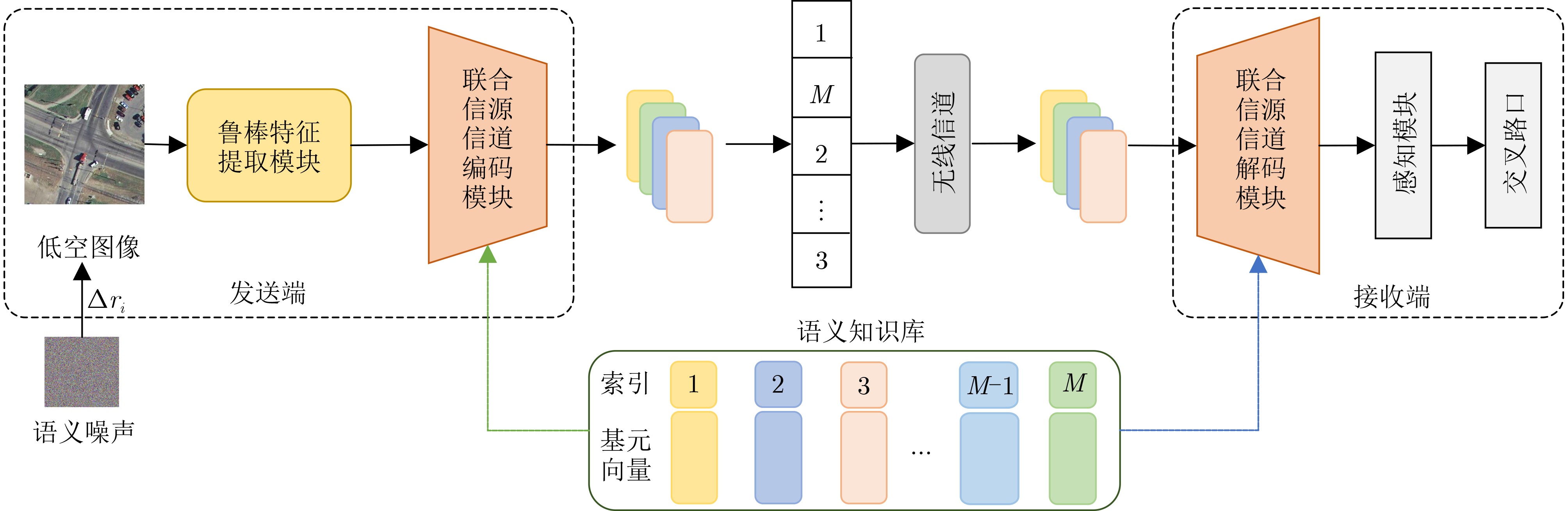
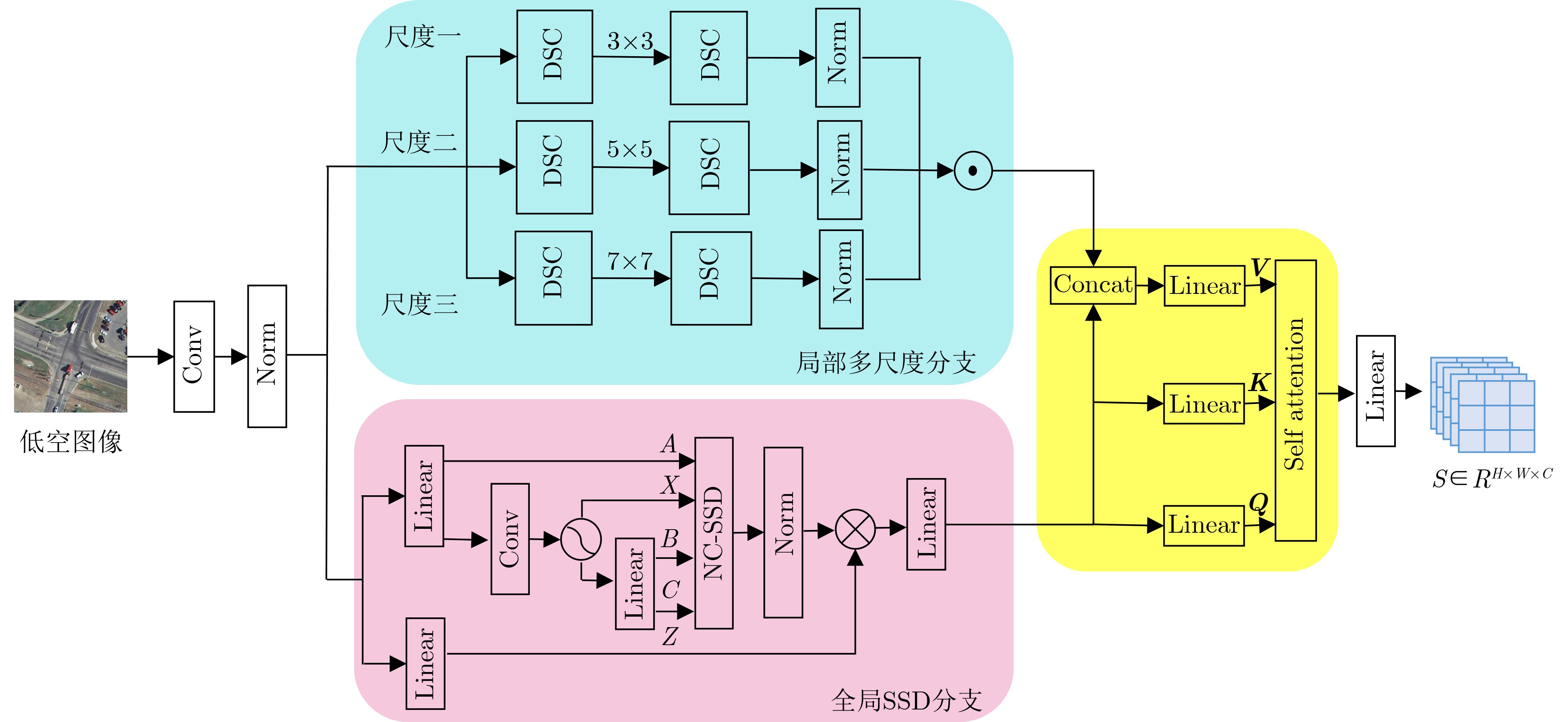
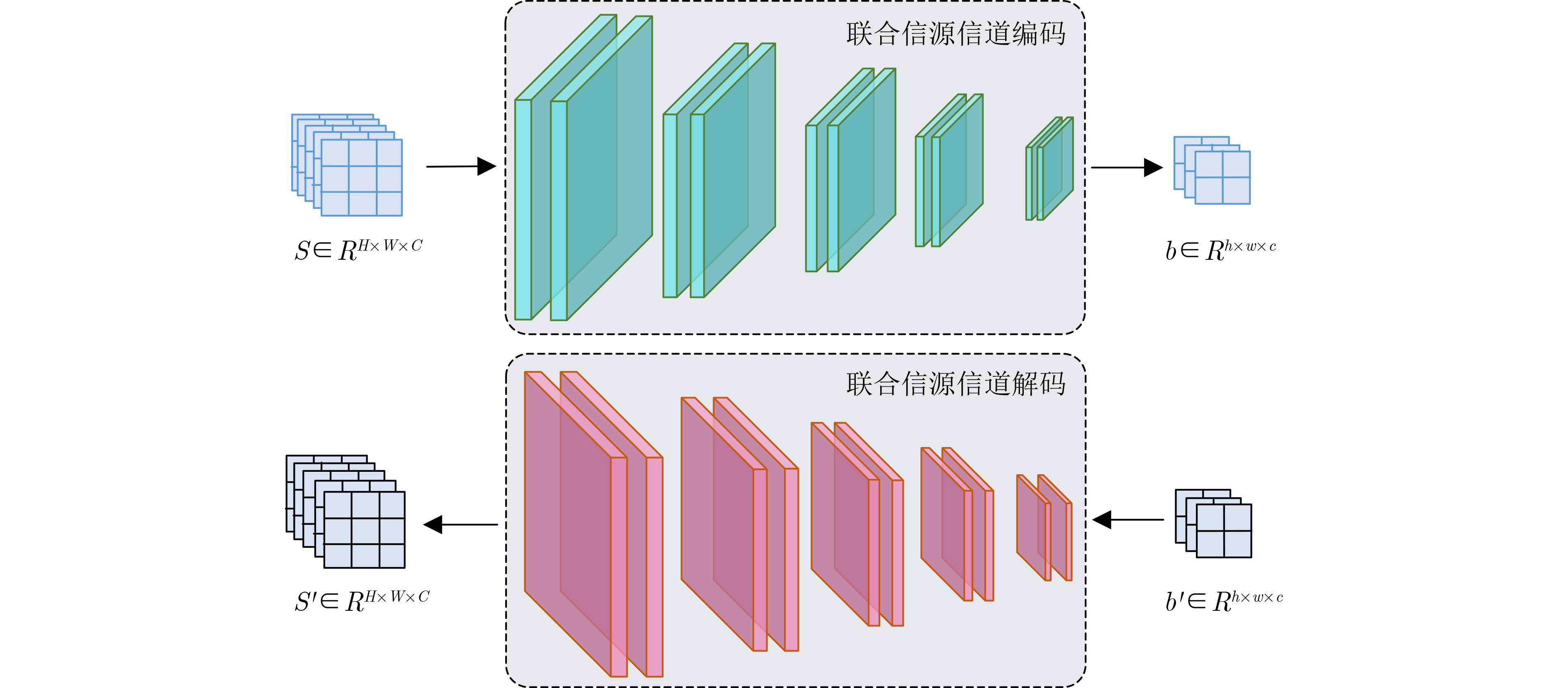
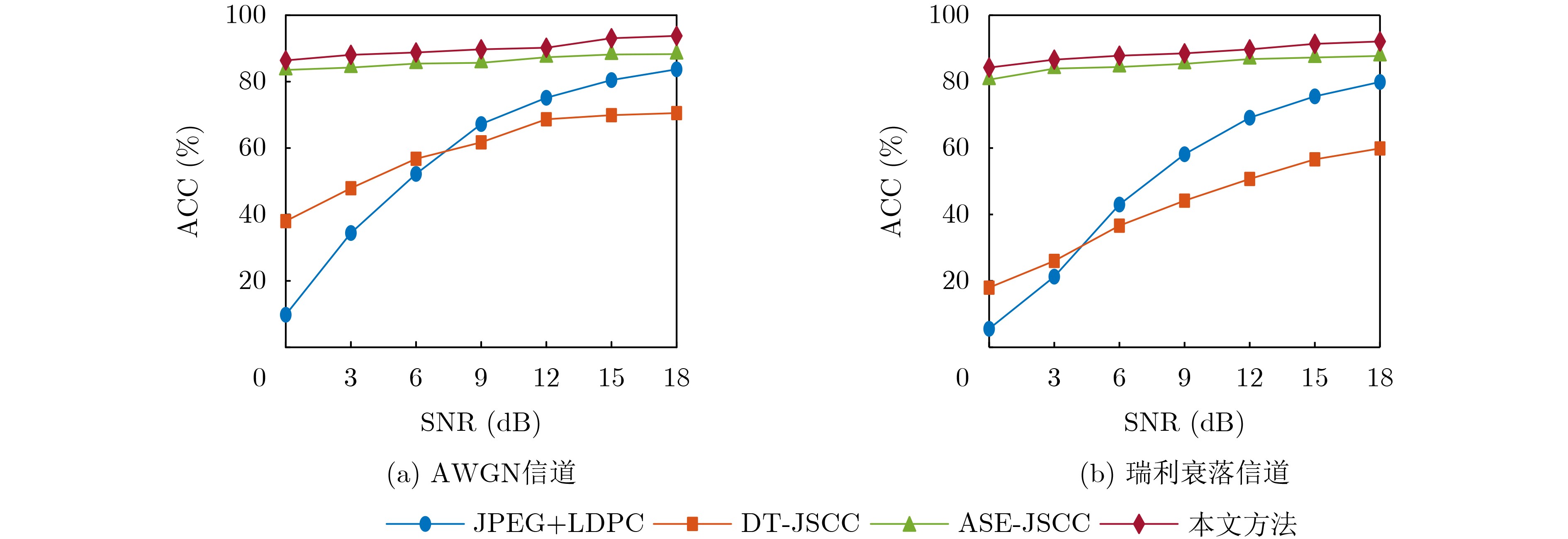
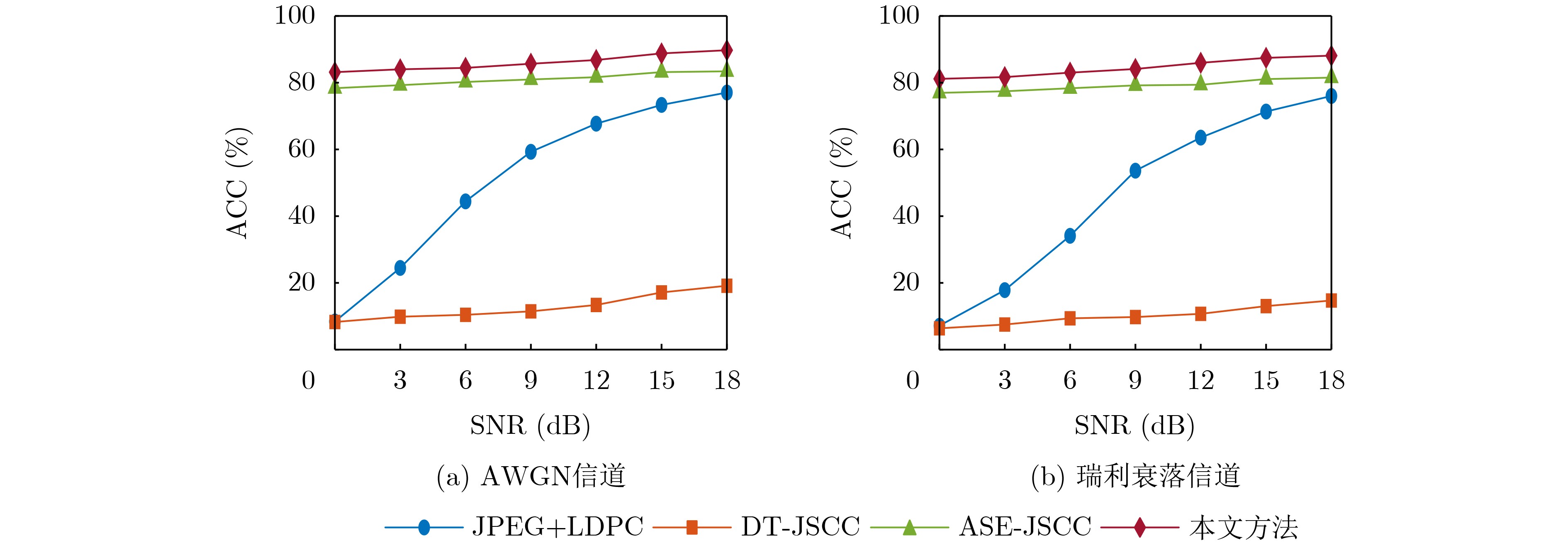
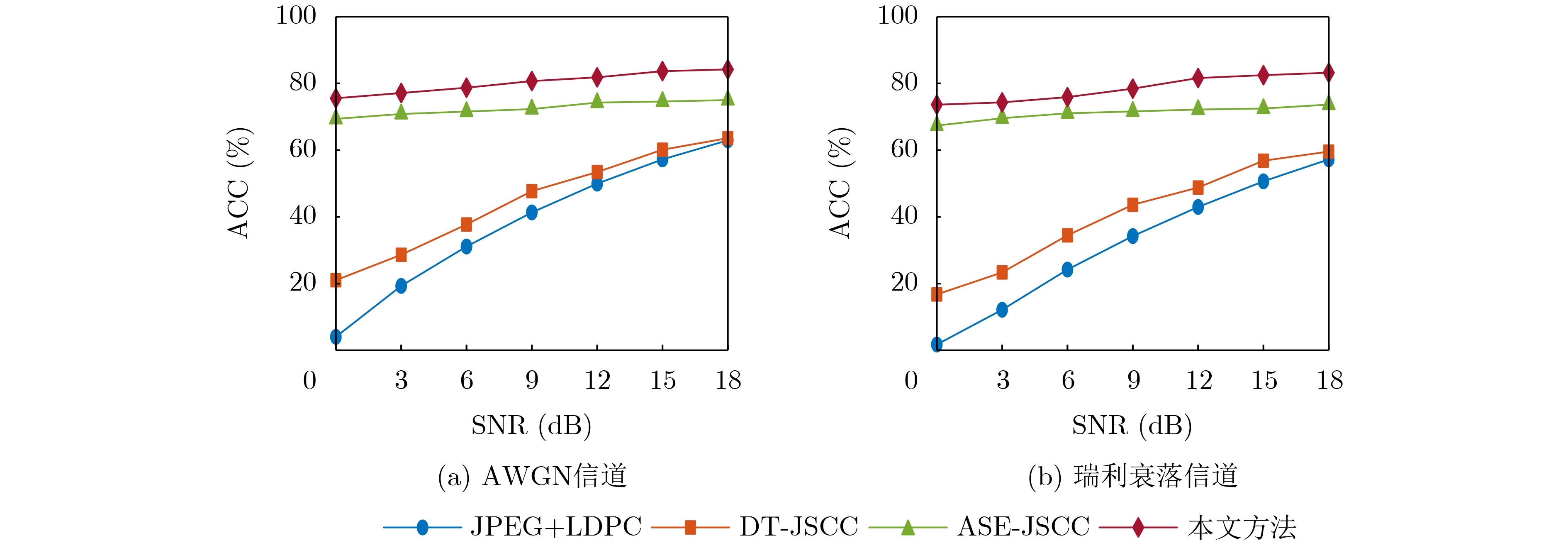
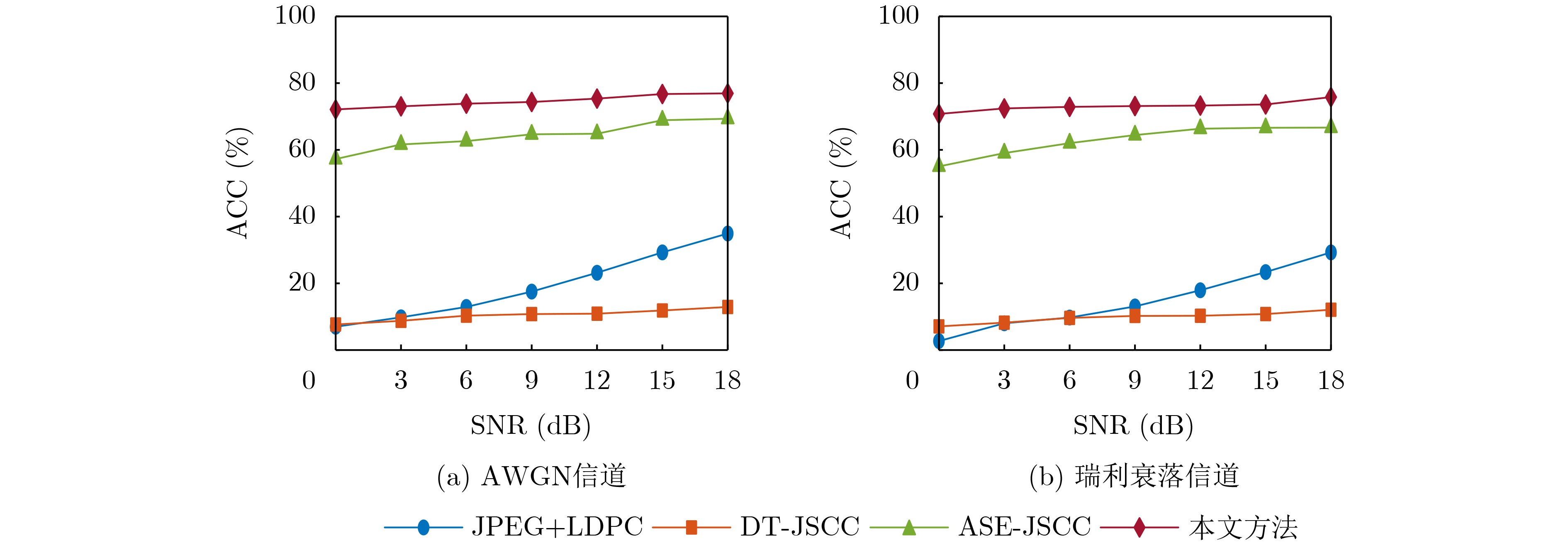
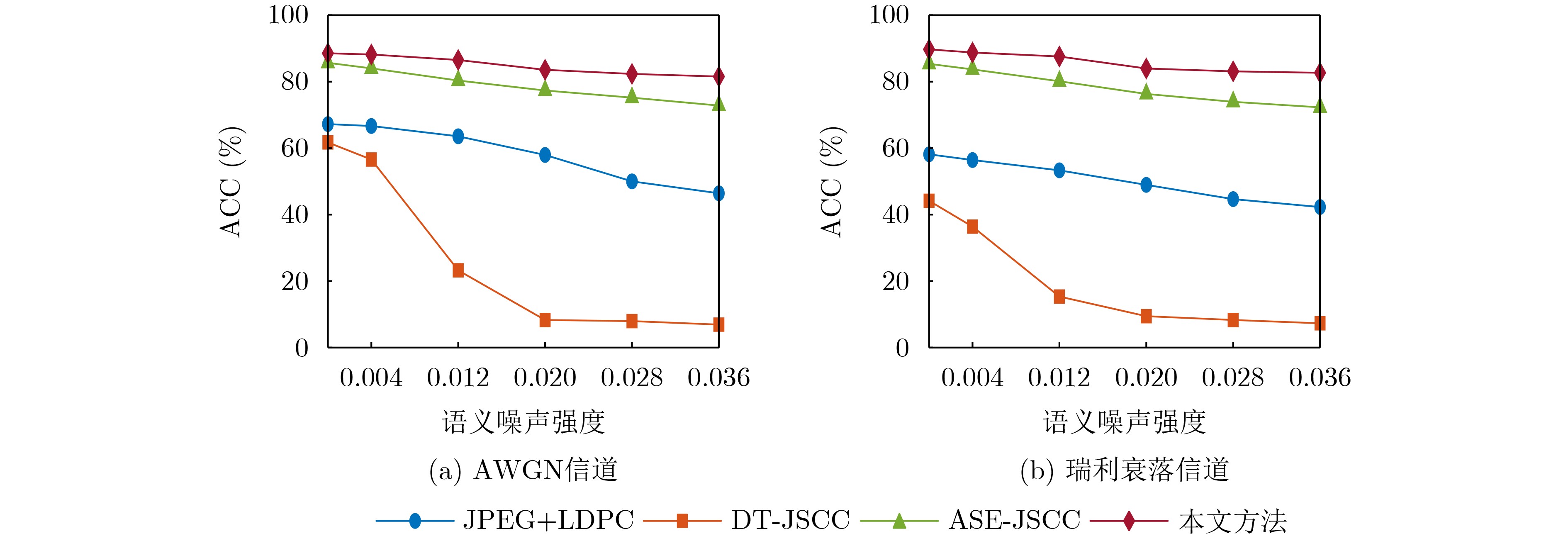
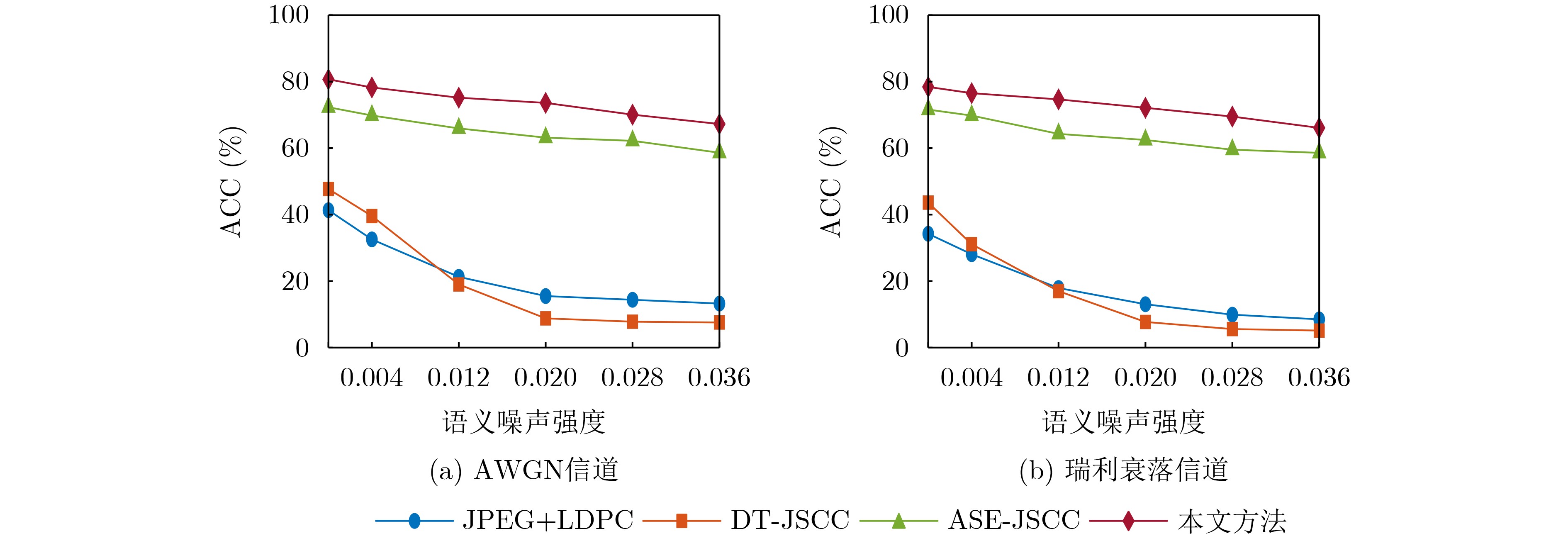
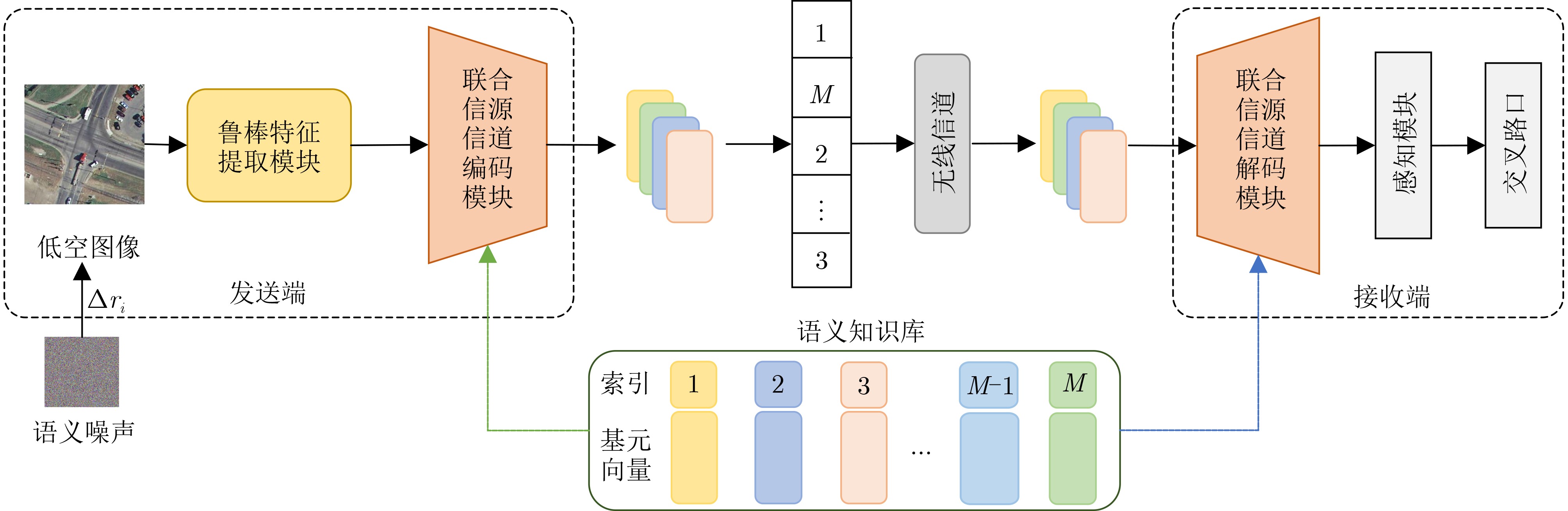
Objective Low-altitude intelligent platforms support aerial inspection, smart logistics, emergency search and rescue, and disaster monitoring by transmitting image observations to edge or ground receivers. Reliable scene recognition depends on preserving task-relevant information over wireless links with limited bandwidth and varying channel conditions. Conventional image transmission emphasizes accurate pixel- or bit-level recovery, which can consume communication resources by transmitting image content that contributes little to downstream tasks. In contrast, task-oriented semantic communication prioritizes discriminative information for scene perception. However, platform motion, occlusion, and multipath propagation can cause fluctuations in wireless channel conditions, whereas small input perturbations can distort extracted semantic features and alter classification results. Moreover, low-altitude images contain fine-grained local textures and complex spatial structures, requiring both local details and global structural information for reliable scene perception. To address these challenges, a reliable semantic transmission framework for low-altitude image perception is proposed to preserve task-relevant features under varying channel conditions and semantic noise. The framework aims to improve classification accuracy at the receiver through the joint design of robust feature extraction, compact semantic transmission, and a shared semantic knowledge base. Methods Semantic noise is modeled as a constrained task-related perturbation generated using the Fast Gradient Sign Method (FGSM), which increases classification loss while maintaining small visual changes. The proposed framework consists of a Robust Feature Extraction Module (RFEM), a Joint Source-Channel Coding (JSCC) encoder and decoder, a shared Semantic Knowledge Base (SKB), and a scene perception module. The transmitter is deployed on the low-altitude platform, whereas the receiver is located at an edge or ground node ( Fig. 1 ). The RFEM combines a local multi-scale branch with a global State Space Duality (SSD) branch. The local branch uses depthwise separable convolutions with kernel sizes of 3 × 3, 5 × 5, and 7 × 7 to extract textures, edges, and local structures at different scales. The global branch employs Non-Causal State Space Duality (NC-SSD) to capture long-range spatial dependencies among image regions. Both branches generate 256-dimensional features, which are integrated through an eight-head attention fusion block to produce representations that are less sensitive to semantic noise (Fig. 2 ). The JSCC encoder consists of five convolutional layers that compress robust semantic features, while the corresponding decoder uses five deconvolutional layers to recover task-relevant semantic representations at the receiver (Fig. 3 ). The SKB contains trainable semantic primitive vectors shared between the transmitter and receiver. Continuous encoded features are mapped to their nearest primitive vectors, and the corresponding indices are transmitted for retrieval at the receiver. During training, a straight-through estimator approximates gradients through the non-differentiable nearest-neighbor mapping. Feature-to-primitive alignment is promoted, and similarity between different primitive vectors is reduced to improve feature discriminability and limit semantic feature confusion. The recovered semantic representations are processed by the scene perception module using global average pooling, a fully connected layer, and a softmax function (Fig. 4 ). The entire framework is optimized end to end using cross-entropy classification loss and SKB-related constraints. Performance is evaluated on the UCMerced-LandUse dataset, which contains 21 scene categories, and the NWPU-RESISC45 dataset, which contains 45 categories. All experimental results are averaged over three independent runs.Results and Discussions Classification accuracy is evaluated under Additive White Gaussian Noise (AWGN) and Rayleigh fading channels. The comparison methods include Joint Photographic Experts Group (JPEG) image compression combined with Low-Density Parity-Check (LDPC) channel coding, DT-JSCC with discrete task representations and digital modulation, and ASE-JSCC with attention-based semantic encoding and decoding. At a Signal-to-Noise Ratio (SNR) of 3 dB, the proposed framework achieves classification accuracies of 87.07% and 85.62% on UCMerced-LandUse without semantic noise under AWGN and Rayleigh fading channels, respectively, exceeding ASE-JSCC by 2.83 and 1.69 percentage points. With semantic noise, the corresponding accuracies are 83.01% and 80.68%, representing improvements of 3.75 and 3.25 percentage points over ASE-JSCC (Table 1). Under the same channel conditions, the proposed framework achieves accuracies of 76.12% and 73.31% on NWPU-RESISC45 without semantic noise, exceeding ASE-JSCC by 5.28 and 3.74 percentage points, respectively. With semantic noise, the accuracies reach 72.54% and 71.42%, compared with 61.62% and 59.03% for ASE-JSCC, corresponding to improvements of 10.92 and 12.39 percentage points ( Table 2 ). The larger improvements on NWPU-RESISC45 indicate that the proposed framework better preserves discriminative semantic information in more complex scene classification tasks. Ablation experiments at an SNR of 3 dB further evaluate the contributions of the RFEM and SKB. On UCMerced-LandUse, removing the RFEM reduces classification accuracy to 77.38% and 75.79% under AWGN and Rayleigh fading channels, respectively, whereas removing the SKB reduces accuracy to 71.47% and 69.05%. Removing both modules further reduces accuracy to 63.85% and 57.96%, compared with 87.07% and 85.62% for the complete framework (Table 3). On NWPU-RESISC45, the corresponding accuracies are 66.27% and 62.93% without the RFEM, 61.03% and 58.74% without the SKB, and 52.38% and 50.44% without both modules, compared with 76.12% and 73.31% for the complete framework (Table 4 ). These results demonstrate the complementary contributions of robust feature extraction and discrete semantic representation. Removing the SKB causes a greater reduction in classification accuracy than removing the RFEM on both datasets, indicating the importance of the shared semantic knowledge base for preserving discriminative semantic representations. Across all evaluated SNRs, the proposed framework consistently achieves the highest classification accuracy among the compared methods on UCMerced-LandUse, both with and without semantic noise (Figs. 5 and6 ). Similar advantages are observed on NWPU-RESISC45 under both channel models (Figs. 7 and8 ). As semantic noise intensity increases from 0 to 0.036, classification accuracy generally decreases for all methods. Nevertheless, the proposed framework consistently maintains the highest accuracy on both datasets, demonstrating its robustness to different semantic noise intensities (Figs. 9 and10 ). Model complexity analysis shows that the proposed framework contains 4.77 million parameters, fewer than the 11.28 million and 14.54 million parameters of DT-JSCC and ASE-JSCC, respectively. Its computational cost is 6.45 billion Floating-Point Operations (FLOPs), with an inference latency of 6.93 ms. Although its computational cost and inference latency are higher than those of ASE-JSCC, the proposed framework achieves higher classification accuracy with fewer model parameters. These results indicate that the improvements in classification accuracy and robustness are achieved at the expense of greater computational cost and inference latency relative to ASE-JSCC (Table 5 ).Conclusions The proposed framework improves task-oriented semantic transmission for low-altitude image perception by preserving local discriminative details and global structural information through the RFEM, compressing task-relevant features using JSCC, and improving semantic discriminability and robustness through the shared SKB. Experimental results demonstrate that the proposed framework achieves higher classification accuracy than JPEG+LDPC, DT-JSCC, and ASE-JSCC under AWGN and Rayleigh fading channels, both with and without semantic noise. Ablation experiments further confirm the complementary contributions of the RFEM and SKB to reliable semantic transmission. The proposed framework maintains superior classification performance across different SNRs and semantic noise intensities, demonstrating its effectiveness in improving task-oriented transmission reliability for low-altitude scene perception under the evaluated channel conditions. -
表 1 不同方法在UCMerced-LandUse数据集上的分类准确率对比(%)
数据集 方法 不同信道下的分类准确率 AWGN信道 瑞利衰落信道 不包含
语义噪声JPEG+LDPC 34.42 21.28 DT-JSCC 47.91 26.01 ASE-JSCC 84.24 83.93 本文方法 87.07 85.62 包含
语义噪声JPEG+LDPC 24.48 17.83 DT-JSCC 9.86 7.52 ASE-JSCC 79.26 77.43 本文方法 83.01 80.68  下载: 导出CSV
表 2 不同方法在NWPU-RESISC45数据集上的分类准确率对比(%)
数据集 方法 不同信道下的分类准确率 AWGN信道 瑞利衰落信道 不包含
语义噪声JPEG+LDPC 19.31 12.16 DT-JSCC 28.64 23.35 ASE-JSCC 70.84 69.57 本文方法 76.12 73.31 包含
语义噪声JPEG+LDPC 9.81 8.02 DT-JSCC 8.76 8.21 ASE-JSCC 61.62 59.03 本文方法 72.54 71.42
下载: 导出CSV
表 3 不同方法在UCMerced-LandUse数据集上的分类准确率对比(%)
方法 不同信道下的分类准确率 AWGN信道 瑞利衰落信道 本文方法缺少RFEM 77.38 75.79 本文方法缺少SKB 71.47 69.05 本文方法缺少RFEM和SKB 63.85 57.96 本文方法 87.07 85.62
下载: 导出CSV
表 4 不同方法在NWPU-RESISC45数据集上的分类准确率对比(%)
方法 不同信道下的分类准确率 AWGN信道 瑞利衰落信道 本文方法缺少RFEM 66.27 62.93 本文方法缺少SKB 61.03 58.74 本文方法缺少RFEM和SKB 52.38 50.44 本文方法 76.12 73.31
下载: 导出CSV
表 5 不同方法在UCMerced-LandUse数据集上的模型复杂度
方法 模型参数量(M) FLOPs(G) 推理延迟(ms) JPEG+LDPC - - 50.4 DT-JSCC 11.28 5.17 10.31 ASE-JSCC 14.54 3.29 4.53 本文方法 4.77 6.45 6.93
下载: 导出CSV
-
[1] HU Qiyu, ZHANG Guangyi, QIN Zhijin, et al. Robust semantic communications with masked VQ-VAE enabled codebook[J]. IEEE Transactions on Wireless Communications, 2023, 22(12): 8707–8722. doi: 10.1109/TWC.2023.3265201. [2] FU Yuzhou, CHENG Wenchi, and ZHANG Wei. Content-aware semantic communication for goal-oriented wireless communications[C]. IEEE INFOCOM 2023 - IEEE Conference on Computer Communications Workshops (INFOCOM WKSHPS), Hoboken, USA, 2023: 1–6. doi: 10.1109/INFOCOMWKSHPS57453.2023.10226153. [3] ERDEMIR E, TUNG T Y, DRAGOTTI P L, et al. Generative joint source-channel coding for semantic image transmission[J]. IEEE Journal on Selected Areas in Communications, 2023, 41(8): 2645–2657. doi: 10.1109/JSAC.2023.3288243. [4] DAI Jincheng, WANG Sixian, YANG Ke, et al. Toward adaptive semantic communications: Efficient data transmission via online learned nonlinear transform source-channel coding[J]. IEEE Journal on Selected Areas in Communications, 2023, 41(8): 2609–2627. doi: 10.1109/JSAC.2023.3288246. [5] 石光明, 杨旻曦, 高大化, 等. 面向语义信息直传的通信架构[J]. 通信学报, 2023, 44(5): 15–27. doi: 10.11959/j.issn.1000-436x.2023098.SHI Guangming, YANG Minxi, GAO Dahua, et al. Communication framework for directed transmission of informative semantic[J]. Journal on Communications, 2023, 44(5): 15–27. doi: 10.11959/j.issn.1000-436x.2023098. [6] XU Jialong, TUNG T Y, AI Bo, et al. Deep joint source-channel coding for semantic communications[J]. IEEE Communications Magazine, 2023, 61(11): 42–48. doi: 10.1109/MCOM.004.2200819. [7] 张中强, 邱奇, 苗雅杰, 等. 面向无人机航拍图像传输的信道弹性编解码方法[J]. 物联网学报, 2026, 10(2): 12–23. doi: 10.11959/j.issn.2096-3750.WLW25161.ZHANG Zhongqiang, QIU Qi, MIAO Yajie, et al. A channel elastic encoding and decoding method for unmanned aerial vehicle image transmission[J]. Chinese Journal on Internet of Things, 2026, 10(2): 12–23. doi: 10.11959/j.issn.2096-3750.WLW25161. [8] 石光明, 高大化, 杨旻曦, 等. 信号的语义刻画与度量[J]. 电子学报, 2022, 50(9): 2068–2078. doi: 10.12263/DZXB.20210238.SHI Guangming, GAO Dahua, YANG Minxi, et al. Semantic characterization and measurement of signals[J]. Acta Electronica Sinica, 2022, 50(9): 2068–2078. doi: 10.12263/DZXB.20210238. [9] XIE Huiqiang, QIN Zhijin, LI G Y, et al. Deep learning enabled semantic communication systems[J]. IEEE Transactions on Signal Processing, 2021, 69: 2663–2675. doi: 10.1109/TSP.2021.3071210. [10] HUH Y, SEO H, and CHOI W. Universal joint source-channel coding for modulation-agnostic semantic communication[J]. IEEE Journal on Selected Areas in Communications, 2025, 43(7): 2560–2574. doi: 10.1109/JSAC.2025.3559138. [11] PENG Xiang, QIN Zhijin, TAO Xiaoming, et al. A robust semantic communication system for image transmission[C]. GLOBECOM 2024 - 2024 IEEE Global Communications Conference, Cape Town, South Africa, 2024: 2154–2159. doi: 10.1109/GLOBECOM52923.2024.10901733. [12] ZHANG Guangyi, HU Qiyu, QIN Zhijin, et al. A unified multi-task semantic communication system for multimodal data[J]. IEEE Transactions on Communications, 2024, 72(7): 4101–4116. doi: 10.1109/TCOMM.2024.3364990. [13] ZHANG Hongwei, TAO Meixia, SUN Yaping, et al. Improving learning-based semantic coding efficiency for image transmission via shared semantic-aware codebook[J]. IEEE Transactions on Communications, 2025, 73(2): 1217–1232. doi: 10.1109/TCOMM.2024.3450877. [14] MA Shuai, QIAO Weining, WU Youlong, et al. Task-oriented explainable semantic communications[J]. IEEE Transactions on Wireless Communications, 2023, 22(12): 9248–9262. doi: 10.1109/TWC.2023.3269444. [15] TUNG T Y, KURKA D B, JANKOWSKI M, et al. DeepJSCC-Q: Constellation constrained deep joint source-channel coding[J]. IEEE Journal on Selected Areas in Information Theory, 2022, 3(4): 720–731. doi: 10.1109/JSAIT.2022.3231042. [16] 王文远, 周明宇, 王朝炜, 等. 面向空天地网络的弹性语义通信[J]. 电子与信息学报, 2025, 47(10): 3646–3657. doi: 10.11999/JEIT250077.WANG Wenyuan, ZHOU Mingyu, WANG Chaowei, et al. Resilient semantic communication for space-air-ground networks[J]. Journal of Electronics & Information Technology, 2025, 47(10): 3646–3657. doi: 10.11999/JEIT250077. [17] 申滨, 李旋, 赖雪冰, 等. 基于Swin Transformer的宽带无线图传语义联合编解码方法[J]. 电子与信息学报, 2025, 47(8): 2665–2674. doi: 10.11999/JEIT250039.SHEN Bin, LI Xuan, LAI Xuebing, et al. Swin Transformer-based wideband wireless image transmission semantic joint encoding and decoding method[J]. Journal of Electronics & Information Technology, 2025, 47(8): 2665–2674. doi: 10.11999/JEIT250039. [18] ZHANG Zhongqiang, ZHANG Shuhang, QIU Qi, et al. A channel adaptive encoding and decoding method for unmanned aerial vehicle image transmission[J]. IEEE Internet of Things Journal, 2026, 13(14): 31064–31078. doi: 10.1109/JIOT.2026.3686205. [19] ZHANG Zhongqiang, ZHANG Shuhang, LI Haoyong, et al. An elastic coding and decoding method for satellite remote sensing image semantic transmission[J]. IEEE Transactions on Network Science and Engineering, 2026, 13: 3485–3498. doi: 10.1109/TNSE.2025.3632547. [20] 张祖凡, 尹星然, 周建萍, 等. 面向语义重要性和鲁棒性的RIS增强语义通信系统[J]. 电子与信息学报, 2025, 47(8): 2608–2620. doi: 10.11999/JEIT250159.ZHANG Zufan, YIN Xingran, ZHOU Jianping, et al. RIS-enhanced semantic communication systems oriented towards semantic importance and robustness[J]. Journal of Electronics & Information Technology, 2025, 47(8): 2608–2620. doi: 10.11999/JEIT250159. [21] MADRY A, MAKELOV A, SCHMIDT L, et al. Towards deep learning models resistant to adversarial attacks[C]. 6th International Conference on Learning Representations, Vancouver, Canada, 2018. [22] WEI Kai, XIE Renjie, XU Wei, et al. Robust semantic communication via adversarial training[J]. IEEE Transactions on Vehicular Technology, 2025, 74(12): 19849–19853. doi: 10.1109/TVT.2025.3585536. [23] NAN Guoshun, LI Zhichun, ZHAI Jinli, et al. Physical-layer adversarial robustness for deep learning-based semantic communications[J]. IEEE Journal on Selected Areas in Communications, 2023, 41(8): 2592–2608. doi: 10.1109/JSAC.2023.3288249. [24] SHI Jiting, ZHANG Qianyun, ZENG Weihao, et al. Secure transmission in wireless semantic communications with adversarial training[J]. IEEE Communications Letters, 2025, 29(3): 487–491. doi: 10.1109/LCOMM.2025.3526601. [25] KANG Jiawen, HE Jiayi, DU Hongyang, et al. Adversarial attacks and defenses for semantic communication in vehicular metaverses[J]. IEEE Wireless Communications, 2023, 30(4): 48–55. doi: 10.1109/MWC.004.2200617. [26] PENG Xiang, QIN Zhijin, TAO Xiaoming, et al. A robust image semantic communication system with multi-scale vision transformer[J]. IEEE Journal on Selected Areas in Communications, 2025, 43(4): 1278–1291. doi: 10.1109/JSAC.2025.3531413. [27] CHEN Gong, NAN Guoshun, JIANG Zhanghao, et al. Lightweight and robust wireless semantic communications[J]. IEEE Communications Letters, 2024, 28(11): 2633–2637. doi: 10.1109/LCOMM.2024.3409559. [28] GOODFELLOW I J, SHLENS J, and SZEGEDY C. Explaining and harnessing adversarial examples[C]. 3rd International Conference on Learning Representations, San Diego, USA, 2015. [29] CHOLLET F. Xception: Deep learning with depthwise separable convolutions[C]. 2017 IEEE Conference on Computer Vision and Pattern Recognition (CVPR), Honolulu, USA, 2017: 1800–1807. doi: 10.1109/CVPR.2017.195. [30] SHI Yuheng, LI Mingjia, DONG Minjing, et al. VSSD: Vision mamba with non-causal state space duality[C]. The IEEE/CVF International Conference on Computer Vision (ICCV), Honolulu, USA, 2025: 10819–10829. doi: 10.1109/ICCV51701.2025.01007. [31] VAN DEN OORD A, VINYALS O, and KAVUKCUOGLU K. Neural discrete representation learning[C]. The 31st International Conference on Neural Information Processing Systems, Long Beach, USA, 2017: 6309–6318. [32] YANG Yi and NEWSAM S. Geographic image retrieval using local invariant features[J]. IEEE Transactions on Geoscience and Remote Sensing, 2013, 51(2): 818–832. doi: 10.1109/TGRS.2012.2205158. [33] CHENG Gong, HAN Junwei, and LU Xiaoqiang. Remote sensing image scene classification: Benchmark and state of the art[J]. Proceedings of the IEEE, 2017, 105(10): 1865–1883. doi: 10.1109/JPROC.2017.2675998. [34] WALLACE G K. The JPEG still picture compression standard[J]. Communications of the ACM, 1991, 34(4): 30–44. doi: 10.1145/103085.103089. [35] RICHARDSON T and KUDEKAR S. Design of low-density parity check codes for 5G new radio[J]. IEEE Communications Magazine, 2018, 56(3): 28–34. doi: 10.1109/MCOM.2018.1700839. [36] XIE Songjie, MA Shuai, DING Ming, et al. Robust information bottleneck for task-oriented communication with digital modulation[J]. IEEE Journal on Selected Areas in Communications, 2023, 41(8): 2577–2591. doi: 10.1109/JSAC.2023.3288252. [37] JIANG Yan, XIE Kun, OUYANG Yudian, et al. High quality compression and transmission of remote sensing images based on semantic communication[J]. IEEE Transactions on Sustainable Computing, 2025, 10(5): 843–857. doi: 10.1109/TSUSC.2025.3544249. -

 下载:


图(10) / 表(5)
计量
- 文章访问数: 125
- HTML全文浏览量: 26
- PDF下载量: 6
- 被引次数: 0
