




Lightweight Image-to-image Steganography Based on Improved Bidimensional Empirical Mode Decomposition and a Dual-domain Graph Convolutional Network
-
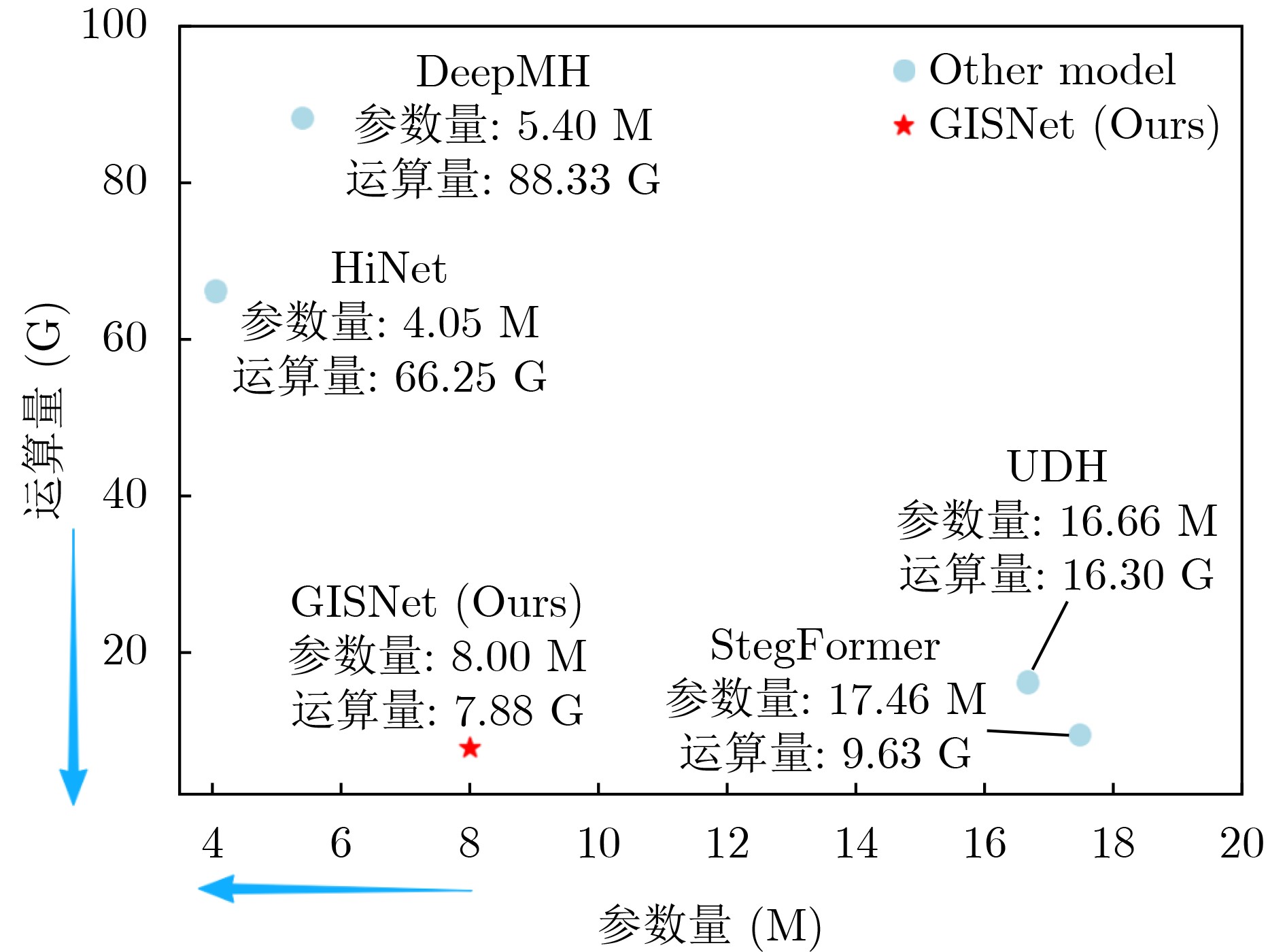
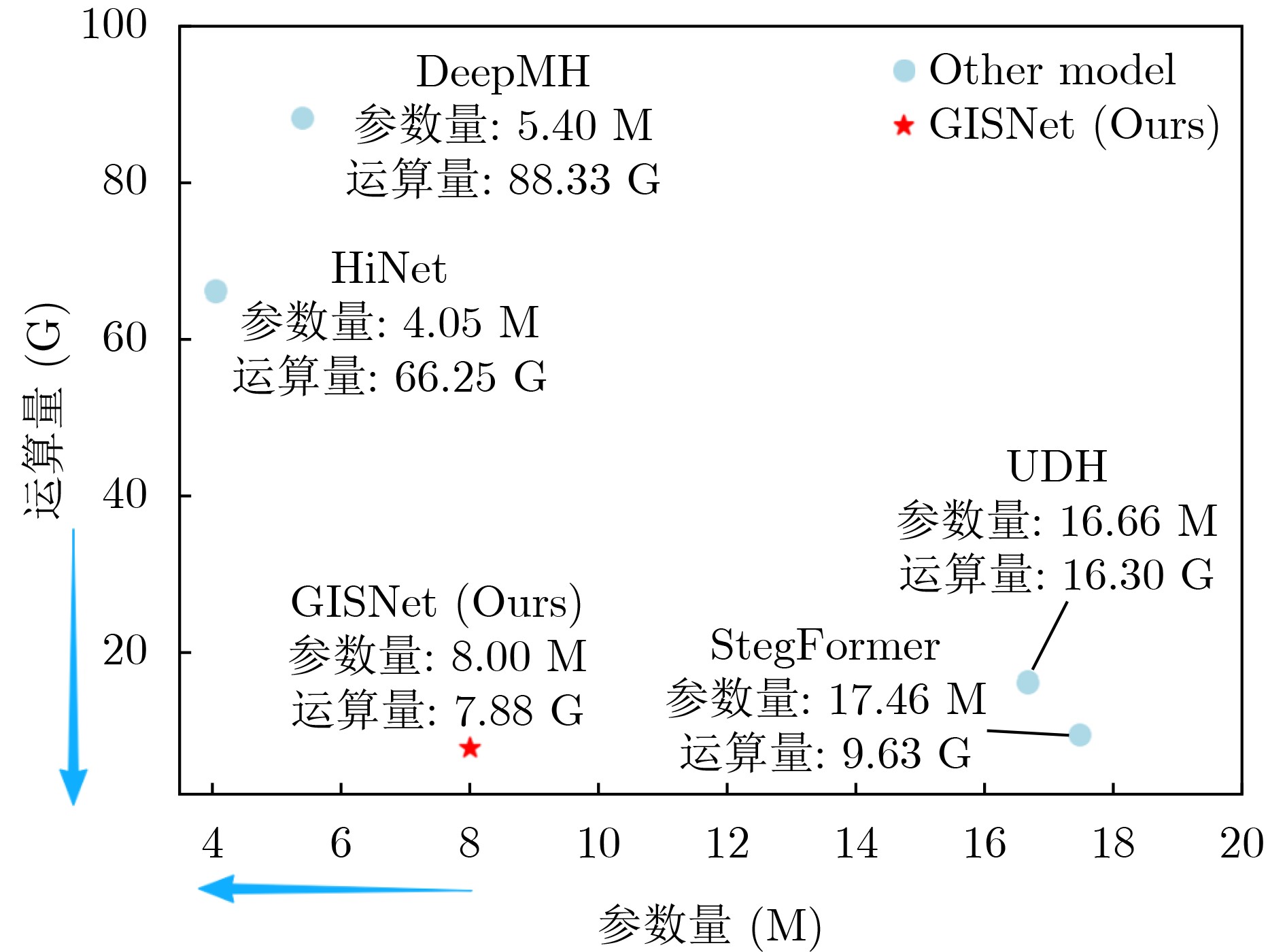
摘要: 针对现有单域图像隐写方法面临的难以同时兼顾隐蔽性、抗隐写分析能力与运行效率,以及高性能模型结构复杂、难以轻量化部署等问题,该文提出一种基于改进经验模态分解与双域图卷积的轻量化图像隐写网络模型。首先,利用改进的二维经验模态分解模块将秘密图像自适应分解为多尺度分量,以实现隐秘信息在不同形态组件中的自适应层级分散;其次,设计多尺度空频块,通过融合多分支扩张卷积、注意力机制与频域感知单元,实现空间域与频域特征的深度融合与协同优化,在增强抗检测能力的同时确保秘密信息的高保真提取;最后,引入改进的图特征神经网络作为瓶颈层,利用高效的稀疏图卷积操作显式建模远距离像素关联,在有效表征非连续纹理区修改模式的同时大幅降低模型计算复杂度。实验结果表明,该模型参数量仅为8.00 M,计算成本仅为7.88 GFLOPs,单幅图像推理时延低至76 ms,展现出显著的轻量化特征与高运行效率,更适用于资源受限的实际部署环境。Abstract:
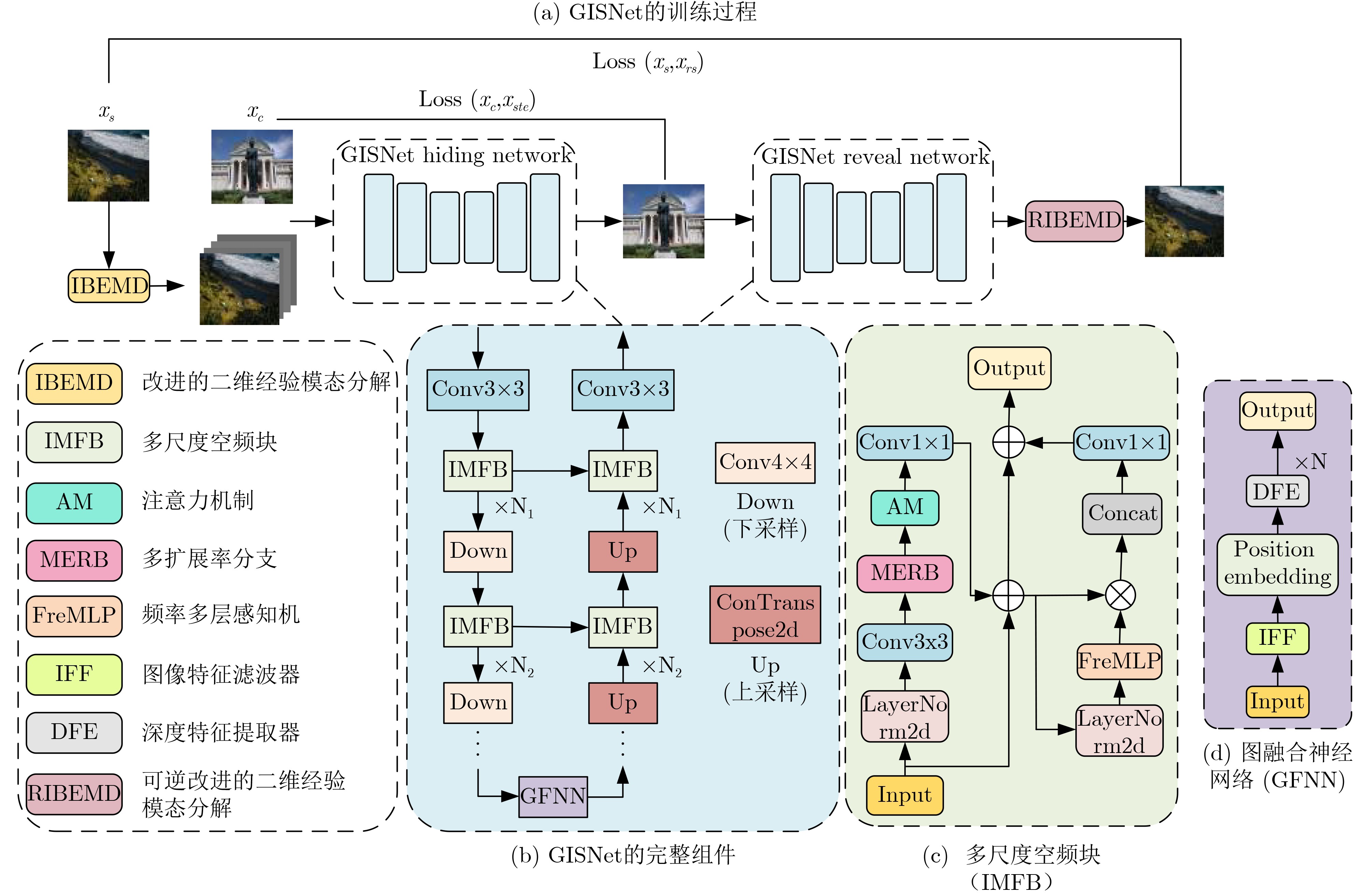
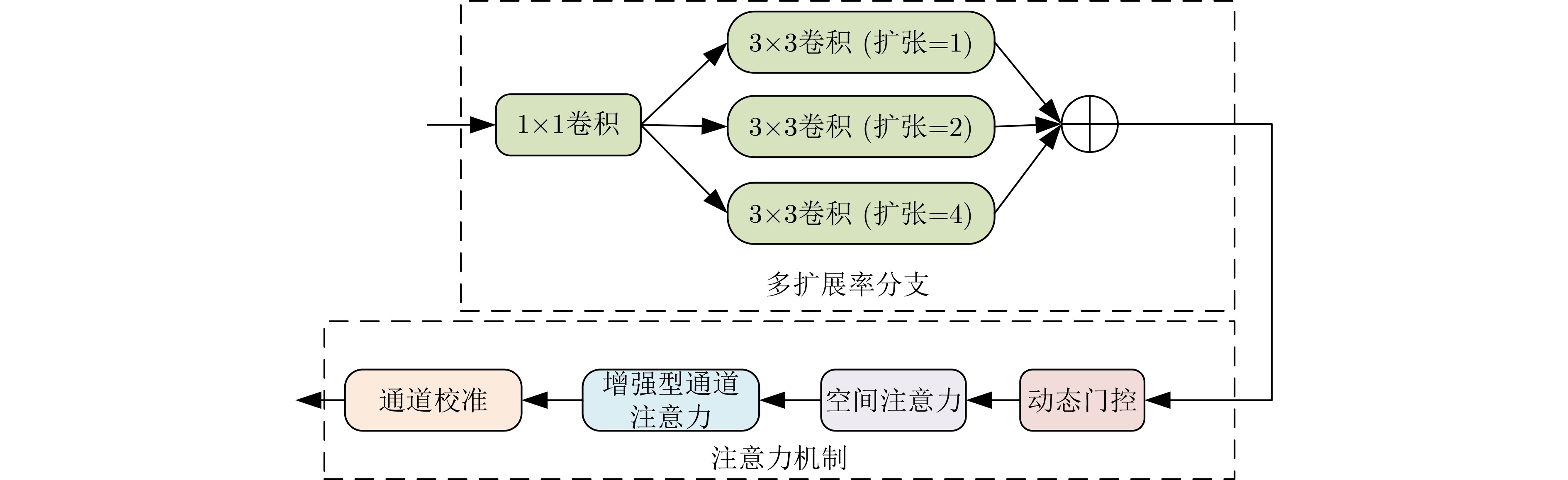
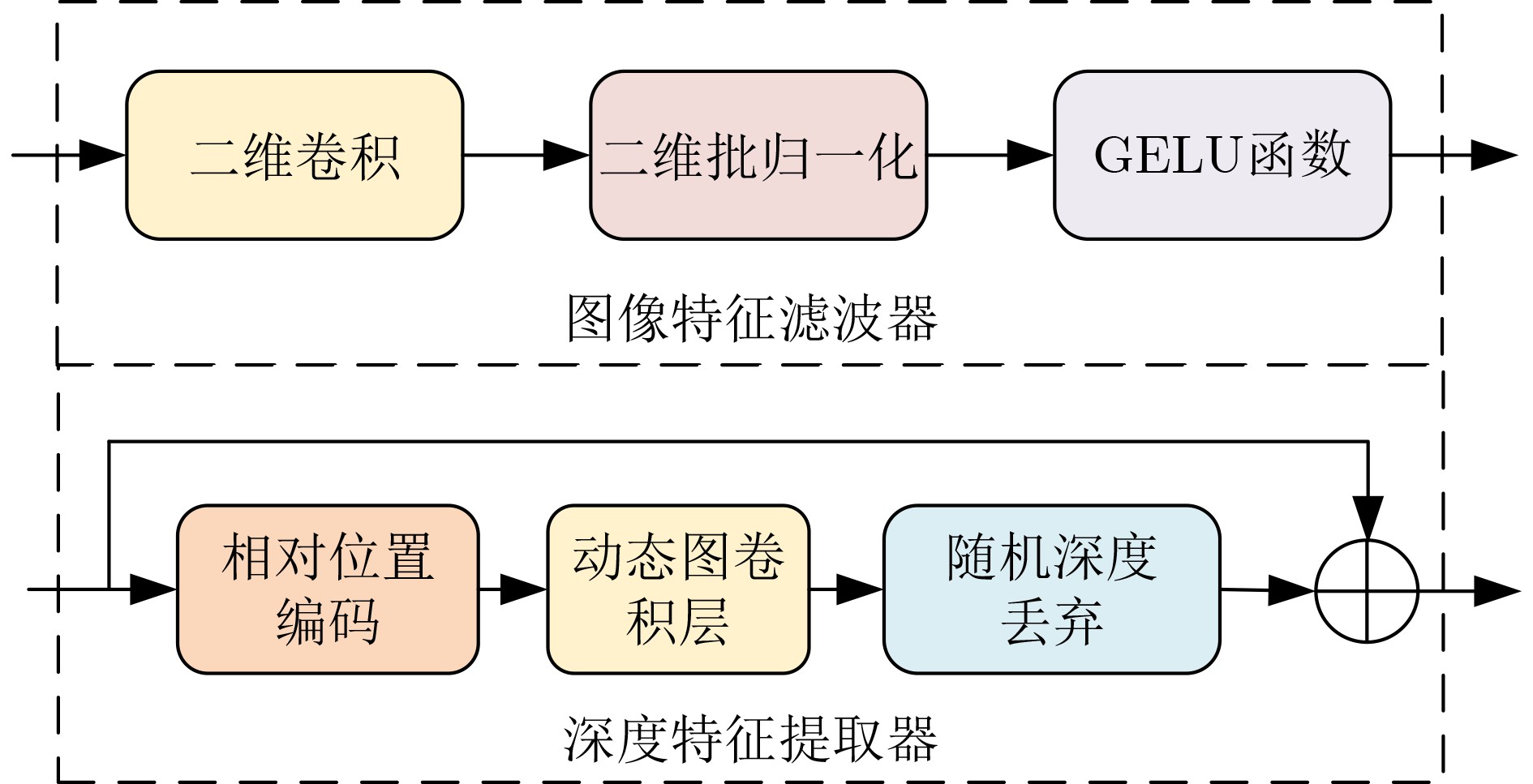
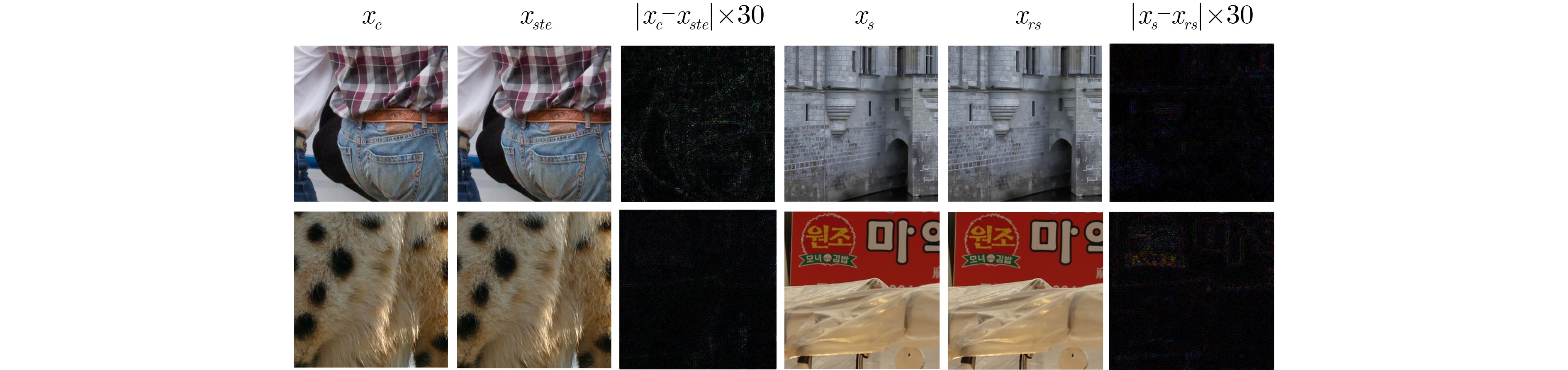
Objective Image steganography embeds secret information into a cover image for secure transmission and is an important technique for confidential communication and privacy protection. With the development of deep learning, learning-based steganography has substantially improved embedding capacity and reconstruction quality. However, high steganographic performance, strong resistance to steganalysis, and lightweight design remain difficult to achieve simultaneously. This trade-off has become a major obstacle to practical deployment. Single-domain methods have difficulty balancing these requirements, whereas existing high-performance models are often structurally complex and difficult to deploy in resource-constrained environments. Moreover, mainstream dual-domain schemes generally assume that embedding distortion follows a continuous distribution in the spatial and frequency domains. In practice, however, steganographic modifications tend to concentrate in discontinuous, complex-texture regions of the cover image. To address these problems, a lightweight image steganography network is designed to jointly optimize the embedding and extraction paths. The aim is to improve stego image quality and resistance to steganalysis while maintaining low computational cost and inference latency. Methods A lightweight steganographic network named GISNet is proposed. An encoder-decoder architecture with skip connections is adopted, and the hiding and extraction networks are structurally symmetric but do not share weights. First, Improved Bidimensional Empirical Mode Decomposition (IBEMD) is used to adaptively decompose the secret image into multiple intrinsic mode functions and a residual component. The secret information is thereby hierarchically dispersed among components with different morphological characteristics. Gaussian blur replaces extremum interpolation to estimate the local mean envelope, and the separability of the Gaussian kernel is used to reduce computational complexity. Fixed Gaussian parameters and ensemble averaging are further used to support deterministic and reversible reconstruction. Next, the Innovative Multispatial FreqBlock (IMFB) is designed by integrating multibranch dilated convolutions, an attention mechanism, dynamic gating, and frequency-domain processing. Spatial- and frequency-domain features are jointly processed to improve resistance to detection while maintaining high-fidelity extraction of secret information. Finally, the GraphFusion Neural Network (GFNN) is used as the bottleneck layer. A sparse graph is constructed in the feature space using the K-nearest-neighbor algorithm, and messages are propagated only among highly similar nonlocal nodes. Long-range pixel associations are therefore modeled explicitly, modification patterns in discontinuous texture regions are represented more effectively, and model complexity is substantially reduced. The hiding and extraction networks are jointly optimized using a four-term loss function consisting of the hiding loss, restriction loss, Laplacian pyramid loss, and perceptual loss. The terminology and module functions follow those defined in the main manuscript. Results and Discussions GISNet achieves the best overall hiding and recovery performance on DIV2K, COCO, and ImageNet, demonstrating high reconstruction quality and strong cross-dataset generalization ( Table 1 ). On DIV2K, the Peak Signal-to-Noise Ratio (PSNR) reaches 58.07 dB for cover/stego image pairs and 60.10 dB for secret/recovered secret image pairs. The cover and stego images are visually indistinguishable, and the residual maps remain nearly black even after 30-fold magnification (Fig. 5 ). Ablation experiments show that replacing the Discrete Wavelet Transform (DWT) with IBEMD increases the PSNR by 8.04 dB and 5.57 dB for the two types of image pairs, respectively (Table 2 ). The complete combination of IBEMD, IMFB, and GFNN produces the best results. These findings confirm the complementary effects of hierarchical information dispersion, multiscale spatial-frequency mapping, and nonlocal feature association (Table 3 ). Multi-dilation-rate branches and joint spatial-frequency processing further improve hiding quality and recovery accuracy (Tables 4 and5 ). Under four steganalysis methods, the detection accuracies range from 49.35% to 49.65%, indicating that the stego images are difficult to distinguish from natural cover images (Table 6 ). GISNet contains only 8.00 M parameters and requires 7.88 GFLOPs, with an inference time of 76 ms (Table 7 ). These results demonstrate that GISNet effectively balances visual quality, recovery accuracy, resistance to steganalysis, and computational efficiency. The manuscript reports the same comparative and computational results.Conclusions A lightweight dual-domain graph convolutional network for image steganography, named GISNet, is proposed. The experimental results support the following conclusions. (1) IBEMD hierarchically disperses secret information and supports deterministic and reversible reconstruction, providing a reliable basis for high-quality hiding and recovery. (2) IMFB and GFNN jointly improve stego image quality and resistance to steganalysis, enabling the stego images to resist detection by multiple steganalysis tools. (3) The lightweight design based on depthwise separable convolutions and sparse graph construction significantly reduces model complexity and computational cost, making GISNet suitable for deployment in resource-constrained environments. Future work will focus on robustness against channel interference and extensions to multi-image and cross-modal steganography to further improve the security and applicability of the proposed scheme. The lightweight mechanisms are consistent with the manuscript, which attributes the low computational cost to depthwise separable convolutions in IMFB and KNN-based sparse graph construction in GFNN. -
表 1 单图像隐藏结果
方法 载体/载密图像对 DIV2K ( 1024 ×1024 )COCO (256 × 256) ImageNet (256 × 256) PSNR(dB) SSIM MAE RMSE PSNR(dB) SSIM MAE RMSE PSNR(dB) SSIM MAE RMSE HiDDeN[7] 32.48 0.9172 9.73 13.93 32.98 0.9137 9.66 13.39 32.95 0.9124 9.87 13.60 UDH[31] 44.68 0.8913 3.58 4.43 43.89 0.8988 3.79 4.65 43.87 0.9018 3.81 4.66 HiNet[3] 50.79 0.9926 1.46 2.06 45.98 0.9806 2.43 3.56 46.00 0.9853 2.49 3.55 DeepMIH[10] 43.73 0.9873 2.21 3.14 43.13 0.9721 2.83 3.91 43.29 0.9621 2.74 4.21 DAH-Net[29] 49.39 0.9896 1.72 2.79 46.15 0.9856 2.96 3.84 45.75 0.9857 2.98 3.78 StegFormer[30] 56.30 0.9956 0.73 1.23 48.77 0.9884 1.41 2.48 48.79 0.9859 1.51 2.50 CamStegNet[32] 38.36 0.9798 / 3.26 40.05 0.9776 / 2.70 39.49 0.9774 / 2.88 本文 58.07 0.9972 0.64 1.07 49.42 0.9911 1.03 2.35 48.96 0.9894 1.43 2.41 方法 秘密/恢复秘密图像对 DIV2K ( 1024 ×1024 )COCO (256 × 256) Imagenet (256 × 256) PSNR(dB) SSIM MAE RMSE PSNR(dB) SSIM MAE RMSE PSNR(dB) SSIM MAE RMSE HiDDeN[7] 39.24 0.9502 3.54 5.29 36.29 0.9235 5.32 8.01 36.02 0.9132 5.02 7.32 UDH[31] 42.02 0.9781 2.15 3.23 34.75 0.9175 4.82 7.79 34.62 0.9034 5.29 8.22 HiNet[3] 52.32 0.9936 0.88 1.28 47.06 0.9796 1.82 2.78 47.07 0.9764 1.95 2.86 DeepMIH[10] 47.92 0.9892 1.76 2.54 45.31 0.9698 2.83 3.53 45.83 0.9889 2.79 3.54 DAH-Net[29] 50.72 0.9896 1.54 1.98 47.46 0.9726 1.54 2.17 47.35 0.9834 2.07 2.95 StegFormer[30] 55.45 0.9964 0.73 1.08 49.21 0.9882 1.48 2.33 49.18 0.9851 1.62 2.41 CamStegNet[32] 31.94 0.9314 / 6.70 32.47 0.9273 / 6.30 31.95 0.9192 / 6.96 本文 60.10 0.9964 0.72 0.97 53.43 0.9929 1.11 2.04 50.10 0.9907 1.51 2.17 注:“/”表示该对应指标未在原始出版物中报告,且该方法的源代码尚未公开发布;最佳结果以粗体显示,次优结果以下划线标出。  下载: 导出CSV
表 2 不同分解方法的实验结果
分解方式 载体/载密图像对 秘密/恢复秘密图像对 PSNR(dB) SSIM MAE RMSE PSNR(dB) SSIM MAE RMSE DWT 50.03 0.9846 1.64 2.77 54.53 0.9914 0.96 0.97 IBEMD 58.07 0.9972 0.64 1.07 60.10 0.9964 0.72 0.97
下载: 导出CSV
表 3 IBEMD, IMFB和GFNN的消融实验结果
IBEMD IMFB GFNN 载体/载密图像对 秘密/恢复秘密图像对 PSNR(dB) SSIM MAE RMSE PSNR(dB) SSIM MAE RMSE × × × 30.83 0.9803 4.08 9.89 38.33 0.9814 2.29 2.19 × √ × 53.24 0.9930 0.90 1.55 52.17 0.9927 0.96 1.67 × × √ 51.50 0.9926 0.94 1.78 52.91 0.9931 0.99 1.88 × √ √ 54.31 0.9938 1.13 1.53 53.31 0.9949 0.84 1.20 √ × × 52.46 0.9914 0.91 1.48 51.28 0.9937 0.91 1.80 √ √ × 54.19 0.9937 0.81 1.23 56.78 0.9956 0.89 1.20 √ × √ 54.27 0.9942 0.79 1.37 56.34 0.9951 0.90 1.31 √ √ √ 58.07 0.9972 0.64 1.07 60.10 0.9964 0.72 0.97
下载: 导出CSV
表 4 膨胀卷积的消融实验结果
扩展分支 载体/载密图像对 秘密/恢复秘密图像对 PSNR(dB) SSIM MAE RMSE PSNR(dB) SSIM MAE RMSE × 52.96 0.9943 0.97 1.57 54.98 0.9950 0.90 1.57 √ 58.07 0.9972 0.64 1.07 60.10 0.9964 0.72 0.97
下载: 导出CSV
表 5 不同域的使用的实验结果
空域 频域 载体/载密图像对 秘密/恢复秘密图像对 PSNR(dB) SSIM MAE RMSE PSNR(dB) SSIM MAE RMSE × √ 51.78 0.9927 0.99 1.54 53.36 0.9929 1.12 2.01 √ × 52.43 0.9951 0.86 1.44 56.16 0.9950 0.88 1.53 √ √ 58.07 0.9972 0.64 1.07 60.10 0.9964 0.72 0.97
下载: 导出CSV
-
[1] ZENG Kai, CHEN Kejiang, ZHANG Weiming, et al. Robust steganography for high quality images[J]. IEEE Transactions on Circuits and Systems for Video Technology, 2023, 33(9): 4893–4906. doi: 10.1109/TCSVT.2023.3250750. [2] BALUJA S. Hiding images within images[J]. IEEE Transactions on Pattern Analysis and Machine Intelligence, 2020, 42(7): 1685–1697. doi: 10.1109/TPAMI.2019.2901877. [3] JING Junpeng, DENG Xin, XU Mai, et al. HiNet: Deep image hiding by invertible network[C]. The IEEE/CVF International Conference on Computer Vision (ICCV), Montreal, Canada, 2021: 4713–4722. doi: 10.1109/ICCV48922.2021.00469. [4] ZHANG Jiansong, CHEN Kejiang, LI Weixiang, et al. Steganography with generated images: Leveraging volatility to enhance security[J]. IEEE Transactions on Dependable and Secure Computing, 2024, 21(4): 3994–4005. doi: 10.1109/TDSC.2023.3341427. [5] LUO Ting, ZHOU Yuhang, HE Zhouyan, et al. StegMamba: Distortion-free immune-cover for multi-image steganography with state space model[J]. IEEE Transactions on Circuits and Systems for Video Technology, 2025, 35(5): 4576–4591. doi: 10.1109/TCSVT.2024.3515652. [6] ZHANG Le, LU Yao, LI Tong, et al. Joint adaptive robust steganography network[J]. IEEE Transactions on Industrial Informatics, 2024, 20(8): 10156–10166. doi: 10.1109/TII.2024.3388674. [7] ZHU Jiren, KAPLAN R, JOHNSON J, et al. HiDDeN: Hiding data with deep networks[C]. The 15th European Conference on Computer Vision (ECCV), Munich, Germany, 2018: 682–697. doi: 10.1007/978-3-030-01267-0_40. [8] CHEN Huajie, ZHU Tianqing, ZHAO Yuan, et al. Low-frequency image deep steganography: Manipulate the frequency distribution to hide secrets with tenacious robustness[EB/OL]. https://arxiv.org/abs/2303.13713, 2023. [9] 刘媛妮, 范飞, 赵宇洋, 等. 基于图像多重隐写的区块链隐蔽通信方案[J]. 电子与信息学报, 2025, 47(4): 1126–1139. doi: 10.11999/JEIT240798.LIU Yuanni, FAN Fei, ZHAO Yuyang, et al. A convert communication scheme of blockchain based on image multilevel steganography embedding[J]. Journal of Electronics & Information Technology, 2025, 47(4): 1126–1139. doi: 10.11999/JEIT240798. [10] GUAN Zhenyu, JING Junpeng, DENG Xin, et al. DeepMIH: Deep invertible network for multiple image hiding[J]. IEEE Transactions on Pattern Analysis and Machine Intelligence, 2023, 45(1): 372–390. doi: 10.1109/TPAMI.2022.3141725. [11] XU Zihao, XU Dawei, LI Zihan, et al. MDDM: Practical message-driven generative image steganography based on diffusion models[C]. The 42nd International Conference on Machine Learning, Vancouver, Canada, 2025: 69832–69848. [12] QI Yu’ang, CHEN Kejiang, ZHAO Na, et al. Provably secure robust image steganography via cross-modal error correction[C]. The 39th AAAI Conference on Artificial Intelligence, Philadelphia, USA, 2025: 26354–26362. doi: 10.1609/aaai.v39i25.34834. [13] YE Huayuan, ZHANG Shenzhuo, JIANG Shiqi, et al. Robust message embedding via attention flow-based steganography[C]. IEEE/CVF Conference on Computer Vision and Pattern Recognition (CVPR), Nashville, USA, 2025: 12840–12849. doi: 10.1109/CVPR52734.2025.01198. [14] TANG Weixuan, YANG Haoyu, RAO Yuan, et al. Dig a hole and fill in sand: Adversary and hiding decoupled steganography[C]. The 32nd ACM International Conference on Multimedia, Melbourne, Australia, 2024: 10440–10448. doi: 10.1145/3664647.3681330. [15] LI Guobiao, LI Sheng, LUO Zicong, et al. Purified and unified steganographic network[C]. The IEEE/CVF Conference on Computer Vision and Pattern Recognition (CVPR), Seattle, USA, 2024: 27559–27568. doi: 10.1109/CVPR52733.2024.02603. [16] LI Xiao, CHEN Liquan, FU Tong, et al. Coverless image steganography based on semantic-controlled text-to-image generation[J]. IEEE Transactions on Circuits and Systems for Video Technology, 2025, 35(8): 8391–8405. doi: 10.1109/TCSVT.2025.3545067. [17] LI Xiang, LI Xiaolong, HU Shaohai, et al. Steganography-enhanced prediction-error expansion: A novel reversible data hiding framework[J]. IEEE Transactions on Circuits and Systems for Video Technology, 2025, 35(3): 2701–2711. doi: 10.1109/TCSVT.2024.3495673. [18] SU Wenkang, NI Jiangqun, and SUN Yiyan. StegaStyleGAN: Towards generic and practical generative image steganography[C]. The 38th AAAI Conference on Artificial Intelligence, Vancouver, Canada, 2024: 240–248. doi: 10.1609/aaai.v38i1.27776. [19] BOEHM B. StegExpose-A tool for detecting LSB steganography[EB/OL]. https://arxiv.org/abs/1410.6656v1, 2014. [20] XU Guanshuo, WU Hanzhou, and SHI Yunqing. Structural design of convolutional neural networks for steganalysis[J]. IEEE Signal Processing Letters, 2016, 23(5): 708–712. doi: 10.1109/LSP.2016.2548421. [21] YOU Weike, ZHANG Hong, and ZHAO Xianfeng. A Siamese CNN for image steganalysis[J]. IEEE Transactions on Information Forensics and Security, 2021, 16: 291–306. doi: 10.1109/TIFS.2020.3013204. [22] ZHANG Ru, ZHU Feng, LIU Jianyi, et al. Depth-wise separable convolutions and multi-level pooling for an efficient spatial CNN-based steganalysis[J]. IEEE Transactions on Information Forensics and Security, 2020, 15: 1138–1150. doi: 10.1109/TIFS.2019.2936913. [23] HUANG N E, SHEN Zheng, LONG S R, et al. The empirical mode decomposition and the Hilbert spectrum for nonlinear and non-stationary time series analysis[J]. Proceedings of the Royal Society of London. Series A: Mathematical, Physical and Engineering Sciences, 1998, 454(1971): 903–995. doi: 10.1098/rspa.1998.0193. [24] WU Zhaohua and HUANG N E. Ensemble empirical mode decomposition: A noise-assisted data analysis method[J]. Advances in Adaptive Data Analysis, 2009, 1(1): 1–41. doi: 10.1142/S1793536909000047. [25] NUNES J C, BOUAOUNE Y, DELECHELLE E, et al. Image analysis by bidimensional empirical mode decomposition[J]. Image and Vision Computing, 2003, 21(12): 1019–1026. doi: 10.1016/S0262-8856(03)00094-5. [26] TIMOFTE R, AGUSTSSON E, VAN GOOL L, et al. NTIRE 2017 challenge on single image super-resolution: Methods and results[C]. 2017 IEEE Conference on Computer Vision and Pattern Recognition Workshops (CVPRW), Honolulu, USA, 2017: 1110–1121. doi: 10.1109/CVPRW.2017.149. [27] RUSSAKOVSKY O, DENG Jia, SU Hao, et al. ImageNet large scale visual recognition challenge[J]. International Journal of Computer Vision, 2015, 115(3): 211–252. doi: 10.1007/s11263-015-0816-y. [28] LIN T Y, MAIRE M, BELONGIE S, et al. Microsoft COCO: Common objects in context[C]. The 13th European Conference on Computer Vision (ECCV), Zurich, Switzerland, 2014: 740–755. doi: 10.1007/978-3-319-10602-1_48. [29] ZHANG Le, LU Yao, LI Jinxing, et al. Deep adaptive hiding network for image hiding using attentive frequency extraction and gradual depth extraction[J]. Neural Computing and Applications, 2023, 35(15): 10909–10927. doi: 10.1007/s00521-023-08274-w. [30] KE Xiao, WU Huanqi, and GUO Wenzhong. StegFormer: Rebuilding the glory of autoencoder-based steganography[C]. The 38th AAAI Conference on Artificial Intelligence, Vancouver, Canada, 2024: 2723–2731. doi: 10.1609/aaai.v38i3.28051. [31] ZHANG Chaoning, BENZ P, KARJAUV A, et al. UDH: Universal deep hiding for steganography, watermarking, and light field messaging[C]. The 34th International Conference on Neural Information Processing Systems, Vancouver, Canada, 2020: 857. [32] MAO Le, TAN Yun, QIN Jiaohua, et al. CamStegNet: A robust image steganography method based on camouflage model[J]. IEEE Transactions on Circuits and Systems for Video Technology, 2025, 35(10): 10599–10611. doi: 10.1109/TCSVT.2025.3570725. [33] DUAN Xintao, WANG Wenxin, LIU Nao, et al. StegoPNet: Image steganography with generalization ability based on pyramid pooling module[J]. IEEE Access, 2020, 8: 195253–195262. doi: 10.1109/ACCESS.2020.3033895. [34] MA Bin, WANG Haocheng, XU Jian, et al. Color image high-capacity differential steganography algorithm based on multiple adversarial networks[J]. IEEE Transactions on Circuits and Systems for Video Technology, 2025, 35(4): 3907–3920. doi: 10.1109/TCSVT.2024.3508849. -

 下载:
下载:

图(5) / 表(7)
计量
- 文章访问数: 278
- HTML全文浏览量: 56
- PDF下载量: 26
- 被引次数: 0
