




Frequency-domain Decoupling and Spatial-Prior-constrained Detection Method for Infrared Dim and Small Targets
-
摘要: 针对红外弱小目标检测中目标尺度小、纹理弱导致的细节表征衰减、低频背景渗透,以及实时检测变换器(RT-DETR)在跨尺度融合中易传播背景冗余、空间约束不足的问题,该文提出一种频域解耦与空间先验约束的端到端检测模型。该模型以子空间渐进注意力补偿浅层局部细节,以频域非对称解耦交互分离目标细节与背景低频成分,并通过高阶空间关系建模与空间先验注入增强跨尺度融合,约束同质杂波关联。在IRSTD-1k和NUAA-SIRST数据集上,所提模型较RT-DETR基准的mAP@0.5分别提升3.39和3.08个百分点,参数量和计算量分别降低13.24%和11.42%。结果表明,该模型能在降低开销的同时提升检测精度与定位鲁棒性。Abstract:
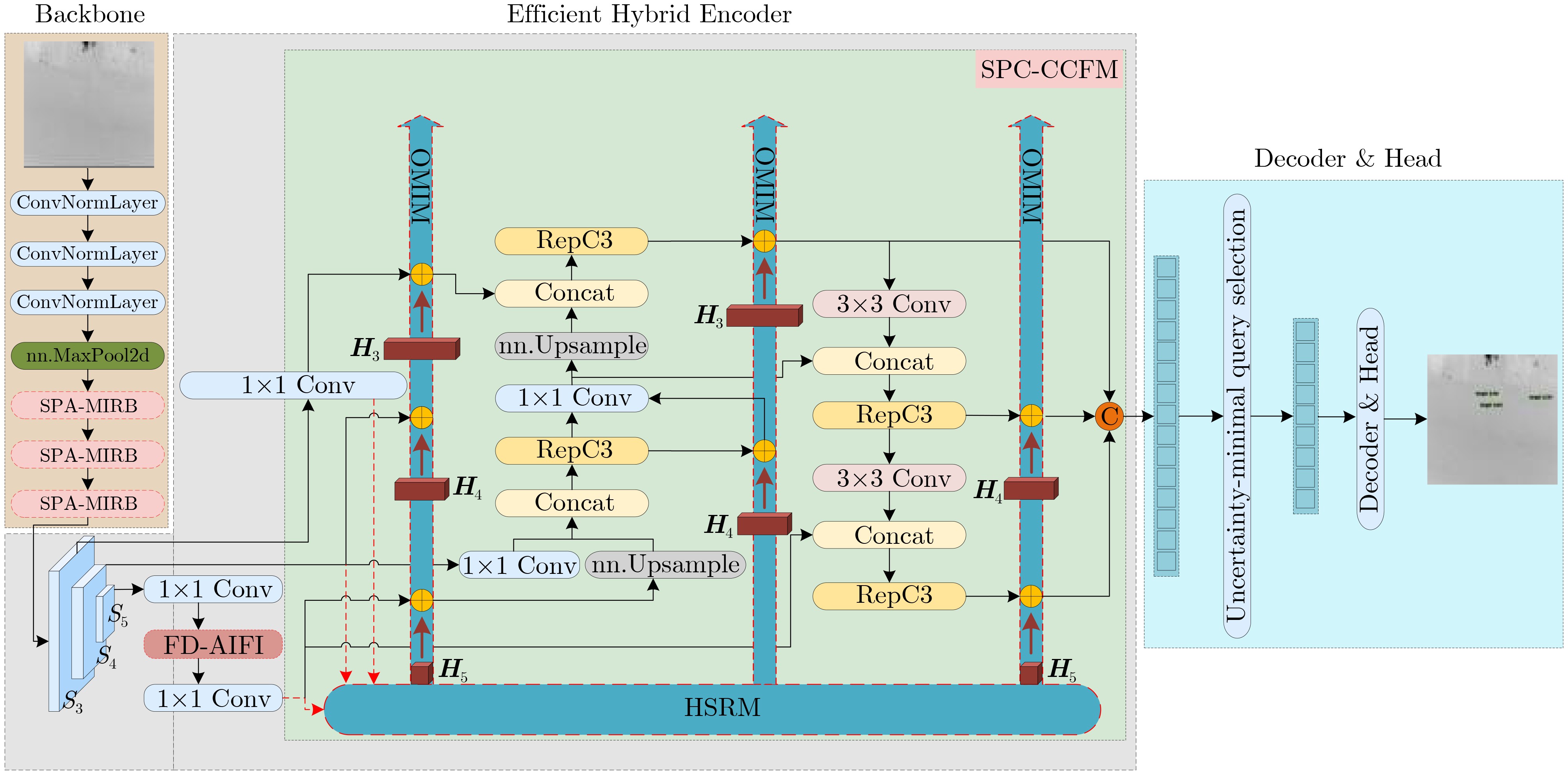
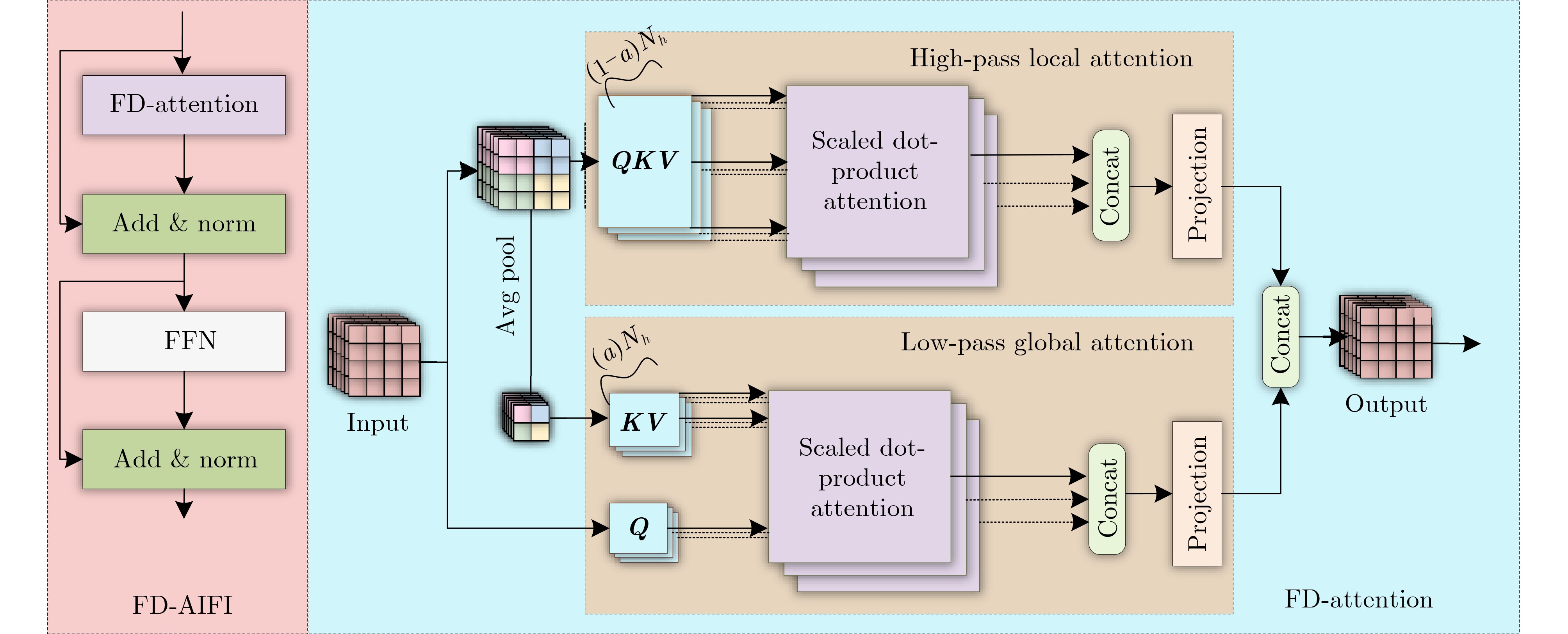
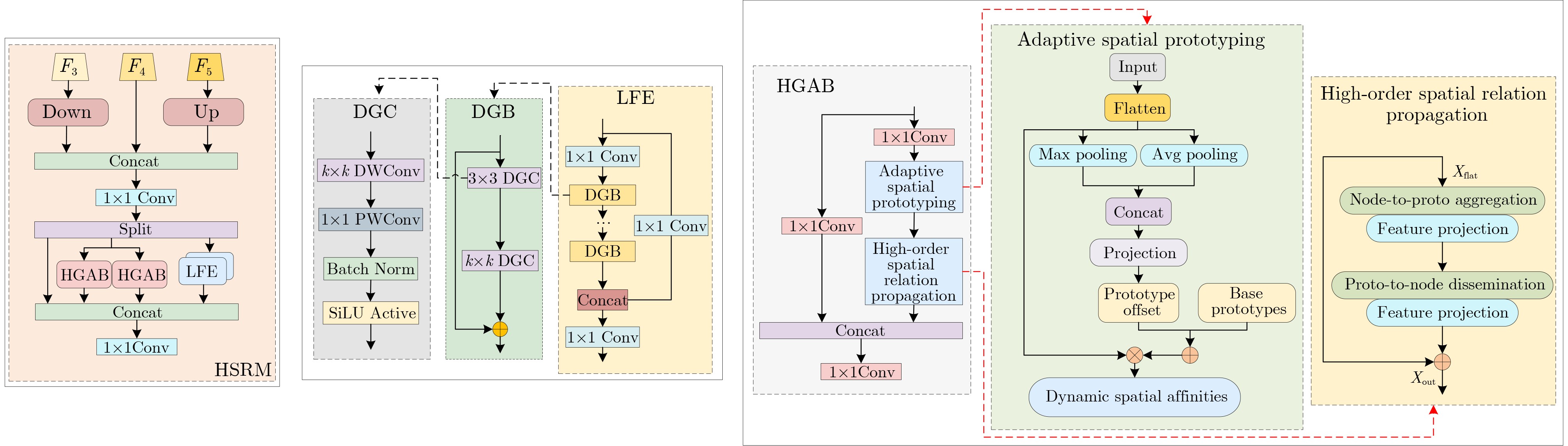
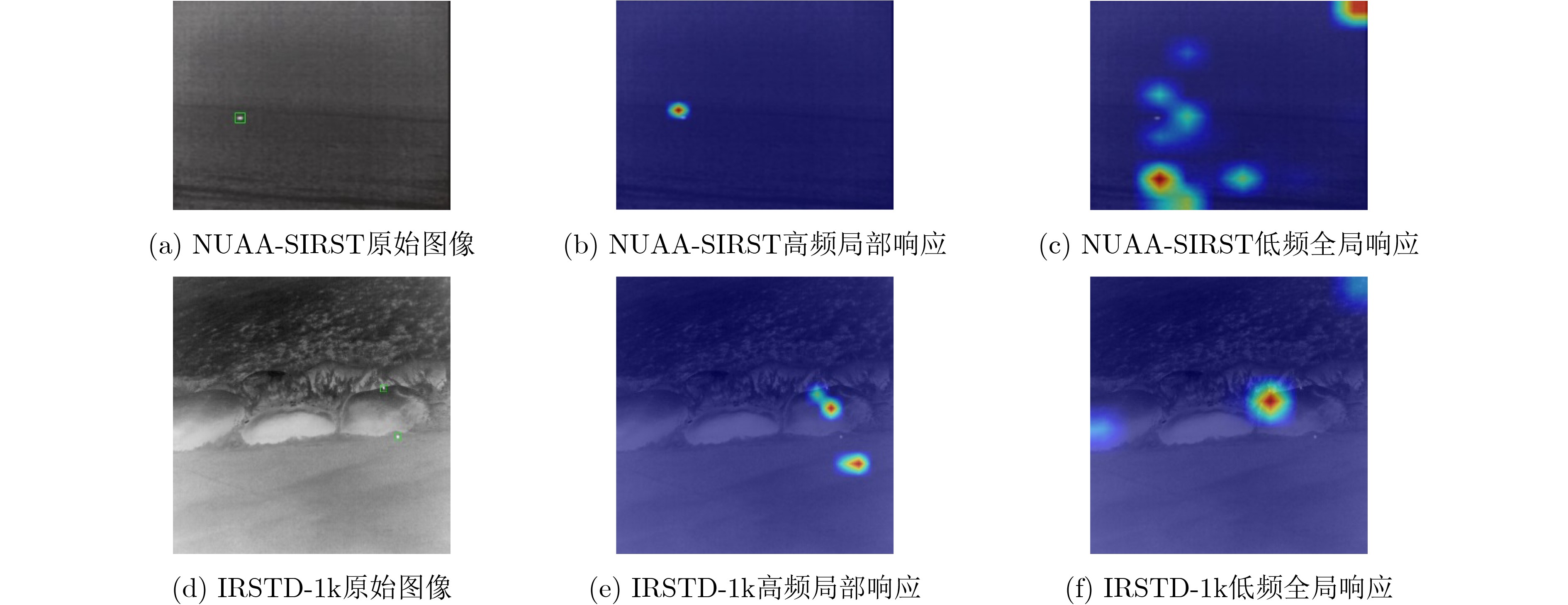
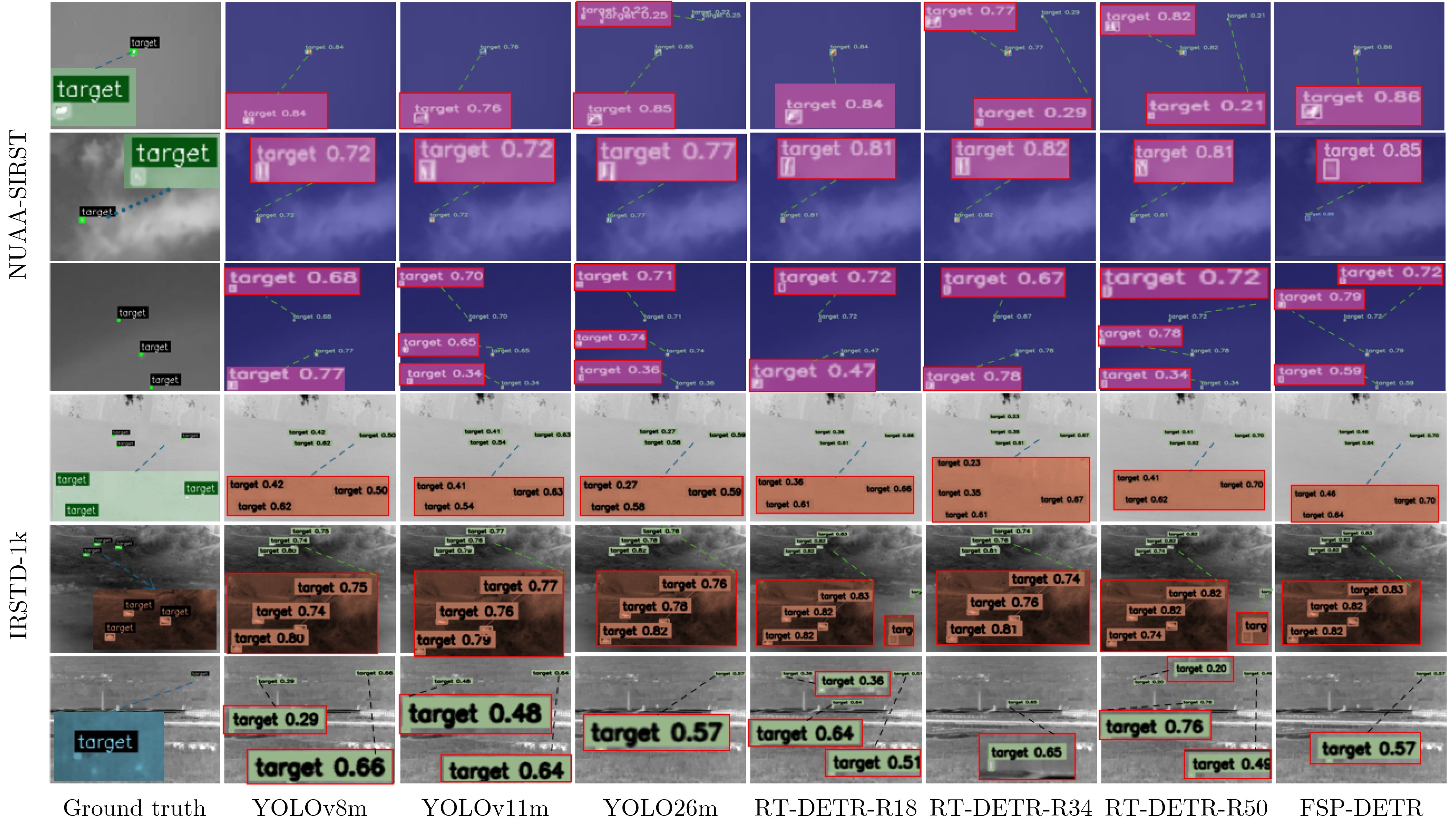
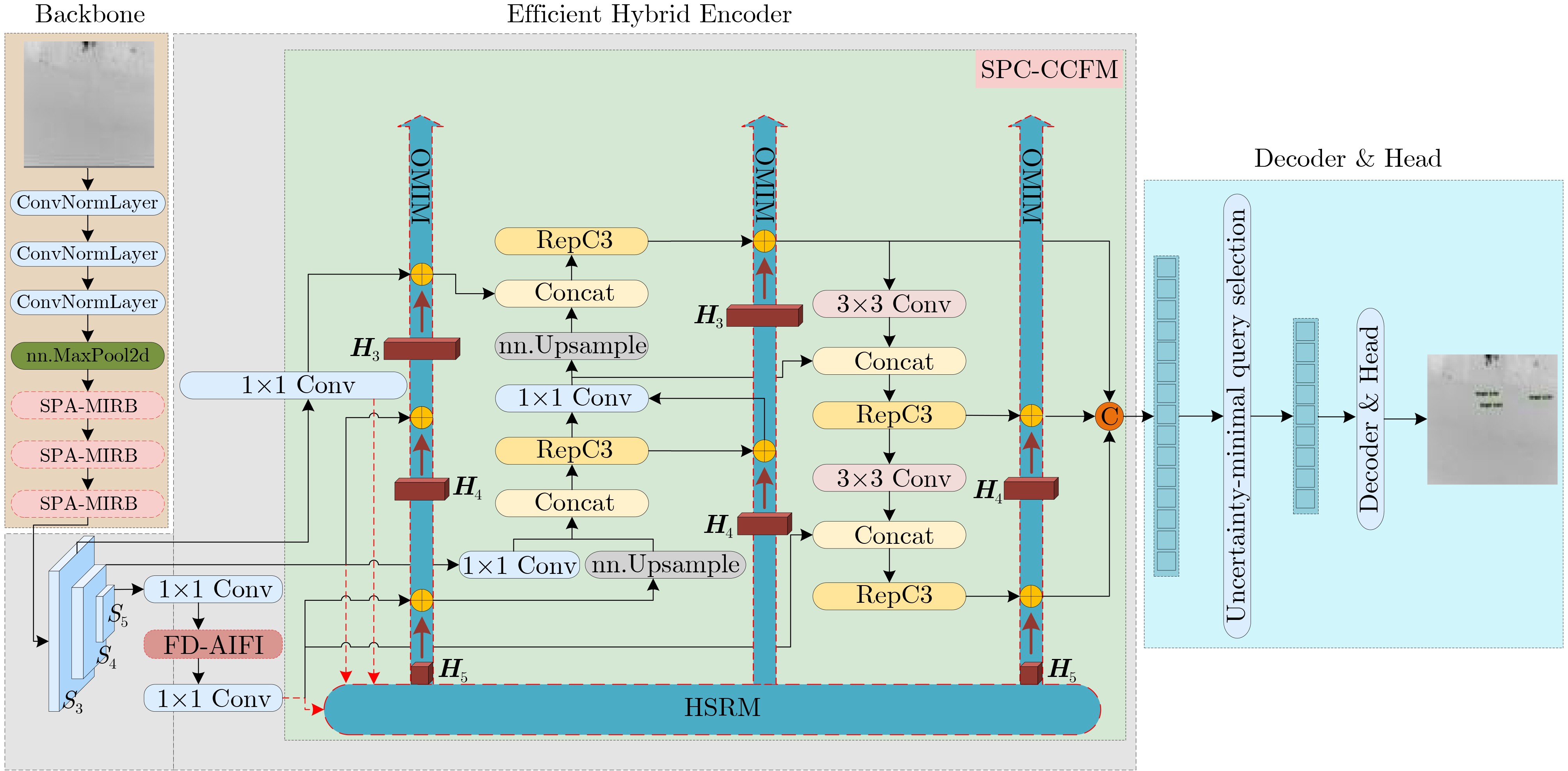
Objective Infrared dim and small target detection exploits thermal-radiation differences between targets and backgrounds for passive sensing in air-ground inspection, maritime surveillance, and wide-area warning. Under long-range imaging, low signal-to-noise ratios, and complex backgrounds, targets occupy few pixels and exhibit weak textures, blurred contours, and low contrast. Bounding-box detection directly predicts class confidence and target locations, making it suitable for rapid edge deployment and subsequent tracking initialization. The Real-Time DEtection TRansformer (RT-DETR) provides an efficient end-to-end framework. However, its application to infrared dim and small targets has three limitations. Repeated downsampling weakens local details and initial localization cues. Intra-scale global interaction does not sufficiently distinguish high-frequency target responses from low-frequency background context. In addition, cross-scale fusion may propagate homogeneous clutter because of insufficient explicit spatial constraints. Therefore, a Frequency-domain decoupling and Spatial-Prior-constrained DETR (FSP-DETR) is proposed to coordinate shallow detail preservation, target-background decoupling, and localization constraints. Methods FSP-DETR is built on RT-DETR-R18 and follows a pipeline of backbone feature extraction, intra-scale interaction, cross-scale fusion, and query-based decoding ( Fig. 1 ). Three modules are introduced at successive stages to address the identified limitations. First, a Subspace Progressive Attention Modulated Inverted Residual Block (SPA-MIRB) is embedded in the Residual Network 18 (ResNet18) backbone to preserve shallow details (Fig. 2 ). Its inverted-residual branch combines pointwise and depthwise convolutions with a residual connection to retain target edges, spots, and weak textures. Its attention branch partitions the channels into multiple subspaces and progressively transfers interaction results across them to strengthen weak target responses. Second, a Frequency-Domain asymmetrically decoupled Attention-based Intra-scale Feature Interaction module (FD-AIFI) replaces the Attention-based Intra-scale Feature Interaction module (AIFI) (Fig. 3 ). The original unified global interaction is divided into a high-pass local attention path and a low-pass global attention path. The high-pass path applies attention within local windows to preserve compact target responses and limit interference from distant clutter. The low-pass path retains the original spatial resolution of the query features but pools the key and value features. This design compresses low-frequency context while preserving spatial queries and target-position indices. The outputs of the two paths are concatenated along the channel dimension and then linearly projected. Third, a Spatial-Prior-Constrained CNN-based Crossscale Feature-fusion Module (SPC-CCFM) retains the original upsampling, concatenation, and convolution path and introduces a High-order Spatial Representation Module (HSRM) and an Overall-level Mapping Injection Mechanism (OMIM). HSRM aligns multilevel features and constructs spatial passthrough, high-order spatial relation, and low-order fidelity branches (Fig. 4 ). These branches preserve the original spatial responses, model spatially separated but response-similar clutter through hypergraph aggregation, and supplement local edge and weak-texture information, respectively. OMIM performs scale mapping and channel adaptation according to each fusion node and injects the resulting spatial prior into the corresponding node to constrain cross-scale feature refinement.Results and Discussions Experiments are performed on IRSTD-1k and NUAA-SIRST, with pixel-level masks converted into single-class minimum bounding rectangles. Component ablation shows that SPA-MIRB, FD-AIFI, and SPC-CCFM each improve Mean average precision at an Intersection over Union threshold of 0.5 (mAP@0.5) on both datasets ( Table 1 ). FSP-DETR achieves mAP@0.5 values of 89.03% and 98.75% on IRSTD-1k and NUAA-SIRST, respectively, exceeding RT-DETR-R18 by 3.39 and 3.08 percentage points. The parameter count decreases from 19.87 million to 17.24 million, and the computational cost decreases from 56.9 to 50.4 billion floating-point operations, corresponding to reductions of 13.2% and 11.4%, respectively. Although some variants achieve higher precision or recall at a single operating point, the complete model obtains the highest mAP@0.5 with lower complexity. Replacement experiments further support the structural choices. SPA-MIRB and FD-AIFI achieve the highest mAP@0.5 among their respective alternatives. SPC-CCFM exceeds the two alternative fusion modules by 0.48 and 0.26 percentage points, respectively, indicating that its main benefit is stronger spatial constraint rather than complexity reduction (Table 2 ). SPA-MIRB reaches accuracy-complexity trade-off. A computation-allocation factor a = 0.50 yields the best performance, with mAP@0.5 and mAP@0.5:0.95 reaching 97.27% and 53.04%, respectively, on NUAA-SIRST (Table 3 ). Attention maps show that the high-pass path concentrates its responses around target neighborhoods, whereas the low-pass path produces broader and smoother responses that cover more surrounding background regions (Fig. 5 ). Under unified experimental settings, FSP-DETR achieves the highest mAP@0.5 on both datasets, with a frame rate of 172 frame/s and an average per-image forward time of 5.81 ms (Table 4 ). It also outperforms deeper RT-DETR variants with fewer parameters, lower computational cost, and shorter forward time. These results demonstrate the advantage of task-oriented structural adaptation over simply enlarging the backbone. Detection visualizations show better agreement between predicted bounding boxes and target regions in cluttered scenes (Fig. 6 ). Instance-level error analysis shows that the missed-detection rate decreases from 15.70% to 13.22% on IRSTD-1k and from 10.71% to 5.36% on NUAA-SIRST. The average number of false positives per image decreases from 0.490 to 0.380 and from 0.209 to 0.070, respectively (Table 5 ). Normalized center-offset errors also decrease on both datasets. However, the scale error on NUAA-SIRST increases slightly from 10.63% to 11.05%, indicating that scale regression for extremely small targets still requires improvement.Conclusions FSP-DETR coordinates shallow detail preservation, frequency-domain decoupled intra-scale interaction, and spatial-prior-constrained cross-scale fusion for end-to-end bounding-box detection. The model improves detection accuracy, reduces missed detections and false positives, and decreases normalized center-offset error. At the same time, model complexity is reduced and efficient inference is maintained. A favorable balance between detection accuracy and efficiency is therefore achieved in complex infrared scenes. Future work will investigate multi-frame spatiotemporal modeling for thermal crossover backgrounds and dense dim and small target scenes. -
表 1 IRSTD-1k与NUAA-SIRST数据集消融实验
数据集 模型 A B C P(%) R(%) mAP@0.5(%) F1(%) 参数量(M) 计算量(G) IRSTD-1k RT-DETR - - - 87.02 84.38 85.64 85.68 19.87 56.9 A √ - - 91.51 85.68 88.35 88.50 15.28 46.8 B - √ - 92.26 82.78 87.97 87.26 19.83 57.1 C - - √ 87.99 83.75 86.98 86.35 21.86 60.4 D √ √ - 89.53 84.77 88.85 87.09 15.24 46.9 E √ - √ 87.77 84.78 87.22 86.42 17.27 50.3 F - √ √ 92.57 82.57 86.35 87.29 21.82 60.5 FSP-DETR √ √ √ 88.82 86.75 89.03 87.78 17.24 50.4 NUAA-SIRST RT-DETR - - - 93.22 89.29 95.67 91.21 19.87 56.9 A √ - - 98.51 87.50 96.75 92.68 15.28 46.8 B - √ - 96.29 92.66 97.27 94.44 19.83 57.1 C - - √ 94.61 89.29 96.17 91.87 21.86 60.4 D √ √ - 93.02 95.19 97.86 94.09 15.24 46.9 E √ - √ 92.71 91.07 95.11 91.88 17.27 50.3 F - √ √ 94.44 92.86 98.24 93.64 21.82 60.5 FSP-DETR √ √ √ 96.33 93.72 98.75 95.01 17.24 50.4  下载: 导出CSV
表 2 不同模块结构的对比实验结果
位置 模块 P(%) R(%) mAP@0.5(%) 参数量(M) 计算量(G) 基准 RT-DETR 93.22 89.29 95.67 19.87 56.9 浅层细节保持 FasterBlock 97.40 85.71 95.84 16.79 49.5 浅层细节保持 Conv3XC 97.42 87.50 94.60 19.87 56.9 浅层细节保持 SPA-MIRB 98.51 87.50 96.75 15.28 46.8 尺度内交互 Pola 98.06 90.37 97.21 20.04 57.2 尺度内交互 AIFI-DAttention 94.57 93.24 96.30 19.88 57.2 尺度内交互 FD-AIFI 96.29 92.66 97.27 19.83 57.1 跨尺度融合 BiFPN 93.51 88.58 95.69 20.43 58.3 跨尺度融合 SDFM 94.08 88.94 95.91 21.24 59.4 跨尺度融合 SPC-CCFM 94.61 89.29 96.17 21.86 60.4
下载: 导出CSV
表 3 算力分配因子$ a $消融实验结果(%)
数据集 模型 a P R F1 mAP@0.5 mAP@0.5:0.95 NUAA-SIRST RT-DETR+FD-AIFI 0.00 95.23 89.29 92.16 93.65 50.34 0.25 91.18 92.31 91.74 95.21 48.04 0.50 96.29 92.66 94.44 97.27 53.04 0.75 91.61 91.07 91.34 96.17 49.64 1.00 94.36 89.55 91.89 96.27 50.92
下载: 导出CSV
表 4 不同类型检测方法性能与效率对比实验
模型 参数量
(M)计算量
(G)帧率
(f/s)前向耗时
(ms)IRSTD-1k NUAA-SIRST P(%) R(%) mAP@0.5(%) P(%) R(%) mAP@0.5(%) SCTransNet* 20.20 58.9 - - 87.20 81.60 85.10 96.10 91.70 96.90 YOLOv5m 25.04 64.0 185 5.41 84.27 83.44 85.03 96.07 92.86 95.44 YOLOv8m 25.84 78.7 165 6.06 82.19 82.78 83.28 94.28 93.64 94.72 YOLOv9m 20.01 76.5 170 5.88 85.40 81.34 85.08 96.15 89.13 92.68 YOLOv10m 15.31 58.9 210 4.76 83.00 80.82 84.09 96.12 88.48 93.49 YOLO11m 20.03 67.6 180 5.56 82.69 79.47 82.30 95.83 92.86 93.96 YOLO12m 20.10 67.1 182 5.49 84.58 83.52 86.97 95.32 89.29 91.56 YOLO26m 20.35 67.8 178 5.62 88.64 76.38 85.72 87.92 82.14 88.82 RT-DETR-R18 19.87 56.9 160 6.25 87.02 84.38 85.64 93.22 89.29 95.67 RT-DETR-R34 31.11 88.8 125 8.00 90.91 83.44 87.70 93.31 91.07 95.11 RT-DETR-R50 41.96 129.6 90 11.11 86.11 84.11 85.34 94.48 91.72 96.17 RT-DETR-L 31.99 103.5 115 8.70 88.15 83.79 84.26 98.11 92.79 97.70 LIST-DETR* 14.60 41.4 - - 89.60 83.00 85.80 97.80 92.10 97.20 FSP-DETR 17.24 50.4 172 5.81 88.82 86.75 89.03 96.33 93.72 98.75 注:*表示结果引自相应文献,仅供参考;“-”表示缺少同环境下的可比效率结果。前向耗时为单幅图像的模型前向平均耗时,不含图像读取、预处理、后处理、结果保存及指标计算;帧率据此前向耗时换算。
下载: 导出CSV
表 5 目标检测误差分析结果
数据集 模型 漏检率(%) 平均误检数(幅) 平均IoU(%) 中心偏移误差 尺度误差(%) IRSTD-1k RT-DETR-R18 15.70 0.490 74.84 0.0575 10.73 IRSTD-1k FSP-DETR 13.22 0.380 75.15 0.0520 10.45 NUAA-SIRST RT-DETR-R18 10.71 0.209 76.44 0.0533 10.63 NUAA-SIRST FSP-DETR 5.36 0.070 76.80 0.0491 11.05
下载: 导出CSV
-
[1] ZHANG Nan, LIU Youmeng, LIU Hao, et al. DTNet: A specialized dual-tuning network for infrared vehicle detection in aerial images[J]. IEEE Transactions on Geoscience and Remote Sensing, 2024, 62: 5002815. doi: 10.1109/TGRS.2024.3386309. [2] LI Boyang, XIAO Chao, WANG Longguang, et al. Dense nested attention network for infrared small target detection[J]. IEEE Transactions on Image Processing, 2023, 32: 1745–1758. doi: 10.1109/TIP.2022.3199107. [3] LIN Fanzhao, BAO Kexin, LI Yong, et al. Learning contrast-enhanced shape-biased representations for infrared small target detection[J]. IEEE Transactions on Image Processing, 2024, 33: 3047–3058. doi: 10.1109/TIP.2024.3391011. [4] LI Fenghong, RAO Peng, SUN Wen, et al. A low signal-to-noise ratio infrared small-target detection network[J]. IEEE Journal of Selected Topics in Applied Earth Observations and Remote Sensing, 2025, 18: 8643–8658. doi: 10.1109/JSTARS.2025.3550581. [5] LI Qiang, ZHANG Mingwei, YANG Zhigang, et al. Edge-guided perceptual network for infrared small target detection[J]. IEEE Transactions on Geoscience and Remote Sensing, 2024, 62: 5643510. doi: 10.1109/TGRS.2024.3471865. [6] YANG Huoren, MU Tingkui, DONG Ziyue, et al. PBT: Progressive background-aware transformer for infrared small target detection[J]. IEEE Transactions on Geoscience and Remote Sensing, 2024, 62: 5004513. doi: 10.1109/TGRS.2024.3415080. [7] ZHANG Shizhou, WANG Zhang, XING Yinghui, et al. SCAFNet: Semantic-guided cascade adaptive fusion network for infrared small target detection[J]. IEEE Transactions on Geoscience and Remote Sensing, 2024, 62: 5007712. doi: 10.1109/TGRS.2024.3492256. [8] 张晶晶, 曹思华, 崔文楠, 等. 基于改进顶帽变换的红外弱小目标检测[J]. 电子与信息学报, 2024, 46(1): 267–276. doi: 10.11999/JEIT221562.ZHANG Jingjing, CAO Sihua, CUI Wennan, et al. Improved top-hat transform-based algorithm for infrared dim and small target detection[J]. Journal of Electronics & Information Technology, 2024, 46(1): 267–276. doi: 10.11999/JEIT221562. [9] 薛驰, 陈小梅, 李海彤. 融合背景估计与相对局部对比度的天基短波红外弱小目标检测[J]. 光学 精密工程, 2026, 34(3): 450–465. doi: 10.37188/OPE.20263403.0450.XUE Chi, CHEN Xiaomei, and LI Haitong. SWIR weak targets detection on space-based platform integrating background estimation and relative local contrast[J]. Optics and Precision Engineering, 2026, 34(3): 450–465. doi: 10.37188/OPE.20263403.0450. [10] YANG Bo, ZHANG Xinyu, ZHANG Jian, et al. EFLNet: Enhancing feature learning network for infrared small target detection[J]. IEEE Transactions on Geoscience and Remote Sensing, 2024, 62: 5906511. doi: 10.1109/TGRS.2024.3365677. [11] CHEN Tianxiang, TAN Zhentao, GONG Tao, et al. Feature preservation and shape cues assist infrared small target detection[J]. IEEE Transactions on Geoscience and Remote Sensing, 2024, 62: 5006412. doi: 10.1109/TGRS.2024.3461795. [12] 盛卫东, 吴双林, 肖超, 等. 可微稀疏掩模引导的红外小目标快速检测网络[J]. 电子与信息学报, 2025, 47(12): 4779–4789. doi: 10.11999/JEIT250989.SHENG Weidong, WU Shuanglin, XIAO Chao, et al. Differentiable sparse mask guided infrared small target fast detection network[J]. Journal of Electronics & Information Technology, 2025, 47(12): 4779–4789. doi: 10.11999/JEIT250989. [13] 吕鹏远, 兰金江, 曾学仁, 等. 基于特征增强与融合的红外目标检测算法[J]. 红外技术, 2024, 46(7): 782–790.LYU Pengyuan, LAN Jinjiang, ZENG Xueren, et al. Infrared object detection algorithm based on feature enhancement and fusion[J]. Infrared Technology, 2024, 46(7): 782–790. [14] YUAN Shuai, QIN Hanlin, YAN Xiang, et al. SCTransNet: Spatial-channel cross transformer network for infrared small target detection[J]. IEEE Transactions on Geoscience and Remote Sensing, 2024, 62: 5002615. doi: 10.1109/TGRS.2024.3383649. [15] CHEN Tianxiang, YE Zi, TAN Zhentao, et al. MiM-ISTD: Mamba-in-mamba for efficient infrared small-target detection[J]. IEEE Transactions on Geoscience and Remote Sensing, 2024, 62: 5007613. doi: 10.1109/TGRS.2024.3485721. [16] MA Tianfeng, GUO Guanqin, LI Zhimeng, et al. Infrared small target detection method based on high-low-frequency semantic reconstruction[J]. IEEE Geoscience and Remote Sensing Letters, 2024, 21: 6012505. doi: 10.1109/LGRS.2024.3428626. [17] XU Mingzhu, YU Chenglong, LI Zexuan, et al. HDNet: A hybrid domain network with multiscale high-frequency information enhancement for infrared small-target detection[J]. IEEE Transactions on Geoscience and Remote Sensing, 2025, 63: 5004115. doi: 10.1109/TGRS.2025.3574962. [18] 刘皓皎, 刘力双, 张明淳. 基于YOLOv5改进的红外目标检测算法[J]. 激光技术, 2024, 48(4): 534–541. doi: 10.7510/jgjs.issn.1001-3806.2024.04.011.LIU Haojiao, LIU Lishuang, and ZHANG Mingchun. An improved infrared object detection algorithm based on YOLOv5[J]. Laser Technology, 2024, 48(4): 534–541. doi: 10.7510/jgjs.issn.1001-3806.2024.04.011. [19] 汪佳旭, 杨俊, 许聪源. 基于YOLO的自适应多尺度红外目标检测网络[J]. 光电工程, 2026, 53(4): 250292. doi: 10.12086/oee.2026.250292.WANG Jiaxu, YANG Jun, and XU Congyuan. YOLO-based adaptive multi-scale infrared target detection network[J]. Opto-Electronic Engineering, 2026, 53(4): 250292. doi: 10.12086/oee.2026.250292. [20] 王坤, 丁麒龙. 利用自适应融合和混合锚检测器的遥感图像小目标检测算法[J]. 电子与信息学报, 2024, 46(7): 2942–2951. doi: 10.11999/JEIT230966.WANG Kun and DING Qilong. Remote sensing images small object detection algorithm with adaptive fusion and hybrid anchor detector[J]. Journal of Electronics & Information Technology, 2024, 46(7): 2942–2951. doi: 10.11999/JEIT230966. [21] 刘杰, 刘书豪, 田明, 等. 复杂环境下无人机航拍小目标检测算法[J]. 电子与信息学报, 2026, 48(4): 1763–1773. doi: 10.11999/JEIT251126.LIU Jie, LIU Shuhao, TIAN Ming, et al. Small object detection algorithm for UAV aerial images in complex environments[J]. Journal of Electronics & Information Technology, 2026, 48(4): 1763–1773. doi: 10.11999/JEIT251126. [22] XIAO Bin and HU Yue. Bounding box regression network for infrared small target detection with adaptive receptive field and cross-scale fusion[J]. IEEE Transactions on Geoscience and Remote Sensing, 2025, 63: 5003514. doi: 10.1109/TGRS.2025.3564958. [23] 张上, 崔玉杰, 龚国强, 等. LIST-DETR: 复杂背景下红外小目标检测的高效轻量级检测网络[J]. 红外与激光工程, 2025, 54(10): 20250271. doi: 10.3788/IRLA20250271.ZHANG Shang, CUI Yujie, GONG Guoqiang, et al. LIST-DETR: An efficient and lightweight detection network for infrared small target detection in complex backgrounds[J]. Infrared and Laser Engineering, 2025, 54(10): 20250271. doi: 10.3788/IRLA20250271. [24] ZHAO Yian, LV Wenyu, XU Shangliang, et al. DETRs beat YOLOs on real-time object detection[C]. 2024 IEEE/CVF Conference on Computer Vision and Pattern Recognition, Seattle, USA, 2024: 16965–16974. doi: 10.1109/CVPR52733.2024.01605. -

 下载:
下载:


图(6) / 表(5)
计量
- 文章访问数: 328
- HTML全文浏览量: 69
- PDF下载量: 41
- 被引次数: 0
